SOCIALISM
• the broadest political ideologies----- confusion
of theories and traditions
• Tempted to refer to socialism
• For “true” socialism-----more hostile with one
another not to other ideologies
• Major pol: force---- confusions
• Socialist ideas------ molded & transformed by
social, cultural & historical forces
• Origin of socialism----- in the nineteenth
century
• Modern socialism------- a response to the
liberalism
• socialists objected----- competition & individual
liberty
• human beings ---- by nature social or
communal creatures
• Individuals don’t live or work or reproduce the
species in isolation
• cooperation among individuals, not
competition between them
• foundation of a society------- enjoy liberty,
justice and prosperity.
• assign no particular value
• Don’t share the conservative's affection
• private property----- the source of the class
divisions
• Program of distribution wealth and power
• everything that people produce----a social product
participant ----- entitled to a share
• society ------own and control property for the
benefit of all
.
• how much property is society to own &
control
• most goods should be regarded as public
property
• major means of production should be publicly
owned & controlled
• anything that contributes to the production,
distribution, and delivery of socially necessary
goods----- socially controlled
• Society should own & control a power plant
• "how society is to operate this plant?" ------?
• centralized or decentralized ?
• centralized control
-the state or government assume the responsibility
for managing property & resources
- promotes efficiency of the state
- the top-heavy and sluggish bureaucracies
-centrally planned economies
• The best way-------decentralized or control in groups
• differ on important issues
• united in their opposition to unrestricted
capitalism
• determines the distribution of power
• Poor people have a less power
• In a capitalist society, socialists charge
"freedom" and "equality of opportunity" for
many working people
• Early socialists often sought a radical, even
revolutionary, alternative to industrial
capitalism
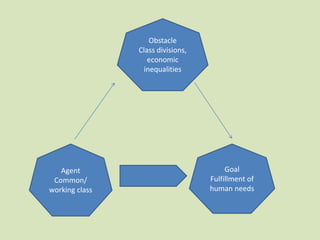
Agent
Common/
working class
Goal
Fulfillment of
human needs
Obstacle
Class divisions,
economic
inequalities
• In the late 19th century-----to provide greater
economic security & to integrate the working
class into industrial society
• In the advanced Western Europe, they didn't
see working class as a revolutionary force
• the First World War, the socialist world was
clearly divided b/w "communist" &
"socialist" or "social democratic"
• In the 20th century,----- spread into Africa,
Asia & Latin America
• Socialism often developed out of the anti-
colonial struggle
• class exploitation------- colonial oppression,
• a mixture of socialism & nationalism
• In the late 20th century------ challenges to socialism
• major reform programs-----mixture of economies &
expanding welfare provision----social democratic
parties
• recession in the 1970s has eroded electoral support
for socialist parties
• the breath and flexibility of socialist ideology has
also been its strength
• difficult to predict the end of an ideology

Socialism.pptx

  • 1.
    SOCIALISM • the broadestpolitical ideologies----- confusion of theories and traditions • Tempted to refer to socialism • For “true” socialism-----more hostile with one another not to other ideologies
  • 2.
    • Major pol:force---- confusions • Socialist ideas------ molded & transformed by social, cultural & historical forces • Origin of socialism----- in the nineteenth century
  • 3.
    • Modern socialism-------a response to the liberalism • socialists objected----- competition & individual liberty • human beings ---- by nature social or communal creatures • Individuals don’t live or work or reproduce the species in isolation • cooperation among individuals, not competition between them • foundation of a society------- enjoy liberty, justice and prosperity.
  • 4.
    • assign noparticular value • Don’t share the conservative's affection • private property----- the source of the class divisions • Program of distribution wealth and power • everything that people produce----a social product participant ----- entitled to a share • society ------own and control property for the benefit of all .
  • 5.
    • how muchproperty is society to own & control • most goods should be regarded as public property • major means of production should be publicly owned & controlled • anything that contributes to the production, distribution, and delivery of socially necessary goods----- socially controlled
  • 6.
    • Society shouldown & control a power plant • "how society is to operate this plant?" ------? • centralized or decentralized ? • centralized control -the state or government assume the responsibility for managing property & resources - promotes efficiency of the state - the top-heavy and sluggish bureaucracies -centrally planned economies • The best way-------decentralized or control in groups
  • 7.
    • differ onimportant issues • united in their opposition to unrestricted capitalism • determines the distribution of power • Poor people have a less power • In a capitalist society, socialists charge "freedom" and "equality of opportunity" for many working people • Early socialists often sought a radical, even revolutionary, alternative to industrial capitalism
  • 8.
    Agent Common/ working class Goal Fulfillment of humanneeds Obstacle Class divisions, economic inequalities
  • 9.
    • In thelate 19th century-----to provide greater economic security & to integrate the working class into industrial society • In the advanced Western Europe, they didn't see working class as a revolutionary force • the First World War, the socialist world was clearly divided b/w "communist" & "socialist" or "social democratic"
  • 10.
    • In the20th century,----- spread into Africa, Asia & Latin America • Socialism often developed out of the anti- colonial struggle • class exploitation------- colonial oppression, • a mixture of socialism & nationalism
  • 11.
    • In thelate 20th century------ challenges to socialism • major reform programs-----mixture of economies & expanding welfare provision----social democratic parties • recession in the 1970s has eroded electoral support for socialist parties • the breath and flexibility of socialist ideology has also been its strength • difficult to predict the end of an ideology