 Communicative Competence’s
recent trends have put more attention
to language as interactive
communication among individuals,
each with a sociocultural identity.
 communicative competence enables
us to convey and interpret messages
and to negotiate meanings
interpersonally within specific
contexts.
 Paulston- Hymes
 Linguistic- forms
 communicative
competence-
knowledge that
enable to
communicate.
 James Cummins
 CALP- Context-
reduced- forms
 BICS- Context-
embedded- face to
face
communication.
BICS describes the
development of conversational
fluency (Basic Interpersonal
Communicative Skills) in the
second language.
CALP describes the use of
language in decontextualized
academic situations (Cognitive
Academic Language
Proficiency ).
 Grammatical competence: focused on
sentence-level grammar.
 Discourse competence: concerned with
intersentential relationships.
 Sociolinguistic Competence: knowledge of
the sociocultural rules.
 Strategic Competence: verbal and
nonverbal communication strategies to
compensate breakdowns.
Canale and Swain said that CC
has four components:
 Strategic competence enhance the
effectiveness of communication or to
compensate for breakdowns. (Swain four
years later)
 Strategic competence is the way we
manipulate language in order to meet
communicative goals.
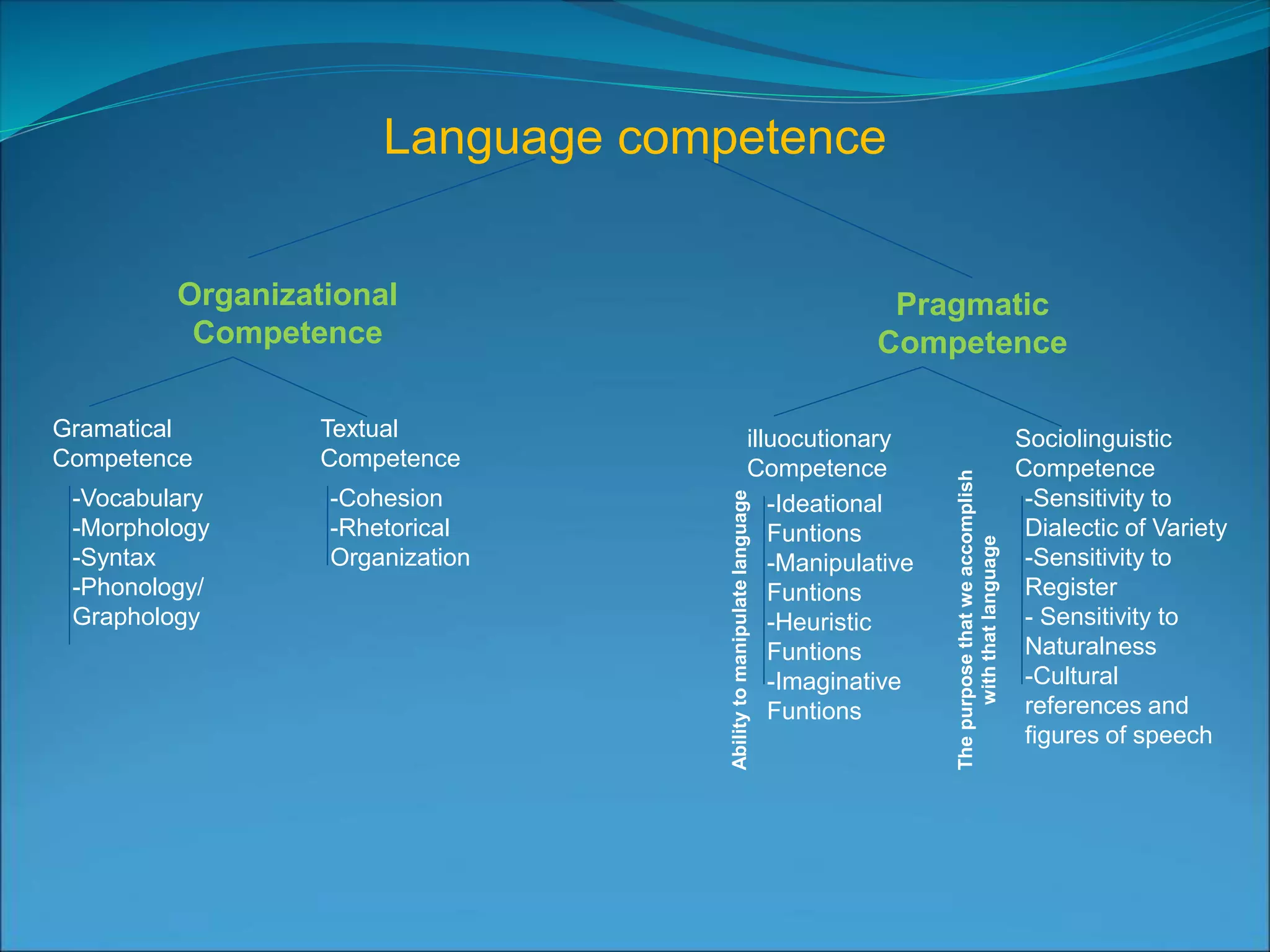
Language competence
Organizational
Competence
Pragmatic
Competence
Gramatical
Competence
Textual
Competence
-Vocabulary
-Morphology
-Syntax
-Phonology/
Graphology
-Cohesion
-Rhetorical
Organization
illuocutionary
Competence
Sociolinguistic
Competence
-Ideational
Funtions
-Manipulative
Funtions
-Heuristic
Funtions
-Imaginative
Funtions
-Sensitivity to
Dialectic of Variety
-Sensitivity to
Register
- Sensitivity to
Naturalness
-Cultural
references and
figures of speechAbilitytomanipulatelanguage
Thepurposethatweaccomplish
withthatlanguage
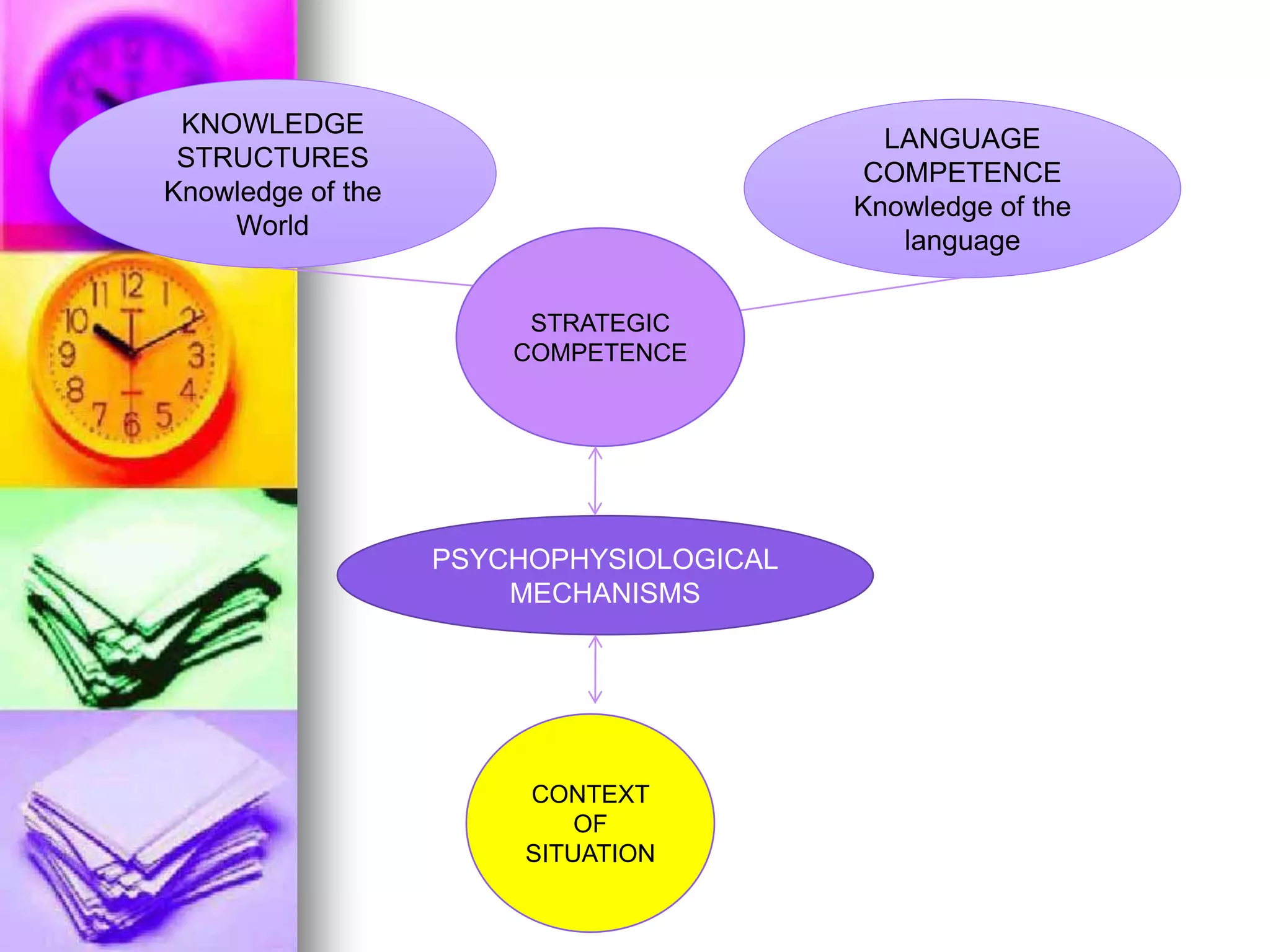
KNOWLEDGE
STRUCTURES
Knowledge of the
World
LANGUAGE
COMPETENCE
Knowledge of the
language
STRATEGIC
COMPETENCE
PSYCHOPHYSIOLOGICAL
MECHANISMS
CONTEXT
OF
SITUATION
Halliday´s seven function
 The instrumental : manipulate the
environment.
 The regulatory: to control of the situation.
 The representational : as one sees it.
 The interactional: to ensure social
maintenance.
 The personal: to express feelings, emotions,
personality.
 The heuristic: involves language used to
acquire knowledge, to learn about the
environment
 The imaginative: to create imaginary systems
or ideas.
 A single sentence or conversation might
incorporate many different functions
simultaneously.c
 Curricula were organized around different functions:
identifying, reporting, denying, declining an
invitation, asking permission, apologizing, etc. Now
it is referred to as functional syllabuses.
(Van EK and Alexander 1975)
 Berns went on to show how context is the real key
to giving meaning to both form and function.
 THANKS FOR
LISTENING AND
COOPERATION 

Communicative competence