Business meeting
Presented by
Shah Kushal
(17p066)
Shah abhi
(17p002)
Guided by
Prof.Kunj ganatra
Types of
business
meeting
 Status Update Meetings
 Information Sharing Meetings
 Decision Making Meetings
 Problem Solving Meetings
 Innovation Meetings
 Team Building Meetings
Purpose of business meetings
●The purpose of a business meeting is to address issues that affect company
operations and productivity. Those issues could be positive, or they could be
challenges that threaten to affect profitability. To administer effective business
meetings, you need to understand how to create and achieve meeting
objectives. Using efficient meeting processes can help you to get more out of
your meeting time.
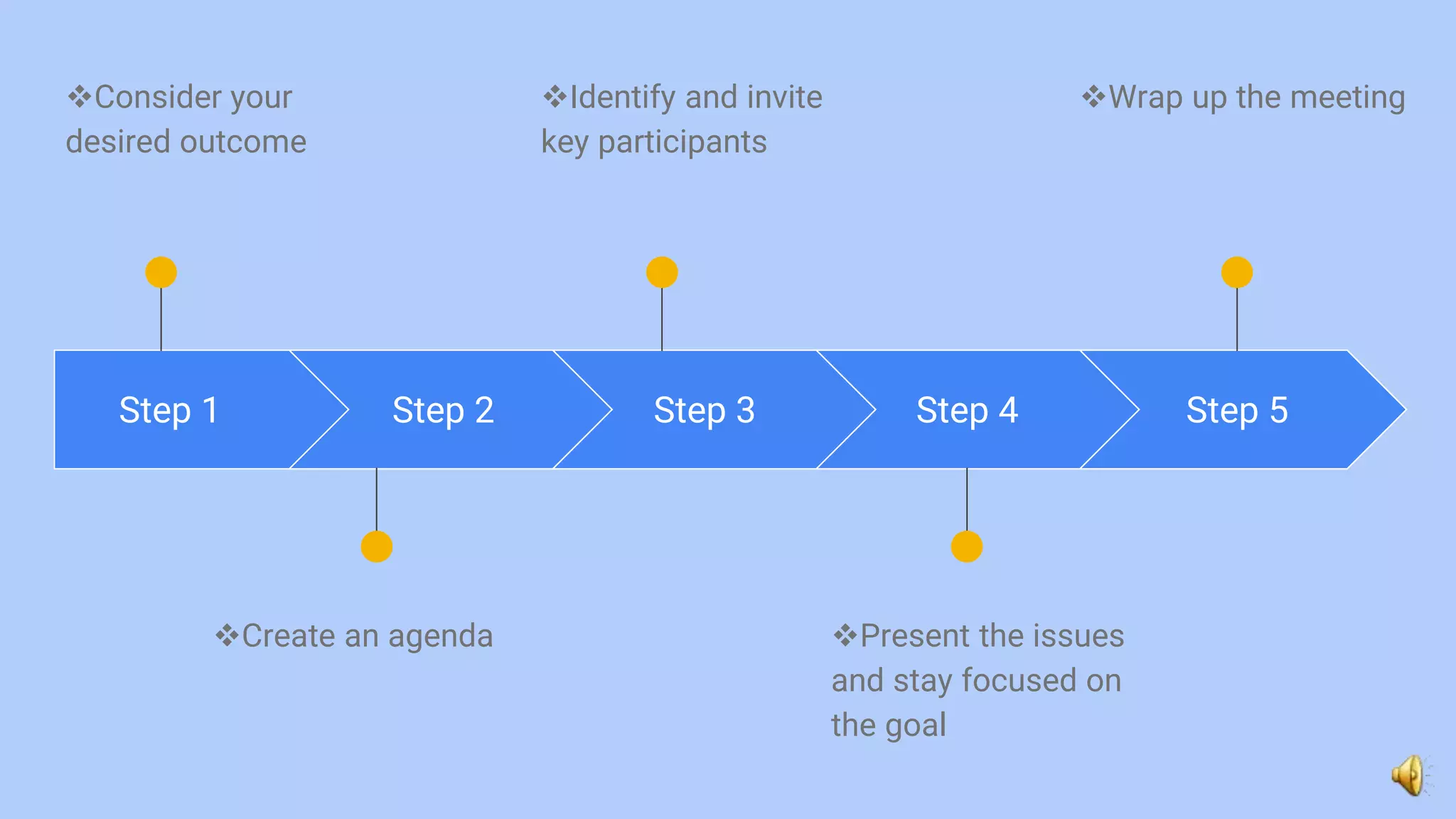
Step 1
Consider your
desired outcome
Step 2
Create an agenda
Step 3
Identify and invite
key participants
Step 4
Present the issues
and stay focused on
the goal
Step 5
Wrap up the meeting
Consider your desired outcome(written and
spoken)
●Before you reserve a room and send out invitations, take a few moments to
consider why you want to call your meeting in the first place. Who should be
present? What outcomes do you expect as a result of the meeting? What
impact do you hope to have? As with any tool, meetings yield desirable results
only when their limitations are taken into consideration.
●A timely email, picking up the phone, or a quick visit to someone in the lab
might get you what you want much more quickly and efficiently than organizing
a meeting. When mismanaged or poorly run, meetings can be
counterproductive, distracting, and a waste of time and money.
Create an agenda
●Once you clearly understand the reasons for your meeting and your intended
outcomes, create an agenda. Clear agendas drive successful meetings. The
agenda not only tells people what to expect, it outlines topics of discussion,
sets the context and scope, lists key issues, and states desired objectives.
●When sent out before the meeting, an agenda permits you and others to
prepare. Avoid wasting valuable meeting time--distribute information
beforehand. If appropriate, ask for input and have your most current agenda
visible during the meeting. It helps keep the meeting focused and references
the most current information.
Identify and invite key participants
●Identify key people you need in the meeting. Include anyone you believe will
help you get the information and results you need-;no more and no less. This
list is easier to compose once you have an agenda completed. Avoid excluding
knowledgeable people based on politics. Include any people, groups, or
departments that you're certain will be affected by your meeting. Have a plan
for distributing your results to those who were present--and also to anyone
invited but unable to attend.
Present the issues and stay focused on the
goal
●Begin and end your meeting on time. Make sure you have any tools, data, and
reports you need readily available before your meeting starts and put it in the
meeting space in advance. Don't waste meeting time hooking up equipment,
checking connections, or looking for files on your laptop if these tasks can be
completed earlier.
Present the issues and stay focused on the
goal
●People will appreciate your efforts to conduct an efficient meeting that ends on time or
earlier than scheduled. Once you start, set a good example by speaking clearly,
respectfully, and constructively. encourage all meeting participants to contribute to the
meeting--if someone isn't actively participating, the meeting is probably a waste of time
for them. Move your meeting along by sticking to your agenda. If discussion goes off
topic, or becomes personal and unconstructive, refocus.
●Identify topics for escalation and possible off-line discussions for a later time.
Animated or heated discussion during meetings can be constructive and quite productive
as long as it does not become personal and off-topic.
Wrap up the meeting
●Once the agenda has been covered, or your allotted time is up, wrap up the meeting.
Avoid the urge to continue by addressing any new issues that may come up. The wrap-up
officially closes the meeting. It confirms, clarifies, and recaps what was discussed--and
everyone's understanding of the situation or goals.
●Confirm whether or not your meeting has fulfilled your objectives. If it turns out that
your meeting has left you with additional questions, identify any new topics, suggest
further action, escalate your concerns, or reschedule follow-up meetings as needed. After
the meeting, distribute notes and minutes to those on your distribution lists in a timely
fashion. As a final thought, solicit feedback from others.
Business
communication
1. Verbal communication
● Oral communication
● Verbal communication
2. Non verbal communication
Verbal communication
●We can categorize verbal communication into two parts, oral communication
and written communication.
●Oral communication is when two or more parties communicate verbally with
words. (meeting discussion)
●The other type is written communication. Written communication can happen
through normal mail, e-mail, or any other form of documented writing.(email
writing, message invitation, presentation in meeting)
Non verbal communication
●Non-verbal communication is mostly body language. It is possible to
understand what a person is trying to say or how he/she is feeling.
(presentation)
●It is also possible to tell the mood of a person by bodily and facial
expressions.
● Facial expressions are very important as well. Facial expressions give out
what the person is feeling.
Mode of communication use in business
meeting
●Sending email
●Phone calls
●Written planning
●Messages(whatsapp)
●Feedback
●Video conference
The end

communication use in business meetings

  • 1.
    Business meeting Presented by ShahKushal (17p066) Shah abhi (17p002) Guided by Prof.Kunj ganatra
  • 2.
    Types of business meeting  StatusUpdate Meetings  Information Sharing Meetings  Decision Making Meetings  Problem Solving Meetings  Innovation Meetings  Team Building Meetings
  • 3.
    Purpose of businessmeetings ●The purpose of a business meeting is to address issues that affect company operations and productivity. Those issues could be positive, or they could be challenges that threaten to affect profitability. To administer effective business meetings, you need to understand how to create and achieve meeting objectives. Using efficient meeting processes can help you to get more out of your meeting time.
  • 4.
    Step 1 Consider your desiredoutcome Step 2 Create an agenda Step 3 Identify and invite key participants Step 4 Present the issues and stay focused on the goal Step 5 Wrap up the meeting
  • 5.
    Consider your desiredoutcome(written and spoken) ●Before you reserve a room and send out invitations, take a few moments to consider why you want to call your meeting in the first place. Who should be present? What outcomes do you expect as a result of the meeting? What impact do you hope to have? As with any tool, meetings yield desirable results only when their limitations are taken into consideration. ●A timely email, picking up the phone, or a quick visit to someone in the lab might get you what you want much more quickly and efficiently than organizing a meeting. When mismanaged or poorly run, meetings can be counterproductive, distracting, and a waste of time and money.
  • 6.
    Create an agenda ●Onceyou clearly understand the reasons for your meeting and your intended outcomes, create an agenda. Clear agendas drive successful meetings. The agenda not only tells people what to expect, it outlines topics of discussion, sets the context and scope, lists key issues, and states desired objectives. ●When sent out before the meeting, an agenda permits you and others to prepare. Avoid wasting valuable meeting time--distribute information beforehand. If appropriate, ask for input and have your most current agenda visible during the meeting. It helps keep the meeting focused and references the most current information.
  • 7.
    Identify and invitekey participants ●Identify key people you need in the meeting. Include anyone you believe will help you get the information and results you need-;no more and no less. This list is easier to compose once you have an agenda completed. Avoid excluding knowledgeable people based on politics. Include any people, groups, or departments that you're certain will be affected by your meeting. Have a plan for distributing your results to those who were present--and also to anyone invited but unable to attend.
  • 8.
    Present the issuesand stay focused on the goal ●Begin and end your meeting on time. Make sure you have any tools, data, and reports you need readily available before your meeting starts and put it in the meeting space in advance. Don't waste meeting time hooking up equipment, checking connections, or looking for files on your laptop if these tasks can be completed earlier.
  • 9.
    Present the issuesand stay focused on the goal ●People will appreciate your efforts to conduct an efficient meeting that ends on time or earlier than scheduled. Once you start, set a good example by speaking clearly, respectfully, and constructively. encourage all meeting participants to contribute to the meeting--if someone isn't actively participating, the meeting is probably a waste of time for them. Move your meeting along by sticking to your agenda. If discussion goes off topic, or becomes personal and unconstructive, refocus. ●Identify topics for escalation and possible off-line discussions for a later time. Animated or heated discussion during meetings can be constructive and quite productive as long as it does not become personal and off-topic.
  • 10.
    Wrap up themeeting ●Once the agenda has been covered, or your allotted time is up, wrap up the meeting. Avoid the urge to continue by addressing any new issues that may come up. The wrap-up officially closes the meeting. It confirms, clarifies, and recaps what was discussed--and everyone's understanding of the situation or goals. ●Confirm whether or not your meeting has fulfilled your objectives. If it turns out that your meeting has left you with additional questions, identify any new topics, suggest further action, escalate your concerns, or reschedule follow-up meetings as needed. After the meeting, distribute notes and minutes to those on your distribution lists in a timely fashion. As a final thought, solicit feedback from others.
  • 11.
    Business communication 1. Verbal communication ●Oral communication ● Verbal communication 2. Non verbal communication
  • 12.
    Verbal communication ●We cancategorize verbal communication into two parts, oral communication and written communication. ●Oral communication is when two or more parties communicate verbally with words. (meeting discussion) ●The other type is written communication. Written communication can happen through normal mail, e-mail, or any other form of documented writing.(email writing, message invitation, presentation in meeting)
  • 13.
    Non verbal communication ●Non-verbalcommunication is mostly body language. It is possible to understand what a person is trying to say or how he/she is feeling. (presentation) ●It is also possible to tell the mood of a person by bodily and facial expressions. ● Facial expressions are very important as well. Facial expressions give out what the person is feeling.
  • 14.
    Mode of communicationuse in business meeting ●Sending email ●Phone calls ●Written planning ●Messages(whatsapp) ●Feedback ●Video conference
  • 15.