Business Meetings
AGENDA
 What is a Meeting?
 Objectives
 Necessity of meeting
 How to plan a meeting?
 Agenda
 Minutes of meeting
 How to organize a meeting
 Meeting preparation
 Types of meeting
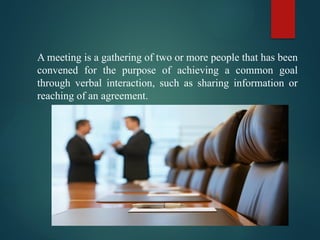
A meeting is a gathering of two or more people that has been
convened for the purpose of achieving a common goal
through verbal interaction, such as sharing information or
reaching of an agreement.
Meeting
 Make a focus statement
 Ensure that meeting roles are understood
 Ensure the group/team uses an agenda
 Take time to prepare, participate and perform
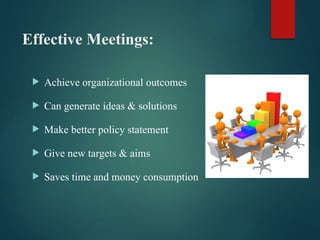
Effective Meetings:
 Achieve organizational outcomes
 Can generate ideas & solutions
 Make better policy statement
 Give new targets & aims
 Saves time and money consumption
?
When do we need to hold
meetings
A meeting should only be conducted when there are specific
objectives.
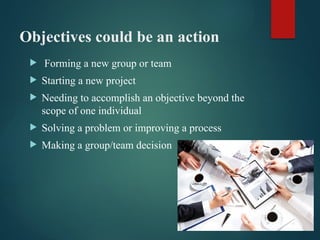
Objectives could be an action
 Forming a new group or team
 Starting a new project
 Needing to accomplish an objective beyond the
scope of one individual
 Solving a problem or improving a process
 Making a group/team decision
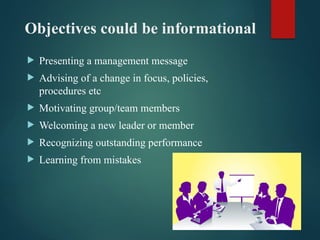
Objectives could be informational
 Presenting a management message
 Advising of a change in focus, policies,
procedures etc
 Motivating group/team members
 Welcoming a new leader or member
 Recognizing outstanding performance
 Learning from mistakes
?
Are meetings necessary for
these objectives?
Many times meetings are not necessary.
Often we could achieve the same objective by sending
couple of emails.
Meeting is necessary
 When we need people from multiple departments to generate
ideas together
 Clear communication requires a face-to-face presentation
 We need to build similarity between team members
 We expect the objective will be controversial
 Issues are urgent and decisions are more important
 Other attempts at reaching the objective have been
unsuccessful or are taking too long
?
Now! How to plan a
meeting
When you have decided that a meeting is the best choice for
achieving your objective, then the nest decision is,
“Who should be there and who should not”.
Who should be there and who shouldn’t
 Are they important to the discussion?
 Do they have expertise that we will need and there is
no alternative
 Do organizations internal politics require this person?
 Do we expect questions to arise during the meeting
that only this person can answer?
?
What will be the
Agenda of meeting?
Agenda is not just only a single statement that shows
the objective or purpose of the meeting.
Agenda is a tool for:
 Identifying missing things
 Ensuring everyone has the information
 Right person comes to the meeting
 Managing the meeting in operation
 Confirmation of the date, time, and location
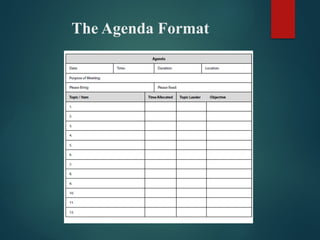
The Agenda Format
?
Are there any records
of the meeting?
Minutes of the Meeting
Yes! Meetings have written records which are called
minutes of meeting, that is used to inform attendees
and non-attendees of the actions during the meeting.
Minutes usually include
 The names of the participants
 The agenda items to be covered
 Decisions made by the participants
 The follow-up actions committed to by
participants
 Due dates for the completion of commitments
?
How to organize a meeting
Organizing the Meeting
 Make sure everyone has a copy of the agenda
 Someone has been assigned for minutes of the
meeting
 If something comes up that is not on the agenda,
assure the group that you will ensure that, that topic
or item comes up at a later discussion
 Agree to stay longer if they want to continue the
discussion
 Agree to postpone the decision on this topic to a
later time so you can stay on time
 During the meeting make sure:
At the end of the meeting:
 Thank everyone for their participation
 Summarize any final points and brief everyone
about what the next steps will be
 Let them know when you will have meeting
minutes or notes made available to them
?
Are there any other thing
you need to do?
There are certain tangible aspects of effective meetings that
should be considered to make the meeting as productive as
possible.
Tangible aspects are:
 Meeting Location:
 Convenience
 Comfort
 Suitability
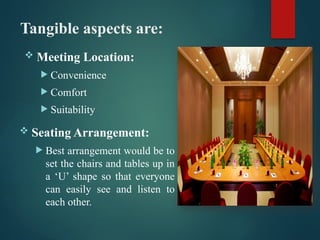
 Seating Arrangement:
 Best arrangement would be to
set the chairs and tables up in
a ‘U’ shape so that everyone
can easily see and listen to
each other.
Meeting Preparation:
 Must send out a reminder email to all of the
attendees
 Bring copies of any supporting information
 Pack a box the day before, for example white
board markers, Name tags or pads of paper
?
How many meetings are to
be held by a business
There is not a specific number of times for a business to conduct
meetings because it depends on the nature of the business.
But some types of meetings are necessary.
Types of Meeting:
 Formal Type
A pre-arranged meeting time and schedule
An agenda
A minutes of the meeting- a written record
A chairperson - to lead, co-ordinate or control
An administrator or secretary
An agreed process and procedure
 Informal Type
Unstructured discussion
No procedures or process
Anyone taking the lead
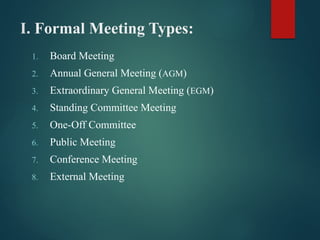
I. Formal Meeting Types:
1. Board Meeting
2. Annual General Meeting (AGM)
3. Extraordinary General Meeting (EGM)
4. Standing Committee Meeting
5. One-Off Committee
6. Public Meeting
7. Conference Meeting
8. External Meeting
1. Board Meeting
 Once a month
 Directors of company attend the meeting
 Discuss company business
 Future direction of the company
2. Annual General Meeting
 In short form is called AGM
 Compulsory yearly meeting for listed company
 All directors and shareholders attend the meeting
3. Extraordinary General Meeting
 In short form is called EGM
 At any time of the year
 Give notice to shareholders
 For voting on proposed plans
4. Standing Committee Meeting
 Standing committee is part of Board of Directors
in the company
 Approve the proposed bonus payment and salary
adjustment
5. One-Off Committee
 Decisions on local matters
 Facilities Update
 Company Officers update
 Set of responsibilities and authorities
 Committee diction are published
6. Public Meeting
 Held for seeking the opinions of the public
 If development plan of the corporation will affect
people in a town
7. Conference Meeting
 Speakers from different corporations to share their
expert knowledge
 Take place over a few days
 Usually takes the form of presentations
8. External Meeting
 Must contribution of two or more different parties
 Negotiation on merger and acquisition matter
 Participants protector their responses
II. Informal Meeting Types
 One-on-One
 Team Meeting
 Informational Meeting
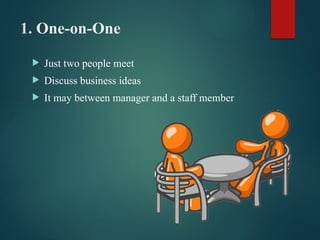
1. One-on-One
 Just two people meet
 Discuss business ideas
 It may between manager and a staff member
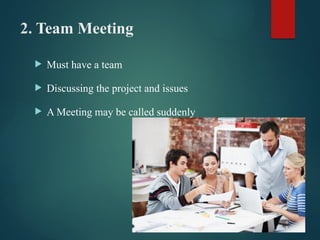
2. Team Meeting
 Must have a team
 Discussing the project and issues
 A Meeting may be called suddenly
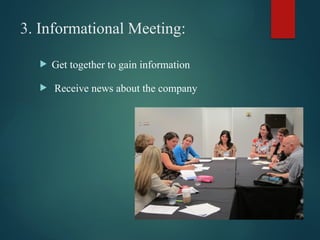
3. Informational Meeting:
 Get together to gain information
 Receive news about the company
Meeting etiquette
10 etiquette rules that every professional should know:
1. Be on time
2. Make introductions
3. Have a strong agenda
4. Sit appropriately
5. Speak up
6. Understand the unwritten speaking rules
7. Do not have your phone out
8. You can drink coffee, but you need permission
for anything else
9. Clean up after yourself
10. Don't save all your questions for the end
Do’s and Don'ts in a meeting:
Do’s:
Be prepared for meeting
Come on time
Respond to queries
Be serious and listen carefully
Take notes
Keep your belongings near you on the floor
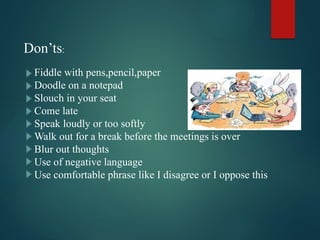
Don’ts:
Fiddle with pens,pencil,paper
Doodle on a notepad
Slouch in your seat
Come late
Speak loudly or too softly
Walk out for a break before the meetings is over
Blur out thoughts
Use of negative language
Use comfortable phrase like I disagree or I oppose this
CONCLUSION
 Meetings are in fact a waste of time
 Lengthy and boring
 But can be very helpful if conducted correctly
 Should be conducted only if necessary
 Brief and to the point
 Always be prepared for Disruptions
THANK YOU

business communication notes to students and guide

  • 1.
  • 2.
    AGENDA  What isa Meeting?  Objectives  Necessity of meeting  How to plan a meeting?  Agenda  Minutes of meeting  How to organize a meeting  Meeting preparation  Types of meeting
  • 3.
    A meeting isa gathering of two or more people that has been convened for the purpose of achieving a common goal through verbal interaction, such as sharing information or reaching of an agreement.
  • 4.
    Meeting  Make afocus statement  Ensure that meeting roles are understood  Ensure the group/team uses an agenda  Take time to prepare, participate and perform
  • 5.
    Effective Meetings:  Achieveorganizational outcomes  Can generate ideas & solutions  Make better policy statement  Give new targets & aims  Saves time and money consumption
  • 6.
    ? When do weneed to hold meetings
  • 7.
    A meeting shouldonly be conducted when there are specific objectives.
  • 8.
    Objectives could bean action  Forming a new group or team  Starting a new project  Needing to accomplish an objective beyond the scope of one individual  Solving a problem or improving a process  Making a group/team decision
  • 9.
    Objectives could beinformational  Presenting a management message  Advising of a change in focus, policies, procedures etc  Motivating group/team members  Welcoming a new leader or member  Recognizing outstanding performance  Learning from mistakes
  • 10.
    ? Are meetings necessaryfor these objectives?
  • 11.
    Many times meetingsare not necessary. Often we could achieve the same objective by sending couple of emails.
  • 12.
    Meeting is necessary When we need people from multiple departments to generate ideas together  Clear communication requires a face-to-face presentation  We need to build similarity between team members  We expect the objective will be controversial  Issues are urgent and decisions are more important  Other attempts at reaching the objective have been unsuccessful or are taking too long
  • 13.
    ? Now! How toplan a meeting
  • 14.
    When you havedecided that a meeting is the best choice for achieving your objective, then the nest decision is, “Who should be there and who should not”.
  • 15.
    Who should bethere and who shouldn’t  Are they important to the discussion?  Do they have expertise that we will need and there is no alternative  Do organizations internal politics require this person?  Do we expect questions to arise during the meeting that only this person can answer?
  • 16.
    ? What will bethe Agenda of meeting?
  • 17.
    Agenda is notjust only a single statement that shows the objective or purpose of the meeting.
  • 18.
    Agenda is atool for:  Identifying missing things  Ensuring everyone has the information  Right person comes to the meeting  Managing the meeting in operation  Confirmation of the date, time, and location
  • 19.
  • 20.
    ? Are there anyrecords of the meeting?
  • 21.
    Minutes of theMeeting Yes! Meetings have written records which are called minutes of meeting, that is used to inform attendees and non-attendees of the actions during the meeting.
  • 22.
    Minutes usually include The names of the participants  The agenda items to be covered  Decisions made by the participants  The follow-up actions committed to by participants  Due dates for the completion of commitments
  • 23.
  • 24.
    Organizing the Meeting Make sure everyone has a copy of the agenda  Someone has been assigned for minutes of the meeting  If something comes up that is not on the agenda, assure the group that you will ensure that, that topic or item comes up at a later discussion  Agree to stay longer if they want to continue the discussion  Agree to postpone the decision on this topic to a later time so you can stay on time  During the meeting make sure:
  • 25.
    At the endof the meeting:  Thank everyone for their participation  Summarize any final points and brief everyone about what the next steps will be  Let them know when you will have meeting minutes or notes made available to them
  • 26.
    ? Are there anyother thing you need to do?
  • 27.
    There are certaintangible aspects of effective meetings that should be considered to make the meeting as productive as possible.
  • 28.
    Tangible aspects are: Meeting Location:  Convenience  Comfort  Suitability  Seating Arrangement:  Best arrangement would be to set the chairs and tables up in a ‘U’ shape so that everyone can easily see and listen to each other.
  • 29.
    Meeting Preparation:  Mustsend out a reminder email to all of the attendees  Bring copies of any supporting information  Pack a box the day before, for example white board markers, Name tags or pads of paper
  • 30.
    ? How many meetingsare to be held by a business
  • 31.
    There is nota specific number of times for a business to conduct meetings because it depends on the nature of the business. But some types of meetings are necessary.
  • 32.
    Types of Meeting: Formal Type A pre-arranged meeting time and schedule An agenda A minutes of the meeting- a written record A chairperson - to lead, co-ordinate or control An administrator or secretary An agreed process and procedure  Informal Type Unstructured discussion No procedures or process Anyone taking the lead
  • 33.
    I. Formal MeetingTypes: 1. Board Meeting 2. Annual General Meeting (AGM) 3. Extraordinary General Meeting (EGM) 4. Standing Committee Meeting 5. One-Off Committee 6. Public Meeting 7. Conference Meeting 8. External Meeting
  • 34.
    1. Board Meeting Once a month  Directors of company attend the meeting  Discuss company business  Future direction of the company
  • 35.
    2. Annual GeneralMeeting  In short form is called AGM  Compulsory yearly meeting for listed company  All directors and shareholders attend the meeting
  • 36.
    3. Extraordinary GeneralMeeting  In short form is called EGM  At any time of the year  Give notice to shareholders  For voting on proposed plans
  • 37.
    4. Standing CommitteeMeeting  Standing committee is part of Board of Directors in the company  Approve the proposed bonus payment and salary adjustment
  • 38.
    5. One-Off Committee Decisions on local matters  Facilities Update  Company Officers update  Set of responsibilities and authorities  Committee diction are published
  • 39.
    6. Public Meeting Held for seeking the opinions of the public  If development plan of the corporation will affect people in a town
  • 40.
    7. Conference Meeting Speakers from different corporations to share their expert knowledge  Take place over a few days  Usually takes the form of presentations
  • 41.
    8. External Meeting Must contribution of two or more different parties  Negotiation on merger and acquisition matter  Participants protector their responses
  • 42.
    II. Informal MeetingTypes  One-on-One  Team Meeting  Informational Meeting
  • 43.
    1. One-on-One  Justtwo people meet  Discuss business ideas  It may between manager and a staff member
  • 44.
    2. Team Meeting Must have a team  Discussing the project and issues  A Meeting may be called suddenly
  • 45.
    3. Informational Meeting: Get together to gain information  Receive news about the company
  • 46.
    Meeting etiquette 10 etiquetterules that every professional should know: 1. Be on time 2. Make introductions 3. Have a strong agenda 4. Sit appropriately 5. Speak up 6. Understand the unwritten speaking rules 7. Do not have your phone out 8. You can drink coffee, but you need permission for anything else 9. Clean up after yourself 10. Don't save all your questions for the end
  • 47.
    Do’s and Don'tsin a meeting: Do’s: Be prepared for meeting Come on time Respond to queries Be serious and listen carefully Take notes Keep your belongings near you on the floor
  • 48.
    Don’ts: Fiddle with pens,pencil,paper Doodleon a notepad Slouch in your seat Come late Speak loudly or too softly Walk out for a break before the meetings is over Blur out thoughts Use of negative language Use comfortable phrase like I disagree or I oppose this
  • 49.
    CONCLUSION  Meetings arein fact a waste of time  Lengthy and boring  But can be very helpful if conducted correctly  Should be conducted only if necessary  Brief and to the point  Always be prepared for Disruptions
  • 50.