

Presented by
Kushal shah (17P066)
Dhruv sheth(17P155)
Abhi shah (17P002)
2
Flow Of The Presentation
What Is Big Data?
Why Big Data?
Who Uses Big Data?
What Does Big Data Mean For Supply Chain
Management?
What Are The Concrete Opportunities That
Big Data Presents?
What is big data ?
 Big data is a term that describes the large
volume of data – both structured and
unstructured – that inundates a business
on a day-to-day basis. But it’s not the
amount of data that’s important. It’s what
organizations do with the data that matters.
 Big data is data that contains greater
variety arriving in increasing volumes and
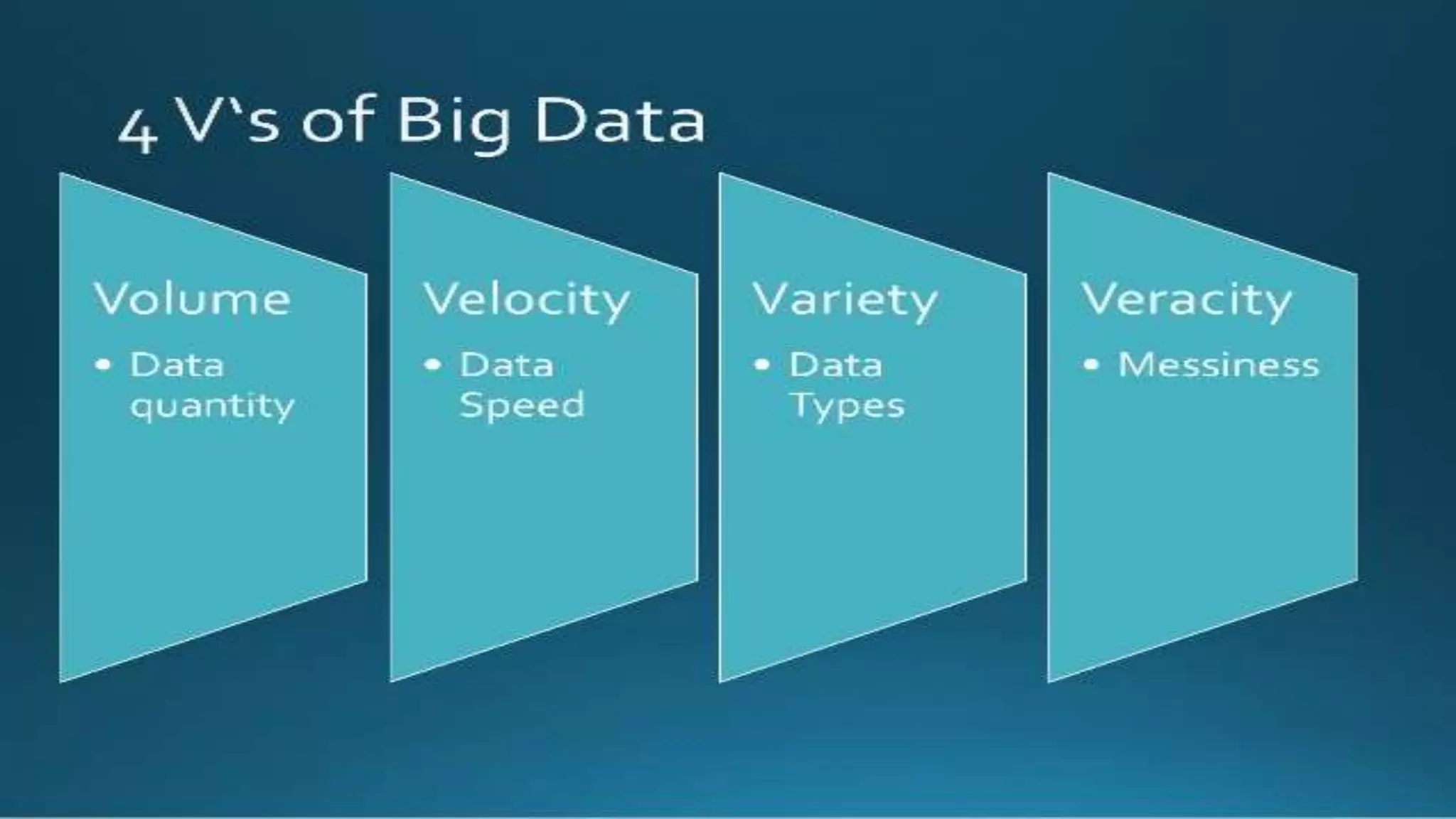
with ever-higher velocity. This is known as
the three Vs.
 Put simply, big data is larger, more
complex data sets, especially from new
data sources. These data sets are so
voluminous that traditional data processing
software just can’t manage them. But these
massive volumes of data can be used to
address business problems you wouldn’t
have been able to tackle before.
Why big data ?
 Key Enablers Of Appearance And Growth
 Increase Of Storage Capacities
 Increase Of Processing Power
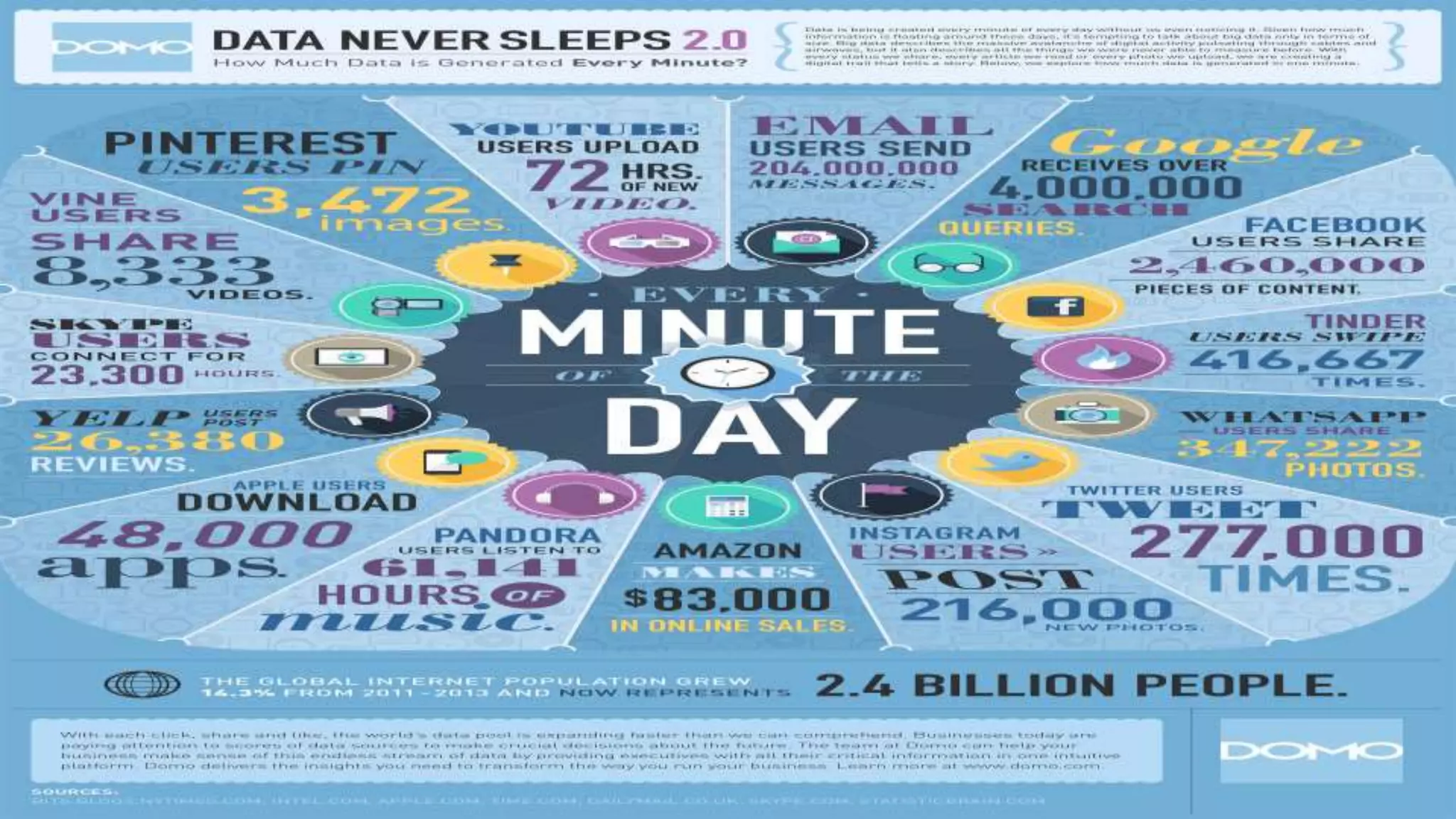
 Every Day We Create 2.5 Quintillion Bytes
Of Data
 90% Of The Data In The World Today Has
Been Created In The Last Two Years Alone
 Smart Decision Making
 Determining Root Causes Of Failures,
Issues And Defects In Near-
 Real Time.Generating Coupons At The
Point Of Sale Based On The Customer’s
Buying Habits.Recalculating Entire Risk
Portfolios In Minutes
 Detecting Fraudulent Behavior Before It
Affects Your Organization.
Who uses big data ?
 Education
 Government
 Healthcare
 Manufacturing
 Retail
What does Big Data mean for
supply chain management?
 Information is the driver of corporate
decision making on strategic, tactical, and
operational levels. Companies in the supply
chain must have access to up-to-date,
accurate, and meaningful information.
That’s why harnessing the power of Big
Data is vital for supply chain management.
 the optimization of a firm’s supply-side
business activities, such as new product
development, production, and product
distribution, to maximize revenue, profits,
and customer value.
 Big Data management has tremendous
implications for supply chain management.
Firms that can aggregate, filter, and
analyze internal data, as well as external
consumer and market data, can use the
insights generated to optimize decision-
making at all levels of the supply chain.
Big data opportunities
 Enhanced information management
 Increased operations efficiency and
maintenance
 Increased supply chain visibility and
transparency
 Greater responsiveness
 Enhanced product and market strategy
 Improved demand management and
production planning
 Innovation and product design benefits
 Positive financial implications
 More integration and collaboration
 Enhanced logistics
 More efficient inventory management
 Improved risk management
.
BENEFITS OF BIG DATA FOR
SUPPLY CHAIN MANAGEMENT
 Customer Service
 Shipping and Delivery
 Forecasting
 Optimizing vendor management
 Automating product sourcing
 Personalizing service
 Pricing Management
ROLE OF BIG DATA FOR
SUPPLY CHAIN MANAGEMENT
 Real-time Delivery Tracking
 Optimized Supplier Management
 Customized Production And Service
 Automatic Product Sourcing
 Optimized Pricing
THE FUTURE OF BIG DATA AND
SUPPLY CHAIN MANAGEMENT
 Several innovations and trends will not
only accelerate the volume of data as a
whole, but also the volume of data relevant
to supply chain management. Mobile will
continue to provide a major source of
supply-chain relevant data, driven by the
GPS technology in mobile devices, as well
as the proliferation of social networks
specializing in social discovery, which
allows users to discover people and events
of interest based on location. Deep analysis
of consumer location information can
afford firms even greater efficiency at
getting products to consumers, whether
through optimizing the locations of regional
fulfillment centers or even distribution of
products at those events and venues well
frequented by its consumers.
 Iot and Cloud Computing.
You can find me at
@username · kushalsshah.wordpress.com
THANKS!
ANY QUESTIONS?

Bigdata analysis in supply chain managment

  • 2.
    Presented by Kushal shah(17P066) Dhruv sheth(17P155) Abhi shah (17P002) 2
  • 4.
    Flow Of ThePresentation What Is Big Data? Why Big Data? Who Uses Big Data? What Does Big Data Mean For Supply Chain Management? What Are The Concrete Opportunities That Big Data Presents?
  • 5.
    What is bigdata ?  Big data is a term that describes the large volume of data – both structured and unstructured – that inundates a business on a day-to-day basis. But it’s not the amount of data that’s important. It’s what organizations do with the data that matters.  Big data is data that contains greater variety arriving in increasing volumes and with ever-higher velocity. This is known as the three Vs.  Put simply, big data is larger, more complex data sets, especially from new data sources. These data sets are so voluminous that traditional data processing software just can’t manage them. But these massive volumes of data can be used to address business problems you wouldn’t have been able to tackle before.
  • 7.
    Why big data?  Key Enablers Of Appearance And Growth  Increase Of Storage Capacities  Increase Of Processing Power  Every Day We Create 2.5 Quintillion Bytes Of Data  90% Of The Data In The World Today Has Been Created In The Last Two Years Alone  Smart Decision Making  Determining Root Causes Of Failures, Issues And Defects In Near-  Real Time.Generating Coupons At The Point Of Sale Based On The Customer’s Buying Habits.Recalculating Entire Risk Portfolios In Minutes  Detecting Fraudulent Behavior Before It Affects Your Organization.
  • 8.
    Who uses bigdata ?  Education  Government  Healthcare  Manufacturing  Retail
  • 9.
    What does BigData mean for supply chain management?  Information is the driver of corporate decision making on strategic, tactical, and operational levels. Companies in the supply chain must have access to up-to-date, accurate, and meaningful information. That’s why harnessing the power of Big Data is vital for supply chain management.  the optimization of a firm’s supply-side business activities, such as new product development, production, and product distribution, to maximize revenue, profits, and customer value.  Big Data management has tremendous implications for supply chain management. Firms that can aggregate, filter, and analyze internal data, as well as external consumer and market data, can use the insights generated to optimize decision- making at all levels of the supply chain.
  • 10.
    Big data opportunities Enhanced information management  Increased operations efficiency and maintenance  Increased supply chain visibility and transparency  Greater responsiveness  Enhanced product and market strategy  Improved demand management and production planning  Innovation and product design benefits  Positive financial implications  More integration and collaboration  Enhanced logistics  More efficient inventory management  Improved risk management .
  • 11.
    BENEFITS OF BIGDATA FOR SUPPLY CHAIN MANAGEMENT  Customer Service  Shipping and Delivery  Forecasting  Optimizing vendor management  Automating product sourcing  Personalizing service  Pricing Management
  • 12.
    ROLE OF BIGDATA FOR SUPPLY CHAIN MANAGEMENT  Real-time Delivery Tracking  Optimized Supplier Management  Customized Production And Service  Automatic Product Sourcing  Optimized Pricing
  • 13.
    THE FUTURE OFBIG DATA AND SUPPLY CHAIN MANAGEMENT  Several innovations and trends will not only accelerate the volume of data as a whole, but also the volume of data relevant to supply chain management. Mobile will continue to provide a major source of supply-chain relevant data, driven by the GPS technology in mobile devices, as well as the proliferation of social networks specializing in social discovery, which allows users to discover people and events of interest based on location. Deep analysis of consumer location information can afford firms even greater efficiency at getting products to consumers, whether through optimizing the locations of regional fulfillment centers or even distribution of products at those events and venues well frequented by its consumers.  Iot and Cloud Computing.
  • 14.
    You can findme at @username · kushalsshah.wordpress.com THANKS! ANY QUESTIONS?

Editor's Notes

  • #7 Complexity. Today's data comes from multiple sources, which makes it difficult to link, match, cleanse and transform data across systems. However, it’s necessary to connect and correlate relationships, hierarchies and multiple data linkages or your data can quickly spiral out of control.
  • #13 Researchers at the University of Kassel in Germany spoke to 20 experts from a leading global company in the management consulting industry who identified the opportunities and challenges that Big Data analytics presents for supply chains.