   Communication skills are some of the most
    important skills that you need to succeed in
    the workplace, school and ultimately, in life.
   We talk to people face to face, and we listen
    when people talk to us. We write emails and
    texts, and we read the documents that are
    sent to us. Communication, therefore, is a
    process that involves at least two people – a
    sender and a receiver. For it to be successful,
    the receiver must understand the message in
    the way that the sender intended.
   If you want to be an expert communicator,
    you need to be effective at all points in the
    communication process – and you must be
    comfortable with the different channels of
    communication. When you communicate well,
    you can be very successful. On the other
    hand, poor communicators struggle to
    develop their careers beyond a certain point.
SO ARE YOU A GOOD COMMUNICATOR?
   Rating: 1=Not at all, 2=rarely, 3= sometimes,
    4= often, 5= very often
   I try to anticipate and predict possible causes
    of confusion, and I deal with them up front
   When I write a paper, I give all of the
    background information and detail I can to
    make sure that my message is understood
   If I don't understand something, I tend to
    keep this to myself and figure it out later.
   I'm sometimes surprised to find that people
    haven't understood what I've said
   I can tend to say what I think, without
    worrying about how the other person
    perceives it. I assume that we'll be able to
    work it out later
   When people talk to me, I try to see their
    perspectives
   I use email to communicate complex issues
    with people. It's quick and efficient
   When I finish writing a paper, I scan it quickly
    for typos and so forth, and then send it off
    right away.
   When talking to people, I pay attention to
    their body language.
   I use diagrams and charts to help express my
    ideas.
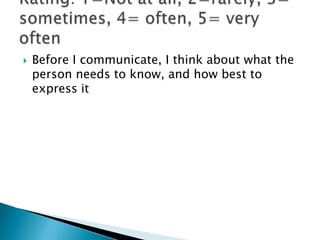
   Before I communicate, I think about what the
    person needs to know, and how best to
    express it
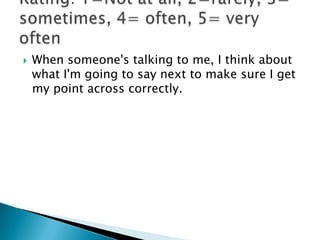
   When someone's talking to me, I think about
    what I'm going to say next to make sure I get
    my point across correctly.
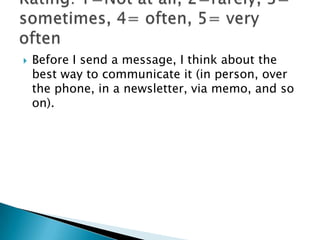
   Before I send a message, I think about the
    best way to communicate it (in person, over
    the phone, in a newsletter, via memo, and so
    on).
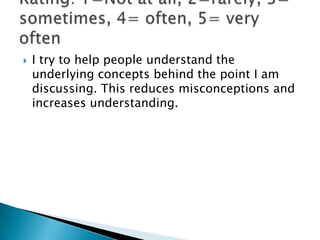
   I try to help people understand the
    underlying concepts behind the point I am
    discussing. This reduces misconceptions and
    increases understanding.
   I consider cultural barriers when planning my
    communications.
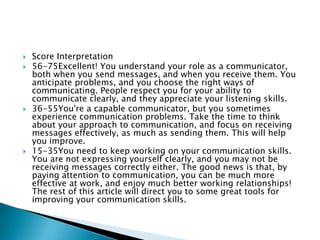
   Score Interpretation
   56-75Excellent! You understand your role as a communicator,
    both when you send messages, and when you receive them. You
    anticipate problems, and you choose the right ways of
    communicating. People respect you for your ability to
    communicate clearly, and they appreciate your listening skills.
   36-55You're a capable communicator, but you sometimes
    experience communication problems. Take the time to think
    about your approach to communication, and focus on receiving
    messages effectively, as much as sending them. This will help
    you improve.
   15-35You need to keep working on your communication skills.
    You are not expressing yourself clearly, and you may not be
    receiving messages correctly either. The good news is that, by
    paying attention to communication, you can be much more
    effective at work, and enjoy much better working relationships!
    The rest of this article will direct you to some great tools for
    improving your communication skills.
   Evaluate your results. Write two paragraphs
    on how you can improve.

Communication skills lesson

  • 2.
    Communication skills are some of the most important skills that you need to succeed in the workplace, school and ultimately, in life.  We talk to people face to face, and we listen when people talk to us. We write emails and texts, and we read the documents that are sent to us. Communication, therefore, is a process that involves at least two people – a sender and a receiver. For it to be successful, the receiver must understand the message in the way that the sender intended.
  • 3.
    If you want to be an expert communicator, you need to be effective at all points in the communication process – and you must be comfortable with the different channels of communication. When you communicate well, you can be very successful. On the other hand, poor communicators struggle to develop their careers beyond a certain point.
  • 4.
    SO ARE YOUA GOOD COMMUNICATOR?
  • 5.
    Rating: 1=Not at all, 2=rarely, 3= sometimes, 4= often, 5= very often
  • 6.
    I try to anticipate and predict possible causes of confusion, and I deal with them up front
  • 7.
    When I write a paper, I give all of the background information and detail I can to make sure that my message is understood
  • 8.
    If I don't understand something, I tend to keep this to myself and figure it out later.
  • 9.
    I'm sometimes surprised to find that people haven't understood what I've said
  • 10.
    I can tend to say what I think, without worrying about how the other person perceives it. I assume that we'll be able to work it out later
  • 11.
    When people talk to me, I try to see their perspectives
  • 12.
    I use email to communicate complex issues with people. It's quick and efficient
  • 13.
    When I finish writing a paper, I scan it quickly for typos and so forth, and then send it off right away.
  • 14.
    When talking to people, I pay attention to their body language.
  • 15.
    I use diagrams and charts to help express my ideas.
  • 16.
    Before I communicate, I think about what the person needs to know, and how best to express it
  • 17.
    When someone's talking to me, I think about what I'm going to say next to make sure I get my point across correctly.
  • 18.
    Before I send a message, I think about the best way to communicate it (in person, over the phone, in a newsletter, via memo, and so on).
  • 19.
    I try to help people understand the underlying concepts behind the point I am discussing. This reduces misconceptions and increases understanding.
  • 20.
    I consider cultural barriers when planning my communications.
  • 21.
    Score Interpretation  56-75Excellent! You understand your role as a communicator, both when you send messages, and when you receive them. You anticipate problems, and you choose the right ways of communicating. People respect you for your ability to communicate clearly, and they appreciate your listening skills.  36-55You're a capable communicator, but you sometimes experience communication problems. Take the time to think about your approach to communication, and focus on receiving messages effectively, as much as sending them. This will help you improve.  15-35You need to keep working on your communication skills. You are not expressing yourself clearly, and you may not be receiving messages correctly either. The good news is that, by paying attention to communication, you can be much more effective at work, and enjoy much better working relationships! The rest of this article will direct you to some great tools for improving your communication skills.
  • 22.
    Evaluate your results. Write two paragraphs on how you can improve.

Editor's Notes

  • #2 http://www.mindtools.com/pages/article/newCS_99.htm