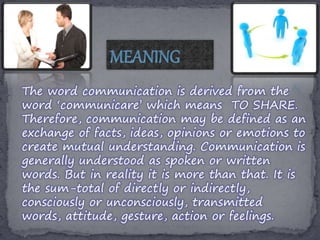
The word communication is derived from the
word ‘communicare’ which means TO SHARE.
Therefore, communication may be defined as an
exchange of facts, ideas, opinions or emotions to
create mutual understanding. Communication is
generally understood as spoken or written
words. But in reality it is more than that. It is
the sum-total of directly or indirectly,
consciously or unconsciously, transmitted
words, attitude, gesture, action or feelings.
On The Basis Of Relationship :
On The Basis Of Direction :
On The Basis Of Means Used :
HI ! RAHUL
METTING TODAT AT
5:00 P.M.
OK !!
Sometimes the message sent by sender does not reach
the receiver in the same manner as expected by the
sender. This filtration, misrepresentation of
communication may cause misunderstanding. Therefore
it is for a manager to identify these barriers and take
measures to overcome these.
SEMANTIC BARRIERS :
Sometimes the same word or same sentence can be understood
differently by different people in the organization which means
difference in the understanding levels of employees.
These barriers could be caused by :
1. Badly Expressed Message
2. Symbols With Different Meaning
3. Faulty Translation
4. Unclarified Assumptions
5. Technical Jargon
6. Body Language And Gesture
PSYCHOLOGICAL BARRIERS :
Emotional or psychological factors also act as barriers to effective
communication. The state of mind has great influence over the
information and its reflection. As a frightened person may not
communicate properly similarly an angry person may not receive
the communication effectively
These barriers could be caused by :
1. Premature Evaluation
2. Lack Of Attention
3. Loss by Transmission And Poor Retention
4. Distrust
ORGANISATIONAL BARRIERS :
Factors related to organization structure, authority relationship,
rules, regulations may act as barrier to effective communication.
These barriers could be caused by :
1. Organizational Policy
2. Rules And Regulation
3. Status Difference
4. Complex Organization
5. Organizational Facilities
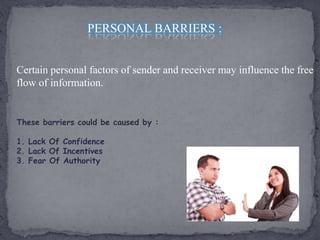
PERSONAL BARRIERS :
Certain personal factors of sender and receiver may influence the free
flow of information.
These barriers could be caused by :
1. Lack Of Confidence
2. Lack Of Incentives
3. Fear Of Authority
Open Mind
Consult Other Before
Communicating
Follow Up
Proper Feedback
Communication For The
Present As Well As For
Future
Use Of Proper Language
Communication According
To The Need Of Receiver
Completeness Of Message
Good Listener
Clarify Idea Before
Communication
Communication

Communication

  • 2.
    The word communicationis derived from the word ‘communicare’ which means TO SHARE. Therefore, communication may be defined as an exchange of facts, ideas, opinions or emotions to create mutual understanding. Communication is generally understood as spoken or written words. But in reality it is more than that. It is the sum-total of directly or indirectly, consciously or unconsciously, transmitted words, attitude, gesture, action or feelings.
  • 5.
    On The BasisOf Relationship :
  • 6.
    On The BasisOf Direction :
  • 7.
    On The BasisOf Means Used :
  • 8.
    HI ! RAHUL METTINGTODAT AT 5:00 P.M. OK !!
  • 9.
    Sometimes the messagesent by sender does not reach the receiver in the same manner as expected by the sender. This filtration, misrepresentation of communication may cause misunderstanding. Therefore it is for a manager to identify these barriers and take measures to overcome these.
  • 11.
    SEMANTIC BARRIERS : Sometimesthe same word or same sentence can be understood differently by different people in the organization which means difference in the understanding levels of employees. These barriers could be caused by : 1. Badly Expressed Message 2. Symbols With Different Meaning 3. Faulty Translation 4. Unclarified Assumptions 5. Technical Jargon 6. Body Language And Gesture
  • 12.
    PSYCHOLOGICAL BARRIERS : Emotionalor psychological factors also act as barriers to effective communication. The state of mind has great influence over the information and its reflection. As a frightened person may not communicate properly similarly an angry person may not receive the communication effectively These barriers could be caused by : 1. Premature Evaluation 2. Lack Of Attention 3. Loss by Transmission And Poor Retention 4. Distrust
  • 13.
    ORGANISATIONAL BARRIERS : Factorsrelated to organization structure, authority relationship, rules, regulations may act as barrier to effective communication. These barriers could be caused by : 1. Organizational Policy 2. Rules And Regulation 3. Status Difference 4. Complex Organization 5. Organizational Facilities
  • 14.
    PERSONAL BARRIERS : Certainpersonal factors of sender and receiver may influence the free flow of information. These barriers could be caused by : 1. Lack Of Confidence 2. Lack Of Incentives 3. Fear Of Authority
  • 15.
    Open Mind Consult OtherBefore Communicating Follow Up Proper Feedback Communication For The Present As Well As For Future Use Of Proper Language Communication According To The Need Of Receiver Completeness Of Message Good Listener Clarify Idea Before Communication