Effective communication
Skills
By Raviteja Godavari
11115035
Objectives
 Define and understand communication and the
communication process.
 List and overcome the filters/barriers in a
communication process.
 Tips to improve verbal and non verbal
communication.
What is Communication?
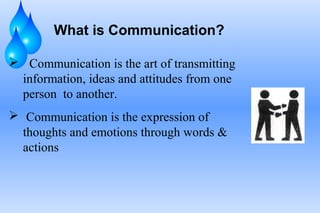
 Communication is the art of transmitting
information, ideas and attitudes from one
person to another.
 Communication is the expression of
thoughts and emotions through words &
actions
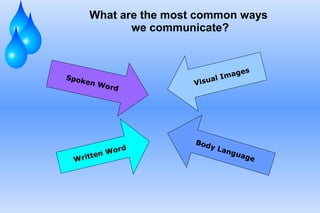
What are the most common ways
we communicate?
Spoken Word
Written Word
Visual Images
Body Language
Types of Communication
People communicate with each other in a number of ways that
depend upon the message and its context in which it is being
sent.
Verbal Communication
Nonverbal Communication
.
Verbal
 Communication is done verbally by Speech or a piece of
writing.
 In verbal communication remember the acronym “KISS”KISS”
(keep it short and simple).
Verbal Communication is divided into:
Oral Communication
Written Communication
Nonverbal
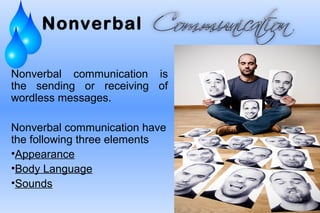
Nonverbal communication is
the sending or receiving of
wordless messages.
Nonverbal communication have
the following three elements
•Appearance
•Body Language
•Sounds
The Communication Process
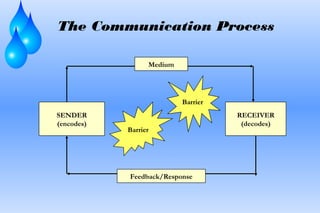
SENDER
(encodes)
RECEIVER
(decodes)
Barrier
Barrier
Medium
Feedback/Response
Barriers to communication
• Noise
• Inappropriate medium
• Assumptions/Misconceptions
• Emotions
• Language differences
• Poor listening skills
• Distractions
Hearing Vs Listening
Hearing – Physical process,
natural, passive.
Listening – Physical as well
as mental process, active,
learned process, a skill.
Listening is hard.
You must choose to participate in the process of listening.
VALUE OF LISTENING
 Listening to others is an elegant art.
 Good listening reflects courtesy and good manners.
 Improve competence and performance.
It can eliminate imaginary grievances & improve social relations
Listening is a positive activity rather than a passive or negative activity.
Do’s :-
Think ahead.
Use simple words.
Increase your knowledge.
Speak clearly and audibly.
Interruption, do a little recap.
Pay attention to the speaker.
Make notes of important points.
Ask for clarification.
ESSENTIALS OF COMMUNICATION
Don’ts :-
Don’t instantly react.
Do not use technical terms & terminologies.
Do not speak too fast or too slow.
Do not assume that every body understands you.
While listening do not glance here and there.
Do not jump to the conclusion that you have understood every
thing.
How to Improve Existing Level of
COMMUNICATION?
Improve language.
Improve pronunciation.
Work on voice modulation.
Work on body language.
Improve on your topic of discussion.
Don’t speak only to impress someone.
Look presentable and confident.
Improving Body Language
• Keep appropriate distance.
• Touch only when appropriate.
• Take care of your appearance.
• Maintain eye contact.
• Smile genuinely.
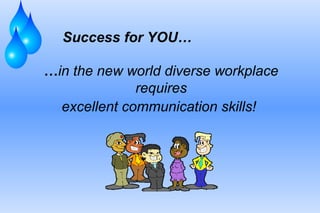
…in the new world diverse workplace
requires
excellent communication skills!
Success for YOU…
Questions??
Thank you

Communication skills

  • 1.
  • 2.
    Objectives  Define andunderstand communication and the communication process.  List and overcome the filters/barriers in a communication process.  Tips to improve verbal and non verbal communication.
  • 3.
    What is Communication? Communication is the art of transmitting information, ideas and attitudes from one person to another.  Communication is the expression of thoughts and emotions through words & actions
  • 4.
    What are themost common ways we communicate? Spoken Word Written Word Visual Images Body Language
  • 5.
    Types of Communication Peoplecommunicate with each other in a number of ways that depend upon the message and its context in which it is being sent. Verbal Communication Nonverbal Communication .
  • 6.
    Verbal  Communication isdone verbally by Speech or a piece of writing.  In verbal communication remember the acronym “KISS”KISS” (keep it short and simple). Verbal Communication is divided into: Oral Communication Written Communication
  • 7.
    Nonverbal Nonverbal communication is thesending or receiving of wordless messages. Nonverbal communication have the following three elements •Appearance •Body Language •Sounds
  • 8.
  • 9.
    Barriers to communication •Noise • Inappropriate medium • Assumptions/Misconceptions • Emotions • Language differences • Poor listening skills • Distractions
  • 10.
    Hearing Vs Listening Hearing– Physical process, natural, passive. Listening – Physical as well as mental process, active, learned process, a skill. Listening is hard. You must choose to participate in the process of listening.
  • 11.
    VALUE OF LISTENING Listening to others is an elegant art.  Good listening reflects courtesy and good manners.  Improve competence and performance. It can eliminate imaginary grievances & improve social relations Listening is a positive activity rather than a passive or negative activity.
  • 12.
    Do’s :- Think ahead. Usesimple words. Increase your knowledge. Speak clearly and audibly. Interruption, do a little recap. Pay attention to the speaker. Make notes of important points. Ask for clarification. ESSENTIALS OF COMMUNICATION
  • 13.
    ESSENTIALS OF COMMUNICATION Don’ts:- Don’t instantly react. Do not use technical terms & terminologies. Do not speak too fast or too slow. Do not assume that every body understands you. While listening do not glance here and there. Do not jump to the conclusion that you have understood every thing.
  • 14.
    How to ImproveExisting Level of COMMUNICATION? Improve language. Improve pronunciation. Work on voice modulation. Work on body language. Improve on your topic of discussion. Don’t speak only to impress someone. Look presentable and confident.
  • 15.
    Improving Body Language •Keep appropriate distance. • Touch only when appropriate. • Take care of your appearance. • Maintain eye contact. • Smile genuinely.
  • 16.
    …in the newworld diverse workplace requires excellent communication skills! Success for YOU…
  • 17.