1
2
DEFINING COMMUNICATION
• communication, n. The imparting
or exchanging of information by
speaking, writing, or using some
other medium. …The successful
conveying or sharing of ideas and
feelings.
• Oxford English Dictionary
3
COMMUNICATION SKILLS
• संचार कौशल आपको दूसरों को समझने और समझने की
अनुमति देिा है।
• दूसरों को प्रभावी ढंग से ववचारों को संप्रेविि करने,
बािचीि में सक्रिय रूप से सुनने, आलोचनात्मक प्रतिक्रिया
देने और प्राप्ि करने और साववजतनक बोलने िक सीममि
नह ं हैं।
4
DESCRIPTION
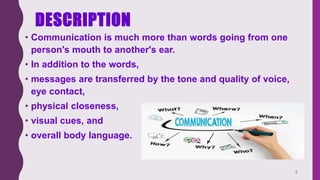
• Communication is much more than words going from one
person's mouth to another's ear.
• In addition to the words,
• messages are transferred by the tone and quality of voice,
eye contact,
• physical closeness,
• visual cues, and
• overall body language.
5
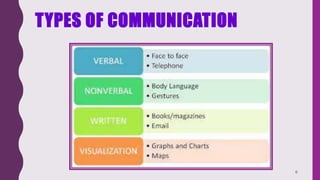
TYPES OF COMMUNICATION
6
LANGUAGE EMPLOYS SYMBOLS
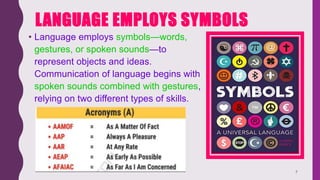
• Language employs symbols—words,
gestures, or spoken sounds—to
represent objects and ideas.
Communication of language begins with
spoken sounds combined with gestures,
relying on two different types of skills.
7
8
9
10
11
12
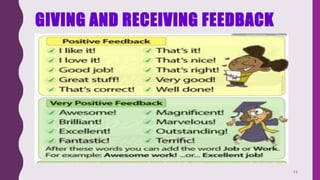
GIVING AND RECEIVING FEEDBACK
13
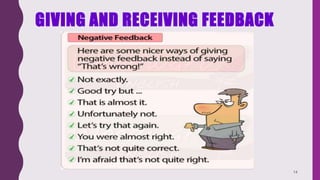
GIVING AND RECEIVING FEEDBACK
14
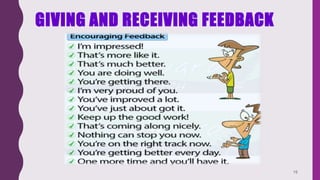
GIVING AND RECEIVING FEEDBACK
15
16
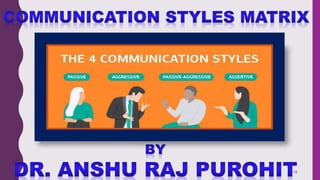
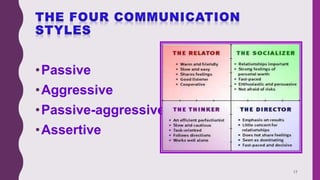
•Passive
•Aggressive
•Passive-aggressive
•Assertive
17
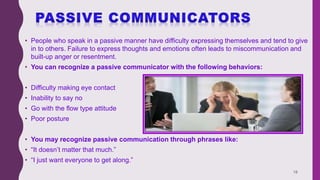
• People who speak in a passive manner have difficulty expressing themselves and tend to give
in to others. Failure to express thoughts and emotions often leads to miscommunication and
built-up anger or resentment.
• You can recognize a passive communicator with the following behaviors:
• Difficulty making eye contact
• Inability to say no
• Go with the flow type attitude
• Poor posture
• You may recognize passive communication through phrases like:
• “It doesn’t matter that much.”
• “I just want everyone to get along.”
18
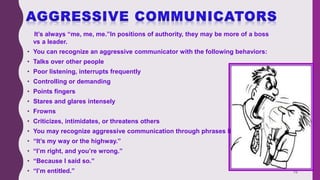
It’s always “me, me, me.”In positions of authority, they may be more of a boss
vs a leader.
• You can recognize an aggressive communicator with the following behaviors:
• Talks over other people
• Poor listening, interrupts frequently
• Controlling or demanding
• Points fingers
• Stares and glares intensely
• Frowns
• Criticizes, intimidates, or threatens others
• You may recognize aggressive communication through phrases like:
• “It’s my way or the highway.”
• “I’m right, and you’re wrong.”
• “Because I said so.”
• “I’m entitled.” 19
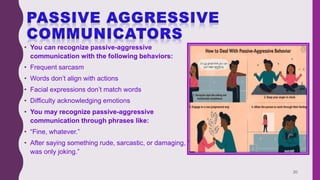
• You can recognize passive-aggressive
communication with the following behaviors:
• Frequent sarcasm
• Words don’t align with actions
• Facial expressions don’t match words
• Difficulty acknowledging emotions
• You may recognize passive-aggressive
communication through phrases like:
• “Fine, whatever.”
• After saying something rude, sarcastic, or damaging, “I
was only joking.”
20
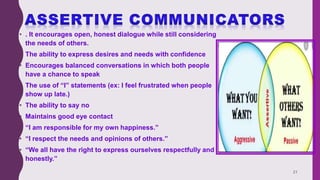
• . It encourages open, honest dialogue while still considering
the needs of others.
• The ability to express desires and needs with confidence
• Encourages balanced conversations in which both people
have a chance to speak
• The use of “I” statements (ex: I feel frustrated when people
show up late.)
• The ability to say no
• Maintains good eye contact
• “I am responsible for my own happiness.”
• “I respect the needs and opinions of others.”
• “We all have the right to express ourselves respectfully and
honestly.”
21
ADAPTING YOUR COMMUNICATION STYLE
TO YOUR AUDIENCE
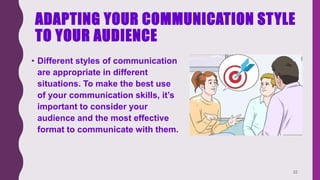
• Different styles of communication
are appropriate in different
situations. To make the best use
of your communication skills, it’s
important to consider your
audience and the most effective
format to communicate with them.
22
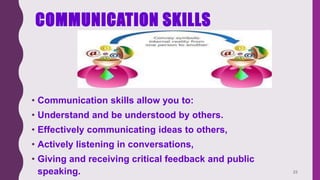
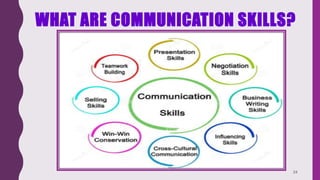
• Communication skills allow you to:
• Understand and be understood by others.
• Effectively communicating ideas to others,
• Actively listening in conversations,
• Giving and receiving critical feedback and public
speaking. 23
WHAT ARE COMMUNICATION SKILLS?
24
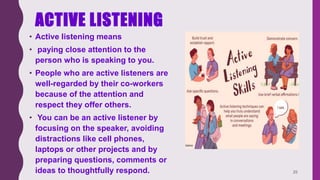
ACTIVE LISTENING
• Active listening means
• paying close attention to the
person who is speaking to you.
• People who are active listeners are
well-regarded by their co-workers
because of the attention and
respect they offer others.
• You can be an active listener by
focusing on the speaker, avoiding
distractions like cell phones,
laptops or other projects and by
preparing questions, comments or
ideas to thoughtfully respond. 25
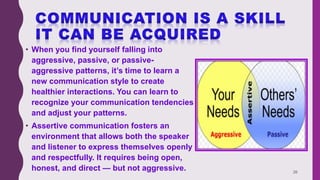
• When you find yourself falling into
aggressive, passive, or passive-
aggressive patterns, it’s time to learn a
new communication style to create
healthier interactions. You can learn to
recognize your communication tendencies
and adjust your patterns.
• Assertive communication fosters an
environment that allows both the speaker
and listener to express themselves openly
and respectfully. It requires being open,
honest, and direct — but not aggressive. 26
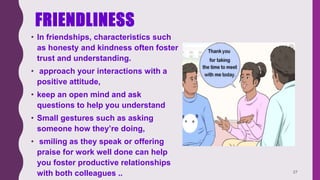
FRIENDLINESS
• In friendships, characteristics such
as honesty and kindness often foster
trust and understanding.
• approach your interactions with a
positive attitude,
• keep an open mind and ask
questions to help you understand
• Small gestures such as asking
someone how they’re doing,
• smiling as they speak or offering
praise for work well done can help
you foster productive relationships
with both colleagues .. 27
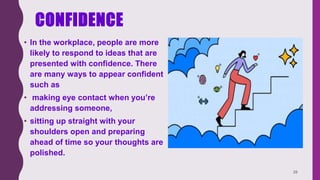
CONFIDENCE
• In the workplace, people are more
likely to respond to ideas that are
presented with confidence. There
are many ways to appear confident
such as
• making eye contact when you’re
addressing someone,
• sitting up straight with your
shoulders open and preparing
ahead of time so your thoughts are
polished.
28
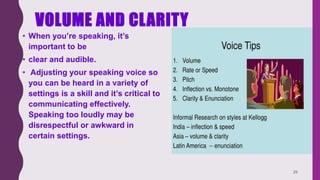
VOLUME AND CLARITY
• When you’re speaking, it’s
important to be
• clear and audible.
• Adjusting your speaking voice so
you can be heard in a variety of
settings is a skill and it’s critical to
communicating effectively.
Speaking too loudly may be
disrespectful or awkward in
certain settings.
29
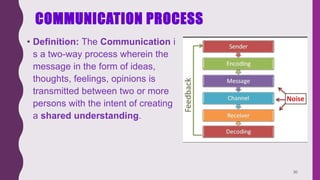
COMMUNICATION PROCESS
• Definition: The Communication i
s a two-way process wherein the
message in the form of ideas,
thoughts, feelings, opinions is
transmitted between two or more
persons with the intent of creating
a shared understanding.
30
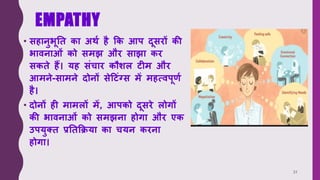
EMPATHY
• सहानुभूति का अर्व है क्रक आप दूसरों की
भावनाओं को समझ और साझा कर
सकिे हैं। यह संचार कौशल ट म और
आमने-सामने दोनों सेटटंग्स में महत्वपूर्व
है।
• दोनों ह मामलों में, आपको दूसरे लोगों
की भावनाओं को समझना होगा और एक
उपयुक्ि प्रतिक्रिया का चयन करना
होगा।
31
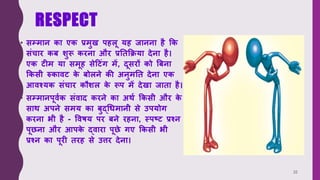
RESPECT
• सम्मान का एक प्रमुख पहलू यह जानना है क्रक
संचार कब शुरू करना और प्रतिक्रिया देना है।
एक ट म या समूह सेटटंग में, दूसरों को बबना
क्रकसी रुकावट क
े बोलने की अनुमति देना एक
आवश्यक संचार कौशल क
े रूप में देखा जािा है।
• सम्मानपूववक संवाद करने का अर्व क्रकसी और क
े
सार् अपने समय का बुद्धिमानी से उपयोग
करना भी है - वविय पर बने रहना, स्पष्ट प्रश्न
पूछना और आपक
े द्वारा पूछे गए क्रकसी भी
प्रश्न का पूर िरह से उत्तर देना।
32
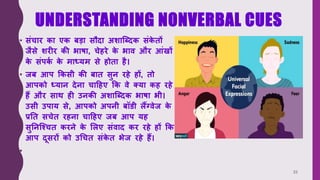
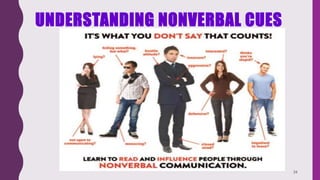
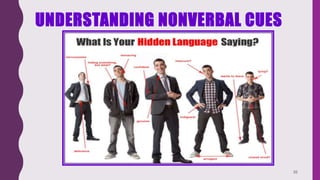
UNDERSTANDING NONVERBAL CUES
• संचार का एक बडा सौदा अशाब्ददक संक
े िों
जैसे शर र की भािा, चेहरे क
े भाव और आंखों
क
े संपक
व क
े माध्यम से होिा है।
• जब आप क्रकसी की बाि सुन रहे हों, िो
आपको ध्यान देना चाटहए क्रक वे क्या कह रहे
हैं और सार् ह उनकी अशाब्ददक भािा भी।
उसी उपाय से, आपको अपनी बॉडी लैंग्वेज क
े
प्रति सचेि रहना चाटहए जब आप यह
सुतनब्श्चि करने क
े मलए संवाद कर रहे हों क्रक
आप दूसरों को उधचि संक
े ि भेज रहे हैं।
•
33
UNDERSTANDING NONVERBAL CUES
34
UNDERSTANDING NONVERBAL CUES
35
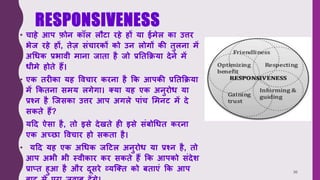
RESPONSIVENESS
• चाहे आप फोन कॉल लौटा रहे हों या ईमेल का उत्तर
भेज रहे हों, िेज़ संचारकों को उन लोगों की िुलना में
अधिक प्रभावी माना जािा है जो प्रतिक्रिया देने में
िीमे होिे हैं।
• एक िर का यह ववचार करना है क्रक आपकी प्रतिक्रिया
में क्रकिना समय लगेगा। क्या यह एक अनुरोि या
प्रश्न है ब्जसका उत्तर आप अगले पांच ममनट में दे
सकिे हैं?
• यटद ऐसा है, िो इसे देखिे ह इसे संबोधिि करना
एक अच्छा ववचार हो सकिा है।
• यटद यह एक अधिक जटटल अनुरोि या प्रश्न है, िो
आप अभी भी स्वीकार कर सकिे हैं क्रक आपको संदेश
प्राप्ि हुआ है और दूसरे व्यब्क्ि को बिाएं क्रक आप 36
37
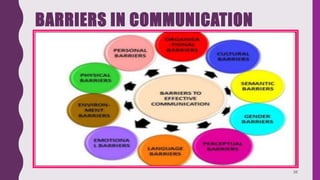
BARRIERS IN COMMUNICATION
38
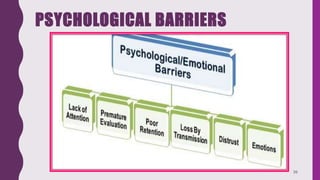
PSYCHOLOGICAL BARRIERS
39
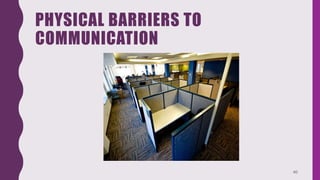
PHYSICAL BARRIERS TO
COMMUNICATION
40
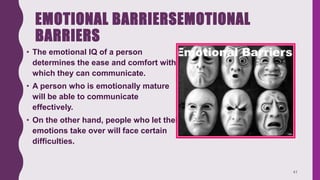
EMOTIONAL BARRIERSEMOTIONAL
BARRIERS
• The emotional IQ of a person
determines the ease and comfort with
which they can communicate.
• A person who is emotionally mature
will be able to communicate
effectively.
• On the other hand, people who let their
emotions take over will face certain
difficulties.
41
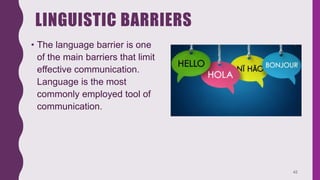
LINGUISTIC BARRIERS
• The language barrier is one
of the main barriers that limit
effective communication.
Language is the most
commonly employed tool of
communication.
42
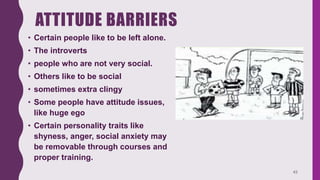
ATTITUDE BARRIERS
• Certain people like to be left alone.
• The introverts
• people who are not very social.
• Others like to be social
• sometimes extra clingy
• Some people have attitude issues,
like huge ego
• Certain personality traits like
shyness, anger, social anxiety may
be removable through courses and
proper training.
43
44
• Do you want to learn how to speak English well?
• Are you also looking for a shortcut to English fluency?
• We don’t have tricks that will give you perfect English in five minutes a day.
• But we do have solid tips that will help you learn how to speak English
more fluently, in less time.
• Here are some tips that will help you speak English better than ever.
ENGLISH SPEAKING SKILLS
• If you’re wondering how to
improve your English speaking
skills, there isn’t one easy
answer.
• Learning how to speak English
fluently isn’t something that
happens overnight
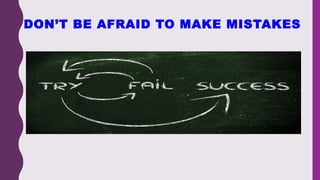
DON’T BE AFRAID TO MAKE MISTAKES
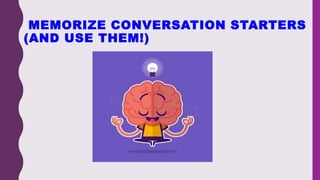
MEMORIZE CONVERSATION STARTERS
(AND USE THEM!)
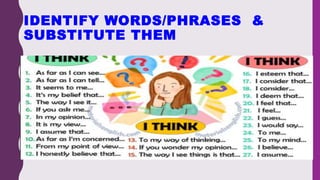
IDENTIFY WORDS/PHRASES &
SUBSTITUTE THEM
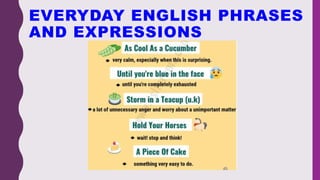
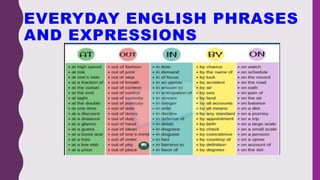
EVERYDAY ENGLISH PHRASES
AND EXPRESSIONS
EVERYDAY ENGLISH PHRASES
AND EXPRESSIONS
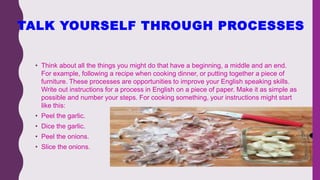
TALK YOURSELF THROUGH PROCESSES
• Think about all the things you might do that have a beginning, a middle and an end.
For example, following a recipe when cooking dinner, or putting together a piece of
furniture. These processes are opportunities to improve your English speaking skills.
Write out instructions for a process in English on a piece of paper. Make it as simple as
possible and number your steps. For cooking something, your instructions might start
like this:
• Peel the garlic.
• Dice the garlic.
• Peel the onions.
• Slice the onions.
IDENTIFY WORDS/PHRASES WHICH
YOU REPEAT FREQUENTLY
• AVOID USING COMMON PHRASES
• “I believe that … ”
“I’m convinced that…”
“I trust that … ”
“I reckon that … ”
• And the list goes on and on …
• ADJECTIVES
• Adjectives are used to describe nouns. That’s why you can go
wild with your creativity!
DON’T STUDY GRAMMAR TOO MUCH
• The key to learning a language is
finding a balance between studying
and practicing.
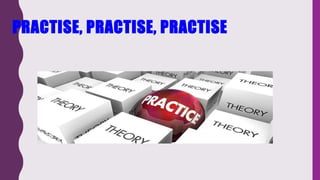
PRACTISE, PRACTISE, PRACTISE
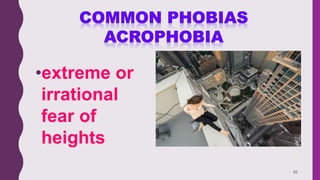
55
•extreme or
irrational
fear of
heights
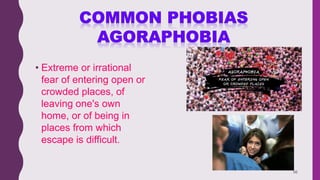
56
• Extreme or irrational
fear of entering open or
crowded places, of
leaving one's own
home, or of being in
places from which
escape is difficult.
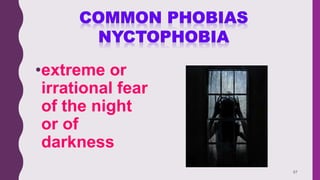
57
•extreme or
irrational fear
of the night
or of
darkness
58
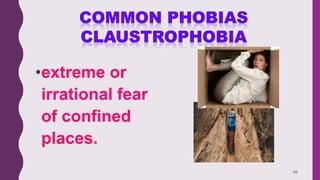
•extreme or
irrational fear
of confined
places.
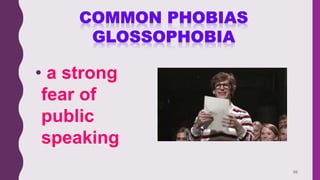
59
• a strong
fear of
public
speaking
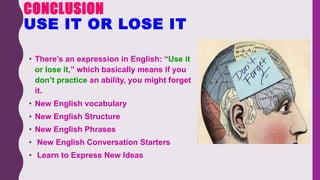
CONCLUSION
USE IT OR LOSE IT
• There’s an expression in English: “Use it
or lose it,” which basically means if you
don’t practice an ability, you might forget
it.
• New English vocabulary
• New English Structure
• New English Phrases
• New English Conversation Starters
• Learn to Express New Ideas
THANK YOU
61

Otts 2 communication skills

  • 1.
  • 2.
  • 3.
    DEFINING COMMUNICATION • communication,n. The imparting or exchanging of information by speaking, writing, or using some other medium. …The successful conveying or sharing of ideas and feelings. • Oxford English Dictionary 3
  • 4.
    COMMUNICATION SKILLS • संचारकौशल आपको दूसरों को समझने और समझने की अनुमति देिा है। • दूसरों को प्रभावी ढंग से ववचारों को संप्रेविि करने, बािचीि में सक्रिय रूप से सुनने, आलोचनात्मक प्रतिक्रिया देने और प्राप्ि करने और साववजतनक बोलने िक सीममि नह ं हैं। 4
  • 5.
    DESCRIPTION • Communication ismuch more than words going from one person's mouth to another's ear. • In addition to the words, • messages are transferred by the tone and quality of voice, eye contact, • physical closeness, • visual cues, and • overall body language. 5
  • 6.
  • 7.
    LANGUAGE EMPLOYS SYMBOLS •Language employs symbols—words, gestures, or spoken sounds—to represent objects and ideas. Communication of language begins with spoken sounds combined with gestures, relying on two different types of skills. 7
  • 8.
  • 9.
  • 10.
  • 11.
  • 12.
  • 13.
  • 14.
  • 15.
  • 16.
  • 17.
  • 18.
    • People whospeak in a passive manner have difficulty expressing themselves and tend to give in to others. Failure to express thoughts and emotions often leads to miscommunication and built-up anger or resentment. • You can recognize a passive communicator with the following behaviors: • Difficulty making eye contact • Inability to say no • Go with the flow type attitude • Poor posture • You may recognize passive communication through phrases like: • “It doesn’t matter that much.” • “I just want everyone to get along.” 18
  • 19.
    It’s always “me,me, me.”In positions of authority, they may be more of a boss vs a leader. • You can recognize an aggressive communicator with the following behaviors: • Talks over other people • Poor listening, interrupts frequently • Controlling or demanding • Points fingers • Stares and glares intensely • Frowns • Criticizes, intimidates, or threatens others • You may recognize aggressive communication through phrases like: • “It’s my way or the highway.” • “I’m right, and you’re wrong.” • “Because I said so.” • “I’m entitled.” 19
  • 20.
    • You canrecognize passive-aggressive communication with the following behaviors: • Frequent sarcasm • Words don’t align with actions • Facial expressions don’t match words • Difficulty acknowledging emotions • You may recognize passive-aggressive communication through phrases like: • “Fine, whatever.” • After saying something rude, sarcastic, or damaging, “I was only joking.” 20
  • 21.
    • . Itencourages open, honest dialogue while still considering the needs of others. • The ability to express desires and needs with confidence • Encourages balanced conversations in which both people have a chance to speak • The use of “I” statements (ex: I feel frustrated when people show up late.) • The ability to say no • Maintains good eye contact • “I am responsible for my own happiness.” • “I respect the needs and opinions of others.” • “We all have the right to express ourselves respectfully and honestly.” 21
  • 22.
    ADAPTING YOUR COMMUNICATIONSTYLE TO YOUR AUDIENCE • Different styles of communication are appropriate in different situations. To make the best use of your communication skills, it’s important to consider your audience and the most effective format to communicate with them. 22
  • 23.
    • Communication skillsallow you to: • Understand and be understood by others. • Effectively communicating ideas to others, • Actively listening in conversations, • Giving and receiving critical feedback and public speaking. 23
  • 24.
  • 25.
    ACTIVE LISTENING • Activelistening means • paying close attention to the person who is speaking to you. • People who are active listeners are well-regarded by their co-workers because of the attention and respect they offer others. • You can be an active listener by focusing on the speaker, avoiding distractions like cell phones, laptops or other projects and by preparing questions, comments or ideas to thoughtfully respond. 25
  • 26.
    • When youfind yourself falling into aggressive, passive, or passive- aggressive patterns, it’s time to learn a new communication style to create healthier interactions. You can learn to recognize your communication tendencies and adjust your patterns. • Assertive communication fosters an environment that allows both the speaker and listener to express themselves openly and respectfully. It requires being open, honest, and direct — but not aggressive. 26
  • 27.
    FRIENDLINESS • In friendships,characteristics such as honesty and kindness often foster trust and understanding. • approach your interactions with a positive attitude, • keep an open mind and ask questions to help you understand • Small gestures such as asking someone how they’re doing, • smiling as they speak or offering praise for work well done can help you foster productive relationships with both colleagues .. 27
  • 28.
    CONFIDENCE • In theworkplace, people are more likely to respond to ideas that are presented with confidence. There are many ways to appear confident such as • making eye contact when you’re addressing someone, • sitting up straight with your shoulders open and preparing ahead of time so your thoughts are polished. 28
  • 29.
    VOLUME AND CLARITY •When you’re speaking, it’s important to be • clear and audible. • Adjusting your speaking voice so you can be heard in a variety of settings is a skill and it’s critical to communicating effectively. Speaking too loudly may be disrespectful or awkward in certain settings. 29
  • 30.
    COMMUNICATION PROCESS • Definition:The Communication i s a two-way process wherein the message in the form of ideas, thoughts, feelings, opinions is transmitted between two or more persons with the intent of creating a shared understanding. 30
  • 31.
    EMPATHY • सहानुभूति काअर्व है क्रक आप दूसरों की भावनाओं को समझ और साझा कर सकिे हैं। यह संचार कौशल ट म और आमने-सामने दोनों सेटटंग्स में महत्वपूर्व है। • दोनों ह मामलों में, आपको दूसरे लोगों की भावनाओं को समझना होगा और एक उपयुक्ि प्रतिक्रिया का चयन करना होगा। 31
  • 32.
    RESPECT • सम्मान काएक प्रमुख पहलू यह जानना है क्रक संचार कब शुरू करना और प्रतिक्रिया देना है। एक ट म या समूह सेटटंग में, दूसरों को बबना क्रकसी रुकावट क े बोलने की अनुमति देना एक आवश्यक संचार कौशल क े रूप में देखा जािा है। • सम्मानपूववक संवाद करने का अर्व क्रकसी और क े सार् अपने समय का बुद्धिमानी से उपयोग करना भी है - वविय पर बने रहना, स्पष्ट प्रश्न पूछना और आपक े द्वारा पूछे गए क्रकसी भी प्रश्न का पूर िरह से उत्तर देना। 32
  • 33.
    UNDERSTANDING NONVERBAL CUES •संचार का एक बडा सौदा अशाब्ददक संक े िों जैसे शर र की भािा, चेहरे क े भाव और आंखों क े संपक व क े माध्यम से होिा है। • जब आप क्रकसी की बाि सुन रहे हों, िो आपको ध्यान देना चाटहए क्रक वे क्या कह रहे हैं और सार् ह उनकी अशाब्ददक भािा भी। उसी उपाय से, आपको अपनी बॉडी लैंग्वेज क े प्रति सचेि रहना चाटहए जब आप यह सुतनब्श्चि करने क े मलए संवाद कर रहे हों क्रक आप दूसरों को उधचि संक े ि भेज रहे हैं। • 33
  • 34.
  • 35.
  • 36.
    RESPONSIVENESS • चाहे आपफोन कॉल लौटा रहे हों या ईमेल का उत्तर भेज रहे हों, िेज़ संचारकों को उन लोगों की िुलना में अधिक प्रभावी माना जािा है जो प्रतिक्रिया देने में िीमे होिे हैं। • एक िर का यह ववचार करना है क्रक आपकी प्रतिक्रिया में क्रकिना समय लगेगा। क्या यह एक अनुरोि या प्रश्न है ब्जसका उत्तर आप अगले पांच ममनट में दे सकिे हैं? • यटद ऐसा है, िो इसे देखिे ह इसे संबोधिि करना एक अच्छा ववचार हो सकिा है। • यटद यह एक अधिक जटटल अनुरोि या प्रश्न है, िो आप अभी भी स्वीकार कर सकिे हैं क्रक आपको संदेश प्राप्ि हुआ है और दूसरे व्यब्क्ि को बिाएं क्रक आप 36
  • 37.
  • 38.
  • 39.
  • 40.
  • 41.
    EMOTIONAL BARRIERSEMOTIONAL BARRIERS • Theemotional IQ of a person determines the ease and comfort with which they can communicate. • A person who is emotionally mature will be able to communicate effectively. • On the other hand, people who let their emotions take over will face certain difficulties. 41
  • 42.
    LINGUISTIC BARRIERS • Thelanguage barrier is one of the main barriers that limit effective communication. Language is the most commonly employed tool of communication. 42
  • 43.
    ATTITUDE BARRIERS • Certainpeople like to be left alone. • The introverts • people who are not very social. • Others like to be social • sometimes extra clingy • Some people have attitude issues, like huge ego • Certain personality traits like shyness, anger, social anxiety may be removable through courses and proper training. 43
  • 44.
    44 • Do youwant to learn how to speak English well? • Are you also looking for a shortcut to English fluency? • We don’t have tricks that will give you perfect English in five minutes a day. • But we do have solid tips that will help you learn how to speak English more fluently, in less time. • Here are some tips that will help you speak English better than ever.
  • 45.
    ENGLISH SPEAKING SKILLS •If you’re wondering how to improve your English speaking skills, there isn’t one easy answer. • Learning how to speak English fluently isn’t something that happens overnight
  • 46.
    DON’T BE AFRAIDTO MAKE MISTAKES
  • 47.
  • 48.
  • 49.
  • 50.
  • 51.
    TALK YOURSELF THROUGHPROCESSES • Think about all the things you might do that have a beginning, a middle and an end. For example, following a recipe when cooking dinner, or putting together a piece of furniture. These processes are opportunities to improve your English speaking skills. Write out instructions for a process in English on a piece of paper. Make it as simple as possible and number your steps. For cooking something, your instructions might start like this: • Peel the garlic. • Dice the garlic. • Peel the onions. • Slice the onions.
  • 52.
    IDENTIFY WORDS/PHRASES WHICH YOUREPEAT FREQUENTLY • AVOID USING COMMON PHRASES • “I believe that … ” “I’m convinced that…” “I trust that … ” “I reckon that … ” • And the list goes on and on … • ADJECTIVES • Adjectives are used to describe nouns. That’s why you can go wild with your creativity!
  • 53.
    DON’T STUDY GRAMMARTOO MUCH • The key to learning a language is finding a balance between studying and practicing.
  • 54.
  • 55.
  • 56.
    56 • Extreme orirrational fear of entering open or crowded places, of leaving one's own home, or of being in places from which escape is difficult.
  • 57.
    57 •extreme or irrational fear ofthe night or of darkness
  • 58.
  • 59.
    59 • a strong fearof public speaking
  • 60.
    CONCLUSION USE IT ORLOSE IT • There’s an expression in English: “Use it or lose it,” which basically means if you don’t practice an ability, you might forget it. • New English vocabulary • New English Structure • New English Phrases • New English Conversation Starters • Learn to Express New Ideas
  • 61.