
Communication Skills
 
 
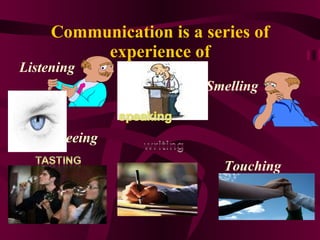
Communication is a series of experience of Seeing Touching Listening Smelling
Communication Skills Communication skills is the ability to use language (receptive) and express (expressive) information.  Effective communication skills are a critical element in your career and personal lives.
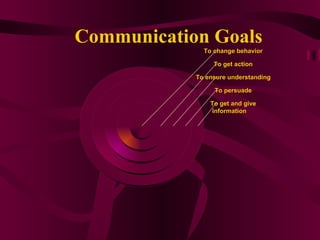
Communication Goals To get and give information To persuade To ensure understanding To get action To change behavior
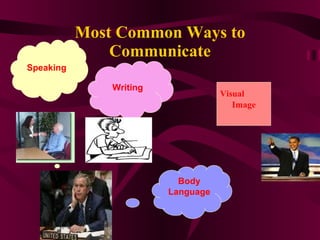
Most Common Ways to Communicate Visual   Image Speaking Writing Body   Language
Types of Communication  On the basis of organization relationship Formal  (persuasive communication) Informal On the basis of Flow Vertical Crosswise/Diagonal Horizontal On the basis of Expression Oral Written Gesture
Barriers to Communication Semantic Barriers(Language) Syntax barrier(Grammatical)(sub-verb agreement, Tense) Emotional Or Psychological Barriers  Organizational Barriers Barriers in Superiors (Attitudinal)
Semantic Barriers Symbols with different meaning Badly expressed message Faulty translation Unclarified assumption Specialist’s language
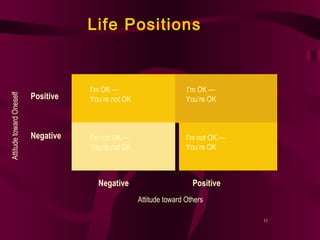
Life Positions I’m OK —   I’m OK — You’re not OK You’re OK I’m not OK — I’m not OK — You’re not OK You’re OK Attitude toward Oneself Attitude toward Others Negative Positive Positive Negative
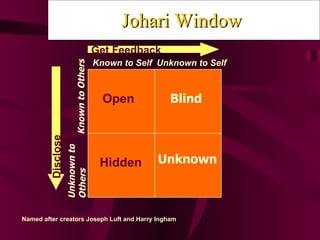
Johari Window  Open Blind Hidden Unknown Unknown to Others Known to Others Named after creators Joseph Luft and Harry Ingham Get   Feedback Disclose Known to Self Unknown to Self
Emotional Or Psychological Barriers Premature mindset[i am not ok,you are not ok] Inattention Loss of transmission & poor retention Undue reliance on the written word Distrust of communication Failure to communicate Over confidence[I am ok,you are not ok]
Organization Barriers Organizational policy Organization rules & regulation Status relation[Power and position] Complexity in organization[Organisational structure]
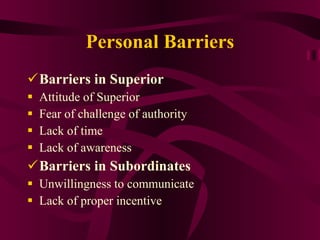
Personal Barriers Barriers in Superior Attitude of Superior Fear of challenge of authority Lack of time  Lack of awareness  Barriers in Subordinates Unwillingness to communicate Lack of proper incentive
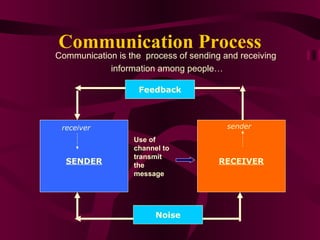
Communication Process SENDER RECEIVER Feedback receiver sender Communication is the  process of sending and receiving  information among people… Noise Use of  channel to  transmit the message
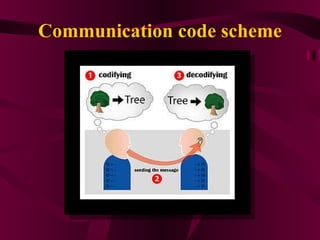
Communication code scheme
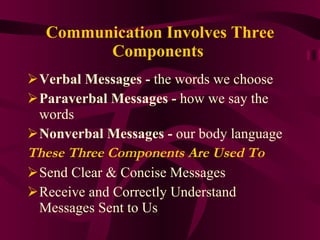
Communication Involves Three Components   Verbal Messages -  the words we choose Paraverbal Messages -  how we say the words Nonverbal Messages -  our body language These Three Components Are Used To   Send Clear & Concise Messages Receive and Correctly Understand Messages Sent to Us
Effective Verbal Messages   Are brief and organized. Are free of jargon. Do not create resistance in the listener.  SENDING MESSAGES
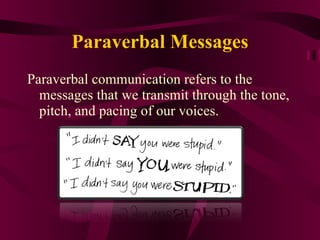
Paraverbal Messages Paraverbal communication refers to the messages that we transmit through the tone, pitch, and pacing of our voices.
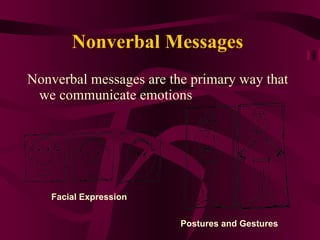
Nonverbal Messages   Nonverbal messages are the primary way that we communicate emotions  Facial Expression Postures and Gestures
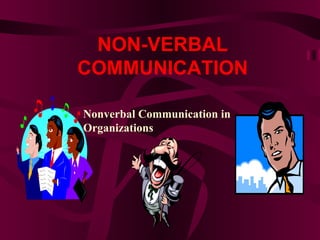
NON-VERBAL COMMUNICATION Nonverbal Communication in Organizations
 
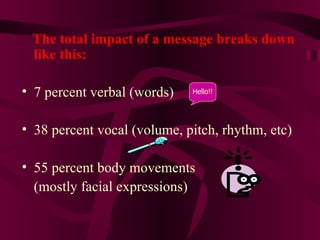
The total impact of a message breaks down like this:   7 percent verbal (words)  38 percent vocal (volume, pitch, rhythm, etc)  55 percent body movements  (mostly facial expressions) Hello!!
Effective communication is the combined harmony of verbal and nonverbal actions. Nonverbal communication consists of body movement, facial expressions and eye movement.
Major areas of nonverbal behaviors are:  Eye contact  Facial expressions   Gestures
EYE CONTACT
E YE  C ONTACT The eyes can give clues to a person’s thoughts. When someone is excited, his pupils dilate to four times the normal size. An angry or negative mood causes the pupils to contract .
E YE  C ONTACT Good eye contact helps the audience develop the interest in the speaker. Eye-contact helps regulate the flow of communication and reflects interest in others.
E YE  C ONTACT Direct eye-contact  conveys interest, warmth, credibility and concern. Shifty eyes  suggest dishonesty. Downward gaze  may be a sign of submissiveness or inferiority .
FACIAL EXPRESSIONS
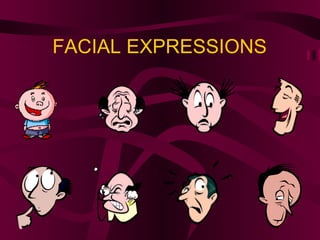
F ACIAL  E XPRESSIONS You have 80 muscles in the face that can create more than 7,000 facial expressions . The facial muscles produce the varying facial expressions that convey information about emotion, mood, and ideas. Emotional expressions are one primary result of activity by the facial muscles.
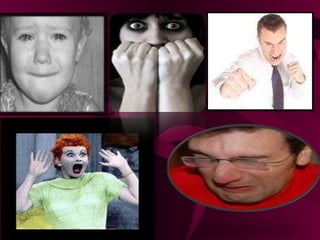
F ACIAL  E XPRESSIONS There are six categories of facial expressions: Happiness Sadness Anger Disgust Surprise Fear
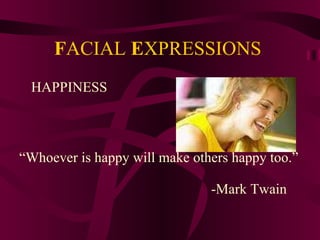
F ACIAL  E XPRESSIONS HAPPINESS  “ Whoever is happy will make others happy too.” -Mark Twain
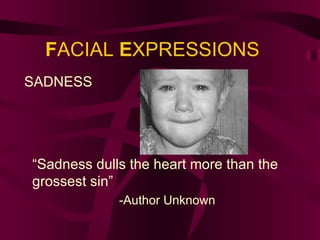
F ACIAL  E XPRESSIONS SADNESS “ Sadness dulls the heart more than the grossest sin”    -Author Unknown
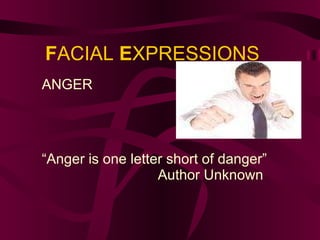
F ACIAL  E XPRESSIONS ANGER “ Anger is one letter short of danger” Author Unknown
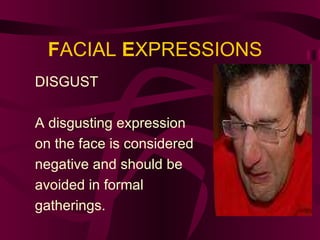
F ACIAL  E XPRESSIONS DISGUST A disgusting expression  on the face is considered negative and should be  avoided in formal  gatherings.
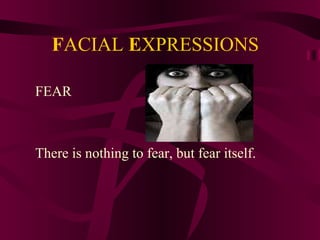
F ACIAL  E XPRESSIONS FEAR There is nothing to fear, but fear itself.
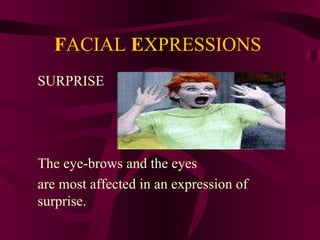
F ACIAL  E XPRESSIONS SURPRISE The eye-brows and the eyes are most affected in an expression of surprise.
 
RECEIVING MESSAGES Listening Requires concentration and energy Involves a psychological connection with the speaker Includes a desire and willingness to try and see things from another's perspective Requires that we suspend judgment and evaluation
Nonverbal Giving full physical attention to the speaker; Being aware of the speaker's nonverbal messages; Verbal Paying attention to the words and feelings that are being expressed  Key Listening Skills
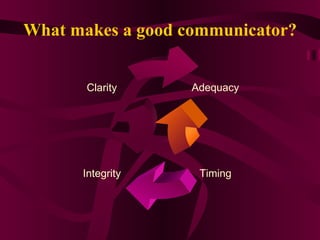
What makes a good communicator? Clarity Integrity Timing Adequacy
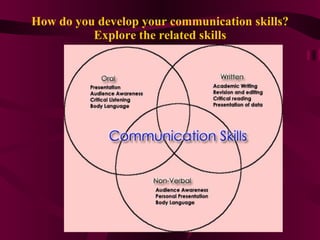
How do you develop your communication skills? Explore the related skills
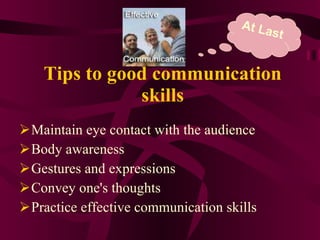
Tips to good communication skills Maintain eye contact with the audience  Body awareness  Gestures and expressions  Convey one's thoughts  Practice effective communication   skills  At Last
Effective Communication . . . It is two way. It involves active listening. It reflects the accountability of speaker and listener. It utilizes feedback. It is free of stress. It is clear.
Winners never quit,  Quitters  never  win .
Questions
Thanks
Mr. Rajib Kumar jena Rajib kumar Campus : Shiksha Vihar, Baranga-Khurda Rd., Chandka, Bhubaneswar: 754 005 Phone: +91 674 2111204, 07, 08  Asian School of Business Management, Bhubaneswar e-mail :   [email_address] :  [email_address] Mobile :   +91  9438412802 Developed for Business Communication by …

Communication skills development

  • 1.
  • 2.
  • 3.
  • 4.
    Communication is aseries of experience of Seeing Touching Listening Smelling
  • 5.
    Communication Skills Communicationskills is the ability to use language (receptive) and express (expressive) information. Effective communication skills are a critical element in your career and personal lives.
  • 6.
    Communication Goals Toget and give information To persuade To ensure understanding To get action To change behavior
  • 7.
    Most Common Waysto Communicate Visual Image Speaking Writing Body Language
  • 8.
    Types of Communication On the basis of organization relationship Formal (persuasive communication) Informal On the basis of Flow Vertical Crosswise/Diagonal Horizontal On the basis of Expression Oral Written Gesture
  • 9.
    Barriers to CommunicationSemantic Barriers(Language) Syntax barrier(Grammatical)(sub-verb agreement, Tense) Emotional Or Psychological Barriers Organizational Barriers Barriers in Superiors (Attitudinal)
  • 10.
    Semantic Barriers Symbolswith different meaning Badly expressed message Faulty translation Unclarified assumption Specialist’s language
  • 11.
    Life Positions I’mOK — I’m OK — You’re not OK You’re OK I’m not OK — I’m not OK — You’re not OK You’re OK Attitude toward Oneself Attitude toward Others Negative Positive Positive Negative
  • 12.
    Johari Window Open Blind Hidden Unknown Unknown to Others Known to Others Named after creators Joseph Luft and Harry Ingham Get Feedback Disclose Known to Self Unknown to Self
  • 13.
    Emotional Or PsychologicalBarriers Premature mindset[i am not ok,you are not ok] Inattention Loss of transmission & poor retention Undue reliance on the written word Distrust of communication Failure to communicate Over confidence[I am ok,you are not ok]
  • 14.
    Organization Barriers Organizationalpolicy Organization rules & regulation Status relation[Power and position] Complexity in organization[Organisational structure]
  • 15.
    Personal Barriers Barriersin Superior Attitude of Superior Fear of challenge of authority Lack of time Lack of awareness Barriers in Subordinates Unwillingness to communicate Lack of proper incentive
  • 16.
    Communication Process SENDERRECEIVER Feedback receiver sender Communication is the process of sending and receiving information among people… Noise Use of channel to transmit the message
  • 17.
  • 18.
    Communication Involves ThreeComponents Verbal Messages - the words we choose Paraverbal Messages - how we say the words Nonverbal Messages - our body language These Three Components Are Used To Send Clear & Concise Messages Receive and Correctly Understand Messages Sent to Us
  • 19.
    Effective Verbal Messages Are brief and organized. Are free of jargon. Do not create resistance in the listener. SENDING MESSAGES
  • 20.
    Paraverbal Messages Paraverbalcommunication refers to the messages that we transmit through the tone, pitch, and pacing of our voices.
  • 21.
    Nonverbal Messages Nonverbal messages are the primary way that we communicate emotions Facial Expression Postures and Gestures
  • 22.
    NON-VERBAL COMMUNICATION NonverbalCommunication in Organizations
  • 23.
  • 24.
    The total impactof a message breaks down like this: 7 percent verbal (words) 38 percent vocal (volume, pitch, rhythm, etc) 55 percent body movements (mostly facial expressions) Hello!!
  • 25.
    Effective communication isthe combined harmony of verbal and nonverbal actions. Nonverbal communication consists of body movement, facial expressions and eye movement.
  • 26.
    Major areas ofnonverbal behaviors are: Eye contact Facial expressions Gestures
  • 27.
  • 28.
    E YE C ONTACT The eyes can give clues to a person’s thoughts. When someone is excited, his pupils dilate to four times the normal size. An angry or negative mood causes the pupils to contract .
  • 29.
    E YE C ONTACT Good eye contact helps the audience develop the interest in the speaker. Eye-contact helps regulate the flow of communication and reflects interest in others.
  • 30.
    E YE C ONTACT Direct eye-contact conveys interest, warmth, credibility and concern. Shifty eyes suggest dishonesty. Downward gaze may be a sign of submissiveness or inferiority .
  • 31.
  • 32.
    F ACIAL E XPRESSIONS You have 80 muscles in the face that can create more than 7,000 facial expressions . The facial muscles produce the varying facial expressions that convey information about emotion, mood, and ideas. Emotional expressions are one primary result of activity by the facial muscles.
  • 33.
    F ACIAL E XPRESSIONS There are six categories of facial expressions: Happiness Sadness Anger Disgust Surprise Fear
  • 34.
    F ACIAL E XPRESSIONS HAPPINESS “ Whoever is happy will make others happy too.” -Mark Twain
  • 35.
    F ACIAL E XPRESSIONS SADNESS “ Sadness dulls the heart more than the grossest sin” -Author Unknown
  • 36.
    F ACIAL E XPRESSIONS ANGER “ Anger is one letter short of danger” Author Unknown
  • 37.
    F ACIAL E XPRESSIONS DISGUST A disgusting expression on the face is considered negative and should be avoided in formal gatherings.
  • 38.
    F ACIAL E XPRESSIONS FEAR There is nothing to fear, but fear itself.
  • 39.
    F ACIAL E XPRESSIONS SURPRISE The eye-brows and the eyes are most affected in an expression of surprise.
  • 40.
  • 41.
    RECEIVING MESSAGES ListeningRequires concentration and energy Involves a psychological connection with the speaker Includes a desire and willingness to try and see things from another's perspective Requires that we suspend judgment and evaluation
  • 42.
    Nonverbal Giving fullphysical attention to the speaker; Being aware of the speaker's nonverbal messages; Verbal Paying attention to the words and feelings that are being expressed Key Listening Skills
  • 43.
    What makes agood communicator? Clarity Integrity Timing Adequacy
  • 44.
    How do youdevelop your communication skills? Explore the related skills
  • 45.
    Tips to goodcommunication skills Maintain eye contact with the audience Body awareness Gestures and expressions Convey one's thoughts Practice effective communication skills At Last
  • 46.
    Effective Communication .. . It is two way. It involves active listening. It reflects the accountability of speaker and listener. It utilizes feedback. It is free of stress. It is clear.
  • 47.
    Winners never quit, Quitters never win .
  • 48.
  • 49.
  • 50.
    Mr. Rajib Kumarjena Rajib kumar Campus : Shiksha Vihar, Baranga-Khurda Rd., Chandka, Bhubaneswar: 754 005 Phone: +91 674 2111204, 07, 08 Asian School of Business Management, Bhubaneswar e-mail : [email_address] : [email_address] Mobile : +91 9438412802 Developed for Business Communication by …