COMMUNICATION
MEANING
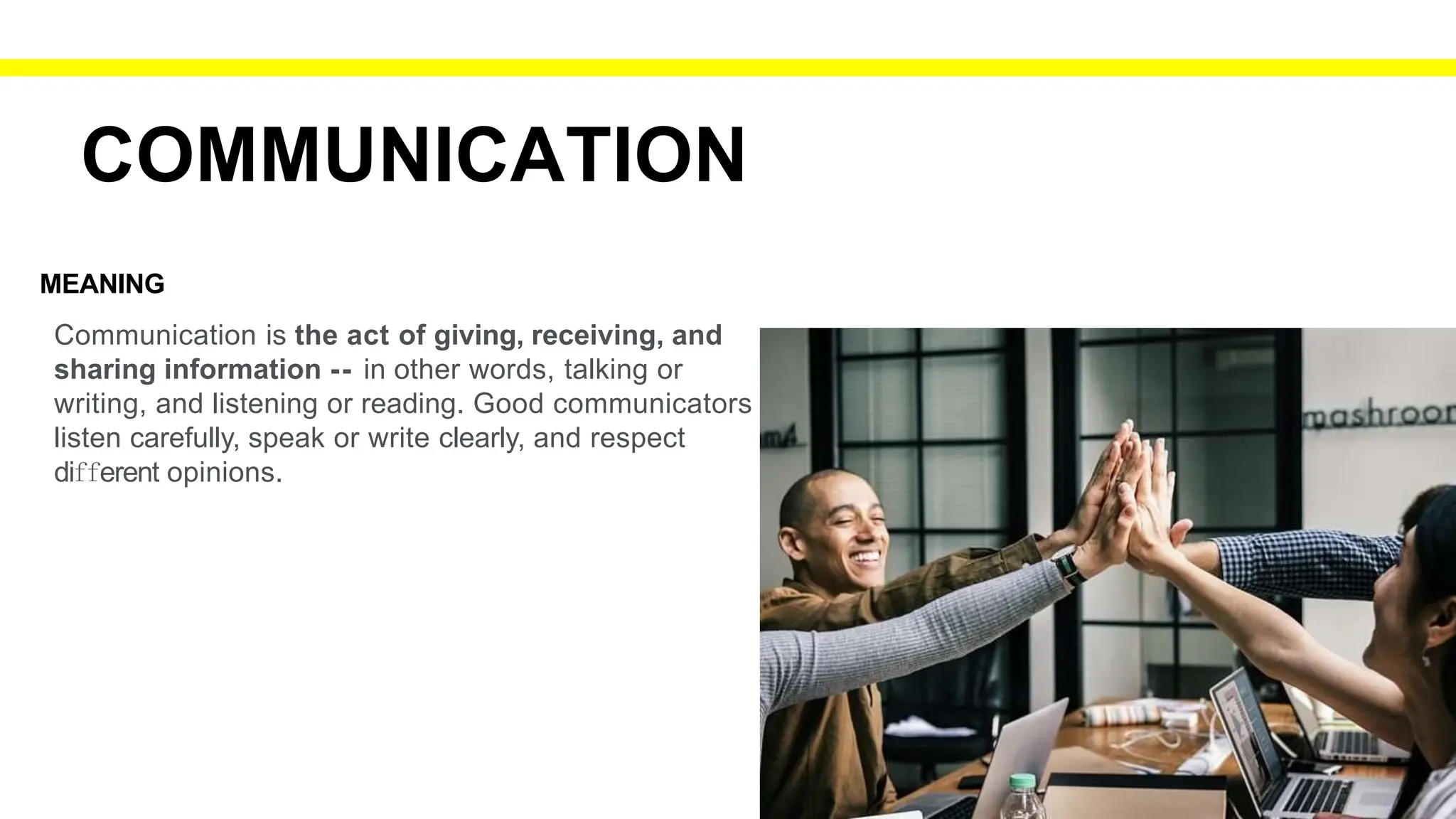
Communication is the act of giving, receiving, and
sharing information -- in other words, talking or
writing, and listening or reading. Good communicators
listen carefully, speak or write clearly, and respect
different opinions.
COMMUNICATION
FUNCTION OF
COMMUNICATION
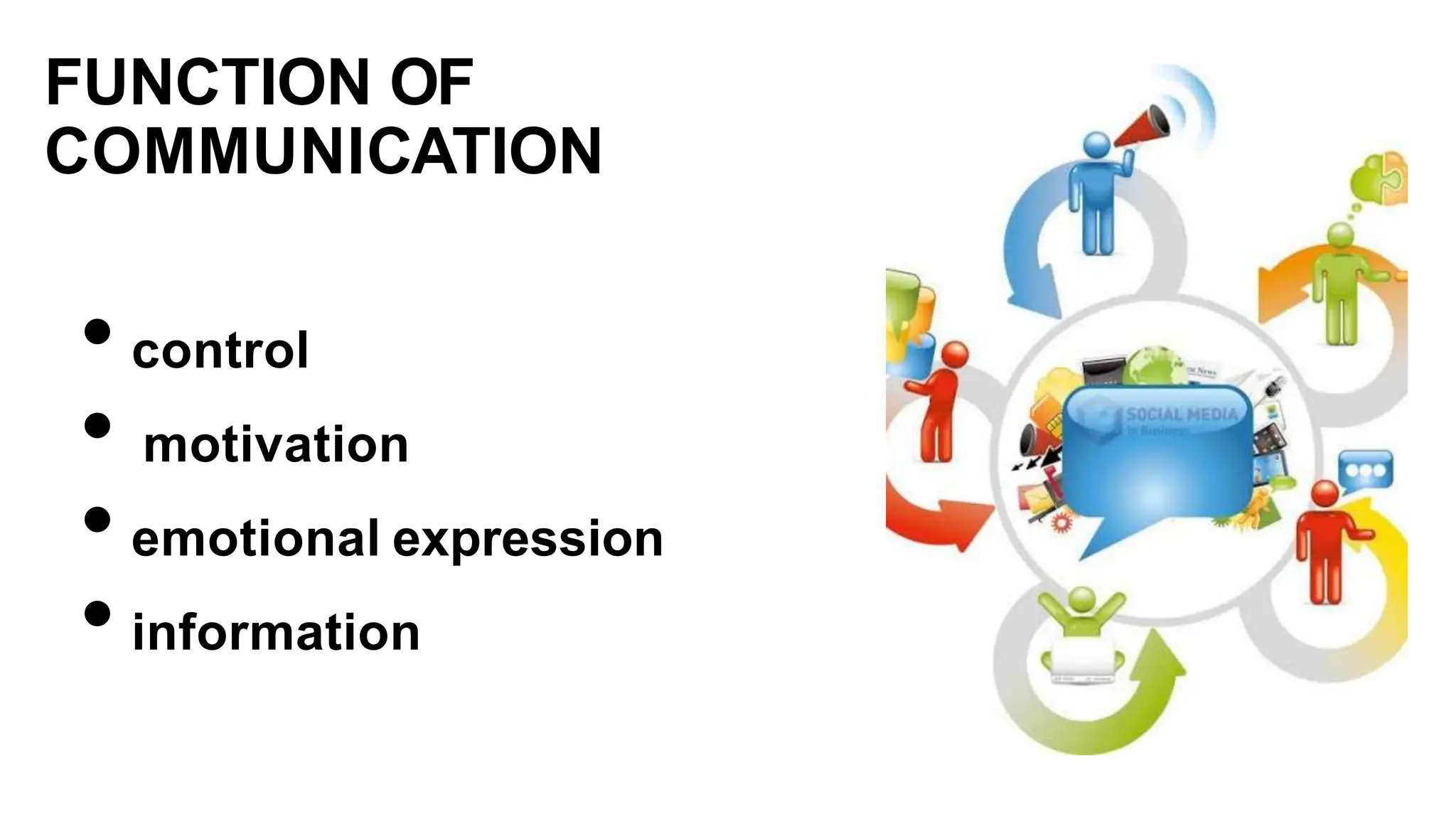
• control
• motivation
• emotional expression
• information
1.Control-Control as a function of communication means being able
to use language, gestures, and emotions to manage individual or
group activities.
2.Motivation-this is used to power up preferences, desires.
needs,wants, decisions, goals, and strengths.
3.Emotional expression-facilitates people’s expression of their
feelings and emotions.
4.information-This function is used for grabbing and sharing
information.
METHODSOF
COMMUNICATION
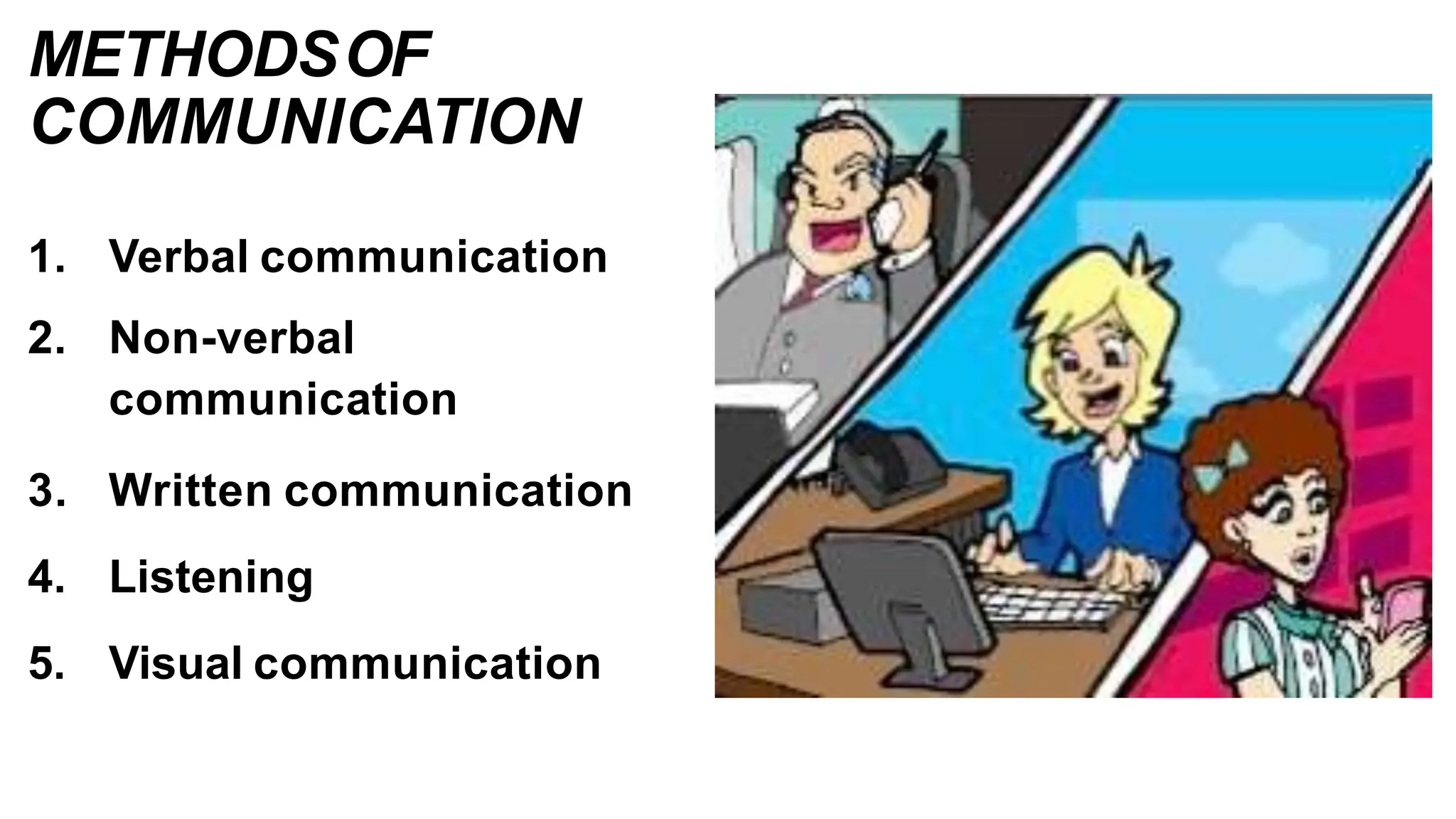
1. Verbal communication
2. Non-verbal
communication
3. Written communication
4. Listening
5. Visual communication
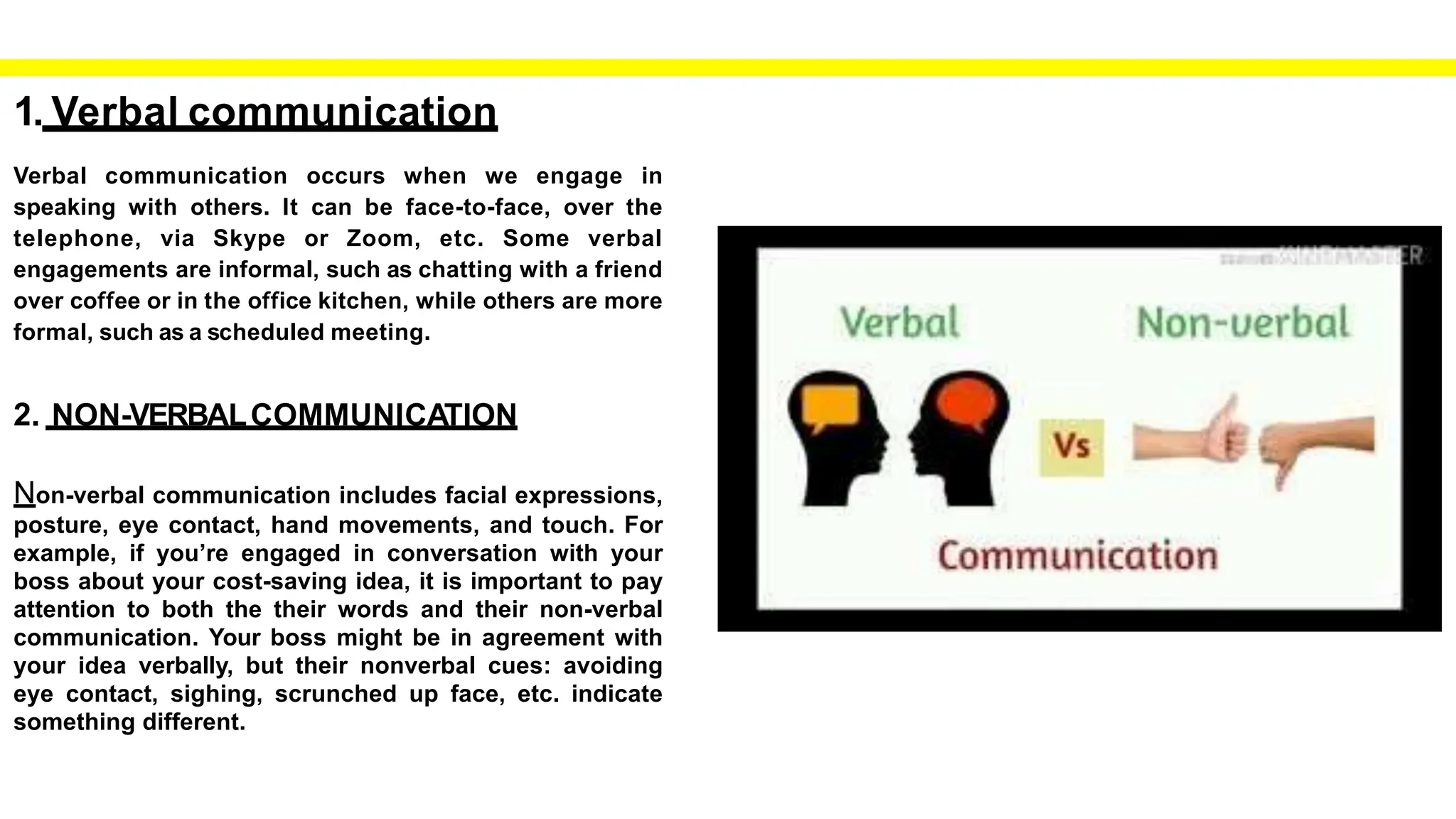
1. Verbal communication
Verbal communication occurs when we engage in
speaking with others. It can be face-to-face, over the
telephone, via Skype or Zoom, etc. Some verbal
engagements are informal, such as chatting with a friend
over coffee or in the office kitchen, while others are more
formal, such as a scheduled meeting.
2. NON-VERBALCOMMUNICATION
Non-verbal communication includes facial expressions,
posture, eye contact, hand movements, and touch. For
example, if you’re engaged in conversation with your
boss about your cost-saving idea, it is important to pay
attention to both the their words and their non-verbal
communication. Your boss might be in agreement with
your idea verbally, but their nonverbal cues: avoiding
eye contact, sighing, scrunched up face, etc. indicate
something different.
3. WRITTEN COMMUNICATION
WHETHERIT IS AN EMAIL,A MEMO, A REPORT,A FACEBOOKPOST,A TWEET,A CONTRACT,ETC.
ALL FORMS OF WRITTEN COMMUNICATION HAVE THE SAME GOAL TO DISSEMINATE
INFORMATIONIN A CLEARAND CONCISEMANNER
4. LISTENING
THE ACT OF LISTENING DOES NOT OFTEN MAKE ITS WAYONTO THE LIST OF TYPES OF
COMMUNICATION.ACTIVELISTENING,HOWEVER,IS PERHAPSONEOFTHEMOSTIMPORTANTTYPES
OFCOMMUNICATION BECAUSEIFWECANNOT LISTENTOTHEPERSONSITTINGACROSSFROMUS,WE
CANNOT EFFECTIVELYENGAGEWITH THEM.
5. VISUALCOMMUNICATION
We are a visual society. Think about it, televisions are running 24/7, Facebook is visual with
memes, videos, images, etc., Instagram is an image-only platform, and advertisers use imagery to
sell products and ideas. Think about from a personal perspective – the images we post on social
media are meant to convey meaning – to communicate a message. In some cases that message
might be, look at me, I’m in Italy or I just won an award.
BARRIERSIN EFFECTIVECOMMUNICATION
1.Language or semantic barrier
2. Organisational barrier
3. Psychological or emotional barrier
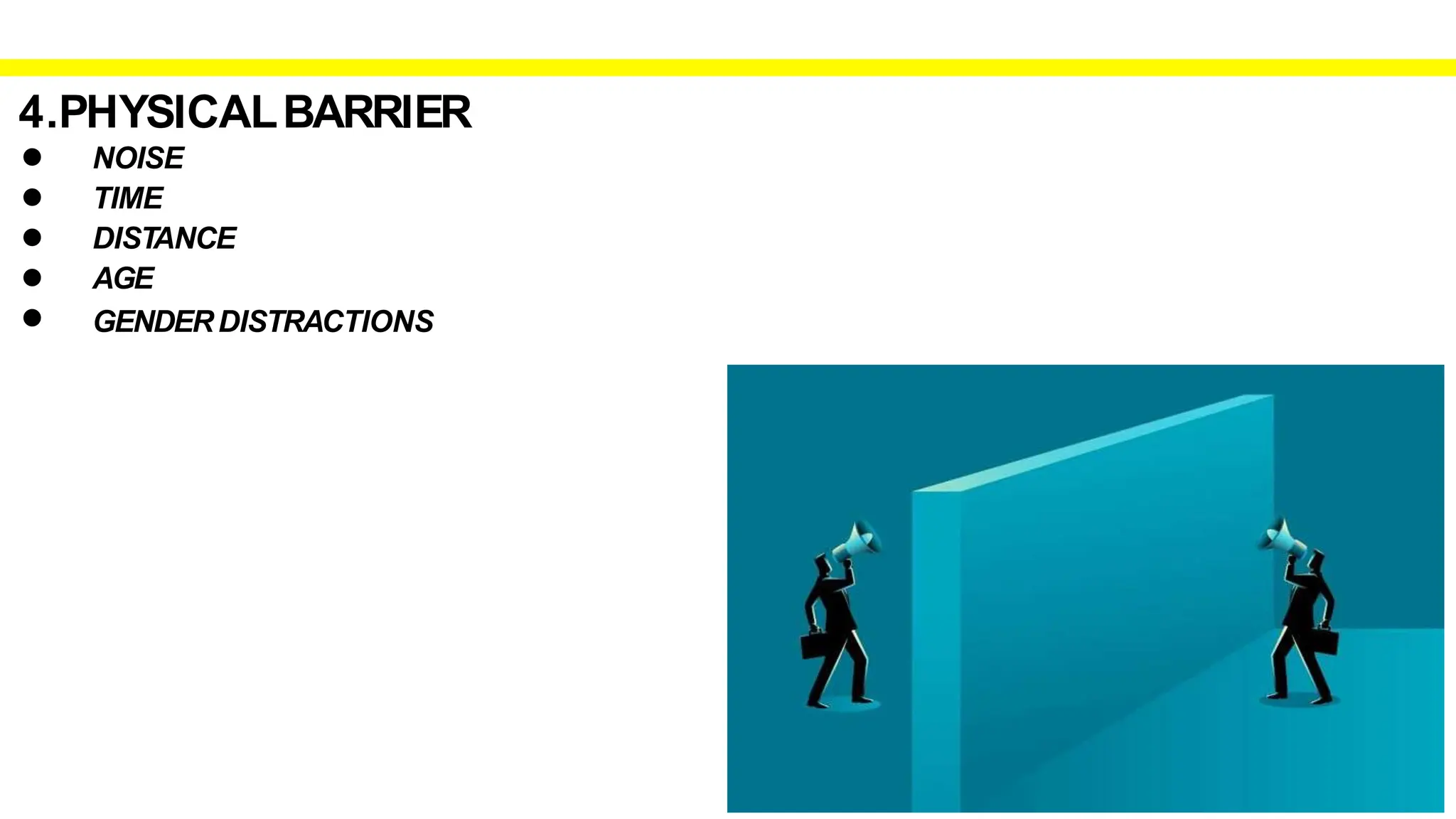
4.physical barriers
1.LANGUAGEORSEMANTIC BARRIER
• LACKOFCOMMON LANGUAGE
DIFFERENTCONTEXTFORWORDSAND SYMBOLS
•
• POOR VOCABULARY
2. ORGANISATIONAL BARRIER
• ORGANISATIONALPOLICIES
RULESAND REGULATIONS
STATUS
COMPLEXITYIN ORGANISATIONALSTRUCTURE
•
•
•
• ORGANISATIONALFACILITIES
3. PSYCHOLOGICALOR EMOTIONAL BARRIER
•
•
•
•
•
LACK OFATTENTION
POOR RETENTION
EMOTIONS
STATUSCONSCIOUSNESS
DISTRUSTAND DEFENSIVENESS
4.PHYSICALBARRIER
•
•
•
•
•
NOISE
TIME
DISTANCE
AGE
GENDERDISTRACTIONS
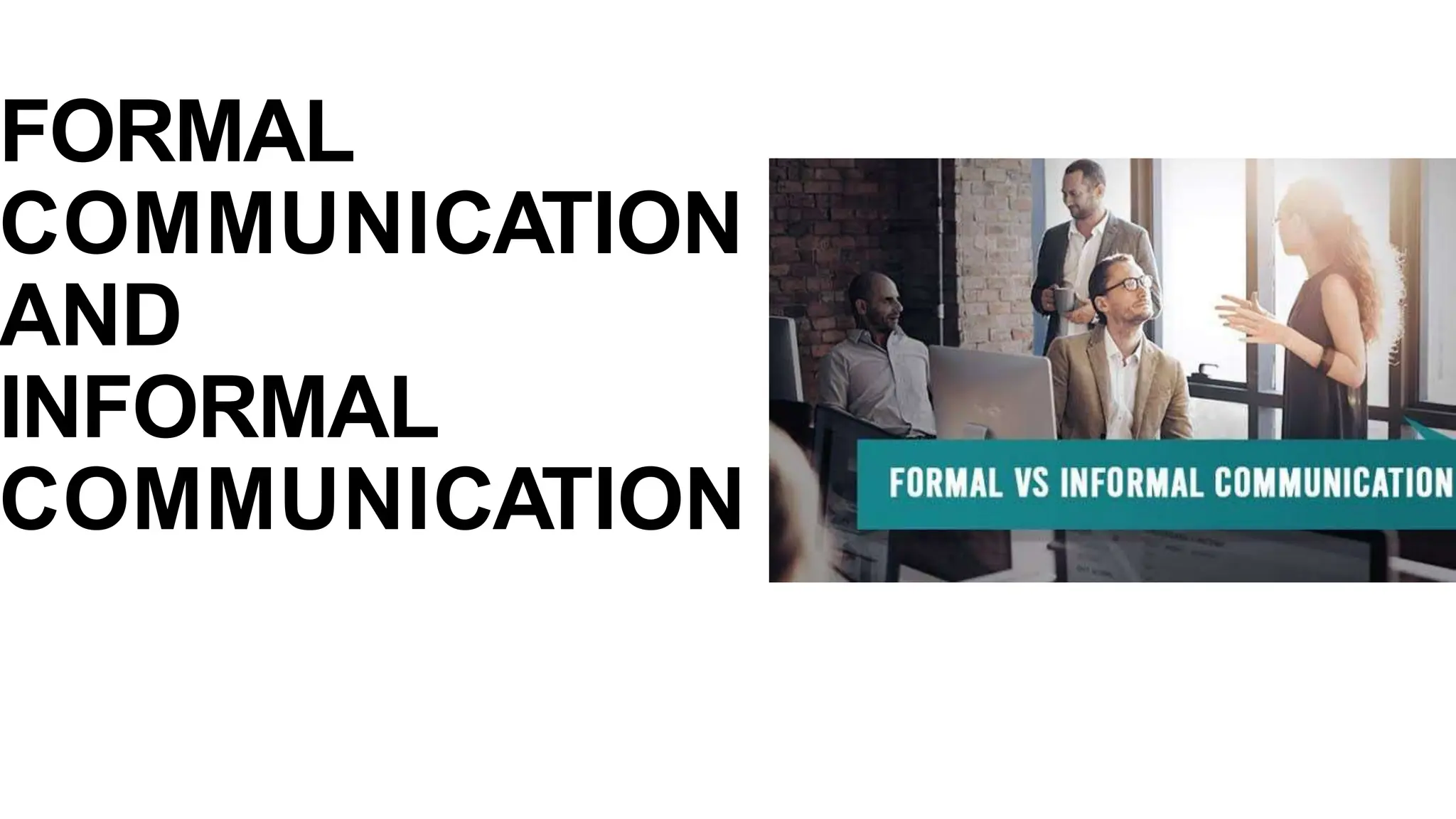
FORMAL
COMMUNICATION
AND
INFORMAL
COMMUNICATION
FORMALANDINFORMAL
COMMUNICATION
Formal communication is, typically, conveyed from the top leadership to various
departments and employees. Usually, every organization follows a procedure for formal
conversation. Think about the annual meetings or even team meetings that your
manager calls for. These are examples of formal communication.
However, there is no predetermined structure for informal communication in any
organization. So what is informal communication all about? To start with, it helps create
and maintain a relationship among colleagues. For instance, consider those chats with
your coworkers about the latest movies over a cup of coffee.
Informal communication can also play a much larger role than just generating friendly
chatter. This form of communication can be very useful in resolving a conflict between
the employees and the management.
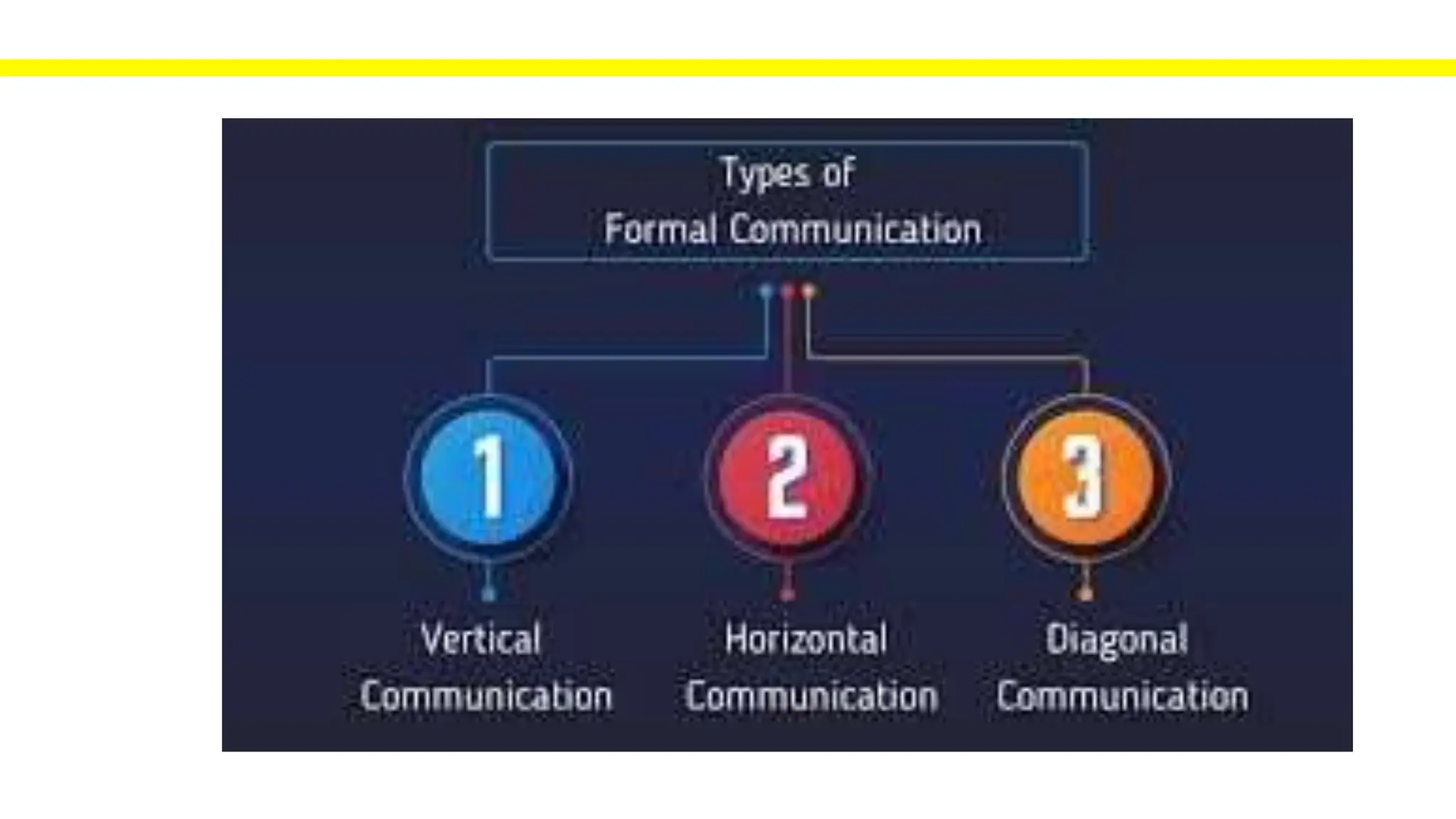
TYPESOFFORMALCOMMUNICATION:
1. VERTICAL
Here, the communication is held between different organizational levels. So the
message is either transferred from the juniors to the team leads to the manager or
vice-versa.
2. HORIZONTAL OR LATERAL
This is the communication that happens between peers from different departments.
3. CROSSWISEOR DIAGONAL
As the name suggests, here the conversation takes place between two employees
working at different levels in different departments. For example, a website
developer discussing a project with a sales manager can be categorized as
crosswise or diagonal communication.
TYPESOFINFORMALCOMMUNICATION:
1. SINGLE STRAND CHAIN
This is the type of communication where A shares an idea or information with B, who then
passes it to C, and so on.
2. CLUSTER CHAIN
Have you ever noticed how a social media challenge becomes viral? People start something
unique and tag, say, three friends for the challenge. They complete the challenge and tag
three more people each, and so on. That’s how a cluster chain communication is formed
and continues.
3. GOSSIP CHAIN
Think of the college canteen conversations, where one person vividly describes her recent
adventures to a group of friends gathered around the table to listen. That’s how the gossip
chain works. One person initiates the conversation and shares information with a group of
people, who then pass on the information to more people.

Communication in principles of management

  • 1.
  • 2.
    MEANING Communication is theact of giving, receiving, and sharing information -- in other words, talking or writing, and listening or reading. Good communicators listen carefully, speak or write clearly, and respect different opinions. COMMUNICATION
  • 3.
    FUNCTION OF COMMUNICATION • control •motivation • emotional expression • information
  • 4.
    1.Control-Control as afunction of communication means being able to use language, gestures, and emotions to manage individual or group activities. 2.Motivation-this is used to power up preferences, desires. needs,wants, decisions, goals, and strengths. 3.Emotional expression-facilitates people’s expression of their feelings and emotions. 4.information-This function is used for grabbing and sharing information.
  • 5.
    METHODSOF COMMUNICATION 1. Verbal communication 2.Non-verbal communication 3. Written communication 4. Listening 5. Visual communication
  • 6.
    1. Verbal communication Verbalcommunication occurs when we engage in speaking with others. It can be face-to-face, over the telephone, via Skype or Zoom, etc. Some verbal engagements are informal, such as chatting with a friend over coffee or in the office kitchen, while others are more formal, such as a scheduled meeting. 2. NON-VERBALCOMMUNICATION Non-verbal communication includes facial expressions, posture, eye contact, hand movements, and touch. For example, if you’re engaged in conversation with your boss about your cost-saving idea, it is important to pay attention to both the their words and their non-verbal communication. Your boss might be in agreement with your idea verbally, but their nonverbal cues: avoiding eye contact, sighing, scrunched up face, etc. indicate something different.
  • 7.
    3. WRITTEN COMMUNICATION WHETHERITIS AN EMAIL,A MEMO, A REPORT,A FACEBOOKPOST,A TWEET,A CONTRACT,ETC. ALL FORMS OF WRITTEN COMMUNICATION HAVE THE SAME GOAL TO DISSEMINATE INFORMATIONIN A CLEARAND CONCISEMANNER 4. LISTENING THE ACT OF LISTENING DOES NOT OFTEN MAKE ITS WAYONTO THE LIST OF TYPES OF COMMUNICATION.ACTIVELISTENING,HOWEVER,IS PERHAPSONEOFTHEMOSTIMPORTANTTYPES OFCOMMUNICATION BECAUSEIFWECANNOT LISTENTOTHEPERSONSITTINGACROSSFROMUS,WE CANNOT EFFECTIVELYENGAGEWITH THEM. 5. VISUALCOMMUNICATION We are a visual society. Think about it, televisions are running 24/7, Facebook is visual with memes, videos, images, etc., Instagram is an image-only platform, and advertisers use imagery to sell products and ideas. Think about from a personal perspective – the images we post on social media are meant to convey meaning – to communicate a message. In some cases that message might be, look at me, I’m in Italy or I just won an award.
  • 8.
    BARRIERSIN EFFECTIVECOMMUNICATION 1.Language orsemantic barrier 2. Organisational barrier 3. Psychological or emotional barrier 4.physical barriers
  • 9.
    1.LANGUAGEORSEMANTIC BARRIER • LACKOFCOMMONLANGUAGE DIFFERENTCONTEXTFORWORDSAND SYMBOLS • • POOR VOCABULARY 2. ORGANISATIONAL BARRIER • ORGANISATIONALPOLICIES RULESAND REGULATIONS STATUS COMPLEXITYIN ORGANISATIONALSTRUCTURE • • • • ORGANISATIONALFACILITIES 3. PSYCHOLOGICALOR EMOTIONAL BARRIER • • • • • LACK OFATTENTION POOR RETENTION EMOTIONS STATUSCONSCIOUSNESS DISTRUSTAND DEFENSIVENESS
  • 10.
  • 11.
  • 12.
    FORMALANDINFORMAL COMMUNICATION Formal communication is,typically, conveyed from the top leadership to various departments and employees. Usually, every organization follows a procedure for formal conversation. Think about the annual meetings or even team meetings that your manager calls for. These are examples of formal communication. However, there is no predetermined structure for informal communication in any organization. So what is informal communication all about? To start with, it helps create and maintain a relationship among colleagues. For instance, consider those chats with your coworkers about the latest movies over a cup of coffee. Informal communication can also play a much larger role than just generating friendly chatter. This form of communication can be very useful in resolving a conflict between the employees and the management.
  • 14.
    TYPESOFFORMALCOMMUNICATION: 1. VERTICAL Here, thecommunication is held between different organizational levels. So the message is either transferred from the juniors to the team leads to the manager or vice-versa. 2. HORIZONTAL OR LATERAL This is the communication that happens between peers from different departments. 3. CROSSWISEOR DIAGONAL As the name suggests, here the conversation takes place between two employees working at different levels in different departments. For example, a website developer discussing a project with a sales manager can be categorized as crosswise or diagonal communication.
  • 15.
    TYPESOFINFORMALCOMMUNICATION: 1. SINGLE STRANDCHAIN This is the type of communication where A shares an idea or information with B, who then passes it to C, and so on. 2. CLUSTER CHAIN Have you ever noticed how a social media challenge becomes viral? People start something unique and tag, say, three friends for the challenge. They complete the challenge and tag three more people each, and so on. That’s how a cluster chain communication is formed and continues. 3. GOSSIP CHAIN Think of the college canteen conversations, where one person vividly describes her recent adventures to a group of friends gathered around the table to listen. That’s how the gossip chain works. One person initiates the conversation and shares information with a group of people, who then pass on the information to more people.