EMPLOYEE ENGAGEMENT ADITYA MULEY RANYA KALIAH ROHAN MOHITE ASHI MISHRA K.A. NARAYANAN
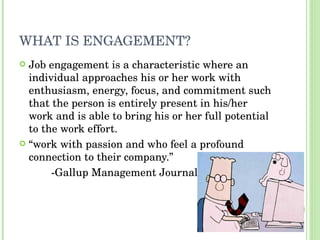
WHAT IS ENGAGEMENT? Job engagement is a characteristic where an individual approaches his or her work with enthusiasm, energy, focus, and commitment such that the person is entirely present in his/her work and is able to bring his or her full potential to the work effort. “ work with passion and who feel a profound connection to their company.”  -Gallup Management Journal
JOB ENGAGEMENT / JOB SATISFACTION Being  satisfied  with your job doesn’t mean that you’re  engaged  with it (you can be happy at work but do a poor job of it!) If you’re  engaged  with your work you will not only be more  satisfied  with it, but you will also be more productive, create higher quality results, and demonstrate better customer service
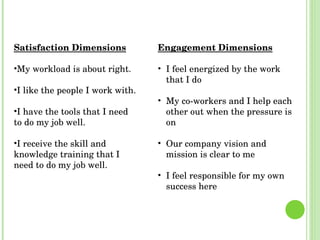
Engagement Dimensions I feel energized by the work that I do My co-workers and I help each other out when the pressure is on Our company vision and mission is clear to me I feel responsible for my own success here Satisfaction Dimensions My workload is about right. I like the people I work with. I have the tools that I need to do my job well. I receive the skill and knowledge training that I need to do my job well.
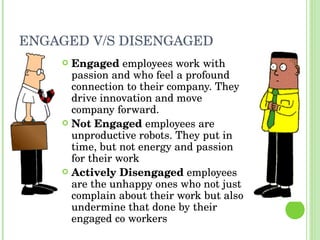
ENGAGED V/S DISENGAGED Engaged  employees work with passion and who feel a profound connection to their company. They drive innovation and move company forward. Not Engaged  employees are unproductive robots. They put in time, but not energy and passion for their work Actively Disengaged  employees are the unhappy ones who not just complain about their work but also undermine that done by their engaged co workers
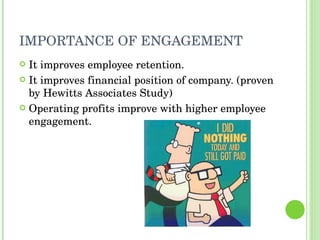
IMPORTANCE OF ENGAGEMENT It improves employee retention. It improves financial position of company. (proven by Hewitts Associates Study) Operating profits improve with higher employee engagement.
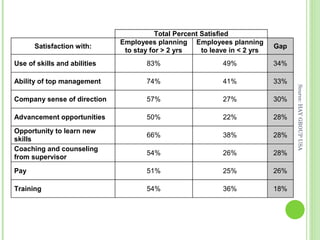
Source: HAY GROUP USA
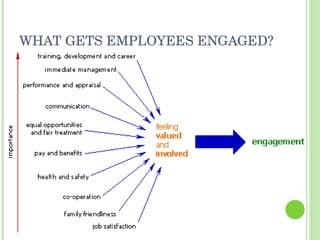
WHAT GETS EMPLOYEES ENGAGED?
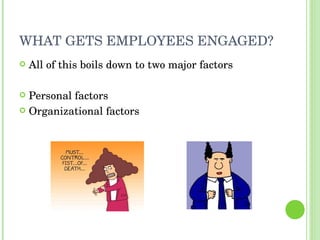
WHAT GETS EMPLOYEES ENGAGED? All of this boils down to two major factors Personal factors Organizational factors
HOW TO GET EMPLOYEES ENGAGED? Leadership concern Talent management system Freedom to contribute to their own job and progress Periodic performance reviews Active participation in decision making High levels of team work Least biased and discriminated work environment Proper exchange of information
Engagement Step One:   Get input from your people.  Engagement Step Two:   Address the cause – don't blame. Engagement Step Three:   Don't get hung up on survey benchmarks. Engagement Step Four:   Be honest about the findings with employees.  Engagement Step Five:   Implement interventions. Engagement Step Six: Involve senior leadership in the research and intervention process. Engagement Step Seven:   After interventions have been implemented, conduct follow-up research to gauge progress. www.jrsconsulting.net/freearticles_31.html
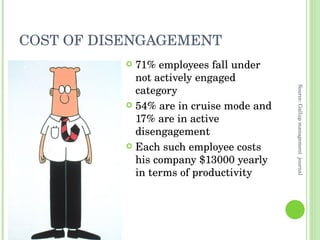
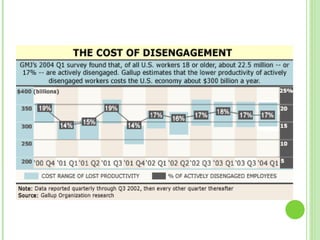
COST OF DISENGAGEMENT 71% employees fall under not actively engaged category 54% are in cruise mode and 17% are in active disengagement Each such employee costs his company $13000 yearly in terms of productivity Source: Gallup management  journal
 
THANK YOU ALL   SPECIALLY DILBERT WHO SHOWED US WHAT TO DO IF OUR PRESENTATION FAILS…

Employee Engagement

  • 1.
    EMPLOYEE ENGAGEMENT ADITYAMULEY RANYA KALIAH ROHAN MOHITE ASHI MISHRA K.A. NARAYANAN
  • 2.
    WHAT IS ENGAGEMENT?Job engagement is a characteristic where an individual approaches his or her work with enthusiasm, energy, focus, and commitment such that the person is entirely present in his/her work and is able to bring his or her full potential to the work effort. “ work with passion and who feel a profound connection to their company.” -Gallup Management Journal
  • 3.
    JOB ENGAGEMENT /JOB SATISFACTION Being satisfied with your job doesn’t mean that you’re engaged with it (you can be happy at work but do a poor job of it!) If you’re engaged with your work you will not only be more satisfied with it, but you will also be more productive, create higher quality results, and demonstrate better customer service
  • 4.
    Engagement Dimensions Ifeel energized by the work that I do My co-workers and I help each other out when the pressure is on Our company vision and mission is clear to me I feel responsible for my own success here Satisfaction Dimensions My workload is about right. I like the people I work with. I have the tools that I need to do my job well. I receive the skill and knowledge training that I need to do my job well.
  • 5.
    ENGAGED V/S DISENGAGEDEngaged employees work with passion and who feel a profound connection to their company. They drive innovation and move company forward. Not Engaged employees are unproductive robots. They put in time, but not energy and passion for their work Actively Disengaged employees are the unhappy ones who not just complain about their work but also undermine that done by their engaged co workers
  • 6.
    IMPORTANCE OF ENGAGEMENTIt improves employee retention. It improves financial position of company. (proven by Hewitts Associates Study) Operating profits improve with higher employee engagement.
  • 7.
  • 8.
  • 9.
    WHAT GETS EMPLOYEESENGAGED? All of this boils down to two major factors Personal factors Organizational factors
  • 10.
    HOW TO GETEMPLOYEES ENGAGED? Leadership concern Talent management system Freedom to contribute to their own job and progress Periodic performance reviews Active participation in decision making High levels of team work Least biased and discriminated work environment Proper exchange of information
  • 11.
    Engagement Step One:  Get input from your people. Engagement Step Two:   Address the cause – don't blame. Engagement Step Three:   Don't get hung up on survey benchmarks. Engagement Step Four:   Be honest about the findings with employees.  Engagement Step Five:   Implement interventions. Engagement Step Six: Involve senior leadership in the research and intervention process. Engagement Step Seven:   After interventions have been implemented, conduct follow-up research to gauge progress. www.jrsconsulting.net/freearticles_31.html
  • 12.
    COST OF DISENGAGEMENT71% employees fall under not actively engaged category 54% are in cruise mode and 17% are in active disengagement Each such employee costs his company $13000 yearly in terms of productivity Source: Gallup management journal
  • 13.
  • 14.
    THANK YOU ALL SPECIALLY DILBERT WHO SHOWED US WHAT TO DO IF OUR PRESENTATION FAILS…

Editor's Notes

  • #4 Satisfaction is comfort and content. Engagement is Deeply connected with their work, Work environment,Team/colleagues,Sense of Ownership, Commitment