Communicable Diseases in
  humanitarian settings


                           1
“communicable” diseases
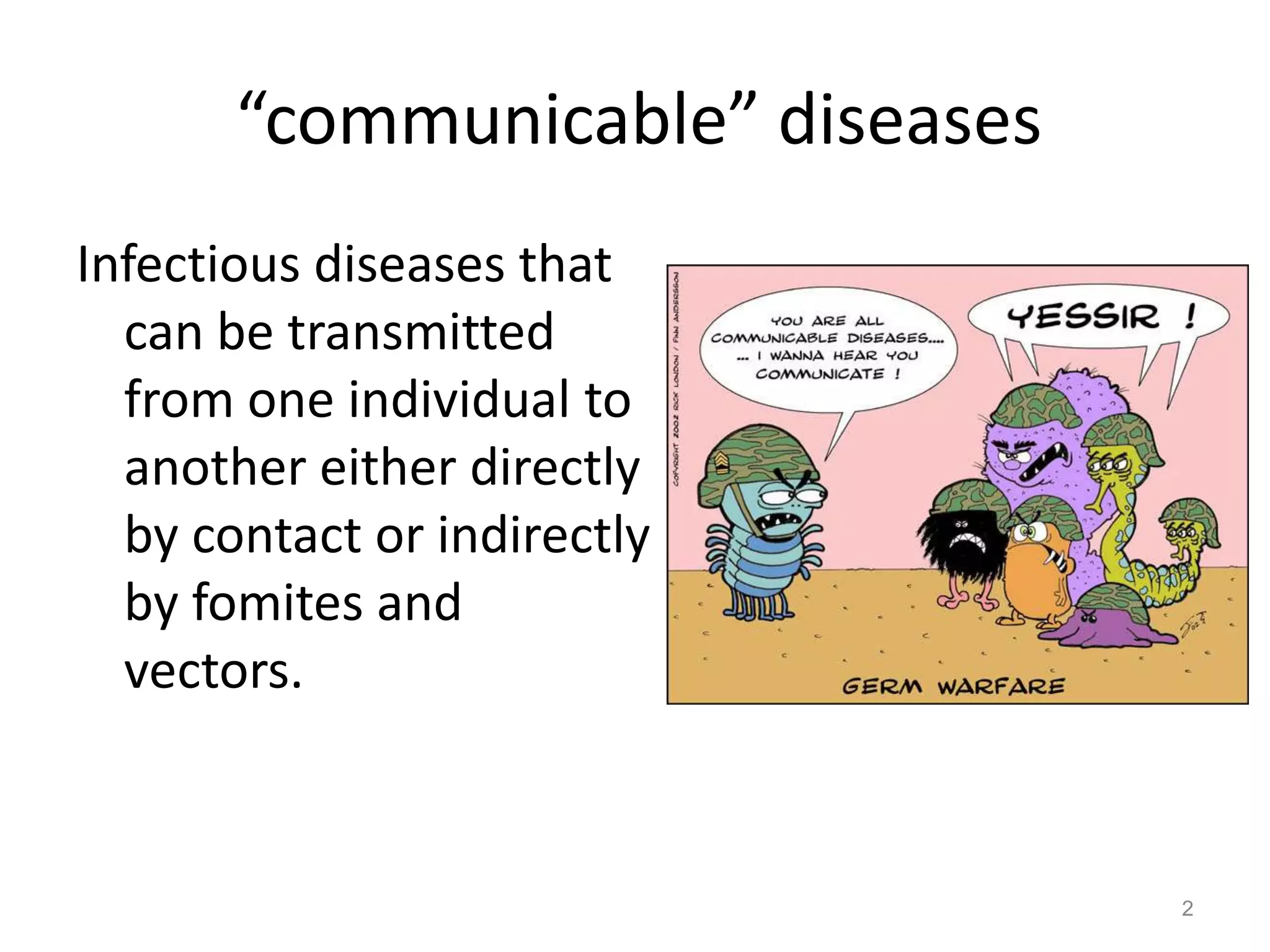
Infectious diseases that
  can be transmitted
  from one individual to
  another either directly
  by contact or indirectly
  by fomites and
  vectors.


                                 2
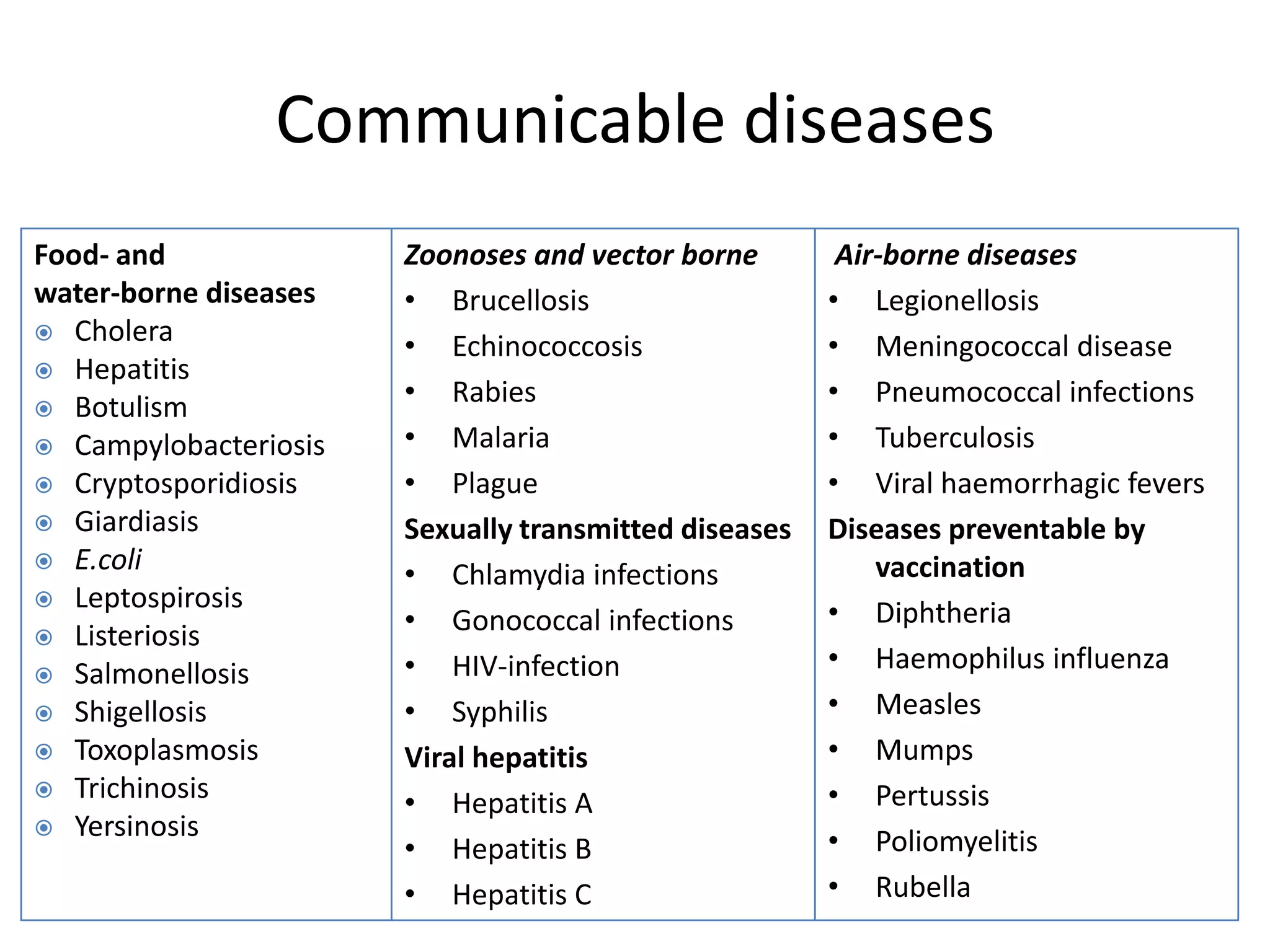
Communicable diseases
Food- and              Zoonoses and vector borne        Air-borne diseases
water-borne diseases   • Brucellosis                   • Legionellosis
 Cholera
                       • Echinococcosis                • Meningococcal disease
 Hepatitis
 Botulism
                       • Rabies                        • Pneumococcal infections
 Campylobacteriosis   • Malaria                       • Tuberculosis
 Cryptosporidiosis    • Plague                        • Viral haemorrhagic fevers
 Giardiasis           Sexually transmitted diseases   Diseases preventable by
 E.coli                                                   vaccination
                       • Chlamydia infections
 Leptospirosis
                       • Gonococcal infections         • Diphtheria
 Listeriosis
 Salmonellosis        • HIV-infection                 • Haemophilus influenza
 Shigellosis          • Syphilis                      • Measles
 Toxoplasmosis        Viral hepatitis                 • Mumps
 Trichinosis                                          • Pertussis
                       • Hepatitis A
 Yersinosis
                       • Hepatitis B                   • Poliomyelitis
                       • Hepatitis C                   • Rubella
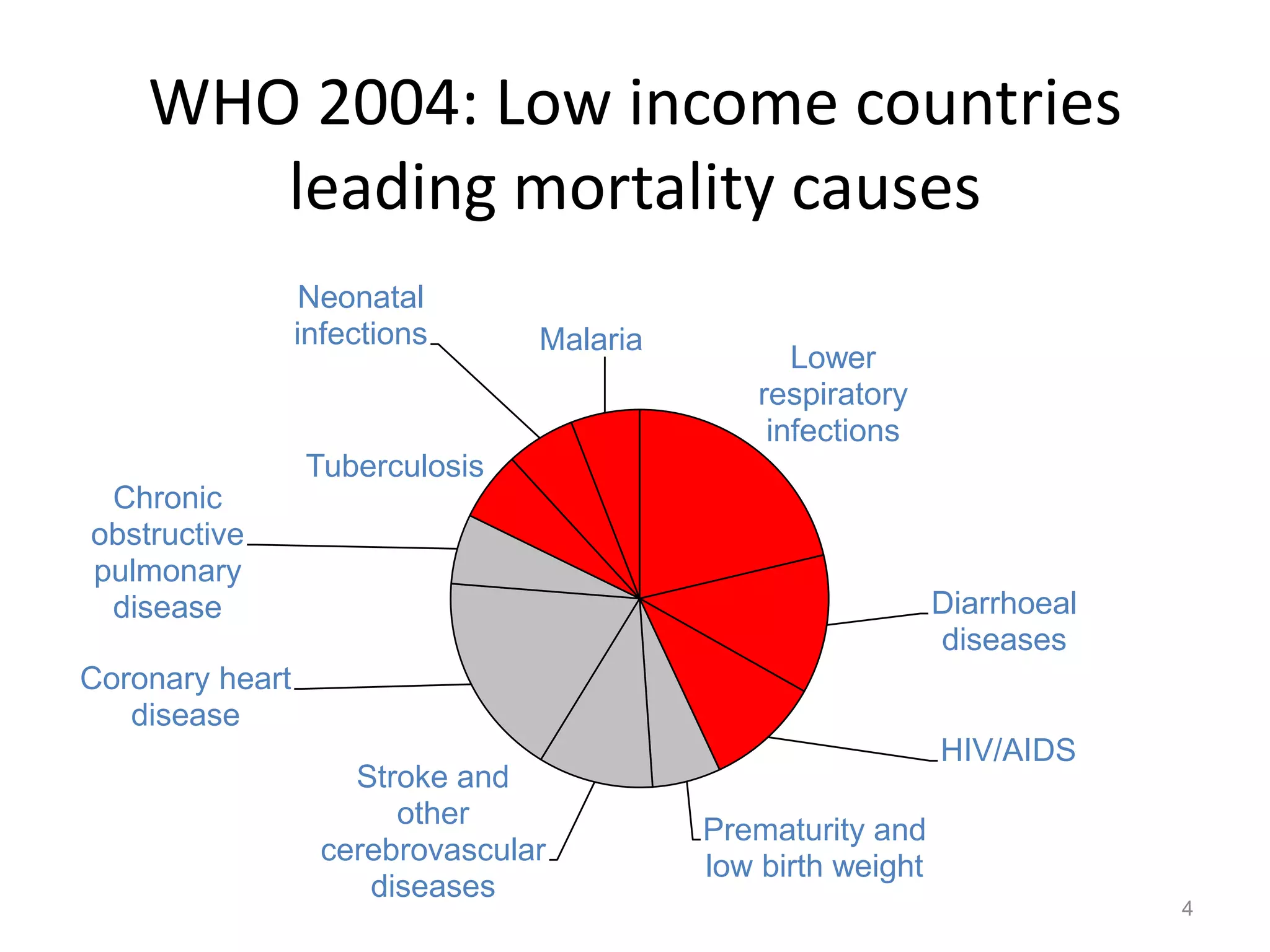
WHO 2004: Low income countries
       leading mortality causes
                  Neonatal
                 infections     Malaria
                                                Lower
                                             respiratory
                                              infections
                 Tuberculosis
 Chronic
obstructive
pulmonary
 disease                                                     Diarrhoeal
                                                             diseases
Coronary heart
   disease
                                                             HIV/AIDS
                    Stroke and
                       other
                                          Prematurity and
                  cerebrovascular
                                          low birth weight
                     diseases
                                                                          4
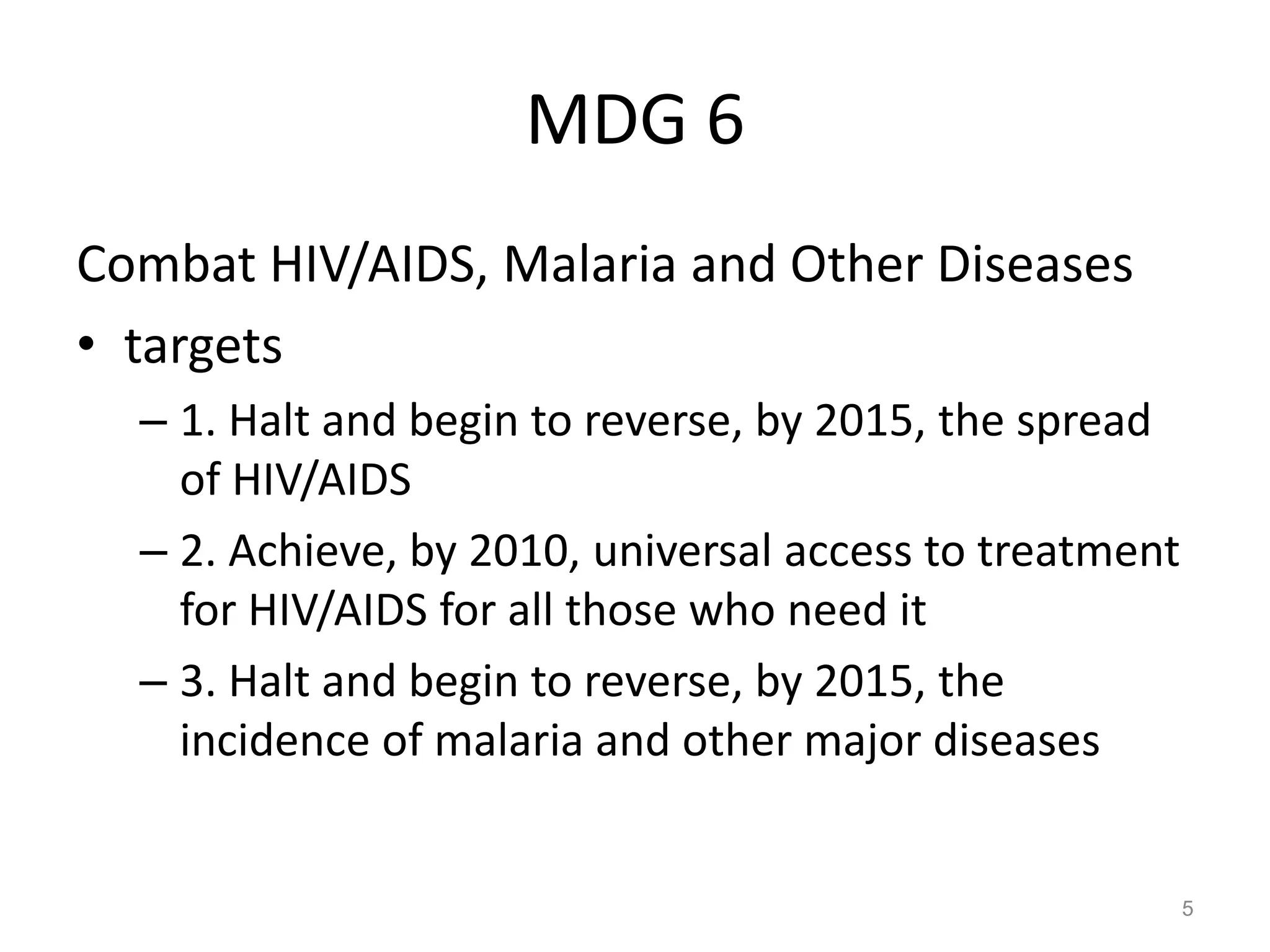
MDG 6
Combat HIV/AIDS, Malaria and Other Diseases
• targets
  – 1. Halt and begin to reverse, by 2015, the spread
    of HIV/AIDS
  – 2. Achieve, by 2010, universal access to treatment
    for HIV/AIDS for all those who need it
  – 3. Halt and begin to reverse, by 2015, the
    incidence of malaria and other major diseases


                                                         5
HIV and crises

• How do crises affect HIV?


                              6
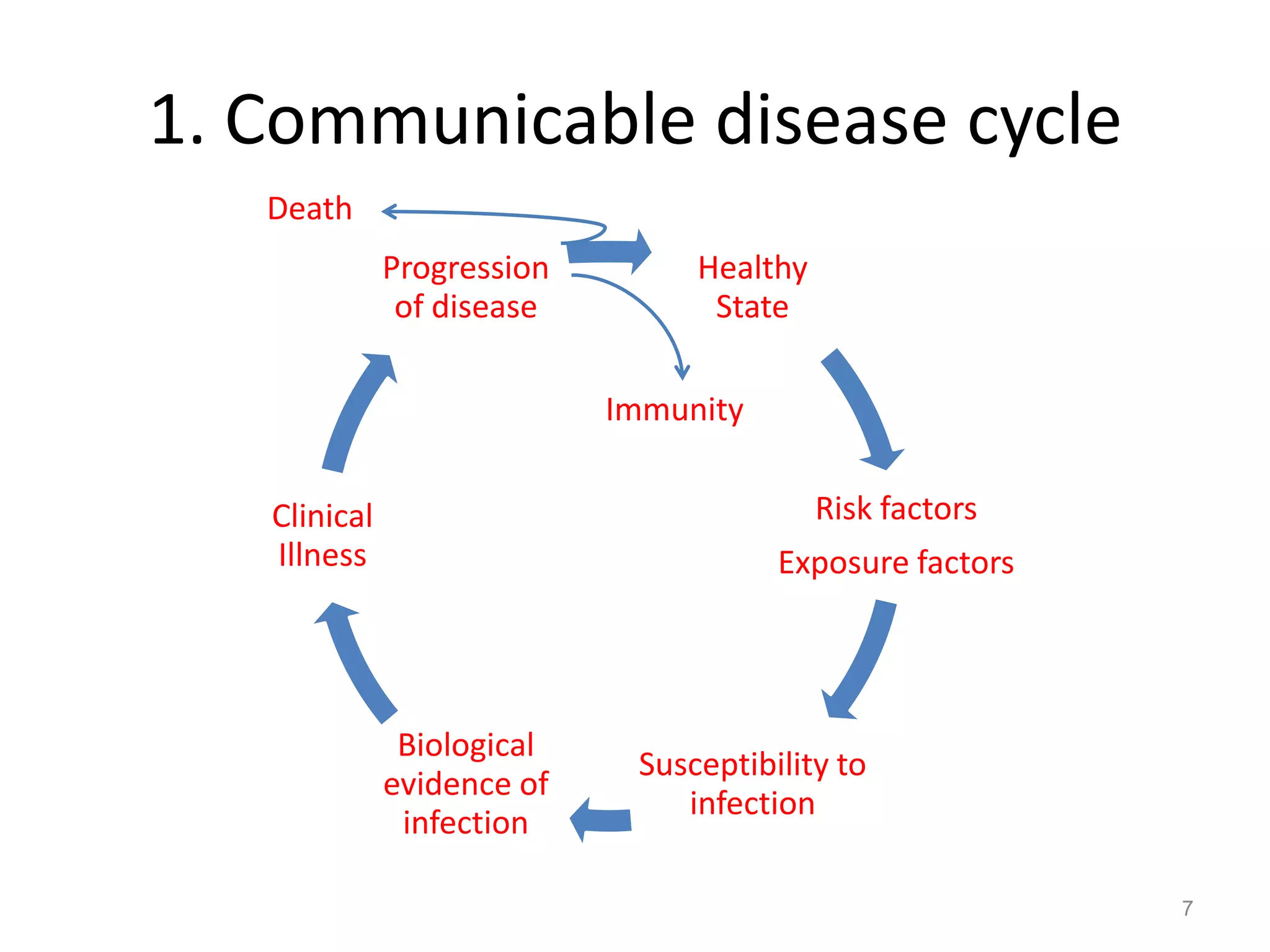
1. Communicable disease cycle
   Death
              Progression        Healthy
               of disease         State

                            Immunity


   Clinical                                Risk factors
   Illness                             Exposure factors


               Biological
                             Susceptibility to
              evidence of
                                infection
               infection

                                                          7
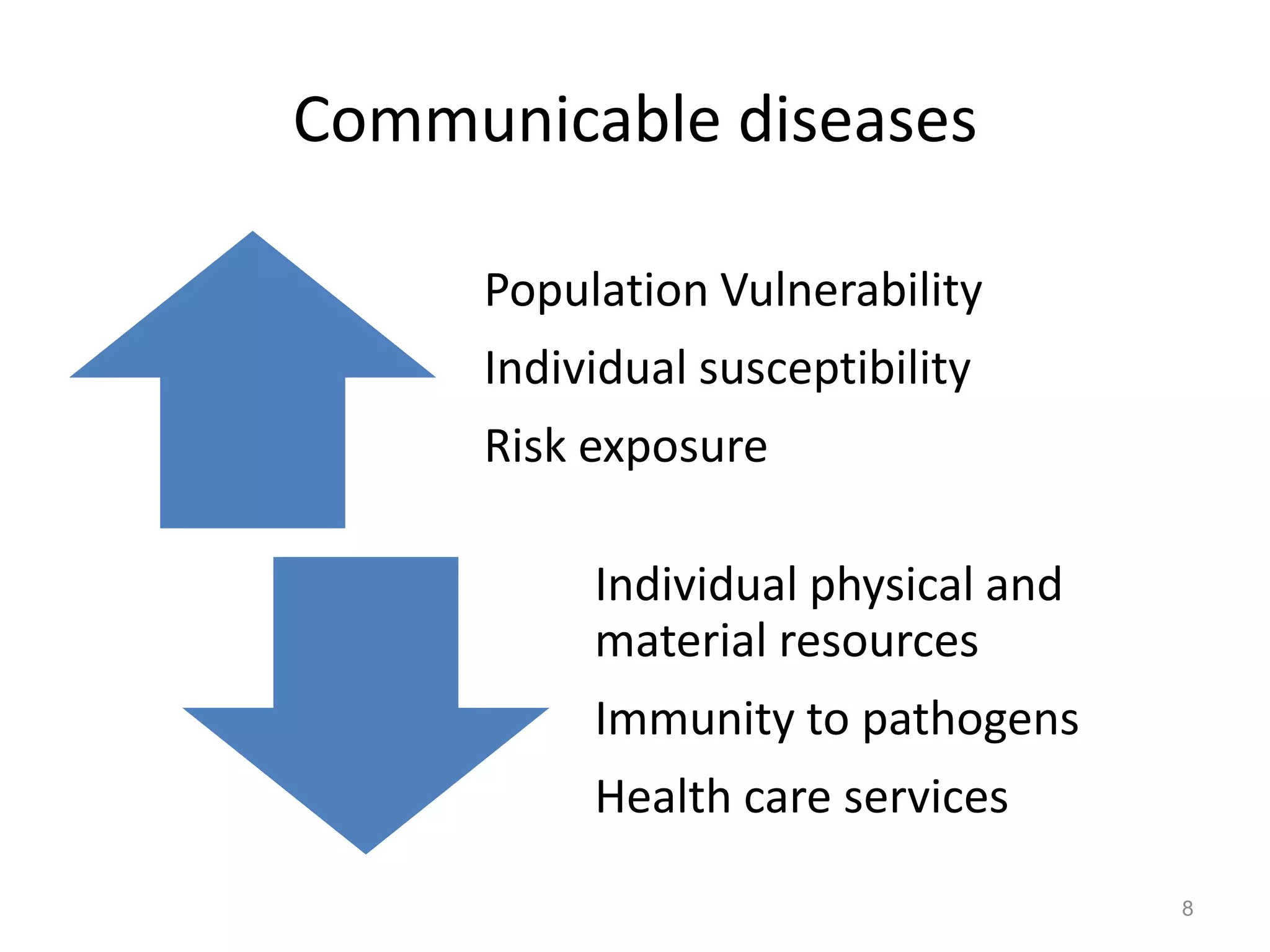
Communicable diseases

     Population Vulnerability
     Individual susceptibility
     Risk exposure

          Individual physical and
          material resources
          Immunity to pathogens
          Health care services

                                    8
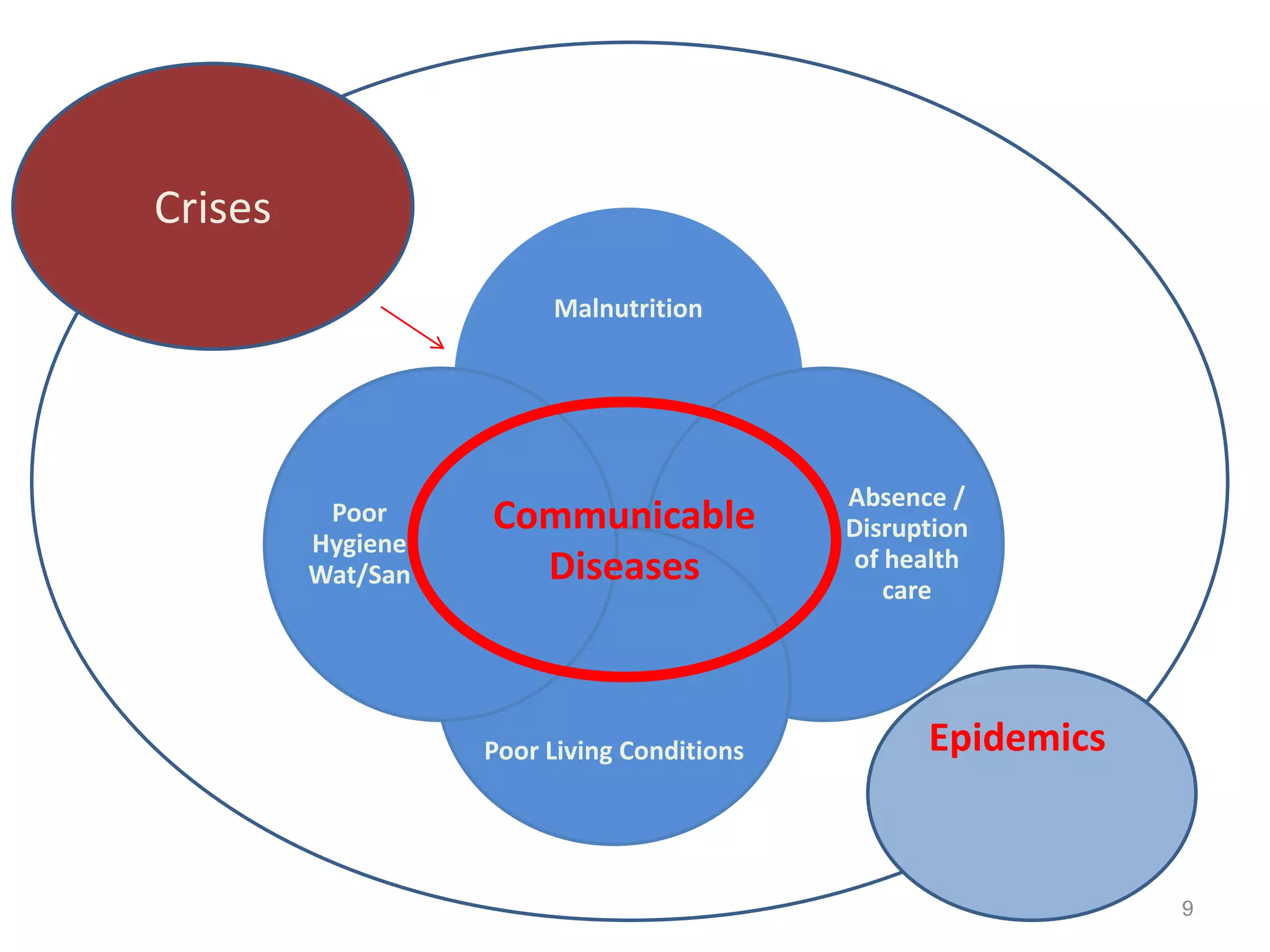
Higher incidence
Crises                                      Higher mortality

                        Malnutrition


                                             Absence /
          Poor     Communicable              Disruption
         Hygiene
                     Diseases                of health
         Wat/San
                                                care


                   Poor Living Conditions          Epidemics


                                                               9
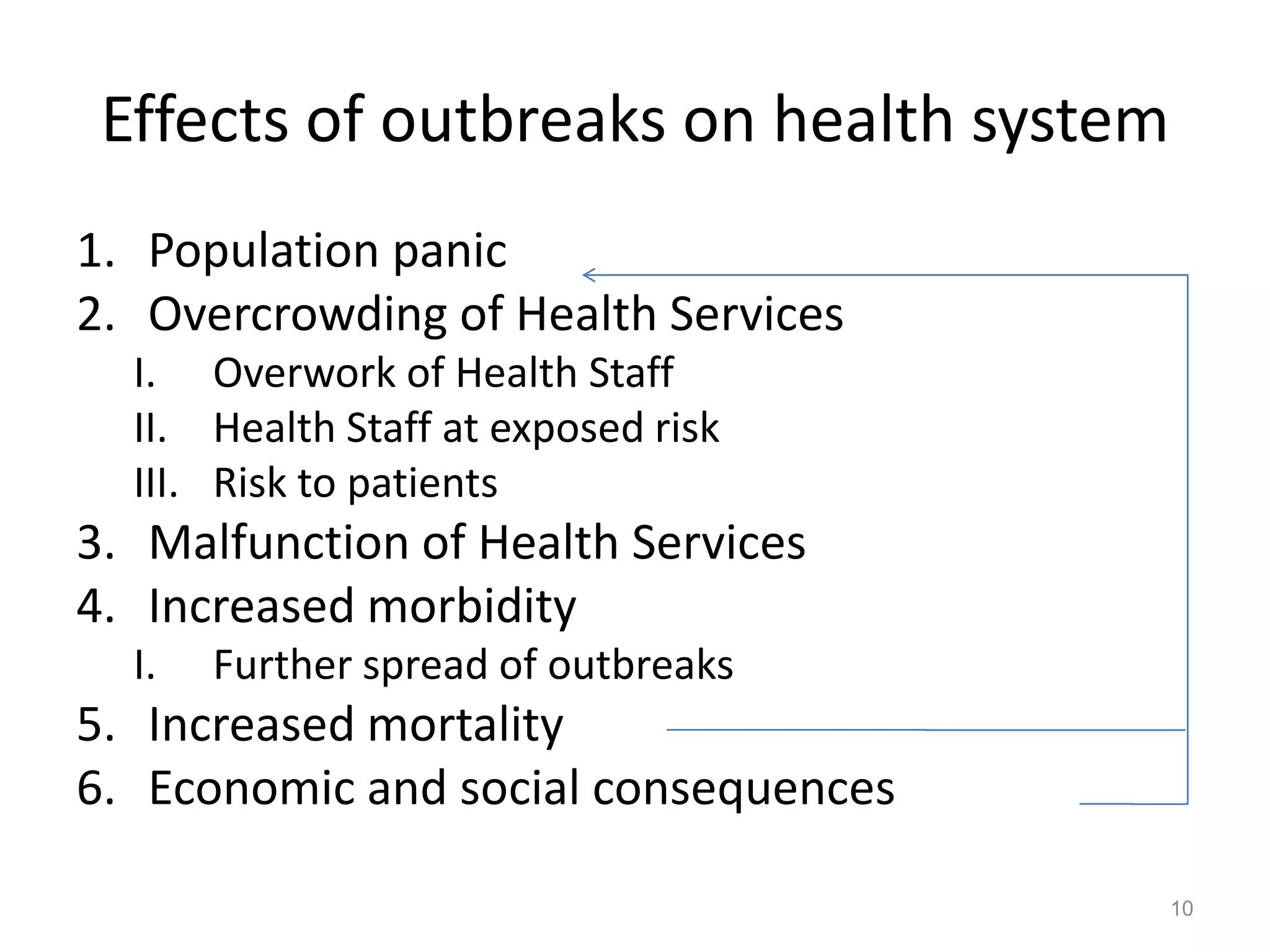
Effects of outbreaks on health system
1. Population panic
2. Overcrowding of Health Services
  I. Overwork of Health Staff
  II. Health Staff at exposed risk
  III. Risk to patients
3. Malfunction of Health Services
4. Increased morbidity
  I.   Further spread of outbreaks
5. Increased mortality
6. Economic and social consequences

                                         10
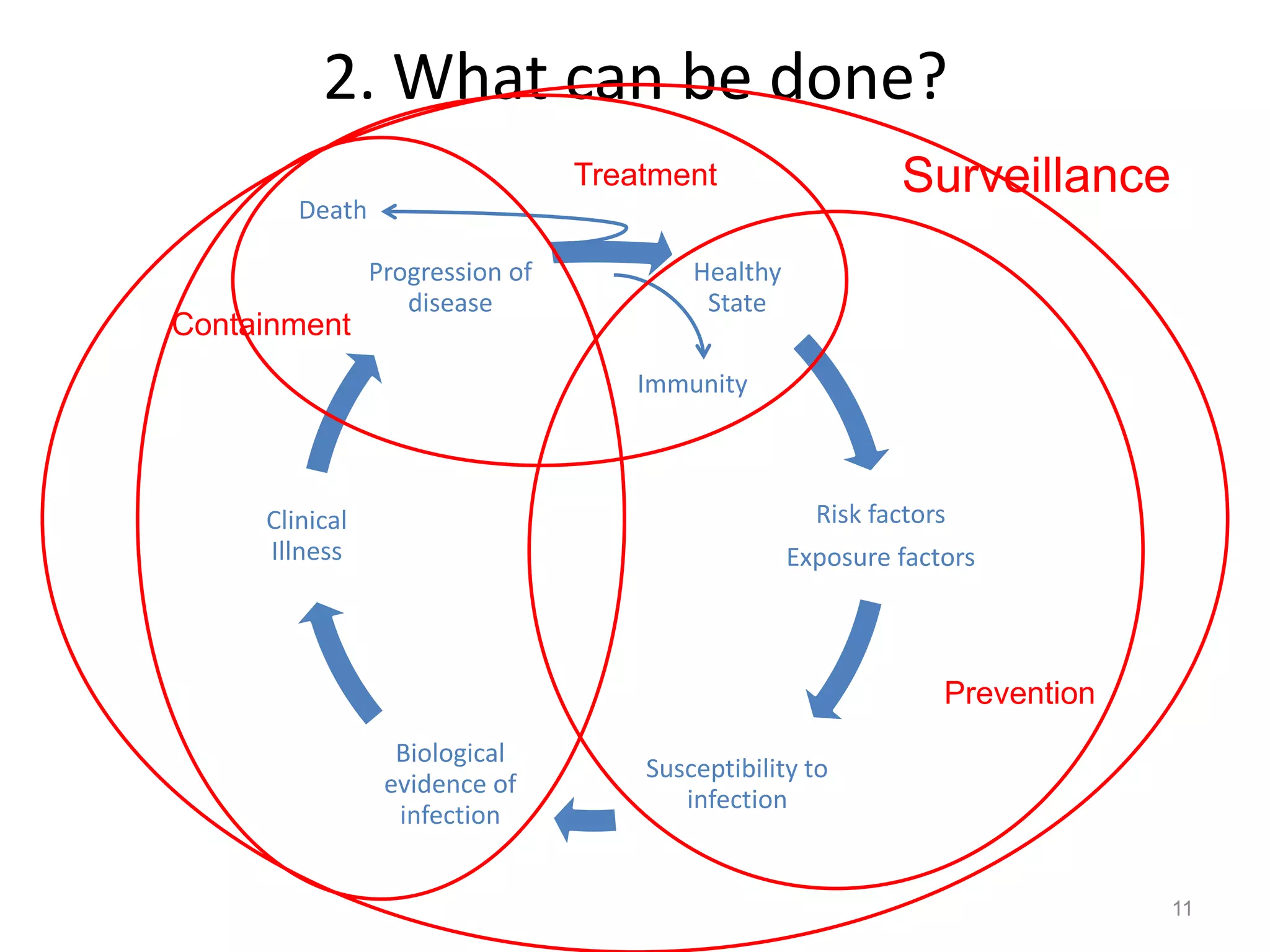
2. What can be done?
                                 Treatment                  Surveillance
        Death

                Progression of           Healthy
                   disease                State
Containment
                                    Immunity


     Clinical                                        Risk factors
     Illness                                       Exposure factors


                                                                Prevention
                  Biological
                                     Susceptibility to
                 evidence of
                                        infection
                  infection


                                                                             11
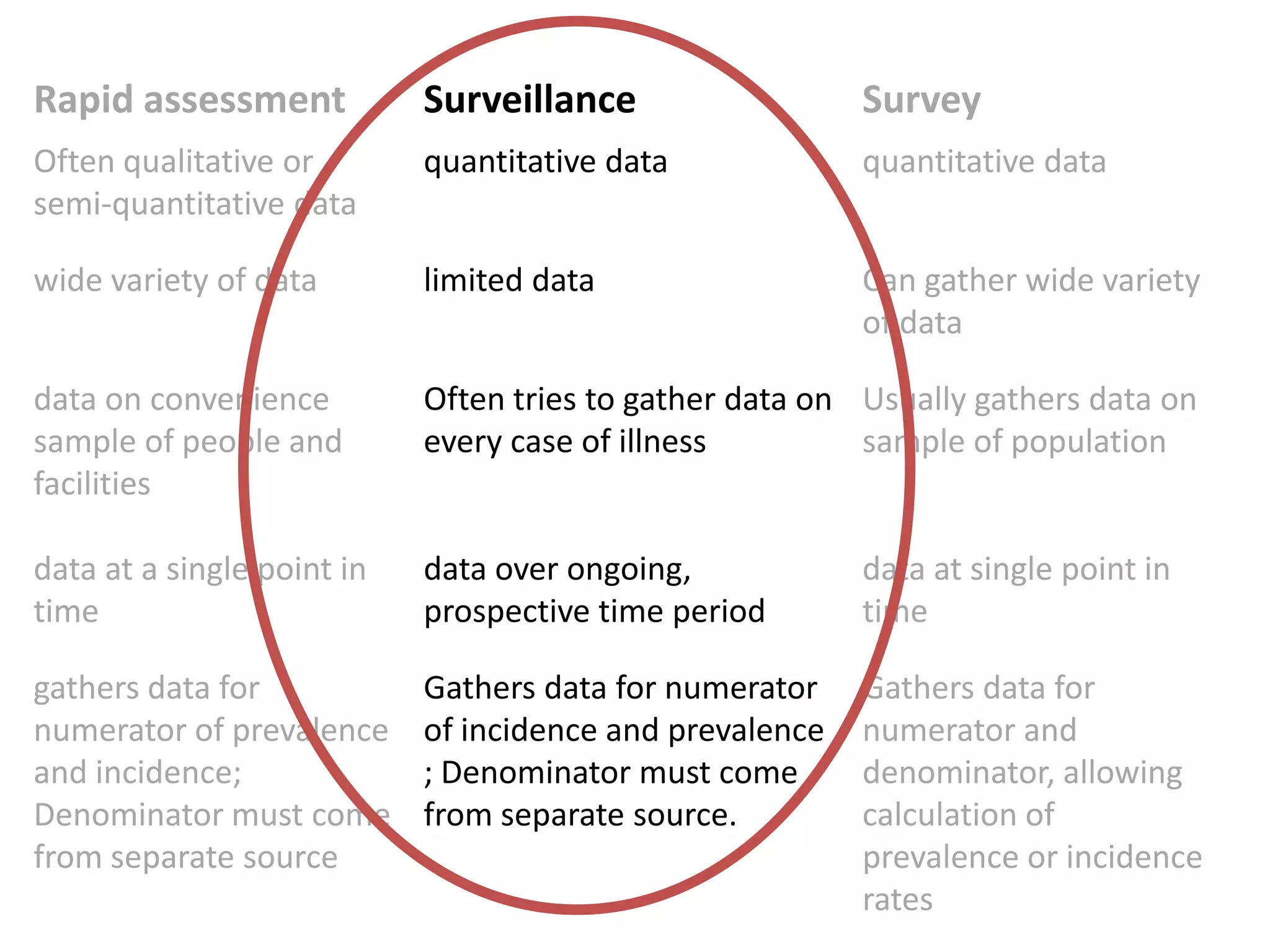
Rapid assessment            Surveillance                  Survey
Often qualitative or        quantitative data             quantitative data
semi-quantitative data

wide variety of data        limited data                  Can gather wide variety
                                                          of data

data on convenience         Often tries to gather data on Usually gathers data on
sample of people and        every case of illness         sample of population
facilities

data at a single point in   data over ongoing,            data at single point in
time                        prospective time period       time

gathers data for            Gathers data for numerator    Gathers data for
numerator of prevalence     of incidence and prevalence   numerator and
and incidence;              ; Denominator must come       denominator, allowing
Denominator must come       from separate source.         calculation of
from separate source                                      prevalence or incidence
                                                          rates
surveillance
• Systematic ongoing collection, collation, and
  analysis of data and the timely dissemination of
  information to those who need to know so that
  action can be taken.
            » World Health Organization
• The ongoing systematic collection, analysis, and
  interpretation of health data, essential to the
  planning, implementation, and evaluation of
  public health practice, closely integrated with the
  timely dissemination of these data to those who
  need to know.
            » US Centers for Disease Control and Prevention
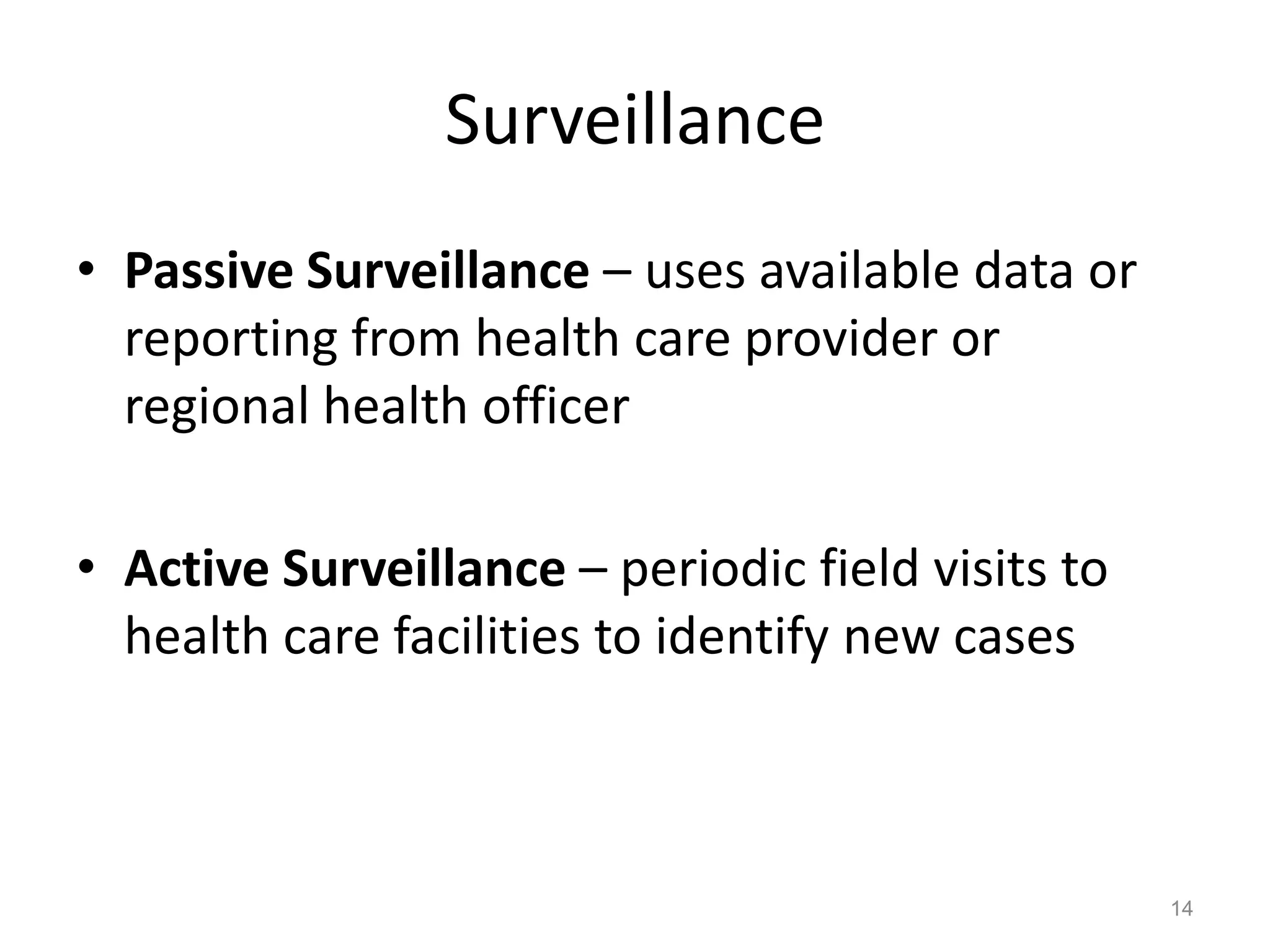
Surveillance
• Passive Surveillance – uses available data or
  reporting from health care provider or
  regional health officer

• Active Surveillance – periodic field visits to
  health care facilities to identify new cases


                                                   14
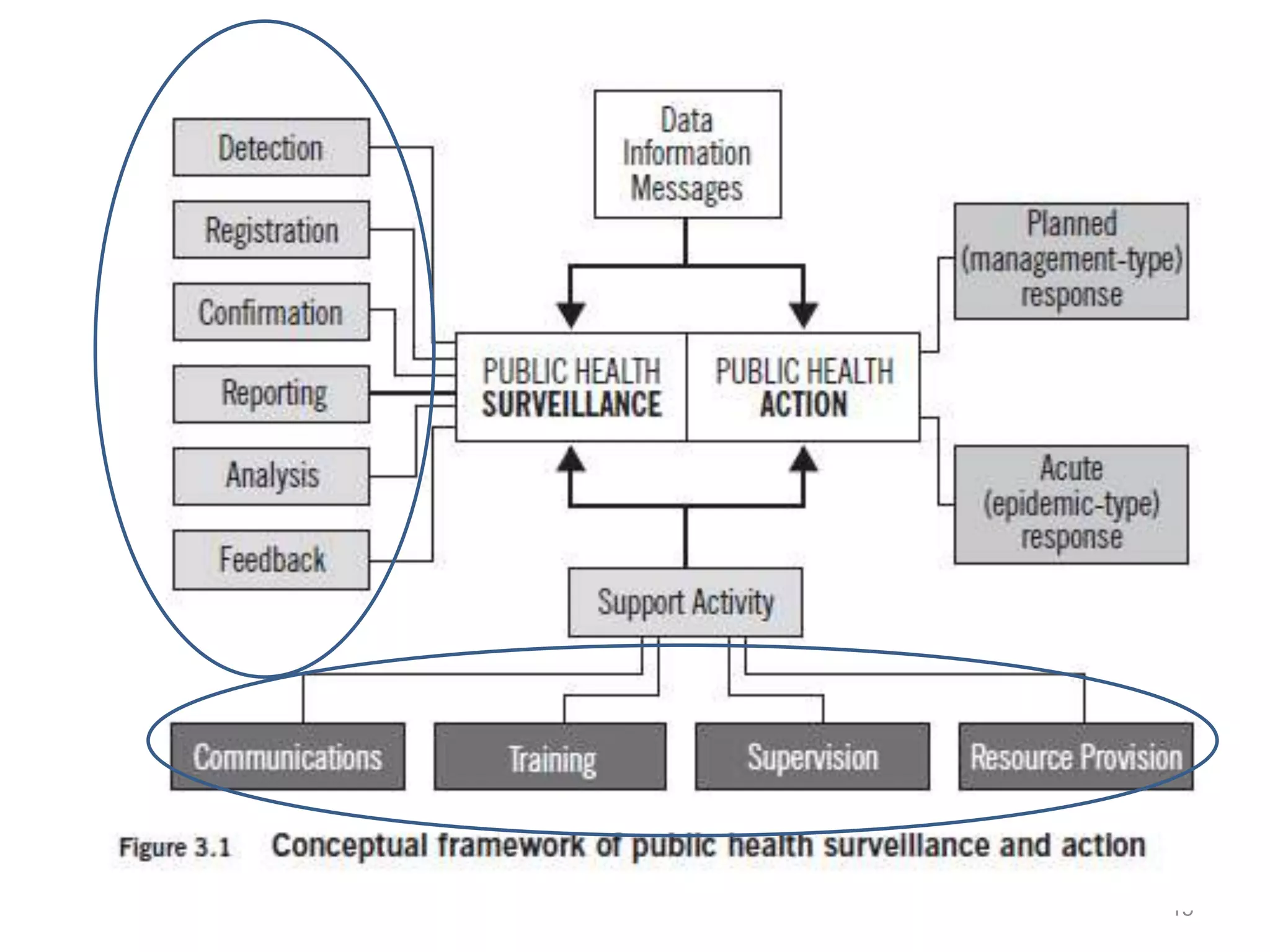
15
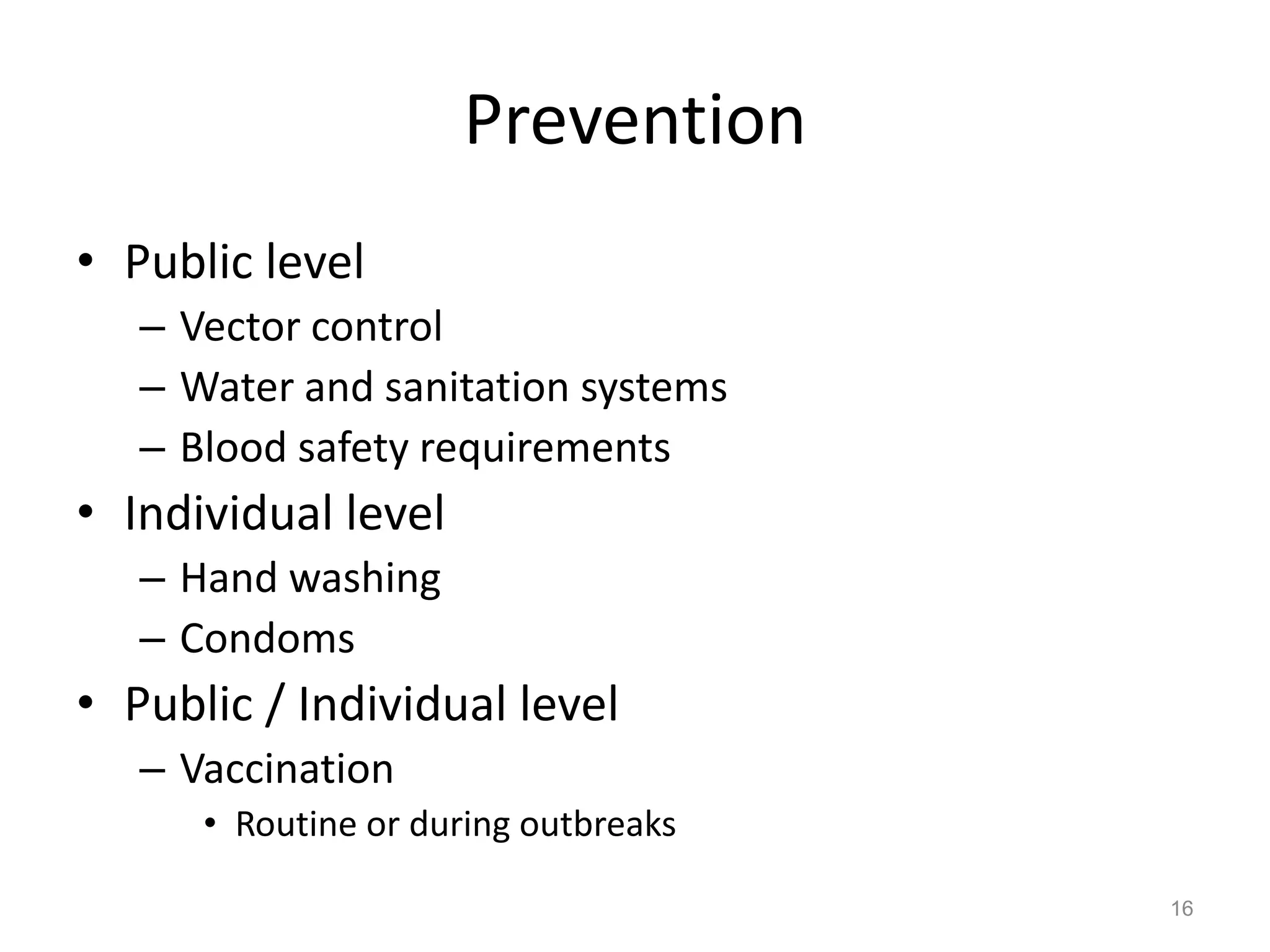
Prevention
• Public level
   – Vector control
   – Water and sanitation systems
   – Blood safety requirements
• Individual level
   – Hand washing
   – Condoms
• Public / Individual level
   – Vaccination
      • Routine or during outbreaks

                                      16
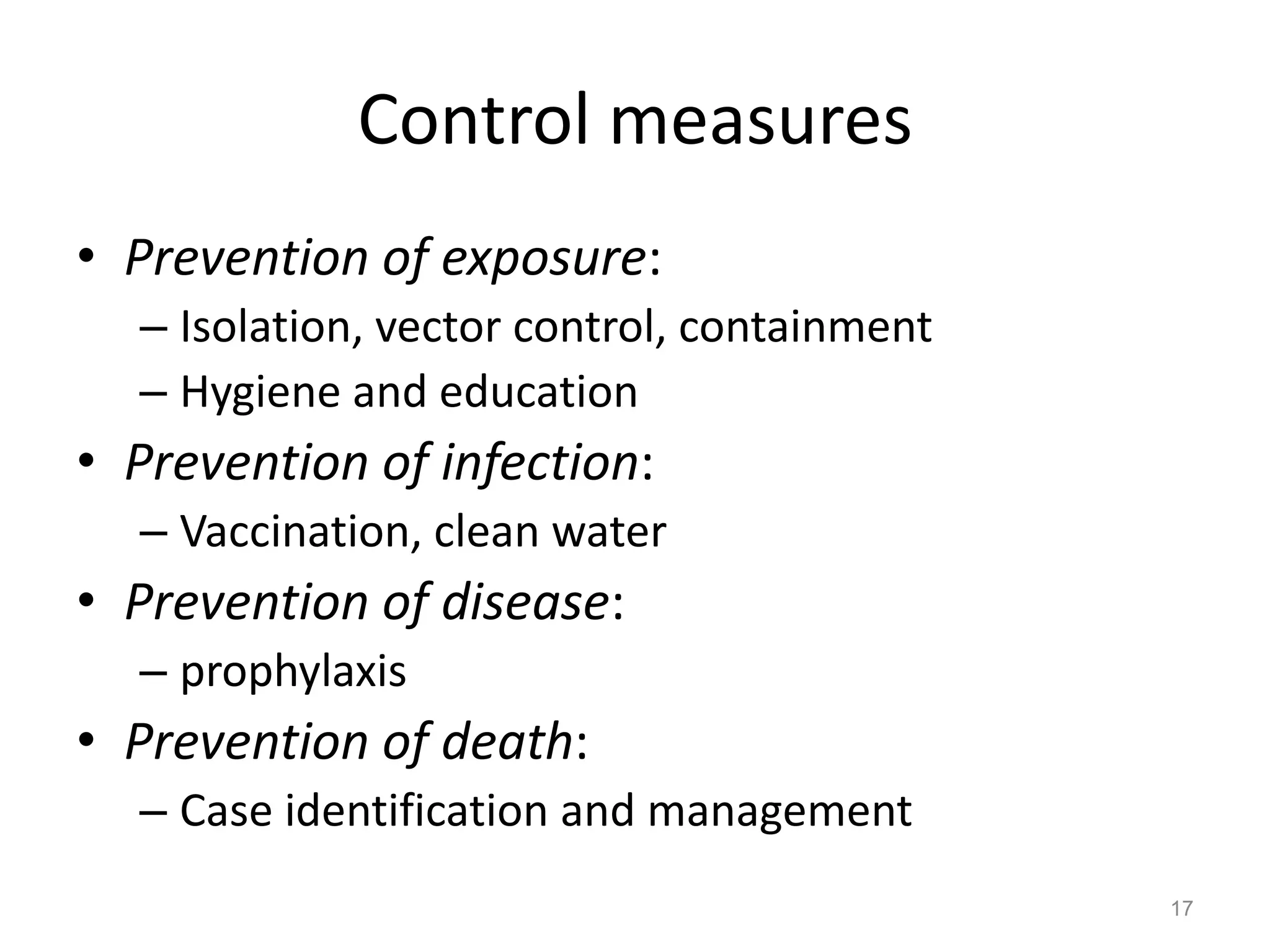
Control measures
• Prevention of exposure:
  – Isolation, vector control, containment
  – Hygiene and education
• Prevention of infection:
  – Vaccination, clean water
• Prevention of disease:
  – prophylaxis
• Prevention of death:
  – Case identification and management
                                             17
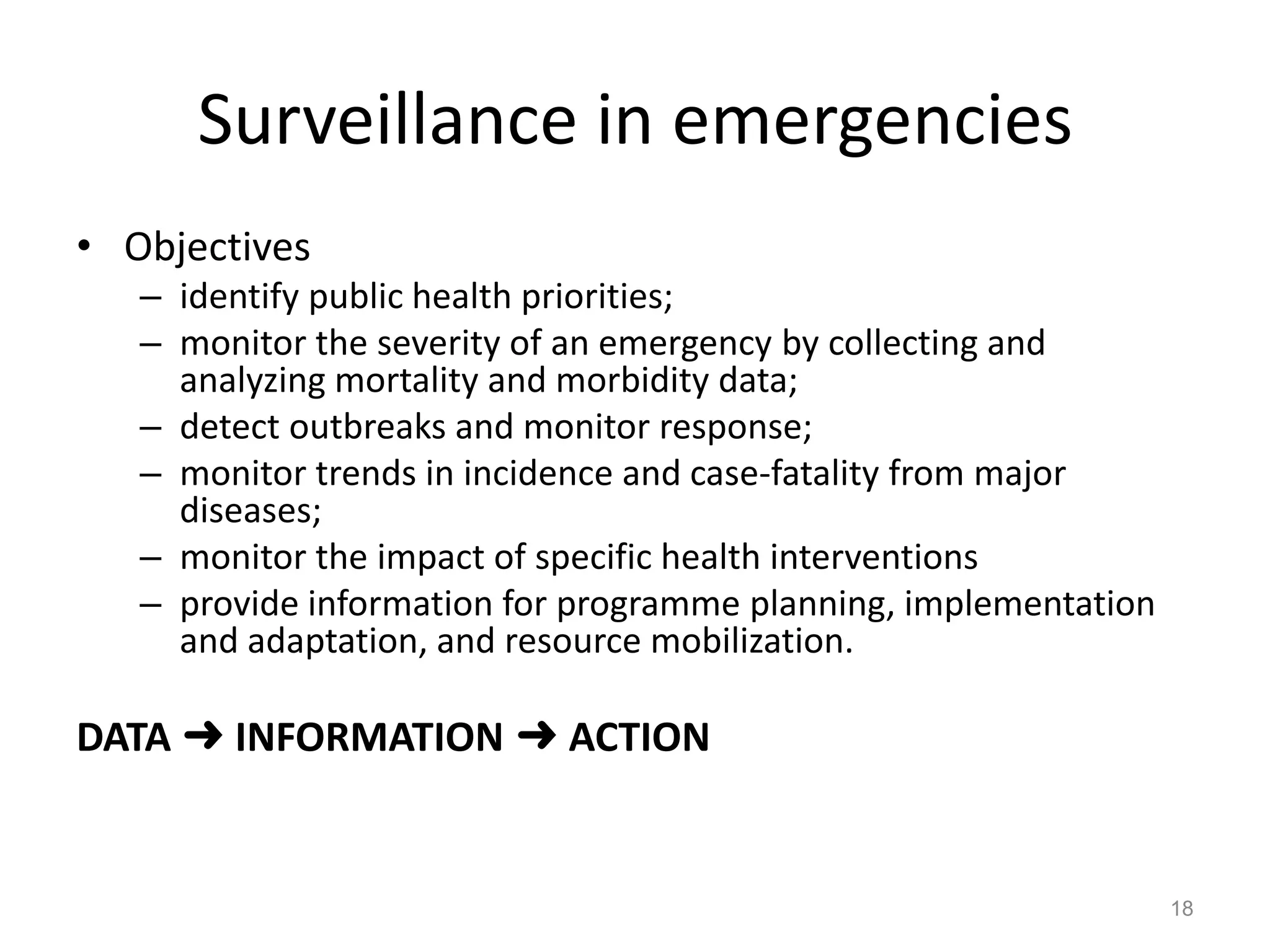
Surveillance in emergencies
• Objectives
   – identify public health priorities;
   – monitor the severity of an emergency by collecting and
     analyzing mortality and morbidity data;
   – detect outbreaks and monitor response;
   – monitor trends in incidence and case-fatality from major
     diseases;
   – monitor the impact of specific health interventions
   – provide information for programme planning, implementation
     and adaptation, and resource mobilization.

DATA ➜ INFORMATION ➜ ACTION


                                                                  18
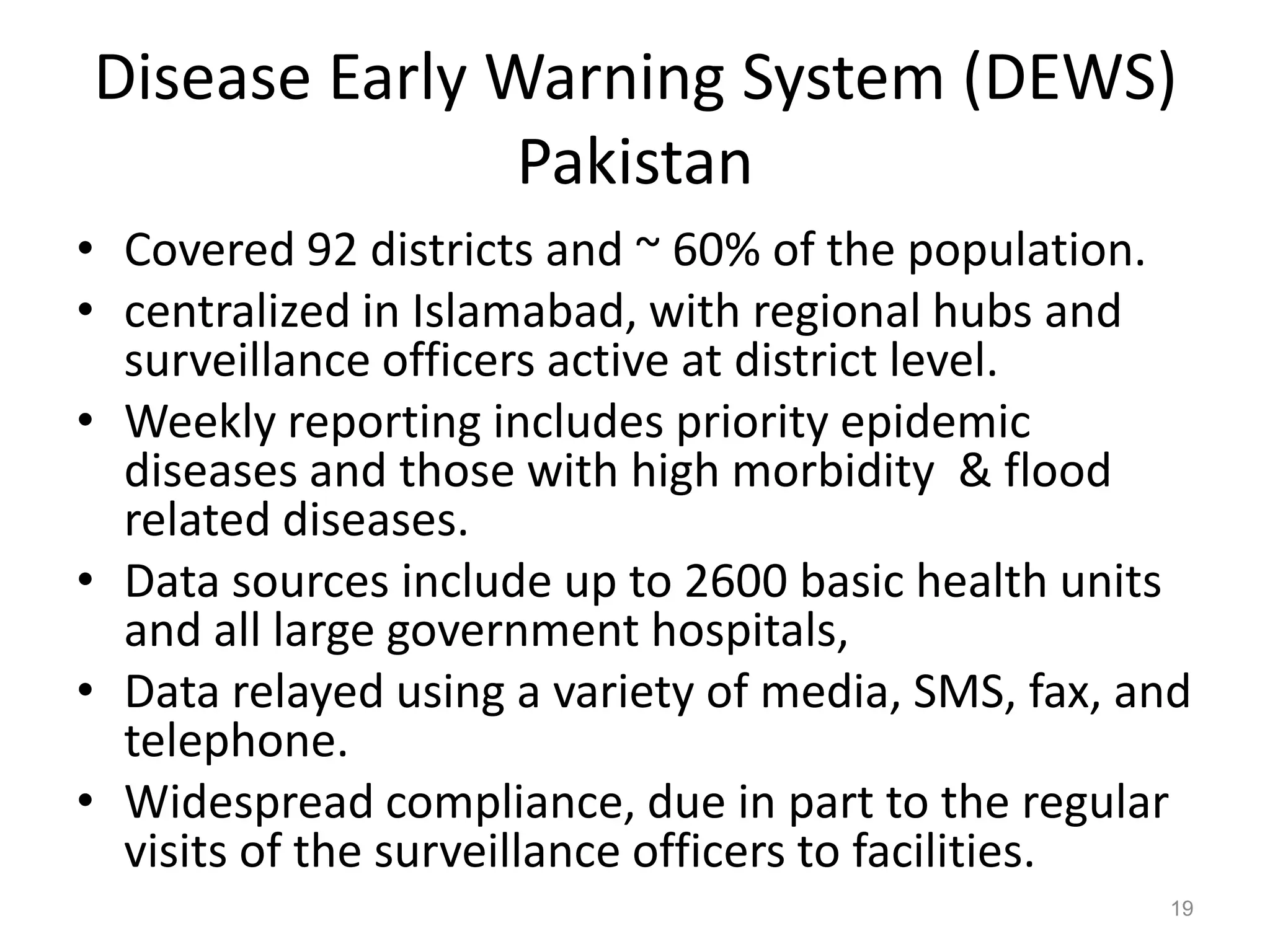
Disease Early Warning System (DEWS)
               Pakistan
• Covered 92 districts and ~ 60% of the population.
• centralized in Islamabad, with regional hubs and
  surveillance officers active at district level.
• Weekly reporting includes priority epidemic
  diseases and those with high morbidity & flood
  related diseases.
• Data sources include up to 2600 basic health units
  and all large government hospitals,
• Data relayed using a variety of media, SMS, fax, and
  telephone.
• Widespread compliance, due in part to the regular
  visits of the surveillance officers to facilities.
                                                    19
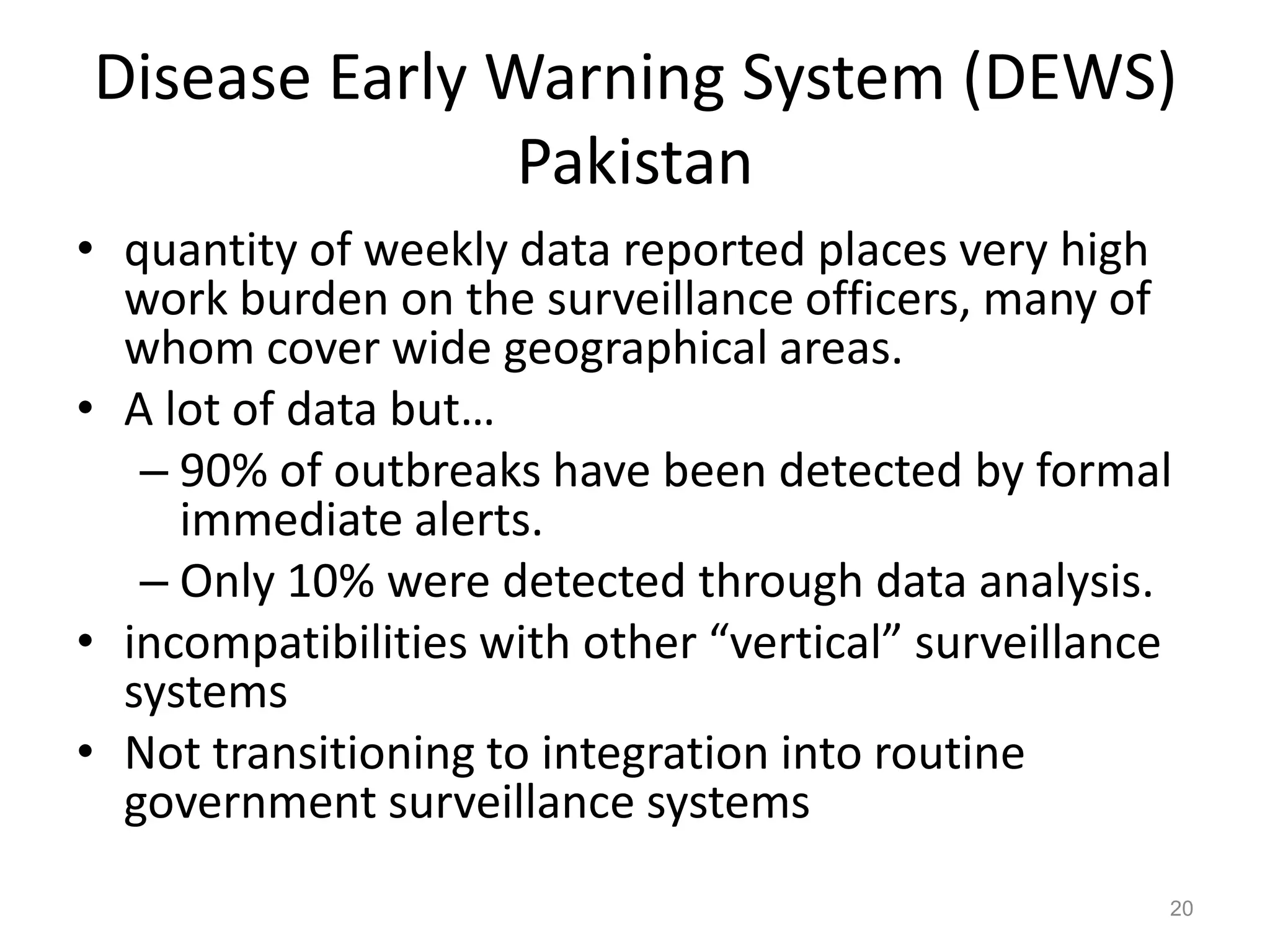
Disease Early Warning System (DEWS)
               Pakistan
• quantity of weekly data reported places very high
  work burden on the surveillance officers, many of
  whom cover wide geographical areas.
• A lot of data but…
   – 90% of outbreaks have been detected by formal
     immediate alerts.
   – Only 10% were detected through data analysis.
• incompatibilities with other “vertical” surveillance
  systems
• Not transitioning to integration into routine
  government surveillance systems
                                                     20
DEWS- Film
• http://www.youtube.com/watch?v=s2Q5oQx4
  dGw&feature=bf_prev&list=ULQRFpUxJxcoE&l
  f=mfu_in_order


                                         21
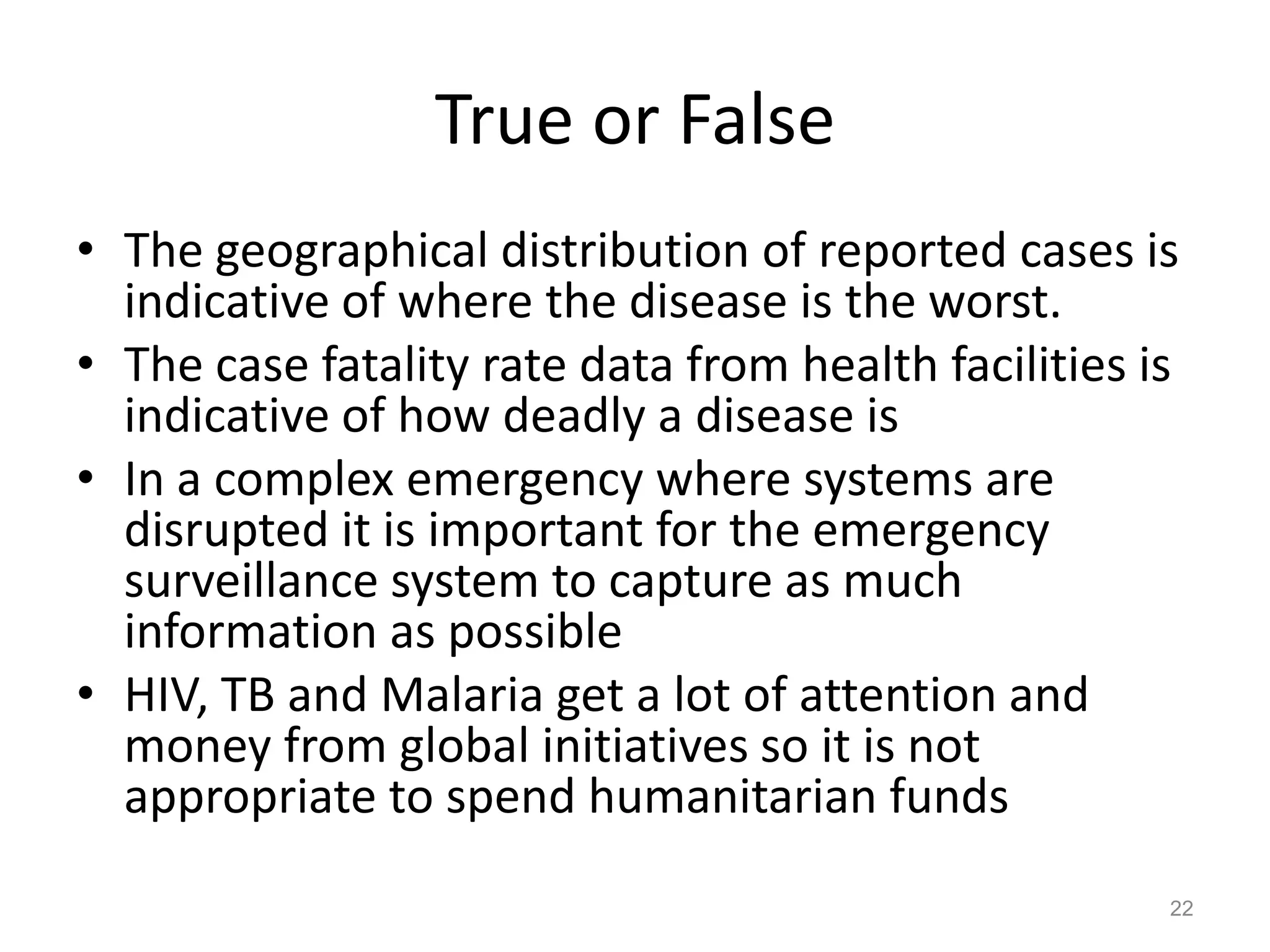
True or False
• The geographical distribution of reported cases is
  indicative of where the disease is the worst.
• The case fatality rate data from health facilities is
  indicative of how deadly a disease is
• In a complex emergency where systems are
  disrupted it is important for the emergency
  surveillance system to capture as much
  information as possible
• HIV, TB and Malaria get a lot of attention and
  money from global initiatives so it is not
  appropriate to spend humanitarian funds
                                                      22
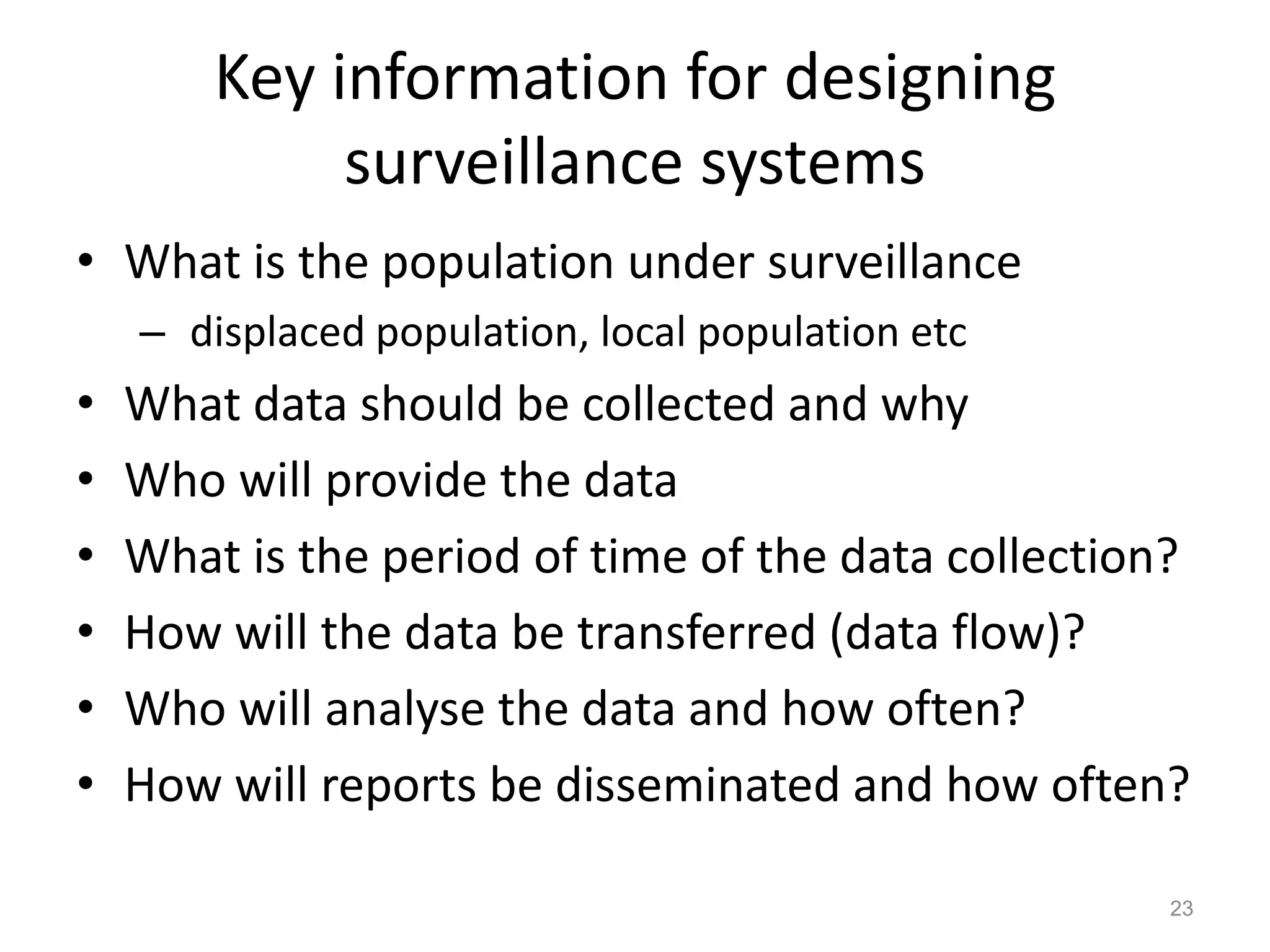
Key information for designing
             surveillance systems
• What is the population under surveillance
    – displaced population, local population etc
•   What data should be collected and why
•   Who will provide the data
•   What is the period of time of the data collection?
•   How will the data be transferred (data flow)?
•   Who will analyse the data and how often?
•   How will reports be disseminated and how often?

                                                     23
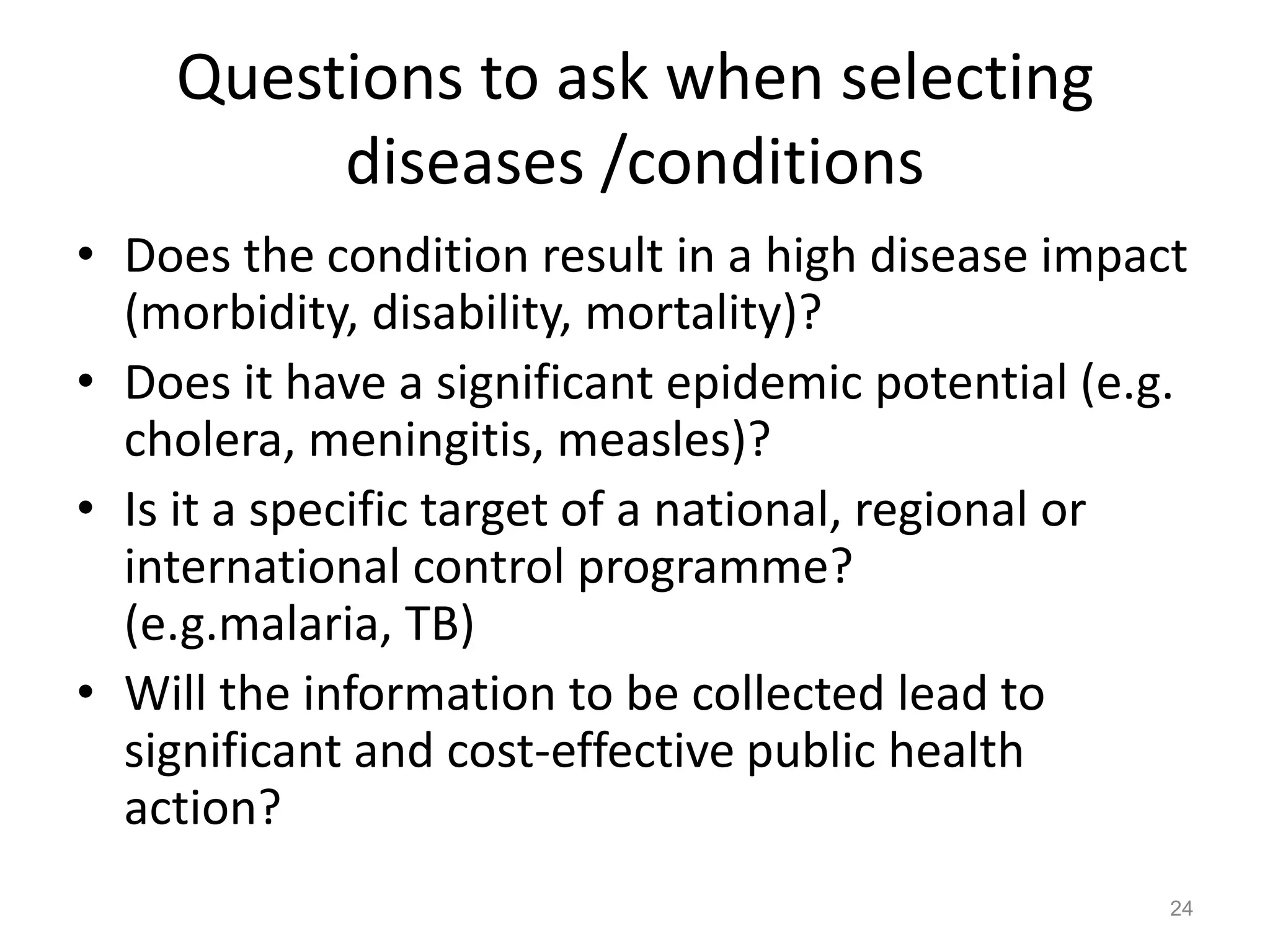
Questions to ask when selecting
         diseases /conditions
• Does the condition result in a high disease impact
  (morbidity, disability, mortality)?
• Does it have a significant epidemic potential (e.g.
  cholera, meningitis, measles)?
• Is it a specific target of a national, regional or
  international control programme?
  (e.g.malaria, TB)
• Will the information to be collected lead to
  significant and cost-effective public health
  action?
                                                    24
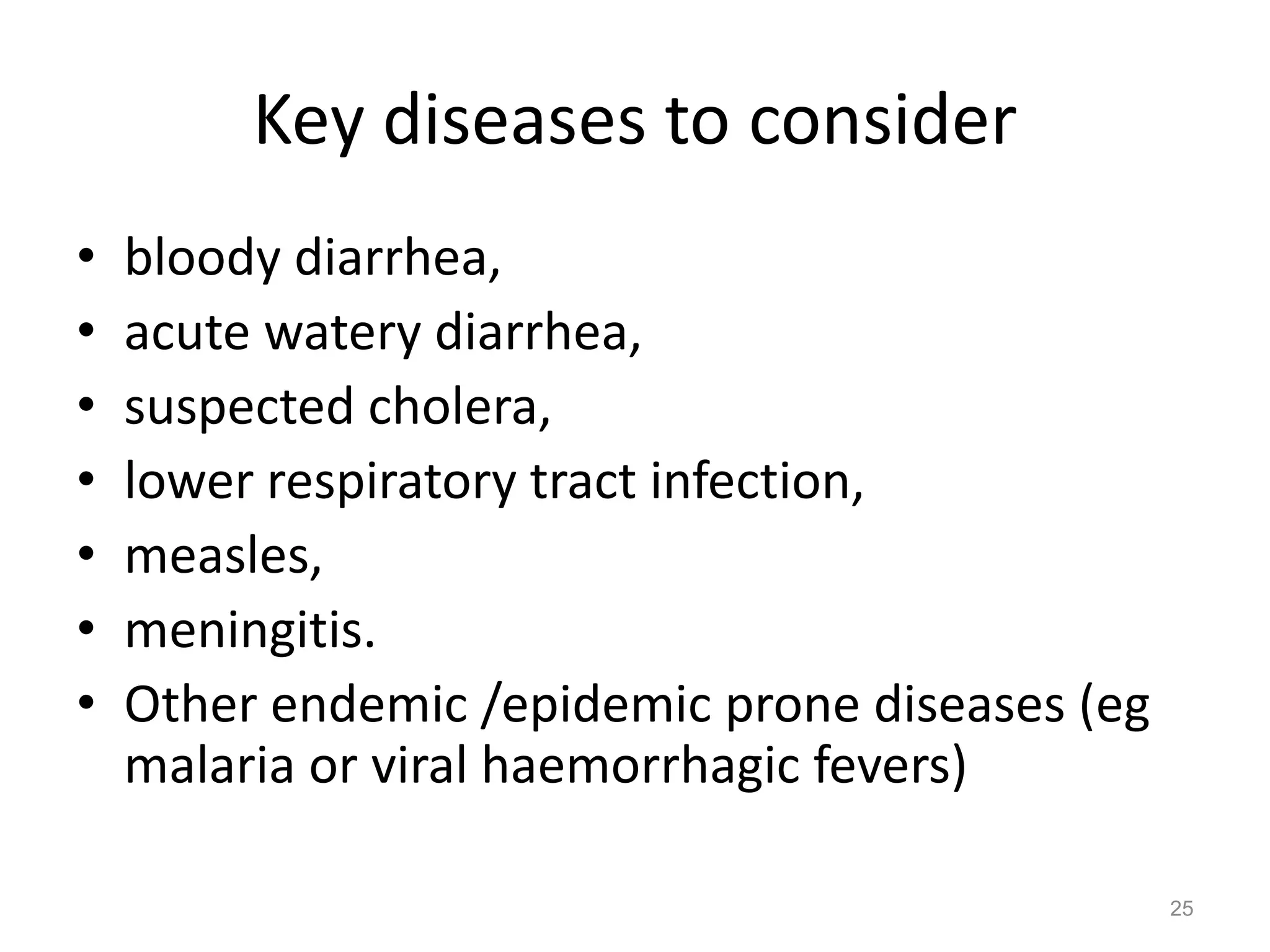
Key diseases to consider
•   bloody diarrhea,
•   acute watery diarrhea,
•   suspected cholera,
•   lower respiratory tract infection,
•   measles,
•   meningitis.
•   Other endemic /epidemic prone diseases (eg
    malaria or viral haemorrhagic fevers)

                                                 25
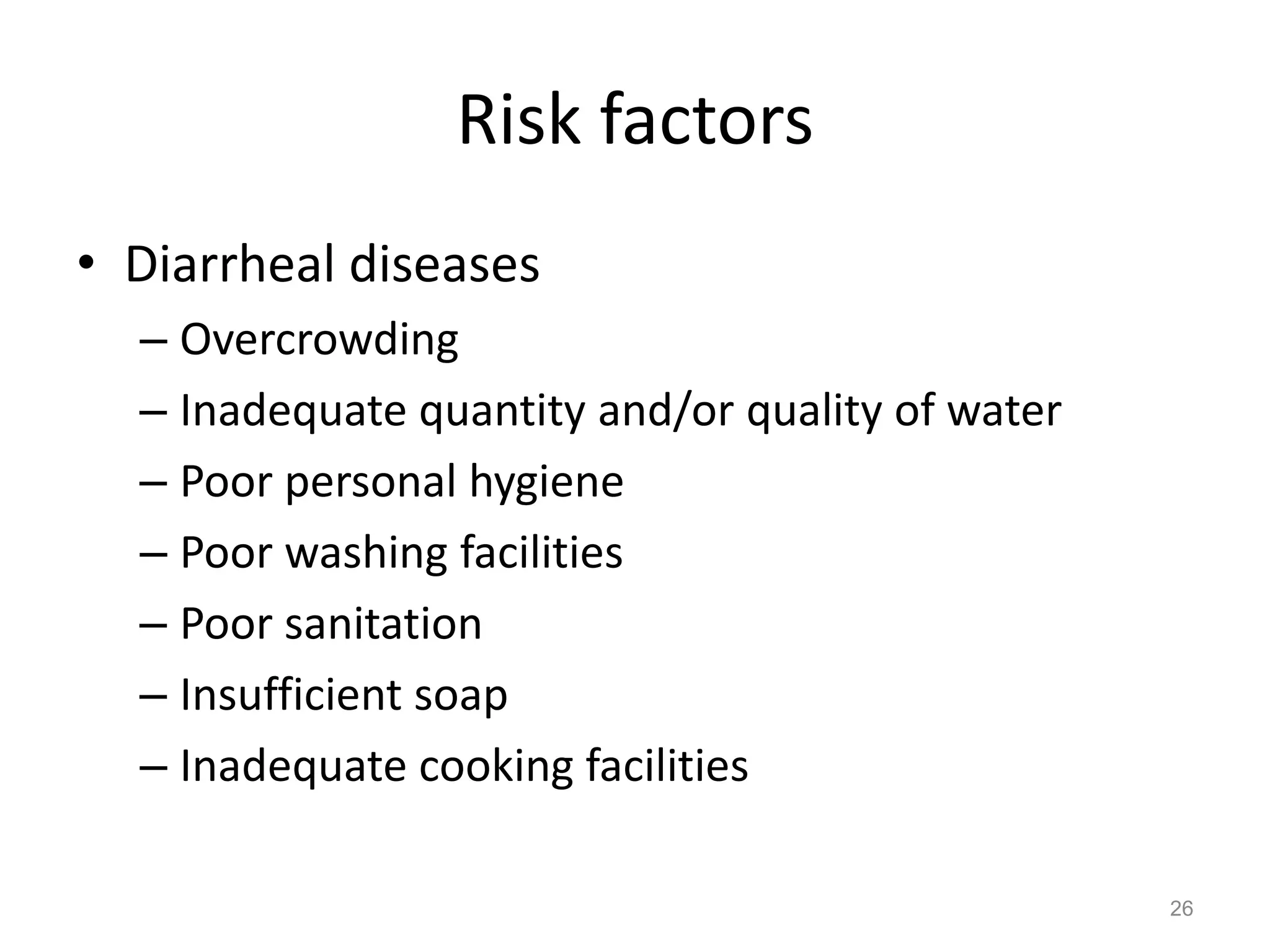
Risk factors
• Diarrheal diseases
  – Overcrowding
  – Inadequate quantity and/or quality of water
  – Poor personal hygiene
  – Poor washing facilities
  – Poor sanitation
  – Insufficient soap
  – Inadequate cooking facilities

                                                  26
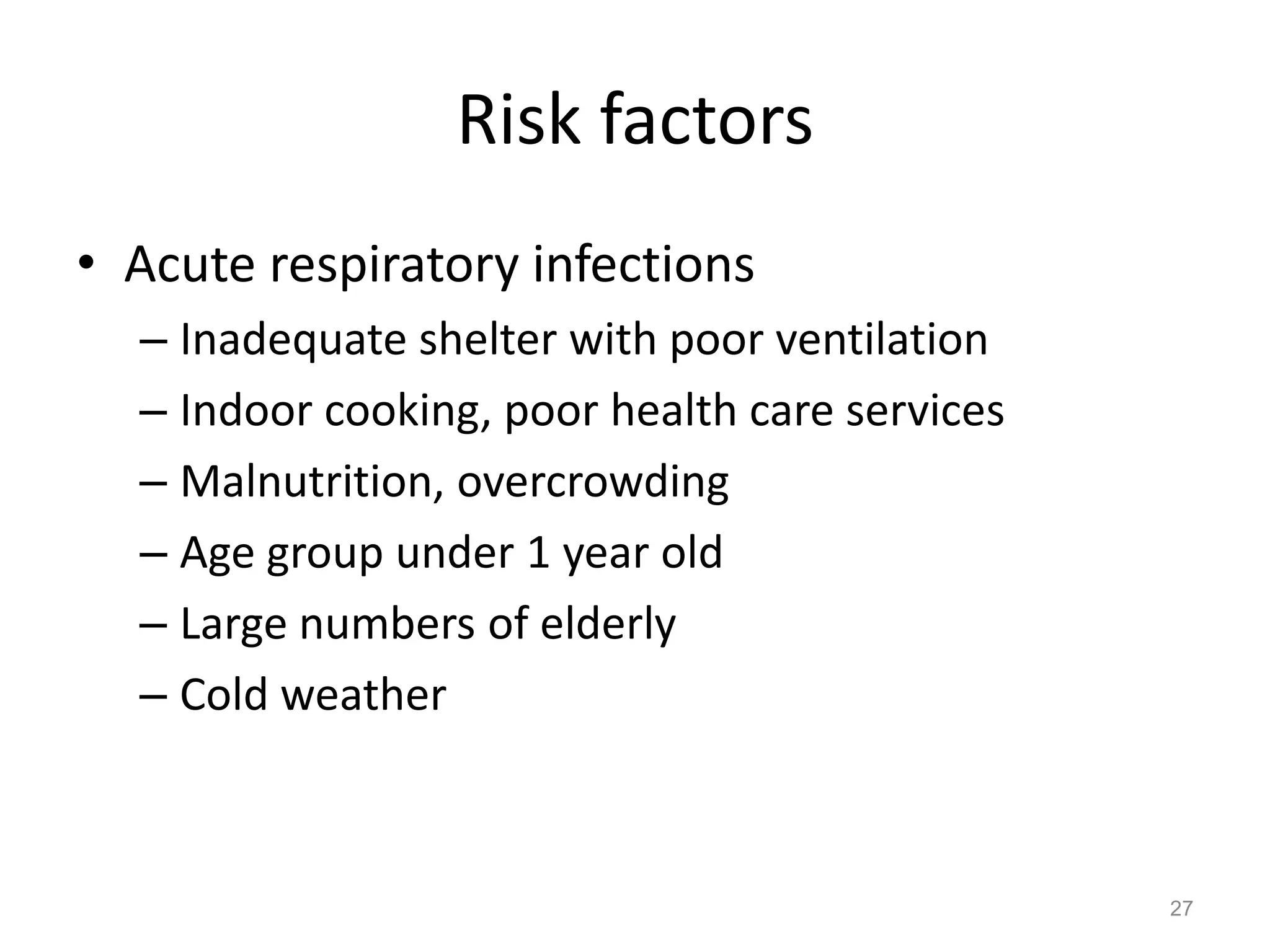
Risk factors
• Acute respiratory infections
  – Inadequate shelter with poor ventilation
  – Indoor cooking, poor health care services
  – Malnutrition, overcrowding
  – Age group under 1 year old
  – Large numbers of elderly
  – Cold weather


                                                27
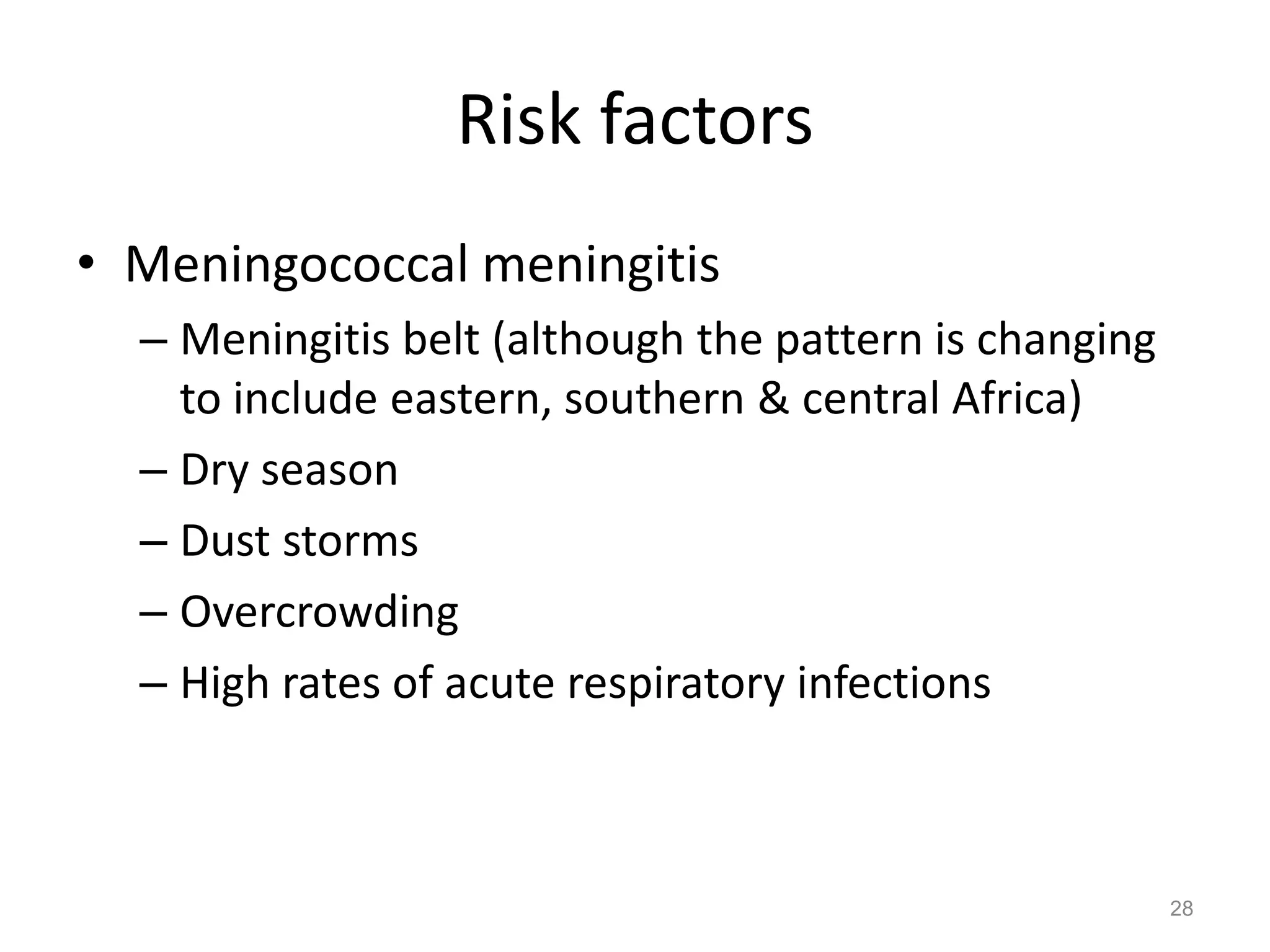
Risk factors
• Meningococcal meningitis
  – Meningitis belt (although the pattern is changing
    to include eastern, southern & central Africa)
  – Dry season
  – Dust storms
  – Overcrowding
  – High rates of acute respiratory infections


                                                        28
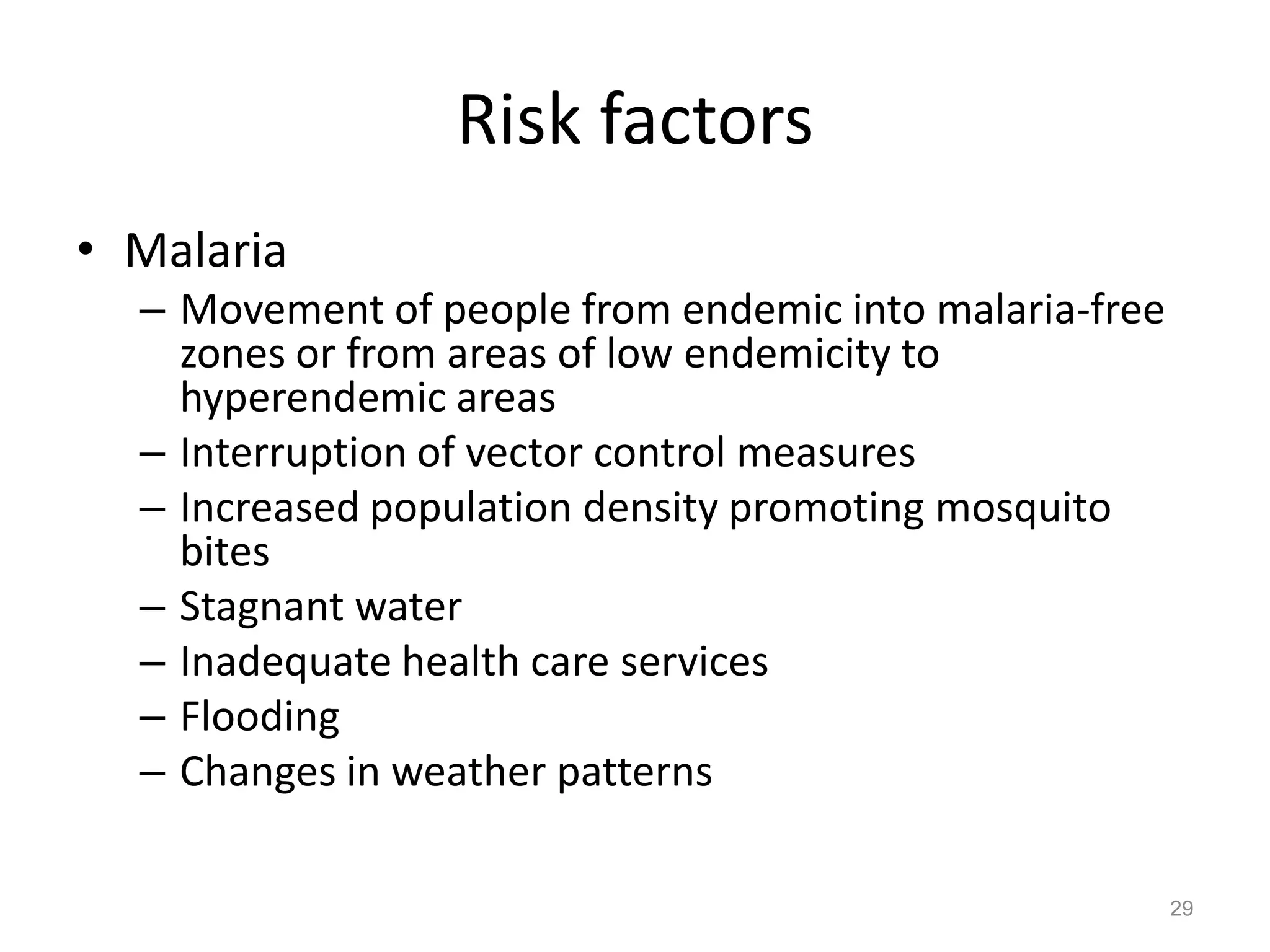
Risk factors
• Malaria
  – Movement of people from endemic into malaria-free
    zones or from areas of low endemicity to
    hyperendemic areas
  – Interruption of vector control measures
  – Increased population density promoting mosquito
    bites
  – Stagnant water
  – Inadequate health care services
  – Flooding
  – Changes in weather patterns

                                                        29
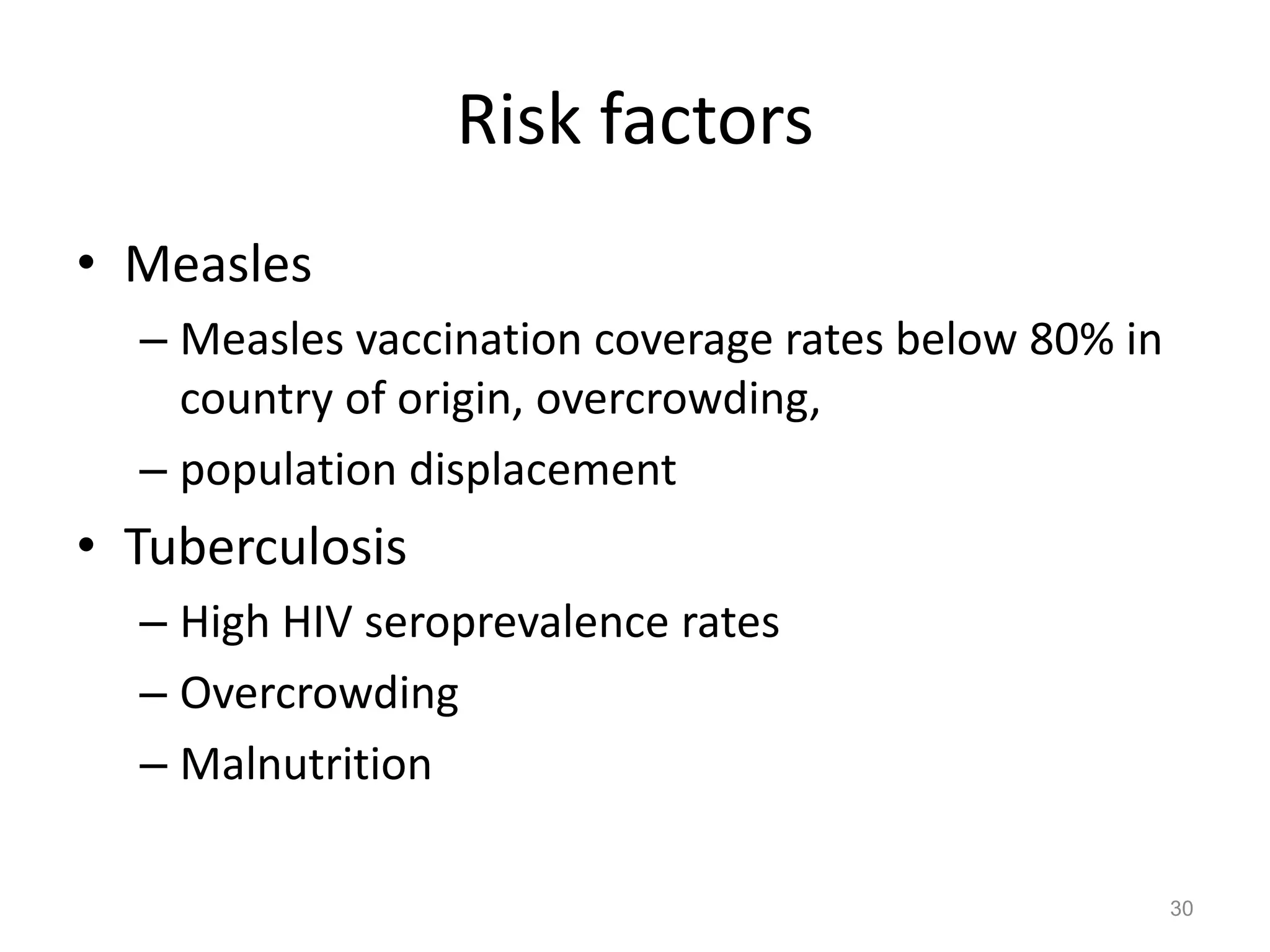
Risk factors
• Measles
  – Measles vaccination coverage rates below 80% in
    country of origin, overcrowding,
  – population displacement
• Tuberculosis
  – High HIV seroprevalence rates
  – Overcrowding
  – Malnutrition

                                                      30
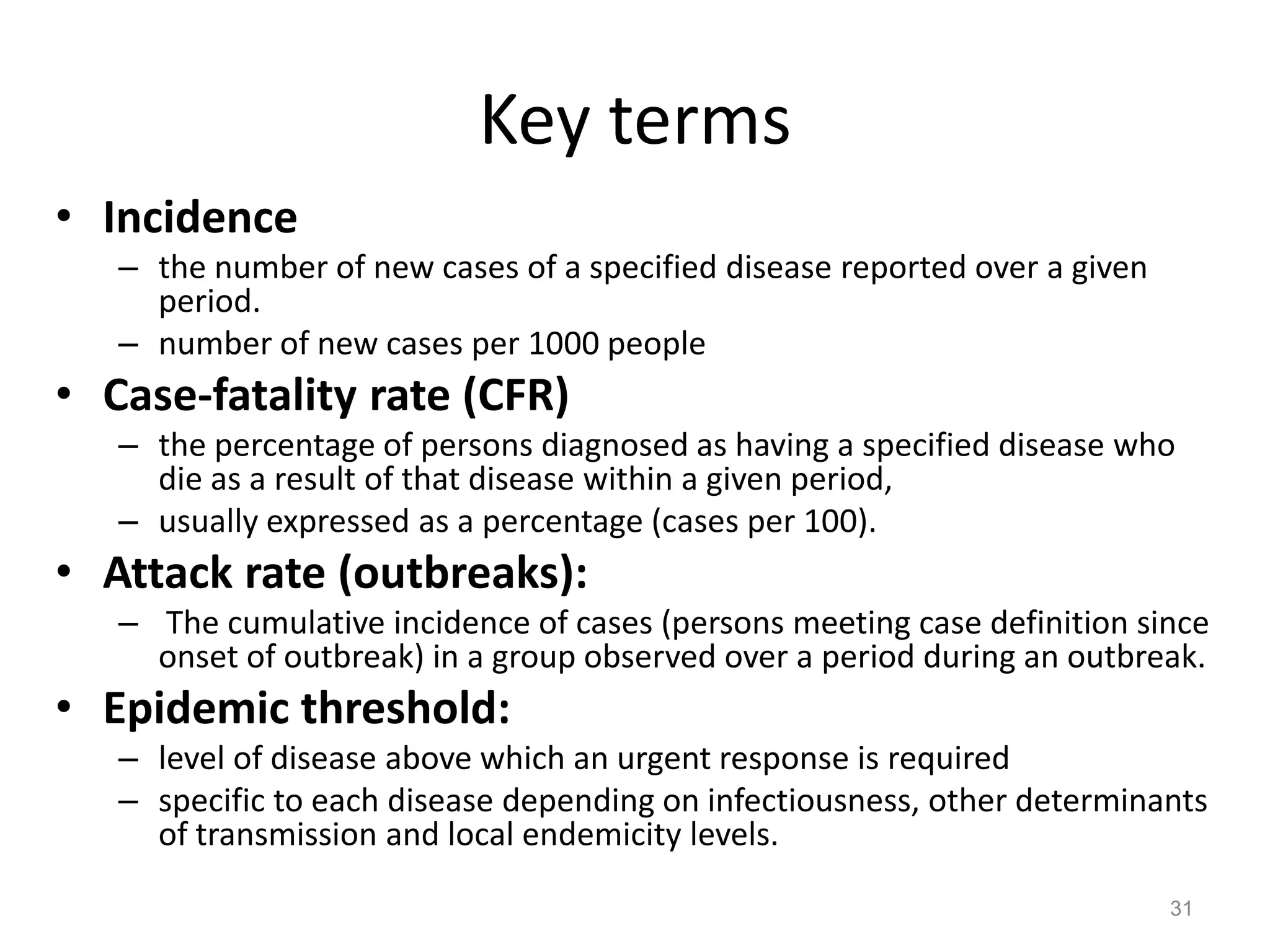
Key terms
• Incidence
   – the number of new cases of a specified disease reported over a given
     period.
   – number of new cases per 1000 people
• Case-fatality rate (CFR)
   – the percentage of persons diagnosed as having a specified disease who
     die as a result of that disease within a given period,
   – usually expressed as a percentage (cases per 100).
• Attack rate (outbreaks):
   – The cumulative incidence of cases (persons meeting case definition since
     onset of outbreak) in a group observed over a period during an outbreak.
• Epidemic threshold:
   – level of disease above which an urgent response is required
   – specific to each disease depending on infectiousness, other determinants
     of transmission and local endemicity levels.
                                                                            31
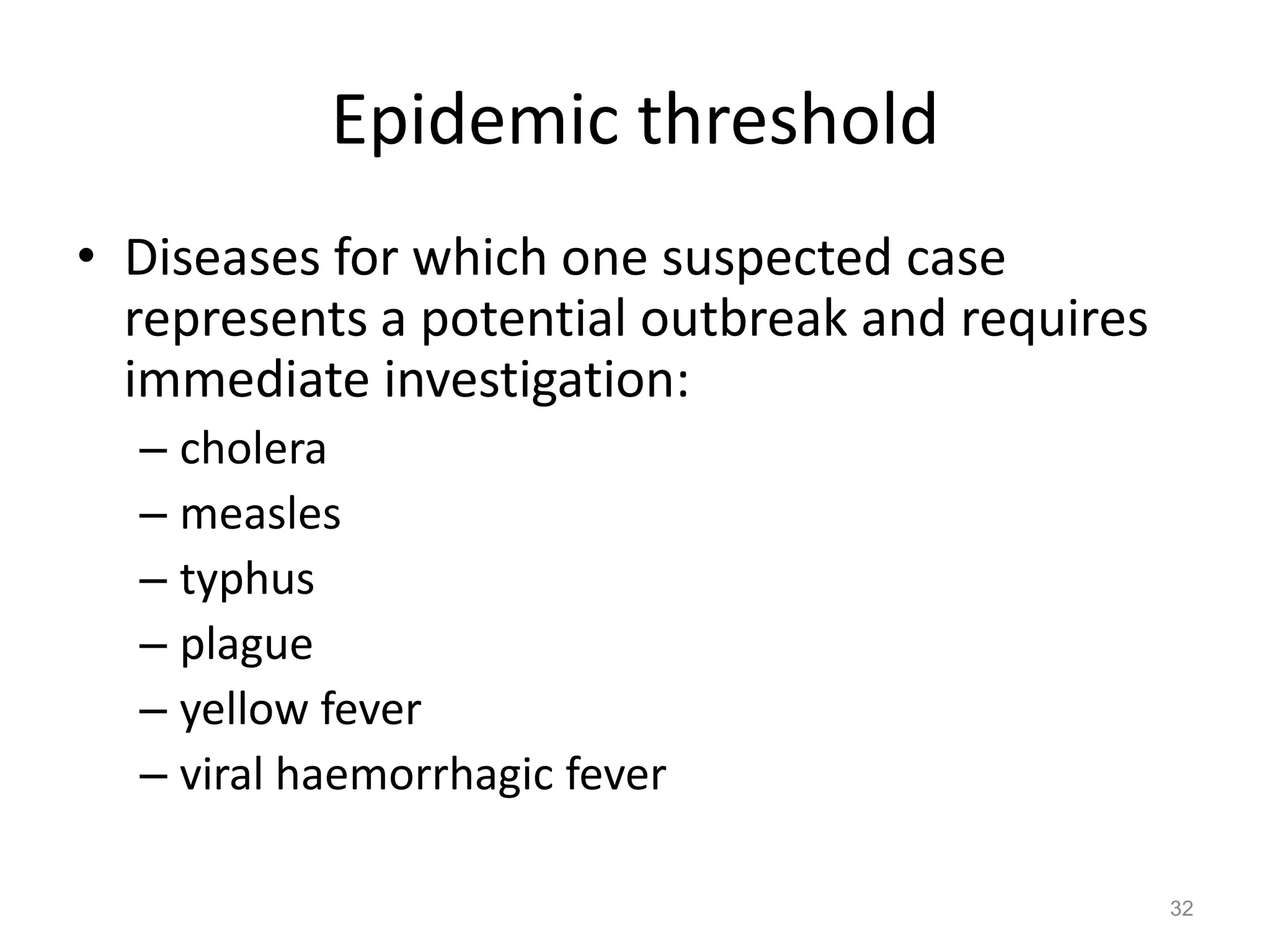
Epidemic threshold
• Diseases for which one suspected case
  represents a potential outbreak and requires
  immediate investigation:
  – cholera
  – measles
  – typhus
  – plague
  – yellow fever
  – viral haemorrhagic fever

                                                 32
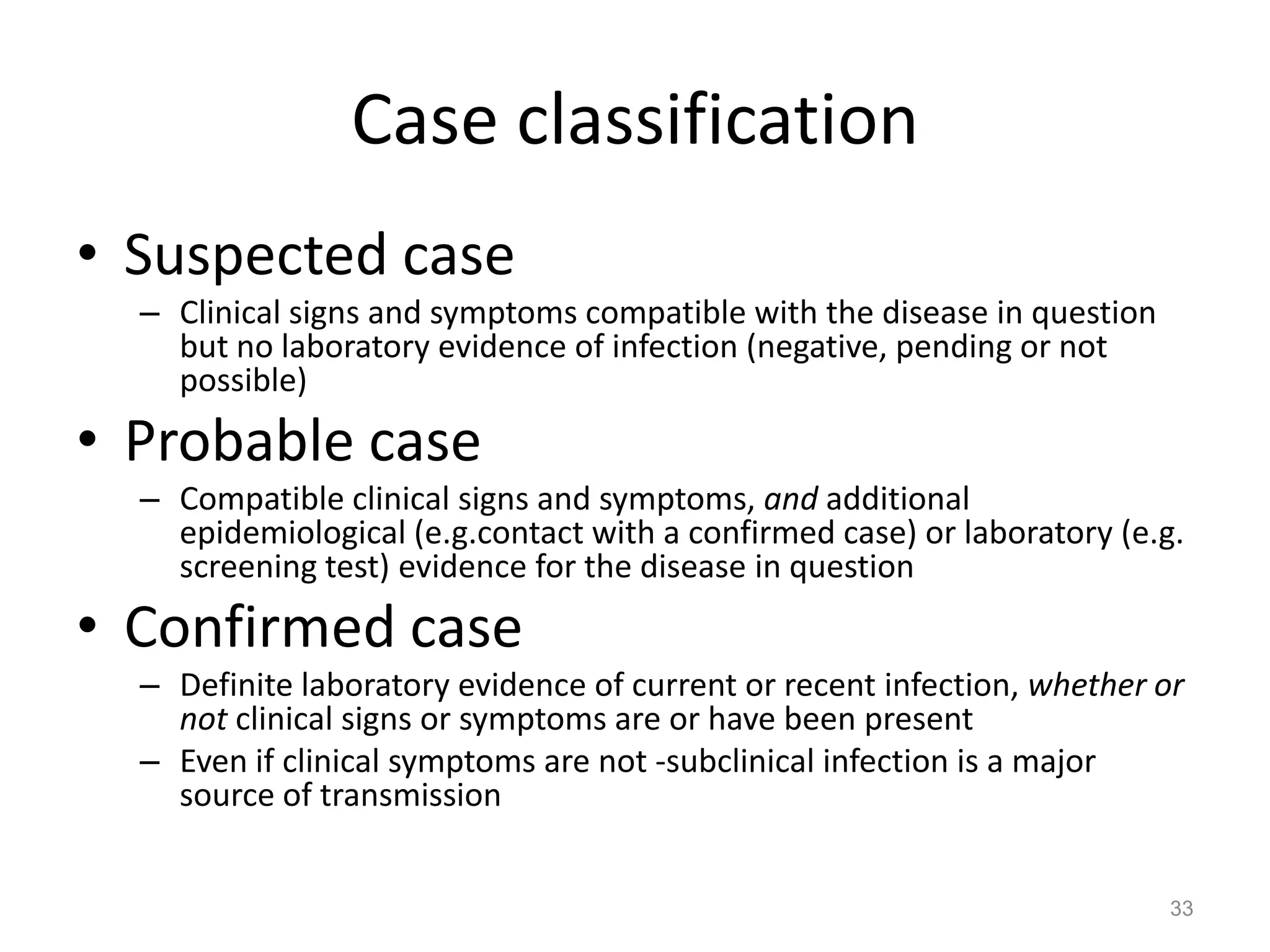
Case classification
• Suspected case
  – Clinical signs and symptoms compatible with the disease in question
    but no laboratory evidence of infection (negative, pending or not
    possible)
• Probable case
  – Compatible clinical signs and symptoms, and additional
    epidemiological (e.g.contact with a confirmed case) or laboratory (e.g.
    screening test) evidence for the disease in question
• Confirmed case
  – Definite laboratory evidence of current or recent infection, whether or
    not clinical signs or symptoms are or have been present
  – Even if clinical symptoms are not -subclinical infection is a major
    source of transmission


                                                                          33
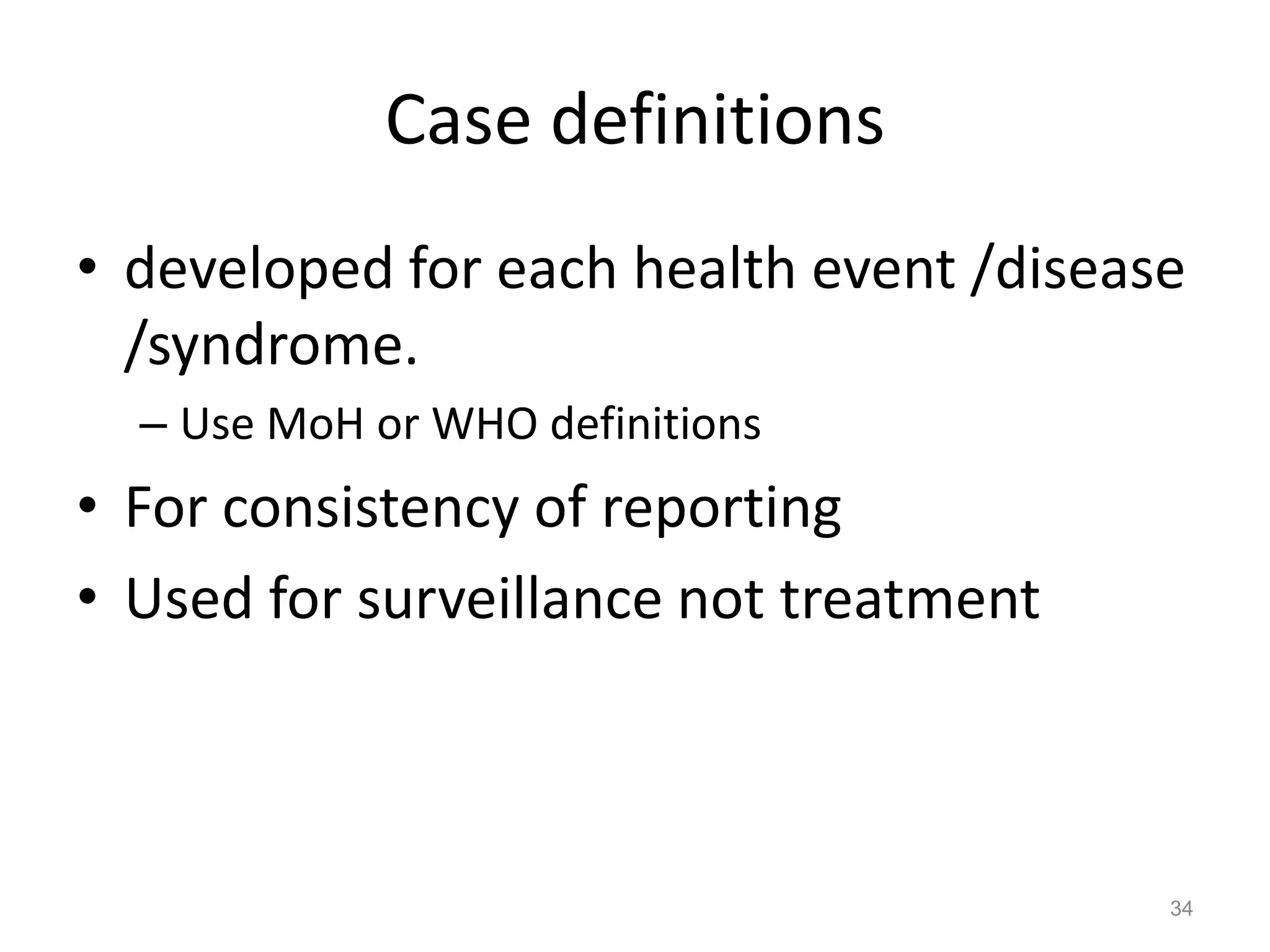
Case definitions
• developed for each health event /disease
  /syndrome.
  – Use MoH or WHO definitions
• For consistency of reporting
• Used for surveillance not treatment


                                         34
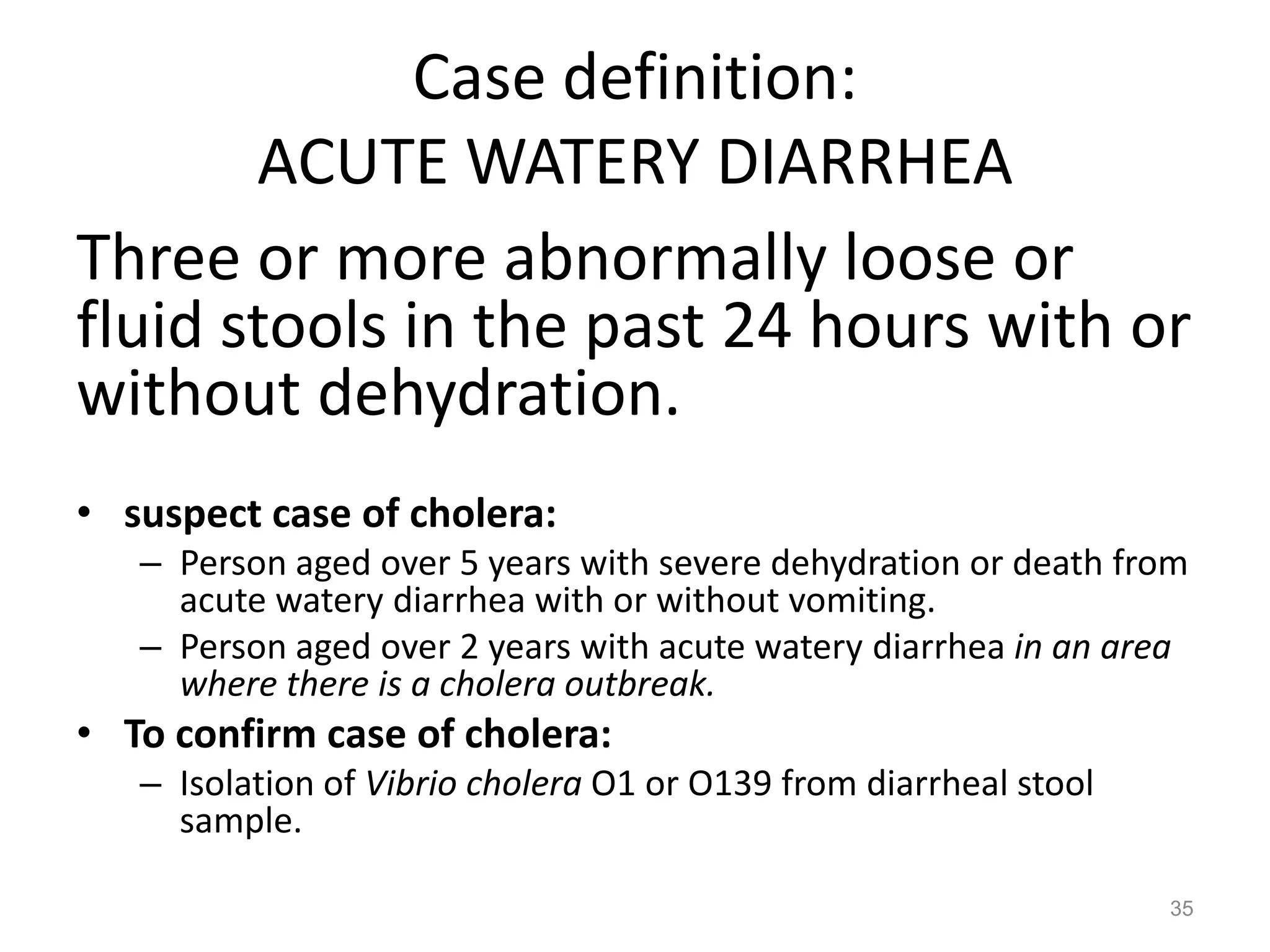
Case definition:
       ACUTE WATERY DIARRHEA
Three or more abnormally loose or
fluid stools in the past 24 hours with or
without dehydration.
• suspect case of cholera:
   – Person aged over 5 years with severe dehydration or death from
     acute watery diarrhea with or without vomiting.
   – Person aged over 2 years with acute watery diarrhea in an area
     where there is a cholera outbreak.
• To confirm case of cholera:
   – Isolation of Vibrio cholera O1 or O139 from diarrheal stool
     sample.

                                                                   35
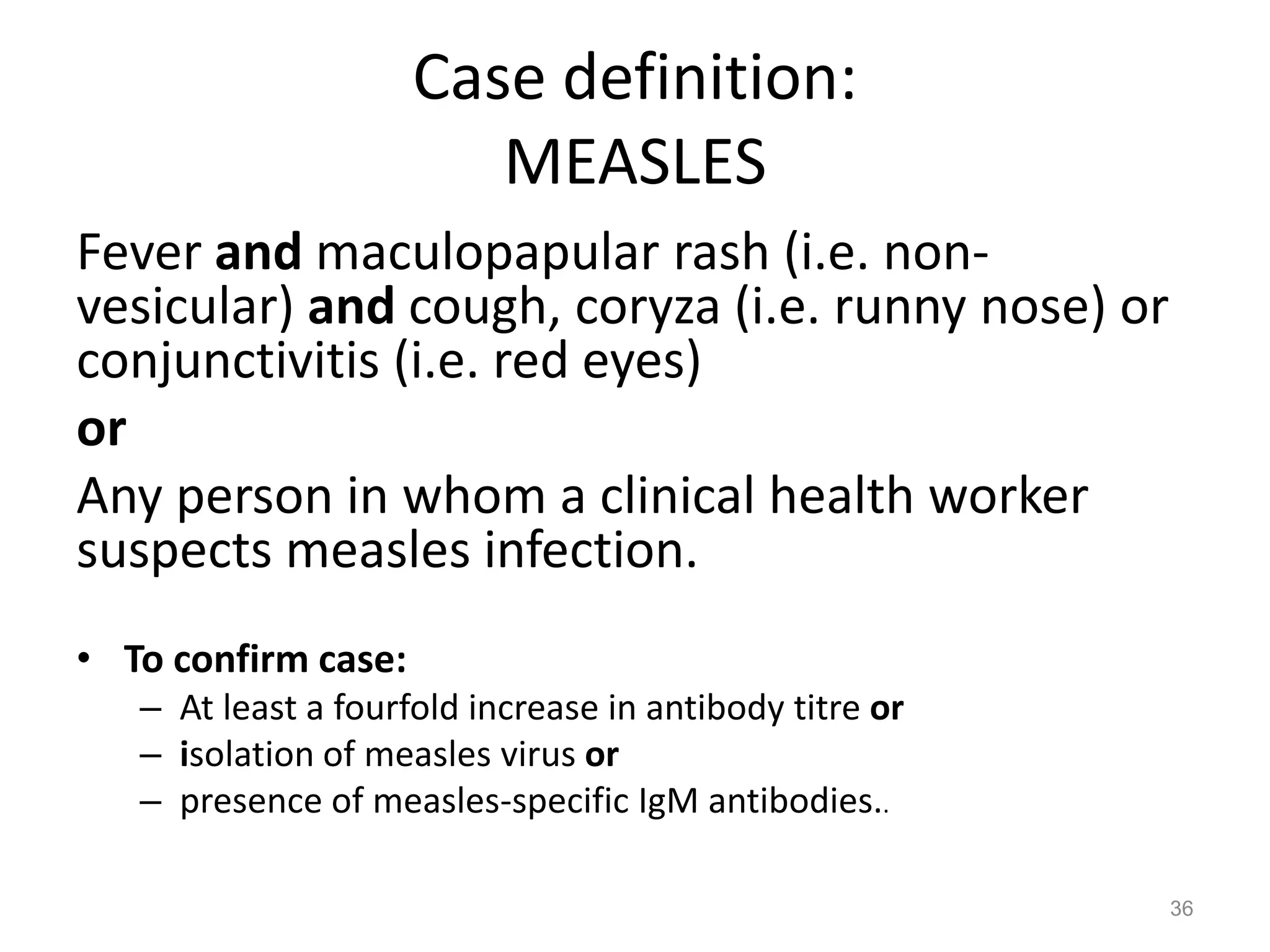
Case definition:
                        MEASLES
Fever and maculopapular rash (i.e. non-
vesicular) and cough, coryza (i.e. runny nose) or
conjunctivitis (i.e. red eyes)
or
Any person in whom a clinical health worker
suspects measles infection.
• To confirm case:
   – At least a fourfold increase in antibody titre or
   – isolation of measles virus or
   – presence of measles-specific IgM antibodies..

                                                         36
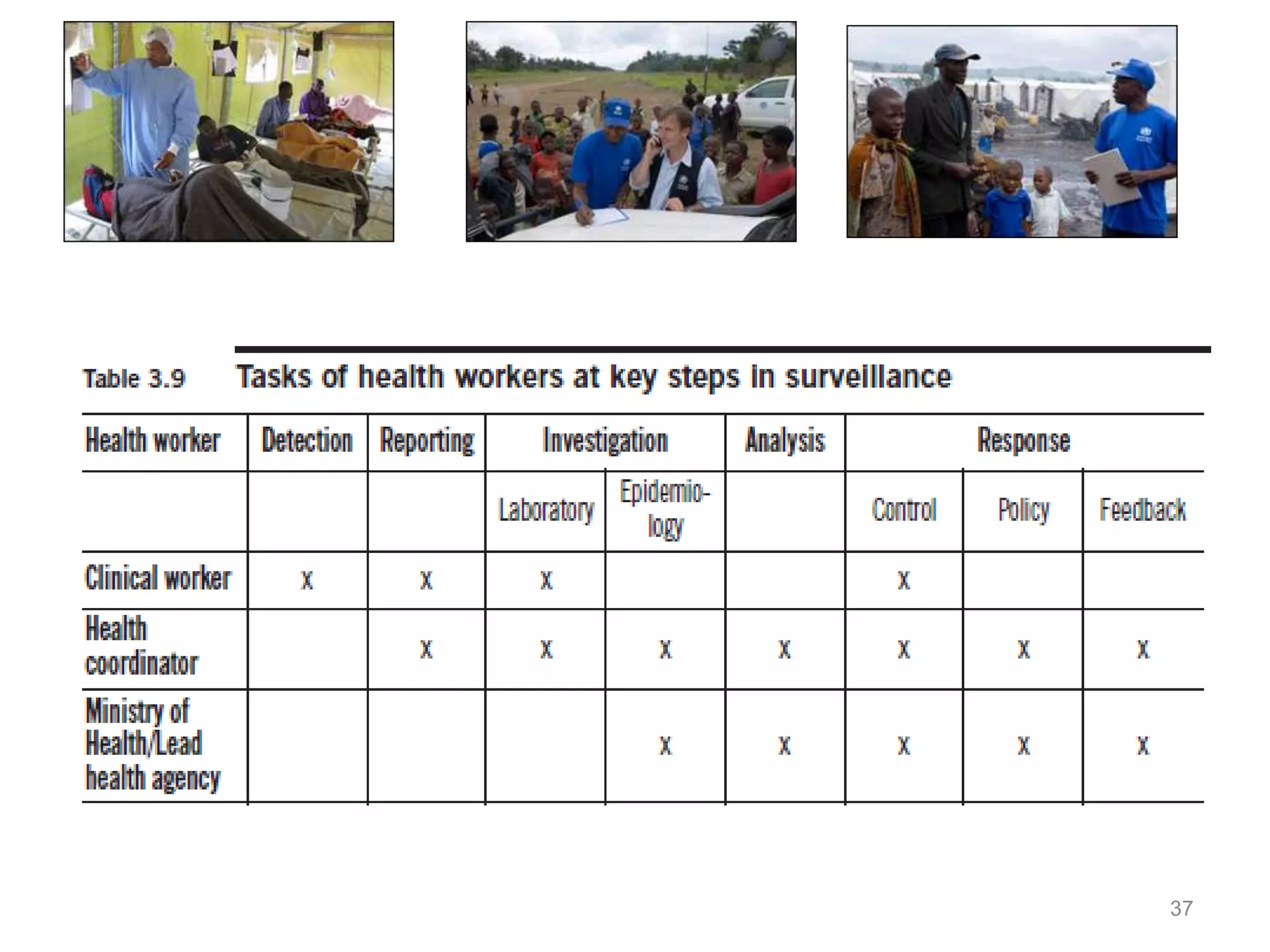
37
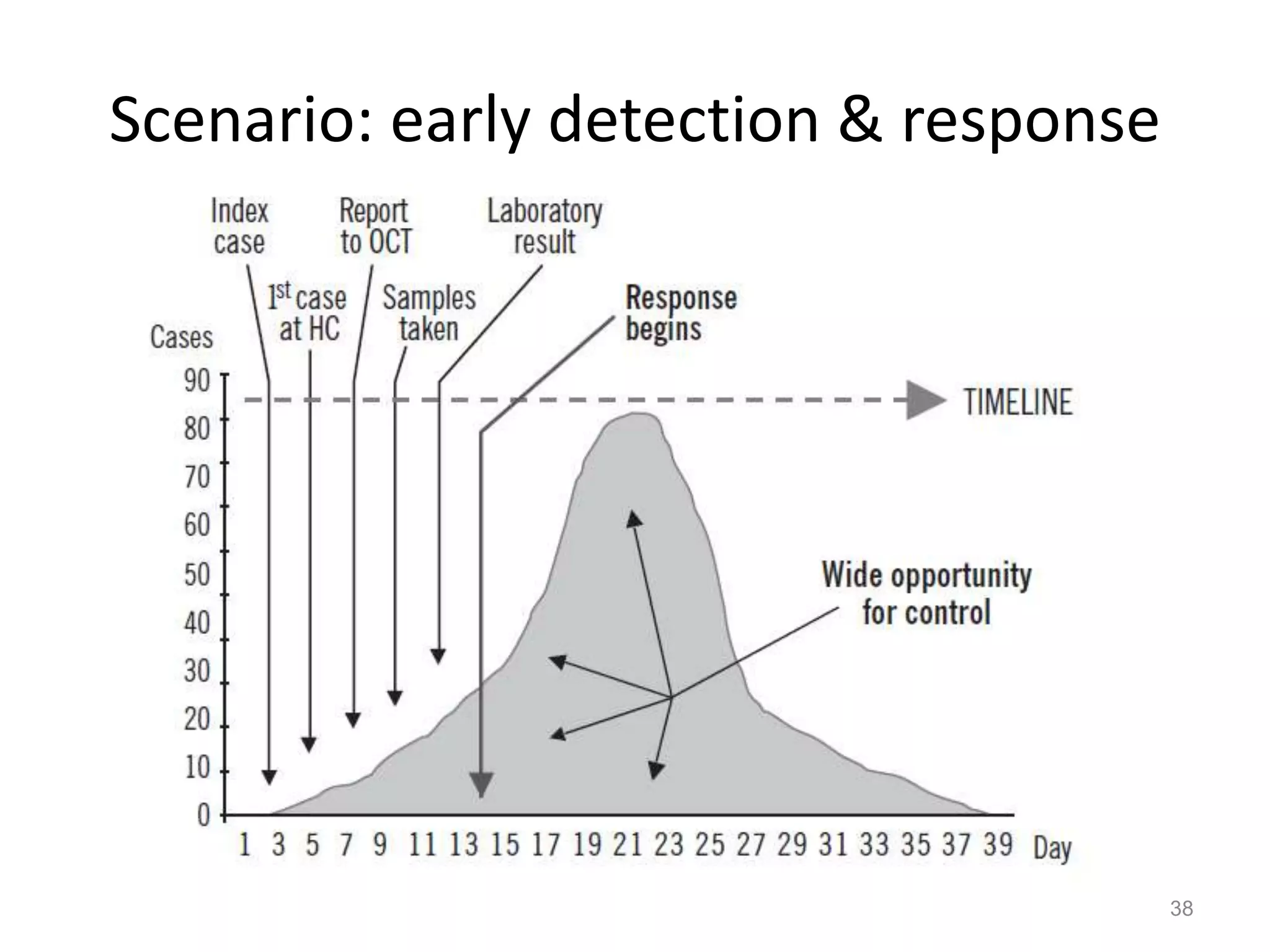
Scenario: early detection & response


                                       38
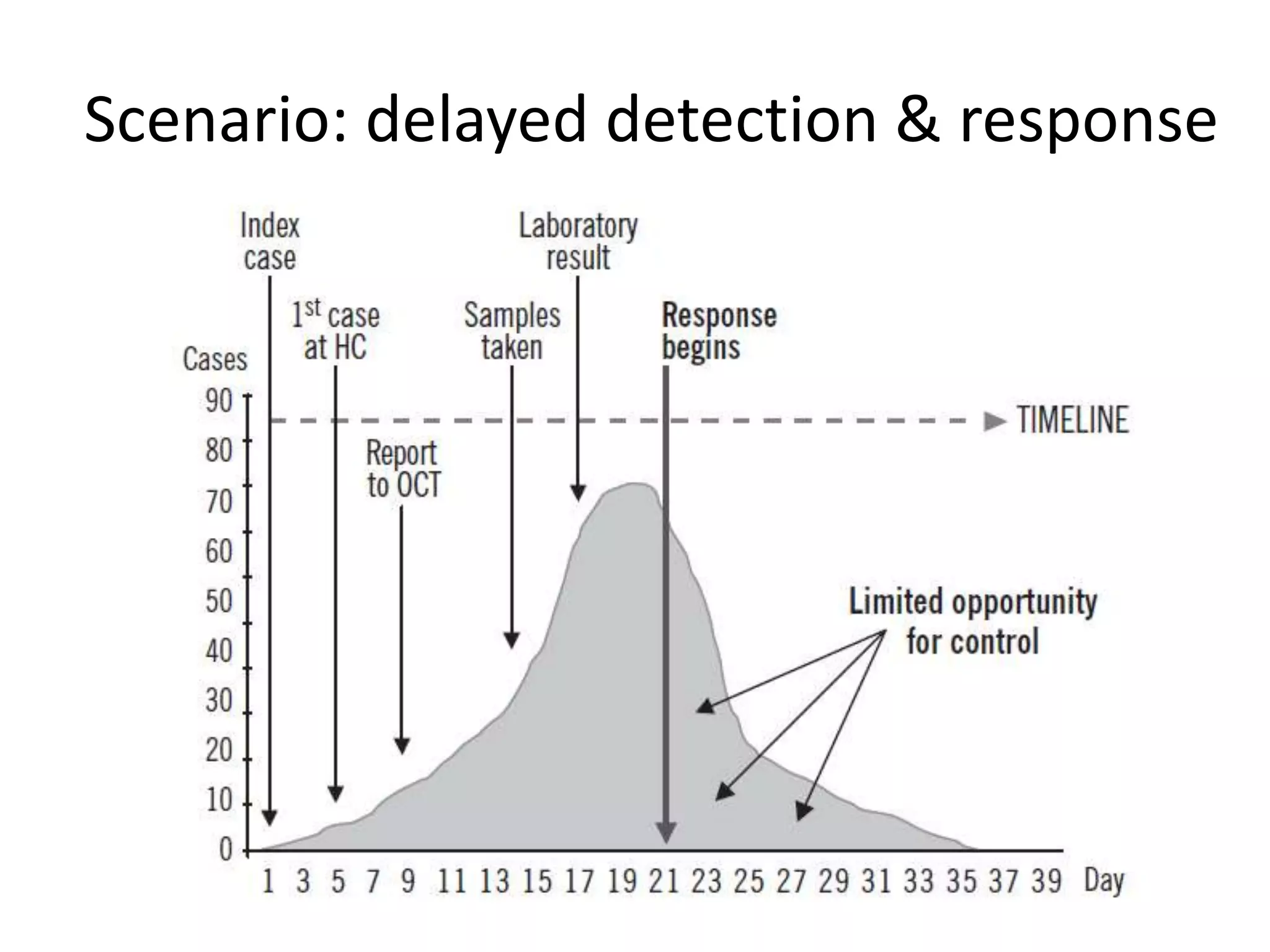
Scenario: delayed detection & response


                                    39
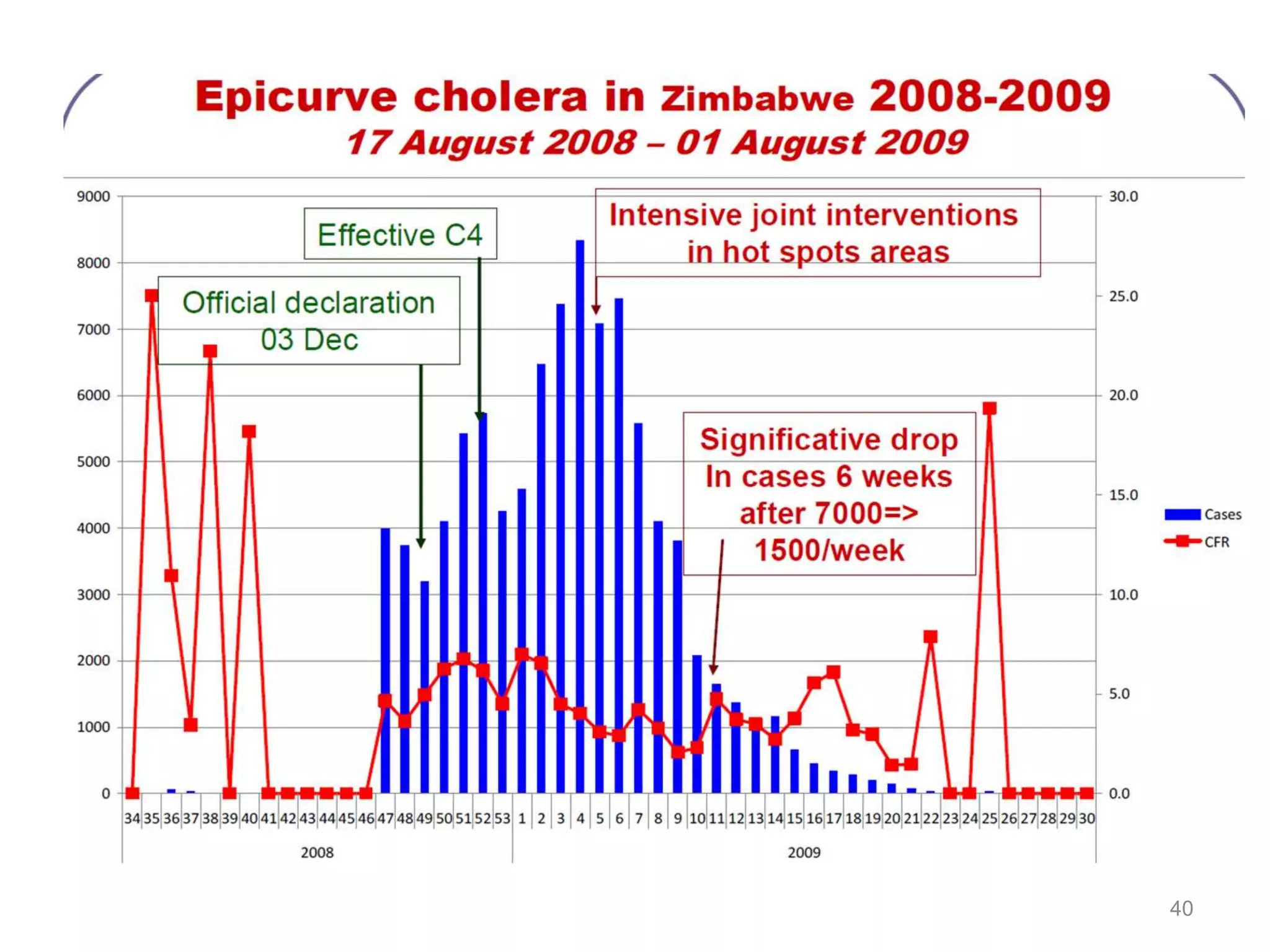
40
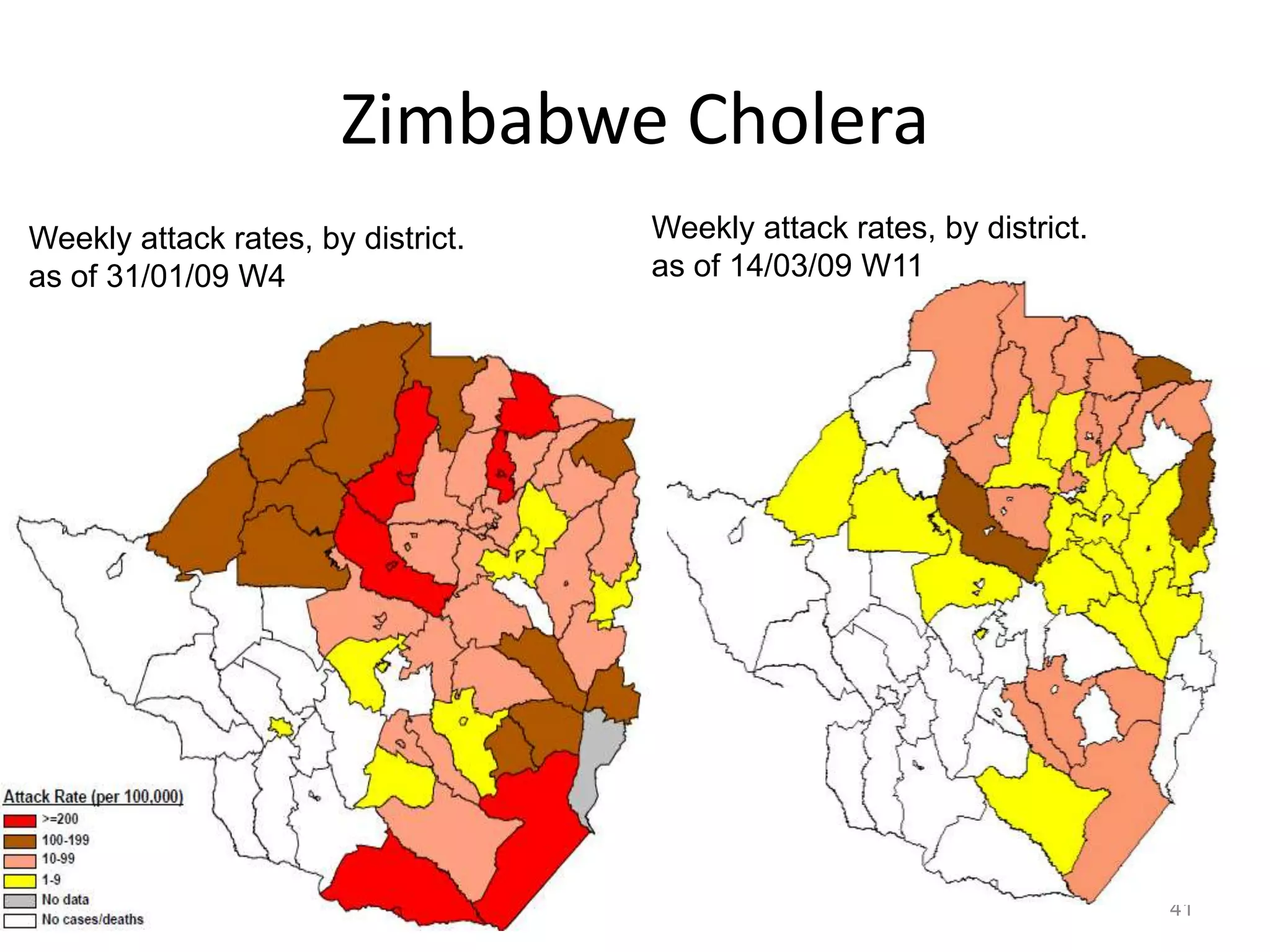
Zimbabwe Cholera
Weekly attack rates, by district.   Weekly attack rates, by district.
as of 31/01/09 W4                   as of 14/03/09 W11


                                                                        41
Global system
• CDC
  – International Emergency and Refugee Health Branch
• European CDC
• WHO
  – DCE (disease control in humanitarian emergencies)
     • Part of Global Alert and Response department
     • Produce “public health risk assessment” for crises
  – GOARN (global alert and response network)
    http://video.who.int/streaming/eprfilms/GOARN_Wor
    king_Together_in_Outbreak_Response.wmv
  – Event management system

                                                            42
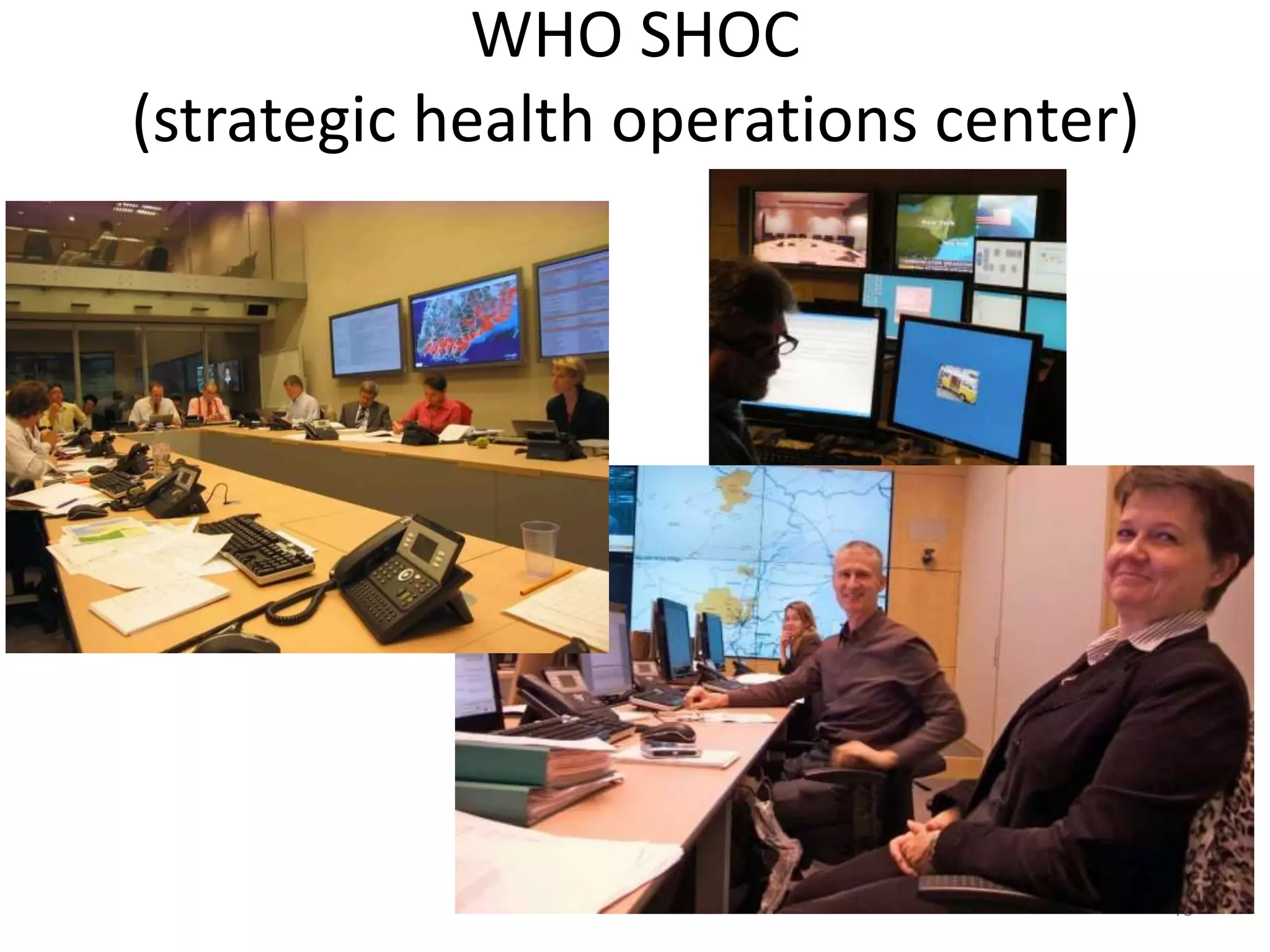
WHO SHOC
(strategic health operations center)


                                       43
International Health Regulations
• Legally binding international treaty
   – 194 signatory countries
   – entered into force on 15 June 2007,
• Purpose: enable international community to
  prevent and respond to acute public health risks
   – potential to cross borders and threaten people
     worldwide
• requires countries to report certain disease
  outbreaks and public health events to WHO.
• requires countries to strengthen their existing
  capacities for public health surveillance and
  response.

                                                      44
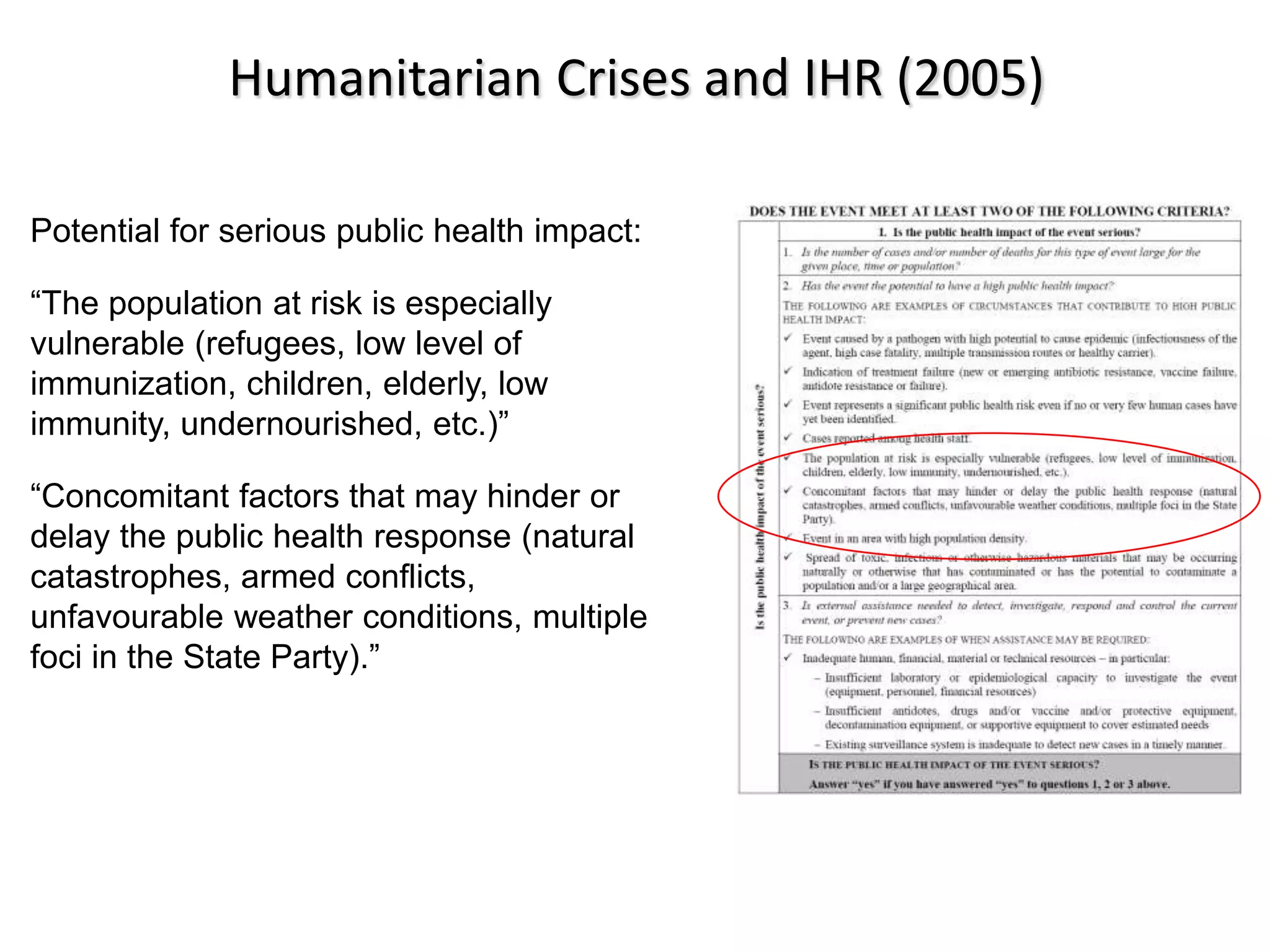
Humanitarian Crises and IHR (2005)

Potential for serious public health impact:

“The population at risk is especially
vulnerable (refugees, low level of
immunization, children, elderly, low
immunity, undernourished, etc.)”

“Concomitant factors that may hinder or
delay the public health response (natural
catastrophes, armed conflicts,
unfavourable weather conditions, multiple
foci in the State Party).”
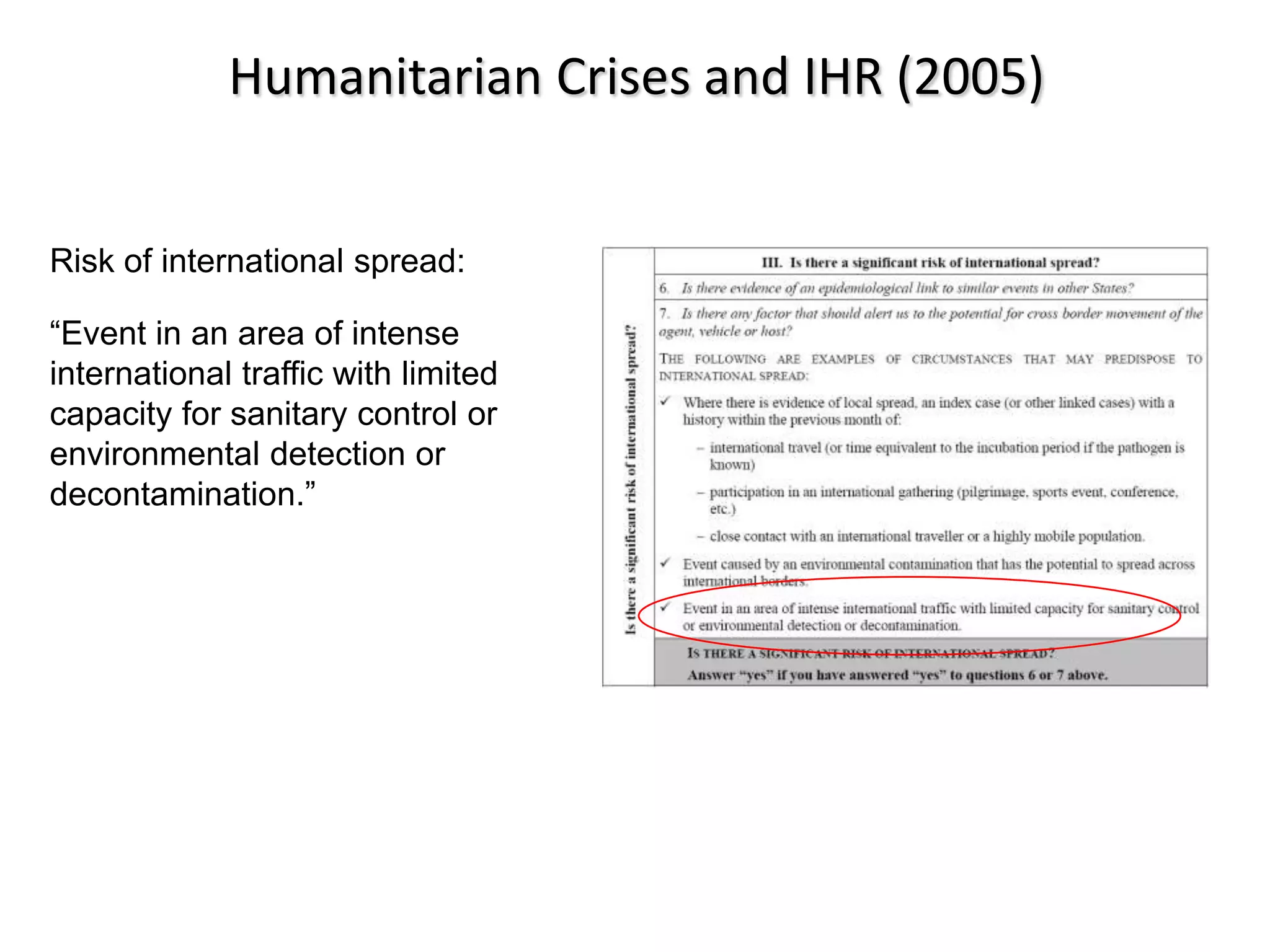
Humanitarian Crises and IHR (2005)


Risk of international spread:

“Event in an area of intense
international traffic with limited
capacity for sanitary control or
environmental detection or
decontamination.”

Communicable diseases hha_2012w.2

  • 1.
    Communicable Diseases in humanitarian settings 1
  • 2.
    “communicable” diseases Infectious diseasesthat can be transmitted from one individual to another either directly by contact or indirectly by fomites and vectors. 2
  • 3.
    Communicable diseases Food- and Zoonoses and vector borne Air-borne diseases water-borne diseases • Brucellosis • Legionellosis  Cholera • Echinococcosis • Meningococcal disease  Hepatitis  Botulism • Rabies • Pneumococcal infections  Campylobacteriosis • Malaria • Tuberculosis  Cryptosporidiosis • Plague • Viral haemorrhagic fevers  Giardiasis Sexually transmitted diseases Diseases preventable by  E.coli vaccination • Chlamydia infections  Leptospirosis • Gonococcal infections • Diphtheria  Listeriosis  Salmonellosis • HIV-infection • Haemophilus influenza  Shigellosis • Syphilis • Measles  Toxoplasmosis Viral hepatitis • Mumps  Trichinosis • Pertussis • Hepatitis A  Yersinosis • Hepatitis B • Poliomyelitis • Hepatitis C • Rubella
  • 4.
    WHO 2004: Lowincome countries leading mortality causes Neonatal infections Malaria Lower respiratory infections Tuberculosis Chronic obstructive pulmonary disease Diarrhoeal diseases Coronary heart disease HIV/AIDS Stroke and other Prematurity and cerebrovascular low birth weight diseases 4
  • 5.
    MDG 6 Combat HIV/AIDS,Malaria and Other Diseases • targets – 1. Halt and begin to reverse, by 2015, the spread of HIV/AIDS – 2. Achieve, by 2010, universal access to treatment for HIV/AIDS for all those who need it – 3. Halt and begin to reverse, by 2015, the incidence of malaria and other major diseases 5
  • 6.
    HIV and crises •How do crises affect HIV? 6
  • 7.
    1. Communicable diseasecycle Death Progression Healthy of disease State Immunity Clinical Risk factors Illness Exposure factors Biological Susceptibility to evidence of infection infection 7
  • 8.
    Communicable diseases Population Vulnerability Individual susceptibility Risk exposure Individual physical and material resources Immunity to pathogens Health care services 8
  • 9.
    Higher incidence Crises Higher mortality Malnutrition Absence / Poor Communicable Disruption Hygiene Diseases of health Wat/San care Poor Living Conditions Epidemics 9
  • 10.
    Effects of outbreakson health system 1. Population panic 2. Overcrowding of Health Services I. Overwork of Health Staff II. Health Staff at exposed risk III. Risk to patients 3. Malfunction of Health Services 4. Increased morbidity I. Further spread of outbreaks 5. Increased mortality 6. Economic and social consequences 10
  • 11.
    2. What canbe done? Treatment Surveillance Death Progression of Healthy disease State Containment Immunity Clinical Risk factors Illness Exposure factors Prevention Biological Susceptibility to evidence of infection infection 11
  • 12.
    Rapid assessment Surveillance Survey Often qualitative or quantitative data quantitative data semi-quantitative data wide variety of data limited data Can gather wide variety of data data on convenience Often tries to gather data on Usually gathers data on sample of people and every case of illness sample of population facilities data at a single point in data over ongoing, data at single point in time prospective time period time gathers data for Gathers data for numerator Gathers data for numerator of prevalence of incidence and prevalence numerator and and incidence; ; Denominator must come denominator, allowing Denominator must come from separate source. calculation of from separate source prevalence or incidence rates
  • 13.
    surveillance • Systematic ongoingcollection, collation, and analysis of data and the timely dissemination of information to those who need to know so that action can be taken. » World Health Organization • The ongoing systematic collection, analysis, and interpretation of health data, essential to the planning, implementation, and evaluation of public health practice, closely integrated with the timely dissemination of these data to those who need to know. » US Centers for Disease Control and Prevention
  • 14.
    Surveillance • Passive Surveillance– uses available data or reporting from health care provider or regional health officer • Active Surveillance – periodic field visits to health care facilities to identify new cases 14
  • 15.
  • 16.
    Prevention • Public level – Vector control – Water and sanitation systems – Blood safety requirements • Individual level – Hand washing – Condoms • Public / Individual level – Vaccination • Routine or during outbreaks 16
  • 17.
    Control measures • Preventionof exposure: – Isolation, vector control, containment – Hygiene and education • Prevention of infection: – Vaccination, clean water • Prevention of disease: – prophylaxis • Prevention of death: – Case identification and management 17
  • 18.
    Surveillance in emergencies •Objectives – identify public health priorities; – monitor the severity of an emergency by collecting and analyzing mortality and morbidity data; – detect outbreaks and monitor response; – monitor trends in incidence and case-fatality from major diseases; – monitor the impact of specific health interventions – provide information for programme planning, implementation and adaptation, and resource mobilization. DATA ➜ INFORMATION ➜ ACTION 18
  • 19.
    Disease Early WarningSystem (DEWS) Pakistan • Covered 92 districts and ~ 60% of the population. • centralized in Islamabad, with regional hubs and surveillance officers active at district level. • Weekly reporting includes priority epidemic diseases and those with high morbidity & flood related diseases. • Data sources include up to 2600 basic health units and all large government hospitals, • Data relayed using a variety of media, SMS, fax, and telephone. • Widespread compliance, due in part to the regular visits of the surveillance officers to facilities. 19
  • 20.
    Disease Early WarningSystem (DEWS) Pakistan • quantity of weekly data reported places very high work burden on the surveillance officers, many of whom cover wide geographical areas. • A lot of data but… – 90% of outbreaks have been detected by formal immediate alerts. – Only 10% were detected through data analysis. • incompatibilities with other “vertical” surveillance systems • Not transitioning to integration into routine government surveillance systems 20
  • 21.
    DEWS- Film • http://www.youtube.com/watch?v=s2Q5oQx4 dGw&feature=bf_prev&list=ULQRFpUxJxcoE&l f=mfu_in_order 21
  • 22.
    True or False •The geographical distribution of reported cases is indicative of where the disease is the worst. • The case fatality rate data from health facilities is indicative of how deadly a disease is • In a complex emergency where systems are disrupted it is important for the emergency surveillance system to capture as much information as possible • HIV, TB and Malaria get a lot of attention and money from global initiatives so it is not appropriate to spend humanitarian funds 22
  • 23.
    Key information fordesigning surveillance systems • What is the population under surveillance – displaced population, local population etc • What data should be collected and why • Who will provide the data • What is the period of time of the data collection? • How will the data be transferred (data flow)? • Who will analyse the data and how often? • How will reports be disseminated and how often? 23
  • 24.
    Questions to askwhen selecting diseases /conditions • Does the condition result in a high disease impact (morbidity, disability, mortality)? • Does it have a significant epidemic potential (e.g. cholera, meningitis, measles)? • Is it a specific target of a national, regional or international control programme? (e.g.malaria, TB) • Will the information to be collected lead to significant and cost-effective public health action? 24
  • 25.
    Key diseases toconsider • bloody diarrhea, • acute watery diarrhea, • suspected cholera, • lower respiratory tract infection, • measles, • meningitis. • Other endemic /epidemic prone diseases (eg malaria or viral haemorrhagic fevers) 25
  • 26.
    Risk factors • Diarrhealdiseases – Overcrowding – Inadequate quantity and/or quality of water – Poor personal hygiene – Poor washing facilities – Poor sanitation – Insufficient soap – Inadequate cooking facilities 26
  • 27.
    Risk factors • Acuterespiratory infections – Inadequate shelter with poor ventilation – Indoor cooking, poor health care services – Malnutrition, overcrowding – Age group under 1 year old – Large numbers of elderly – Cold weather 27
  • 28.
    Risk factors • Meningococcalmeningitis – Meningitis belt (although the pattern is changing to include eastern, southern & central Africa) – Dry season – Dust storms – Overcrowding – High rates of acute respiratory infections 28
  • 29.
    Risk factors • Malaria – Movement of people from endemic into malaria-free zones or from areas of low endemicity to hyperendemic areas – Interruption of vector control measures – Increased population density promoting mosquito bites – Stagnant water – Inadequate health care services – Flooding – Changes in weather patterns 29
  • 30.
    Risk factors • Measles – Measles vaccination coverage rates below 80% in country of origin, overcrowding, – population displacement • Tuberculosis – High HIV seroprevalence rates – Overcrowding – Malnutrition 30
  • 31.
    Key terms • Incidence – the number of new cases of a specified disease reported over a given period. – number of new cases per 1000 people • Case-fatality rate (CFR) – the percentage of persons diagnosed as having a specified disease who die as a result of that disease within a given period, – usually expressed as a percentage (cases per 100). • Attack rate (outbreaks): – The cumulative incidence of cases (persons meeting case definition since onset of outbreak) in a group observed over a period during an outbreak. • Epidemic threshold: – level of disease above which an urgent response is required – specific to each disease depending on infectiousness, other determinants of transmission and local endemicity levels. 31
  • 32.
    Epidemic threshold • Diseasesfor which one suspected case represents a potential outbreak and requires immediate investigation: – cholera – measles – typhus – plague – yellow fever – viral haemorrhagic fever 32
  • 33.
    Case classification • Suspectedcase – Clinical signs and symptoms compatible with the disease in question but no laboratory evidence of infection (negative, pending or not possible) • Probable case – Compatible clinical signs and symptoms, and additional epidemiological (e.g.contact with a confirmed case) or laboratory (e.g. screening test) evidence for the disease in question • Confirmed case – Definite laboratory evidence of current or recent infection, whether or not clinical signs or symptoms are or have been present – Even if clinical symptoms are not -subclinical infection is a major source of transmission 33
  • 34.
    Case definitions • developedfor each health event /disease /syndrome. – Use MoH or WHO definitions • For consistency of reporting • Used for surveillance not treatment 34
  • 35.
    Case definition: ACUTE WATERY DIARRHEA Three or more abnormally loose or fluid stools in the past 24 hours with or without dehydration. • suspect case of cholera: – Person aged over 5 years with severe dehydration or death from acute watery diarrhea with or without vomiting. – Person aged over 2 years with acute watery diarrhea in an area where there is a cholera outbreak. • To confirm case of cholera: – Isolation of Vibrio cholera O1 or O139 from diarrheal stool sample. 35
  • 36.
    Case definition: MEASLES Fever and maculopapular rash (i.e. non- vesicular) and cough, coryza (i.e. runny nose) or conjunctivitis (i.e. red eyes) or Any person in whom a clinical health worker suspects measles infection. • To confirm case: – At least a fourfold increase in antibody titre or – isolation of measles virus or – presence of measles-specific IgM antibodies.. 36
  • 37.
  • 38.
  • 39.
  • 40.
  • 41.
    Zimbabwe Cholera Weekly attackrates, by district. Weekly attack rates, by district. as of 31/01/09 W4 as of 14/03/09 W11 41
  • 42.
    Global system • CDC – International Emergency and Refugee Health Branch • European CDC • WHO – DCE (disease control in humanitarian emergencies) • Part of Global Alert and Response department • Produce “public health risk assessment” for crises – GOARN (global alert and response network) http://video.who.int/streaming/eprfilms/GOARN_Wor king_Together_in_Outbreak_Response.wmv – Event management system 42
  • 43.
    WHO SHOC (strategic healthoperations center) 43
  • 44.
    International Health Regulations •Legally binding international treaty – 194 signatory countries – entered into force on 15 June 2007, • Purpose: enable international community to prevent and respond to acute public health risks – potential to cross borders and threaten people worldwide • requires countries to report certain disease outbreaks and public health events to WHO. • requires countries to strengthen their existing capacities for public health surveillance and response. 44
  • 45.
    Humanitarian Crises andIHR (2005) Potential for serious public health impact: “The population at risk is especially vulnerable (refugees, low level of immunization, children, elderly, low immunity, undernourished, etc.)” “Concomitant factors that may hinder or delay the public health response (natural catastrophes, armed conflicts, unfavourable weather conditions, multiple foci in the State Party).”
  • 46.
    Humanitarian Crises andIHR (2005) Risk of international spread: “Event in an area of intense international traffic with limited capacity for sanitary control or environmental detection or decontamination.”