4210011 0010 1010 1101 0001 0100 1011
421
0011 0010 1010 1101 0001 0100 1011
TOPIC:
PACKAGING AND STORAGE OF EGG
• SUBMITTED TO:
DR AJMAL
• SUBMITTED BY:
NASIR ALI
15S933
HAMZA GHAFOR
15S935
421
0011 0010 1010 1101 0001 0100 1011
Requirements for containers and outer
containers:
• Made from suitable material.
• Should not give off any taste or odour to the eggs.
• Strong so that it will not bulge out or buckle in during normal
handling or transporting.
• Should not absorb excessive moisture during cooling.
• Free from any matter other than the eggs packed therein.
• Unbroken.
421
0011 0010 1010 1101 0001 0100 1011
Requirements for containers and outer
containers:
• When reused: clean before eggs are packed, remove all
marks and labels or cover with new labels.
• Should close properly.
421
0011 0010 1010 1101 0001 0100 1011
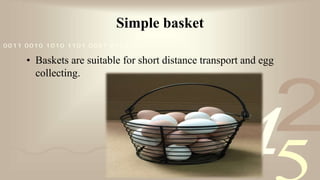
Simple basket
• Baskets are suitable for short distance transport and egg
collecting.
421
0011 0010 1010 1101 0001 0100 1011
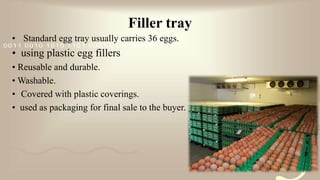
Filler tray
• Standard egg tray usually carries 36 eggs.
• using plastic egg fillers
• Reusable and durable.
• Washable.
• Covered with plastic coverings.
• used as packaging for final sale to the buyer.
421
0011 0010 1010 1101 0001 0100 1011
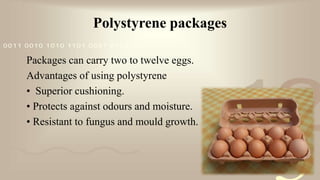
Polystyrene packages
Packages can carry two to twelve eggs.
Advantages of using polystyrene
• Superior cushioning.
• Protects against odours and moisture.
• Resistant to fungus and mould growth.
421
0011 0010 1010 1101 0001 0100 1011
Functions of packaging
• Packaging protects the eggs from:
• Micro-organisms, such as bacteria
• Natural predators
• Loss of moisture
• Tainting
• Temperatures that cause deterioration; and
• possible crushing while being handled, stored or
transported.
421
0011 0010 1010 1101 0001 0100 1011
Advantages of packaging
• Protects the produce from damage.
• Convenient unit for distribution.
• Serves as an advertisement for the product.
• Labels/brands the product.
• Provides protection against odours and moisture.
421
0011 0010 1010 1101 0001 0100 1011
Storage of egg
Storage techniques :
1. Lime water method
2. Water glass method
3. Oil treatment
4. Thermostabilization
5. Use of gases
6. Drying
7. Refrigeration
8. Freezing
421
0011 0010 1010 1101 0001 0100 1011
Lime water treatment
• Lime water =1kg cao +20 L water
• Not soluble Dissolve
• Lime water filtrate
• Dip eggs
• Ca will deposit on shell
• Holes of shell are filled with Ca
• Pores are closed
421
0011 0010 1010 1101 0001 0100 1011
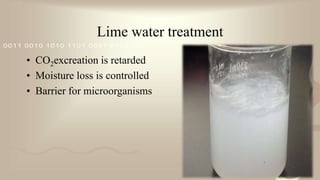
Lime water treatment
• CO2excreation is retarded
• Moisture loss is controlled
• Barrier for microorganisms
421
0011 0010 1010 1101 0001 0100 1011
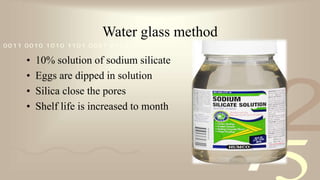
Water glass method
• 10% solution of sodium silicate
• Eggs are dipped in solution
• Silica close the pores
• Shelf life is increased to month
421
0011 0010 1010 1101 0001 0100 1011
Waxing/oil treatment
• Evaporation is reduced
• CO2-excretion retarded
• O2 is retorted to enter
• Less increase in Ph
• Oil is applied as spray or dip
• Life few month in cold storage
421
0011 0010 1010 1101 0001 0100 1011
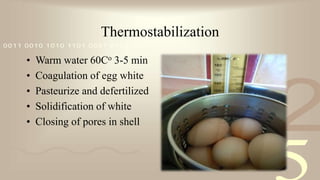
Thermostabilization
• Warm water 60Co 3-5 min
• Coagulation of egg white
• Pasteurize and defertilized
• Solidification of white
• Closing of pores in shell
421
0011 0010 1010 1101 0001 0100 1011
Use of Gases
• Nitrogen ,carbon dioxide-inert gases
• Causes cloudiness in egg white
• Egg should be packed in polyethylene before the use of
gases
421
0011 0010 1010 1101 0001 0100 1011
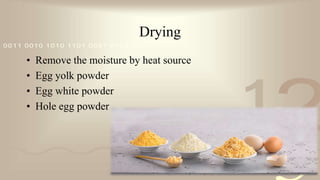
Drying
• Remove the moisture by heat source
• Egg yolk powder
• Egg white powder
• Hole egg powder
421
0011 0010 1010 1101 0001 0100 1011
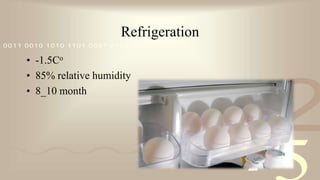
Refrigeration
• -1.5Co
• 85% relative humidity
• 8_10 month
421
0011 0010 1010 1101 0001 0100 1011
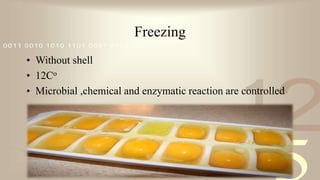
Freezing
• Without shell
• 12Co
• Microbial ,chemical and enzymatic reaction are controlled
421
0011 0010 1010 1101 0001 0100 1011

Packaging and storage of egg

  • 1.
    4210011 0010 10101101 0001 0100 1011
  • 2.
    421 0011 0010 10101101 0001 0100 1011 TOPIC: PACKAGING AND STORAGE OF EGG • SUBMITTED TO: DR AJMAL • SUBMITTED BY: NASIR ALI 15S933 HAMZA GHAFOR 15S935
  • 3.
    421 0011 0010 10101101 0001 0100 1011 Requirements for containers and outer containers: • Made from suitable material. • Should not give off any taste or odour to the eggs. • Strong so that it will not bulge out or buckle in during normal handling or transporting. • Should not absorb excessive moisture during cooling. • Free from any matter other than the eggs packed therein. • Unbroken.
  • 4.
    421 0011 0010 10101101 0001 0100 1011 Requirements for containers and outer containers: • When reused: clean before eggs are packed, remove all marks and labels or cover with new labels. • Should close properly.
  • 5.
    421 0011 0010 10101101 0001 0100 1011 Simple basket • Baskets are suitable for short distance transport and egg collecting.
  • 6.
    421 0011 0010 10101101 0001 0100 1011 Filler tray • Standard egg tray usually carries 36 eggs. • using plastic egg fillers • Reusable and durable. • Washable. • Covered with plastic coverings. • used as packaging for final sale to the buyer.
  • 7.
    421 0011 0010 10101101 0001 0100 1011 Polystyrene packages Packages can carry two to twelve eggs. Advantages of using polystyrene • Superior cushioning. • Protects against odours and moisture. • Resistant to fungus and mould growth.
  • 8.
    421 0011 0010 10101101 0001 0100 1011 Functions of packaging • Packaging protects the eggs from: • Micro-organisms, such as bacteria • Natural predators • Loss of moisture • Tainting • Temperatures that cause deterioration; and • possible crushing while being handled, stored or transported.
  • 9.
    421 0011 0010 10101101 0001 0100 1011 Advantages of packaging • Protects the produce from damage. • Convenient unit for distribution. • Serves as an advertisement for the product. • Labels/brands the product. • Provides protection against odours and moisture.
  • 10.
    421 0011 0010 10101101 0001 0100 1011 Storage of egg Storage techniques : 1. Lime water method 2. Water glass method 3. Oil treatment 4. Thermostabilization 5. Use of gases 6. Drying 7. Refrigeration 8. Freezing
  • 11.
    421 0011 0010 10101101 0001 0100 1011 Lime water treatment • Lime water =1kg cao +20 L water • Not soluble Dissolve • Lime water filtrate • Dip eggs • Ca will deposit on shell • Holes of shell are filled with Ca • Pores are closed
  • 12.
    421 0011 0010 10101101 0001 0100 1011 Lime water treatment • CO2excreation is retarded • Moisture loss is controlled • Barrier for microorganisms
  • 13.
    421 0011 0010 10101101 0001 0100 1011 Water glass method • 10% solution of sodium silicate • Eggs are dipped in solution • Silica close the pores • Shelf life is increased to month
  • 14.
    421 0011 0010 10101101 0001 0100 1011 Waxing/oil treatment • Evaporation is reduced • CO2-excretion retarded • O2 is retorted to enter • Less increase in Ph • Oil is applied as spray or dip • Life few month in cold storage
  • 15.
    421 0011 0010 10101101 0001 0100 1011 Thermostabilization • Warm water 60Co 3-5 min • Coagulation of egg white • Pasteurize and defertilized • Solidification of white • Closing of pores in shell
  • 16.
    421 0011 0010 10101101 0001 0100 1011 Use of Gases • Nitrogen ,carbon dioxide-inert gases • Causes cloudiness in egg white • Egg should be packed in polyethylene before the use of gases
  • 17.
    421 0011 0010 10101101 0001 0100 1011 Drying • Remove the moisture by heat source • Egg yolk powder • Egg white powder • Hole egg powder
  • 18.
    421 0011 0010 10101101 0001 0100 1011 Refrigeration • -1.5Co • 85% relative humidity • 8_10 month
  • 19.
    421 0011 0010 10101101 0001 0100 1011 Freezing • Without shell • 12Co • Microbial ,chemical and enzymatic reaction are controlled
  • 20.
    421 0011 0010 10101101 0001 0100 1011