



Conveyors
QU PUTEH QU PUTEH
Name: Abdul Mutalib Bin Idris
Course code: HFC 4033 AUTOMATION
i/c: 951008-07-5095
Matrix card: 1203546
Department: DMK 4A
Lecturer:Sir Muhammad Fauzi Bin Anuar
KOLEJ KEMAHIRAN TINGGI MARA
BALIK PULAU
1.Introduction and definition of
conveyor
2.Explain different Type for conveyor
3.How to knowledge the unit load of
conveyor
4.I LOVE U SO MUCH QYA
• A conveyor system is a common piece of
mechanical handling equipment that moves
materials from one location to another.
• According to Sclater, conveyor systems can be
divided into two classes: those that are part
of a machine for processing product, and
those that move products in various stages of
fabrication.
DEFINITION
TYPES OF CONVEYORS
MAMAMIAAAAAA
SCREW CONVEYORS
• The screw conveyor usually consists of a long-pitch
plate –steel helix mounted on shaft or spindle carried
in bearings within U-shaped trough.
• According to Hudson, for many functions, it is the
best type of conveyor.
FLIGHT AND APRON CONVEYORS
 FLIGHT CONVEYORS
The flight conveyor has an endless chain or twin
chains passing around sprockets at the head and
foot ends, with spaced transverse scrapers or
“flights” which push the material along a trough.
Types of flight conveyor
I. SCRAPER FLIGHT
II. SUSPENDED FLIGHT
III.ROLLER FLIGHT
IV.ROLLER CHAIN
V. DRAG CHAIN
Flights are drawn along the trough bottom. The figure
below is a single strand, scraper flight conveyor.
SCRAPER FLIGHT
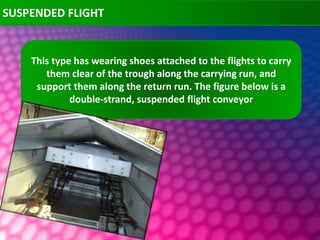
SUSPENDED FLIGHT
This type has wearing shoes attached to the flights to carry
them clear of the trough along the carrying run, and
support them along the return run. The figure below is a
double-strand, suspended flight conveyor
ROLLER FLIGHT
It is similar with the suspended flight conveyor except that,
rollers are substituted for shoes.
ROLLER CHAIN
The figure below is a double strand with roller chains to
carry the flights.
DRAG CHAIN
Such conveyors do not have
flights as the open links serve to
move the material.
APRON CONVEYORS
The alternative to a flight conveyor may be an
apron conveyor.
The apron conveyor consists of overlapping
beaded steel pans supported between or
mounted upon two strands of roller chain, and
with the usual head and foot assembly
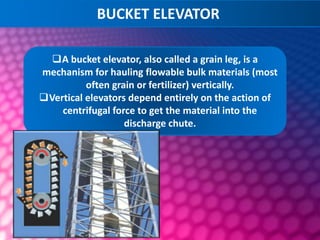
BUCKET ELEVATOR
A bucket elevator, also called a grain leg, is a
mechanism for hauling flowable bulk materials (most
often grain or fertilizer) vertically.
Vertical elevators depend entirely on the action of
centrifugal force to get the material into the
discharge chute.
UNIT LOADS
The term unit loads is generally use to cover the
handling of boxes, bags, packaged materials, castings,
paper rolls and in general integrated items as
distinguished from pulverized, granular, and lumpy bulk
materials.
Is the simplest method and lowest cost when a direct
lowering of package or boxed materials is involved.
Either gravity-roll or power-roll conveyors may
solve the problem of horizontal and inclined
movements more economically than is possible
with any other machines
When two or more roller conveyors are tributary
to a trunk line, it is necessary to prevent
collisions by an interceptor.
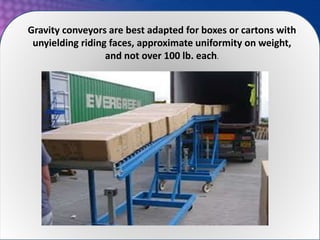
Gravity conveyors are best adapted for boxes or cartons with
unyielding riding faces, approximate uniformity on weight,
and not over 100 lb. each.
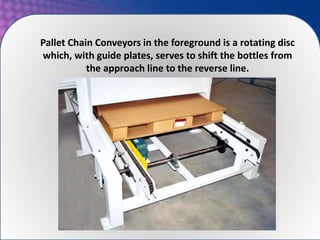
Pallet Chain Conveyors in the foreground is a rotating disc
which, with guide plates, serves to shift the bottles from
the approach line to the reverse line.
For unit loads, it may be similar to the standard flat-belt conveyor, but with
closely spaced carrying idler rolls. Almost any type of unit loads, not destructive
to the belt, may be so handled.
The Vibrating Trough, sometimes referred to as grasshopper
conveyor is the best machine to move sustained output of
fragmentary materials.
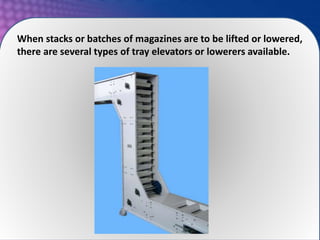
When stacks or batches of magazines are to be lifted or lowered,
there are several types of tray elevators or lowerers available.
Manufacturing operations, may preferably be by
overhead transport, keeping the aisles clear and
eliminating damage to the floors
The tramrail, or monorail system, consists of a carrier
suspended from an overhead I-beam track or runway
usually suspended from the ceiling beams except in the
larger units wherein it is supported below.
• Overhead conveyors, or trolley conveyors, consists of a
power-propelled chain travelling at moderate speed
• suspended by trolleys from a suitable track, and
• provided with attachments of various forms adapted to
the work to be done.
CONTINUOUS-FLOW CONVEYOR
The continuous-flow conveyor is a machine in which the
material moves slowly within a duct as a continuous core
PNEUMATIC AND HYDRAULIC CONVEYORS
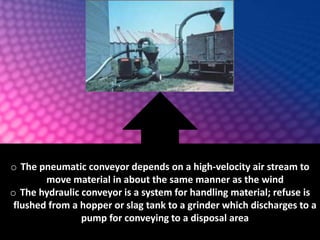
o The pneumatic conveyor depends on a high-velocity air stream to
move material in about the same manner as the wind
o The hydraulic conveyor is a system for handling material; refuse is
flushed from a hopper or slag tank to a grinder which discharges to a
pump for conveying to a disposal area
 Photoelectric control is the control of a
circuit or piece of equipment by changes
in incident light.
 Applications of photoelectric control
includes:
 automatic weighing and filling
 operator safeguard
 sorting
 heat treatment
 jam detection
 automatic inspection
o A conveyor system is often the lifeline to a company’s
ability to effectively move its product in a timely fashion
o Steps to ensure Peak Performance:
 inspections
 close monitoring of motors and reducers
 keeping key parts in stock
 proper training of personnel
o Increasing the service life of your conveyor system
involves: choosing the right conveyor type, the right
system design and paying attention to regular
maintenance practices.
o Here are six of the biggest problems to watch for in
overhead type conveyor systems including I-beam
monorails, enclosed track conveyors and power and free
conveyors
 Poor Take-up Adjustment
 Lack of Lubrication
 Contamination
 Product Handling
 Drive Train
 Bad Belt Tracking or Timing

Conveyor

  • 1.
    Conveyors QU PUTEH QUPUTEH Name: Abdul Mutalib Bin Idris Course code: HFC 4033 AUTOMATION i/c: 951008-07-5095 Matrix card: 1203546 Department: DMK 4A Lecturer:Sir Muhammad Fauzi Bin Anuar KOLEJ KEMAHIRAN TINGGI MARA BALIK PULAU
  • 2.
    1.Introduction and definitionof conveyor 2.Explain different Type for conveyor 3.How to knowledge the unit load of conveyor 4.I LOVE U SO MUCH QYA
  • 3.
    • A conveyorsystem is a common piece of mechanical handling equipment that moves materials from one location to another. • According to Sclater, conveyor systems can be divided into two classes: those that are part of a machine for processing product, and those that move products in various stages of fabrication. DEFINITION
  • 4.
  • 5.
    SCREW CONVEYORS • Thescrew conveyor usually consists of a long-pitch plate –steel helix mounted on shaft or spindle carried in bearings within U-shaped trough. • According to Hudson, for many functions, it is the best type of conveyor.
  • 7.
    FLIGHT AND APRONCONVEYORS  FLIGHT CONVEYORS The flight conveyor has an endless chain or twin chains passing around sprockets at the head and foot ends, with spaced transverse scrapers or “flights” which push the material along a trough.
  • 8.
    Types of flightconveyor I. SCRAPER FLIGHT II. SUSPENDED FLIGHT III.ROLLER FLIGHT IV.ROLLER CHAIN V. DRAG CHAIN
  • 9.
    Flights are drawnalong the trough bottom. The figure below is a single strand, scraper flight conveyor. SCRAPER FLIGHT
  • 10.
    SUSPENDED FLIGHT This typehas wearing shoes attached to the flights to carry them clear of the trough along the carrying run, and support them along the return run. The figure below is a double-strand, suspended flight conveyor
  • 11.
    ROLLER FLIGHT It issimilar with the suspended flight conveyor except that, rollers are substituted for shoes.
  • 12.
    ROLLER CHAIN The figurebelow is a double strand with roller chains to carry the flights.
  • 13.
    DRAG CHAIN Such conveyorsdo not have flights as the open links serve to move the material.
  • 14.
    APRON CONVEYORS The alternativeto a flight conveyor may be an apron conveyor. The apron conveyor consists of overlapping beaded steel pans supported between or mounted upon two strands of roller chain, and with the usual head and foot assembly
  • 15.
    BUCKET ELEVATOR A bucketelevator, also called a grain leg, is a mechanism for hauling flowable bulk materials (most often grain or fertilizer) vertically. Vertical elevators depend entirely on the action of centrifugal force to get the material into the discharge chute.
  • 16.
  • 17.
    The term unitloads is generally use to cover the handling of boxes, bags, packaged materials, castings, paper rolls and in general integrated items as distinguished from pulverized, granular, and lumpy bulk materials.
  • 18.
    Is the simplestmethod and lowest cost when a direct lowering of package or boxed materials is involved.
  • 19.
    Either gravity-roll orpower-roll conveyors may solve the problem of horizontal and inclined movements more economically than is possible with any other machines When two or more roller conveyors are tributary to a trunk line, it is necessary to prevent collisions by an interceptor.
  • 20.
    Gravity conveyors arebest adapted for boxes or cartons with unyielding riding faces, approximate uniformity on weight, and not over 100 lb. each.
  • 21.
    Pallet Chain Conveyorsin the foreground is a rotating disc which, with guide plates, serves to shift the bottles from the approach line to the reverse line.
  • 22.
    For unit loads,it may be similar to the standard flat-belt conveyor, but with closely spaced carrying idler rolls. Almost any type of unit loads, not destructive to the belt, may be so handled.
  • 23.
    The Vibrating Trough,sometimes referred to as grasshopper conveyor is the best machine to move sustained output of fragmentary materials.
  • 24.
    When stacks orbatches of magazines are to be lifted or lowered, there are several types of tray elevators or lowerers available.
  • 25.
    Manufacturing operations, maypreferably be by overhead transport, keeping the aisles clear and eliminating damage to the floors
  • 26.
    The tramrail, ormonorail system, consists of a carrier suspended from an overhead I-beam track or runway usually suspended from the ceiling beams except in the larger units wherein it is supported below.
  • 27.
    • Overhead conveyors,or trolley conveyors, consists of a power-propelled chain travelling at moderate speed • suspended by trolleys from a suitable track, and • provided with attachments of various forms adapted to the work to be done.
  • 28.
  • 29.
    The continuous-flow conveyoris a machine in which the material moves slowly within a duct as a continuous core
  • 30.
  • 31.
    o The pneumaticconveyor depends on a high-velocity air stream to move material in about the same manner as the wind o The hydraulic conveyor is a system for handling material; refuse is flushed from a hopper or slag tank to a grinder which discharges to a pump for conveying to a disposal area
  • 33.
     Photoelectric controlis the control of a circuit or piece of equipment by changes in incident light.  Applications of photoelectric control includes:  automatic weighing and filling  operator safeguard  sorting  heat treatment  jam detection  automatic inspection
  • 34.
    o A conveyorsystem is often the lifeline to a company’s ability to effectively move its product in a timely fashion o Steps to ensure Peak Performance:  inspections  close monitoring of motors and reducers  keeping key parts in stock  proper training of personnel o Increasing the service life of your conveyor system involves: choosing the right conveyor type, the right system design and paying attention to regular maintenance practices.
  • 35.
    o Here aresix of the biggest problems to watch for in overhead type conveyor systems including I-beam monorails, enclosed track conveyors and power and free conveyors  Poor Take-up Adjustment  Lack of Lubrication  Contamination  Product Handling  Drive Train  Bad Belt Tracking or Timing