Slide 1


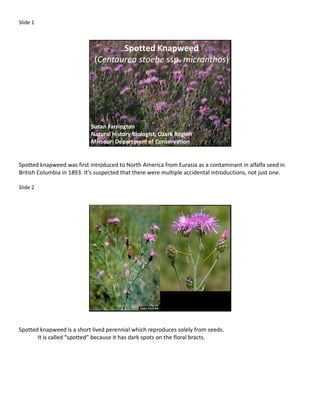
                                    Spotted Knapweed
                             (Centaurea stoebe ssp. micranthos)


                            Susan Farrington
                            Natural History Biologist, Ozark Region
                            Missouri Department of Conservation


Spotted knapweed was first introduced to North America from Eurasia as a contaminant in alfalfa seed in
British Columbia in 1893. It’s suspected that there were multiple accidental introductions, not just one.

Slide 2


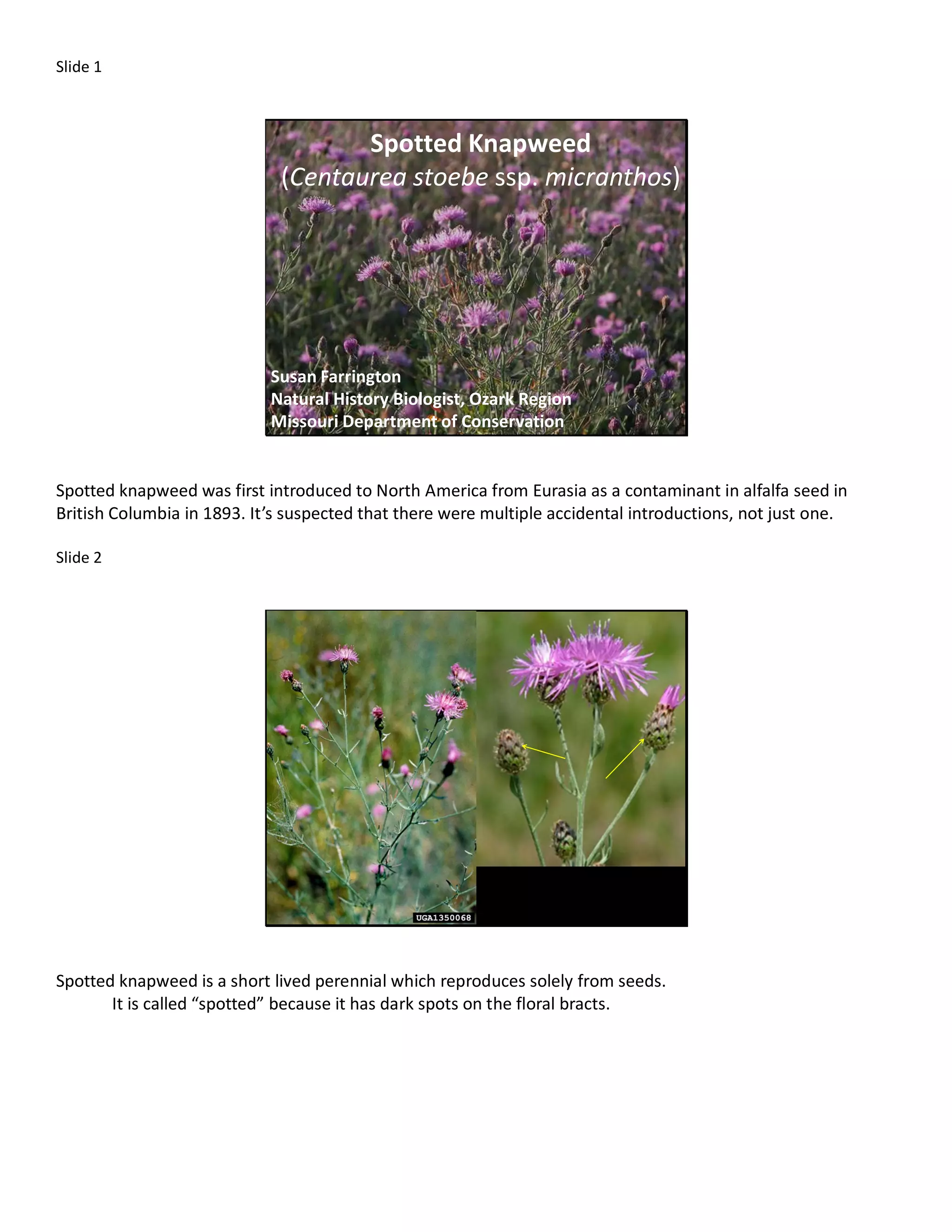
Spotted knapweed is a short lived perennial which reproduces solely from seeds.
       It is called “spotted” because it has dark spots on the floral bracts.
Slide 3


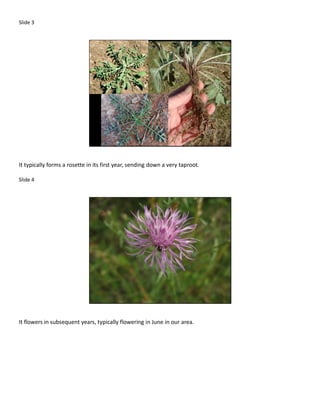
It typically forms a rosette in its first year, sending down a very taproot.

Slide 4


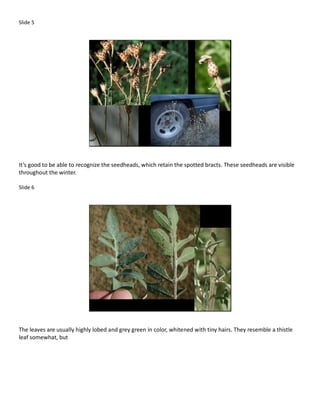
It flowers in subsequent years, typically flowering in June in our area.
Slide 5


It’s good to be able to recognize the seedheads, which retain the spotted bracts. These seedheads are visible
throughout the winter.

Slide 6


The leaves are usually highly lobed and grey green in color, whitened with tiny hairs. They resemble a thistle
leaf somewhat, but
Slide 7


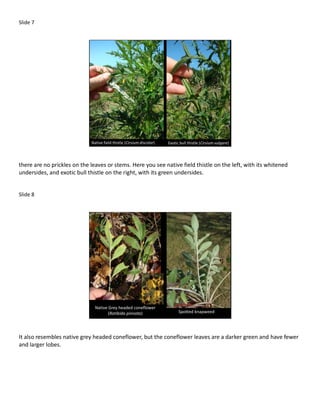
                             Native field thistle (Cirsium discolor)   Exotic bull thistle (Cirsium vulgare)


there are no prickles on the leaves or stems. Here you see native field thistle on the left, with its whitened
undersides, and exotic bull thistle on the right, with its green undersides.


Slide 8


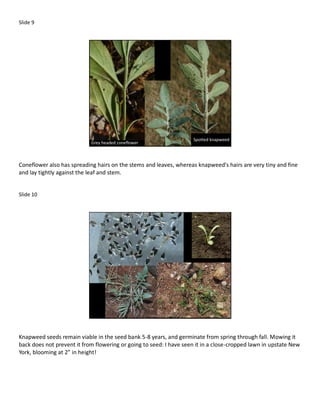
                               Native Grey headed coneflower
                                      (Ratibida pinnata)                     Spotted knapweed


It also resembles native grey headed coneflower, but the coneflower leaves are a darker green and have fewer
and larger lobes.
Slide 9


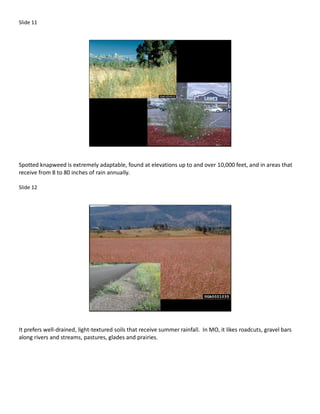
                                                                    Spotted knapweed
                            Grey headed coneflower


Coneflower also has spreading hairs on the stems and leaves, whereas knapweed’s hairs are very tiny and fine
and lay tightly against the leaf and stem.


Slide 10


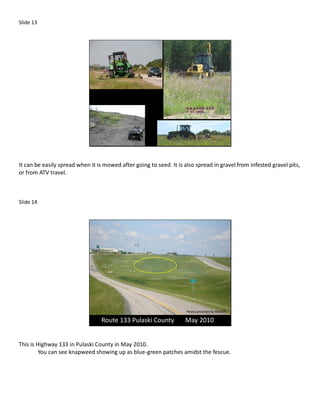
Knapweed seeds remain viable in the seed bank 5-8 years, and germinate from spring through fall. Mowing it
back does not prevent it from flowering or going to seed: I have seen it in a close-cropped lawn in upstate New
York, blooming at 2” in height!
Slide 11


Spotted knapweed is extremely adaptable, found at elevations up to and over 10,000 feet, and in areas that
receive from 8 to 80 inches of rain annually.

Slide 12


It prefers well-drained, light-textured soils that receive summer rainfall. In MO, it likes roadcuts, gravel bars
along rivers and streams, pastures, glades and prairies.
Slide 13


It can be easily spread when it is mowed after going to seed. It is also spread in gravel from infested gravel pits,
or from ATV travel.


Slide 14


                                                                     Photos provided by MoDOT

                                  Route 133 Pulaski County          May 2010


This is Highway 133 in Pulaski County in May 2010.
         You can see knapweed showing up as blue-green patches amidst the fescue.
Slide 15


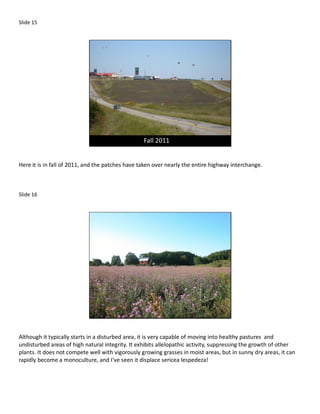
                                                  Fall 2011


Here it is in fall of 2011, and the patches have taken over nearly the entire highway interchange.


Slide 16


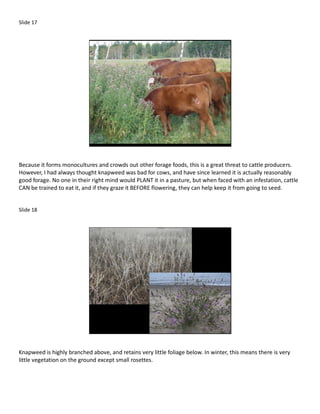
Although it typically starts in a disturbed area, it is very capable of moving into healthy pastures and
undisturbed areas of high natural integrity. It exhibits allelopathic activity, suppressing the growth of other
plants. It does not compete well with vigorously growing grasses in moist areas, but in sunny dry areas, it can
rapidly become a monoculture, and I’ve seen it displace sericea lespedeza!
Slide 17


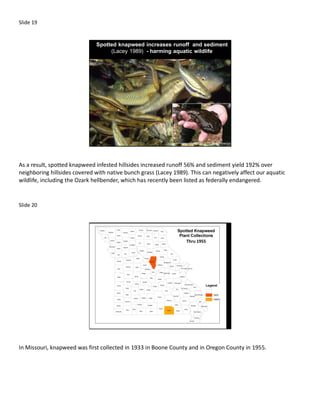
Because it forms monocultures and crowds out other forage foods, this is a great threat to cattle producers.
However, I had always thought knapweed was bad for cows, and have since learned it is actually reasonably
good forage. No one in their right mind would PLANT it in a pasture, but when faced with an infestation, cattle
CAN be trained to eat it, and if they graze it BEFORE flowering, they can help keep it from going to seed.


Slide 18


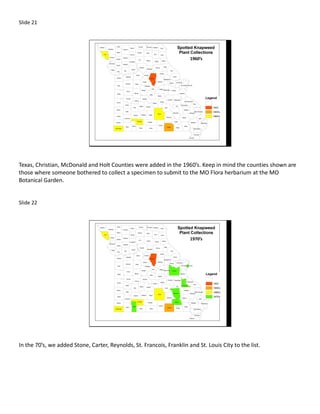
Knapweed is highly branched above, and retains very little foliage below. In winter, this means there is very
little vegetation on the ground except small rosettes.
Slide 19


                              Spotted knapweed increases runoff and sediment
                                   (Lacey 1989) - harming aquatic wildlife


As a result, spotted knapweed infested hillsides increased runoff 56% and sediment yield 192% over
neighboring hillsides covered with native bunch grass (Lacey 1989). This can negatively affect our aquatic
wildlife, including the Ozark hellbender, which has recently been listed as federally endangered.


Slide 20


                                                                  Thru 1955


In Missouri, knapweed was first collected in 1933 in Boone County and in Oregon County in 1955.
Slide 21


                                                                       1960’s


Texas, Christian, McDonald and Holt Counties were added in the 1960’s. Keep in mind the counties shown are
those where someone bothered to collect a specimen to submit to the MO Flora herbarium at the MO
Botanical Garden.


Slide 22


                                                                       1970’s


In the 70’s, we added Stone, Carter, Reynolds, St. Francois, Franklin and St. Louis City to the list.
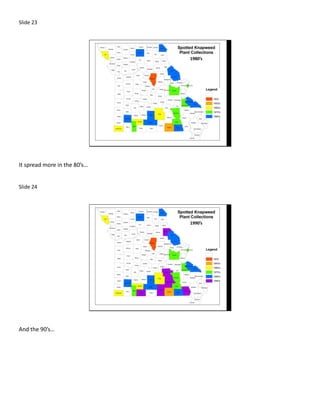
Slide 23


                              1980’s


It spread more in the 80’s…


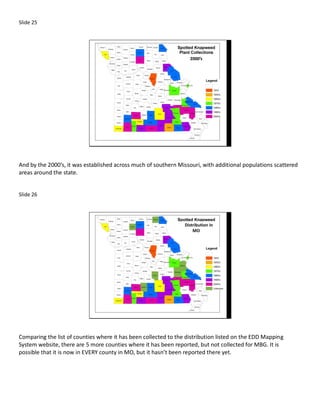
Slide 24


                              1990’s


And the 90’s…
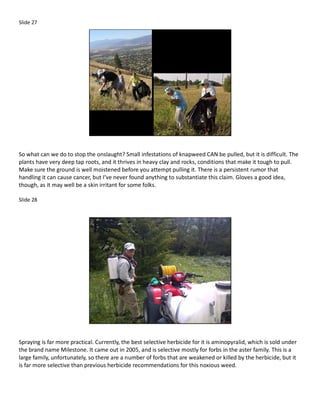
Slide 25


                                                                   2000’s


And by the 2000’s, it was established across much of southern Missouri, with additional populations scattered
areas around the state.


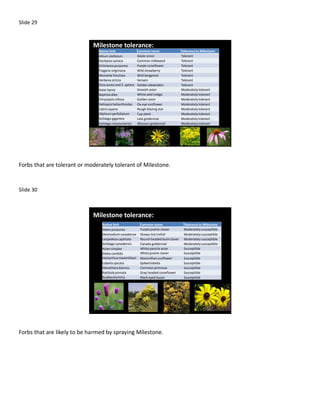
Slide 26


                                                                 Distribution in
                                                                     MO


Comparing the list of counties where it has been collected to the distribution listed on the EDD Mapping
System website, there are 5 more counties where it has been reported, but not collected for MBG. It is
possible that it is now in EVERY county in MO, but it hasn’t been reported there yet.
Slide 27


So what can we do to stop the onslaught? Small infestations of knapweed CAN be pulled, but it is difficult. The
plants have very deep tap roots, and it thrives in heavy clay and rocks, conditions that make it tough to pull.
Make sure the ground is well moistened before you attempt pulling it. There is a persistent rumor that
handling it can cause cancer, but I’ve never found anything to substantiate this claim. Gloves a good idea,
though, as it may well be a skin irritant for some folks.

Slide 28


Spraying is far more practical. Currently, the best selective herbicide for it is aminopyralid, which is sold under
the brand name Milestone. It came out in 2005, and is selective mostly for forbs in the aster family. This is a
large family, unfortunately, so there are a number of forbs that are weakened or killed by the herbicide, but it
is far more selective than previous herbicide recommendations for this noxious weed.
Slide 29


                             Milestone tolerance:
                               Native forb                            Common name                                   Tolerance to Milestone:
                               Allium stellatum                       Glade onion                                   Tolerant
                               Asclepias syriaca                      Common milkweed                               Tolerant
                               Echinacea purpurea Common name coneflower to Milestone:
                                       Native forb
                                       Allium stellatum
                                                                      Purple
                                                               Glade onion
                                                                                        Tolerance
                                                                                        Tolerant
                                                                                                                    Tolerant
                               Fragaria virginiana Common milkweed
                                       Asclepias syriaca              Wild strawberry   Tolerant                    Tolerant
                                       Fragaria virginiana     Wild strawberry          Tolerant
                               Monarda fistulosa
                                       Monarda fistulosa       Wild bergamot bergamot
                                                                      Wild              Tolerant                    Tolerant
                                       Verbena stricta         Vervain                  Tolerant
                               Verbena stricta Z. aptera GoldenVervain
                                       Zizia aurea and                 alexanders       Tolerant                    Tolerant
                                       Aster laevis
                               Zizia aurea and Z. aptera wild indigo alexanders tolerant
                                       Baptisia alba
                                                               Smooth aster
                                                               White Golden
                                                                                        Moderately
                                                                                        Moderately tolerant         Tolerant
                               Aster laevis helianthoides GoldenSmooth aster Moderately tolerant
                                       Chrysopsis villosa
                                       Heliopsis
                                                                       aster
                                                               Ox-eye sunflower         Moderately tolerant
                                                                                                                    Moderately tolerant
                               Baptisia alba
                                       Liatris aspera          Rough blazing starwild indigo
                                                                      White             Moderately tolerant         Moderately tolerant
                                       Silphium perfoliatum    Cup plant                Moderately tolerant
                               Chrysopsis villosa
                                       Solidago gigantea              Golden aster Moderately tolerant
                                                               Late goldenrod                                       Moderately tolerant
                                       Solidago missouriensis Missouri goldenrod        Moderately tolerant
                               Heliopsis helianthoides prairie cloversunflower susceptible
                                       Dalea purpurea          Purple Ox-eye            Moderately                  Moderately tolerant
                                       Desmodium canadense Showy tick trefoil
                               Liatris asperacaptiata
                                       Lespedeza                      Rough blazingModerately susceptible
                                                                                         star
                                                               Round-headed bush clover Moderately susceptible      Moderately tolerant
                               Silphium perfoliatum CanadaCup plant
                                       Solidago canadensis
                                       Aster simplex
                                                                       goldenrod        Moderately susceptible
                                                                                                                    Moderately tolerant
                                                               White panicle aster      Susceptible
                               Solidago gigantea
                                       Dalea candida                  Late goldenrod
                                                               White prairie clover     Susceptible                 Moderately tolerant
                                       Helianthus maximilliani Maximillian sunflower    Susceptible
                               Solidago missouriensis
                                       Lobelia spicata         Spiked Missouri goldenrod
                                                                      lobelia           Susceptible                 Moderately tolerant
                                        Oenothera biennis         Common primrose          Susceptible
                                        Ratibida pinnata          Gray headed coneflower   Susceptible
                                        Rudbeckia hirta           Black eyed Susan         Susceptible


Forbs that are tolerant or moderately tolerant of Milestone.


Slide 30


                             Milestone tolerance:
                                  Native forb                           Common name                                  Tolerance to Milestone:
                                  Dalea purpurea                        Purple prairie clover                        Moderately susceptible
                                      Native forb             Common name            Tolerance to Milestone:
                                  Desmodium canadenseonion
                                      Allium stellatum        Glade     Showy tick trefoil
                                                                                     Tolerant                        Moderately susceptible
                                      Asclepias syriaca       Common milkweed        Tolerant
                                  Lespedeza captitataWild strawberry
                                      Fragaria virginiana               Round-headed bush clover
                                                                                     Tolerant                        Moderately susceptible
                                      Monarda fistulosa       Wild bergamot          Tolerant
                                  Solidago canadensis
                                      Verbena stricta         Vervain
                                                                        Canada goldenrod
                                                                                     Tolerant
                                                                                                                     Moderately susceptible
                                  Aster simplex Z. aptera Golden alexanders panicle aster
                                      Zizia aurea and                   White        Tolerant                        Susceptible
                                      Aster laevis            Smooth aster           Moderately tolerant
                                  Dalea candida
                                      Baptisia alba           White wildWhite prairie clover
                                                                         indigo      Moderately tolerant             Susceptible
                                      Chrysopsis villosa      Golden aster           Moderately tolerant
                                  Helianthus maximilliani sunflower
                                      Heliopsis helianthoides Ox-eye    MaximillianModerately tolerant
                                                                                      sunflower                      Susceptible
                                      Liatris aspera          Rough blazing star     Moderately tolerant
                                  Lobelia spicata
                                      Silphium perfoliatum    Cup plant Spiked lobelia
                                                                                     Moderately tolerant             Susceptible
                                  Oenothera biennis Late goldenrod
                                      Solidago gigantea
                                                                        Common primrose tolerant
                                      Solidago missouriensis Missouri goldenrod
                                                                                     Moderately
                                                                                     Moderately tolerant
                                                                                                                     Susceptible
                                  Ratibida pinnata Purple prairie clover
                                      Dalea purpurea                    Gray headed coneflower
                                                                                     Moderately susceptible          Susceptible
                                      Desmodium canadense Showy tick trefoil         Moderately susceptible
                                  Rudbeckia captiata
                                      Lespedeza hirta         Round-headed bush eyed Susan susceptible
                                                                        Black clover Moderately                      Susceptible
                                        Solidago canadensis       Canada goldenrod         Moderately susceptible
                                        Aster simplex             White panicle aster      Susceptible
                                        Dalea candida             White prairie clover     Susceptible
                                        Helianthus maximilliani   Maximillian sunflower    Susceptible
                                        Lobelia spicata           Spiked lobelia           Susceptible
                                        Oenothera biennis         Common primrose          Susceptible
                                        Ratibida pinnata          Gray headed coneflower   Susceptible
                                        Rudbeckia hirta           Black eyed Susan         Susceptible


Forbs that are likely to be harmed by spraying Milestone.
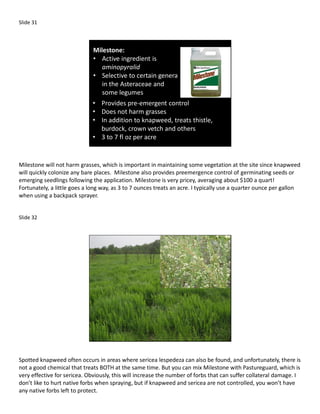
Slide 31


                              Milestone:
                              • Active ingredient is
                                 aminopyralid
                              • Selective to certain genera
                                 in the Asteraceae and
                                 some legumes
                             • Provides pre-emergent control
                             • Does not harm grasses
                             • In addition to knapweed, treats thistle,
                               burdock, crown vetch and others
                             • 3 to 7 fl oz per acre


Milestone will not harm grasses, which is important in maintaining some vegetation at the site since knapweed
will quickly colonize any bare places. Milestone also provides preemergence control of germinating seeds or
emerging seedlings following the application. Milestone is very pricey, averaging about $100 a quart!
Fortunately, a little goes a long way, as 3 to 7 ounces treats an acre. I typically use a quarter ounce per gallon
when using a backpack sprayer.


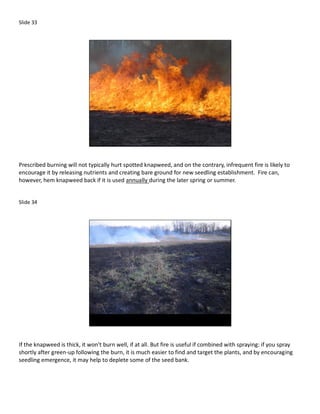
Slide 32


Spotted knapweed often occurs in areas where sericea lespedeza can also be found, and unfortunately, there is
not a good chemical that treats BOTH at the same time. But you can mix Milestone with Pastureguard, which is
very effective for sericea. Obviously, this will increase the number of forbs that can suffer collateral damage. I
don’t like to hurt native forbs when spraying, but if knapweed and sericea are not controlled, you won’t have
any native forbs left to protect.
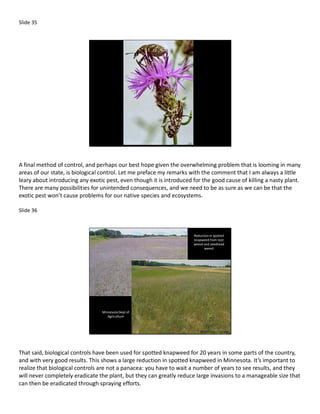
Slide 33


Prescribed burning will not typically hurt spotted knapweed, and on the contrary, infrequent fire is likely to
encourage it by releasing nutrients and creating bare ground for new seedling establishment. Fire can,
however, hem knapweed back if it is used annually during the later spring or summer.


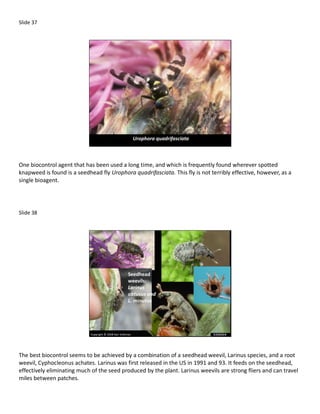
Slide 34


If the knapweed is thick, it won’t burn well, if at all. But fire is useful if combined with spraying: if you spray
shortly after green-up following the burn, it is much easier to find and target the plants, and by encouraging
seedling emergence, it may help to deplete some of the seed bank.
Slide 35


A final method of control, and perhaps our best hope given the overwhelming problem that is looming in many
areas of our state, is biological control. Let me preface my remarks with the comment that I am always a little
leary about introducing any exotic pest, even though it is introduced for the good cause of killing a nasty plant.
There are many possibilities for unintended consequences, and we need to be as sure as we can be that the
exotic pest won’t cause problems for our native species and ecosystems.

Slide 36


                                                                      Reduction in spotted
                                                                      knapweed from root
                                                                      weevil and seedhead
                                                                             weevil


                                 Minnesota Dept of
                                    Agriculture


That said, biological controls have been used for spotted knapweed for 20 years in some parts of the country,
and with very good results. This shows a large reduction in spotted knapweed in Minnesota. It’s important to
realize that biological controls are not a panacea: you have to wait a number of years to see results, and they
will never completely eradicate the plant, but they can greatly reduce large invasions to a manageable size that
can then be eradicated through spraying efforts.
Slide 37


                                                            Urophora quadrifasciata


One biocontrol agent that has been used a long time, and which is frequently found wherever spotted
knapweed is found is a seedhead fly Urophora quadrifasciata. This fly is not terribly effective, however, as a
single bioagent.


Slide 38


                                                      Seedhead
                                                      weevils:
                                                      Larinus
                                                      obtusus and
                                                      L. minutus


                            Copyright © 2008 Karl Volkman


The best biocontrol seems to be achieved by a combination of a seedhead weevil, Larinus species, and a root
weevil, Cyphocleonus achates. Larinus was first released in the US in 1991 and 93. It feeds on the seedhead,
effectively eliminating much of the seed produced by the plant. Larinus weevils are strong fliers and can travel
miles between patches.
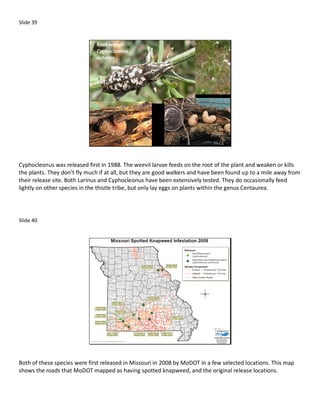
Slide 39


                              Root weevil:
                              Cyphocleonus
                              achates


Cyphocleonus was released first in 1988. The weevil larvae feeds on the root of the plant and weaken or kills
the plants. They don’t fly much if at all, but they are good walkers and have been found up to a mile away from
their release site. Both Larinus and Cyphocleonus have been extensively tested. They do occasionally feed
lightly on other species in the thistle tribe, but only lay eggs on plants within the genus Centaurea.


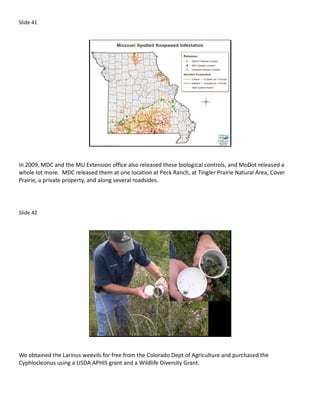
Slide 40


Both of these species were first released in Missouri in 2008 by MoDOT in a few selected locations. This map
shows the roads that MoDOT mapped as having spotted knapweed, and the original release locations.
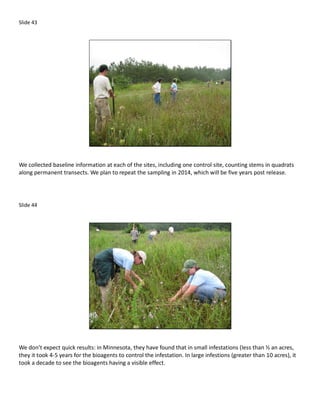
Slide 41


In 2009, MDC and the MU Extension office also released these biological controls, and MoDot released a
whole lot more. MDC released them at one location at Peck Ranch, at Tingler Prairie Natural Area, Cover
Prairie, a private property, and along several roadsides.


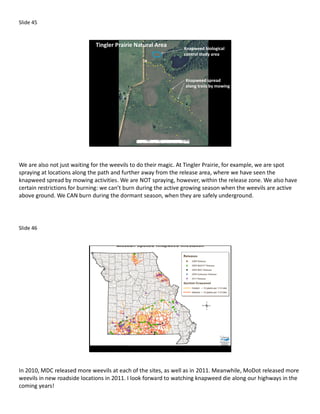
Slide 42


We obtained the Larinus weevils for free from the Colorado Dept of Agriculture and purchased the
Cyphlocleonus using a USDA APHIS grant and a Wildlife Diversity Grant.
Slide 43


We collected baseline information at each of the sites, including one control site, counting stems in quadrats
along permanent transects. We plan to repeat the sampling in 2014, which will be five years post release.


Slide 44


We don’t expect quick results: in Minnesota, they have found that in small infestations (less than ½ an acres,
they it took 4-5 years for the bioagents to control the infestation. In large infestions (greater than 10 acres), it
took a decade to see the bioagents having a visible effect.
Slide 45


                             Tingler Prairie Natural Area       Knapweed biological
                                                                control study area


                                                                Knapweed spread
                                                                along trails by mowing


We are also not just waiting for the weevils to do their magic. At Tingler Prairie, for example, we are spot
spraying at locations along the path and further away from the release area, where we have seen the
knapweed spread by mowing activities. We are NOT spraying, however, within the release zone. We also have
certain restrictions for burning: we can’t burn during the active growing season when the weevils are active
above ground. We CAN burn during the dormant season, when they are safely underground.


Slide 46


In 2010, MDC released more weevils at each of the sites, as well as in 2011. Meanwhile, MoDot released more
weevils in new roadside locations in 2011. I look forward to watching knapweed die along our highways in the
coming years!
Slide 47


           Questions?

Spotted Knapweed

  • 1.
    Slide 1 Spotted Knapweed (Centaurea stoebe ssp. micranthos) Susan Farrington Natural History Biologist, Ozark Region Missouri Department of Conservation Spotted knapweed was first introduced to North America from Eurasia as a contaminant in alfalfa seed in British Columbia in 1893. It’s suspected that there were multiple accidental introductions, not just one. Slide 2 Spotted knapweed is a short lived perennial which reproduces solely from seeds. It is called “spotted” because it has dark spots on the floral bracts.
  • 2.
    Slide 3 It typicallyforms a rosette in its first year, sending down a very taproot. Slide 4 It flowers in subsequent years, typically flowering in June in our area.
  • 3.
    Slide 5 It’s goodto be able to recognize the seedheads, which retain the spotted bracts. These seedheads are visible throughout the winter. Slide 6 The leaves are usually highly lobed and grey green in color, whitened with tiny hairs. They resemble a thistle leaf somewhat, but
  • 4.
    Slide 7 Native field thistle (Cirsium discolor) Exotic bull thistle (Cirsium vulgare) there are no prickles on the leaves or stems. Here you see native field thistle on the left, with its whitened undersides, and exotic bull thistle on the right, with its green undersides. Slide 8 Native Grey headed coneflower (Ratibida pinnata) Spotted knapweed It also resembles native grey headed coneflower, but the coneflower leaves are a darker green and have fewer and larger lobes.
  • 5.
    Slide 9 Spotted knapweed Grey headed coneflower Coneflower also has spreading hairs on the stems and leaves, whereas knapweed’s hairs are very tiny and fine and lay tightly against the leaf and stem. Slide 10 Knapweed seeds remain viable in the seed bank 5-8 years, and germinate from spring through fall. Mowing it back does not prevent it from flowering or going to seed: I have seen it in a close-cropped lawn in upstate New York, blooming at 2” in height!
  • 6.
    Slide 11 Spotted knapweedis extremely adaptable, found at elevations up to and over 10,000 feet, and in areas that receive from 8 to 80 inches of rain annually. Slide 12 It prefers well-drained, light-textured soils that receive summer rainfall. In MO, it likes roadcuts, gravel bars along rivers and streams, pastures, glades and prairies.
  • 7.
    Slide 13 It canbe easily spread when it is mowed after going to seed. It is also spread in gravel from infested gravel pits, or from ATV travel. Slide 14 Photos provided by MoDOT Route 133 Pulaski County May 2010 This is Highway 133 in Pulaski County in May 2010. You can see knapweed showing up as blue-green patches amidst the fescue.
  • 8.
    Slide 15 Fall 2011 Here it is in fall of 2011, and the patches have taken over nearly the entire highway interchange. Slide 16 Although it typically starts in a disturbed area, it is very capable of moving into healthy pastures and undisturbed areas of high natural integrity. It exhibits allelopathic activity, suppressing the growth of other plants. It does not compete well with vigorously growing grasses in moist areas, but in sunny dry areas, it can rapidly become a monoculture, and I’ve seen it displace sericea lespedeza!
  • 9.
    Slide 17 Because itforms monocultures and crowds out other forage foods, this is a great threat to cattle producers. However, I had always thought knapweed was bad for cows, and have since learned it is actually reasonably good forage. No one in their right mind would PLANT it in a pasture, but when faced with an infestation, cattle CAN be trained to eat it, and if they graze it BEFORE flowering, they can help keep it from going to seed. Slide 18 Knapweed is highly branched above, and retains very little foliage below. In winter, this means there is very little vegetation on the ground except small rosettes.
  • 10.
    Slide 19 Spotted knapweed increases runoff and sediment (Lacey 1989) - harming aquatic wildlife As a result, spotted knapweed infested hillsides increased runoff 56% and sediment yield 192% over neighboring hillsides covered with native bunch grass (Lacey 1989). This can negatively affect our aquatic wildlife, including the Ozark hellbender, which has recently been listed as federally endangered. Slide 20 Thru 1955 In Missouri, knapweed was first collected in 1933 in Boone County and in Oregon County in 1955.
  • 11.
    Slide 21 1960’s Texas, Christian, McDonald and Holt Counties were added in the 1960’s. Keep in mind the counties shown are those where someone bothered to collect a specimen to submit to the MO Flora herbarium at the MO Botanical Garden. Slide 22 1970’s In the 70’s, we added Stone, Carter, Reynolds, St. Francois, Franklin and St. Louis City to the list.
  • 12.
    Slide 23 1980’s It spread more in the 80’s… Slide 24 1990’s And the 90’s…
  • 13.
    Slide 25 2000’s And by the 2000’s, it was established across much of southern Missouri, with additional populations scattered areas around the state. Slide 26 Distribution in MO Comparing the list of counties where it has been collected to the distribution listed on the EDD Mapping System website, there are 5 more counties where it has been reported, but not collected for MBG. It is possible that it is now in EVERY county in MO, but it hasn’t been reported there yet.
  • 14.
    Slide 27 So whatcan we do to stop the onslaught? Small infestations of knapweed CAN be pulled, but it is difficult. The plants have very deep tap roots, and it thrives in heavy clay and rocks, conditions that make it tough to pull. Make sure the ground is well moistened before you attempt pulling it. There is a persistent rumor that handling it can cause cancer, but I’ve never found anything to substantiate this claim. Gloves a good idea, though, as it may well be a skin irritant for some folks. Slide 28 Spraying is far more practical. Currently, the best selective herbicide for it is aminopyralid, which is sold under the brand name Milestone. It came out in 2005, and is selective mostly for forbs in the aster family. This is a large family, unfortunately, so there are a number of forbs that are weakened or killed by the herbicide, but it is far more selective than previous herbicide recommendations for this noxious weed.
  • 15.
    Slide 29 Milestone tolerance: Native forb Common name Tolerance to Milestone: Allium stellatum Glade onion Tolerant Asclepias syriaca Common milkweed Tolerant Echinacea purpurea Common name coneflower to Milestone: Native forb Allium stellatum Purple Glade onion Tolerance Tolerant Tolerant Fragaria virginiana Common milkweed Asclepias syriaca Wild strawberry Tolerant Tolerant Fragaria virginiana Wild strawberry Tolerant Monarda fistulosa Monarda fistulosa Wild bergamot bergamot Wild Tolerant Tolerant Verbena stricta Vervain Tolerant Verbena stricta Z. aptera GoldenVervain Zizia aurea and alexanders Tolerant Tolerant Aster laevis Zizia aurea and Z. aptera wild indigo alexanders tolerant Baptisia alba Smooth aster White Golden Moderately Moderately tolerant Tolerant Aster laevis helianthoides GoldenSmooth aster Moderately tolerant Chrysopsis villosa Heliopsis aster Ox-eye sunflower Moderately tolerant Moderately tolerant Baptisia alba Liatris aspera Rough blazing starwild indigo White Moderately tolerant Moderately tolerant Silphium perfoliatum Cup plant Moderately tolerant Chrysopsis villosa Solidago gigantea Golden aster Moderately tolerant Late goldenrod Moderately tolerant Solidago missouriensis Missouri goldenrod Moderately tolerant Heliopsis helianthoides prairie cloversunflower susceptible Dalea purpurea Purple Ox-eye Moderately Moderately tolerant Desmodium canadense Showy tick trefoil Liatris asperacaptiata Lespedeza Rough blazingModerately susceptible star Round-headed bush clover Moderately susceptible Moderately tolerant Silphium perfoliatum CanadaCup plant Solidago canadensis Aster simplex goldenrod Moderately susceptible Moderately tolerant White panicle aster Susceptible Solidago gigantea Dalea candida Late goldenrod White prairie clover Susceptible Moderately tolerant Helianthus maximilliani Maximillian sunflower Susceptible Solidago missouriensis Lobelia spicata Spiked Missouri goldenrod lobelia Susceptible Moderately tolerant Oenothera biennis Common primrose Susceptible Ratibida pinnata Gray headed coneflower Susceptible Rudbeckia hirta Black eyed Susan Susceptible Forbs that are tolerant or moderately tolerant of Milestone. Slide 30 Milestone tolerance: Native forb Common name Tolerance to Milestone: Dalea purpurea Purple prairie clover Moderately susceptible Native forb Common name Tolerance to Milestone: Desmodium canadenseonion Allium stellatum Glade Showy tick trefoil Tolerant Moderately susceptible Asclepias syriaca Common milkweed Tolerant Lespedeza captitataWild strawberry Fragaria virginiana Round-headed bush clover Tolerant Moderately susceptible Monarda fistulosa Wild bergamot Tolerant Solidago canadensis Verbena stricta Vervain Canada goldenrod Tolerant Moderately susceptible Aster simplex Z. aptera Golden alexanders panicle aster Zizia aurea and White Tolerant Susceptible Aster laevis Smooth aster Moderately tolerant Dalea candida Baptisia alba White wildWhite prairie clover indigo Moderately tolerant Susceptible Chrysopsis villosa Golden aster Moderately tolerant Helianthus maximilliani sunflower Heliopsis helianthoides Ox-eye MaximillianModerately tolerant sunflower Susceptible Liatris aspera Rough blazing star Moderately tolerant Lobelia spicata Silphium perfoliatum Cup plant Spiked lobelia Moderately tolerant Susceptible Oenothera biennis Late goldenrod Solidago gigantea Common primrose tolerant Solidago missouriensis Missouri goldenrod Moderately Moderately tolerant Susceptible Ratibida pinnata Purple prairie clover Dalea purpurea Gray headed coneflower Moderately susceptible Susceptible Desmodium canadense Showy tick trefoil Moderately susceptible Rudbeckia captiata Lespedeza hirta Round-headed bush eyed Susan susceptible Black clover Moderately Susceptible Solidago canadensis Canada goldenrod Moderately susceptible Aster simplex White panicle aster Susceptible Dalea candida White prairie clover Susceptible Helianthus maximilliani Maximillian sunflower Susceptible Lobelia spicata Spiked lobelia Susceptible Oenothera biennis Common primrose Susceptible Ratibida pinnata Gray headed coneflower Susceptible Rudbeckia hirta Black eyed Susan Susceptible Forbs that are likely to be harmed by spraying Milestone.
  • 16.
    Slide 31 Milestone: • Active ingredient is aminopyralid • Selective to certain genera in the Asteraceae and some legumes • Provides pre-emergent control • Does not harm grasses • In addition to knapweed, treats thistle, burdock, crown vetch and others • 3 to 7 fl oz per acre Milestone will not harm grasses, which is important in maintaining some vegetation at the site since knapweed will quickly colonize any bare places. Milestone also provides preemergence control of germinating seeds or emerging seedlings following the application. Milestone is very pricey, averaging about $100 a quart! Fortunately, a little goes a long way, as 3 to 7 ounces treats an acre. I typically use a quarter ounce per gallon when using a backpack sprayer. Slide 32 Spotted knapweed often occurs in areas where sericea lespedeza can also be found, and unfortunately, there is not a good chemical that treats BOTH at the same time. But you can mix Milestone with Pastureguard, which is very effective for sericea. Obviously, this will increase the number of forbs that can suffer collateral damage. I don’t like to hurt native forbs when spraying, but if knapweed and sericea are not controlled, you won’t have any native forbs left to protect.
  • 17.
    Slide 33 Prescribed burningwill not typically hurt spotted knapweed, and on the contrary, infrequent fire is likely to encourage it by releasing nutrients and creating bare ground for new seedling establishment. Fire can, however, hem knapweed back if it is used annually during the later spring or summer. Slide 34 If the knapweed is thick, it won’t burn well, if at all. But fire is useful if combined with spraying: if you spray shortly after green-up following the burn, it is much easier to find and target the plants, and by encouraging seedling emergence, it may help to deplete some of the seed bank.
  • 18.
    Slide 35 A finalmethod of control, and perhaps our best hope given the overwhelming problem that is looming in many areas of our state, is biological control. Let me preface my remarks with the comment that I am always a little leary about introducing any exotic pest, even though it is introduced for the good cause of killing a nasty plant. There are many possibilities for unintended consequences, and we need to be as sure as we can be that the exotic pest won’t cause problems for our native species and ecosystems. Slide 36 Reduction in spotted knapweed from root weevil and seedhead weevil Minnesota Dept of Agriculture That said, biological controls have been used for spotted knapweed for 20 years in some parts of the country, and with very good results. This shows a large reduction in spotted knapweed in Minnesota. It’s important to realize that biological controls are not a panacea: you have to wait a number of years to see results, and they will never completely eradicate the plant, but they can greatly reduce large invasions to a manageable size that can then be eradicated through spraying efforts.
  • 19.
    Slide 37 Urophora quadrifasciata One biocontrol agent that has been used a long time, and which is frequently found wherever spotted knapweed is found is a seedhead fly Urophora quadrifasciata. This fly is not terribly effective, however, as a single bioagent. Slide 38 Seedhead weevils: Larinus obtusus and L. minutus Copyright © 2008 Karl Volkman The best biocontrol seems to be achieved by a combination of a seedhead weevil, Larinus species, and a root weevil, Cyphocleonus achates. Larinus was first released in the US in 1991 and 93. It feeds on the seedhead, effectively eliminating much of the seed produced by the plant. Larinus weevils are strong fliers and can travel miles between patches.
  • 20.
    Slide 39 Root weevil: Cyphocleonus achates Cyphocleonus was released first in 1988. The weevil larvae feeds on the root of the plant and weaken or kills the plants. They don’t fly much if at all, but they are good walkers and have been found up to a mile away from their release site. Both Larinus and Cyphocleonus have been extensively tested. They do occasionally feed lightly on other species in the thistle tribe, but only lay eggs on plants within the genus Centaurea. Slide 40 Both of these species were first released in Missouri in 2008 by MoDOT in a few selected locations. This map shows the roads that MoDOT mapped as having spotted knapweed, and the original release locations.
  • 21.
    Slide 41 In 2009,MDC and the MU Extension office also released these biological controls, and MoDot released a whole lot more. MDC released them at one location at Peck Ranch, at Tingler Prairie Natural Area, Cover Prairie, a private property, and along several roadsides. Slide 42 We obtained the Larinus weevils for free from the Colorado Dept of Agriculture and purchased the Cyphlocleonus using a USDA APHIS grant and a Wildlife Diversity Grant.
  • 22.
    Slide 43 We collectedbaseline information at each of the sites, including one control site, counting stems in quadrats along permanent transects. We plan to repeat the sampling in 2014, which will be five years post release. Slide 44 We don’t expect quick results: in Minnesota, they have found that in small infestations (less than ½ an acres, they it took 4-5 years for the bioagents to control the infestation. In large infestions (greater than 10 acres), it took a decade to see the bioagents having a visible effect.
  • 23.
    Slide 45 Tingler Prairie Natural Area Knapweed biological control study area Knapweed spread along trails by mowing We are also not just waiting for the weevils to do their magic. At Tingler Prairie, for example, we are spot spraying at locations along the path and further away from the release area, where we have seen the knapweed spread by mowing activities. We are NOT spraying, however, within the release zone. We also have certain restrictions for burning: we can’t burn during the active growing season when the weevils are active above ground. We CAN burn during the dormant season, when they are safely underground. Slide 46 In 2010, MDC released more weevils at each of the sites, as well as in 2011. Meanwhile, MoDot released more weevils in new roadside locations in 2011. I look forward to watching knapweed die along our highways in the coming years!
  • 24.
    Slide 47 Questions?