Statewide Integrated Pest Management Program	 November 2013
PEST NOTES	 Publication 74165
Integrated Pest Management for Home Gardeners and Landscape Professionals
Myoporum Thrips
The myoporum thrips, Klambothrips
myopori (Thysanoptera: Phlaeothripi-
dae), is an invasive species that has
been causing great damage to Myopo-
rum plants in landscapes and nurseries
along the California coast from San
Diego to San Francisco. Native to New
Zealand, this thrips has a limited host
range and is primarily found on Myo-
porum trees, shrubs and groundcovers.
In California, myoporum thrips has
only been observed on two species of
Myoporum: M. laetum, which is a shrub
or small tree, and M. pacificum, a creep-
ing form grown as a ground cover.
Live thrips and damage have not yet
been observed on M. parvifolium, a
common prostrate form of Myoporum
typically used for erosion control in
California landscapes.
In Hawaii, it has also been found at-
tacking Naio, Myoporum sandwicense.
The Naio tree is a dominant, native tree
species that is both culturally and eco-
logically important to Hawaii.
A decline in the aesthetic quality of
susceptible Myoporum plantings and
tree death is now a common occurrence
in California, where these plants have
been widely planted because of their
visual appeal, minimal management
needs, low water requirement, and lack
of pests prior to the introduction of the
myoporum thrips.
Little is known about myoporum thrips,
and it was only recently described in
the scientific literature from samples
collected in California and sent to Aus-
tralia’s Commonwealth Scientific and
Industrial Research Organization. It is
a new genus, Klambothrips, and the new
species name is Klambothrips myopori.
Identification
Myoporum thrips adults are slender
insects, 2-2.5 mm long. They are dark
brown to black with fringed wings
(Figure 1). Males are slightly smaller
and similar in appearance to females.
Their oblong white eggs are relatively
large compared to the adult female and
are deposited on leaf surfaces where
they are enclosed within distorted
plant tissue. In California, myoporum
thrips adults may be confused with the
greenhouse thrips, Heliothrips haemor-
rhoidalis or the Cuban laurel thrips Gyn-
aikothrips ficorum, which has an almost
identical life history and appearance
and produces similar symptoms on
Ficus species.
life cycle
The life cycle of myoporum thrips
includes the egg, two actively feed-
ing larval stages, two non-feeding
pupal stages, and the adult (Figures
2-4). The length of the life cycle from
egg to adult depends on temperature,
and there are multiple generations per
year. The following are the average
lengths of each life stage for myopo-
rum thrips reared at 86°F (30°C): egg,
14 days; two larval stages, 14 days
total; pre-pupa, 5.3 days; and pupa,
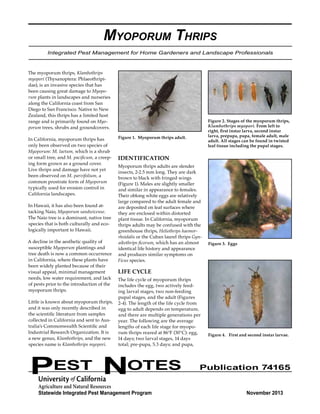
Figure 1. Myoporum thrips adult.
Figure 2. Stages of the myoporum thrips,
Klambothrips myopori. From left to
right, first instar larva, second instar
larva, prepupa, pupa, female adult, male
adult. All stages can be found in twisted
leaf tissue including the pupal stages.
Figure 4. First and second instar larvae.
Figure 3. Eggs
November 2013	 Myoporum Thrips
◆ 2 of 3 ◆
5.0 days. Adults live an average of 9.2
days. A generation from egg to an
egg-producing adult is about 38 days.
These times compare closely with the
Cuban laurel thrips, a closely related
thrips species. In warm areas, myopo-
rum thrips can reproduce throughout
the year and have many generations.
damage
Myoporum plants damaged by this
thrips are characterized by gall-like
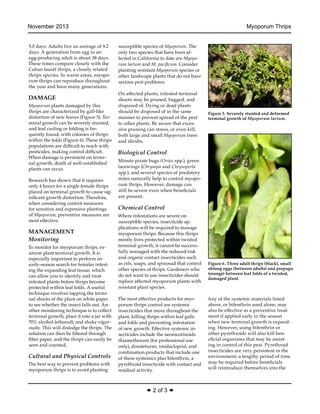
distortion of new leaves (Figure 5). Ter-
minal growth can be severely stunted,
and leaf curling or folding is fre-
quently found, with colonies of thrips
within the folds (Figure 6). These thrips
populations are difficult to reach with
pesticides, making control difficult.
When damage is persistent on termi-
nal growth, death of well-established
plants can occur.
Research has shown that it requires
only 4 hours for a single female thrips
placed on terminal growth to cause sig-
nificant growth distortion. Therefore,
when considering control measures
for sensitive and expensive plantings
of Myoporum, preventive measures are
most effective.
management
Monitoring
To monitor for myoporum thrips, ex-
amine plant terminal growth. It is
especially important to perform an
early-season search for females infest-
ing the expanding leaf tissue, which
can allow you to identify and treat
infested plants before thrips become
protected within leaf folds. A useful
technique involves tapping the termi-
nal shoots of the plant on white paper
to see whether the insect falls out. An-
other monitoring technique is to collect
terminal growth, place it into a jar with
70% alcohol (ethanol), and shake vigor-
ously. This will dislodge the thrips. The
solution can then be filtered through
filter paper, and the thrips can easily be
seen and counted.
Cultural and Physical Controls
The best way to prevent problems with
myoporum thrips is to avoid planting
susceptible species of Myoporum. The
only two species that have been af-
fected in California to date are Myopo-
rum laetum and M. pacificum. Consider
planting resistant Myoporum species or
other landscape plants that do not have
serious pest problems.
On affected plants, infested terminal
shoots may be pruned, bagged, and
disposed of. Dying or dead plants
should be disposed of in the same
manner to prevent spread of the pest
to other plants. Be aware that exces-
sive pruning can stress, or even kill,
both large and small Myoporum trees
and shrubs.
Biological Control
Minute pirate bugs (Orius spp.), green
lacewings (Chrysopa and Chrysoperla
spp.), and several species of predatory
mites naturally help to control myopo-
rum thrips. However, damage can
still be severe even when beneficials
are present.
Chemical Control
Where infestations are severe on
susceptible species, insecticide ap-
plications will be required to manage
myoporum thrips. Because this thrips
mostly lives protected within twisted
terminal growth, it cannot be success-
fully managed with the reduced-risk
and organic contact insecticides such
as oils, soaps, and spinosad that control
other species of thrips. Gardeners who
do not want to use insecticides should
replace affected myoporum plants with
resistant plant species.
The most effective products for myo-
porum thrips control are systemic
insecticides that move throughout the
plant, killing thrips within leaf galls
and folds and preventing infestation
of new growth. Effective systemic in-
secticides include the neonicotinoids
thiamethoxam (for professional use
only), dinotefuran, imidacloprid, and
combination products that include one
of these systemics plus bifenthrin, a
pyrethroid insecticide with contact and
residual activity.
Any of the systemic materials listed
above, or bifenthrin used alone, may
also be effective as a preventive treat-
ment if applied early in the season
when new terminal growth is expand-
ing. However, using bifenthrin or
other pyrethroids will also kill ben-
eficial organisms that may be assist-
ing in control of this pest. Pyrethroid
insecticides are very persistent in the
environment; a lengthy period of time
may be required before beneficials
will reintroduce themselves into the
Figure 6. Three adult thrips (black), small
oblong eggs (between adults) and prepupa
(orange) between leaf folds of a twisted,
damaged plant.
Figure 5. Severely stunted and deformed
terminal growth of Myoporum laetum.
November 2013	 Myoporum Thrips
◆ 3 of 3 ◆
Authors: J. A. Bethke and L. Bates,
UCCE San Diego
Technical Editor: M.L. Flint
Editor: C. Laning
Photos: Fig 1, L.L. Strand; Figs 2-4, J.A.
Bethke; Figs 5-6, D.S. Shaw.
This and other Pest Notes are available
at www.ipm.ucanr.edu.
For more information, contact the University of
California Cooperative Extension office in your
county. See your telephone directory for addresses
and phone numbers, or visit http://ucanr.org/ce.cfm.
WARNING ON THE USE OF CHEMICALS
	 Pesticides are poisonous. Always read and carefully follow all precautions and safety recommendations
given on the container label. Store all chemicals in the original, labeled containers in a locked cabinet or shed,
away from food or feeds, and out of the reach of children, unauthorized persons, pets, and livestock.
	 Pesticides applied in your home and landscape can move and contaminate creeks, rivers, and oceans.
Confine chemicals to the property being treated. Avoid drift onto neighboring properties, especially gardens
containing fruits or vegetables ready to be picked.
	 Do not place containers containing pesticide in the trash or pour pesticides down the sink or toilet. Either use
the pesticide according to the label, or take unwanted pesticides to a Household Hazardous Waste Collection
site. Contact your county agricultural commissioner for additional information on safe container disposal and
for the location of the Household Hazardous Waste Collection site nearest you. Dispose of empty containers
by following label directions. Never reuse or burn the containers or dispose of them in such a manner that
they may contaminate water supplies or natural waterways.
ANR NONDISCRIMINATION AND AFFIRMATIVE ACTION POLICY STATEMENT
FOR UNIVERSITY OF CALIFORNIA
	 It is the policy of the University of California (UC) and the UC Division ofAgriculture & Natural Resources not
to engage in discrimination against or harassment of any person in any of its programs or activities (Complete
nondiscrimination policy statement can be found at http://ucanr.edu/sites/anrstaff/files/169224.pdf )
	 Inquiries regarding ANR’s nondiscrimination policies may be directed to Linda Marie Manton, Affirmative
Action Contact, University of California, Davis,Agriculture and Natural Resources, One ShieldsAvenue, Davis,
CA 95616, (530) 752-0495.
Produced by UC Statewide
Integrated Pest Management Program
University of California, Davis, CA 95616
	 University of California scientists and other
qualified professionals have anonymously peer
reviewed this publication for technical accuracy.
The ANR Associate Editor for Pest Management
managed this process.
	 To simplify information, trade names of products
have been used. No endorsement of named products
is intended, nor is criticism implied of similar products
that are not mentioned.
	 This material is partially based upon work
supportedbytheExtensionService,U.S.Department
of Agriculture, under special project Section 3(d),
Integrated Pest Management.
system after an application. Systemics
applied as drench or soil injections
may be safer for natural enemies, but
can have negative impacts on bees
and other pollinators that visit treated
plants. Always follow label instruc-
tions carefully. Systemics should never
be used during the flowering period
or when bees are present.
Research has shown that applying
dinotefuran to Myoporum tree trunks
is very effective against this pest. How-
ever, products labeled for this use are
only available to licensed pesticide
applicators. This application method
uses a small amount of pesticide solu-
tion that is applied in a narrow band
around the tree trunk. The active
ingredient penetrates the bark, and
systemically moves throughout the
tree, eventually reaching the new ter-
minal growth. This method avoids soil
drenching, spray drift, and contact
with numerous beneficial predators
and parasites. However, basal trunk
applications may still impact pollina-
tors if applied before or during bloom,
as mentioned above.
REFERENCES
Bethke, J. A. and D. A. Shaw. 2008.
Myoporum Thrips Control. CAPCA
Advisor. February 2008 Vol. XI (1): 28-31.
Hoddle, M. Updated 2009. Myoporum
Thrips. Center for Invasive Species
Research, U.C. Berkeley. http://cisr.ucr.
edu/myoporum_thrips.html
Mound, L.A. and D.C. Morris. 2007. A
new thrips pest of Myoporum cultivars
in California, in a new genus of leaf-
galling Australian Phlaeothripidae
(Thysanoptera). Zootaxa. 1495: 35-45.

Myoporum Thrips Integrated Pest Management

  • 1.
    Statewide Integrated PestManagement Program November 2013 PEST NOTES Publication 74165 Integrated Pest Management for Home Gardeners and Landscape Professionals Myoporum Thrips The myoporum thrips, Klambothrips myopori (Thysanoptera: Phlaeothripi- dae), is an invasive species that has been causing great damage to Myopo- rum plants in landscapes and nurseries along the California coast from San Diego to San Francisco. Native to New Zealand, this thrips has a limited host range and is primarily found on Myo- porum trees, shrubs and groundcovers. In California, myoporum thrips has only been observed on two species of Myoporum: M. laetum, which is a shrub or small tree, and M. pacificum, a creep- ing form grown as a ground cover. Live thrips and damage have not yet been observed on M. parvifolium, a common prostrate form of Myoporum typically used for erosion control in California landscapes. In Hawaii, it has also been found at- tacking Naio, Myoporum sandwicense. The Naio tree is a dominant, native tree species that is both culturally and eco- logically important to Hawaii. A decline in the aesthetic quality of susceptible Myoporum plantings and tree death is now a common occurrence in California, where these plants have been widely planted because of their visual appeal, minimal management needs, low water requirement, and lack of pests prior to the introduction of the myoporum thrips. Little is known about myoporum thrips, and it was only recently described in the scientific literature from samples collected in California and sent to Aus- tralia’s Commonwealth Scientific and Industrial Research Organization. It is a new genus, Klambothrips, and the new species name is Klambothrips myopori. Identification Myoporum thrips adults are slender insects, 2-2.5 mm long. They are dark brown to black with fringed wings (Figure 1). Males are slightly smaller and similar in appearance to females. Their oblong white eggs are relatively large compared to the adult female and are deposited on leaf surfaces where they are enclosed within distorted plant tissue. In California, myoporum thrips adults may be confused with the greenhouse thrips, Heliothrips haemor- rhoidalis or the Cuban laurel thrips Gyn- aikothrips ficorum, which has an almost identical life history and appearance and produces similar symptoms on Ficus species. life cycle The life cycle of myoporum thrips includes the egg, two actively feed- ing larval stages, two non-feeding pupal stages, and the adult (Figures 2-4). The length of the life cycle from egg to adult depends on temperature, and there are multiple generations per year. The following are the average lengths of each life stage for myopo- rum thrips reared at 86°F (30°C): egg, 14 days; two larval stages, 14 days total; pre-pupa, 5.3 days; and pupa, Figure 1. Myoporum thrips adult. Figure 2. Stages of the myoporum thrips, Klambothrips myopori. From left to right, first instar larva, second instar larva, prepupa, pupa, female adult, male adult. All stages can be found in twisted leaf tissue including the pupal stages. Figure 4. First and second instar larvae. Figure 3. Eggs
  • 2.
    November 2013 MyoporumThrips ◆ 2 of 3 ◆ 5.0 days. Adults live an average of 9.2 days. A generation from egg to an egg-producing adult is about 38 days. These times compare closely with the Cuban laurel thrips, a closely related thrips species. In warm areas, myopo- rum thrips can reproduce throughout the year and have many generations. damage Myoporum plants damaged by this thrips are characterized by gall-like distortion of new leaves (Figure 5). Ter- minal growth can be severely stunted, and leaf curling or folding is fre- quently found, with colonies of thrips within the folds (Figure 6). These thrips populations are difficult to reach with pesticides, making control difficult. When damage is persistent on termi- nal growth, death of well-established plants can occur. Research has shown that it requires only 4 hours for a single female thrips placed on terminal growth to cause sig- nificant growth distortion. Therefore, when considering control measures for sensitive and expensive plantings of Myoporum, preventive measures are most effective. management Monitoring To monitor for myoporum thrips, ex- amine plant terminal growth. It is especially important to perform an early-season search for females infest- ing the expanding leaf tissue, which can allow you to identify and treat infested plants before thrips become protected within leaf folds. A useful technique involves tapping the termi- nal shoots of the plant on white paper to see whether the insect falls out. An- other monitoring technique is to collect terminal growth, place it into a jar with 70% alcohol (ethanol), and shake vigor- ously. This will dislodge the thrips. The solution can then be filtered through filter paper, and the thrips can easily be seen and counted. Cultural and Physical Controls The best way to prevent problems with myoporum thrips is to avoid planting susceptible species of Myoporum. The only two species that have been af- fected in California to date are Myopo- rum laetum and M. pacificum. Consider planting resistant Myoporum species or other landscape plants that do not have serious pest problems. On affected plants, infested terminal shoots may be pruned, bagged, and disposed of. Dying or dead plants should be disposed of in the same manner to prevent spread of the pest to other plants. Be aware that exces- sive pruning can stress, or even kill, both large and small Myoporum trees and shrubs. Biological Control Minute pirate bugs (Orius spp.), green lacewings (Chrysopa and Chrysoperla spp.), and several species of predatory mites naturally help to control myopo- rum thrips. However, damage can still be severe even when beneficials are present. Chemical Control Where infestations are severe on susceptible species, insecticide ap- plications will be required to manage myoporum thrips. Because this thrips mostly lives protected within twisted terminal growth, it cannot be success- fully managed with the reduced-risk and organic contact insecticides such as oils, soaps, and spinosad that control other species of thrips. Gardeners who do not want to use insecticides should replace affected myoporum plants with resistant plant species. The most effective products for myo- porum thrips control are systemic insecticides that move throughout the plant, killing thrips within leaf galls and folds and preventing infestation of new growth. Effective systemic in- secticides include the neonicotinoids thiamethoxam (for professional use only), dinotefuran, imidacloprid, and combination products that include one of these systemics plus bifenthrin, a pyrethroid insecticide with contact and residual activity. Any of the systemic materials listed above, or bifenthrin used alone, may also be effective as a preventive treat- ment if applied early in the season when new terminal growth is expand- ing. However, using bifenthrin or other pyrethroids will also kill ben- eficial organisms that may be assist- ing in control of this pest. Pyrethroid insecticides are very persistent in the environment; a lengthy period of time may be required before beneficials will reintroduce themselves into the Figure 6. Three adult thrips (black), small oblong eggs (between adults) and prepupa (orange) between leaf folds of a twisted, damaged plant. Figure 5. Severely stunted and deformed terminal growth of Myoporum laetum.
  • 3.
    November 2013 MyoporumThrips ◆ 3 of 3 ◆ Authors: J. A. Bethke and L. Bates, UCCE San Diego Technical Editor: M.L. Flint Editor: C. Laning Photos: Fig 1, L.L. Strand; Figs 2-4, J.A. Bethke; Figs 5-6, D.S. Shaw. This and other Pest Notes are available at www.ipm.ucanr.edu. For more information, contact the University of California Cooperative Extension office in your county. See your telephone directory for addresses and phone numbers, or visit http://ucanr.org/ce.cfm. WARNING ON THE USE OF CHEMICALS Pesticides are poisonous. Always read and carefully follow all precautions and safety recommendations given on the container label. Store all chemicals in the original, labeled containers in a locked cabinet or shed, away from food or feeds, and out of the reach of children, unauthorized persons, pets, and livestock. Pesticides applied in your home and landscape can move and contaminate creeks, rivers, and oceans. Confine chemicals to the property being treated. Avoid drift onto neighboring properties, especially gardens containing fruits or vegetables ready to be picked. Do not place containers containing pesticide in the trash or pour pesticides down the sink or toilet. Either use the pesticide according to the label, or take unwanted pesticides to a Household Hazardous Waste Collection site. Contact your county agricultural commissioner for additional information on safe container disposal and for the location of the Household Hazardous Waste Collection site nearest you. Dispose of empty containers by following label directions. Never reuse or burn the containers or dispose of them in such a manner that they may contaminate water supplies or natural waterways. ANR NONDISCRIMINATION AND AFFIRMATIVE ACTION POLICY STATEMENT FOR UNIVERSITY OF CALIFORNIA It is the policy of the University of California (UC) and the UC Division ofAgriculture & Natural Resources not to engage in discrimination against or harassment of any person in any of its programs or activities (Complete nondiscrimination policy statement can be found at http://ucanr.edu/sites/anrstaff/files/169224.pdf ) Inquiries regarding ANR’s nondiscrimination policies may be directed to Linda Marie Manton, Affirmative Action Contact, University of California, Davis,Agriculture and Natural Resources, One ShieldsAvenue, Davis, CA 95616, (530) 752-0495. Produced by UC Statewide Integrated Pest Management Program University of California, Davis, CA 95616 University of California scientists and other qualified professionals have anonymously peer reviewed this publication for technical accuracy. The ANR Associate Editor for Pest Management managed this process. To simplify information, trade names of products have been used. No endorsement of named products is intended, nor is criticism implied of similar products that are not mentioned. This material is partially based upon work supportedbytheExtensionService,U.S.Department of Agriculture, under special project Section 3(d), Integrated Pest Management. system after an application. Systemics applied as drench or soil injections may be safer for natural enemies, but can have negative impacts on bees and other pollinators that visit treated plants. Always follow label instruc- tions carefully. Systemics should never be used during the flowering period or when bees are present. Research has shown that applying dinotefuran to Myoporum tree trunks is very effective against this pest. How- ever, products labeled for this use are only available to licensed pesticide applicators. This application method uses a small amount of pesticide solu- tion that is applied in a narrow band around the tree trunk. The active ingredient penetrates the bark, and systemically moves throughout the tree, eventually reaching the new ter- minal growth. This method avoids soil drenching, spray drift, and contact with numerous beneficial predators and parasites. However, basal trunk applications may still impact pollina- tors if applied before or during bloom, as mentioned above. REFERENCES Bethke, J. A. and D. A. Shaw. 2008. Myoporum Thrips Control. CAPCA Advisor. February 2008 Vol. XI (1): 28-31. Hoddle, M. Updated 2009. Myoporum Thrips. Center for Invasive Species Research, U.C. Berkeley. http://cisr.ucr. edu/myoporum_thrips.html Mound, L.A. and D.C. Morris. 2007. A new thrips pest of Myoporum cultivars in California, in a new genus of leaf- galling Australian Phlaeothripidae (Thysanoptera). Zootaxa. 1495: 35-45.