Name : Manoj Kumar
M.Sc. (Ag) Agroforestry
ID : AGF-14205
Supervisor : Dr. Rajesh Kumar Singh
Co-supervisor: Dr. Mahendra Singh
Effect of Various Weed Control Methods on Yield and Yield Components
of Wheat Under Different Cropping Patterns
 Introduction
 Weed
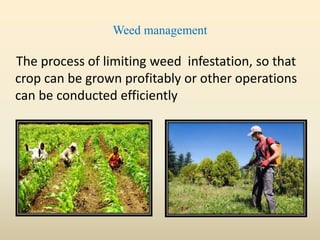
 Weed management
 Principle of weed management
INTRODUCTION
WEED
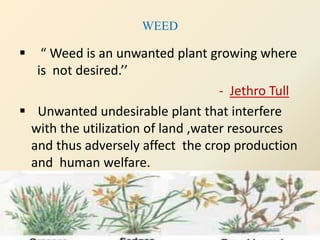
 “ Weed is an unwanted plant growing where
is not desired.’’
- Jethro Tull
 Unwanted undesirable plant that interfere
with the utilization of land ,water resources
and thus adversely affect the crop production
and human welfare.
Characteristics of weed:-
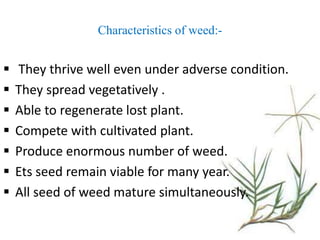
 They thrive well even under adverse condition.
 They spread vegetatively .
 Able to regenerate lost plant.
 Compete with cultivated plant.
 Produce enormous number of weed.
 Ets seed remain viable for many year.
 All seed of weed mature simultaneously.
Weed management
The process of limiting weed infestation, so that
crop can be grown profitably or other operations
can be conducted efficiently
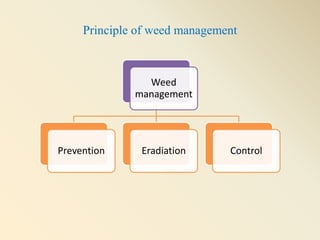
Principle of weed management
Weed
management
Prevention Eradiation Control
Prevention
It is a long term planning so that the weeds could be
controlled or managed more effectively and economically
than is possible where these are allowed to disperse freely.
Following preventive control measures are suggested for
adoption wherever possible & practicable.
Eradication
It infers that a given weed species, its seed & vegetative
part has been killed or completely removed from a given
area & that weed will not reappear unless reintroduced to
the area.
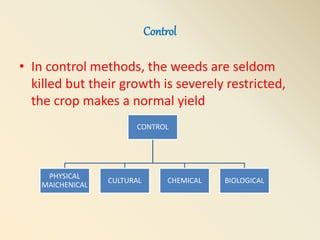
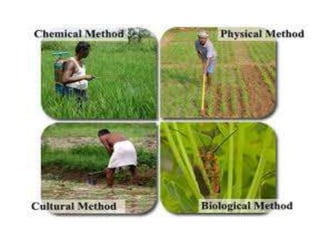
Control
• In control methods, the weeds are seldom
killed but their growth is severely restricted,
the crop makes a normal yield
CONTROL
PHYSICAL
MAICHENICAL
CULTURAL CHEMICAL BIOLOGICAL
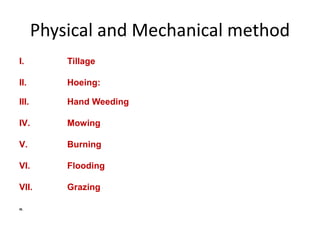
Physical and Mechanical method
I. Tillage
II. Hoeing:
III. Hand Weeding
IV. Mowing
V. Burning
VI. Flooding
VII. Grazing
IX.
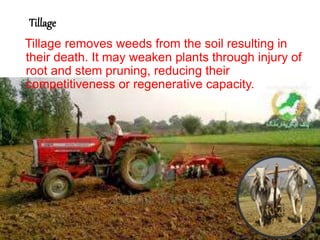
Tillage
Tillage removes weeds from the soil resulting in
their death. It may weaken plants through injury of
root and stem pruning, reducing their
competitiveness or regenerative capacity.
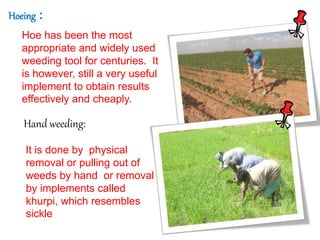
Hand weeding:
It is done by physical
removal or pulling out of
weeds by hand or removal
by implements called
khurpi, which resembles
sickle
Hoeing :
Hoe has been the most
appropriate and widely used
weeding tool for centuries. It
is however, still a very useful
implement to obtain results
effectively and cheaply.
Sicklingand Moving:
Sickling is also done by hand
with the help of sickle to remove the top growth of
weeds to prevent seed production and to starve the
underground parts.Mowing is a machine-operated
practice mostly done on roadsides and in lawns
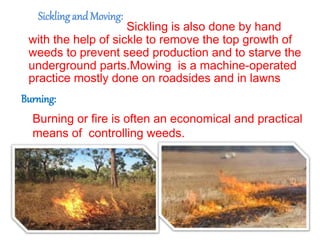
Burning:
Burning or fire is often an economical and practical
means of controlling weeds.
Flooding::
Flooding kills plants by reducing oxygen availability for plant
growth. The success of flooding depends upon complete
submergence of weeds for longer periods.
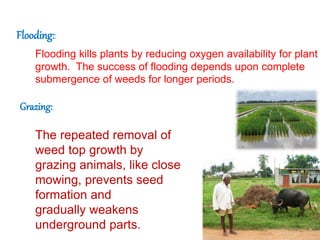
Grazing:
The repeated removal of
weed top growth by
grazing animals, like close
mowing, prevents seed
formation and
gradually weakens
underground parts.
Cultural
i. Field preparation
ii. Crop Rotations
iii. Maintenance of optimum plant population
iv. Mulching
Several cultural practices like tillage, planting,
fertilizer application, irrigation etc., are employed for
creating favorable condition for the crop. These
practices if used properly, help in controlling weeds
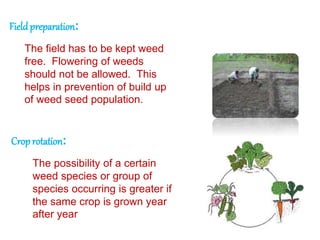
The field has to be kept weed
free. Flowering of weeds
should not be allowed. This
helps in prevention of build up
of weed seed population.
Fieldpreparation:
Crop rotation:
The possibility of a certain
weed species or group of
species occurring is greater if
the same crop is grown year
after year
Maintenance of optimumplant population:
Lack of adequate plant population is prone to heavy weed
infestation, which becomes, difficult to control later
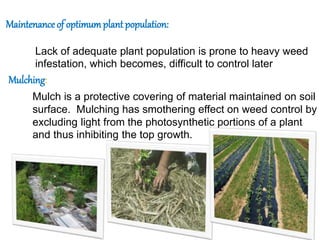
Mulch is a protective covering of material maintained on soil
surface. Mulching has smothering effect on weed control by
excluding light from the photosynthetic portions of a plant
and thus inhibiting the top growth.
Mulching:
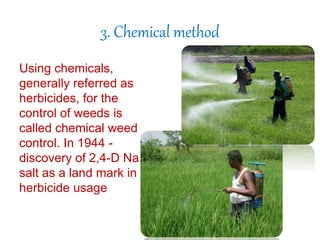
3. Chemical method
Using chemicals,
generally referred as
herbicides, for the
control of weeds is
called chemical weed
control. In 1944 -
discovery of 2,4-D Na
salt as a land mark in
herbicide usage
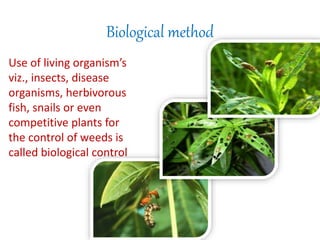
Biological method
Use of living organism’s
viz., insects, disease
organisms, herbivorous
fish, snails or even
competitive plants for
the control of weeds is
called biological control
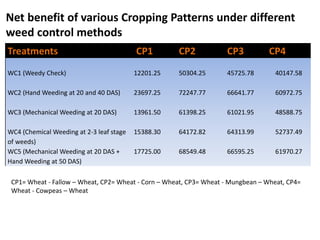
Treatments CP1 CP2 CP3 CP4
WC1 (Weedy Check)
WC2 (Hand Weeding at 20 and 40 DAS)
WC3 (Mechanical Weeding at 20 DAS)
WC4 (Chemical Weeding at 2-3 leaf stage
of weeds)
WC5 (Mechanical Weeding at 20 DAS +
Hand Weeding at 50 DAS)
12201.25
23697.25
13961.50
15388.30
17725.00
50304.25
72247.77
61398.25
64172.82
68549.48
45725.78
66641.77
61021.95
64313.99
66595.25
40147.58
60972.75
48588.75
52737.49
61970.27
Net benefit of various Cropping Patterns under different
weed control methods
CP1= Wheat - Fallow – Wheat, CP2= Wheat - Corn – Wheat, CP3= Wheat - Mungbean – Wheat, CP4=
Wheat - Cowpeas – Wheat
Integrated weed management

Weed manegment method

  • 2.
    Name : ManojKumar M.Sc. (Ag) Agroforestry ID : AGF-14205 Supervisor : Dr. Rajesh Kumar Singh Co-supervisor: Dr. Mahendra Singh Effect of Various Weed Control Methods on Yield and Yield Components of Wheat Under Different Cropping Patterns
  • 3.
     Introduction  Weed Weed management  Principle of weed management
  • 4.
  • 5.
    WEED  “ Weedis an unwanted plant growing where is not desired.’’ - Jethro Tull  Unwanted undesirable plant that interfere with the utilization of land ,water resources and thus adversely affect the crop production and human welfare.
  • 6.
    Characteristics of weed:- They thrive well even under adverse condition.  They spread vegetatively .  Able to regenerate lost plant.  Compete with cultivated plant.  Produce enormous number of weed.  Ets seed remain viable for many year.  All seed of weed mature simultaneously.
  • 7.
    Weed management The processof limiting weed infestation, so that crop can be grown profitably or other operations can be conducted efficiently
  • 8.
    Principle of weedmanagement Weed management Prevention Eradiation Control
  • 9.
    Prevention It is along term planning so that the weeds could be controlled or managed more effectively and economically than is possible where these are allowed to disperse freely. Following preventive control measures are suggested for adoption wherever possible & practicable.
  • 10.
    Eradication It infers thata given weed species, its seed & vegetative part has been killed or completely removed from a given area & that weed will not reappear unless reintroduced to the area.
  • 11.
    Control • In controlmethods, the weeds are seldom killed but their growth is severely restricted, the crop makes a normal yield CONTROL PHYSICAL MAICHENICAL CULTURAL CHEMICAL BIOLOGICAL
  • 13.
    Physical and Mechanicalmethod I. Tillage II. Hoeing: III. Hand Weeding IV. Mowing V. Burning VI. Flooding VII. Grazing IX.
  • 14.
    Tillage Tillage removes weedsfrom the soil resulting in their death. It may weaken plants through injury of root and stem pruning, reducing their competitiveness or regenerative capacity.
  • 15.
    Hand weeding: It isdone by physical removal or pulling out of weeds by hand or removal by implements called khurpi, which resembles sickle Hoeing : Hoe has been the most appropriate and widely used weeding tool for centuries. It is however, still a very useful implement to obtain results effectively and cheaply.
  • 16.
    Sicklingand Moving: Sickling isalso done by hand with the help of sickle to remove the top growth of weeds to prevent seed production and to starve the underground parts.Mowing is a machine-operated practice mostly done on roadsides and in lawns Burning: Burning or fire is often an economical and practical means of controlling weeds.
  • 17.
    Flooding:: Flooding kills plantsby reducing oxygen availability for plant growth. The success of flooding depends upon complete submergence of weeds for longer periods. Grazing: The repeated removal of weed top growth by grazing animals, like close mowing, prevents seed formation and gradually weakens underground parts.
  • 18.
    Cultural i. Field preparation ii.Crop Rotations iii. Maintenance of optimum plant population iv. Mulching Several cultural practices like tillage, planting, fertilizer application, irrigation etc., are employed for creating favorable condition for the crop. These practices if used properly, help in controlling weeds
  • 19.
    The field hasto be kept weed free. Flowering of weeds should not be allowed. This helps in prevention of build up of weed seed population. Fieldpreparation: Crop rotation: The possibility of a certain weed species or group of species occurring is greater if the same crop is grown year after year
  • 20.
    Maintenance of optimumplantpopulation: Lack of adequate plant population is prone to heavy weed infestation, which becomes, difficult to control later Mulch is a protective covering of material maintained on soil surface. Mulching has smothering effect on weed control by excluding light from the photosynthetic portions of a plant and thus inhibiting the top growth. Mulching:
  • 21.
    3. Chemical method Usingchemicals, generally referred as herbicides, for the control of weeds is called chemical weed control. In 1944 - discovery of 2,4-D Na salt as a land mark in herbicide usage
  • 22.
    Biological method Use ofliving organism’s viz., insects, disease organisms, herbivorous fish, snails or even competitive plants for the control of weeds is called biological control
  • 23.
    Treatments CP1 CP2CP3 CP4 WC1 (Weedy Check) WC2 (Hand Weeding at 20 and 40 DAS) WC3 (Mechanical Weeding at 20 DAS) WC4 (Chemical Weeding at 2-3 leaf stage of weeds) WC5 (Mechanical Weeding at 20 DAS + Hand Weeding at 50 DAS) 12201.25 23697.25 13961.50 15388.30 17725.00 50304.25 72247.77 61398.25 64172.82 68549.48 45725.78 66641.77 61021.95 64313.99 66595.25 40147.58 60972.75 48588.75 52737.49 61970.27 Net benefit of various Cropping Patterns under different weed control methods CP1= Wheat - Fallow – Wheat, CP2= Wheat - Corn – Wheat, CP3= Wheat - Mungbean – Wheat, CP4= Wheat - Cowpeas – Wheat
  • 24.