
Broiler Management
BELIZE Poultry Production School 2014
Rodrigo Espinosa MV, MAM, ACPV Dipl.
November, 2014
Why Broilers?
Pedigree SelectionGenetic Improvement
GGP
Grandparent Stock
Parent Stock
Broilers
Processing
Consumers
Aviagen
Broiler Performance Variance
Range in 42 day Live weights
Worst
Best
3
Std 42 Days
A/H 2637
Gms
LA Comparison
4
Actual
LA
Aviagen
Std
Actual
New Zealand
Kill Weight (Gms) 1600 1600 1600
FCR 1.86 1.48 1.42
Kill Age (Days) 34.5 29.5 27.5
ADWG 46.4 54.2 58.2
50 million broilers per annum
Approx 2 million dollar saving PA
$575 USD/Tonne Broiler feed
Hygiene
•Cleanout
•Bio security
Disease control
•Vaccine administration
•Vaccine response
•Coccidiostats
Nutrition
•Feed specification
•Physical texture
•Water
Management
Environment
•Temperature
•Humidity
5
Management Topics
•Chick Start/Brooding
•Brooding Layout
•Light Program & Intensity
•Water & Drinking
•Feed & Feeding
•Temperature/Humidity/Ventilation
•Stocking Density
6
Brooding Phase - first 10 days
Brooding - establish feeding
behaviour & drinking behaviour
Brooding/Chick Start
7
Brooding - % of flocks’ life
Genetic gains in growth rate means broilers will
reach killing age sooner. Brooding period is
steadily increasing proportion of the total life
of the flock
36 Day Broiler
9
Growing Period
Incubation and Brooding
46% 54%
Brooding/Chick Start
“Get It Right!”
• Good brooding is critical to good performance
• Plan before the chicks arrive and follow the plan
• Brooding management affects uniformity
• Don’t Leave Anything to Luck
10
Brooding Layout
“Setting the Table”
 Even distribution of temperature and humidity
 Enough feed space and accessibility – 1 Metre rule
 Enough drinker space and accessibility
 Supplementary feeders and drinkers
 Proper litter coverage on floor – min 5cm
 Light Intensity & Spread
 Bird Density
 Paper
11
Brooding Layout – Spot Brooding
12
6 Bell Drinkers
6 Mini Drinkers
12 Feed Trays
Automatic Feeder Automatic Feeder
25% - 35%
Paper Cover
2m2m
5m
7 Day Bodyweights
• Breed Target: Approx 182gms
– Aim for 4.5 X chick weight
– 40 Gm chick = 180 Gms at Day 7
• Potential: >210 Gms
• Field: ~125-200 Gms
13
Factors which influence
7-day bodyweight
• Parent stock age
• Hatch window
• Chick Temperature – Hatchery (>104.5F/40.5C)
• Delivery times
• Brooding temperature
• Light Intensity
• Access to feed and water
• Disease challenge / vaccination
• Litter temperature
• Feed quality
14
Effect of early feed intake on 7 day weight
100
110
120
130
140
150
160
170
180
190
200
100 120 140 160 180 200 220
7d Weight (g)
7dFeedintake(g)
Early feed consumption and its effect
in BW at 7 days
BW at 7 d
Feed intake (g) at 7 d
BW at 7 d
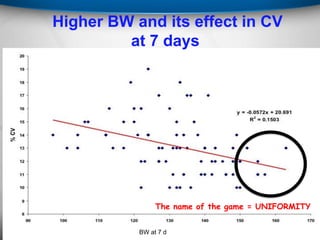
The name of the game = UNIFORMITY
Higher BW and its effect in CV
at 7 days
Weight
Gain
+ 10 g + 50-70 g
7 days
42 days
Day 7 Vs Final Kill Weight Correlation
17
Day 7 Vs Final Kill Weight Correlation
Management Tip
“Follow the Broiler Manual Specifications for Brooding Layout”
“Develop Standard Operating Procedures SOP’s for Brooding”
Remember – Stew Ritchie talked about a “checklist”
19
Preheat far ahead of chick arrival to warm the floor
and the litter as well as the air
24 hrs in normal climates
48 hrs in cooler times
72 hours in cold winters
Brooding Setup - Pre-Heating
20
 Basic Light Intensity and Photoperiod
Recommendations to optimise Live Performance
Ross Broiler Manual 2011
LIGHT
Initial Light intensity
40-60 lux

Allow chicks to find feed, water and source of heat
 Basic Light Intensity and Photoperiod
Recommendations to optimise Live Performance
Ross Broiler Manual 2011
LIGHT
Dark Barns
> Bird density
< Bird activity
< Energy cost
< FCR
 Basic Light Intensity and Photoperiod
Recommendations to optimise Live Performance
Ross Broiler Manual 2011
LIGHT
Water
• Water is considered to be the most important nutrient
• Chicks need immediate source of clean, fresh water at placement
• Plenty of drinker space at an appropriate height
• Supplementary drinkers for the first 4 days
• 1 week old chick = 85% water
• Reduced water availability reduces body weight (~15%) and
increases FCR drastically (Lott 2004)
26
Water availability
Water Flow Rates
• Reduction in flow rate from 75 ml/min to 25
ml/min decreased final Bodyweight by -225
grams and reduced breast meat yield by 14 %
– Miles et al, 2003
28
Water consumption over years
2007
1984
1965
29
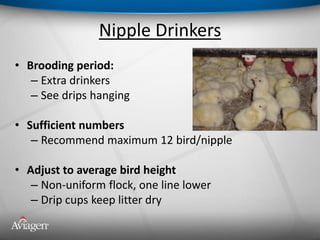
Nipple Drinkers
• Brooding period:
– Extra drinkers
– See drips hanging
• Sufficient numbers
– Recommend maximum 12 bird/nipple
• Adjust to average bird height
– Non-uniform flock, one line lower
– Drip cups keep litter dry
Keep the cups clean
31
Water Quality
Open water surfaces rapidly become contaminated with
bacteria from the environment
Water Quality
33
• Protect against bacterial growth by both:
– Chlorinating the water (3ppm to 5ppm recommended)
– Cleaning once a day with chlorinated sponge
– Change water once every 4 hours for 1st 3 days
• Control of bacterial load in drinking water –
improved leg health & fewer factory downgrades
• Susan Watkins – Slats/Staph in water/leg problems
Feed
• Immediate access to good quality feed together with
water is essential
• Supplementary feeders (pans or paper) are needed
to get started. Refill for 4-5 days until the chicks are
able to use the main feeding system
• Make sure that the main feeding system is available
from Day 1
34
When there is feed in the digestive tract:
 Residual yolk will be used more quickly
 Digestive tract develops faster
 Gut immunity develops faster
 The supply systems develop faster
e.g. circulatory
Outcome:
 Faster growth, increased robustness
 Improved breast meat yield (4-10%)
35
Feed Type – Starter Feed
36
Sieved Crumb 2-3mm
Low dust levels
• Feed Availability
– Don’t let chicks run out of feed
• Feed Accessibility
– Make sure plenty of feed or supplemental feeders
spread throughout the area
– Make sure the feed available is accessible!
– Weak chicks or chicks from young breeder flocks will
not travel far for feed or water
The “1 metre rule”
37
Empty trays
38
Feed availability


Feed availability
Good Practices

30 C
28.2 C
26 C
25 C
SENSOR
CHICK LEVEL
LITTER
CONCRETE
FEEL IF THE CHICKS FEET ARE COLD
42
House Temperature
Temperature
• Too Cold: – the chicks will huddle, and so will not start well -
ascites
• Too hot: – chicks will not eat as they should (depressed
appetite), they may dehydrate and feathering will be delayed
• Variation from target temperature will decrease uniformity &
FCR
• After 21 days - Aim to have temperatures on or slightly below
target to develop appetite and stimulate activity
43
What Happens When Chicks Get Cold?
• Blood Temperature
Decreases
• Chicks Get Colder
• Metabolism Increased To
Compensate – Energy Use
• Activity Decreased
• COLD STRESS
44 23.9°C
37.8°C
24
26
28
30
32
34
36
25.2
Too Cold
45
Too Hot
46
Correct temperature
47
Crop fill at 24 hrs after placement

Downtime and Productivity
Downtime Kill age
(days)
Mortality
(%)
Avg BW
(K)
FCR Production Factor
Growing Successful Broilers
Quote
“Successful broiler growing is about what you
can’t see rather than what you can see.
Controlling the environment (thermal neutral
zone) is the key to success. More important
than lighting or feed program etc”
53
Temperature
Humidity
Ventilation
1. Perceived Temperature – what the bird feels
2. Temperature Fluctuations
3. Temperature Control – Actual Examples
4. Ventilation Strategies
5. Summary
Key Points – FCR Focus
54
Perceived Temperature
What the Bird feels
55
The temperature
on your
Controller
is NOT always the
temperature the
bird feels
The temperature the bird feels is a combination of:
• Air Temperature
• Humidity
• Wind-chill
OK – so how do we adjust for Humidity and Wind-chill?
56
Perceived Temperature
What the Bird feels
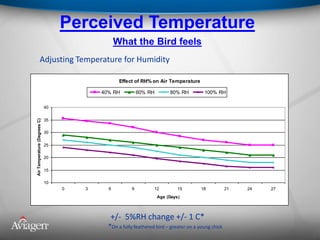
Adjusting Temperature for Humidity
+/- 5%RH change +/- 1 C*
*On a fully feathered bird – greater on a young chick
Effect of RH% on Air Temperature
10
15
20
25
30
35
40
0 3 6 9 12 15 18 21 24 27
Age (Days)
AirTemperature(DegreesC)
40% RH 60% RH 80% RH 100% RH
Perceived Temperature
What the Bird feels
Adjusting Temperature for Wind-chill
+/- 0.5m/s = +/- 1 C
*On a fully feathered bird – greater on a young chick
Windchill Effect
0
1
2
3
4
5
6
0 0.5 1 1.5 2 2.5
Airspeed (m/s)
Windchill(DegreesC) Perceived Temperature
What the Bird feels
Managing Temperature Fluctuations
59
• Temperature Fluctuations cause the bird to constantly
re-adjust and regulate its body temperature
• This burns energy and has a negative impact on FCR
• The greater the Fluctuations, the more the bird has to regulate its
temperature
• At its extremes – Fluctuations will cause the birds to sit and huddle
to keep warm or pant to cool down, limiting growth potential as
well
ObjectiveTemperatures vs. Age
BROODING COOLING
0 1 2 3 4 5 6 7 8 9 10 11 12 13 14 15 16 17 18 19 20 21 22 23 24 25 26 27 28 29 30 31 32 33 34 35 36
Managing Temperature Fluctuations
Good Control +/- 1o
C
Poorer Control +/- 3o
C
FCR Difference between profiles = ? >5pts FCR
Temperature Control
62 0
10
20
30
40
50
60
70
80
90
100
OK - Let’s add Humidity…………
0 1 2 3 4 5 6 7 8 9 10 11 12 13 14 15 16 17 18 19 20 21 22 23 24 25 26 27 28 29 30 31 32 33 34 35 36
Temperature Control
Adusting Temperature for Humidity levels…And what about Wind-chill…………?
0
1
2
3
4
5
6
7
8
9
10
0 1 2 3 4 5 6 7 8 9 10 11 12 13 14 15 16 17 18 19 20 21 22 23 24 25 26 27 28 29 30 31 32 33 34 35 36
Temperature Control
And what about Wind-chill…………?
And we thought our
Temperature Control was
OK?
Temperature Control
The Final Perceived Temperature…………?
66
STOP
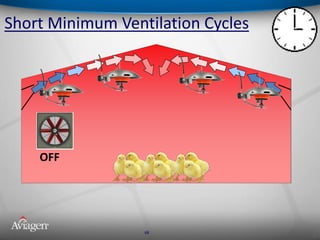
Short Minimum Ventilation Cycles
Air Movement = Wind-chill
ONOFF
+ 10oC
OFF
Short Minimum Ventilation Cycles
68
ONOFF
Short Minimum Ventilation Cycles
69
OFF
Short Minimum Ventilation Cycles
70
71
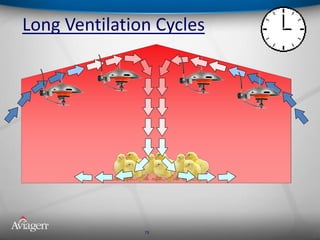
What happens if
I run my fans on longer Cycles?
Long Ventilation Cycles
$
$$
$ $
$$
$ $
$$
$ $
$$
$ $
$$
$ $
$$
$ $
$$
$ $
$$
$ $
$$
$
72
Long Ventilation Cycles
$
$$
$ $
$$
$ $
$$
$ $
$$
$ $
$$
$ $
$$
$ $
$$
$ $
$$
$ $
$$
$
73
Minimum Ventilation
YesYesMeets min. air requirement
MoreLessHeating Requirements
NoYesStable Humidity
NoYesStable Temperatures
Long CyclesShort Cycles
NoYesGives a good FCR result?
74
Ventilation Summary
• There is no single “Best” temperature Profile
• Think “Bird Comfort” not “Temperature Profile”
• Spend time in your barns – Learn to “read the birds”.
They will tell you what temperature they want
• Comfortable birds do not huddle up or pant – react, react!
• Minimise Temperature and Humidity Fluctuations
• Always re-check your barns 20 minutes after any temperature or
ventilation adjustment………
• did you get it right?
75
1957 1977 2005
The Genetic has changed!
Stocking Density
• 1990 = 5.65 lbs./sq ft (27.6 kgs/m2)
• 2002 = 6.28 lbs./sq ft (30.7 kgs/m2)
• 2010 = 6.95 to 7.77lbs/sq ft (34 to 38 kgs/m2)
• Considerations:
– Climate
– Product demand
– Water availability
– Feed availability
– Litter quality
– House type
– Ventilation capacity
77
Conclusions
• Better brooding management will improve
growth, uniformity and breast yield
• Successful broiler management is achieved by
matching environment with bird
requirements
78
Broiler Manuals
New Broiler Manual 2014
www.aviagen.com
respinosa@aviagen.com
Gracias

تربية دجاج الاحم في دولة بليز الأمريكية

  • 1.
    Broiler Management BELIZE PoultryProduction School 2014 Rodrigo Espinosa MV, MAM, ACPV Dipl. November, 2014
  • 2.
    Why Broilers? Pedigree SelectionGeneticImprovement GGP Grandparent Stock Parent Stock Broilers Processing Consumers Aviagen
  • 3.
    Broiler Performance Variance Rangein 42 day Live weights Worst Best 3 Std 42 Days A/H 2637 Gms
  • 4.
    LA Comparison 4 Actual LA Aviagen Std Actual New Zealand KillWeight (Gms) 1600 1600 1600 FCR 1.86 1.48 1.42 Kill Age (Days) 34.5 29.5 27.5 ADWG 46.4 54.2 58.2 50 million broilers per annum Approx 2 million dollar saving PA $575 USD/Tonne Broiler feed
  • 5.
    Hygiene •Cleanout •Bio security Disease control •Vaccineadministration •Vaccine response •Coccidiostats Nutrition •Feed specification •Physical texture •Water Management Environment •Temperature •Humidity 5
  • 6.
    Management Topics •Chick Start/Brooding •BroodingLayout •Light Program & Intensity •Water & Drinking •Feed & Feeding •Temperature/Humidity/Ventilation •Stocking Density 6
  • 7.
    Brooding Phase -first 10 days Brooding - establish feeding behaviour & drinking behaviour Brooding/Chick Start 7
  • 8.
    Brooding - %of flocks’ life Genetic gains in growth rate means broilers will reach killing age sooner. Brooding period is steadily increasing proportion of the total life of the flock
  • 9.
    36 Day Broiler 9 GrowingPeriod Incubation and Brooding 46% 54%
  • 10.
    Brooding/Chick Start “Get ItRight!” • Good brooding is critical to good performance • Plan before the chicks arrive and follow the plan • Brooding management affects uniformity • Don’t Leave Anything to Luck 10
  • 11.
    Brooding Layout “Setting theTable”  Even distribution of temperature and humidity  Enough feed space and accessibility – 1 Metre rule  Enough drinker space and accessibility  Supplementary feeders and drinkers  Proper litter coverage on floor – min 5cm  Light Intensity & Spread  Bird Density  Paper 11
  • 12.
    Brooding Layout –Spot Brooding 12 6 Bell Drinkers 6 Mini Drinkers 12 Feed Trays Automatic Feeder Automatic Feeder 25% - 35% Paper Cover 2m2m 5m
  • 13.
    7 Day Bodyweights •Breed Target: Approx 182gms – Aim for 4.5 X chick weight – 40 Gm chick = 180 Gms at Day 7 • Potential: >210 Gms • Field: ~125-200 Gms 13
  • 14.
    Factors which influence 7-daybodyweight • Parent stock age • Hatch window • Chick Temperature – Hatchery (>104.5F/40.5C) • Delivery times • Brooding temperature • Light Intensity • Access to feed and water • Disease challenge / vaccination • Litter temperature • Feed quality 14
  • 15.
    Effect of earlyfeed intake on 7 day weight 100 110 120 130 140 150 160 170 180 190 200 100 120 140 160 180 200 220 7d Weight (g) 7dFeedintake(g) Early feed consumption and its effect in BW at 7 days BW at 7 d Feed intake (g) at 7 d
  • 16.
    BW at 7d The name of the game = UNIFORMITY Higher BW and its effect in CV at 7 days
  • 17.
    Weight Gain + 10 g+ 50-70 g 7 days 42 days Day 7 Vs Final Kill Weight Correlation 17
  • 18.
    Day 7 VsFinal Kill Weight Correlation
  • 19.
    Management Tip “Follow theBroiler Manual Specifications for Brooding Layout” “Develop Standard Operating Procedures SOP’s for Brooding” Remember – Stew Ritchie talked about a “checklist” 19
  • 20.
    Preheat far aheadof chick arrival to warm the floor and the litter as well as the air 24 hrs in normal climates 48 hrs in cooler times 72 hours in cold winters Brooding Setup - Pre-Heating 20
  • 21.
     Basic LightIntensity and Photoperiod Recommendations to optimise Live Performance Ross Broiler Manual 2011 LIGHT
  • 22.
    Initial Light intensity 40-60lux  Allow chicks to find feed, water and source of heat
  • 23.
     Basic LightIntensity and Photoperiod Recommendations to optimise Live Performance Ross Broiler Manual 2011 LIGHT
  • 24.
    Dark Barns > Birddensity < Bird activity < Energy cost < FCR
  • 25.
     Basic LightIntensity and Photoperiod Recommendations to optimise Live Performance Ross Broiler Manual 2011 LIGHT
  • 26.
    Water • Water isconsidered to be the most important nutrient • Chicks need immediate source of clean, fresh water at placement • Plenty of drinker space at an appropriate height • Supplementary drinkers for the first 4 days • 1 week old chick = 85% water • Reduced water availability reduces body weight (~15%) and increases FCR drastically (Lott 2004) 26
  • 27.
  • 28.
    Water Flow Rates •Reduction in flow rate from 75 ml/min to 25 ml/min decreased final Bodyweight by -225 grams and reduced breast meat yield by 14 % – Miles et al, 2003 28
  • 29.
    Water consumption overyears 2007 1984 1965 29
  • 30.
    Nipple Drinkers • Broodingperiod: – Extra drinkers – See drips hanging • Sufficient numbers – Recommend maximum 12 bird/nipple • Adjust to average bird height – Non-uniform flock, one line lower – Drip cups keep litter dry
  • 31.
    Keep the cupsclean 31
  • 32.
    Water Quality Open watersurfaces rapidly become contaminated with bacteria from the environment
  • 33.
    Water Quality 33 • Protectagainst bacterial growth by both: – Chlorinating the water (3ppm to 5ppm recommended) – Cleaning once a day with chlorinated sponge – Change water once every 4 hours for 1st 3 days • Control of bacterial load in drinking water – improved leg health & fewer factory downgrades • Susan Watkins – Slats/Staph in water/leg problems
  • 34.
    Feed • Immediate accessto good quality feed together with water is essential • Supplementary feeders (pans or paper) are needed to get started. Refill for 4-5 days until the chicks are able to use the main feeding system • Make sure that the main feeding system is available from Day 1 34
  • 35.
    When there isfeed in the digestive tract:  Residual yolk will be used more quickly  Digestive tract develops faster  Gut immunity develops faster  The supply systems develop faster e.g. circulatory Outcome:  Faster growth, increased robustness  Improved breast meat yield (4-10%) 35
  • 36.
    Feed Type –Starter Feed 36 Sieved Crumb 2-3mm Low dust levels
  • 37.
    • Feed Availability –Don’t let chicks run out of feed • Feed Accessibility – Make sure plenty of feed or supplemental feeders spread throughout the area – Make sure the feed available is accessible! – Weak chicks or chicks from young breeder flocks will not travel far for feed or water The “1 metre rule” 37
  • 38.
  • 39.
  • 40.
  • 41.
  • 42.
    30 C 28.2 C 26C 25 C SENSOR CHICK LEVEL LITTER CONCRETE FEEL IF THE CHICKS FEET ARE COLD 42 House Temperature
  • 43.
    Temperature • Too Cold:– the chicks will huddle, and so will not start well - ascites • Too hot: – chicks will not eat as they should (depressed appetite), they may dehydrate and feathering will be delayed • Variation from target temperature will decrease uniformity & FCR • After 21 days - Aim to have temperatures on or slightly below target to develop appetite and stimulate activity 43
  • 44.
    What Happens WhenChicks Get Cold? • Blood Temperature Decreases • Chicks Get Colder • Metabolism Increased To Compensate – Energy Use • Activity Decreased • COLD STRESS 44 23.9°C 37.8°C 24 26 28 30 32 34 36 25.2
  • 45.
  • 46.
  • 47.
  • 48.
    Crop fill at24 hrs after placement 
  • 50.
    Downtime and Productivity DowntimeKill age (days) Mortality (%) Avg BW (K) FCR Production Factor
  • 51.
    Growing Successful Broilers Quote “Successfulbroiler growing is about what you can’t see rather than what you can see. Controlling the environment (thermal neutral zone) is the key to success. More important than lighting or feed program etc”
  • 52.
  • 53.
    1. Perceived Temperature– what the bird feels 2. Temperature Fluctuations 3. Temperature Control – Actual Examples 4. Ventilation Strategies 5. Summary Key Points – FCR Focus 54
  • 54.
    Perceived Temperature What theBird feels 55 The temperature on your Controller is NOT always the temperature the bird feels
  • 55.
    The temperature thebird feels is a combination of: • Air Temperature • Humidity • Wind-chill OK – so how do we adjust for Humidity and Wind-chill? 56 Perceived Temperature What the Bird feels
  • 56.
    Adjusting Temperature forHumidity +/- 5%RH change +/- 1 C* *On a fully feathered bird – greater on a young chick Effect of RH% on Air Temperature 10 15 20 25 30 35 40 0 3 6 9 12 15 18 21 24 27 Age (Days) AirTemperature(DegreesC) 40% RH 60% RH 80% RH 100% RH Perceived Temperature What the Bird feels
  • 57.
    Adjusting Temperature forWind-chill +/- 0.5m/s = +/- 1 C *On a fully feathered bird – greater on a young chick Windchill Effect 0 1 2 3 4 5 6 0 0.5 1 1.5 2 2.5 Airspeed (m/s) Windchill(DegreesC) Perceived Temperature What the Bird feels
  • 58.
    Managing Temperature Fluctuations 59 •Temperature Fluctuations cause the bird to constantly re-adjust and regulate its body temperature • This burns energy and has a negative impact on FCR • The greater the Fluctuations, the more the bird has to regulate its temperature • At its extremes – Fluctuations will cause the birds to sit and huddle to keep warm or pant to cool down, limiting growth potential as well
  • 59.
  • 60.
    0 1 23 4 5 6 7 8 9 10 11 12 13 14 15 16 17 18 19 20 21 22 23 24 25 26 27 28 29 30 31 32 33 34 35 36 Managing Temperature Fluctuations Good Control +/- 1o C Poorer Control +/- 3o C FCR Difference between profiles = ? >5pts FCR
  • 61.
  • 62.
    0 1 23 4 5 6 7 8 9 10 11 12 13 14 15 16 17 18 19 20 21 22 23 24 25 26 27 28 29 30 31 32 33 34 35 36 Temperature Control Adusting Temperature for Humidity levels…And what about Wind-chill…………?
  • 63.
    0 1 2 3 4 5 6 7 8 9 10 0 1 23 4 5 6 7 8 9 10 11 12 13 14 15 16 17 18 19 20 21 22 23 24 25 26 27 28 29 30 31 32 33 34 35 36 Temperature Control And what about Wind-chill…………?
  • 64.
    And we thoughtour Temperature Control was OK? Temperature Control The Final Perceived Temperature…………?
  • 65.
  • 66.
    STOP Short Minimum VentilationCycles Air Movement = Wind-chill ONOFF + 10oC
  • 67.
  • 68.
  • 69.
  • 70.
    71 What happens if Irun my fans on longer Cycles?
  • 71.
    Long Ventilation Cycles $ $$ $$ $$ $ $ $$ $ $ $$ $ $ $$ $ $ $$ $ $ $$ $ $ $$ $ $ $$ $ 72
  • 72.
    Long Ventilation Cycles $ $$ $$ $$ $ $ $$ $ $ $$ $ $ $$ $ $ $$ $ $ $$ $ $ $$ $ $ $$ $ 73
  • 73.
    Minimum Ventilation YesYesMeets min.air requirement MoreLessHeating Requirements NoYesStable Humidity NoYesStable Temperatures Long CyclesShort Cycles NoYesGives a good FCR result? 74
  • 74.
    Ventilation Summary • Thereis no single “Best” temperature Profile • Think “Bird Comfort” not “Temperature Profile” • Spend time in your barns – Learn to “read the birds”. They will tell you what temperature they want • Comfortable birds do not huddle up or pant – react, react! • Minimise Temperature and Humidity Fluctuations • Always re-check your barns 20 minutes after any temperature or ventilation adjustment……… • did you get it right? 75
  • 75.
    1957 1977 2005 TheGenetic has changed!
  • 76.
    Stocking Density • 1990= 5.65 lbs./sq ft (27.6 kgs/m2) • 2002 = 6.28 lbs./sq ft (30.7 kgs/m2) • 2010 = 6.95 to 7.77lbs/sq ft (34 to 38 kgs/m2) • Considerations: – Climate – Product demand – Water availability – Feed availability – Litter quality – House type – Ventilation capacity 77
  • 77.
    Conclusions • Better broodingmanagement will improve growth, uniformity and breast yield • Successful broiler management is achieved by matching environment with bird requirements 78
  • 78.
    Broiler Manuals New BroilerManual 2014 www.aviagen.com respinosa@aviagen.com
  • 79.