ON OF
CHRONIC
SUPPURATIV
E OTITIS
MEDIA
Amalina Aminuddin
0820121000 67
• Factors
• Spread of infection
• Classification
• Sequelae
• Complications:
• Intratemporal complication
• Intracranial complication
Content
Factors
 Age
 Poor socioeconomic group
 Virulence of organism
 Immune-compromised host
 Preformed pathways
 Cholesteatoma
Pathways spread of infection
 Direct bone erosion
 Venous thrombophlebitis
 Preformed pathways
 Congenital dehiscences
 Patent sutures
 Previous skull fractures
 Surgical defects
 Oval and round windows
 Infection from labyrinth
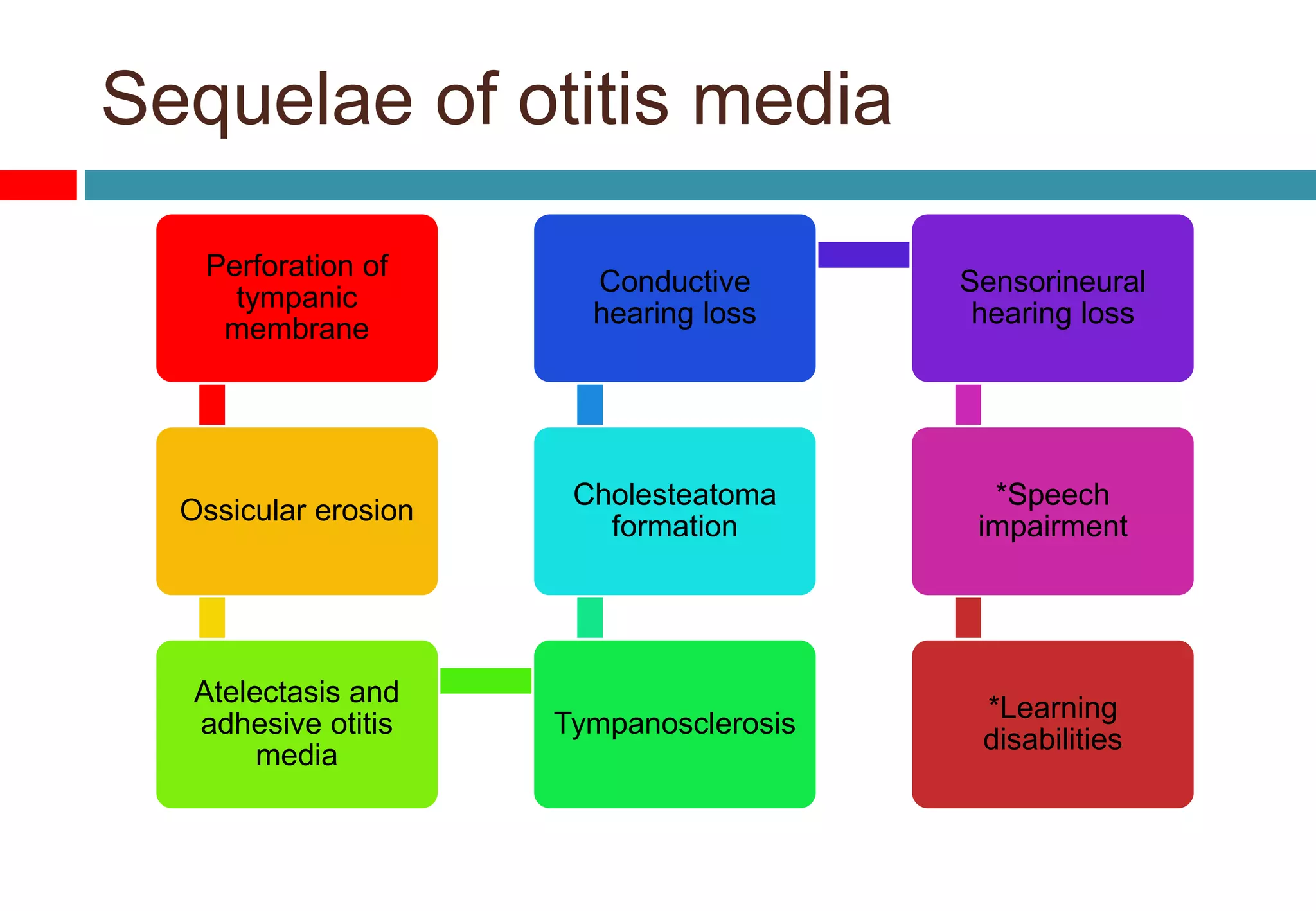
Sequelae of otitis media
Perforation of
tympanic
membrane
Ossicular erosion
Atelectasis and
adhesive otitis
media
Tympanosclerosis
Cholesteatoma
formation
Conductive
hearing loss
Sensorineural
hearing loss
*Speech
impairment
*Learning
disabilities
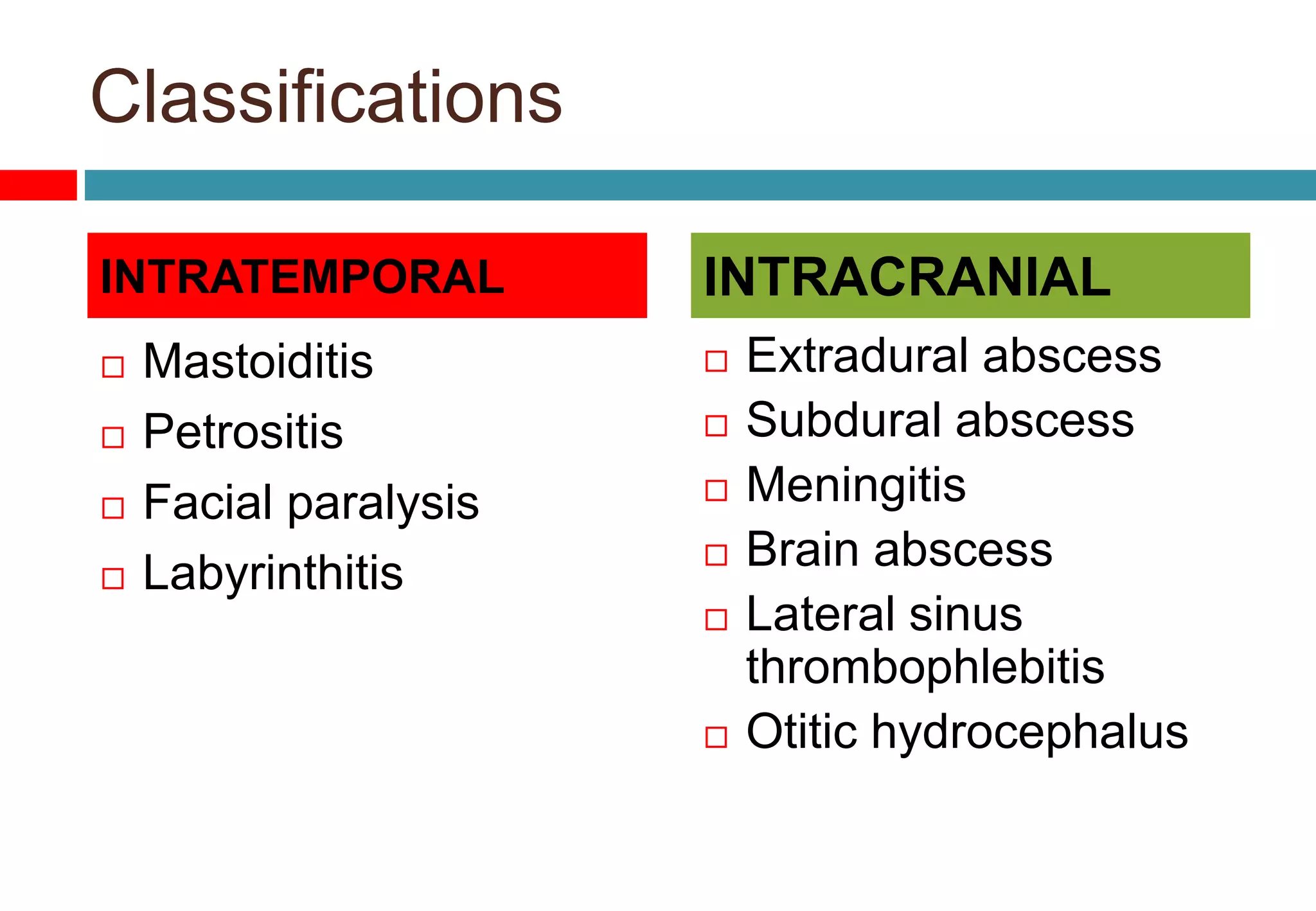
Classifications
 Mastoiditis
 Petrositis
 Facial paralysis
 Labyrinthitis
 Extradural abscess
 Subdural abscess
 Meningitis
 Brain abscess
 Lateral sinus
thrombophlebitis
 Otitic hydrocephalus
INTRATEMPORAL INTRACRANIAL
Intratempor
al
Complicatio
n
A. [i] ACUTE MASTOIDITIS
 Inflammation of
mucosal lining
of antrum and
mastoid air cell
system
 mucosa bony
walls
Accompanies / follow
ASOM
1. Virulence of organism
2. Lowered resistance
3. Children
1. Production of pus
under tension
 Production > drainage
2. Hyperaemic
decalcification and
osteoclastic resorption
of bony wall
 Destruction,
coalescence of
mastoid air cell
[empyema of mastoid]
 subperiosteal
Aetiology PATHOLOGY
Clinical Features
 Pain behind the ear
 Fever
 Ear discharge
 Mastoid tenderness
 Light house effect (
pulsatile purulent
discharge)
 Sagging of
posterosuperior meatal
wall
 Perforation of tympanic
membrane
 Swelling over the
mastoid
 Hearing loss
SYMPTOMS SIGNS
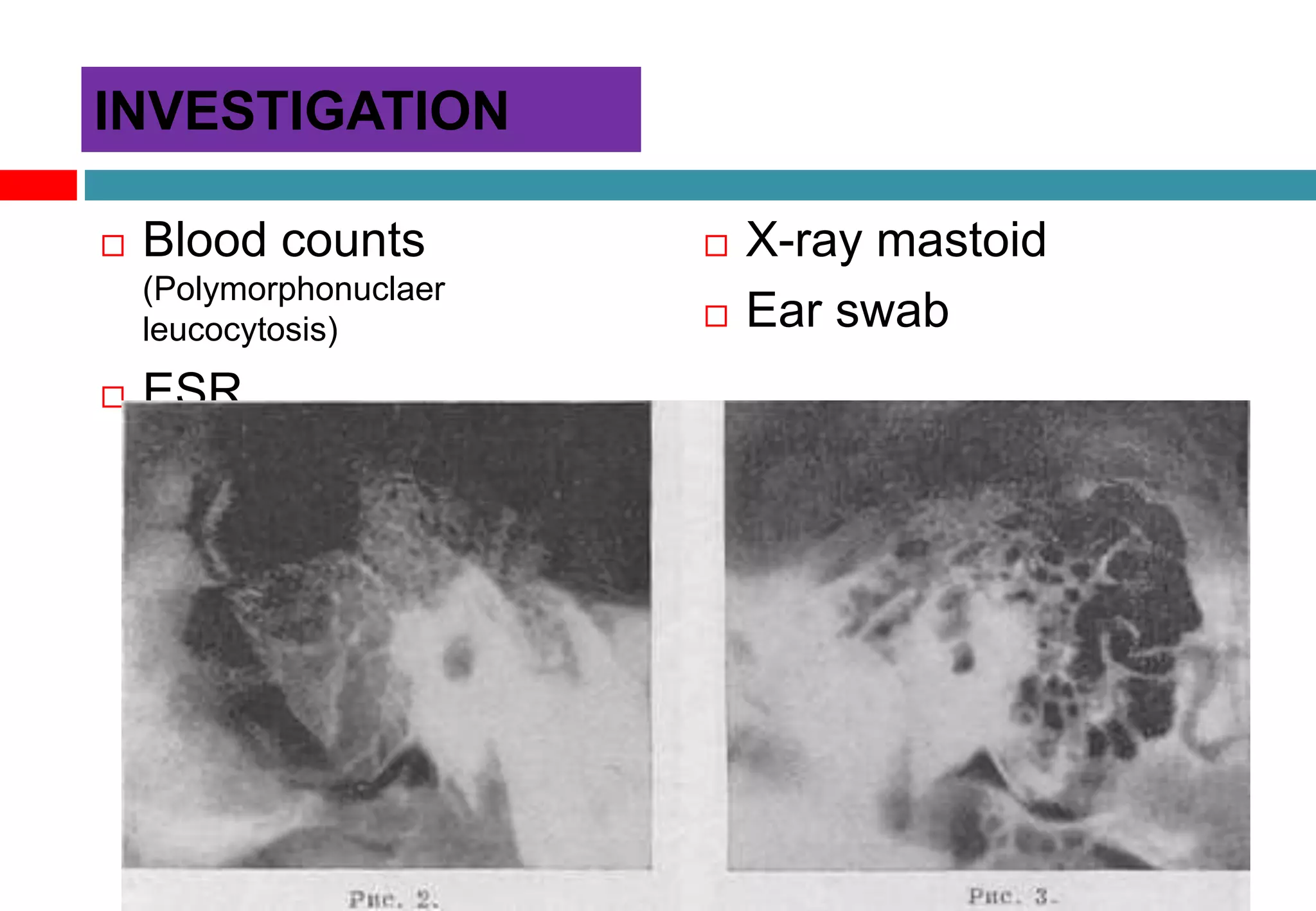
 Blood counts
(Polymorphonuclaer
leucocytosis)
 ESR
 X-ray mastoid
 Ear swab
INVESTIGATION
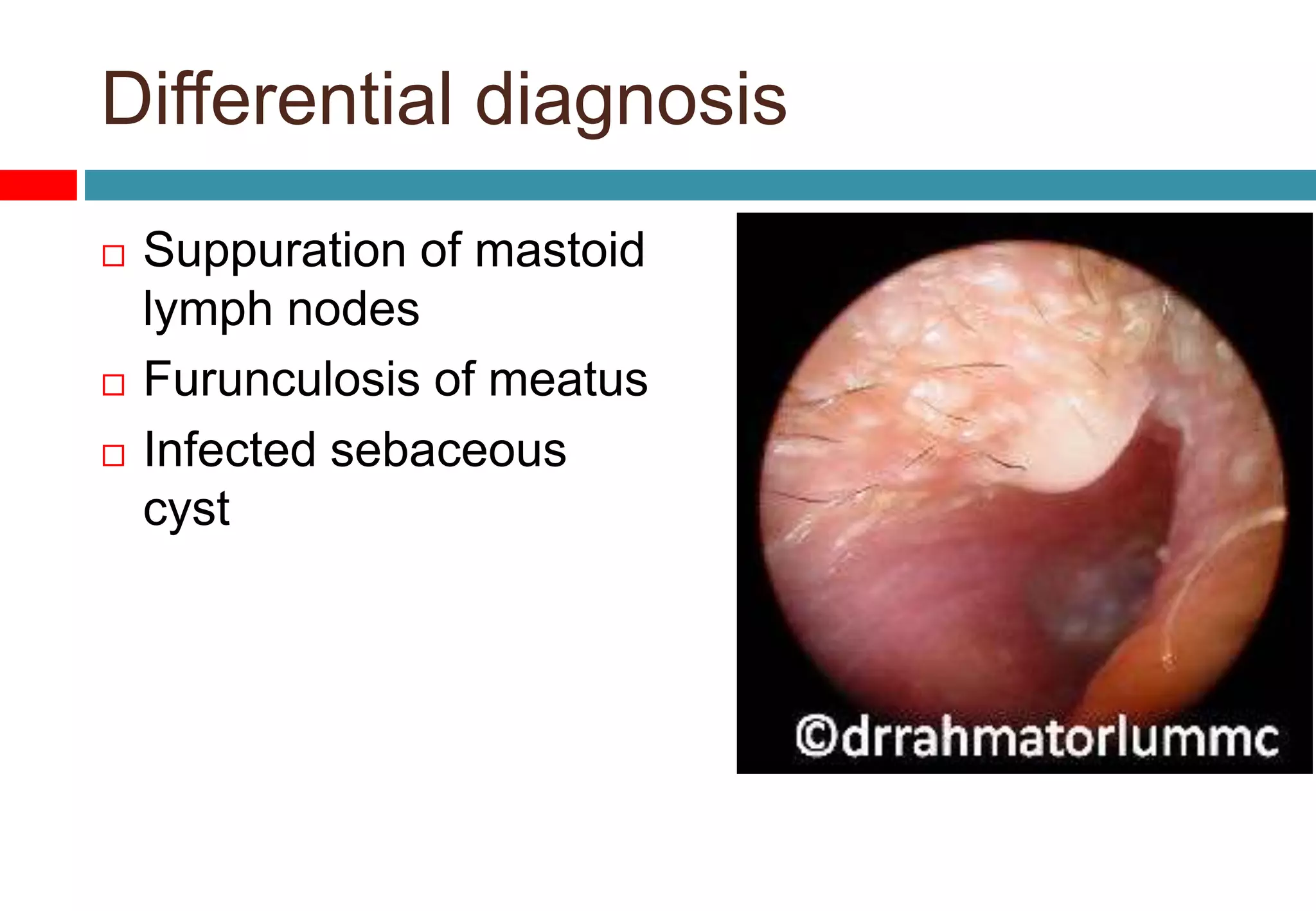
Differential diagnosis
 Suppuration of mastoid
lymph nodes
 Furunculosis of meatus
 Infected sebaceous
cyst
Treatment
 Hospitalization
 Antibiotics
 Myringotomy
 Cortical
mastoidectomy
[Subperiosteal abscess,
positive resevoir sign, no
change despite medical
treatment for 48hours]
Complications
 Subperiosteal
abscess
 Labyrinthitis
 Facial paralysis
 Petrositis
 Extradural
abscess
 Subdural abscess
 Meningitis
 Brain abscess
 Lateral sinus
thrombophlebitis
 Otitic hydrocephalous
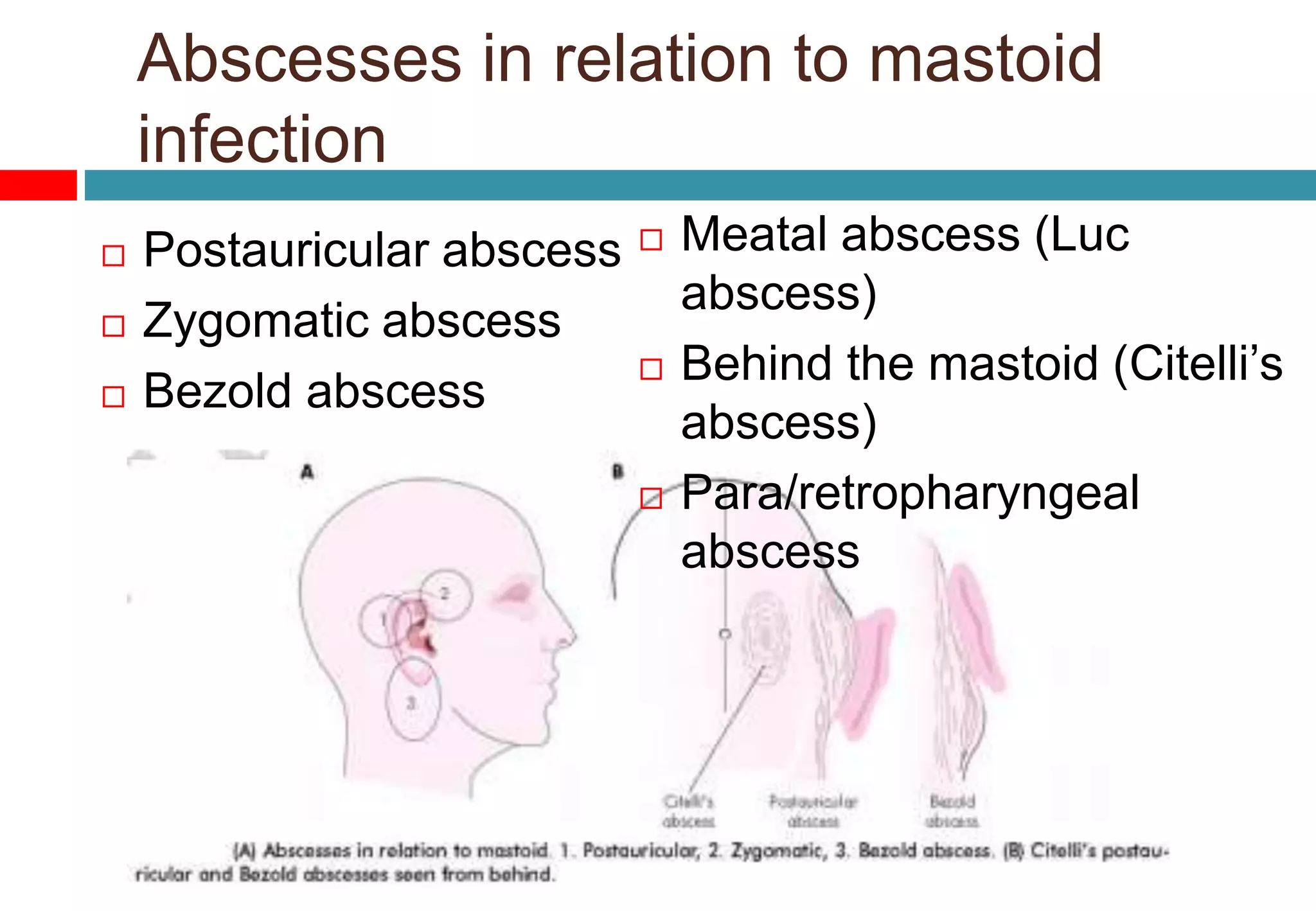
Abscesses in relation to mastoid
infection
 Postauricular abscess
 Zygomatic abscess
 Bezold abscess
 Meatal abscess (Luc
abscess)
 Behind the mastoid (Citelli’s
abscess)
 Para/retropharyngeal
abscess
A. (ii) MASKED (LATENT)
MASTOIDITIS
 Slow destruction of mastoid air cells with no sign
and symptoms
 Destruction of air cells + dark gelatinous material +
Eroded tegmen tympani and sinus plate +
extradural or perisinus abscess
 Aetiology :
 Inadequate dose/ duration/ frequency of antibiotic
 Mild pain behind ear +
Persistent hearing loss
 Thick , opaque
tympanic membrane
 Tenderness over
mastoid
 Audiometry- conductive
hearing loss
 X-ray mastoid- clouding
of air cells with loss of
cell outline
 Cortical
mastoidectomy
 Antibiotics
CLINICAL
FEATURES
TREATMENT
B.PETROSITIS
 Spread from middle ear
and mastoid to petrous
part of temporal bone
 Associated with acute
coalescent /latent
mastoiditis or chronic
middle ear infection
Pathology
 Spread thorugh:
1. Posterosuperior tract-
mastoid  runs
behind/ above
labyrinth  petrous
apex
2. Anteroinferior tract-
hypotympanum near
Eustachian tube
cochlea  petrous
apex
Clinical Symptoms
 Gradenigo syndrome
 External rectus palsy
 Deep-seated ear /retro-
orbital pain
 Persistent ear discharge
 Fever, headache,
vomiting, neck rigidity
 Facial paralysis,
recurrent vertigo
 Diagnosis- CT scan and
MRI
Treatment
 Cortical, modified radical /radical
mastoidectomy
 Find fistulous tract, curette and enlarge
 free drainage
 IV antibiotic + surgical intervention
 Only antibiotics: Initial 4-5 days of high
dose systemic antibiotics
C. FACIAL PARALYSIS
 Result from cholesteatoma /penetrating
granulation tissue
 Cholesteatoma destroys bony canal + edema
pressure on nerve
 Insidious but slowly progressive
 Treatment:
 Exploration of middle ear and mastoid
 Uncapped cholesteatoma
 Remove granulation tissue if not involving nerve
sheath
 Resection of nerve and grafting after infection
controlled and fibrosis matured
D. LABYRINTHITIS
Circumscribe
d labyrinthitis
Diffuse
suppurative
labyrithitis
Diffuse
serous
labyrinthitis
Circumscribed labyrinthitis
 Thinning/erosion of
bony capsule of
labyrinth
 Aetiology:
 Chronic suppurative
otitis media
 Neoplasm of middle ear
 Surgical or accidental
trauma
 Clinical Features
 Transient vertigo by
pressure on tragus/
Vasalva manoeuvre
 Diagnosis: Fistula test
 Pressure on tragus
 Siegel’s speculum
 Treatment
 Mastoid exploration and
systemic antibiotic
therapy
Diffuse labyrinthitis
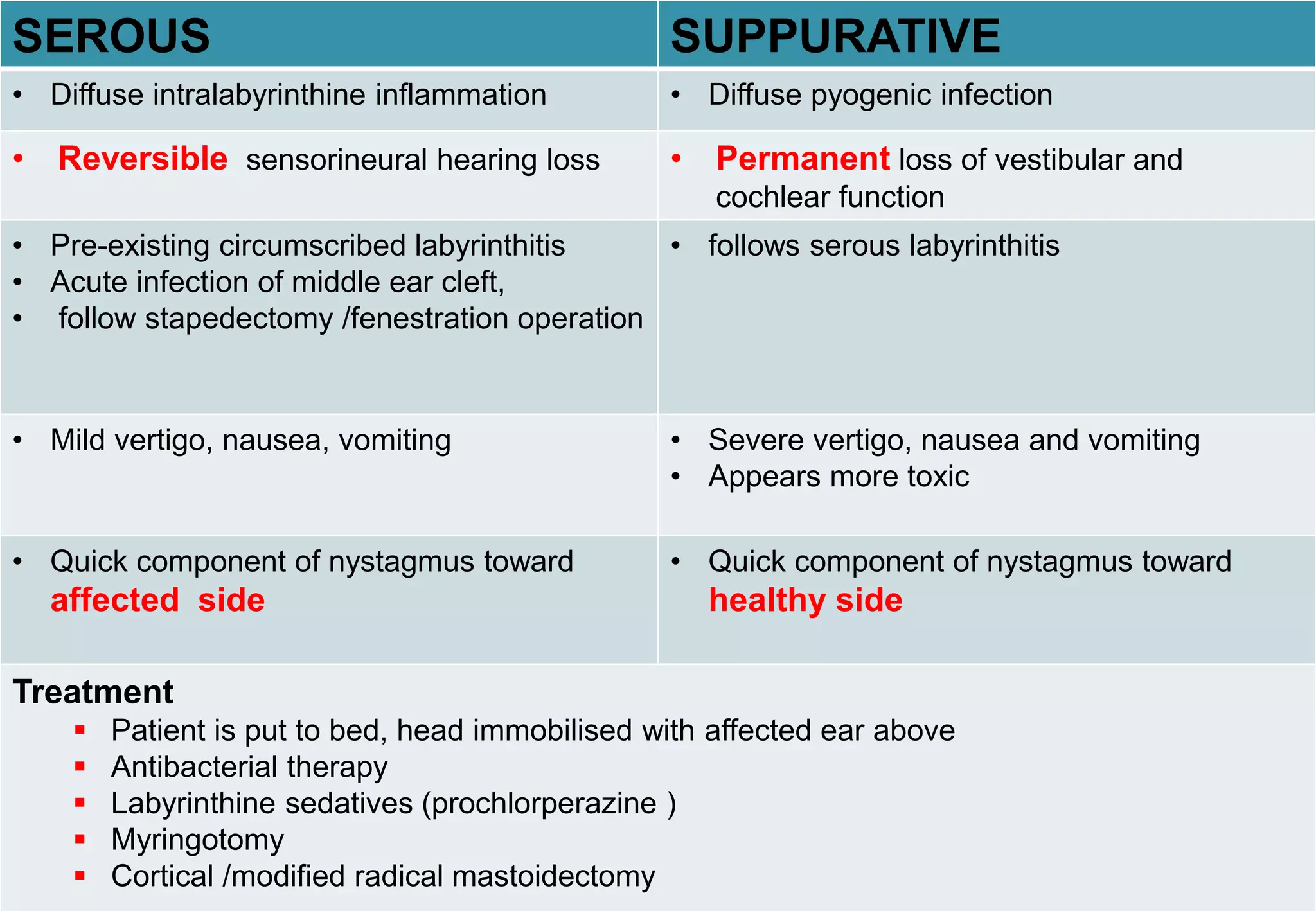
SEROUS SUPPURATIVE
• Diffuse intralabyrinthine inflammation • Diffuse pyogenic infection
• Reversible sensorineural hearing loss • Permanent loss of vestibular and
cochlear function
• Pre-existing circumscribed labyrinthitis
• Acute infection of middle ear cleft,
• follow stapedectomy /fenestration operation
• follows serous labyrinthitis
• Mild vertigo, nausea, vomiting • Severe vertigo, nausea and vomiting
• Appears more toxic
• Quick component of nystagmus toward
affected side
• Quick component of nystagmus toward
healthy side
Treatment
 Patient is put to bed, head immobilised with affected ear above
 Antibacterial therapy
 Labyrinthine sedatives (prochlorperazine )
 Myringotomy
 Cortical /modified radical mastoidectomy
Intracranial
Complications
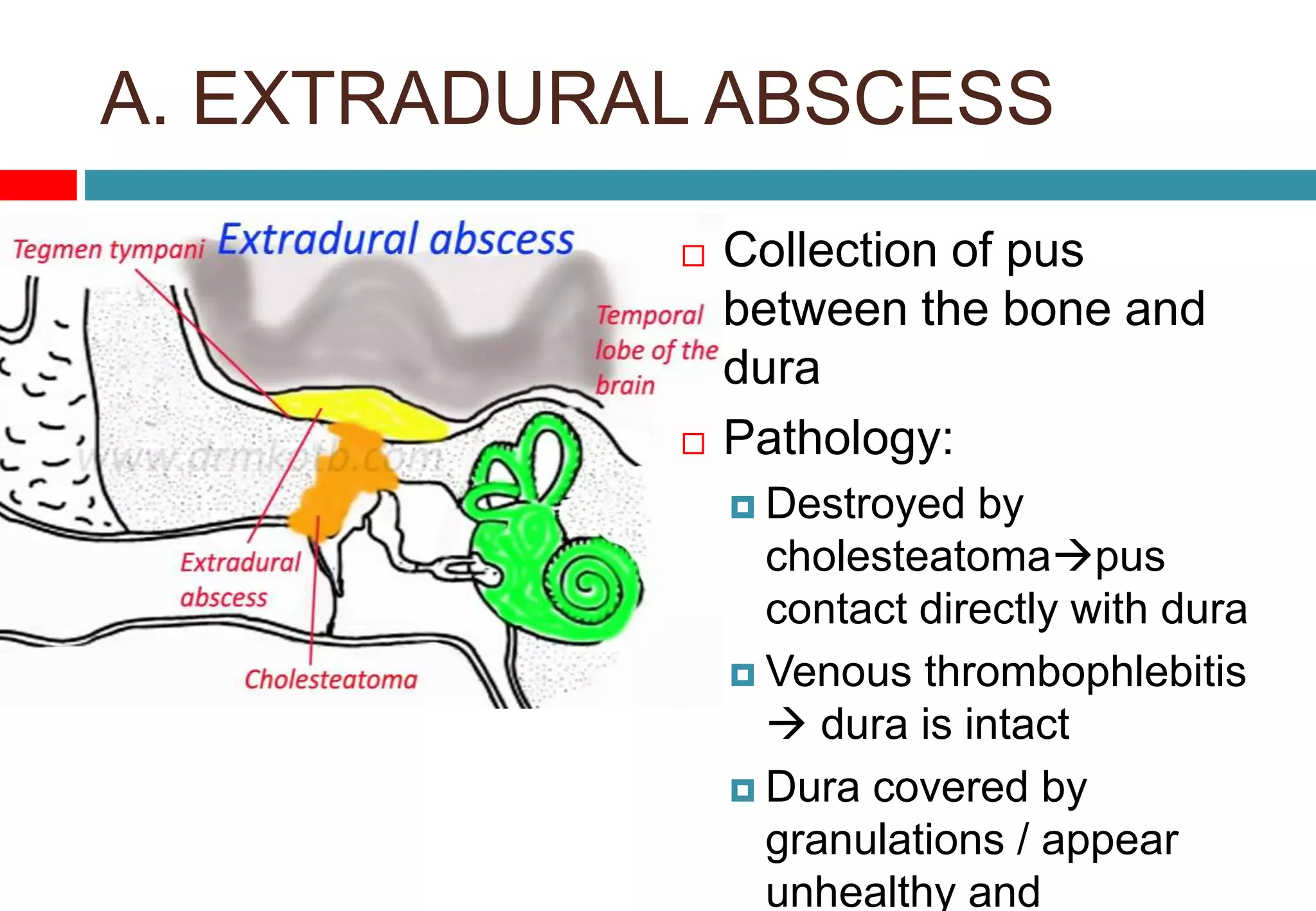
A. EXTRADURAL ABSCESS
 Collection of pus
between the bone and
dura
 Pathology:
 Destroyed by
cholesteatomapus
contact directly with dura
 Venous thrombophlebitis
 dura is intact
 Dura covered by
granulations / appear
unhealthy and
 Asymptomatic
 Persistent headache
on the side of otitis
media
 Severe pain in ear
 General malaise with
low grade fever
 Pulsatile purulent ear
discharge
 Disappearance of
headache with free
flow of pus from the
ear
 Cortical / modified
radical /radical
mastoidectomy
 Antibiotic X 5 days
 Diagnosis: contrast
enhanced CT or MRI
CLINICAL FEATURE TREATMENT
B. SUBDURAL ABSCESS
 Pus between dura and
archnoid
 Pathology
 Spreads by erosion of
bone and dura
/thrombophlebitic
process subdural
space and comes to lie
against the convex
surface of cerebral
hemisphere
 Clinical features
 Meningeal irritation [
headache, fever, neck
rigidity, Kernig’s sign]
 Cortical venous
thrombophlebitis [
aphasia, hemiplegia]
 Raised ICP [
papilledema, ptosis,
dilated pupil ]
 Treatment:
 burr holes /craniotomy
for drainage +IV
antibiotics
C. MENINGITIS
 Inflammation of pia
and arachnoid
 Most common
intracranial
complication
 Mode of infection
 Blood-borne
 Chronic ear disease
 Fever with chills and
rigors
 Headache
 Neck rigidity
 Photophobia and mental
irritability
 Nausea and vomiting
 Drowsiness, delirium or
coma
 Cranial nerve palsies and
hemiplegia
CLINICAL
FEATURES
 Contrast CT or MRI,
 Lumbar puncture
 CSF examination
 Antibiotics +
corticosteroids
 AOM :Myringotomy or
cortical mastoidectomy
 Cholesteoma :Radical
or modified radical
mastoidectomy
DIAGNOSIS TREATMENT:
D. OTOGENIC BRAIN ABSCESS
 Adult ( 50%) : CSOM with
cholesteatoma
 Child ( 25%) : acute otitis media
 Route of infection:
 Cerebral : direct extension through
tegmen /retrograde thrombophlebitis
 Cerebellar : direct extension through
Trautmann’s triangle / retrograde
thrombophlebitis
 Bacteriology:
 aerobic [ SP, PM, EC,]
 Anaerobic [ BF, HI]
Pathology
 Stage of invasion (initial
encephalitis)
 Headache, low grade fever,
malaise, drowsiness
 Stage of localization (latent
abscess)
 Stage of enlargement
(manifest abscess)
 Edema raised ICP
 Stage of termination
(rupture of abscess)
Clinical features
 1.Symptoms and
signs of raised ICP
 Headache
 Nausea and vomiting
 Level of
consciousness
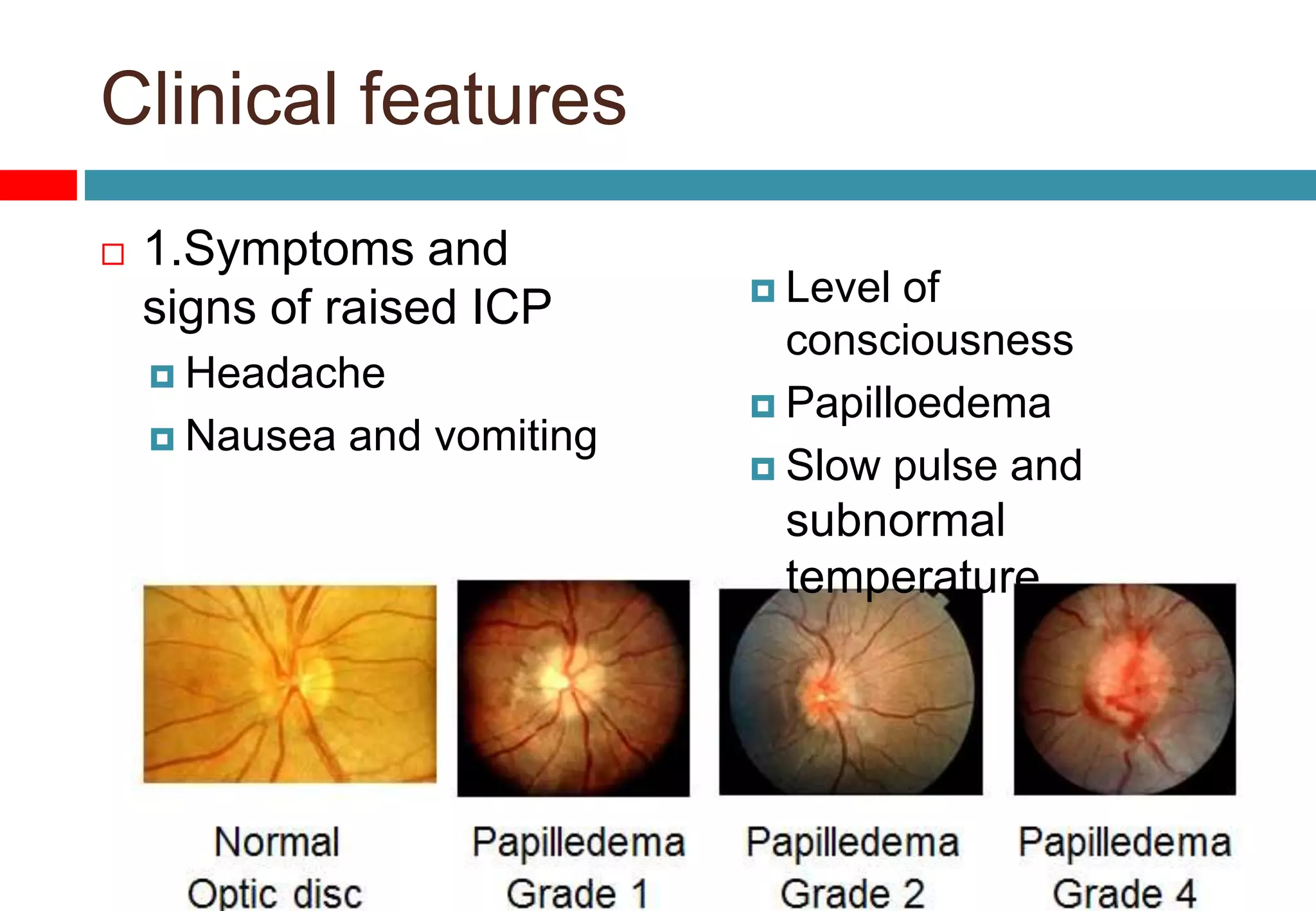
 Papilloedema
 Slow pulse and
subnormal
temperature
2.Localizing features
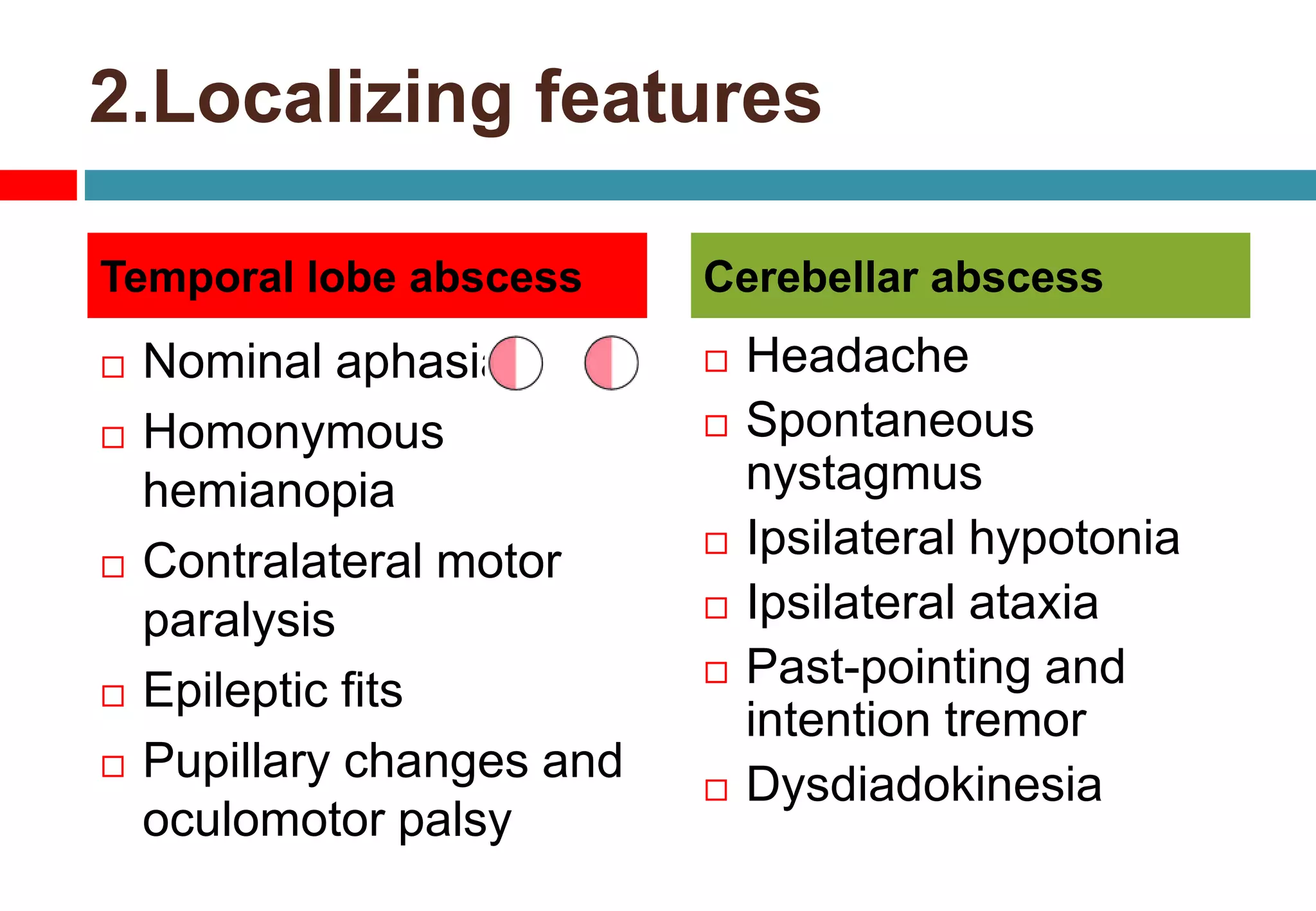
 Nominal aphasia
 Homonymous
hemianopia
 Contralateral motor
paralysis
 Epileptic fits
 Pupillary changes and
oculomotor palsy
 Headache
 Spontaneous
nystagmus
 Ipsilateral hypotonia
 Ipsilateral ataxia
 Past-pointing and
intention tremor
 Dysdiadokinesia
Temporal lobe abscess Cerebellar abscess
 Skull x-ray
 CT scan
 X-ray mastoids or CT
scan
 Lumbar puncture
 Antibiotics IV
 Dexamethasone or
mannitol
 Suction clearance and
topical drops
 Repeated aspiration
through a burr hole
 Excision of abscess
 Open incision of the
abscess and evacuation
of pus
 Radical mastoidectomy
INVESTIGATION TREATMENT
E.LATERAL SINUS
THROMBOPHLEBITIS
 Inflammation of inner wall of lateral venous sinus with
formation of intrasinus thrombus
 Occur due to acute coalescent mastoiditis, masked
mastoiditis, chronic suppuration of middle ear and
cholesteatoma
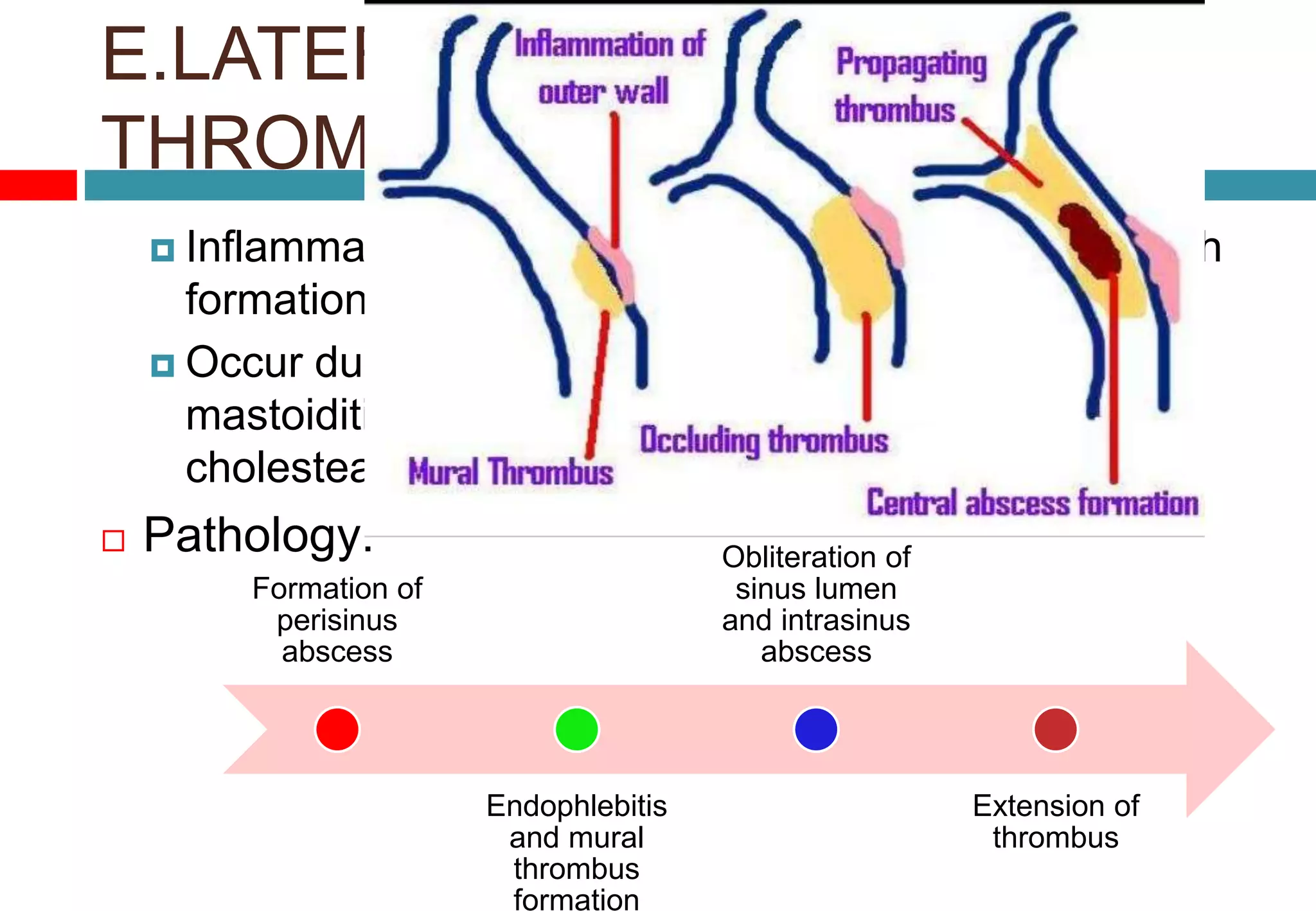
 Pathology:
Formation of
perisinus
abscess
Endophlebitis
and mural
thrombus
formation
Obliteration of
sinus lumen
and intrasinus
abscess
Extension of
thrombus
 Acute- haemolytic
streptococcus,
pneumococcus or
staphylococcus
 Chronic- +
cholesteatoma,
Bacillus proteus,
Pseudomonas
pyocyaneus, E. coli
and staphylococci
 Hectic Picket-fence
type of fever with
rigors
 Headache
 Progressive anaemia
and emaciation
 Griesinger’s sign
 Papilloedema
 Tobey-Ayer test,
Crowe-Beck test
 Tenderness along
jugular vein
BACTERIOLOGY
CLINICAL
FEATURES:
 Blood smear
 Blood culture
 CSF examination
 X-ray mastoid
 Imaging studies
 Culture and sensitivity
 Septicaemia and
pyaemic abscess in
lungs, bones, joints or
subcuteaneous tissue
 Meningitis and subdural
abscess
 Cerebellar abscess
 Thrombosis of jugular
bulb and jugular vein
 Cavernous sinus
thormbosis
 Otitic hydrocephalus
INVESTIGATION COMPLICATION
Treatment
 Intravenous antibacterial drugs
 C/ MR mastoidectomy and exposure of sinus
 Ligation of internal jugular vein
 Failed antibiotic and surgical treatment
 Spreading tenderness along jugular vein
 Anticoagulant therapy
 Supportive treatment
F.OTITIC HYDROCEPHALUS
 Raised ICP with normal CSF findings
 In children with acute/ chronic middle ear infection
 Lateral sinus thrombosis  obstruction +
extension to superior sagittal sinus  decreased
absorption
 Clinical features
Symptoms:
• Severe
headache
• Diplopia
• Blurring of vision
Signs:
• Papilloedem
a
• Nystagmus
Treatment:
 Reduce CSF pressure to
prevent optic atrophy and
blindness
 Acetazolamide and
corticosteroids
 Repeated lumbar
puncture / placement of
lumbar drain,
lumboperitoneal shunt
 Antibiotic therapy and
mastoid exploration
Melss yr4 ent complication of cs om

Melss yr4 ent complication of cs om

  • 1.
  • 2.
    • Factors • Spreadof infection • Classification • Sequelae • Complications: • Intratemporal complication • Intracranial complication Content
  • 3.
    Factors  Age  Poorsocioeconomic group  Virulence of organism  Immune-compromised host  Preformed pathways  Cholesteatoma
  • 4.
    Pathways spread ofinfection  Direct bone erosion  Venous thrombophlebitis  Preformed pathways  Congenital dehiscences  Patent sutures  Previous skull fractures  Surgical defects  Oval and round windows  Infection from labyrinth
  • 5.
    Sequelae of otitismedia Perforation of tympanic membrane Ossicular erosion Atelectasis and adhesive otitis media Tympanosclerosis Cholesteatoma formation Conductive hearing loss Sensorineural hearing loss *Speech impairment *Learning disabilities
  • 6.
    Classifications  Mastoiditis  Petrositis Facial paralysis  Labyrinthitis  Extradural abscess  Subdural abscess  Meningitis  Brain abscess  Lateral sinus thrombophlebitis  Otitic hydrocephalus INTRATEMPORAL INTRACRANIAL
  • 8.
  • 9.
    A. [i] ACUTEMASTOIDITIS  Inflammation of mucosal lining of antrum and mastoid air cell system  mucosa bony walls
  • 10.
    Accompanies / follow ASOM 1.Virulence of organism 2. Lowered resistance 3. Children 1. Production of pus under tension  Production > drainage 2. Hyperaemic decalcification and osteoclastic resorption of bony wall  Destruction, coalescence of mastoid air cell [empyema of mastoid]  subperiosteal Aetiology PATHOLOGY
  • 11.
    Clinical Features  Painbehind the ear  Fever  Ear discharge  Mastoid tenderness  Light house effect ( pulsatile purulent discharge)  Sagging of posterosuperior meatal wall  Perforation of tympanic membrane  Swelling over the mastoid  Hearing loss SYMPTOMS SIGNS
  • 12.
     Blood counts (Polymorphonuclaer leucocytosis) ESR  X-ray mastoid  Ear swab INVESTIGATION
  • 13.
    Differential diagnosis  Suppurationof mastoid lymph nodes  Furunculosis of meatus  Infected sebaceous cyst
  • 14.
    Treatment  Hospitalization  Antibiotics Myringotomy  Cortical mastoidectomy [Subperiosteal abscess, positive resevoir sign, no change despite medical treatment for 48hours]
  • 15.
    Complications  Subperiosteal abscess  Labyrinthitis Facial paralysis  Petrositis  Extradural abscess  Subdural abscess  Meningitis  Brain abscess  Lateral sinus thrombophlebitis  Otitic hydrocephalous
  • 16.
    Abscesses in relationto mastoid infection  Postauricular abscess  Zygomatic abscess  Bezold abscess  Meatal abscess (Luc abscess)  Behind the mastoid (Citelli’s abscess)  Para/retropharyngeal abscess
  • 17.
    A. (ii) MASKED(LATENT) MASTOIDITIS  Slow destruction of mastoid air cells with no sign and symptoms  Destruction of air cells + dark gelatinous material + Eroded tegmen tympani and sinus plate + extradural or perisinus abscess  Aetiology :  Inadequate dose/ duration/ frequency of antibiotic
  • 18.
     Mild painbehind ear + Persistent hearing loss  Thick , opaque tympanic membrane  Tenderness over mastoid  Audiometry- conductive hearing loss  X-ray mastoid- clouding of air cells with loss of cell outline  Cortical mastoidectomy  Antibiotics CLINICAL FEATURES TREATMENT
  • 19.
    B.PETROSITIS  Spread frommiddle ear and mastoid to petrous part of temporal bone  Associated with acute coalescent /latent mastoiditis or chronic middle ear infection
  • 20.
    Pathology  Spread thorugh: 1.Posterosuperior tract- mastoid  runs behind/ above labyrinth  petrous apex 2. Anteroinferior tract- hypotympanum near Eustachian tube cochlea  petrous apex
  • 21.
    Clinical Symptoms  Gradenigosyndrome  External rectus palsy  Deep-seated ear /retro- orbital pain  Persistent ear discharge  Fever, headache, vomiting, neck rigidity  Facial paralysis, recurrent vertigo  Diagnosis- CT scan and MRI
  • 22.
    Treatment  Cortical, modifiedradical /radical mastoidectomy  Find fistulous tract, curette and enlarge  free drainage  IV antibiotic + surgical intervention  Only antibiotics: Initial 4-5 days of high dose systemic antibiotics
  • 23.
    C. FACIAL PARALYSIS Result from cholesteatoma /penetrating granulation tissue  Cholesteatoma destroys bony canal + edema pressure on nerve  Insidious but slowly progressive  Treatment:  Exploration of middle ear and mastoid  Uncapped cholesteatoma  Remove granulation tissue if not involving nerve sheath  Resection of nerve and grafting after infection controlled and fibrosis matured
  • 24.
  • 25.
    Circumscribed labyrinthitis  Thinning/erosionof bony capsule of labyrinth  Aetiology:  Chronic suppurative otitis media  Neoplasm of middle ear  Surgical or accidental trauma  Clinical Features  Transient vertigo by pressure on tragus/ Vasalva manoeuvre  Diagnosis: Fistula test  Pressure on tragus  Siegel’s speculum  Treatment  Mastoid exploration and systemic antibiotic therapy
  • 26.
    Diffuse labyrinthitis SEROUS SUPPURATIVE •Diffuse intralabyrinthine inflammation • Diffuse pyogenic infection • Reversible sensorineural hearing loss • Permanent loss of vestibular and cochlear function • Pre-existing circumscribed labyrinthitis • Acute infection of middle ear cleft, • follow stapedectomy /fenestration operation • follows serous labyrinthitis • Mild vertigo, nausea, vomiting • Severe vertigo, nausea and vomiting • Appears more toxic • Quick component of nystagmus toward affected side • Quick component of nystagmus toward healthy side Treatment  Patient is put to bed, head immobilised with affected ear above  Antibacterial therapy  Labyrinthine sedatives (prochlorperazine )  Myringotomy  Cortical /modified radical mastoidectomy
  • 27.
  • 28.
    A. EXTRADURAL ABSCESS Collection of pus between the bone and dura  Pathology:  Destroyed by cholesteatomapus contact directly with dura  Venous thrombophlebitis  dura is intact  Dura covered by granulations / appear unhealthy and
  • 29.
     Asymptomatic  Persistentheadache on the side of otitis media  Severe pain in ear  General malaise with low grade fever  Pulsatile purulent ear discharge  Disappearance of headache with free flow of pus from the ear  Cortical / modified radical /radical mastoidectomy  Antibiotic X 5 days  Diagnosis: contrast enhanced CT or MRI CLINICAL FEATURE TREATMENT
  • 30.
    B. SUBDURAL ABSCESS Pus between dura and archnoid  Pathology  Spreads by erosion of bone and dura /thrombophlebitic process subdural space and comes to lie against the convex surface of cerebral hemisphere  Clinical features  Meningeal irritation [ headache, fever, neck rigidity, Kernig’s sign]  Cortical venous thrombophlebitis [ aphasia, hemiplegia]  Raised ICP [ papilledema, ptosis, dilated pupil ]  Treatment:  burr holes /craniotomy for drainage +IV antibiotics
  • 31.
    C. MENINGITIS  Inflammationof pia and arachnoid  Most common intracranial complication  Mode of infection  Blood-borne  Chronic ear disease  Fever with chills and rigors  Headache  Neck rigidity  Photophobia and mental irritability  Nausea and vomiting  Drowsiness, delirium or coma  Cranial nerve palsies and hemiplegia CLINICAL FEATURES
  • 32.
     Contrast CTor MRI,  Lumbar puncture  CSF examination  Antibiotics + corticosteroids  AOM :Myringotomy or cortical mastoidectomy  Cholesteoma :Radical or modified radical mastoidectomy DIAGNOSIS TREATMENT:
  • 33.
    D. OTOGENIC BRAINABSCESS  Adult ( 50%) : CSOM with cholesteatoma  Child ( 25%) : acute otitis media  Route of infection:  Cerebral : direct extension through tegmen /retrograde thrombophlebitis  Cerebellar : direct extension through Trautmann’s triangle / retrograde thrombophlebitis  Bacteriology:  aerobic [ SP, PM, EC,]  Anaerobic [ BF, HI]
  • 34.
    Pathology  Stage ofinvasion (initial encephalitis)  Headache, low grade fever, malaise, drowsiness  Stage of localization (latent abscess)  Stage of enlargement (manifest abscess)  Edema raised ICP  Stage of termination (rupture of abscess)
  • 35.
    Clinical features  1.Symptomsand signs of raised ICP  Headache  Nausea and vomiting  Level of consciousness  Papilloedema  Slow pulse and subnormal temperature
  • 36.
    2.Localizing features  Nominalaphasia  Homonymous hemianopia  Contralateral motor paralysis  Epileptic fits  Pupillary changes and oculomotor palsy  Headache  Spontaneous nystagmus  Ipsilateral hypotonia  Ipsilateral ataxia  Past-pointing and intention tremor  Dysdiadokinesia Temporal lobe abscess Cerebellar abscess
  • 37.
     Skull x-ray CT scan  X-ray mastoids or CT scan  Lumbar puncture  Antibiotics IV  Dexamethasone or mannitol  Suction clearance and topical drops  Repeated aspiration through a burr hole  Excision of abscess  Open incision of the abscess and evacuation of pus  Radical mastoidectomy INVESTIGATION TREATMENT
  • 38.
    E.LATERAL SINUS THROMBOPHLEBITIS  Inflammationof inner wall of lateral venous sinus with formation of intrasinus thrombus  Occur due to acute coalescent mastoiditis, masked mastoiditis, chronic suppuration of middle ear and cholesteatoma  Pathology: Formation of perisinus abscess Endophlebitis and mural thrombus formation Obliteration of sinus lumen and intrasinus abscess Extension of thrombus
  • 39.
     Acute- haemolytic streptococcus, pneumococcusor staphylococcus  Chronic- + cholesteatoma, Bacillus proteus, Pseudomonas pyocyaneus, E. coli and staphylococci  Hectic Picket-fence type of fever with rigors  Headache  Progressive anaemia and emaciation  Griesinger’s sign  Papilloedema  Tobey-Ayer test, Crowe-Beck test  Tenderness along jugular vein BACTERIOLOGY CLINICAL FEATURES:
  • 40.
     Blood smear Blood culture  CSF examination  X-ray mastoid  Imaging studies  Culture and sensitivity  Septicaemia and pyaemic abscess in lungs, bones, joints or subcuteaneous tissue  Meningitis and subdural abscess  Cerebellar abscess  Thrombosis of jugular bulb and jugular vein  Cavernous sinus thormbosis  Otitic hydrocephalus INVESTIGATION COMPLICATION
  • 41.
    Treatment  Intravenous antibacterialdrugs  C/ MR mastoidectomy and exposure of sinus  Ligation of internal jugular vein  Failed antibiotic and surgical treatment  Spreading tenderness along jugular vein  Anticoagulant therapy  Supportive treatment
  • 42.
    F.OTITIC HYDROCEPHALUS  RaisedICP with normal CSF findings  In children with acute/ chronic middle ear infection  Lateral sinus thrombosis  obstruction + extension to superior sagittal sinus  decreased absorption  Clinical features Symptoms: • Severe headache • Diplopia • Blurring of vision Signs: • Papilloedem a • Nystagmus
  • 43.
    Treatment:  Reduce CSFpressure to prevent optic atrophy and blindness  Acetazolamide and corticosteroids  Repeated lumbar puncture / placement of lumbar drain, lumboperitoneal shunt  Antibiotic therapy and mastoid exploration

Editor's Notes

  • #13 2. mastoiditis: clouding of air cell, unclear bony partitions, cavity
  • #14 Scalp infc LN enlarged n supp , no ho OM, ear disc, superficial No ho OM,painful pinna movement, enlarge pre/post aur LN, normal TM,  boil/furuncle
  • #15 Amoxicillin, ampicillin chloramphenicol, metronidazole
  • #16 Except for subperiosteal abscess, all are also compl of CSOM
  • #21 Runs along these cells tracts and reaches the petrous apex Forming epidural abscess involving cranial nerve VI and trigeminal gangion
  • #24 Can also be compl of ACOM, dehiscent bony canaln nerve under middle ear mucosa,
  • #31 3rd nerve
  • #33 Inc cell and protein, dec sugar
  • #36 Worse in morning, projectile,leth, drowsy, conf, stup, coma,
  • #37 Face first, uncinate gyrus, transtentorial herniation To lesion side, finger nose,
  • #38 Lower icp, ear discharge
  • #39 Abscess on outer dural wall of sinus, infl cause thrombus,
  • #40 IRREGULAR FEVER WITH SEV PEAKS PER DAY, CR,mild due to perisinus abscess, eryth n edema over posterior part o mastoid Blur disc margin, retinal hemo, cbt healthy side caus eretinal engorged retinal vein
  • #41 Out malaria.], ceCT,