
CERVICAL CYTOLOGY
SAVING LIVES ONE CELL AT ATIME
CYTOPATHOLOGY OF CERVICAL SMEAR
 The human papillomavirus (HPV) is noted to be responsible for 62.8% of invasive
cervical cancers.
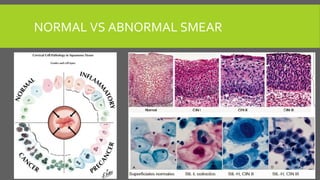
 Cervical cancer screening test (Pap smear) detects potentially pre-cancerous
changes in the cervix
 Pap-smear screening can reduce cervical cancer incidence by 60% – 90%
 Altogether, screening aims to reduce the mortality rate associated with the
disease through the early detection and treatment of abnormalities in the cells
lining the cervix.
 Treating a woman with an abnormal smear is cost friendly, compared to treating a
woman with invasive cancer.
NORMAL VS ABNORMAL SMEAR
THE SOUTH AFRICAN PERSPECTIVE
 Cervical cancer is one of the most prevalent cancers amongst South African women and
women worldwide. It was found that South African women have a risk of 1 in 31 for
developing invasive cervical cancer in their lifetime, and that 60% of them will die from
the disease.
 In South Africa, women are offered a cervical smear and 30, 40, and 50 years of age.
 A study conducted by… showed that only 27.6% of South African women were aware of
their HIV status. Therefore, the larger proportion whom are unaware of their HIV status
are not receiving HIV treatment and are thus not attending the relevant health screenings.
 It was recently announced that every woman who is HIV positive is offered a free smear at
the time of diagnosis of HIV.
 Women of 25 to 29 years of age carry the highest infection rates with 32.7% of them being
HIV infected.
METHOD AND MATERIAL
 GSH Cytology Laboratory DISA database was used to search for data on cervical
smears which were taken in the year 2012. (insert image)
 Participants in this study were women between the ages of 89 and 19 years of age
(with 101 years and 4 years of age as outliers)
 Only lab numbers were used as identification of patients in this study.
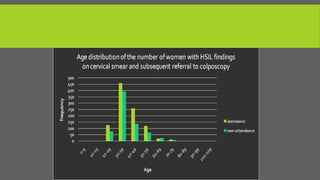
 A calculation of the total and age-specific prevalence of women with HSIL
identified on cervical smear was done.
 The age-specific proportion of women who attended colposcopy was calculated
as well as the proportion of non-attendance to colposcopy.
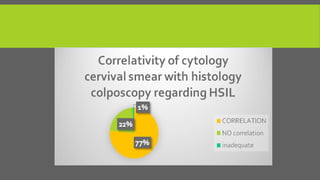
 Calculation of correlativity between cytology smears which reported HSIL results
against histology colposcopy which likewise reported HSIL results.
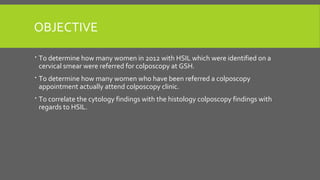
OBJECTIVE
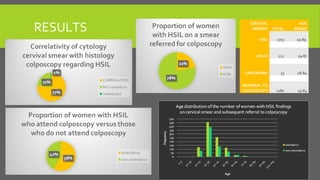
 To determine how many women in 2012 with HSIL which were identified on a
cervical smear were referred for colposcopy at GSH.
 To determine how many women who have been referred a colposcopy
appointment actually attend colposcopy clinic.
 To correlate the cytology findings with the histology colposcopy findings with
regards to HSIL.
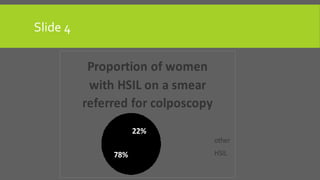
Slide 4
Proportion of women
with HSIL on a smear
referred for colposcopy
22%
78%
other
HSIL
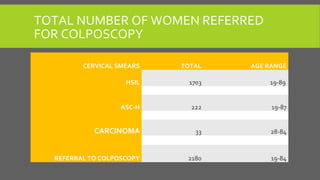
TOTAL NUMBER OF WOMEN REFERRED
FOR COLPOSCOPY
CERVICAL SMEARS TOTAL AGE RANGE
HSIL 1703 19-89
ASC-H 222 19-87
CARCINOMA 33 28-84
REFERRAL TO COLPOSCOPY 2180 19-84
RESULTS
CERVICAL
SMEARS TOTAL
AGE
RANGE
HSIL 1703 19-89
ASC-H 222 19-87
CARCINOMA 33 28-84
REFERRAL TO
COLPOSCOPY 2180 19-84
THE SOCIAL-PSYCHOLOGY OF
COLPOSCOPY
IN CONCLUSION…
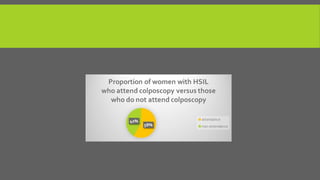
 South African women still majorly affected by cervical cancer and there is a high
non-attendance proportion for colposcopy.
 Even though there is a screening programme in place aimed at preventing and
reducing the prevalence of HPV infection, more health promotion strategies have
to be considered.
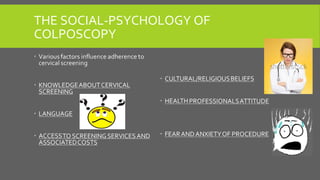
 The health promotion should take into consideration the psychosocial factors
involved in non-adherence to screening of cervical cancer.
 Health education is most important of strategies.
 With more understanding, women could be less inclined to reject the screening
process.

Colposcopy attendance in women with High Grade Lesion of Cervix and histological correlation

  • 1.
  • 2.
    CYTOPATHOLOGY OF CERVICALSMEAR  The human papillomavirus (HPV) is noted to be responsible for 62.8% of invasive cervical cancers.  Cervical cancer screening test (Pap smear) detects potentially pre-cancerous changes in the cervix  Pap-smear screening can reduce cervical cancer incidence by 60% – 90%  Altogether, screening aims to reduce the mortality rate associated with the disease through the early detection and treatment of abnormalities in the cells lining the cervix.  Treating a woman with an abnormal smear is cost friendly, compared to treating a woman with invasive cancer.
  • 3.
  • 4.
    THE SOUTH AFRICANPERSPECTIVE  Cervical cancer is one of the most prevalent cancers amongst South African women and women worldwide. It was found that South African women have a risk of 1 in 31 for developing invasive cervical cancer in their lifetime, and that 60% of them will die from the disease.  In South Africa, women are offered a cervical smear and 30, 40, and 50 years of age.  A study conducted by… showed that only 27.6% of South African women were aware of their HIV status. Therefore, the larger proportion whom are unaware of their HIV status are not receiving HIV treatment and are thus not attending the relevant health screenings.  It was recently announced that every woman who is HIV positive is offered a free smear at the time of diagnosis of HIV.  Women of 25 to 29 years of age carry the highest infection rates with 32.7% of them being HIV infected.
  • 5.
    METHOD AND MATERIAL GSH Cytology Laboratory DISA database was used to search for data on cervical smears which were taken in the year 2012. (insert image)  Participants in this study were women between the ages of 89 and 19 years of age (with 101 years and 4 years of age as outliers)  Only lab numbers were used as identification of patients in this study.  A calculation of the total and age-specific prevalence of women with HSIL identified on cervical smear was done.  The age-specific proportion of women who attended colposcopy was calculated as well as the proportion of non-attendance to colposcopy.  Calculation of correlativity between cytology smears which reported HSIL results against histology colposcopy which likewise reported HSIL results.
  • 6.
    OBJECTIVE  To determinehow many women in 2012 with HSIL which were identified on a cervical smear were referred for colposcopy at GSH.  To determine how many women who have been referred a colposcopy appointment actually attend colposcopy clinic.  To correlate the cytology findings with the histology colposcopy findings with regards to HSIL.
  • 7.
    Slide 4 Proportion ofwomen with HSIL on a smear referred for colposcopy 22% 78% other HSIL
  • 8.
    TOTAL NUMBER OFWOMEN REFERRED FOR COLPOSCOPY CERVICAL SMEARS TOTAL AGE RANGE HSIL 1703 19-89 ASC-H 222 19-87 CARCINOMA 33 28-84 REFERRAL TO COLPOSCOPY 2180 19-84
  • 12.
    RESULTS CERVICAL SMEARS TOTAL AGE RANGE HSIL 170319-89 ASC-H 222 19-87 CARCINOMA 33 28-84 REFERRAL TO COLPOSCOPY 2180 19-84
  • 13.
  • 14.
    IN CONCLUSION…  SouthAfrican women still majorly affected by cervical cancer and there is a high non-attendance proportion for colposcopy.  Even though there is a screening programme in place aimed at preventing and reducing the prevalence of HPV infection, more health promotion strategies have to be considered.  The health promotion should take into consideration the psychosocial factors involved in non-adherence to screening of cervical cancer.  Health education is most important of strategies.  With more understanding, women could be less inclined to reject the screening process.

Editor's Notes

  • #2 RESULTS DISCUSSION (PSYCHOSOCIAL FACTORS) Wear blue