Cervical cancer screening
Dr Anjum khan
Chart of cervical screening policy
Start of screening age 21
21 - 29 Every 3 years
30 - 65 Every 3 years , Every 5 years with HPV
DNA co testing
Methods of screening
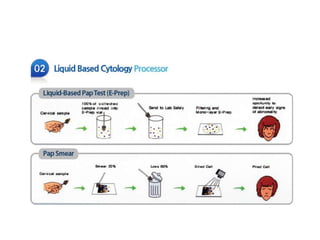
Cytology ( conventional, LBC)
21-29 years 3 years
30-65 years 3 years
HPV DNA co testing with cytology
21 – 29 Not recommended
30-65 5 years
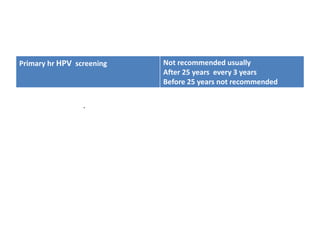
Primary hr HPV screening Not recommended usually
After 25 years every 3 years
Before 25 years not recommended
.
When to stop screening
• Aged >65 years with adequate negative prior screening and no history of
CIN2 or higher within the last 20 years.
• Adequate negative prior screening results are defined as 3 consecutive
negative cytology results or 2 consecutive negative co-test results within
the previous 10 years, with the most recent test performed within the
past 5 years.
When to screen after 65 years
• History of CIN2, CIN3, or adenocarcinoma in situ, routine screening
should continue for at least 20 years.
• Women aged >65 years who have never been screened
• Do not meet the criteria for adequate prior screening, routine screening
should continue for at least 20 years after spontaneous regression or
appropriate management of a highgrade precancerous lesion, even if this
extends screening past age 65 years.
• High risk ( highgrade precancerous lesion or cervical cancer, women with
in utero exposure to diethylstilbestrol, or immunocompromised HIV)
Special cases
Post hysterectomy
• cervix was removed?
• why the hysterectomy was needed?
• whether you have a history of moderate or severe cervical cell
changes or cervical cancer.
• Even if cervix is removed at the time of hysterectomy, cervical cells
can still be present at the top of the vagina. If have a history of
cervical cancer or cervical cell changes, should continue to have
screening for 20 years after surgery.
• Total hysterectomy (removal of the uterus and cervix) should
stop screening
• Women who have had a supracervical hysterectomy (cervix intact)
should continue screening according to guidelines.
• Women who have had a hysterectomy (removal of the cervix) should
stop screening and not restart for any reason.
Screening among those immunized
with HPV vaccine
• Women who have received the HPV vaccine should be screened according
to the same guidelines as women who have not been vaccinated
• These recommendations do not address special, high-risk populations
who may need more intensive or alternative screening.
• women with a history of CIN2, CIN3, or cervical cancer,
• women who were exposed in utero to diethylstilbestrol,
• women who are infected with HIV,
• women who are immunocompromised (such as those who have
received solid organ transplants).
• Primary HR HPV testing is defined as a stand-alone test for cervical cancer
screening without concomitant cytology testing. It may be followed by
other tests (like a Pap) for triage. This test specifically identifies HPV 16
and HPV 18, while concurrently detecting 12 other types of high-risk HPVs.
The Bethesda system (TBS) is a system for reporting cervical or vaginal
cytologic diagnoses, used for reporting Pap smear results. It was
introduced in 1988 and revised in 1991, 2001, and 2014. The name comes
from the location (Bethesda, Maryland) of the conference that established
the system.
Bethesda system
• 1988 bethesda (Maryland) 1st workshop of NCI
• It follows the 2 tier system of cytology includes LSIL/HSIL
• IN 2001 3 categories atypical squamous cells
• Robert kurman
• To decide terminology
• Decrease interobserver variability
• Management
Bethesda system
SPECIMEN TYPE
Indicate conventional smear (Pap smear)
• vs. liquid-based preparation
• vs. other.
SPECIMEN ADEQUACY
Satisfactory for evaluation (describe presence or absence of endocervical/transformation zone
component and any other quality indicators, e.g., partially obscuring blood, inflammation, etc.)
• Unsatisfactory for evaluation …(specify reason)
• Specimen rejected/not processed (specify reason)
• Specimen processed and examined, but unsatisfactory for evaluation of epithelial abnormality
because of (specify reason)
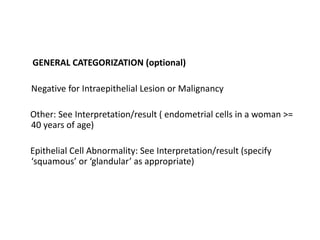
GENERAL CATEGORIZATION (optional)
Negative for Intraepithelial Lesion or Malignancy
Other: See Interpretation/result ( endometrial cells in a woman >=
40 years of age)
Epithelial Cell Abnormality: See Interpretation/result (specify
‘squamous’ or ‘glandular’ as appropriate)
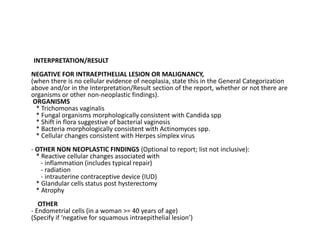
INTERPRETATION/RESULT
NEGATIVE FOR INTRAEPITHELIAL LESION OR MALIGNANCY,
(when there is no cellular evidence of neoplasia, state this in the General Categorization
above and/or in the Interpretation/Result section of the report, whether or not there are
organisms or other non-neoplastic findings).
ORGANISMS
* Trichomonas vaginalis
* Fungal organisms morphologically consistent with Candida spp
* Shift in flora suggestive of bacterial vaginosis
* Bacteria morphologically consistent with Actinomyces spp.
* Cellular changes consistent with Herpes simplex virus
- OTHER NON NEOPLASTIC FINDINGS (Optional to report; list not inclusive):
* Reactive cellular changes associated with
- inflammation (includes typical repair)
- radiation
- intrauterine contraceptive device (IUD)
* Glandular cells status post hysterectomy
* Atrophy
OTHER
- Endometrial cells (in a woman >= 40 years of age)
(Specify if ‘negative for squamous intraepithelial lesion’)
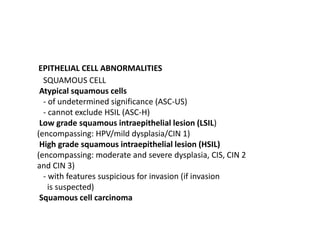
EPITHELIAL CELL ABNORMALITIES
SQUAMOUS CELL
Atypical squamous cells
- of undetermined significance (ASC-US)
- cannot exclude HSIL (ASC-H)
Low grade squamous intraepithelial lesion (LSIL)
(encompassing: HPV/mild dysplasia/CIN 1)
High grade squamous intraepithelial lesion (HSIL)
(encompassing: moderate and severe dysplasia, CIS, CIN 2
and CIN 3)
- with features suspicious for invasion (if invasion
is suspected)
Squamous cell carcinoma
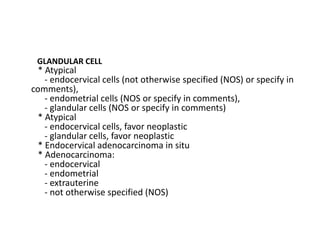
GLANDULAR CELL
* Atypical
- endocervical cells (not otherwise specified (NOS) or specify in
comments),
- endometrial cells (NOS or specify in comments),
- glandular cells (NOS or specify in comments)
* Atypical
- endocervical cells, favor neoplastic
- glandular cells, favor neoplastic
* Endocervical adenocarcinoma in situ
* Adenocarcinoma:
- endocervical
- endometrial
- extrauterine
- not otherwise specified (NOS)
• OTHER MALIGNANT NEOPLASMS: (specify)
ANCILLARY TESTING
Provide a brief description of the test method(s) and report the result so that it is
easily understood by the clinician.
AUTOMATED REVIEW
If case examined by automated device, specify device and result.
EDUCATIONAL NOTES AND SUGGESTIONS (optional)
Suggestions should be concise and consistent with clinical follow-up guidelines
published by professional organizations (references to relevant publications may
be included).
• WHO treatment policy –” screen and treat”
Management
• Decisions regarding treatment must include an assessment
of the
• Degree of dysplasia,
• Extent of the disease,
• Age of the patient, and
• Her desire regarding fertility
• decisions regarding management of patients with cervical
dysplasia can be divided into two subgroups: those with
low-grade cervical intraepithelial neoplasia (HPV and CIN
I)
• high-grade cervical intraepithelial neoplasia (CIN II–
III/CIS).
CIN I / HPV
• Repeat pap test 6-12 months
• HPV dna co testing yearly
• If CIN I persist for more than 2 years – treatment
CIN II / III
• Cryotherapy
• LEEP
• LLETZ
• Conisation
• hysterectomy
• Breast cancer- annual Self breast examination
• Ovarian cancer- annual bimanual pelvic
examination

Cervical cancer screeningppt

  • 1.
  • 2.
    Chart of cervicalscreening policy Start of screening age 21 21 - 29 Every 3 years 30 - 65 Every 3 years , Every 5 years with HPV DNA co testing Methods of screening Cytology ( conventional, LBC) 21-29 years 3 years 30-65 years 3 years HPV DNA co testing with cytology 21 – 29 Not recommended 30-65 5 years
  • 3.
    Primary hr HPVscreening Not recommended usually After 25 years every 3 years Before 25 years not recommended .
  • 4.
    When to stopscreening • Aged >65 years with adequate negative prior screening and no history of CIN2 or higher within the last 20 years. • Adequate negative prior screening results are defined as 3 consecutive negative cytology results or 2 consecutive negative co-test results within the previous 10 years, with the most recent test performed within the past 5 years.
  • 5.
    When to screenafter 65 years • History of CIN2, CIN3, or adenocarcinoma in situ, routine screening should continue for at least 20 years. • Women aged >65 years who have never been screened • Do not meet the criteria for adequate prior screening, routine screening should continue for at least 20 years after spontaneous regression or appropriate management of a highgrade precancerous lesion, even if this extends screening past age 65 years. • High risk ( highgrade precancerous lesion or cervical cancer, women with in utero exposure to diethylstilbestrol, or immunocompromised HIV)
  • 6.
    Special cases Post hysterectomy •cervix was removed? • why the hysterectomy was needed? • whether you have a history of moderate or severe cervical cell changes or cervical cancer. • Even if cervix is removed at the time of hysterectomy, cervical cells can still be present at the top of the vagina. If have a history of cervical cancer or cervical cell changes, should continue to have screening for 20 years after surgery.
  • 7.
    • Total hysterectomy(removal of the uterus and cervix) should stop screening • Women who have had a supracervical hysterectomy (cervix intact) should continue screening according to guidelines. • Women who have had a hysterectomy (removal of the cervix) should stop screening and not restart for any reason.
  • 8.
    Screening among thoseimmunized with HPV vaccine • Women who have received the HPV vaccine should be screened according to the same guidelines as women who have not been vaccinated
  • 9.
    • These recommendationsdo not address special, high-risk populations who may need more intensive or alternative screening. • women with a history of CIN2, CIN3, or cervical cancer, • women who were exposed in utero to diethylstilbestrol, • women who are infected with HIV, • women who are immunocompromised (such as those who have received solid organ transplants).
  • 10.
    • Primary HRHPV testing is defined as a stand-alone test for cervical cancer screening without concomitant cytology testing. It may be followed by other tests (like a Pap) for triage. This test specifically identifies HPV 16 and HPV 18, while concurrently detecting 12 other types of high-risk HPVs.
  • 11.
    The Bethesda system(TBS) is a system for reporting cervical or vaginal cytologic diagnoses, used for reporting Pap smear results. It was introduced in 1988 and revised in 1991, 2001, and 2014. The name comes from the location (Bethesda, Maryland) of the conference that established the system.
  • 12.
    Bethesda system • 1988bethesda (Maryland) 1st workshop of NCI • It follows the 2 tier system of cytology includes LSIL/HSIL • IN 2001 3 categories atypical squamous cells • Robert kurman • To decide terminology • Decrease interobserver variability • Management
  • 13.
    Bethesda system SPECIMEN TYPE Indicateconventional smear (Pap smear) • vs. liquid-based preparation • vs. other. SPECIMEN ADEQUACY Satisfactory for evaluation (describe presence or absence of endocervical/transformation zone component and any other quality indicators, e.g., partially obscuring blood, inflammation, etc.) • Unsatisfactory for evaluation …(specify reason) • Specimen rejected/not processed (specify reason) • Specimen processed and examined, but unsatisfactory for evaluation of epithelial abnormality because of (specify reason)
  • 14.
    GENERAL CATEGORIZATION (optional) Negativefor Intraepithelial Lesion or Malignancy Other: See Interpretation/result ( endometrial cells in a woman >= 40 years of age) Epithelial Cell Abnormality: See Interpretation/result (specify ‘squamous’ or ‘glandular’ as appropriate)
  • 15.
    INTERPRETATION/RESULT NEGATIVE FOR INTRAEPITHELIALLESION OR MALIGNANCY, (when there is no cellular evidence of neoplasia, state this in the General Categorization above and/or in the Interpretation/Result section of the report, whether or not there are organisms or other non-neoplastic findings). ORGANISMS * Trichomonas vaginalis * Fungal organisms morphologically consistent with Candida spp * Shift in flora suggestive of bacterial vaginosis * Bacteria morphologically consistent with Actinomyces spp. * Cellular changes consistent with Herpes simplex virus - OTHER NON NEOPLASTIC FINDINGS (Optional to report; list not inclusive): * Reactive cellular changes associated with - inflammation (includes typical repair) - radiation - intrauterine contraceptive device (IUD) * Glandular cells status post hysterectomy * Atrophy OTHER - Endometrial cells (in a woman >= 40 years of age) (Specify if ‘negative for squamous intraepithelial lesion’)
  • 16.
    EPITHELIAL CELL ABNORMALITIES SQUAMOUSCELL Atypical squamous cells - of undetermined significance (ASC-US) - cannot exclude HSIL (ASC-H) Low grade squamous intraepithelial lesion (LSIL) (encompassing: HPV/mild dysplasia/CIN 1) High grade squamous intraepithelial lesion (HSIL) (encompassing: moderate and severe dysplasia, CIS, CIN 2 and CIN 3) - with features suspicious for invasion (if invasion is suspected) Squamous cell carcinoma
  • 17.
    GLANDULAR CELL * Atypical -endocervical cells (not otherwise specified (NOS) or specify in comments), - endometrial cells (NOS or specify in comments), - glandular cells (NOS or specify in comments) * Atypical - endocervical cells, favor neoplastic - glandular cells, favor neoplastic * Endocervical adenocarcinoma in situ * Adenocarcinoma: - endocervical - endometrial - extrauterine - not otherwise specified (NOS)
  • 18.
    • OTHER MALIGNANTNEOPLASMS: (specify) ANCILLARY TESTING Provide a brief description of the test method(s) and report the result so that it is easily understood by the clinician. AUTOMATED REVIEW If case examined by automated device, specify device and result. EDUCATIONAL NOTES AND SUGGESTIONS (optional) Suggestions should be concise and consistent with clinical follow-up guidelines published by professional organizations (references to relevant publications may be included).
  • 26.
    • WHO treatmentpolicy –” screen and treat”
  • 27.
    Management • Decisions regardingtreatment must include an assessment of the • Degree of dysplasia, • Extent of the disease, • Age of the patient, and • Her desire regarding fertility • decisions regarding management of patients with cervical dysplasia can be divided into two subgroups: those with low-grade cervical intraepithelial neoplasia (HPV and CIN I) • high-grade cervical intraepithelial neoplasia (CIN II– III/CIS).
  • 28.
    CIN I /HPV • Repeat pap test 6-12 months • HPV dna co testing yearly • If CIN I persist for more than 2 years – treatment CIN II / III • Cryotherapy • LEEP • LLETZ • Conisation • hysterectomy
  • 29.
    • Breast cancer-annual Self breast examination • Ovarian cancer- annual bimanual pelvic examination