Screening & Prevention of Cervical
Malignancy
Dr.KG Hewawitharana
Spectrum of Discussion
• Basic introduction
• Cervical Smears
• Colposcopy
• HPV testing
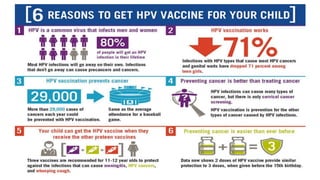
• HPV Vaccine
Cancer burden & Importance of Screening
• 7th most common malignancy globally 1 (4𝑡ℎ 𝑖𝑛 𝑡𝑜𝑔) 2 (2nd in SL)
• 85% occurs in under-developed countries as no proper screening 2
• 12% of all female cancers
• Most common CA in 15-44yrs age group with 9% new cases /yr 2
• Proper screening for premalignant lesions lead to early intervention &
cancer prevention.
• Reason- long natural history with prolonged precancerous phase in
pathogenesis
• So easily detectable and treatable in early phase
cont.
• In UK, nearly 5000 lives per year is saved due to screening
• 30% reduction of incidence of cervical CA observed
• SL provides cervical screening via WWC & Hospital Gyn clinics
HPV Infection – Main risk factor
• Persistent oncogenic high risk HPV viral infection is responsible for
initiation of neoplastic process & It is the rule at present
• HPV16/18 are most commonly associated with up to 75% cases
• Others high oncogenic ones are HPV-31,33,45,56
• Life time risk of having any HPV infection is about 80%
• But risk of having invasive cervical CA is 0.6%
• Thus cervical CA is a rare complication of HPV infection.
Risk of SCC following HPV 16 is-400 times
And following HPV 18 is 250 times than
uninfected women 2
• Immature immune system & Biologically vulnerable immature cervical
epithelia leads to high prevalence of HPV infection in Adolescents
(45%)
• But it declines to about 5% when women age >30Yrs
• Since most HPV infection are transient, up to 80% clears in 2 yrs.
• Remainder lead to Cervical intraepithelial neoplasia in 2-4 Yrs.
cont.
• Progression rate of CIN in women with high risk HPV- 5% annually.
• After 30yrs of age, regression rate is low.
Roughly if not intervened,
1/3rd – early lesions disappears
1/3rd - persists
1/3rd - progress to CIN3 or Invasive carcinoma
HPV is necessary but not the only factor cause neoplasm
• Since HPV is a non lytic infection, inflammatory response is much
subtle
• Initially innate immunity and much later adaptive immunity combats
against infection
• Estimated time to premalignant lesion from infection -7 yrs 2
• Estimated time to malignant lesion from infection – 15 yrs 1
Other risk factors- act as co factors
• Low socio-economic status
• Tobacco smoking (2x)
• OCP (2.5x)
• Early sexual exposure
• Multiple sexual partners
• Co-STDs
• Bact. Vaginosis- HPV persistence & progression to dyskaryosis
promote
• Immunocompromise including HIV (5x)
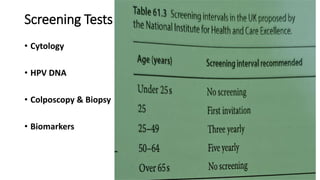
Screening Tests
• Cytology
• HPV DNA
• Colposcopy & Biopsy
• Biomarkers
Cytology
• Current primary screening
• Traditional exfoliative cytology smears introduced by Papanicolaou
replaced with Liquid based cytology since 2007
semi-automated
reduce the rate of unsatisfactory yields from 9% to 2%
easy to study slides since they are made of uniform cell spreads
Minimal contamination by pus cells, red cells
Colposcopy
WHAT IS COLPOSCOPY?
• Inroduced by Hinselman in late 1925
• Magnification and illumination of female lower genital tract with
various stains
Lugol’s iodine and Acetic acid(3% or 5%)
Except illumination, magnification and Green filter to enhance
visualization of vascularity, no much advanced over the last century
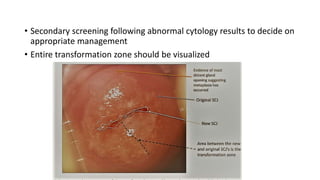
• Secondary screening following abnormal cytology results to decide on
appropriate management
• Entire transformation zone should be visualized
Objectives of Colposcopic Assessments 𝟏
• Assess the presence and severity of cytological abnormalities found in
pap test
• Guided biopsy from most unusual site
• Exclude invasive disease
• Aid in OPD mx/Rx of CIN
• Assist follow up after treatment
Indications for Colposcopy
1)one cervical sample with borderline changes in high risk HPV+
2)one sample with mild dyskaryosis in high risk HPV+
3)One sample with mild dyskaryosis with inadequate HPV test
4)one sample with borderline changes involving endocervix
5)one sample with moderate – severe dyskaryosis
6)One sample with possible invasive disease
7)One sample with glandular neoplasia
Cont.
8)One sample with glandular neoplasia
9) Three consecutive inadequate samples
10)Any grade of dyskaryosis after CIN treatment prior next recall
11)Three abnormal sample of any grade over 10 years period
12)Suspicious symptoms and abnormal cervix
If there is no HPV DNA test facilities, consider colposcopy if,
13)Three samples with borderline changes in squamous cells
14)One sample with mild dyskaryosis
• Accuracy of colposcopy improved if entire
squamo-columnar junction is seen and upper
limit of any lesion is seen
• Size and topography of lesion are taken
seriously when extend into cervical canal or
vagina
• This is a subjective assessment with intra
observer variability and commonly produce
inconclusive findings
• Inter observer variability affect low grade
lesions more often than high grade lesions
Colposcopy rather than the biopsy itself limit the
detection, because we can not take targeted
biopsy from place which is not visible
Agreement between Colposcopic impression &
histological finding is achieved in only 37%
cases 2
.
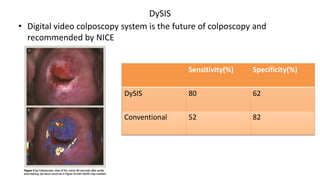
DySIS
• Digital video colposcopy system is the future of colposcopy and
recommended by NICE
Sensitivity(%) Specificity(%)
DySIS 80 62
Conventional 52 82
Histology
• Colposcopic or direct cervical biopsies under anesthesia(Punch/cone)
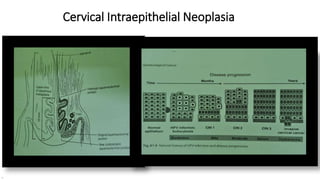
• Squamous premalignant changes studies and represent as CIN
• Classically CIN correlates with cytological dyskrasias as mid,moderate
or severe
Cervical Intraepithelial Neoplasia
Squamous lesions
Bethesda system is widely used
ASCUS-atypical sq. cells of undetermined significance
ASC-H-Atypical sq. cells can not exclude HSIL
LSIL-low grade sq. intraepithelial lesion as CIN 1
HSIL-high grade sq. intraepithelial lesion as CIN2,3 or SCC
Glandular lesions
Bethesda system divides this as
AGC-atypical glandular cells
AGC favor neoplastic
Endocervical AIS
Adenocarcinoma
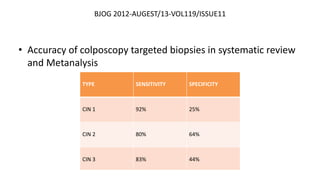
BJOG 2012-AUGEST/13-VOL119/ISSUE11
• Accuracy of colposcopy targeted biopsies in systematic review
and Metanalysis
TYPE SENSITIVITY SPECIFICITY
CIN 1 92% 25%
CIN 2 80% 64%
CIN 3 83% 44%
HPV DNA Test & Triage
• HPV can not culture invitro, exfoliating cervical cell infected with HPV
used with molecular biological tests to find its DNA presence.
• About 31%-72% patients with borderline cytological abnormalities
have +HPV DNA results
• This use to divide female in to high risk of developing high grade CIN
from low risk (triage)
• So that number of repeat cytology and time taken to return for
recall/reviews were reduced.
• But colposcopy rate goes up.
HPV DNA as Test of cure
• Women under went treatment for CIN or early stromal CA will have
risk of recurrence in 7%-11%
• HPV DNA is superior than cytology based follow up for accurate
prediction of residual/recurrent CIN
• Sensitivity 96% with NPV 99%
• Women with any grade of CIN after treatment will evaluate at 6
months for cytology+DNA
Cochrane review
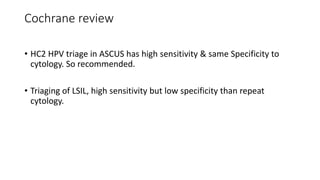
• HC2 HPV triage in ASCUS has high sensitivity & same Specificity to
cytology. So recommended.
• Triaging of LSIL, high sensitivity but low specificity than repeat
cytology.
HPV DNA as Primary Screening Test
• Effective with high NPV
• Even single study could markedly reduce risk of advanced cancer
compared to cytology
• Negative DNA test more reassuring than negative cytology test as
cytology has high false negative results
• But this will increase colposcopy referrals
• 60%-70% greater protection against invasive CA than Cytology
CYTOLOGY HPV DNA
Sensitivity 53% 96%
Specificity 96% 90%
Colposcopy referral
rate
4% 3%-6%
ATHENA Trial(2011)
• Baseline Negative HPV DNA test predicts 50% risk of CIN3 in next 3
years than a negative cytology test
• Cytology failed to detect about 50% of CIN3 in 25-29yrs age group
• HPV primary testing requires less screening tests
HPV subtyping
• Enables immediate attention/Colposcopy for those who are positive
for 16/18 strains
• Athena Trial (2011) showed subtype 16/18 triage able to detect CIN3
with high sensitivity and 28% over cytology.
• Since it only covers 16/18,there is a chance of missing 31/33 strains
which are also more invasive cancer causing forms
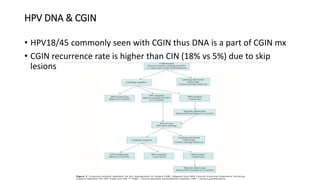
HPV DNA & CGIN
• HPV18/45 commonly seen with CGIN thus DNA is a part of CGIN mx
• CGIN recurrence rate is higher than CIN (18% vs 5%) due to skip
lesions
Future Emerging Markers
• (1)p16 𝐼𝑁𝐾4𝑎 over expresssion as surrogate marker −
if positive CIN1 progression to High grade CIN risk rises
• (2) E6/E7 over expression differentiate transient HPV from high risk of
progressing to neoplasia category thus reduce colposcopy rate. But
sensitivity is less than DNA/Cytology.
Self-sampling screening Programme
• Acceptable & effective
• DNA sample had same sensitivity to high grade lesion/invasive CA like
Pap smear
• Increase cervical screening rate with attendance to follow up
7,8
Mechanism of action
• Viral L1 capsid protein can be expressed in human cells
• They self assemble to virus like particles
• VLP morphologically & immunologically like HPV
• As no genome , non infectious
• Injection generate Anti HPV L1 IgG
• Provide type specific protection
Efficacy
• Both vaccines protect (>90%)against persistent infection (>6
months)from HPV16/18 and some cross protection do exist.
• Prevention of intraepithelial lesions
a) 16/18 DNA negative women->95% efficacy for strain 16/18 induced
lesions and 20%-100% cross protection against lesions from related
HPV
>95% reduction of anogenital Warts , VIN & VAIN
b) b) HPV 16/18 DNA positive women – marginal value
safety
• To the date, no trial revealed contraindications
• Vaccine is safe
• Injection site irritation + Transient flue like symptoms may occur
• Vaccine safety in pregnancy has not well studied. So if got pregnant
prior completion of course, vaccine should not be given and after
pregnancy rest of the course can be completed 6.
• Gardasil safe in breast feeding mothers
• No impact on any medicine,contraceptive method
• No effect on birth outcome
Duration of protection
• Almost 100% seroconversion rate
• Peak antibody titre level are 10-100 fold higher than immune
response to natural infection
• Immune response persists about 6.5 years with AB titre level high as
11 folds
• Adequate AB titres exist for 20-30 years (Mathematical suggestion)
Indication for women
• Optimal target age for prophylactic vaccination is pre-pubertal age
prior coitarche(9-14Yrs)
• Catch-up vaccination for slightly older women (15-18 Yrs)
• Level of protection after 18yrs of age is unclear but theoretically
benefitted if HPV16/18 negative
• Not licensed over 26 Yrs
Indication for men
• Reduce incidence of HPV and complications
• Herd immunity brings prevention of transmission to women
• Cost????????????
References
• 1-Dewhurst text book 9th edition
• 2- TOG (2016) Cervical cancer prevention and Screening
• 3-WHO colposcopy manual
• 4-FIGO http://dx.doi.org/10.1016/j.ygyno.2014.11.076-ATHENA
• 5-FIGO http://dx.doi.org/10.1016/j.ygyno.2014.12.022-HPV
• 6-TOG (2015) Vaccination in Pregnancy
• 7-OGRM HPV vaccine (2008)
• 8-OGRM HPV update (2013)
• 9-OGRM Colposcopy & CIN (2017)
`

Cervical ca prevention

  • 1.
    Screening & Preventionof Cervical Malignancy Dr.KG Hewawitharana
  • 2.
    Spectrum of Discussion •Basic introduction • Cervical Smears • Colposcopy • HPV testing • HPV Vaccine
  • 3.
    Cancer burden &Importance of Screening • 7th most common malignancy globally 1 (4𝑡ℎ 𝑖𝑛 𝑡𝑜𝑔) 2 (2nd in SL) • 85% occurs in under-developed countries as no proper screening 2 • 12% of all female cancers • Most common CA in 15-44yrs age group with 9% new cases /yr 2 • Proper screening for premalignant lesions lead to early intervention & cancer prevention. • Reason- long natural history with prolonged precancerous phase in pathogenesis • So easily detectable and treatable in early phase
  • 4.
    cont. • In UK,nearly 5000 lives per year is saved due to screening • 30% reduction of incidence of cervical CA observed • SL provides cervical screening via WWC & Hospital Gyn clinics
  • 5.
    HPV Infection –Main risk factor • Persistent oncogenic high risk HPV viral infection is responsible for initiation of neoplastic process & It is the rule at present • HPV16/18 are most commonly associated with up to 75% cases • Others high oncogenic ones are HPV-31,33,45,56 • Life time risk of having any HPV infection is about 80% • But risk of having invasive cervical CA is 0.6% • Thus cervical CA is a rare complication of HPV infection.
  • 6.
    Risk of SCCfollowing HPV 16 is-400 times And following HPV 18 is 250 times than uninfected women 2
  • 7.
    • Immature immunesystem & Biologically vulnerable immature cervical epithelia leads to high prevalence of HPV infection in Adolescents (45%) • But it declines to about 5% when women age >30Yrs • Since most HPV infection are transient, up to 80% clears in 2 yrs. • Remainder lead to Cervical intraepithelial neoplasia in 2-4 Yrs.
  • 8.
    cont. • Progression rateof CIN in women with high risk HPV- 5% annually. • After 30yrs of age, regression rate is low. Roughly if not intervened, 1/3rd – early lesions disappears 1/3rd - persists 1/3rd - progress to CIN3 or Invasive carcinoma HPV is necessary but not the only factor cause neoplasm
  • 9.
    • Since HPVis a non lytic infection, inflammatory response is much subtle • Initially innate immunity and much later adaptive immunity combats against infection • Estimated time to premalignant lesion from infection -7 yrs 2 • Estimated time to malignant lesion from infection – 15 yrs 1
  • 10.
    Other risk factors-act as co factors • Low socio-economic status • Tobacco smoking (2x) • OCP (2.5x) • Early sexual exposure • Multiple sexual partners • Co-STDs • Bact. Vaginosis- HPV persistence & progression to dyskaryosis promote • Immunocompromise including HIV (5x)
  • 11.
    Screening Tests • Cytology •HPV DNA • Colposcopy & Biopsy • Biomarkers
  • 12.
  • 13.
    • Current primaryscreening • Traditional exfoliative cytology smears introduced by Papanicolaou replaced with Liquid based cytology since 2007 semi-automated reduce the rate of unsatisfactory yields from 9% to 2% easy to study slides since they are made of uniform cell spreads Minimal contamination by pus cells, red cells
  • 14.
  • 15.
    WHAT IS COLPOSCOPY? •Inroduced by Hinselman in late 1925 • Magnification and illumination of female lower genital tract with various stains Lugol’s iodine and Acetic acid(3% or 5%) Except illumination, magnification and Green filter to enhance visualization of vascularity, no much advanced over the last century
  • 16.
    • Secondary screeningfollowing abnormal cytology results to decide on appropriate management • Entire transformation zone should be visualized
  • 17.
    Objectives of ColposcopicAssessments 𝟏 • Assess the presence and severity of cytological abnormalities found in pap test • Guided biopsy from most unusual site • Exclude invasive disease • Aid in OPD mx/Rx of CIN • Assist follow up after treatment
  • 18.
    Indications for Colposcopy 1)onecervical sample with borderline changes in high risk HPV+ 2)one sample with mild dyskaryosis in high risk HPV+ 3)One sample with mild dyskaryosis with inadequate HPV test 4)one sample with borderline changes involving endocervix 5)one sample with moderate – severe dyskaryosis 6)One sample with possible invasive disease 7)One sample with glandular neoplasia
  • 19.
    Cont. 8)One sample withglandular neoplasia 9) Three consecutive inadequate samples 10)Any grade of dyskaryosis after CIN treatment prior next recall 11)Three abnormal sample of any grade over 10 years period 12)Suspicious symptoms and abnormal cervix If there is no HPV DNA test facilities, consider colposcopy if, 13)Three samples with borderline changes in squamous cells 14)One sample with mild dyskaryosis
  • 20.
    • Accuracy ofcolposcopy improved if entire squamo-columnar junction is seen and upper limit of any lesion is seen • Size and topography of lesion are taken seriously when extend into cervical canal or vagina • This is a subjective assessment with intra observer variability and commonly produce inconclusive findings • Inter observer variability affect low grade lesions more often than high grade lesions
  • 21.
    Colposcopy rather thanthe biopsy itself limit the detection, because we can not take targeted biopsy from place which is not visible Agreement between Colposcopic impression & histological finding is achieved in only 37% cases 2 .
  • 22.
    DySIS • Digital videocolposcopy system is the future of colposcopy and recommended by NICE Sensitivity(%) Specificity(%) DySIS 80 62 Conventional 52 82
  • 23.
    Histology • Colposcopic ordirect cervical biopsies under anesthesia(Punch/cone) • Squamous premalignant changes studies and represent as CIN • Classically CIN correlates with cytological dyskrasias as mid,moderate or severe
  • 24.
  • 25.
    Squamous lesions Bethesda systemis widely used ASCUS-atypical sq. cells of undetermined significance ASC-H-Atypical sq. cells can not exclude HSIL LSIL-low grade sq. intraepithelial lesion as CIN 1 HSIL-high grade sq. intraepithelial lesion as CIN2,3 or SCC
  • 26.
    Glandular lesions Bethesda systemdivides this as AGC-atypical glandular cells AGC favor neoplastic Endocervical AIS Adenocarcinoma
  • 27.
    BJOG 2012-AUGEST/13-VOL119/ISSUE11 • Accuracyof colposcopy targeted biopsies in systematic review and Metanalysis TYPE SENSITIVITY SPECIFICITY CIN 1 92% 25% CIN 2 80% 64% CIN 3 83% 44%
  • 28.
    HPV DNA Test& Triage • HPV can not culture invitro, exfoliating cervical cell infected with HPV used with molecular biological tests to find its DNA presence. • About 31%-72% patients with borderline cytological abnormalities have +HPV DNA results • This use to divide female in to high risk of developing high grade CIN from low risk (triage) • So that number of repeat cytology and time taken to return for recall/reviews were reduced. • But colposcopy rate goes up.
  • 29.
    HPV DNA asTest of cure • Women under went treatment for CIN or early stromal CA will have risk of recurrence in 7%-11% • HPV DNA is superior than cytology based follow up for accurate prediction of residual/recurrent CIN • Sensitivity 96% with NPV 99% • Women with any grade of CIN after treatment will evaluate at 6 months for cytology+DNA
  • 32.
    Cochrane review • HC2HPV triage in ASCUS has high sensitivity & same Specificity to cytology. So recommended. • Triaging of LSIL, high sensitivity but low specificity than repeat cytology.
  • 33.
    HPV DNA asPrimary Screening Test • Effective with high NPV • Even single study could markedly reduce risk of advanced cancer compared to cytology • Negative DNA test more reassuring than negative cytology test as cytology has high false negative results • But this will increase colposcopy referrals • 60%-70% greater protection against invasive CA than Cytology
  • 34.
    CYTOLOGY HPV DNA Sensitivity53% 96% Specificity 96% 90% Colposcopy referral rate 4% 3%-6%
  • 35.
    ATHENA Trial(2011) • BaselineNegative HPV DNA test predicts 50% risk of CIN3 in next 3 years than a negative cytology test • Cytology failed to detect about 50% of CIN3 in 25-29yrs age group • HPV primary testing requires less screening tests
  • 36.
    HPV subtyping • Enablesimmediate attention/Colposcopy for those who are positive for 16/18 strains • Athena Trial (2011) showed subtype 16/18 triage able to detect CIN3 with high sensitivity and 28% over cytology. • Since it only covers 16/18,there is a chance of missing 31/33 strains which are also more invasive cancer causing forms
  • 37.
    HPV DNA &CGIN • HPV18/45 commonly seen with CGIN thus DNA is a part of CGIN mx • CGIN recurrence rate is higher than CIN (18% vs 5%) due to skip lesions
  • 38.
    Future Emerging Markers •(1)p16 𝐼𝑁𝐾4𝑎 over expresssion as surrogate marker − if positive CIN1 progression to High grade CIN risk rises • (2) E6/E7 over expression differentiate transient HPV from high risk of progressing to neoplasia category thus reduce colposcopy rate. But sensitivity is less than DNA/Cytology.
  • 39.
    Self-sampling screening Programme •Acceptable & effective • DNA sample had same sensitivity to high grade lesion/invasive CA like Pap smear • Increase cervical screening rate with attendance to follow up
  • 40.
  • 44.
    Mechanism of action •Viral L1 capsid protein can be expressed in human cells • They self assemble to virus like particles • VLP morphologically & immunologically like HPV • As no genome , non infectious • Injection generate Anti HPV L1 IgG • Provide type specific protection
  • 45.
    Efficacy • Both vaccinesprotect (>90%)against persistent infection (>6 months)from HPV16/18 and some cross protection do exist. • Prevention of intraepithelial lesions a) 16/18 DNA negative women->95% efficacy for strain 16/18 induced lesions and 20%-100% cross protection against lesions from related HPV >95% reduction of anogenital Warts , VIN & VAIN b) b) HPV 16/18 DNA positive women – marginal value
  • 46.
    safety • To thedate, no trial revealed contraindications • Vaccine is safe • Injection site irritation + Transient flue like symptoms may occur • Vaccine safety in pregnancy has not well studied. So if got pregnant prior completion of course, vaccine should not be given and after pregnancy rest of the course can be completed 6. • Gardasil safe in breast feeding mothers • No impact on any medicine,contraceptive method • No effect on birth outcome
  • 47.
    Duration of protection •Almost 100% seroconversion rate • Peak antibody titre level are 10-100 fold higher than immune response to natural infection • Immune response persists about 6.5 years with AB titre level high as 11 folds • Adequate AB titres exist for 20-30 years (Mathematical suggestion)
  • 48.
    Indication for women •Optimal target age for prophylactic vaccination is pre-pubertal age prior coitarche(9-14Yrs) • Catch-up vaccination for slightly older women (15-18 Yrs) • Level of protection after 18yrs of age is unclear but theoretically benefitted if HPV16/18 negative • Not licensed over 26 Yrs
  • 49.
    Indication for men •Reduce incidence of HPV and complications • Herd immunity brings prevention of transmission to women • Cost????????????
  • 50.
    References • 1-Dewhurst textbook 9th edition • 2- TOG (2016) Cervical cancer prevention and Screening • 3-WHO colposcopy manual • 4-FIGO http://dx.doi.org/10.1016/j.ygyno.2014.11.076-ATHENA • 5-FIGO http://dx.doi.org/10.1016/j.ygyno.2014.12.022-HPV • 6-TOG (2015) Vaccination in Pregnancy • 7-OGRM HPV vaccine (2008) • 8-OGRM HPV update (2013) • 9-OGRM Colposcopy & CIN (2017)
  • 51.