Color
Color matters!
Research reveals people make a subconscious
judgment about a person, environment, or product
within 90 seconds of initial viewing and that
between 62% and 90% of that assessment is
based on color alone.!
Source: CCICOLOR - Institute for Color Research
Powerful tool for
communication
But color is subjective!
People respond differently to the
same color due to:

Personal preference

Cultural background

Color memory/associations
Example: Red
FIRE/DEVIL BLOOD/WARFARE ANGER
LOVE/CUPID IMPORTANCE PROSPERITY/
HAPPINESS
DEFIANCE/
COMMUNISM
DANGER
In general...
• Red: Passion, Love, Anger

• Orange: Energy, Happiness, Vitality

• Yellow: Happiness, Hope, Deceit

• Green: New Beginnings, Abundance, Nature

• Blue: Calm, Responsible, Sadness

• Purple: Creativity, Royalty, Wealth

• Black: Mystery, Elegance, Evil

• Gray: Moody, Conservative, Formality

• White: Purity, Cleanliness, Virtue

• Brown: Nature, Wholesomeness, Dependability

• Tan or Beige: Conservative, Piety, Dull

• Cream or Ivory: Calm, Elegant, Purity
Color Wheel
Primary Colors: Red, yellow and blue

Primary colors are the 3 pigment colors that can not
be mixed or formed by any combination of other
colors. All other colors are derived from these 3
hues. 

Secondary Colors: Green, orange and
purple

These are the colors formed by mixing the primary
colors.

Tertiary Colors: Yellow-orange, red-
orange, red-purple, blue-purple, blue-
green & yellow-green

These are the colors formed by mixing a primary
and a secondary color. That's why the hue is a
two word name, such as blue-green.
Color is a general term
Hue

Saturation

Shade

Tint
COLOR TERMINOLOGY:
Hue
An object’s color

Blue, green, red, etc.
Saturation
How pure a color is

High saturation =
purest color. No white
or black added
HIGH SATURATION
LOW SATURATION
GREEN & RED
HUES
HIGH
SATURATION
Shade	
Created by adding
black to a hue, making
the hue darker
Tint
Created by adding
white to a hue, making
the hue lighter
Shade vs. Tint
Color schemes/palettes
Important to
define your
color palette/
scheme before
starting on a
project

Use your color
wheel!
Traditional schemes
Monochromatic

Analogous

Complementary

Triad
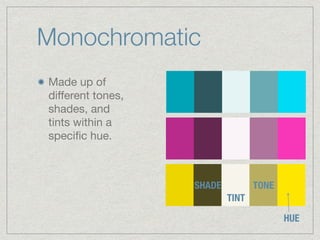
Monochromatic
Made up of
different tones,
shades, and
tints within a
specific hue.
SHADE
TINT
TONE
HUE
Analogous
Created by using three
colors that are next to
each other on the 12-
spoke color wheel

Ex: Blue, blue-green,
and green
V
Analogous Cont’d
Analogous
schemes are good,
but sometimes they
don’t provide
enough contrast to
the design

Use shades, tints,
and tones of colors
to give more
contrast
Complementary
Created by combining
colors from opposite
sides of the color
wheel

Again, use shades,
tints, and tones of
complementary hues
to give more contrast
Triad
Created by using
three colors that are
evenly spaced
around the color
wheel.
Color slides
Color slides

Color slides