Symmetry	
11/15/13
Monday, November 18, 13
Symmetry	
Ordering principle in nature that represents the center of
balance between two or more opposing sides

Monday, November 18, 13
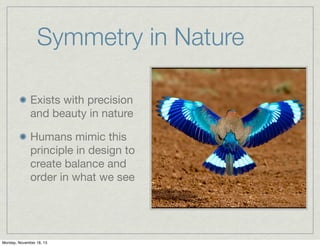
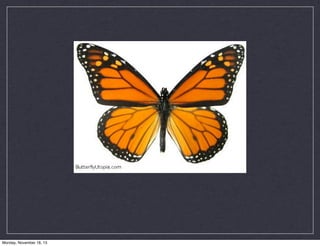
Symmetry in Nature
Exists with precision
and beauty in nature
Humans mimic this
principle in design to
create balance and
order in what we see

Monday, November 18, 13
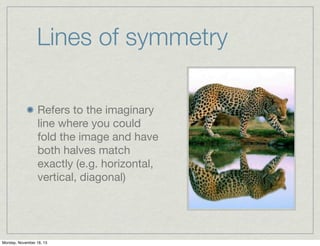
Lines of symmetry
Refers to the imaginary
line where you could
fold the image and have
both halves match
exactly (e.g. horizontal,
vertical, diagonal)

Monday, November 18, 13
Types of Symmetry
Translation
Reflection
Rotation

Monday, November 18, 13
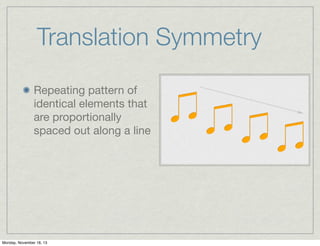
Translation Symmetry
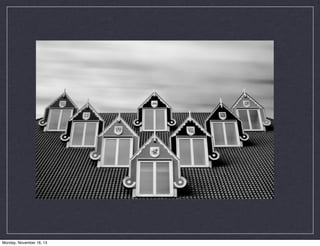
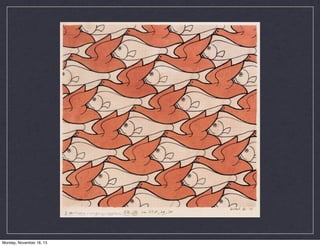
Repeating pattern of
identical elements that
are proportionally
spaced out along a line

Monday, November 18, 13
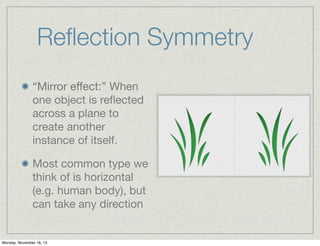
Reflection Symmetry
“Mirror effect:” When
one object is reflected
across a plane to
create another
instance of itself.
Most common type we
think of is horizontal
(e.g. human body), but
can take any direction

Monday, November 18, 13
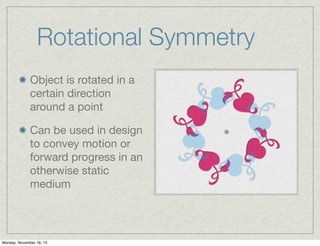
Rotational Symmetry
Object is rotated in a
certain direction
around a point
Can be used in design
to convey motion or
forward progress in an
otherwise static
medium

Monday, November 18, 13
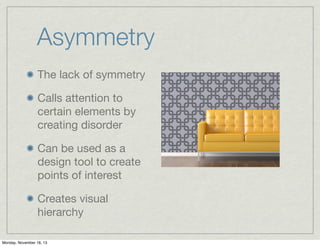
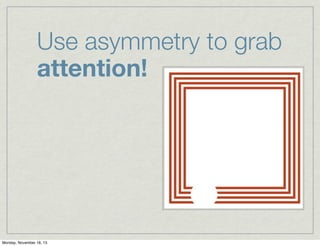
Asymmetry
The lack of symmetry
Calls attention to
certain elements by
creating disorder
Can be used as a
design tool to create
points of interest
Creates visual
hierarchy
Monday, November 18, 13
Use asymmetry to grab
attention!

Monday, November 18, 13
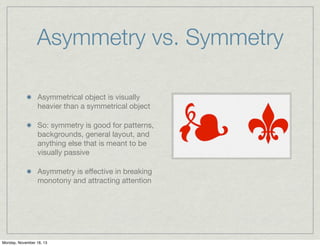
Asymmetry vs. Symmetry
Asymmetrical object is visually
heavier than a symmetrical object
So: symmetry is good for patterns,
backgrounds, general layout, and
anything else that is meant to be
visually passive
Asymmetry is effective in breaking
monotony and attracting attention

Monday, November 18, 13

Symmetry