WELCOME
TO
THE PRESENTATION ON
Colonialism, its types, characteristics
or nature. Causes/ aims of colonialism
Md. Firoz Al Mamun
Assistant Professor
Department of Political Science
Islamic University, Kushtia
Bangladesh
Introduction
Colonialism, as a historical phenomenon, refers to foreign domination
which implies that the colonised area is regulated in a manner known
as ‘unequal exchange’. Colonised societies are intended to serve the
interests of the ruling country. Thus, by colonialism, we mean a
system of political and social relations between two countries—of
which one is the ruler and the other is its colony.
So colonialism refers to foreign domination in social, economic, and
political policies of the colony countries. Obviously, the destiny of the
colony is governed by the policies of the foreign country so as to sub-
serve the interests of the ruling country.
• What is Colonialism?
Colonialism is a policy where one country seeks to extend
political or economic authority over the people and physical
territory of another country. Generally, economic dominance and
exploitation of resources is the primary aim of a country
indulging in colonialism.
Etymologically, the word "colony" comes from the
Latin colōnia—"a place for agriculture".
• Colonialism is a practice or policy of control by one
people or power over other people or areas, often by
establishing colonies and generally with the aim of
economic dominance. In the process of colonisation,
colonisers may impose their religion, language,
economics, and other cultural practices. The foreign
administrators rule the territory in pursuit of their
interests, seeking to benefit from the colonised region's
people and resources. It is associated with but distinct
from imperialism
• Collins English Dictionary defines colonialism as "the
practice by which a powerful country directly controls
less powerful countries and uses their resources to
increase its own power and wealth".
• Webster's Encyclopedic Dictionary defines colonialism as
"the system or policy of a nation seeking to extend or
retain its authority over other people or territories".
• The Merriam-Webster Dictionary offers four definitions,
including "something characteristic of a colony" and
"control by one power over a dependent area or people".
• The Stanford Encyclopedia of Philosophy uses the term "to
describe the process of European settlement and political control
over the rest of the world, including the Americas, Australia, and
parts of Africa and Asia".
Types of Colonialism
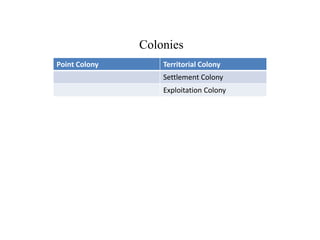
Colonies
Colonies
Point Colony Territorial Colony
Settlement Colony
Exploitation Colony
• The Times once quipped that there were three types of colonial
empire: "The English, which consists in making colonies with
colonists; the German, which collects colonists without colonies;
the French, which sets up colonies without colonists." Modern
studies of colonialism have often distinguished between various
overlapping categories of colonialism, broadly classified into
four types: settler colonialism, exploitation
colonialism, surrogate colonialism, and internal colonialism.
Some historians have identified other forms of colonialism,
including national and trade forms.
• Settler colonialism involves large-
scale immigration by settlers to colonies, often
motivated by religious, political, or economic reasons.
This form of colonialism aims largely to supplant prior
existing populations with a settler one, and involves
large number of settlers emigrating to colonies for the
purpose of settling down and establishing
settlements. Argentina, Australia, Brazil, Canada, Chile
, New Zealand, Russia, South Africa, United
States, Uruguay, (and to a more controversial
extent Israel) are examples of nations created or
expanded in their contemporary form by settler
colonization.
• Exploitation colonialism involves fewer colonists and
focuses on the exploitation of natural resources or labour
to the benefit of the metropole. This form consists
of trading posts as well as larger colonies where colonists
would constitute much of the political and economic
administration. The European colonization of
Africa and Asia was largely conducted under the auspices
of exploitation colonialism.
• Surrogate colonialism involves a settlement project
supported by a colonial power, in which most of the
settlers do not come from the same ethnic group as the
ruling power.
• Internal colonialism is a notion of uneven structural power between
areas of a state. The source of exploitation comes from within the
state. This is demonstrated in the way control and exploitation may
pass from people from the colonizing country to an immigrant
population within a newly independent country.
• National colonialism is a process involving elements of both settler
and internal colonialism, in which nation-building and colonization
are symbiotically connected, with the colonial regime seeking to
remake the colonized peoples into their own cultural and political
image. The goal is to integrate them into the state, but only as
reflections of the state's preferred culture. The Republic of China in
Taiwan is the archetypal example of a national-colonialist society.
• Trade colonialism involves the undertaking of colonialist ventures
in support of trade opportunities for merchants. This form of
colonialism was most prominent in 19th-century Asia, where
previously isolationist states were forced to open their ports to
Western powers. Examples of this include the Opium Wars and
the opening of Japan.
• The basic feature of colonialism:
• Colonies were always as a subordinate part of mother
country.
• Metropolis consider the colonies as a market of their
produced goods and supplier of raw materials and during
this exchange the balance of economy became always
against the colonies.
• During this economic exchange colonies were attached to
world economic system but the internal economic
infrastructure were always dis-articulated.
• Drain of wealth took place through unrequited exports
and state expenditure on armed forces and civil services.
• Foreign political domination i.e. Political control by the
colonizers.
• There are four common characteristics of colonialism:
• Political and legal domination over an alien society.
• Relations of economics and political dependence.
• Exploitation between imperial powers and the colony.
• Racial and cultural inequality.
• Colonialism, as a historical phenomenon of territorial expansion, is intimately
connected with the rise and growth of the modern capitalist world system.
• So it is entwined with history, economics, politics, etc., of the modern
capitalist society.
• Colonialism is a complex phenomenon of capitalist expansion.
• In a narrow sense, colonialism refers to the process of control of supplies of
raw materials, mineral resources, and markets in underdeveloped and pre--
capitalist regions. Such narrow definition of colonialism overlooks a vital
aspect of colonialism relating to political activity and the drive for dominance
over the daily lives of the people of colonies.
• In a modern sense, colonialism is a general description of the state of
subjection—political, economic, intellectual—of a non-European society as a
result of the process of
• colonial organisation. Colonialism deprives a society of its
freedom and its earth and, above all, it leaves its people
intellectually and morally disoriented.
• Colonialism, as a historical phenomenon, refers to foreign
domination which implies that the colonised area is regulated
in a manner known as ‘unequal exchange’. Colonised
societies are intended to serve the interests of the ruling
country. Thus, by colonialism, we mean a system of political
and social relations between two countries—of which one is
the ruler and the other is its colony.
What are the 4 functions of diplomacy
The purpose of diplomacy is to foster the interests of state
or non-state actors at the expense of other players and to
foster order and peace in an anarchic world.
• Representation,
• protection of national interests,
• negotiation, reporting, and
• promotion of friendly relations.
• Broadly speaking, diplomacy has two functions. First,
communication and negotiation, and second, intelligence
gathering, image management, and policy implementation
• The collection of information helps diplomats to foresee
domestic predicaments and subsequent foreign policy shifts.
Moreover, the functions of diplomacy are not merely limited to
representing the political and strategic interests of the sending
state. They also include ‘ceremonial, management, duty of
protection, preservation of international order, international
negotiation, and information and communication functions’
(Bull 1995, pp. 164–165).
• Communication is the most important function of diplomacy.
Without diplomacy, international relations would present a
dilemma. Thus, a diplomat must be an expert generalist in
order to represent the sending state effectively and win the
support of interlocutors.
Motives of Imperialism and Colonialism
1.Increase of National Power and Dignity
2. Economic Advantage
3.Spread of Executive Power
4.Control of Political system
5. National defense and Military opportunity
6. Rehabilitation of extra population
7.Cultural Rearrangement
8.Spread of Western Education
9.Religion Publicity
10. National Inspiration
11.Caste Discrimination
12.Colonial agreement and alteration
• Thank You

coloniasm.pptx

  • 1.
    WELCOME TO THE PRESENTATION ON Colonialism,its types, characteristics or nature. Causes/ aims of colonialism Md. Firoz Al Mamun Assistant Professor Department of Political Science Islamic University, Kushtia Bangladesh
  • 2.
    Introduction Colonialism, as ahistorical phenomenon, refers to foreign domination which implies that the colonised area is regulated in a manner known as ‘unequal exchange’. Colonised societies are intended to serve the interests of the ruling country. Thus, by colonialism, we mean a system of political and social relations between two countries—of which one is the ruler and the other is its colony. So colonialism refers to foreign domination in social, economic, and political policies of the colony countries. Obviously, the destiny of the colony is governed by the policies of the foreign country so as to sub- serve the interests of the ruling country.
  • 3.
    • What isColonialism? Colonialism is a policy where one country seeks to extend political or economic authority over the people and physical territory of another country. Generally, economic dominance and exploitation of resources is the primary aim of a country indulging in colonialism. Etymologically, the word "colony" comes from the Latin colōnia—"a place for agriculture".
  • 4.
    • Colonialism isa practice or policy of control by one people or power over other people or areas, often by establishing colonies and generally with the aim of economic dominance. In the process of colonisation, colonisers may impose their religion, language, economics, and other cultural practices. The foreign administrators rule the territory in pursuit of their interests, seeking to benefit from the colonised region's people and resources. It is associated with but distinct from imperialism
  • 5.
    • Collins EnglishDictionary defines colonialism as "the practice by which a powerful country directly controls less powerful countries and uses their resources to increase its own power and wealth". • Webster's Encyclopedic Dictionary defines colonialism as "the system or policy of a nation seeking to extend or retain its authority over other people or territories". • The Merriam-Webster Dictionary offers four definitions, including "something characteristic of a colony" and "control by one power over a dependent area or people".
  • 6.
    • The StanfordEncyclopedia of Philosophy uses the term "to describe the process of European settlement and political control over the rest of the world, including the Americas, Australia, and parts of Africa and Asia".
  • 7.
  • 8.
    Colonies Point Colony TerritorialColony Settlement Colony Exploitation Colony
  • 9.
    • The Timesonce quipped that there were three types of colonial empire: "The English, which consists in making colonies with colonists; the German, which collects colonists without colonies; the French, which sets up colonies without colonists." Modern studies of colonialism have often distinguished between various overlapping categories of colonialism, broadly classified into four types: settler colonialism, exploitation colonialism, surrogate colonialism, and internal colonialism. Some historians have identified other forms of colonialism, including national and trade forms.
  • 10.
    • Settler colonialisminvolves large- scale immigration by settlers to colonies, often motivated by religious, political, or economic reasons. This form of colonialism aims largely to supplant prior existing populations with a settler one, and involves large number of settlers emigrating to colonies for the purpose of settling down and establishing settlements. Argentina, Australia, Brazil, Canada, Chile , New Zealand, Russia, South Africa, United States, Uruguay, (and to a more controversial extent Israel) are examples of nations created or expanded in their contemporary form by settler colonization.
  • 11.
    • Exploitation colonialisminvolves fewer colonists and focuses on the exploitation of natural resources or labour to the benefit of the metropole. This form consists of trading posts as well as larger colonies where colonists would constitute much of the political and economic administration. The European colonization of Africa and Asia was largely conducted under the auspices of exploitation colonialism. • Surrogate colonialism involves a settlement project supported by a colonial power, in which most of the settlers do not come from the same ethnic group as the ruling power.
  • 12.
    • Internal colonialismis a notion of uneven structural power between areas of a state. The source of exploitation comes from within the state. This is demonstrated in the way control and exploitation may pass from people from the colonizing country to an immigrant population within a newly independent country. • National colonialism is a process involving elements of both settler and internal colonialism, in which nation-building and colonization are symbiotically connected, with the colonial regime seeking to remake the colonized peoples into their own cultural and political image. The goal is to integrate them into the state, but only as reflections of the state's preferred culture. The Republic of China in Taiwan is the archetypal example of a national-colonialist society.
  • 13.
    • Trade colonialisminvolves the undertaking of colonialist ventures in support of trade opportunities for merchants. This form of colonialism was most prominent in 19th-century Asia, where previously isolationist states were forced to open their ports to Western powers. Examples of this include the Opium Wars and the opening of Japan.
  • 14.
    • The basicfeature of colonialism: • Colonies were always as a subordinate part of mother country. • Metropolis consider the colonies as a market of their produced goods and supplier of raw materials and during this exchange the balance of economy became always against the colonies. • During this economic exchange colonies were attached to world economic system but the internal economic infrastructure were always dis-articulated. • Drain of wealth took place through unrequited exports and state expenditure on armed forces and civil services. • Foreign political domination i.e. Political control by the colonizers.
  • 15.
    • There arefour common characteristics of colonialism: • Political and legal domination over an alien society. • Relations of economics and political dependence. • Exploitation between imperial powers and the colony. • Racial and cultural inequality.
  • 16.
    • Colonialism, asa historical phenomenon of territorial expansion, is intimately connected with the rise and growth of the modern capitalist world system. • So it is entwined with history, economics, politics, etc., of the modern capitalist society. • Colonialism is a complex phenomenon of capitalist expansion. • In a narrow sense, colonialism refers to the process of control of supplies of raw materials, mineral resources, and markets in underdeveloped and pre-- capitalist regions. Such narrow definition of colonialism overlooks a vital aspect of colonialism relating to political activity and the drive for dominance over the daily lives of the people of colonies. • In a modern sense, colonialism is a general description of the state of subjection—political, economic, intellectual—of a non-European society as a result of the process of
  • 17.
    • colonial organisation.Colonialism deprives a society of its freedom and its earth and, above all, it leaves its people intellectually and morally disoriented. • Colonialism, as a historical phenomenon, refers to foreign domination which implies that the colonised area is regulated in a manner known as ‘unequal exchange’. Colonised societies are intended to serve the interests of the ruling country. Thus, by colonialism, we mean a system of political and social relations between two countries—of which one is the ruler and the other is its colony.
  • 21.
    What are the4 functions of diplomacy The purpose of diplomacy is to foster the interests of state or non-state actors at the expense of other players and to foster order and peace in an anarchic world. • Representation, • protection of national interests, • negotiation, reporting, and • promotion of friendly relations.
  • 22.
    • Broadly speaking,diplomacy has two functions. First, communication and negotiation, and second, intelligence gathering, image management, and policy implementation • The collection of information helps diplomats to foresee domestic predicaments and subsequent foreign policy shifts. Moreover, the functions of diplomacy are not merely limited to representing the political and strategic interests of the sending state. They also include ‘ceremonial, management, duty of protection, preservation of international order, international negotiation, and information and communication functions’ (Bull 1995, pp. 164–165).
  • 23.
    • Communication isthe most important function of diplomacy. Without diplomacy, international relations would present a dilemma. Thus, a diplomat must be an expert generalist in order to represent the sending state effectively and win the support of interlocutors.
  • 24.
    Motives of Imperialismand Colonialism 1.Increase of National Power and Dignity 2. Economic Advantage 3.Spread of Executive Power 4.Control of Political system 5. National defense and Military opportunity 6. Rehabilitation of extra population
  • 25.
    7.Cultural Rearrangement 8.Spread ofWestern Education 9.Religion Publicity 10. National Inspiration 11.Caste Discrimination 12.Colonial agreement and alteration
  • 26.