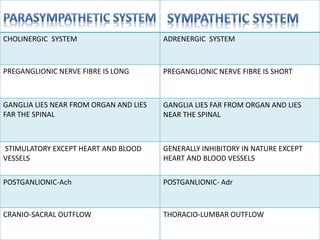
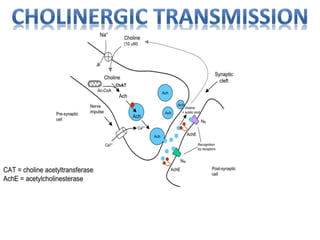
CHOLINERGIC SYSTEM ADRENERGIC SYSTEM
PREGANGLIONIC NERVE FIBRE IS LONG PREGANGLIONIC NERVE FIBRE IS SHORT
GANGLIA LIES NEAR FROM ORGAN AND LIES
FAR THE SPINAL
GANGLIA LIES FAR FROM ORGAN AND LIES
NEAR THE SPINAL
STIMULATORY EXCEPT HEART AND BLOOD
VESSELS
GENERALLY INHIBITORY IN NATURE EXCEPT
HEART AND BLOOD VESSELS
POSTGANLIONIC-Ach POSTGANLIONIC- Adr
CRANIO-SACRAL OUTFLOW THORACIO-LUMBAR OUTFLOW
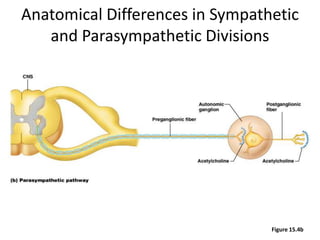
Anatomical Differences in Sympathetic
and Parasympathetic Divisions
Figure 15.4b
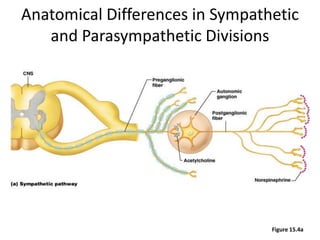
Anatomical Differences in Sympathetic
and Parasympathetic Divisions
Figure 15.4a
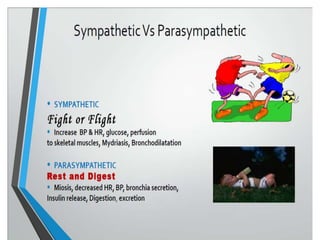
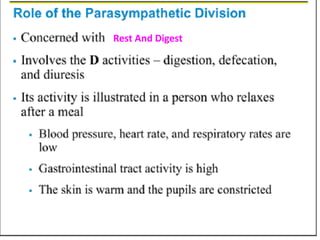
Rest And Digest
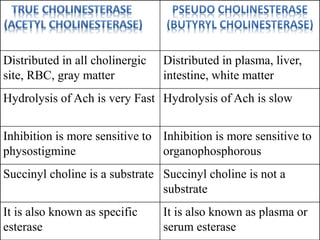
Distributed in all cholinergic
site, RBC, gray matter
Distributed in plasma, liver,
intestine, white matter
Hydrolysis of Ach is very Fast Hydrolysis of Ach is slow
Inhibition is more sensitive to
physostigmine
Inhibition is more sensitive to
organophosphorous
Succinyl choline is a substrate Succinyl choline is not a
substrate
It is also known as specific
esterase
It is also known as plasma or
serum esterase
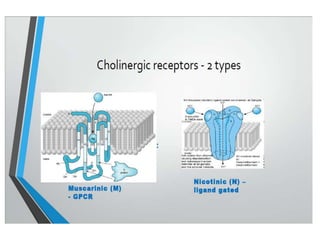
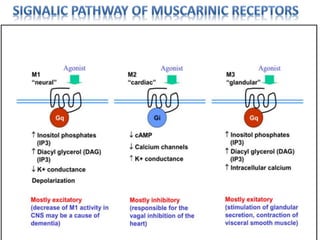
• Muscarinic receptors
– The alkaloid muscarine mimics the actions of
acetylcholine at these receptor sites
– G-protein couple receptor
– Several subtypes: M1, M2, M3, M4, M5
– Associated with various biochemical and
electrophysiological responses
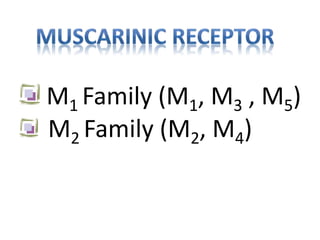
M1 Family (M1, M3 , M5)
M2 Family (M2, M4)
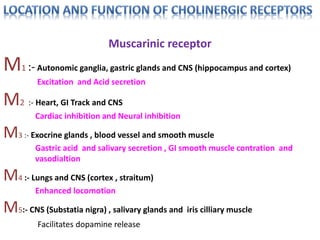
Muscarinic receptor
M1 :- Autonomic ganglia, gastric glands and CNS (hippocampus and cortex)
Excitation and Acid secretion
M2 :- Heart, GI Track and CNS
Cardiac inhibition and Neural inhibition
M3 :- Exocrine glands , blood vessel and smooth muscle
Gastric acid and salivary secretion , GI smooth muscle contration and
vasodialtion
M4 :- Lungs and CNS (cortex , straitum)
Enhanced locomotion
M5:- CNS (Substatia nigra) , salivary glands and iris cilliary muscle
Facilitates dopamine release
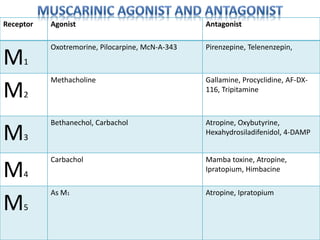
Receptor Agonist Antagonist
M1
Oxotremorine, Pilocarpine, McN-A-343 Pirenzepine, Telenenzepin,
M2
Methacholine Gallamine, Procyclidine, AF-DX-
116, Tripitamine
M3
Bethanechol, Carbachol Atropine, Oxybutyrine,
Hexahydrosiladifenidol, 4-DAMP
M4
Carbachol Mamba toxine, Atropine,
Ipratopium, Himbacine
M5
As M1 Atropine, Ipratopium
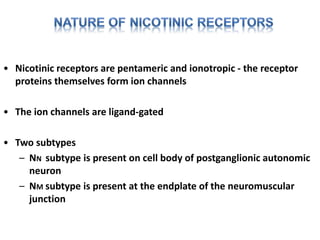
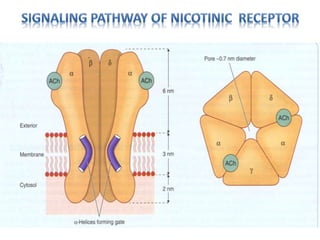
• Nicotinic receptors are pentameric and ionotropic - the receptor
proteins themselves form ion channels
• The ion channels are ligand-gated
• Two subtypes
– NN subtype is present on cell body of postganglionic autonomic
neuron
– NM subtype is present at the endplate of the neuromuscular
junction
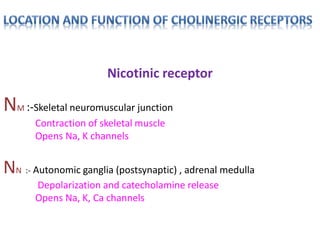
Nicotinic receptor
NM :-Skeletal neuromuscular junction
Contraction of skeletal muscle
Opens Na, K channels
NN :- Autonomic ganglia (postsynaptic) , adrenal medulla
Depolarization and catecholamine release
Opens Na, K, Ca channels
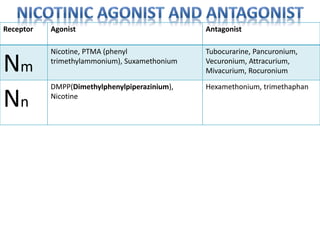
Receptor Agonist Antagonist
Nm
Nicotine, PTMA (phenyl
trimethylammonium), Suxamethonium
Tubocurarine, Pancuronium,
Vecuronium, Attracurium,
Mivacurium, Rocuronium
Nn
DMPP(Dimethylphenylpiperazinium),
Nicotine
Hexamethonium, trimethaphan
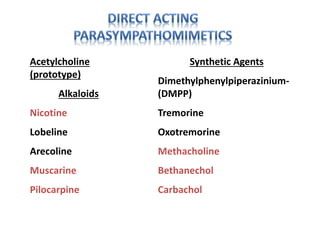
Acetylcholine
(prototype)
Alkaloids
Nicotine
Lobeline
Arecoline
Muscarine
Pilocarpine
Synthetic Agents
Dimethylphenylpiperazinium-
(DMPP)
Tremorine
Oxotremorine
Methacholine
Bethanechol
Carbachol
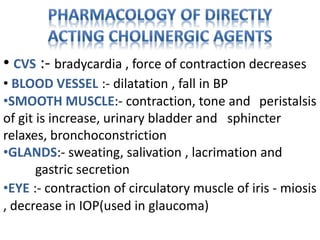
• CVS :- bradycardia , force of contraction decreases
• BLOOD VESSEL :- dilatation , fall in BP
•SMOOTH MUSCLE:- contraction, tone and peristalsis
of git is increase, urinary bladder and sphincter
relaxes, bronchoconstriction
•GLANDS:- sweating, salivation , lacrimation and
gastric secretion
•EYE :- contraction of circulatory muscle of iris - miosis
, decrease in IOP(used in glaucoma)
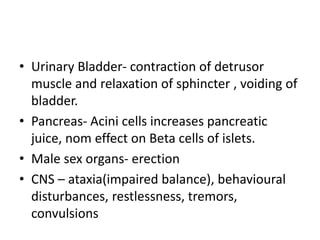
• Urinary Bladder- contraction of detrusor
muscle and relaxation of sphincter , voiding of
bladder.
• Pancreas- Acini cells increases pancreatic
juice, nom effect on Beta cells of islets.
• Male sex organs- erection
• CNS – ataxia(impaired balance), behavioural
disturbances, restlessness, tremors,
convulsions
All above actions are through muscarinic receptors,
now actions through nicotinic receptors
• Adrenal medulla release NE.
• At NMJ, fasciculations(spontaneous
contraction of muscle), spasm of skeletal
muscle. Prolonged activation results in
paralysis.
• Ach is rapidly hydrolyzed and hence ineffective
orally.
•Carbachol ,bethanacol and Methacholine are
absorbed orally and are relatively resistant to
cholinesterase so they have higher duration of
action.
•Methacoline:- diagnosis of
pheochromocytoma(neuroendocrine tumor of
adrenal medulla) , diagnosis of atropine poisoning
•Carbachol:- glaucoma (rarely)
•Bethanachol:- To treat atony of bladder, to treat
salivary gland malfunction
• Acetylcholine- not absorbed if given orally or
s.c.. Rapidly metabolised. Has only one use.
Direct application of Ach drops to the exposed
iris, during surgery produces complete and
prompt and complete miosis for 2 hrs. This
facilitates iridectomy and after removal of lens
in cataract
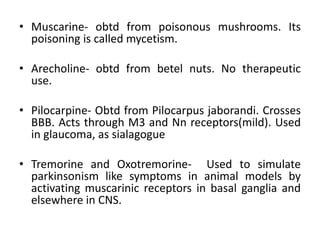
• Muscarine- obtd from poisonous mushrooms. Its
poisoning is called mycetism.
• Arecholine- obtd from betel nuts. No therapeutic
use.
• Pilocarpine- Obtd from Pilocarpus jaborandi. Crosses
BBB. Acts through M3 and Nn receptors(mild). Used
in glaucoma, as sialagogue
• Tremorine and Oxotremorine- Used to simulate
parkinsonism like symptoms in animal models by
activating muscarinic receptors in basal ganglia and
elsewhere in CNS.
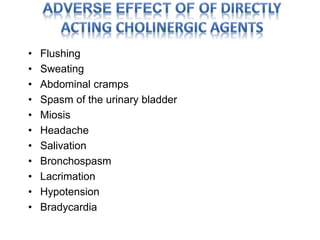
• Flushing
• Sweating
• Abdominal cramps
• Spasm of the urinary bladder
• Miosis
• Headache
• Salivation
• Bronchospasm
• Lacrimation
• Hypotension
• Bradycardia
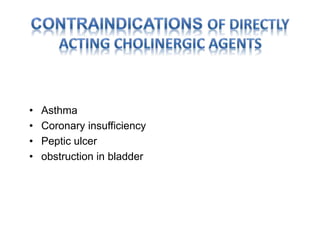
• Asthma
• Coronary insufficiency
• Peptic ulcer
• obstruction in bladder
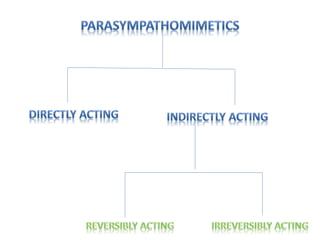
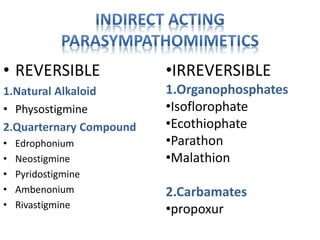
• REVERSIBLE
1.Natural Alkaloid
• Physostigmine
2.Quarternary Compound
• Edrophonium
• Neostigmine
• Pyridostigmine
• Ambenonium
• Rivastigmine
•IRREVERSIBLE
1.Organophosphates
•Isoflorophate
•Ecothiophate
•Parathon
•Malathion
2.Carbamates
•propoxur
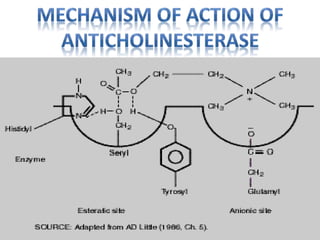
• The anti-chE react with the enzyme essentially in the same
way as Ach.
• The carbamates and phosphates respectively carbamylate
and phosphorylate the esteric site of the enzyme.
• Whereas the acetylated enzyme react with water extremely
rapidly and the esteric site is free in fraction of milisecond,
the carbamylated enzyme (reversible inhibitors) reacts slowly
and the phosphorylated enzyme (irreversible inhibitors)
reacts extremely slowly or not at all.
• It is noteworthy that edrophonium and tacrine (reversible
inhibitors) attach only to the anionic site of the enzyme,
while organophosphates (irreversible inhibitors) attach only
to the esteric site.
• The phosphorylated enzyme may also undergo ‘aging’ by the
loss of one of the alkyl group and become totally resistant to
hydrolysis.
GANGLIA :- They stimulate ganglia through muscarinic
receptors, High doses cause persistant depolarization.
cvs :- complex, muscarinic receptors produce
bradycardia and hypotension, while gangionic stimulation
tends to increase heart rate and BP.
SKELETAL MUSCLE :- Twitching and fasciculation, Higher
doses cause weakness and paralysis.
Other effect:- Stimulation of smooth muscle, GIT,
Respiratory and Urinary tract occur.
• Physostigmine :- rapidly absorbed from GIT and parenteral sites,can
cross BBB.
• Neostigmine and congeners :- poorly absorbed from orally as
compare to parenteral, do not cross BBB, partially hydrolysed and
partially excreted unchanged in urine.
• Organophosphates :- absorbed from all sites including intact skin and
lungs, they are hydrolysed as well oxidised in body and little is
excreted.
• As Miotic
• Glaucoma
• Myasthenia gravis
• Atropine poisoning, drug overdosage
• Curare, belladona poisoning, cobra bite
• Alzheimer’s disease
• Post operative paralytic ileus/urinary retention
Drugs used to in Myasthenia gravis
• Immunosupressants
• Glucorticoids
• Flushing
• Sweating
• Abdominal cramps
• Spasm of the urinary bladder
• Miosis
• Headache
• Salivation
• Bronchospasm
• Hypotension
• Bradycardia
• Asthma
• Coronary insufficiency
• Peptic ulcer
• Are easily available
• Extensively used as agricultural and house hold
insecticides as well as suicidal poisoning is common
• Local muscarinic manifestation at the site of
exposure occurs immediately
• The overdose of anticholinesterase will lead to
overproduction of Ach and that will lead to
poisoning.
•Irritation of EYE
•Lacrimation
•Sweating
•Fall in BP
•Bradycardia
•Weakness
•Respiratory paralysis
•Excitement
•Death may occur due to respiratory paralysis
• Termination of further exposure to the poision –
fresh air, wash the skin and mucus membrane with
soap and water, gastric lavage accordnig to need
• maintain BP , hydration , control of convulsion by
Diazepam
• Specific antidotes:-
1. Atropine:- highly effective in counter acting the
muscarinic symptoms.
• Higher doses are required to antagonise the central
effect
• In all cases, atropine must be promptly given 2 mg
I.v. repeatedly every 10 min till dryness of mouth or
other signs of atropinization appears
• Cholinesterase reactivator :-
• Oximes are used to restore Neuromuscular
transmission in case of organophosphates antichE
poisoning.
• The phophorylated chE reacts very slowly or not at all
with water.
• Pralidoxime (2-PAM) is injected I.v. slowly in dose of 1-
2 gm.
• It causes more marked reactivation of Skeletal muscle.
• Treatment should be started as early as possible before
the phophorylated enzyme has undergo aging and
become resistent to hydrolysis.
• Other oximes are OBIDOXIMES
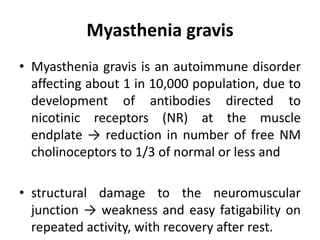
Myasthenia gravis
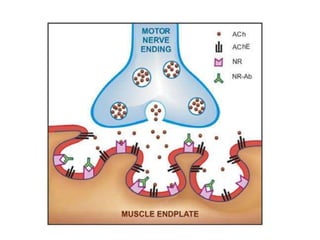
• Myasthenia gravis is an autoimmune disorder
affecting about 1 in 10,000 population, due to
development of antibodies directed to
nicotinic receptors (NR) at the muscle
endplate → reduction in number of free NM
cholinoceptors to 1/3 of normal or less and
• structural damage to the neuromuscular
junction → weakness and easy fatigability on
repeated activity, with recovery after rest.
• Neostigmine and its congeners improve muscle
contraction by allowing ACh released from
prejunctional endings to accumulate and act on
receptors over a larger area, and by directly
depolarizing the endplate.
• Treatment is usually started with neostigmine 15 mg
orally 6 hourly; dose and frequency is then adjusted
according to response.
• Pyridostigmine is an alternative which needs less
frequent dosing. If intolerable muscarinic side effects
are produced, atropine can be added to block them.
• Corticosteroids afford considerable improvement in
such cases by their immunosuppressant action.
• They inhibit production of NR-antibodies and may
increase synthesis of NRs.
• Prednisolone 30–60 mg/day induces remission in
about 80% of the advanced cases; 10 mg daily or on
alternate days can be used for maintenance therapy
• Other immunosuppressants have also been used
with benefit in advanced cases. Both azathioprine
and cyclosporine also inhibit NR-antibody synthesis
by affecting T-cells,
• Myasthenic crisis is characterized by acute
weakness of respiratory muscles.
• It is managed by tracheal intubation and
mechanical ventilation.
• Generally, i.v. methylprednisolone pulse
therapy is given while anti-ChEs are withheld
for 2–3 days
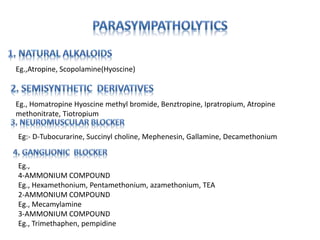
Eg.,Atropine, Scopolamine(Hyoscine)
Eg., Homatropine Hyoscine methyl bromide, Benztropine, Ipratropium, Atropine
methonitrate, Tiotropium
Eg:- D-Tubocurarine, Succinyl choline, Mephenesin, Gallamine, Decamethonium
Eg.,
4-AMMONIUM COMPOUND
Eg., Hexamethonium, Pentamethonium, azamethonium, TEA
2-AMMONIUM COMPOUND
Eg., Mecamylamine
3-AMMONIUM COMPOUND
Eg., Trimethaphen, pempidine
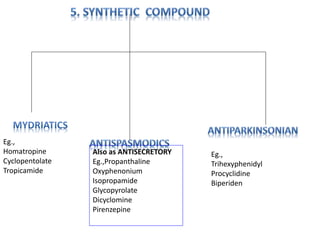
Eg.,
Homatropine
Cyclopentolate
Tropicamide
Also as ANTISECRETORY
Eg.,Propanthaline
Oxyphenonium
Isopropamide
Glycopyrolate
Dicyclomine
Pirenzepine
Eg.,
Trihexyphenidyl
Procyclidine
Biperiden
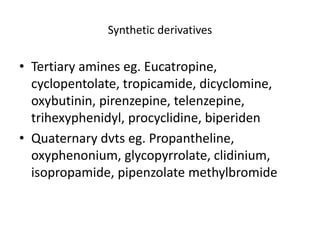
Synthetic derivatives
• Tertiary amines eg. Eucatropine,
cyclopentolate, tropicamide, dicyclomine,
oxybutinin, pirenzepine, telenzepine,
trihexyphenidyl, procyclidine, biperiden
• Quaternary dvts eg. Propantheline,
oxyphenonium, glycopyrrolate, clidinium,
isopropamide, pipenzolate methylbromide
• 4th new group under synthetics are
Vasicoselective eg. Oxybutynin, Flavoxate,
Tolterodine, darifenacin
They act on bladder ti inhibit micturition and
are used for treating incontinence, produce
less side effects.
Uses- neurogenic bladder, spina bifida,
nocturnal enuresis.
• Semisynthetic derivative of Atropine alkaloid and large no.
of synthetic compound have been introduce with the aim
of producing more selective actions on certain functions
• Most of these differ only marginally from the natural
alkaloids, but some recent ones are promising.
• Drugs in this category are :
• hyoscine butylbromide , atropine methonitrate,
ipratropium bromide, clidinium, isopropamide,
oxiphenonium, glycopyrolate
Other groups possessing anti-muscarinic effects
• Antihistamines , antipsychotics, tricyclic
antidepressants
• M/A:- Atropine and scopolamine block
muscarinic receptors
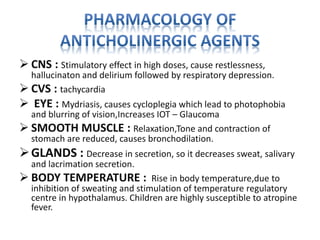
 CNS : Stimulatory effect in high doses, cause restlessness,
hallucinaton and delirium followed by respiratory depression.
 CVS : tachycardia
 EYE : Mydriasis, causes cycloplegia which lead to photophobia
and blurring of vision,Increases IOT – Glaucoma
 SMOOTH MUSCLE : Relaxation,Tone and contraction of
stomach are reduced, causes bronchodilation.
GLANDS : Decrease in secretion, so it decreases sweat, salivary
and lacrimation secretion.
 BODY TEMPERATURE : Rise in body temperature,due to
inhibition of sweating and stimulation of temperature regulatory
centre in hypothalamus. Children are highly susceptible to atropine
fever.
• Genitourinary tract:- muscles are relaxed,
voiding is slowed ( urinary retention)
• Local anesthetics:- atropine has mild
anesthetic action on cornea.
Atropine and hyoscine are rapidly absorbed
from GIT, applies to eyes as they freely
penetrate cornea, passage across blood brain
barrier is somewhat restricted.
About 50% of atropine is metabolized in liver
and rest is excreted unchanged in urine, has
half life of about 3-4 hrs.
Hyoscine is more completely metabolized and
has better blood brain barier penetration
• Black rabbits are resistant to atropine actions
because they possess atropine esterase which
degrades atropine atv faster rate than in
humans.
 As Preanaesthetic medication(reduce secretions,prevent vagal
effects)
 Peptic uicer
 As antispasmodic
 Bronchial asthma and COPD
 Pulmonary embolism- reduce reflex secretions
 As mydriatic and cycloplegic. Alternated with miotics to
prevent adhesions in inflammed eyes.
 Parkinsonism
 Motion sickness
 Renal colics, ureteral smooth muscle spasm. To improve
bladder capacity . Eg. Dicyclomine and oxybutinin.
• Hyperhydrosis treated with antimuscarinics.
• Hyoscine- produce sedation and amnesia during
labour(twilight sleep), control maniac states, its
amnesic and depressant action puts the subject ‘off
guard’ in the face of sustained interrogation and
sleep deprivation , so that he came out with truth,
reputed as “lie detector’.
• Miscellaneous uses of atropine:-
treatment of mushroom poisoning,
treatment of muscarinic side effects of neostigmine
during management of myasthenia gravis,
treatment of organophosphorus poisoning along
with Pralidoxime.
 Atropine poisoning
 Dry mouth
 Blurred vision
 Slurred speech
 Urinary retension
 Fever
 Difficult in micturition
 Photophobia
 Palpitation
 Hallucination
 Convulsion in severe poisoning
 Narrow angle glaucoma
 Atony of the bladder
 Atony of the G.I. Tract
 With the emergence of five M receptors subtypes
( M1-M5), a search is directed towards the development of
subtypes selective agonists.
 Newer agents lack unwanted concomitant agonist action on
presynaptic M receptor and hence they do not inhibit the
release of endogenous Ach.
 Such selective post synaptic M receptors agonists are now
under clinical trials for use in treating Alzheimer’s disease.
 It is believe that progressive dementia observed with
Alzheimer’s disease due to dearrangement of cholinergic
transmission in subcortical area of brain.
 Maximise ratio of central to peripheral AchE inhibition.
 Tacrine is new Anti-AchE used for treatment of Alzheimer’s
disease because it is orally active, enters in CNS readily and
blocks acetyl as well as butyryl cholinesterase and has
duration of action lasting for 6 to 8 hours. But drawback of
this drug is, it causes hepatotoxicity.
 Donepeziil is newer Anti-AchE with good penetration into
CNS, the drug has excellent bioavailability and has longer
half life of about 70 hrs and lacks hepatotoxicity.
 Rivastigmine and Galantamine has recently been approved
for use in Europe and USA, its therapeutic uses and side
effects are similar to that of donepeziil, except that
rivastigmine is longer acting than galantamine.
 Donepezil and Rivastigmine both are now available in India
for treatment of Alzheimer’s disease.
 Certain selective presynaptic M2 auto receptors antagonist
useful in Alzheimer’s disease as they enhance the release of
Ach in brain.
 Nicotinic and Muscarinic agonists are in clinical development
for treatment of AD.
 M2 receptors agonist has been found to be useful in epilepsy
because their action is inhibitory in CNS
 Nicotinic receptors may also provide target for Epilepsy.
 Newer M2 selective antagonist i.e. tripitamine may prove
useful in treating Vagal bradycardia.
 M3 selective antagonist i.e. darifenacin was found useful in
smooth muscle or glandular overacting disorder. Tried for
overactive bladder and irritable bowel syndrome.
 Trospium a quaternary amine, for overactive bladder.
 Solifenacin, for overactive bladder, with favourable efficacy :
ADR ratio
 Selective M3 receptor agonists tried to treat erectile
dysfunction.
• Duloxetin used to treat stress urinary incontinence, that acts
centrally to influence serotonin and nor-adrenaline levels.
• Cevimeline is a muscarinic agonist that is an Food and Drug
Administration (FDA)-approved drug and used for the
management of dry mouth in SjĂśgren's syndrome
• For organ selectivity, to avoid side effects, new
methods of drug delivery like instillation into
eyes or inhalation into lungs (COPD).
• Sildenafil and related drugs inhibit
degradation of cGMP by type V PDE , thereby
potentiate vasodilative action of Ach in penis
and other tissues. Used to treat male erectile
dysfunction.
• Goodman & Gilman’s The pharmacological basis of
therapeutics, 9th edition
• Pharmacology Fifth Edition, 2003, H.P. Rang, M. M.
Dale
• K.D. Tripathi’s essential of medical pharmacology 6
th edition
• HL sharma and KK sharma’s principle of
pharmacology , first edition
DRUGS ACTING ON AUTONOMIC
GANGLIA