DAVID TRYSON TEMBO, PhD
MUBAS, PBS, MALAWI
1
PBS-FCH-311
FOOD COLLOIDS
Lecture overview
• Definitions: Colloid, phase, and colloidal
systems
• Food Colloids - classification
• Emulsions and emulsifiers
• Sols and gels
• Foams
Learning outcomes
• At the end of this session, you should be able to:
– Describe what gels, emulsions and foams are and
give food examples of each
– Link key drivers and quality parameters (texture) to
the structure of a number of food products
– Discuss the functionality of phospholipids and
proteins in the structure and texture of emulsions
and foams
What is a colloid?
"A colloid is a dispersion of large
molecules through a continuous phase"
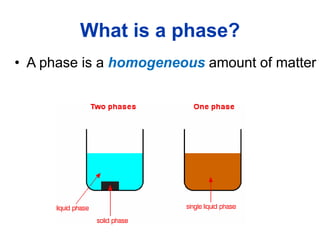
What is a phase?
• A phase is a homogeneous amount of matter
Colloidal Systems
• Colloidal system: made up of large molecules of a
substance dispersed in a continuous phase
Think of it as "the container and the contained"
• The continuous phase (container) can be
• Liquid
• Solid
• The disperse phase (contained) may be:
• Solid
• Liquid
• Gaseous
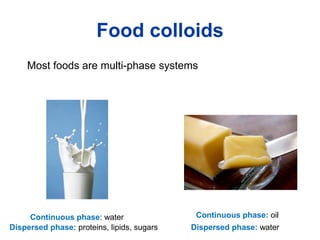
Food colloids
Continuous phase: water
Dispersed phase: proteins, lipids, sugars
Continuous phase: oil
Dispersed phase: water
Most foods are multi-phase systems
Food colloids
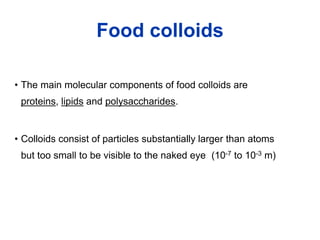
• The main molecular components of food colloids are
proteins, lipids and polysaccharides.
• Colloids consist of particles substantially larger than atoms
but too small to be visible to the naked eye (10-7 to 10-3 m)
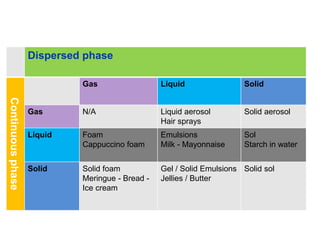
• Colloid: any substance consisting of
particles substantially larger than atoms or
ordinary molecules but too small to be
visible to the unaided eye (10-7 to 10-3 m)
Dispersed phase
Continuous
phase
Gas Liquid Solid
Gas N/A Liquid aerosol
Hair sprays
Solid aerosol
Liquid Foam
Cappuccino foam
Emulsions
Milk - Mayonnaise
Sol
Starch in water
Solid Solid foam
Meringue - Bread -
Ice cream
Gel / Solid Emulsions
Jellies / Butter
Solid sol
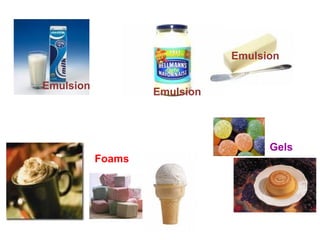
Emulsion
Foams
Gels
Emulsion
Emulsion
Solutions, dispersion and
suspension
Solution: the dissolved substance is < 1 nm (10-9 m) in
size (e.g. sucrose solution): not a colloid
SIZE!
Dispersion: the particles are between 1 nm and
1 m in size (e.g. proteins, starch)
Suspension, if the particles are > 1 m (10-6 m)
in size (e.g. flour in cold water)
Emulsions
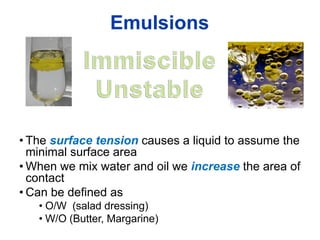
• The surface tension causes a liquid to assume the
minimal surface area
• When we mix water and oil we increase the area of
contact
• Can be defined as
• O/W (salad dressing)
• W/O (Butter, Margarine)
Emulsions
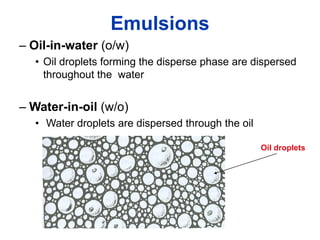
– Oil-in-water (o/w)
• Oil droplets forming the disperse phase are dispersed
throughout the water
– Water-in-oil (w/o)
• Water droplets are dispersed through the oil
Oil droplets
Destabilized emulsions
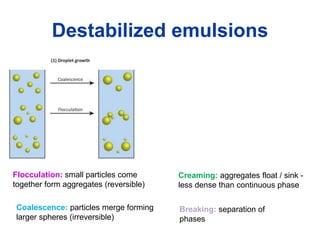
Flocculation: small particles come
together form aggregates (reversible)
Coalescence: particles merge forming
larger spheres (irreversible)
Creaming: aggregates float / sink -
less dense than continuous phase
Breaking: separation of
phases
Emulsifiers
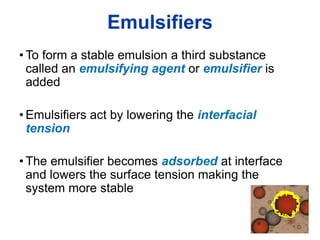
• To form a stable emulsion a third substance
called an emulsifying agent or emulsifier is
added
• Emulsifiers act by lowering the interfacial
tension
• The emulsifier becomes adsorbed at interface
and lowers the surface tension making the
system more stable
Emulsifiers
• Emulsifier molecules contain a hydrophilic and a
hydrophobic group
– The hydrophillic group is polar and is attracted to water
– The hydrophobic group is non-polar and is attached to
the oil
Hydrophillic
group
Hydrophobic
group
Nature of the emulsion
• The type of emulsion formed depends on a
number of factors:
– composition of oil and water phase
– proportions of oil and water
– chemical nature of emulsifier
• HLB (hydrophilic-lipophilic balance) is used to
choose a suitable emulsifier
Natural emulsifiers
• Phospholipids
– Lecithin (HLB values 4 to 9)
• Proteins
– Casein in milk
• Carbohydrates
– Acacia gum in fizzy drinks
Proteins as emulsifiers
• Diffusion to the interface
• Energy of the system is lowered by
– Having hydrophobic parts of the molecule
sticking into the organic (oil) phase
– The hydrophilic part remaining in the aqueous
phase
– Adsorption occurs, protein is denatured Water
Oil
Artificial emulsifier
• Glycerol monostearate (GMS)
– E471
Hydrophilic
Hydrophobic
Food emulsions
Example Type Main emulsifiers
Milk, Cream o/w Proteins (casein)
Butter w/o Proteins (casein)
Mayonnaise, Salad
cream
o/w Egg-yolk (lecithin), GMS, mustard
Margarine w/o Proteins (casein), lecithin, GMS
Ice cream o/w Proteins (casein), GMS plus stabilisers
(gums, alginates)
Strategies for low fat products
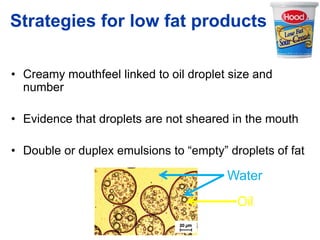
• Creamy mouthfeel linked to oil droplet size and
number
• Evidence that droplets are not sheared in the mouth
• Double or duplex emulsions to “empty” droplets of fat
Water
Oil
Sols and Gels
• A sol is a solid in a liquid (e.g. starch in warm water)
– The dispersed phase is formed by high MW molecules
(e.g. starch, protein)
– A sol can set to a gel if the concentration of DP is high
enough
• A gel is a liquid in a solid (e.g. jellies, jams, custard)
– The liquid phase (e.g. water and dissolved solids) is
dispersed in a solid network of polymer chains (high
MW molecules) such as gelatine, pectin, gums, starches,
which 'trap' the liquid
– They have stable structures and retain their shape
Gels - Gelatine
Gelatine forms thermo-reversible gels
Insoluble in cold water
Soluble in hot water
Stabilisers
• Prevent coalescence, creaming,
flocculation or breaking by increasing the
viscosity
– Pectins
– Starch
– Alginate
Gels – Starch - Alginate –
Carrageenan – Pectin
• Technological aims:
– Increase viscosity: creaminess / mouthfeel
– Improve freeze / thaw stability
– Increase water retention
• Thickeners
• Ferran Adrià
– Liquid olives
http://youtu.be/gKWgmx0kc1A
Foams
•Liquid Foam
• Gas dispersed in liquid
• e.g. whipped cream, beaten egg-white
•Solid Foam
• Gas dispersed in a solid
• e.g. ice cream, marshmallows
•Foams consist of an agglomeration of gas
bubbles separated by thin films
Foams
• Critical for product quality
– Ice cream / Cappuccino / Bread
• Aeration can be achieved by:
– whipping air in
– chemical reaction produces gas e.g. baking
powder produces CO2
– yeasts ferment food (sugar) to produce CO2
Foaming agents
• Foaming agents are required in order for
the foam to remain intact.
• They form a cohesive, deformable film
around the air bubbles.
• Similar mechanism as for emulsions
– Decrease surface tension
Foaming agents
• Proteins:
– Absorption at the interface, denaturation
• Cellulose derivatives
– CMC (carboxymethyl cellulose)
SDS
Foam stability and protein
iso-electric point
• Foam stability is enhanced when pH is
close to the i.p. of the proteins
– The proteins readily denature
• Lower the pH to reach the isoelectric point
– small amounts of acidic materials (e.g. lemon juice,
cream of tartar or vinegar) can be used to lower pH
Foamed foods
• Bread, ice-cream, whipped cream…
• Mint gazpacho with bacon and mushroom
foam
Structure in relation to sensory
properties
Food Structure
• Droplet size
• Droplet number
• Emulsifier type
• Viscosity
• Macromolecule type
• …..
Oral Processing
• Mechanical process
• Enzymes
• Chemical process
• Temperature
Sensory Properties
• Hardness
• Brittleness
• Viscosity
• Gumminess
• Chewiness
• Adhesiveness
• Grittiness
• Mouth coating
QUIZ
Take a paper (can be very small);
do NOT write your name on it
1. In a solution, the substance that is being dissolved
is called?
a. solvent
b. emulsifier
c. solute
d. filtrate
2. An example of a colloid which is an
emulsion:
a. Whipped cream
b. Mayonnaise
c. Gelatin
d. Black coffee
3. A glycerol backbone with 1 or 2 fatty acids plus another
group, possibly a phosphorous group produce?
a. sterol
b. trans fatty acid
c. phosphoric acid group
d. phospholipid
4. Which of the following is NOT an emulsifier:
a. triglyceride
b. bile acids
c. lecithin
d. monoglyceride
Answers
Swap papers with the person next
to you
1. In a solution, the substance that is being dissolved
is called?
a. solvent
b. emulsifier
c. solute
d. filtrate
2. An example of a colloid which is an
emulsion:
a. Whipped cream
b. Mayonnaise
c. Gelatin
d. Wine
3. A glycerol backbone with 1 or 2 fatty acids plus another
group, possibly a phosphorous group produce?
a. sterol
b. trans fatty acid
c. phosphoric acid group
d. phospholipid
4. Which of the following is NOT an emulsifier:
a. triglyceride
b. bile acids
c. lecithin
d. monoglyceride
Take Away Message
• Colloids are important structures which
are found in foods.
• Emulsions are mixtures of immiscible
liquids which constitute a major groups
of food products.
• Foams are mixtures of gases in a
continuous solid or liquid phase.
• Understanding colloid behaviour
enables technologist to alter the
properties of food products.
Further Reading
• Dickinson, Eric (1987) Food emulsions
and Foams, Royal Society of Chemistry.
London.

Food Colloids: PHASES; COLLOIDAL;CLASSES

  • 1.
    DAVID TRYSON TEMBO,PhD MUBAS, PBS, MALAWI 1 PBS-FCH-311 FOOD COLLOIDS
  • 2.
    Lecture overview • Definitions:Colloid, phase, and colloidal systems • Food Colloids - classification • Emulsions and emulsifiers • Sols and gels • Foams
  • 3.
    Learning outcomes • Atthe end of this session, you should be able to: – Describe what gels, emulsions and foams are and give food examples of each – Link key drivers and quality parameters (texture) to the structure of a number of food products – Discuss the functionality of phospholipids and proteins in the structure and texture of emulsions and foams
  • 4.
    What is acolloid? "A colloid is a dispersion of large molecules through a continuous phase"
  • 5.
    What is aphase? • A phase is a homogeneous amount of matter
  • 6.
    Colloidal Systems • Colloidalsystem: made up of large molecules of a substance dispersed in a continuous phase Think of it as "the container and the contained" • The continuous phase (container) can be • Liquid • Solid • The disperse phase (contained) may be: • Solid • Liquid • Gaseous
  • 7.
    Food colloids Continuous phase:water Dispersed phase: proteins, lipids, sugars Continuous phase: oil Dispersed phase: water Most foods are multi-phase systems
  • 8.
    Food colloids • Themain molecular components of food colloids are proteins, lipids and polysaccharides. • Colloids consist of particles substantially larger than atoms but too small to be visible to the naked eye (10-7 to 10-3 m)
  • 9.
    • Colloid: anysubstance consisting of particles substantially larger than atoms or ordinary molecules but too small to be visible to the unaided eye (10-7 to 10-3 m) Dispersed phase Continuous phase Gas Liquid Solid Gas N/A Liquid aerosol Hair sprays Solid aerosol Liquid Foam Cappuccino foam Emulsions Milk - Mayonnaise Sol Starch in water Solid Solid foam Meringue - Bread - Ice cream Gel / Solid Emulsions Jellies / Butter Solid sol
  • 10.
  • 11.
    Solutions, dispersion and suspension Solution:the dissolved substance is < 1 nm (10-9 m) in size (e.g. sucrose solution): not a colloid SIZE! Dispersion: the particles are between 1 nm and 1 m in size (e.g. proteins, starch) Suspension, if the particles are > 1 m (10-6 m) in size (e.g. flour in cold water)
  • 12.
    Emulsions • The surfacetension causes a liquid to assume the minimal surface area • When we mix water and oil we increase the area of contact • Can be defined as • O/W (salad dressing) • W/O (Butter, Margarine)
  • 13.
    Emulsions – Oil-in-water (o/w) •Oil droplets forming the disperse phase are dispersed throughout the water – Water-in-oil (w/o) • Water droplets are dispersed through the oil Oil droplets
  • 14.
    Destabilized emulsions Flocculation: smallparticles come together form aggregates (reversible) Coalescence: particles merge forming larger spheres (irreversible) Creaming: aggregates float / sink - less dense than continuous phase Breaking: separation of phases
  • 15.
    Emulsifiers • To forma stable emulsion a third substance called an emulsifying agent or emulsifier is added • Emulsifiers act by lowering the interfacial tension • The emulsifier becomes adsorbed at interface and lowers the surface tension making the system more stable
  • 16.
    Emulsifiers • Emulsifier moleculescontain a hydrophilic and a hydrophobic group – The hydrophillic group is polar and is attracted to water – The hydrophobic group is non-polar and is attached to the oil Hydrophillic group Hydrophobic group
  • 17.
    Nature of theemulsion • The type of emulsion formed depends on a number of factors: – composition of oil and water phase – proportions of oil and water – chemical nature of emulsifier • HLB (hydrophilic-lipophilic balance) is used to choose a suitable emulsifier
  • 18.
    Natural emulsifiers • Phospholipids –Lecithin (HLB values 4 to 9) • Proteins – Casein in milk • Carbohydrates – Acacia gum in fizzy drinks
  • 19.
    Proteins as emulsifiers •Diffusion to the interface • Energy of the system is lowered by – Having hydrophobic parts of the molecule sticking into the organic (oil) phase – The hydrophilic part remaining in the aqueous phase – Adsorption occurs, protein is denatured Water Oil
  • 20.
    Artificial emulsifier • Glycerolmonostearate (GMS) – E471 Hydrophilic Hydrophobic
  • 21.
    Food emulsions Example TypeMain emulsifiers Milk, Cream o/w Proteins (casein) Butter w/o Proteins (casein) Mayonnaise, Salad cream o/w Egg-yolk (lecithin), GMS, mustard Margarine w/o Proteins (casein), lecithin, GMS Ice cream o/w Proteins (casein), GMS plus stabilisers (gums, alginates)
  • 22.
    Strategies for lowfat products • Creamy mouthfeel linked to oil droplet size and number • Evidence that droplets are not sheared in the mouth • Double or duplex emulsions to “empty” droplets of fat Water Oil
  • 23.
    Sols and Gels •A sol is a solid in a liquid (e.g. starch in warm water) – The dispersed phase is formed by high MW molecules (e.g. starch, protein) – A sol can set to a gel if the concentration of DP is high enough • A gel is a liquid in a solid (e.g. jellies, jams, custard) – The liquid phase (e.g. water and dissolved solids) is dispersed in a solid network of polymer chains (high MW molecules) such as gelatine, pectin, gums, starches, which 'trap' the liquid – They have stable structures and retain their shape
  • 24.
    Gels - Gelatine Gelatineforms thermo-reversible gels Insoluble in cold water Soluble in hot water
  • 25.
    Stabilisers • Prevent coalescence,creaming, flocculation or breaking by increasing the viscosity – Pectins – Starch – Alginate
  • 26.
    Gels – Starch- Alginate – Carrageenan – Pectin • Technological aims: – Increase viscosity: creaminess / mouthfeel – Improve freeze / thaw stability – Increase water retention • Thickeners • Ferran Adrià – Liquid olives http://youtu.be/gKWgmx0kc1A
  • 27.
    Foams •Liquid Foam • Gasdispersed in liquid • e.g. whipped cream, beaten egg-white •Solid Foam • Gas dispersed in a solid • e.g. ice cream, marshmallows •Foams consist of an agglomeration of gas bubbles separated by thin films
  • 28.
    Foams • Critical forproduct quality – Ice cream / Cappuccino / Bread • Aeration can be achieved by: – whipping air in – chemical reaction produces gas e.g. baking powder produces CO2 – yeasts ferment food (sugar) to produce CO2
  • 29.
    Foaming agents • Foamingagents are required in order for the foam to remain intact. • They form a cohesive, deformable film around the air bubbles. • Similar mechanism as for emulsions – Decrease surface tension
  • 30.
    Foaming agents • Proteins: –Absorption at the interface, denaturation • Cellulose derivatives – CMC (carboxymethyl cellulose) SDS
  • 31.
    Foam stability andprotein iso-electric point • Foam stability is enhanced when pH is close to the i.p. of the proteins – The proteins readily denature • Lower the pH to reach the isoelectric point – small amounts of acidic materials (e.g. lemon juice, cream of tartar or vinegar) can be used to lower pH
  • 32.
    Foamed foods • Bread,ice-cream, whipped cream… • Mint gazpacho with bacon and mushroom foam
  • 33.
    Structure in relationto sensory properties Food Structure • Droplet size • Droplet number • Emulsifier type • Viscosity • Macromolecule type • ….. Oral Processing • Mechanical process • Enzymes • Chemical process • Temperature Sensory Properties • Hardness • Brittleness • Viscosity • Gumminess • Chewiness • Adhesiveness • Grittiness • Mouth coating
  • 34.
    QUIZ Take a paper(can be very small); do NOT write your name on it
  • 35.
    1. In asolution, the substance that is being dissolved is called? a. solvent b. emulsifier c. solute d. filtrate 2. An example of a colloid which is an emulsion: a. Whipped cream b. Mayonnaise c. Gelatin d. Black coffee
  • 36.
    3. A glycerolbackbone with 1 or 2 fatty acids plus another group, possibly a phosphorous group produce? a. sterol b. trans fatty acid c. phosphoric acid group d. phospholipid 4. Which of the following is NOT an emulsifier: a. triglyceride b. bile acids c. lecithin d. monoglyceride
  • 37.
    Answers Swap papers withthe person next to you
  • 38.
    1. In asolution, the substance that is being dissolved is called? a. solvent b. emulsifier c. solute d. filtrate 2. An example of a colloid which is an emulsion: a. Whipped cream b. Mayonnaise c. Gelatin d. Wine
  • 39.
    3. A glycerolbackbone with 1 or 2 fatty acids plus another group, possibly a phosphorous group produce? a. sterol b. trans fatty acid c. phosphoric acid group d. phospholipid 4. Which of the following is NOT an emulsifier: a. triglyceride b. bile acids c. lecithin d. monoglyceride
  • 40.
    Take Away Message •Colloids are important structures which are found in foods. • Emulsions are mixtures of immiscible liquids which constitute a major groups of food products. • Foams are mixtures of gases in a continuous solid or liquid phase. • Understanding colloid behaviour enables technologist to alter the properties of food products.
  • 41.
    Further Reading • Dickinson,Eric (1987) Food emulsions and Foams, Royal Society of Chemistry. London.