Tools for problem indentification and analysis:
Collaborative working and the problem tree
Remember yesterday?
• The value of integrated approaches
• The challenges of integrated approaches
• The key role of collaboration in the process
• The need to indentify the real causes of problems
• Design integrated solutions and prioritize
Agenda for this morning
• How to work collaboratively? What are key issues? How
can one improve?
• Tools for problem identification
• What are some available tools?
• Problem tree analysis
• Solution tree and prioritization
• Exercises in groups and feedback
How to work collaboratively?
• Miles, E. and Trott, W. (2011), Collaborative Working: A series of
personal perspectives on government effectiveness. Institute for
Government, London. (Executive summary; chapter 2; box 9)
• Critical success factors for collaborative working within
and outside the public sector
• Grassroots view
• Factors proved relevant across different contexts and
projects
• Queries and check lists
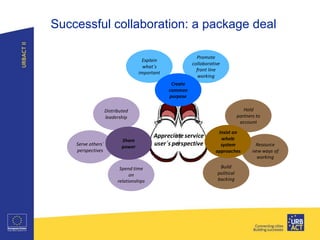
Successful collaboration: a package deal
Promote
collaborative
front line
working
Explain
what´s
important
Appreciateservice
user´s perspective
Create
common
purpose
Resource
new ways of
working
Hold
partners to
account
Build
political
backing
Insist on
whole
system
approaches
Spend time
on
relationships
Serve others´
perspectives
Distributed
leadership
Share
power
Sharing power: the hardest challenge
• “ Not knowing” and “letting go” in tandem with whole
system approach
Appreciateservice
user´sperspective
Distributed
leadership
Serve others´
perspectives
Spend time on
relationships
Share
power
Challenges
• Power struggles
• Competition
• Lack of time
• Changes in leadership
• Impatience
• Culture don't change in one day, but it is worth the try
Further readings
On the integrative approach
• European Union (2013), Urban Development in the EU: 50 Projects supported by
the European Regional Development Fund during the 2007-13 period.
Luxembourg: Publications Office of the European Union.
• Pieterse, E. (2004), Untangling „integration‟ in urban development policy debates,
Urban Forum, Volume 15, Issue 1, pp 1-35.
• Pike, A., Rodriguez-Pose, A. and Tomaney, J. (2006), Local and Regional
Development (Part I and part IV). Abingdon: Routledge.
On methods and tools
• Victorian Local Sustainability Accord and National Centre for Sustainability at
Swinburne University of Technology, Community Sustainability Engagement –
Evaluation Toolbox.
• Kimbell, L., and Julier, J. (2012), The Social Design Methods Menu, Fieldstudio
Ltd, London.
Tools for problems identification and analysis: Collaborative working and the problem tree

Tools for problems identification and analysis: Collaborative working and the problem tree

  • 1.
    Tools for problemindentification and analysis: Collaborative working and the problem tree
  • 2.
    Remember yesterday? • Thevalue of integrated approaches • The challenges of integrated approaches • The key role of collaboration in the process • The need to indentify the real causes of problems • Design integrated solutions and prioritize
  • 3.
    Agenda for thismorning • How to work collaboratively? What are key issues? How can one improve? • Tools for problem identification • What are some available tools? • Problem tree analysis • Solution tree and prioritization • Exercises in groups and feedback
  • 4.
    How to workcollaboratively? • Miles, E. and Trott, W. (2011), Collaborative Working: A series of personal perspectives on government effectiveness. Institute for Government, London. (Executive summary; chapter 2; box 9) • Critical success factors for collaborative working within and outside the public sector • Grassroots view • Factors proved relevant across different contexts and projects • Queries and check lists
  • 5.
    Successful collaboration: apackage deal Promote collaborative front line working Explain what´s important Appreciateservice user´s perspective Create common purpose Resource new ways of working Hold partners to account Build political backing Insist on whole system approaches Spend time on relationships Serve others´ perspectives Distributed leadership Share power
  • 6.
    Sharing power: thehardest challenge • “ Not knowing” and “letting go” in tandem with whole system approach Appreciateservice user´sperspective Distributed leadership Serve others´ perspectives Spend time on relationships Share power
  • 7.
    Challenges • Power struggles •Competition • Lack of time • Changes in leadership • Impatience • Culture don't change in one day, but it is worth the try
  • 8.
    Further readings On theintegrative approach • European Union (2013), Urban Development in the EU: 50 Projects supported by the European Regional Development Fund during the 2007-13 period. Luxembourg: Publications Office of the European Union. • Pieterse, E. (2004), Untangling „integration‟ in urban development policy debates, Urban Forum, Volume 15, Issue 1, pp 1-35. • Pike, A., Rodriguez-Pose, A. and Tomaney, J. (2006), Local and Regional Development (Part I and part IV). Abingdon: Routledge. On methods and tools • Victorian Local Sustainability Accord and National Centre for Sustainability at Swinburne University of Technology, Community Sustainability Engagement – Evaluation Toolbox. • Kimbell, L., and Julier, J. (2012), The Social Design Methods Menu, Fieldstudio Ltd, London.