Transitions to Sustainability
and the role of policy

Prof. Dr. Derk Loorbach
Brussels, 03-12-2013
DRIFT
• Dutch Research Institute For Transitions, Rotterdam with
18 action researchers
• Established 2004 as part of the national transition research
program KSI
• Action/activist research institute; (international)
fundamental and applied research, consultancy,
academic/postgraduate education

• STRN: 600+ members globally
Program of thissession
• Introductiontosustainabilitytransitionsandtrans
ition management
• Examples of urbantransition management
• Group exercises: building blocksfortransition

• Synthesis: the transitionnarrative
12-12-2013

Afvalwaterketen - fabrieken
SUSTAINABILITYTRANSITIONS?
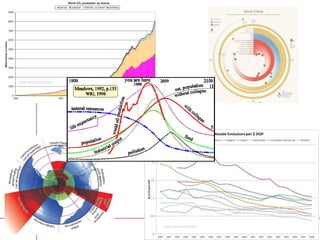
Persistent unsustainability
• Current socio-economic systems are inherently
unsustainable
– Economically, ecologically and socially

• But they are also heavily path-dependent
– Locked in technologically, economically and culturally

• Incremental improvement is not enough and CO2 is only
one of the problems
– Sub-optimization often only strengthens lock-in
Systemic destabilisation
• The foundations underlying historical modernization are at
the end of their life-cycle
– Growth, efficiency, specialisation, optimisation

• Unpredictable and shockwise change seems inevitable
– Just like in historical transitions

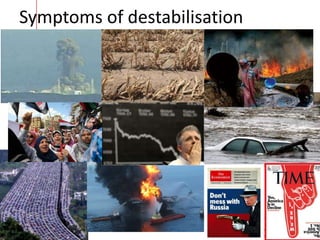
• Current crises are symptoms of non-linear systemic shifts
happening
– We need to consider these as windows of opportunity for major
change towards sustainability
Symptoms of destabilisation
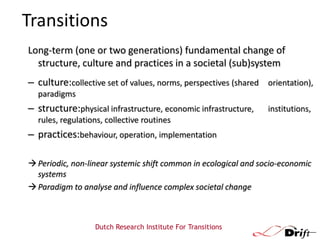
Transitions
Long-term (one or two generations) fundamental change of
structure, culture and practices in a societal (sub)system

– culture:collective set of values, norms, perspectives (shared orientation),
paradigms

– structure:physical infrastructure, economic infrastructure,

institutions,

rules, regulations, collective routines

– practices:behaviour, operation, implementation
 Periodic, non-linear systemic shift common in ecological and socio-economic
systems
 Paradigm to analyse and influence complex societal change

Dutch Research Institute For Transitions
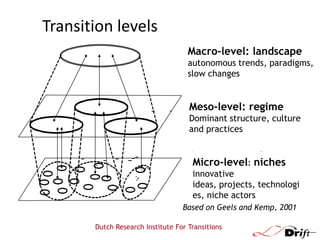
Transition levels
Macro-level: landscape
autonomous trends, paradigms,
slow changes

Meso-level: regime
Dominant structure, culture
and practices

Micro-level: niches
innovative
ideas, projects, technologi
es, niche actors
Based on Geels and Kemp, 2001
Dutch Research Institute For Transitions
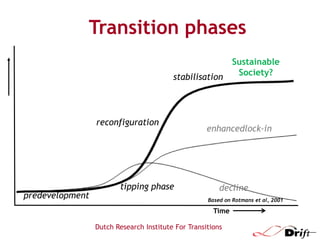
Transition phases
stabilisation

reconfiguration

predevelopment

tipping phase

Sustainable
Society?

enhancedlock-in

decline
Based on Rotmans et al, 2001

Time
Dutch Research Institute For Transitions
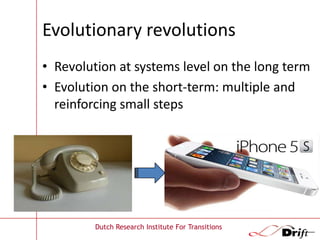
Evolutionary revolutions
• Revolution at systems level on the long term
• Evolution on the short-term: multiple and
reinforcing small steps

Dutch Research Institute For Transitions
Characteristics of transitions
• Inherent uncertainties and unpredictability
– Wicked or unstructured problems

• Emergence, co-evolution and self-organisation
– As typical dynamics underlying systems change

• Unmanageable, ambiguous and contested
– They are mainly about behavioral, institutional, cultural change

• Transitions most likely do not automatically lead to
sustainability
– It is about the process of sustainable development rather than the
end goal
GOVERNANCE OF TRANSITIONS
Transition governance principles
• long-term thinking as the basis for short term policy
• thinking in terms of multiple domains (multi-domain), different
actors (multi-actor), different levels (multi-level)

• learning as an important aim for policy (‘learning-by-doing’ and
‘doing-by-learning’)
• orient governance towards system innovation besides system
improvement
• keeping options open, exploring multiple pathways
• selectiveparticipationfocusing on frontrunners
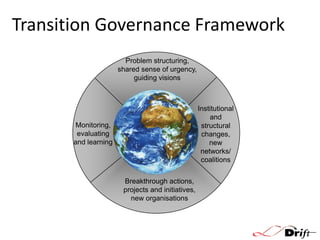
Transition Governance Framework
Problem structuring,
shared sense of urgency,
guiding visions

Institutional
and
structural
changes,
new
networks/
coalitions

Monitoring,
evaluating
and learning

Breakthrough actions,
projects and initiatives,
new organisations
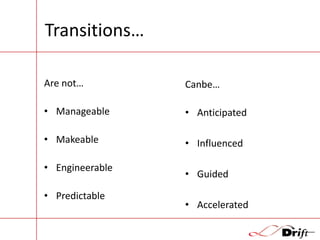
Transitions…
Are not…

Canbe…

• Manageable

• Anticipated

• Makeable

• Influenced

• Engineerable
• Predictable

• Guided
• Accelerated
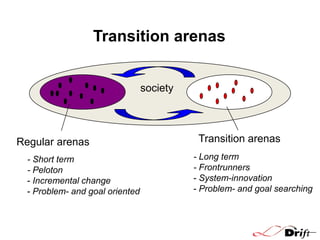
Transition arenas
society

Regular arenas
- Short term
- Peloton
- Incremental change
- Problem- and goal oriented

Transition arenas
- Long term
- Frontrunners
- System-innovation
- Problem- and goal searching
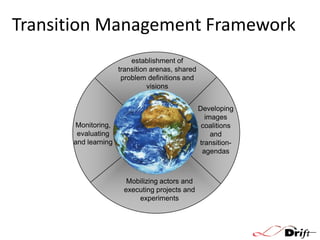
Transition Management Framework
establishment of
transition arenas, shared
problem definitions and
visions
Developing
images
coalitions
and
transitionagendas

Monitoring,
evaluating
and learning

Mobilizing actors and
executing projects and
experiments
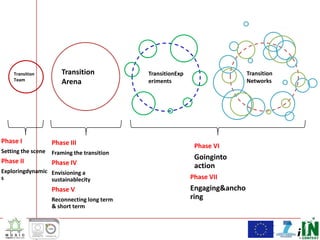
Transition
Team

Transition
Arena

Phase I

Phase III

Setting the scene

Framing the transition

Phase II

Phase IV

Exploringdynamic Envisioning a
s
sustainablecity

Phase V
Reconnecting long term
& short term

Transition
Networks

TransitionExp
eriments

Phase VI

Goinginto
action
Phase VII

Engaging&ancho
ring
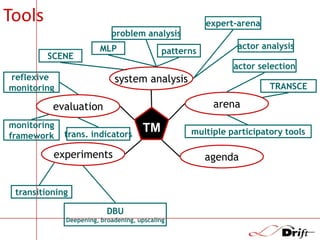
Tools

expert-arena

problem analysis
SCENE

MLP

patterns

actor selection

reflexive
monitoring

system analysis

TRANSCE

arena

evaluation
monitoring
framework

actor analysis

trans. indicators

TM

experiments
transitioning
DBU
Deepening, broadening, upscaling

multiple participatory tools

agenda
EXAMPLES
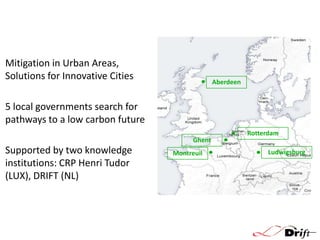
Mitigation in Urban Areas,
Solutions for Innovative Cities

Aberdeen

5 local governments search for
pathways to a low carbon future
Ghent

Supported by two knowledge
institutions: CRP Henri Tudor
(LUX), DRIFT (NL)

Montreuil

Rotterdam
Ludwigsburg
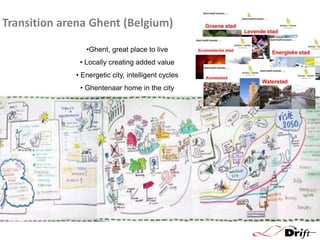
Transition arena Ghent (Belgium)
•Ghent, great place to live
• Locally creating added value
• Energetic city, intelligent cycles
• Ghentenaar home in the city
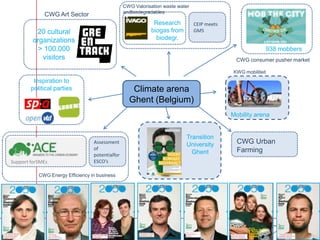
CWG Valorisation waste water
andbiodegradables

CWG Art Sector

Research
biogas from
biodegr.

20 cultural
organizations
> 100.000
visitors

CEIP meets
GMS

938 mobbers
CWG consumer pusher market
KWG mobiliteit

Inspiration to
political parties

Climate arena
Ghent (Belgium)
Mobility arena

Support forSMEs

Transition
University
Ghent

Assessment
of
potentialfor
ESCO’s

CWG Energy Efficiency in business

KWG UGent

CWG Urban
Farming
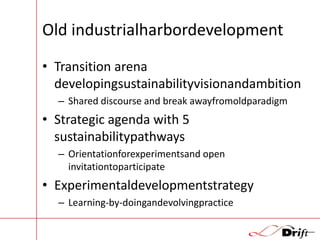
Old industrialharbordevelopment
• Transition arena
developingsustainabilityvisionandambition
– Shared discourse and break awayfromoldparadigm

• Strategic agenda with 5
sustainabilitypathways
– Orientationforexperimentsand open
invitationtoparticipate

• Experimentaldevelopmentstrategy
– Learning-by-doingandevolvingpractice
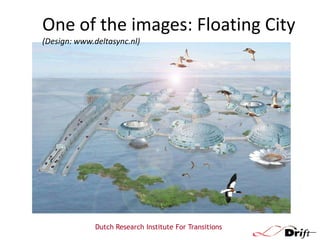
One of the images: Floating City
(Design: www.deltasync.nl)

Dutch Research Institute For Transitions
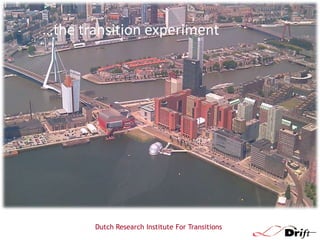
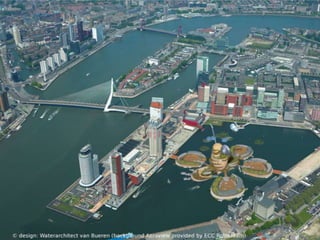
…the transition experiment

Dutch Research Institute For Transitions
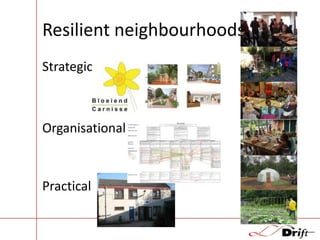
Resilient neighbourhoods
Strategic

Organisational

Practical
Dutch Research Institute For Transitions
EMERGINGTRANSITIONPATTERNS
Tipping points
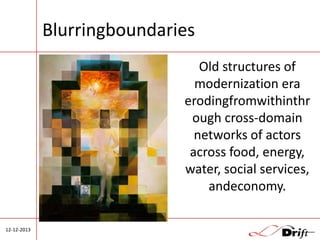
Blurringboundaries
Old structures of
modernization era
erodingfromwithinthr
ough cross-domain
networks of actors
across food, energy,
water, social services,
andeconomy.
12-12-2013
Power shifts

12-12-2013
Emergence

12-12-2013
Economictransition

12-12-2013

Afvalwaterketen - fabrieken
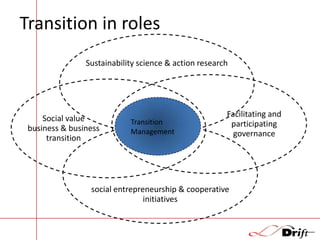
Transition in roles
Sustainability science & action research

Social value
business & business
transition

Transition
Management

Facilitating and
participating
governance

social entrepreneurship & cooperative
initiatives
GROUP EXERCISE
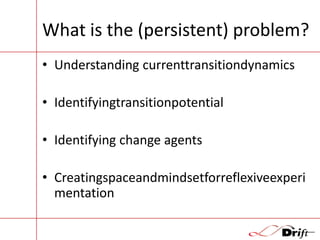
What is the (persistent) problem?
• Understanding currenttransitiondynamics
• Identifyingtransitionpotential

• Identifying change agents
• Creatingspaceandmindsetforreflexiveexperi
mentation
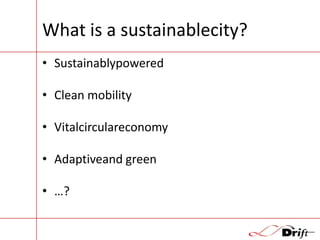
What is a sustainablecity?
• Sustainablypowered
• Clean mobility
• Vitalcirculareconomy
• Adaptiveand green

• …?
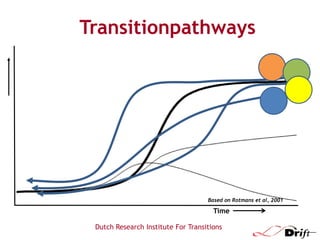
Transitionpathways

Based on Rotmans et al, 2001

Time
Dutch Research Institute For Transitions
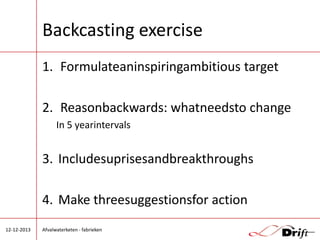
Backcasting exercise
1. Formulateaninspiringambitious target
2. Reasonbackwards: whatneedsto change
In 5 yearintervals

3. Includesuprisesandbreakthroughs

4. Make threesuggestionsfor action
12-12-2013

Afvalwaterketen - fabrieken
Thank you for your attention

For more information and publications:
loorbach@drift.eur.nl
www.drift.eur.nl
www.transitionsnetwork.org
www.twitter.com/drk75

Transitions to Sustainability and the Role of Policy

  • 1.
    Transitions to Sustainability andthe role of policy Prof. Dr. Derk Loorbach Brussels, 03-12-2013
  • 2.
    DRIFT • Dutch ResearchInstitute For Transitions, Rotterdam with 18 action researchers • Established 2004 as part of the national transition research program KSI • Action/activist research institute; (international) fundamental and applied research, consultancy, academic/postgraduate education • STRN: 600+ members globally
  • 3.
    Program of thissession •Introductiontosustainabilitytransitionsandtrans ition management • Examples of urbantransition management • Group exercises: building blocksfortransition • Synthesis: the transitionnarrative 12-12-2013 Afvalwaterketen - fabrieken
  • 4.
  • 6.
    Persistent unsustainability • Currentsocio-economic systems are inherently unsustainable – Economically, ecologically and socially • But they are also heavily path-dependent – Locked in technologically, economically and culturally • Incremental improvement is not enough and CO2 is only one of the problems – Sub-optimization often only strengthens lock-in
  • 7.
    Systemic destabilisation • Thefoundations underlying historical modernization are at the end of their life-cycle – Growth, efficiency, specialisation, optimisation • Unpredictable and shockwise change seems inevitable – Just like in historical transitions • Current crises are symptoms of non-linear systemic shifts happening – We need to consider these as windows of opportunity for major change towards sustainability
  • 8.
  • 9.
    Transitions Long-term (one ortwo generations) fundamental change of structure, culture and practices in a societal (sub)system – culture:collective set of values, norms, perspectives (shared orientation), paradigms – structure:physical infrastructure, economic infrastructure, institutions, rules, regulations, collective routines – practices:behaviour, operation, implementation  Periodic, non-linear systemic shift common in ecological and socio-economic systems  Paradigm to analyse and influence complex societal change Dutch Research Institute For Transitions
  • 10.
    Transition levels Macro-level: landscape autonomoustrends, paradigms, slow changes Meso-level: regime Dominant structure, culture and practices Micro-level: niches innovative ideas, projects, technologi es, niche actors Based on Geels and Kemp, 2001 Dutch Research Institute For Transitions
  • 11.
  • 12.
    Evolutionary revolutions • Revolutionat systems level on the long term • Evolution on the short-term: multiple and reinforcing small steps Dutch Research Institute For Transitions
  • 13.
    Characteristics of transitions •Inherent uncertainties and unpredictability – Wicked or unstructured problems • Emergence, co-evolution and self-organisation – As typical dynamics underlying systems change • Unmanageable, ambiguous and contested – They are mainly about behavioral, institutional, cultural change • Transitions most likely do not automatically lead to sustainability – It is about the process of sustainable development rather than the end goal
  • 14.
  • 15.
    Transition governance principles •long-term thinking as the basis for short term policy • thinking in terms of multiple domains (multi-domain), different actors (multi-actor), different levels (multi-level) • learning as an important aim for policy (‘learning-by-doing’ and ‘doing-by-learning’) • orient governance towards system innovation besides system improvement • keeping options open, exploring multiple pathways • selectiveparticipationfocusing on frontrunners
  • 16.
    Transition Governance Framework Problemstructuring, shared sense of urgency, guiding visions Institutional and structural changes, new networks/ coalitions Monitoring, evaluating and learning Breakthrough actions, projects and initiatives, new organisations
  • 17.
    Transitions… Are not… Canbe… • Manageable •Anticipated • Makeable • Influenced • Engineerable • Predictable • Guided • Accelerated
  • 18.
    Transition arenas society Regular arenas -Short term - Peloton - Incremental change - Problem- and goal oriented Transition arenas - Long term - Frontrunners - System-innovation - Problem- and goal searching
  • 19.
    Transition Management Framework establishmentof transition arenas, shared problem definitions and visions Developing images coalitions and transitionagendas Monitoring, evaluating and learning Mobilizing actors and executing projects and experiments
  • 20.
    Transition Team Transition Arena Phase I Phase III Settingthe scene Framing the transition Phase II Phase IV Exploringdynamic Envisioning a s sustainablecity Phase V Reconnecting long term & short term Transition Networks TransitionExp eriments Phase VI Goinginto action Phase VII Engaging&ancho ring
  • 21.
    Tools expert-arena problem analysis SCENE MLP patterns actor selection reflexive monitoring systemanalysis TRANSCE arena evaluation monitoring framework actor analysis trans. indicators TM experiments transitioning DBU Deepening, broadening, upscaling multiple participatory tools agenda
  • 22.
  • 23.
    Mitigation in UrbanAreas, Solutions for Innovative Cities Aberdeen 5 local governments search for pathways to a low carbon future Ghent Supported by two knowledge institutions: CRP Henri Tudor (LUX), DRIFT (NL) Montreuil Rotterdam Ludwigsburg
  • 26.
    Transition arena Ghent(Belgium) •Ghent, great place to live • Locally creating added value • Energetic city, intelligent cycles • Ghentenaar home in the city
  • 27.
    CWG Valorisation wastewater andbiodegradables CWG Art Sector Research biogas from biodegr. 20 cultural organizations > 100.000 visitors CEIP meets GMS 938 mobbers CWG consumer pusher market KWG mobiliteit Inspiration to political parties Climate arena Ghent (Belgium) Mobility arena Support forSMEs Transition University Ghent Assessment of potentialfor ESCO’s CWG Energy Efficiency in business KWG UGent CWG Urban Farming
  • 28.
    Old industrialharbordevelopment • Transitionarena developingsustainabilityvisionandambition – Shared discourse and break awayfromoldparadigm • Strategic agenda with 5 sustainabilitypathways – Orientationforexperimentsand open invitationtoparticipate • Experimentaldevelopmentstrategy – Learning-by-doingandevolvingpractice
  • 29.
    One of theimages: Floating City (Design: www.deltasync.nl) Dutch Research Institute For Transitions
  • 30.
    …the transition experiment DutchResearch Institute For Transitions
  • 31.
    Dutch Research InstituteFor Transitions
  • 32.
  • 33.
    Dutch Research InstituteFor Transitions
  • 34.
    Dutch Research InstituteFor Transitions
  • 35.
  • 36.
  • 37.
    Blurringboundaries Old structures of modernizationera erodingfromwithinthr ough cross-domain networks of actors across food, energy, water, social services, andeconomy. 12-12-2013
  • 38.
  • 39.
  • 40.
  • 41.
    Transition in roles Sustainabilityscience & action research Social value business & business transition Transition Management Facilitating and participating governance social entrepreneurship & cooperative initiatives
  • 42.
  • 43.
    What is the(persistent) problem? • Understanding currenttransitiondynamics • Identifyingtransitionpotential • Identifying change agents • Creatingspaceandmindsetforreflexiveexperi mentation
  • 44.
    What is asustainablecity? • Sustainablypowered • Clean mobility • Vitalcirculareconomy • Adaptiveand green • …?
  • 45.
    Transitionpathways Based on Rotmanset al, 2001 Time Dutch Research Institute For Transitions
  • 46.
    Backcasting exercise 1. Formulateaninspiringambitioustarget 2. Reasonbackwards: whatneedsto change In 5 yearintervals 3. Includesuprisesandbreakthroughs 4. Make threesuggestionsfor action 12-12-2013 Afvalwaterketen - fabrieken
  • 47.
    Thank you foryour attention For more information and publications: loorbach@drift.eur.nl www.drift.eur.nl www.transitionsnetwork.org www.twitter.com/drk75