3 stories
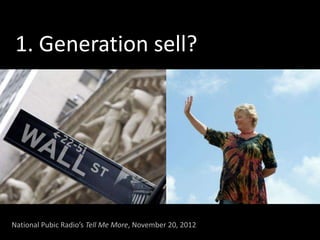
1. Generation sell?
               Generation sell?


National Pubic Radio’s Tell Me More, November 20, 2012
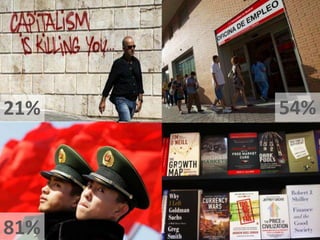
21%   54%


81%
2. A new kind of
   economy?
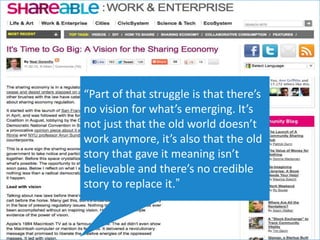
“Part of that struggle is that there’s
no vision for what’s emerging. It’s
not just that the old world doesn’t
work anymore, it’s also that the old
story that gave it meaning isn’t
believable and there’s no credible
story to replace it.”
3. Get in there & do
        stuff!
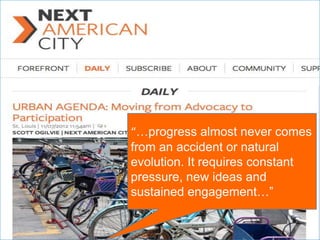
“…progress almost never comes
from an accident or natural
evolution. It requires constant
pressure, new ideas and
sustained engagement…”
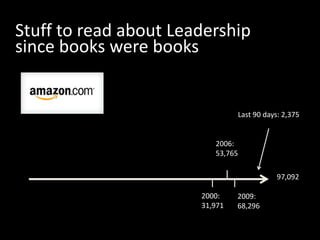
Stuff to read about Leadership
since books were books


                                   Last 90 days: 2,375


                          2006:
                          53,765

                                               97,092

                       2000:    2009:
                       31,971   68,296
LEADERSHIP
(Come on in, the water’s
warm…)
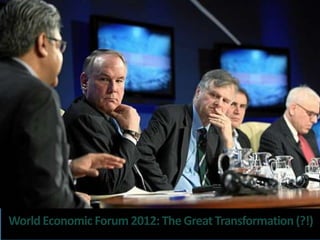
World Economic Forum 2012: The Great Transformation (?!)
An Exploration
of Leadership?
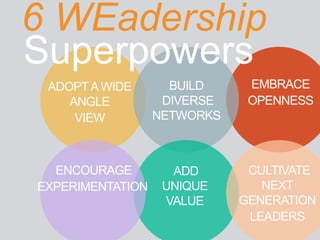
6 WEadership
Superpowers
 ADOPT A WIDE       BUILD     EMBRACE
    ANGLE          DIVERSE    OPENNESS
     VIEW         NETWORKS


  ENCOURAGE         ADD       CULTIVATE
EXPERIMENTATION    UNIQUE       NEXT
                   VALUE     GENERATION
                              LEADERS
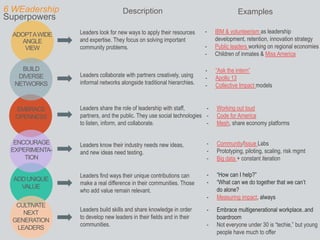
6 WEadership                        Description                                          Examples
Superpowers
                 Leaders look for new ways to apply their resources     -       IBM & volunteerism as leadership
  ADOPT A WIDE
     ANGLE       and expertise. They focus on solving important                 development, retention, innovation strategy
      VIEW       community problems.                                    -       Public leaders working on regional economies
                                                                        -       Children of inmates & Miss America

    BUILD                                                               -       “Ask the intern”
   DIVERSE       Leaders collaborate with partners creatively, using    -       Apollo 13
  NETWORKS       informal networks alongside traditional hierarchies.   -       Collective Impact models


  EMBRACE        Leaders share the role of leadership with staff,       -       Working out loud
  OPENNESS       partners, and the public. They use social technologies -       Code for America
                 to listen, inform, and collaborate.                    -       Mesh, share economy platforms


  ENCOURAGE      Leaders know their industry needs new ideas,               -   Community/Issue Labs
 EXPERIMENTA-    and new ideas need testing.                                -   Prototyping, piloting, scaling, risk mgmt
     TION                                                                   -   Big data + constant iteration

                 Leaders find ways their unique contributions can           -   “How can I help?”
  ADD UNIQUE                                                                -   “What can we do together that we can’t
                 make a real difference in their communities. Those
    VALUE                                                                       do alone?
                 who add value remain relevant.
                                                                            -   Measuring impact, always
   CULTIVATE
                 Leaders build skills and share knowledge in order          -   Embrace multigenerational workplace..and
     NEXT
                 to develop new leaders in their fields and in their            boardroom
  GENERATION
                 communities.                                               -   Not everyone under 30 is “techie,” but young
   LEADERS
                                                                                people have much to offer
WELCOME TO
SIXTOWN!
…YES, THIS IS THE
LEADERSHIP DEEP DIVE
KRISTIN WOLFF, VISHAL JODHANI
& ALL OF YOU
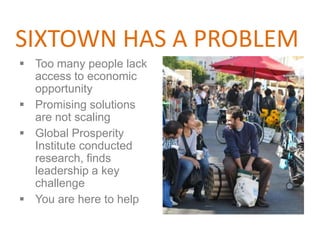
SIXTOWN HAS A PROBLEM
ď‚§ Too many people lack
  access to economic
  opportunity
ď‚§ Promising solutions
  are not scaling
ď‚§ Global Prosperity
  Institute conducted
  research, finds
  leadership a key
  challenge
ď‚§ You are here to help
GUIDING QUESTIONS
ď‚§   What leadership
    practices have you
    found success with in
    similar situations that
    you could share with
    Sixtown leaders?
ď‚§   What are the most
    important actions
    specific leaders could
    take to move Sixtown
    forward? Why these
    actions? What’s in the
    way?
ď‚§   What tools, skills,
    processes do these
    actions require?
ADVISING SIXTOWN

WEadership deep dive, Kristin Wolff

  • 1.
  • 2.
    1. Generation sell? Generation sell? National Pubic Radio’s Tell Me More, November 20, 2012
  • 4.
    21% 54% 81%
  • 5.
    2. A newkind of economy?
  • 6.
    “Part of thatstruggle is that there’s no vision for what’s emerging. It’s not just that the old world doesn’t work anymore, it’s also that the old story that gave it meaning isn’t believable and there’s no credible story to replace it.”
  • 7.
    3. Get inthere & do stuff!
  • 8.
    “…progress almost nevercomes from an accident or natural evolution. It requires constant pressure, new ideas and sustained engagement…”
  • 9.
    Stuff to readabout Leadership since books were books Last 90 days: 2,375 2006: 53,765 97,092 2000: 2009: 31,971 68,296
  • 10.
    LEADERSHIP (Come on in,the water’s warm…)
  • 11.
    World Economic Forum2012: The Great Transformation (?!)
  • 12.
  • 14.
    6 WEadership Superpowers ADOPTA WIDE BUILD EMBRACE ANGLE DIVERSE OPENNESS VIEW NETWORKS ENCOURAGE ADD CULTIVATE EXPERIMENTATION UNIQUE NEXT VALUE GENERATION LEADERS
  • 15.
    6 WEadership Description Examples Superpowers Leaders look for new ways to apply their resources - IBM & volunteerism as leadership ADOPT A WIDE ANGLE and expertise. They focus on solving important development, retention, innovation strategy VIEW community problems. - Public leaders working on regional economies - Children of inmates & Miss America BUILD - “Ask the intern” DIVERSE Leaders collaborate with partners creatively, using - Apollo 13 NETWORKS informal networks alongside traditional hierarchies. - Collective Impact models EMBRACE Leaders share the role of leadership with staff, - Working out loud OPENNESS partners, and the public. They use social technologies - Code for America to listen, inform, and collaborate. - Mesh, share economy platforms ENCOURAGE Leaders know their industry needs new ideas, - Community/Issue Labs EXPERIMENTA- and new ideas need testing. - Prototyping, piloting, scaling, risk mgmt TION - Big data + constant iteration Leaders find ways their unique contributions can - “How can I help?” ADD UNIQUE - “What can we do together that we can’t make a real difference in their communities. Those VALUE do alone? who add value remain relevant. - Measuring impact, always CULTIVATE Leaders build skills and share knowledge in order - Embrace multigenerational workplace..and NEXT to develop new leaders in their fields and in their boardroom GENERATION communities. - Not everyone under 30 is “techie,” but young LEADERS people have much to offer
  • 16.
    WELCOME TO SIXTOWN! …YES, THISIS THE LEADERSHIP DEEP DIVE KRISTIN WOLFF, VISHAL JODHANI & ALL OF YOU
  • 17.
    SIXTOWN HAS APROBLEM ď‚§ Too many people lack access to economic opportunity ď‚§ Promising solutions are not scaling ď‚§ Global Prosperity Institute conducted research, finds leadership a key challenge ď‚§ You are here to help
  • 18.
    GUIDING QUESTIONS  What leadership practices have you found success with in similar situations that you could share with Sixtown leaders?  What are the most important actions specific leaders could take to move Sixtown forward? Why these actions? What’s in the way?  What tools, skills, processes do these actions require?
  • 19.

Editor's Notes

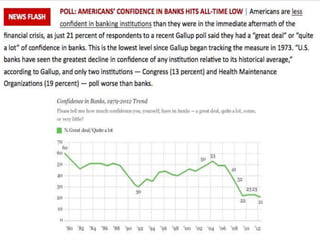
  • #3 One story is about a crisis of institutional leadership – governments, financial institutions, corporations, even the US military.Wall St. photo credit: http://thinkprogress.org/economy/2012/07/24/570181/two-years-after-financial-reform-republicans-rake-in-wall-street-fundraising-dollars/Woman = istockphotoHere are a few factoids I heard in a radio program last week:18% of Americans interested in buying stock, 76% not interested at all. This cuts across generations. Âľ of American adults are completely uninterested in the stock market. 3 out of 4.As a result, since 2008 (4 yrs), $410B left the market – most significant reason? Lack of trust in financial institutions and in the system itself.These positions are not fringe positions, they are quite mainstream, though you don’t hear much about this because the great transformers we saw in the first slide are largely hosting the conversations.Gallup poll, lowest confidence in banks and financial institutions ever recorded. Ever recorded! This is through the savings and loan crisis, the bursting of the tech bubble in 2001, a couple more recessions and then the Great Recession – through all that, trust continued to decline, hitting its low point four years after the eye of the storm. June 2012 – Gallup, lowest since 1973…
  • #4 I can have a sense of humour to an extent, but let me share three stories that I think have a lot to do with why we need to talk about leadership.
  • #5 Wall Street bankers may be among the worst offenders, but they do have good company.Greece: http://m.spokesman.com/galleries/2012/sep/25/today-photos-sept-25/Poverty: Exceeds 21% - more than one in five.Spain: http://www.telegraph.co.uk/finance/financialcrisis/9432212/Spanish-jobless-rate-24.6pc-youth-unemployment-at-53pc.htmlUnemployment rate for under 25s – 54.2% (more than one in two)China: http://news.nationalpost.com/2012/11/13/chinas-leadership-change-over-will-have-far-reaching-effects-in-canada-and-across-the-globe/Global Times newspaper conducted a survey just before the recent election, 81% want political reform (4/5), two biggest reasons:1) Rich/Poor income gap, 2) Inadequate social safety net.Best sellers in business in Changi airport… Increasingly, the narrative accompanying all thee stories in one not of unpredicted crisis, but one of failed institutions, and failed institutional leadership.
  • #7 The second story is about new ideas for economic progress moving from the fringe to the mainstream, or perhaps more accurately, crafting a new narrative altogether. Painting a picture not just of the next “new industry” but of an economy built on a different set of assumptions and values. This values battle is going on everywhere…Social impact investing – so much excitement conceptually but…as it growth, new models.Is the fund about investing in good businesses and how are they measured? Is is about investing in good outcomes (social impact bond-like instruments), or is it about blended value (and if so, are VC funds even the right tool?)San Francisco story about Air BnB… - Air BnB just rented mega office space, ten year lease, in SF, counting on big growth.City Treasurer and tax collector wants hotel tax of 14%.Mayor sees differently.Lyfte, Rideshare,PUC issued a ceast and desist order wanting them to be licensed and certified – these are in SF where cabs reportedly come less than 40% of the time – and on ride share, people can rate drivers!
  • #9 The third story is one of roll-up-your-shirtsleeves change – participation with the system that needs changing.St. Louise. An activist joins city council, supported by an unlikely cast of characters.In this story, he’s pleading with all the critics and commentators to join him in fixing instead of complaining. Know that it take time, but that’s the work of progress. It’s a marathon that only seems like a sprint.Something a little bit back to the future about this story – isn’t this what citizen government is supposed to be about?
  • #10 These stories came from the three days before I left Portland, but lots of people have been raising fundamental questions about the nature and practice of leadership for a long time, and in particular, the last decade.Here’s another interesting datapoint about leadership…As one data point, Amazon books before 2005 and after.Today a search yields 97,092Before 2000 = 31,971Before 2006 = 53,76540 + K between 2006 and now.Before 2009 = 68,296Last 90 days = 2,375 (no wonder I cannot keep up)And more leadership books are “coming soon” as a proportion of leadership books in 90 days, than books generally. Leadership books in fact are coming out at a more frequent rate than books on other subjects. In 2011, my colleagues and I worked a project in the sector we call workforce development. It was a project supported by the US Department of Labor, although I don’t think they knew what they were getting into when they hired us.They had in mind a project that looks like this: Person at computer, focus groupsInstead, our project looked more like this: Simulations, social media, videoAnd what we found was that, just like is other professional fields, leaders in the sector we studied were moving away from traditional hierarchical models, and adopting more collaborative practices and moving away from the idea that leaders are exclusively people of rank and status.We identified six key practices that defined this new model of leadership, which we call Weadership, with a bit if a wink, but also in a nod to its collaborative nature.I’ll be your tour guide for a brief introduction to these six practices.One more things, I have a TEDX talk in Tucson, Arizona about this subject and used a superhero frame to explain them. That’s how I came to call them superpowers, which I kind of liked, so I’ll call them superpowers here, too.
  • #11 Why?Trust in institutions has never been lowerLeaders are almost never in charge of end to end solutions, especially in wicked problem spacesThere are alternatives to organization models at all that pose questions for leaders (shareconomy + tech (Martin) Occupy (Tom)Really? (next slide)
  • #12 Image credit: http://www.toonaripost.com/2012/01/world-news/the-great-transformation-davos-2012/Really?In 2011, my colleagues and I worked a project in the public policy space concerned with jobs, work, and training. It was a project supported by the US Department of Labor, although I don’t think they knew what they asked us, VinzKoller, SPr) were getting into when they hired us.
  • #13 Labor expected something like this.
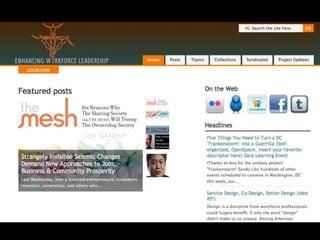
  • #14 Instead, we turned in into an engagement project that would up directly engaging over 500 people in the field from 33 states, and hundreds more via social media.And we did the report, but we turned it into a blurb book.
  • #15 And what we found was that, just like is other professional fields, leaders in the sector we studied were moving away from traditional hierarchical models, and adopting more collaborative practices and moving away from the idea that leaders are exclusively people of rank and status.We identified not just skills leaders need, but also a new way to understand (and practice) leadership. We call it Weadership in a nod to its collective nature. We shifted the focus from leaders to practices (we called them superpowers in a tedx talk and I kind of liked that so I’m using that going forward…).A few of points:They are interrelated and complementary. I think you’ll see why as we talk about them, but I thought I’d make the point.None of the practices are particularly earthshattering in and of themselves – I don’t think they will sound all that new to you. However, what we’re trying to do here is define a new way of leading, a new approach to leadership. Weadership is not about throwing the six practices into your skillset or style now and again, it is about employing them all the time. Weadership is as much about culture as the practices of any single leader. Some of the specific examples we’ll go through are small and subtle. They are easy to do, which also makes them easy not to do. The Weadership model asks us to be attentive to practice of leadership across our networks and organizations, not just during strategy reviews or succession planning. Ask the intern example.
  • #16 This is on your tables you can use it to follow along or not.Wide Angle: Miss America.Build Diverse Networks: Apollo 13Embrace Openness: make sharing the default option, participating the norm, and document everythingExperiment: risk of not doing also needs considerationAdd value: Know your value and how to measure it, another dimension is to go beyond transaction (what can we do together)Next generation: tech stories (want wisdom not just tech skills) Let’s stop there for now, we’ve got a special guest here from the global prosperity foundation who’d like to meet with you.Please go ahead and open you letters, write your name on your name tags and make sure others can see them.
  • #18 As you know, you’ve been selected to advise Sixtown leaders.You understand the situation…SIXTOWN is lucky enough to be the home of WorkMatters, a fantastic little enterprise that is eager to share lessons, partner in new ways and scale its operation. SIXTOWN leaders are struggling with how to interact with WorkMatters – it doesn’t really fit the categories of organizations they are used to working with and it’s asking for something different – not just money, but opportunities for collaboration and learning.We’d like you to work in 2-3 small groups. The way we’ll divide up is by the color of your envelopes.You will have 20 minutes to work as a group
  • #19 Theseare some guiding questions intended to get you going.The Weadership practices are intended to help with language and examples should you need it.In 20 minutes, you will present your advise to SIXTOWN leaders and Prosperity Foundation trustees via Skype. The team with the most useful advice will receive the Prosperity Prize.In your presentation, you may use flipchart paper, make sculptures out of the pipecleaners, or use whatever medium best suits your cause and is immediately accessible.So…20 minutesPrepare to report back (no more than five minutes – Vishal is the time keeper and he’ll keep us on task!
  • #20 Photo…This was a simulation, obviously, but it was also an invitation to actually engage with each other as leaders.What was the experience at the tables like?Did a leader emerge? How did that happens? How you know?What would you have done differently if you had to do this over again (in the same amount of time)?How was this exercise similar or different from your work in your home communities?What surprised you about this exercise?Ultimately, leadership is about advancing an agenda in some form. Of the practices and advice you offered Sixtown leaders, what have you found to be most useful in moving agenda in your own communities and why?