Cities as arenas of low-carbon
transition?
Analysing the cases of Graz and
Freiburg
Harald Rohracher
Professor, Dept. of Thematic Studies –
Technology and Social Change
Linköping University, Sweden
Cities &Climate Change


Sustainability transitions: radical
reconfigurations of systems of production and
consumption
 Energy,



mobility, food systems etc.

Cities increasingly regarded critical to
transitions
as ‘megatrend’
 Source of 70-80% of anthropogenic GHGemissions
 Foremost among victims of climate change
 Key sites of ‘innovative response’
 Urbanisation
A sociotechnicalsystemsperspective


Individual transport / the car: Just a technology?



Which social, cultural and technical elements
stabilise our car-based system of mobility?
 Is



it just habits? Lack of technological alternatives?

How are cars entrenched in our society? Why is
such a system so difficult to change?
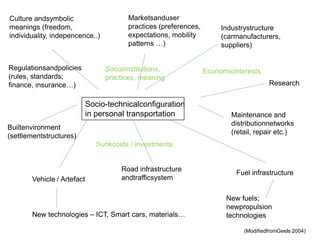
Culture andsymbolic
meanings (freedom,
individuality, indepencence..)

Regulationsandpolicies
(rules, standards;
finance, insurance…)

Marketsanduser
practices (preferences,
expectations, mobility
patterns …)

Socialinstitutions,
practices, meaning

Socio-technicalconfiguration
in personal transportation
Builtenvironment
(settlementstructures)

Industrystructure
(carmanufacturers,
suppliers)

Economicinterests
Research

Maintenance and
distributionnetworks
(retail, repair etc.)

Sunkcosts / investments

Vehicle / Artefact

Road infrastructure
andtrafficsystem

New technologies – ICT, Smart cars, materials…

Fuel infrastructure

New fuels;
newpropulsion
technologies
(ModifiedfromGeels 2004)
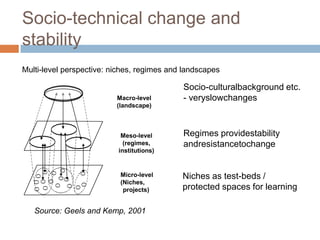
Socio-technical change and
stability
Multi-level perspective: niches, regimes and landscapes

Macro-level
(landscape)

Meso-level
(regimes,
institutions)

Micro-level
(Niches,
projects)

Source: Geels and Kemp, 2001

Socio-culturalbackground etc.
- veryslowchanges

Regimes providestability
andresistancetochange

Niches as test-beds /
protected spaces for learning
Transitions as multi-level
process
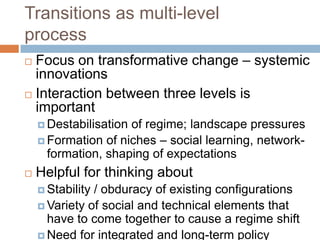
Focus on transformative change – systemic
innovations
 Interaction between three levels is
important


 Destabilisation

of regime; landscape pressures
 Formation of niches – social learning, networkformation, shaping of expectations


Helpful for thinking about
 Stability

/ obduracy of existing configurations
 Variety of social and technical elements that
have to come together to cause a regime shift
 Need for integrated and long-term policy
How can cities shape regime
change?




Infrastructures / regimes often reach far
beyond city limits + limited formal power of
cities
‘Soft power’ to shape change processes:
 Self-governing:

own operation of e.g. buildings,
public procurement
 Limited forms of regulation – mandates and
planning
 Provision of services
 Enabling: facilitating, coordination & encouraging
action, civil society involvement
 Horizontal coordination: city networks
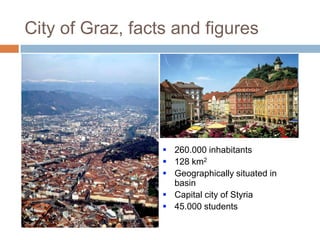
City of Graz, facts and figures

 260.000 inhabitants
 128 km2
 Geographically situated in
basin
 Capital city of Styria
 45.000 students
‘Eco-City’Graz: historic development


External pressures on existing energy
regime
 Bad



air quality due to geographical situation

Network of energy activists established
within city administration and politics (policy
entrepreneurs)
 Partially



roots in anti-nuclear movement

Early 1990s: From ‘smog city’ to ‘eco city’
 Integrated

2000’

Environmental Programme‘Eco-City
Innovative Energy & Climate
Policies




Ambitious aims: Cutting CO2-emissions by 50%
until 2010 (based on 1987 figures)
Innovative type of programmes
Comprehensive and integrative perspective
(policy integration)
 Participatory planning (stakeholders, wider public)
 Partial outsourcing to research partners
 New types of instruments (economic framing; win-win)
 Action oriented; concrete targets; monitoring




Integration with social and economic aims


Local companies & jobs, social housing etc.
International support
Participation in international city networks
 International attention and acclaim for its
activities, e.g.


Greenpeace International Climate Protection Award in
1993
 International Sustainable City Award of the European
Union
in 1996
 Dubai International Award & Climate Star in 2002
 Sustainable Energy Europe Award in 2008
 Civitas City of the Year 2008




Creation of urban identity
Thermoprofit










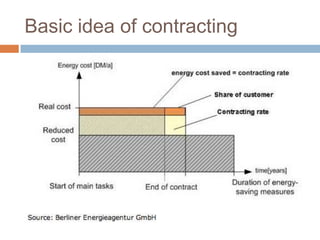
Energy performance contracting for private and
public buildings
Includes energy supply, building envelope, building
services
New financial arrangements + aggregation of
knowledge on energy-efficient refurbishing, models
for tenant participation, legal issues, dealing with
energy aspects in tendering etc.
Networks of local partner companies (Thermoprofit
partners)
Guaranteed quality standards
Basic idea of contracting
‘Soft power’ of institutional change


Institutional change
 Strengthened

department for energy and

environment
 Establishment of more effective intra-municipal
working groups across departments and issues
 Establishment of a municipal energy agency which
is owned by municipality and municipal utilities, but
collaborates internationally and acts (rather)
independently


Importance of intermediaries at urban level
 Facilitation

and coordination of systemic change
 Knowledge brokers; competence centres
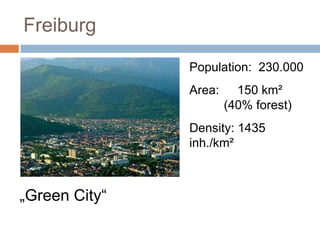
Freiburg
Population: 230.000
Area:

150 km²
(40% forest)

Density: 1435
inh./km²

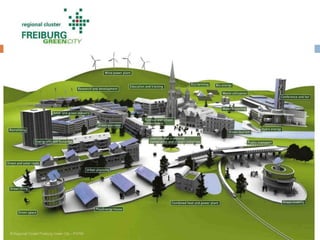
„Green City“
Priorities for an energy transition


Vision: substitution of nuclear electricity, lead in
efficiency and renewables, solar industry cluster
 Germany’s





‘Solar capital’, various international prizes

Policies driven by experts & citizens rather than
administration (main admin-focus: PR, green
image)
Reduce demand by increasing energy efficiency
 Pioneering

enforcement of high energetic building
standards (by plans, private contracts etc.)
 District heating, CHP
 Transport: Change in modal split achieved but anticar policy highly contested
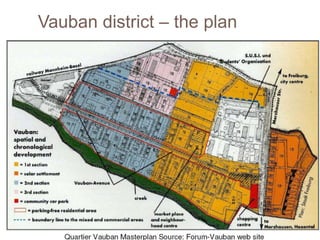
Vauban district – the plan

18

Ph. Späth, Environmental Policies in Freiburg
‘Lessons’ from eco-cities


Despite limited power within multi-level
governance structures cities can be
successful in achieving a (moderate)
restructuring of the energy regime
 Not

so much technology development, but
implementation skills, formation of actor alliances,
new business clusters (e.g. energy-efficient building
renovation; solar installations)
 Urban governance brings together actors across
energy system level in new roles –
incumbents/utilities, local businesses offering new
products/services, concerned citizens…
Cities as facilitators of systemic
change


Not only niche-regime dynamics, but other
socio-political dynamics important
 Particular

local agendas, jobs, tourism, visibility
 Interactions between different governance levels
 Competition between cities / networks of cities
important


Despite severe constraints, cities and regions
can be important social context for deviations
from dominant energy system
 Legitimacy

for visions of more sustainable regimes
 Demonstrating the viability of alternative regime
Cities as facilitators of systemic
change


Significant governance capacity at local level…
 Not

only formal powers, but proximity effects,
inclusion of civil society, capacity for coordination,
regional identities
 Strategic action at city/regional level can have
(discursive) repercussions on other scales =>
diffusion of alternative configurations


Regions / cities as sites for
 Formation

of new visions and discourse coalitions
 Formation of heterogeneous networks across
different interests and actor types as effect of
proximity / trust
Challenges for urban transitions


How to create learning effects across different
initiatives and experiments?
 Upscaling?



Systemic change?

How to create long-lasting institutional change?
 New

instruments, standardisation, agencies,
new structures for policy integration



How to broaden the actor basis?
 Involvement





of civil society? Companies?

How to link energy with other socio-political
issues?
Vision building? Urban identity? Measuring
Thank you for your
attention!
harald.rohracher@liu.se

Cities as Arenas of Low-Carbon Transition? Analysing the Cases of Graz and Freiburg

  • 1.
    Cities as arenasof low-carbon transition? Analysing the cases of Graz and Freiburg Harald Rohracher Professor, Dept. of Thematic Studies – Technology and Social Change Linköping University, Sweden
  • 2.
    Cities &Climate Change  Sustainabilitytransitions: radical reconfigurations of systems of production and consumption  Energy,  mobility, food systems etc. Cities increasingly regarded critical to transitions as ‘megatrend’  Source of 70-80% of anthropogenic GHGemissions  Foremost among victims of climate change  Key sites of ‘innovative response’  Urbanisation
  • 3.
    A sociotechnicalsystemsperspective  Individual transport/ the car: Just a technology?  Which social, cultural and technical elements stabilise our car-based system of mobility?  Is  it just habits? Lack of technological alternatives? How are cars entrenched in our society? Why is such a system so difficult to change?
  • 4.
    Culture andsymbolic meanings (freedom, individuality,indepencence..) Regulationsandpolicies (rules, standards; finance, insurance…) Marketsanduser practices (preferences, expectations, mobility patterns …) Socialinstitutions, practices, meaning Socio-technicalconfiguration in personal transportation Builtenvironment (settlementstructures) Industrystructure (carmanufacturers, suppliers) Economicinterests Research Maintenance and distributionnetworks (retail, repair etc.) Sunkcosts / investments Vehicle / Artefact Road infrastructure andtrafficsystem New technologies – ICT, Smart cars, materials… Fuel infrastructure New fuels; newpropulsion technologies (ModifiedfromGeels 2004)
  • 5.
    Socio-technical change and stability Multi-levelperspective: niches, regimes and landscapes Macro-level (landscape) Meso-level (regimes, institutions) Micro-level (Niches, projects) Source: Geels and Kemp, 2001 Socio-culturalbackground etc. - veryslowchanges Regimes providestability andresistancetochange Niches as test-beds / protected spaces for learning
  • 6.
    Transitions as multi-level process Focuson transformative change – systemic innovations  Interaction between three levels is important   Destabilisation of regime; landscape pressures  Formation of niches – social learning, networkformation, shaping of expectations  Helpful for thinking about  Stability / obduracy of existing configurations  Variety of social and technical elements that have to come together to cause a regime shift  Need for integrated and long-term policy
  • 7.
    How can citiesshape regime change?   Infrastructures / regimes often reach far beyond city limits + limited formal power of cities ‘Soft power’ to shape change processes:  Self-governing: own operation of e.g. buildings, public procurement  Limited forms of regulation – mandates and planning  Provision of services  Enabling: facilitating, coordination & encouraging action, civil society involvement  Horizontal coordination: city networks
  • 8.
    City of Graz,facts and figures  260.000 inhabitants  128 km2  Geographically situated in basin  Capital city of Styria  45.000 students
  • 9.
    ‘Eco-City’Graz: historic development  Externalpressures on existing energy regime  Bad  air quality due to geographical situation Network of energy activists established within city administration and politics (policy entrepreneurs)  Partially  roots in anti-nuclear movement Early 1990s: From ‘smog city’ to ‘eco city’  Integrated 2000’ Environmental Programme‘Eco-City
  • 10.
    Innovative Energy &Climate Policies   Ambitious aims: Cutting CO2-emissions by 50% until 2010 (based on 1987 figures) Innovative type of programmes Comprehensive and integrative perspective (policy integration)  Participatory planning (stakeholders, wider public)  Partial outsourcing to research partners  New types of instruments (economic framing; win-win)  Action oriented; concrete targets; monitoring   Integration with social and economic aims  Local companies & jobs, social housing etc.
  • 11.
    International support Participation ininternational city networks  International attention and acclaim for its activities, e.g.  Greenpeace International Climate Protection Award in 1993  International Sustainable City Award of the European Union in 1996  Dubai International Award & Climate Star in 2002  Sustainable Energy Europe Award in 2008  Civitas City of the Year 2008   Creation of urban identity
  • 12.
    Thermoprofit      Energy performance contractingfor private and public buildings Includes energy supply, building envelope, building services New financial arrangements + aggregation of knowledge on energy-efficient refurbishing, models for tenant participation, legal issues, dealing with energy aspects in tendering etc. Networks of local partner companies (Thermoprofit partners) Guaranteed quality standards
  • 13.
    Basic idea ofcontracting
  • 14.
    ‘Soft power’ ofinstitutional change  Institutional change  Strengthened department for energy and environment  Establishment of more effective intra-municipal working groups across departments and issues  Establishment of a municipal energy agency which is owned by municipality and municipal utilities, but collaborates internationally and acts (rather) independently  Importance of intermediaries at urban level  Facilitation and coordination of systemic change  Knowledge brokers; competence centres
  • 15.
    Freiburg Population: 230.000 Area: 150 km² (40%forest) Density: 1435 inh./km² „Green City“
  • 17.
    Priorities for anenergy transition  Vision: substitution of nuclear electricity, lead in efficiency and renewables, solar industry cluster  Germany’s   ‘Solar capital’, various international prizes Policies driven by experts & citizens rather than administration (main admin-focus: PR, green image) Reduce demand by increasing energy efficiency  Pioneering enforcement of high energetic building standards (by plans, private contracts etc.)  District heating, CHP  Transport: Change in modal split achieved but anticar policy highly contested
  • 18.
    Vauban district –the plan 18 Ph. Späth, Environmental Policies in Freiburg
  • 19.
    ‘Lessons’ from eco-cities  Despitelimited power within multi-level governance structures cities can be successful in achieving a (moderate) restructuring of the energy regime  Not so much technology development, but implementation skills, formation of actor alliances, new business clusters (e.g. energy-efficient building renovation; solar installations)  Urban governance brings together actors across energy system level in new roles – incumbents/utilities, local businesses offering new products/services, concerned citizens…
  • 20.
    Cities as facilitatorsof systemic change  Not only niche-regime dynamics, but other socio-political dynamics important  Particular local agendas, jobs, tourism, visibility  Interactions between different governance levels  Competition between cities / networks of cities important  Despite severe constraints, cities and regions can be important social context for deviations from dominant energy system  Legitimacy for visions of more sustainable regimes  Demonstrating the viability of alternative regime
  • 21.
    Cities as facilitatorsof systemic change  Significant governance capacity at local level…  Not only formal powers, but proximity effects, inclusion of civil society, capacity for coordination, regional identities  Strategic action at city/regional level can have (discursive) repercussions on other scales => diffusion of alternative configurations  Regions / cities as sites for  Formation of new visions and discourse coalitions  Formation of heterogeneous networks across different interests and actor types as effect of proximity / trust
  • 22.
    Challenges for urbantransitions  How to create learning effects across different initiatives and experiments?  Upscaling?  Systemic change? How to create long-lasting institutional change?  New instruments, standardisation, agencies, new structures for policy integration  How to broaden the actor basis?  Involvement   of civil society? Companies? How to link energy with other socio-political issues? Vision building? Urban identity? Measuring
  • 23.
    Thank you foryour attention! harald.rohracher@liu.se