Gaining Traction & Results from
                      Collaboration Platforms
                     (The Human Dimension)

                              Declan Kavanagh


CollaborationIP
Agenda
                  •   Why Collaboration?
                  •   How People Collaborate?
                  •   The Psychology Behind it
                  •   How Organisations Learn?
                  •   The Science Behind it
                  •   A Framework for Collaboration Programs
                  •   Diagnosis of Collaboration Maturity
                  •   The Business Case Framework
CollaborationIP   COLLABORATION SOFTWARE + COLLABORATION MATURITY = COLLABORATIVE PLATFORM
Why Collaboration?


CollaborationIP
What is Collaboration?
                  “Collaboration is a recursive process where two
                  or more people or organizations work together
                  in an intersection of common goals — for
                  example, an intellectual endeavor that is
                  creative in nature—by sharing
                  knowledge, learning and building
                  consensus” (Wikipedia)


                  Collaboration is fundamentally an interpersonal
                  activity and can be observed not only by results
                  but by behaviors, processes, leadership and
CollaborationIP
                  culture.
Why Consider Collaboration ?
                  • Known and accepted benefits
                          •   Speeding up Responsiveness
                          •   Facilitating Innovation
                          •   Enhancing Learning
                          •   Growing the competence mass of the organization
                          •   Increasing the capacity and speed of organizational intelligence
                          •   Improving Involvement and Sharing Responsibility
                  •   Knowledge economy evolution
                  •   Can release talent
                  •   Social Media Phenomenon
                  •   The new workforce entrants
                  •   Established market with challenges

CollaborationIP
What are the challenges ?
                  • Organisation recognition that collaboration is about
                    human behaviours in the system.
                  • Preparing a business case and tracking benefits
                  • Fundamental changes in how an organisation
                    works.
                  • Selecting & Deploying a platform
                    (Proprietary/Public)
                  • Managed as IT projects rather than OD projects.
                  • Interventions not aligned with Organisation
                    Maturity.
CollaborationIP
How People Collaborate?
                  • Nature (Survival) versus Nurture (Secure)
                  • Pre disposed to collaborate (More than one)
                     – “I cant do on my own..It would be better to do with …It
                       would be more enjoyable to do with..”
                  • Desire to seek
                     – “Common goal..common interest..like minded..
                       newness…”
                  • Social
                     – “Collegiate..Friendship..Security..Interaction..stimulation.
                       .Reaction..”
                  • Style
                     – “communication..Ideas..Building..challenging..testing…
CollaborationIP
What influences people to
                            collaborate or not ?
                  •   Pride
                  •   Ego
                  •   Fear
                  •   Trust
                  •   Reward
                  •   Risk
                  •   Personality
                  •   Politics
                  •   Perception
                  •   Norms
                  •   Values
CollaborationIP
                  •   Environment
Now we look at an organisation of
                                  People
                  •   Vision & Mission
                  •   Goals & Objectives
                  •   Structure
                  •   Management & Leadership
                  •   Individuals & Groups      •   Integrative or Dis-Integrative
                  •   Physical Environment      •   Aligned or un aligned
                  •   Style                     •   Congruent or incongruent
                  •   Range of Stakeholders     •   Stable or Unstable
                  •   Processes
                  •   Systems
                  •   Values
                  •   Culture
                  •   Macro environment
CollaborationIP
Organisations Learning


CollaborationIP
How Organisations Learn ?
                  • There are many theories and Models
                  • Theories (some !)
                    – Argris & Schon (1978) looks at expected outcomes
                      versus actual caused by action and also influences
                      on action culture etc.
                    – Kim (1993) looks at information flows
                    – Nonaka & Takeuchi (1995) looks at Tacit
                      (personal, context, subjective) and Explicit
                      (Formal, Systematic) Knowledge
                    – Bontis & Serenko(2009) look at Managerial
                      Leadership & Employee sentiment as Key
                    – And many more……
CollaborationIP
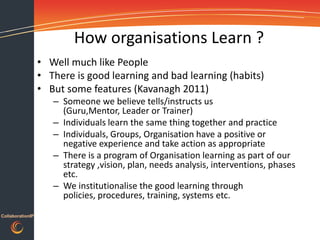
How organisations Learn ?
                  • Well much like People
                  • There is good learning and bad learning (habits)
                  • But some features (Kavanagh 2011)
                     – Someone we believe tells/instructs us
                       (Guru,Mentor, Leader or Trainer)
                     – Individuals learn the same thing together and practice
                     – Individuals, Groups, Organisation have a positive or
                       negative experience and take action as appropriate
                     – There is a program of Organisation learning as part of our
                       strategy ,vision, plan, needs analysis, interventions, phases
                       etc.
                     – We institutionalise the good learning through
                       policies, procedures, training, systems etc.
CollaborationIP
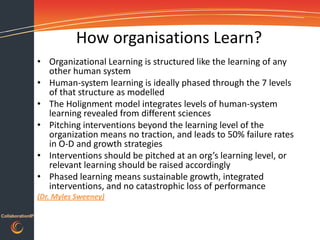
How organisations Learn?
                  • Organizational Learning is structured like the learning of any
                    other human system
                  • Human-system learning is ideally phased through the 7 levels
                    of that structure as modelled
                  • The Holignment model integrates levels of human-system
                    learning revealed from different sciences
                  • Pitching interventions beyond the learning level of the
                    organization means no traction, and leads to 50% failure rates
                    in O-D and growth strategies
                  • Interventions should be pitched at an org’s learning level, or
                    relevant learning should be raised accordingly
                  • Phased learning means sustainable growth, integrated
                    interventions, and no catastrophic loss of performance
                  (Dr. Myles Sweeney)

CollaborationIP
Mid Presentation Conclusions
                  • Organisations have complex systems including
                    the human system.
                  • There are similarities between the way people
                    and organisations learn.
                  • Individual & Group behaviour ultimately
                    determine the outcomes and successes
                  • Accelerating collaboration outcomes normally
                    requires change and all that goes with it.
                  • The level and type of interventions to
                    accelerate the change will depend on the
                    current collaboration maturity.
CollaborationIP
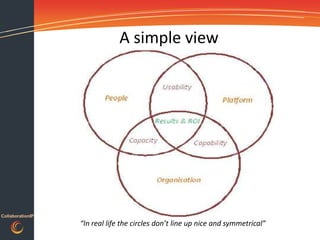
A simple view


CollaborationIP
                  “In real life the circles don’t line up nice and symmetrical”
So what does this mean for
                            collaboration?
                  • People are central
                  • Organisations are complex
                  • Change is frequent
                  • Collaboration is an Organisation
                    Development activity
                  • We must create a system and culture of
                    collaboration before we can maximise ROI
                  • Platforms can be powerful
CollaborationIP
Help is available
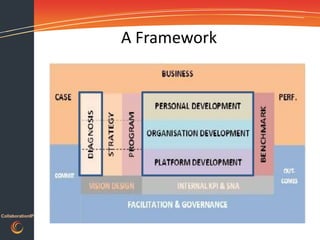
                  • Use a simple framework and set of tools
                    – They inform you on the organisations
                      collaboration maturity.
                    – They provide a road map to design and
                      execute the program of interventions
                    – They connect the 3 intertwined strands
                      (people, organisation, platform) with the
                      business goals

CollaborationIP
A Framework


CollaborationIP
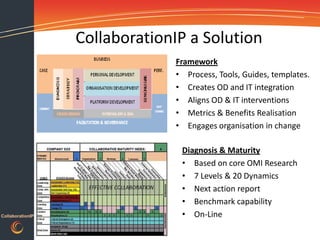
CollaborationIP a Solution
                               Framework
                               • Process, Tools, Guides, templates.
                               • Creates OD and IT integration
                               • Aligns OD & IT interventions
                               • Metrics & Benefits Realisation
                               • Engages organisation in change

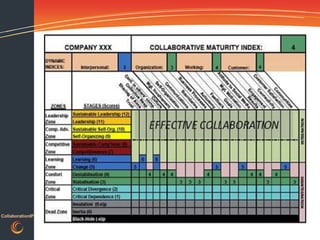
                                Diagnosis & Maturity
                                • Based on core OMI Research
                                • 7 Levels & 20 Dynamics
                                • Next action report
                                • Benchmark capability
CollaborationIP                 • On-Line
CollaborationIP
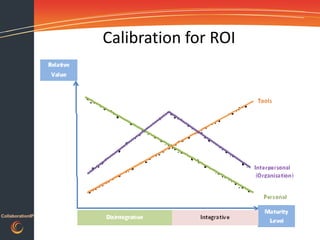
Calibration for ROI


CollaborationIP
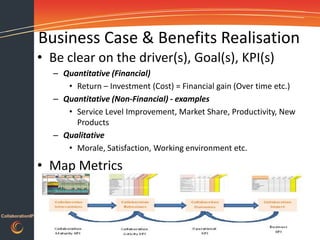
Business Case & Benefits Realisation
                  • Be clear on the driver(s), Goal(s), KPI(s)
                    – Quantitative (Financial)
                       • Return – Investment (Cost) = Financial gain (Over time etc.)
                    – Quantitative (Non-Financial) - examples
                       • Service Level Improvement, Market Share, Productivity, New
                         Products
                    – Qualitative
                       • Morale, Satisfaction, Working environment etc.

                  • Map Metrics


CollaborationIP
COLLABORATION MATURITY + COLLABORATION S/W
                                 = COLLABORATION PLATFORM

                  Customer Benefits
                  • The people are central to adoption
                  • Interventions are at the right learning level
                  • Business case and value can be tracked
                  • Faster adoption and output from
                    technology.
                  • Accelerates Innovation, Productivity,
                    Knowledge & Information Mgmt.
CollaborationIP
Conclusions
                  • Collaboration & Platforms are powerful
                    – Release Talent
                    – Change the way we work
                  • Complex human systems at work
                  • Traction & ROI can be accelerated by:
                    – Diagnosis of maturity
                    – Integrated & Aligned program (people,
                      organisation & Platform)
                    – Having a Framework/Roadmap
CollaborationIP
Thanks
                  For more information on CIP Framework &
                   On-Line diagnosis, report & dashboard.
                    Declan.kavanagh@collaborationIP.com
                           For copy of presentation
                      www.collaborationip.yolasite.com

CollaborationIP

Social Connections II - Gaining Traction & Results from Collaboration Platforms (The Human Dimension) - Declan Kavanagh

  • 1.
    Gaining Traction &Results from Collaboration Platforms (The Human Dimension) Declan Kavanagh CollaborationIP
  • 2.
    Agenda • Why Collaboration? • How People Collaborate? • The Psychology Behind it • How Organisations Learn? • The Science Behind it • A Framework for Collaboration Programs • Diagnosis of Collaboration Maturity • The Business Case Framework CollaborationIP COLLABORATION SOFTWARE + COLLABORATION MATURITY = COLLABORATIVE PLATFORM
  • 3.
  • 4.
    What is Collaboration? “Collaboration is a recursive process where two or more people or organizations work together in an intersection of common goals — for example, an intellectual endeavor that is creative in nature—by sharing knowledge, learning and building consensus” (Wikipedia) Collaboration is fundamentally an interpersonal activity and can be observed not only by results but by behaviors, processes, leadership and CollaborationIP culture.
  • 5.
    Why Consider Collaboration? • Known and accepted benefits • Speeding up Responsiveness • Facilitating Innovation • Enhancing Learning • Growing the competence mass of the organization • Increasing the capacity and speed of organizational intelligence • Improving Involvement and Sharing Responsibility • Knowledge economy evolution • Can release talent • Social Media Phenomenon • The new workforce entrants • Established market with challenges CollaborationIP
  • 6.
    What are thechallenges ? • Organisation recognition that collaboration is about human behaviours in the system. • Preparing a business case and tracking benefits • Fundamental changes in how an organisation works. • Selecting & Deploying a platform (Proprietary/Public) • Managed as IT projects rather than OD projects. • Interventions not aligned with Organisation Maturity. CollaborationIP
  • 7.
    How People Collaborate? • Nature (Survival) versus Nurture (Secure) • Pre disposed to collaborate (More than one) – “I cant do on my own..It would be better to do with …It would be more enjoyable to do with..” • Desire to seek – “Common goal..common interest..like minded.. newness…” • Social – “Collegiate..Friendship..Security..Interaction..stimulation. .Reaction..” • Style – “communication..Ideas..Building..challenging..testing… CollaborationIP
  • 8.
    What influences peopleto collaborate or not ? • Pride • Ego • Fear • Trust • Reward • Risk • Personality • Politics • Perception • Norms • Values CollaborationIP • Environment
  • 9.
    Now we lookat an organisation of People • Vision & Mission • Goals & Objectives • Structure • Management & Leadership • Individuals & Groups • Integrative or Dis-Integrative • Physical Environment • Aligned or un aligned • Style • Congruent or incongruent • Range of Stakeholders • Stable or Unstable • Processes • Systems • Values • Culture • Macro environment CollaborationIP
  • 10.
  • 11.
    How Organisations Learn? • There are many theories and Models • Theories (some !) – Argris & Schon (1978) looks at expected outcomes versus actual caused by action and also influences on action culture etc. – Kim (1993) looks at information flows – Nonaka & Takeuchi (1995) looks at Tacit (personal, context, subjective) and Explicit (Formal, Systematic) Knowledge – Bontis & Serenko(2009) look at Managerial Leadership & Employee sentiment as Key – And many more…… CollaborationIP
  • 12.
    How organisations Learn? • Well much like People • There is good learning and bad learning (habits) • But some features (Kavanagh 2011) – Someone we believe tells/instructs us (Guru,Mentor, Leader or Trainer) – Individuals learn the same thing together and practice – Individuals, Groups, Organisation have a positive or negative experience and take action as appropriate – There is a program of Organisation learning as part of our strategy ,vision, plan, needs analysis, interventions, phases etc. – We institutionalise the good learning through policies, procedures, training, systems etc. CollaborationIP
  • 13.
    How organisations Learn? • Organizational Learning is structured like the learning of any other human system • Human-system learning is ideally phased through the 7 levels of that structure as modelled • The Holignment model integrates levels of human-system learning revealed from different sciences • Pitching interventions beyond the learning level of the organization means no traction, and leads to 50% failure rates in O-D and growth strategies • Interventions should be pitched at an org’s learning level, or relevant learning should be raised accordingly • Phased learning means sustainable growth, integrated interventions, and no catastrophic loss of performance (Dr. Myles Sweeney) CollaborationIP
  • 14.
    Mid Presentation Conclusions • Organisations have complex systems including the human system. • There are similarities between the way people and organisations learn. • Individual & Group behaviour ultimately determine the outcomes and successes • Accelerating collaboration outcomes normally requires change and all that goes with it. • The level and type of interventions to accelerate the change will depend on the current collaboration maturity. CollaborationIP
  • 15.
    A simple view CollaborationIP “In real life the circles don’t line up nice and symmetrical”
  • 16.
    So what doesthis mean for collaboration? • People are central • Organisations are complex • Change is frequent • Collaboration is an Organisation Development activity • We must create a system and culture of collaboration before we can maximise ROI • Platforms can be powerful CollaborationIP
  • 17.
    Help is available • Use a simple framework and set of tools – They inform you on the organisations collaboration maturity. – They provide a road map to design and execute the program of interventions – They connect the 3 intertwined strands (people, organisation, platform) with the business goals CollaborationIP
  • 18.
  • 19.
    CollaborationIP a Solution Framework • Process, Tools, Guides, templates. • Creates OD and IT integration • Aligns OD & IT interventions • Metrics & Benefits Realisation • Engages organisation in change Diagnosis & Maturity • Based on core OMI Research • 7 Levels & 20 Dynamics • Next action report • Benchmark capability CollaborationIP • On-Line
  • 20.
  • 21.
  • 22.
    Business Case &Benefits Realisation • Be clear on the driver(s), Goal(s), KPI(s) – Quantitative (Financial) • Return – Investment (Cost) = Financial gain (Over time etc.) – Quantitative (Non-Financial) - examples • Service Level Improvement, Market Share, Productivity, New Products – Qualitative • Morale, Satisfaction, Working environment etc. • Map Metrics CollaborationIP
  • 23.
    COLLABORATION MATURITY +COLLABORATION S/W = COLLABORATION PLATFORM Customer Benefits • The people are central to adoption • Interventions are at the right learning level • Business case and value can be tracked • Faster adoption and output from technology. • Accelerates Innovation, Productivity, Knowledge & Information Mgmt. CollaborationIP
  • 24.
    Conclusions • Collaboration & Platforms are powerful – Release Talent – Change the way we work • Complex human systems at work • Traction & ROI can be accelerated by: – Diagnosis of maturity – Integrated & Aligned program (people, organisation & Platform) – Having a Framework/Roadmap CollaborationIP
  • 25.
    Thanks For more information on CIP Framework & On-Line diagnosis, report & dashboard. Declan.kavanagh@collaborationIP.com For copy of presentation www.collaborationip.yolasite.com CollaborationIP