PROGRESSIVE
PLANNING
URBAN REGIME THEORY
SOCIAL LEARNING
THEORY
TRANS-ACTIVE
PLANNING
Submitted by :Satish Kumar
Guided by: Ar/Pl . Abhishek Chahuhan Sir., MURP
2020,GBU
PLANNING THEORY
Progressive planning
 Progressive Era (1890s – 1920s) – Social and
Political reforms, in particular eradicate corruption in
government.
 A group of advocacy planning supporters turned to
a more radical direction, they believed that the
current American institutional setting could no longer
meet the needs of the poor so a new institutional
arrangement became a must.
 They advocated public ownership of land, promotion
of industries that could absorb the most
unemployed, and a bottom-up approach in
planning process.
 The movement was named ―progressive planning
with social justice, public participation, and planning
legitimacy as goals.
Progressive Movement as Reform
 Reaction against political and economic
 influence of corporations; monopolies (Rockefeller)
 influence of corrupt ward bosses (Tamany Hall) because of
dispersed, decentralized power of elected officials
 Loss of control of central cities by elites as democracy
spread
 elites moving to streetcar suburbs; dislocation of economic and
political power
 Emergence of corporate models of management
 strong executive leadership
 Rationalize and professionalize city governance
 rationalize city service provision and infrastructure development
 civil service
 depoliticize city
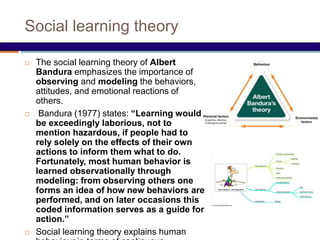
Social learning theory
 The social learning theory of Albert
Bandura emphasizes the importance of
observing and modeling the behaviors,
attitudes, and emotional reactions of
others.
 Bandura (1977) states: “Learning would
be exceedingly laborious, not to
mention hazardous, if people had to
rely solely on the effects of their own
actions to inform them what to do.
Fortunately, most human behavior is
learned observationally through
modeling: from observing others one
forms an idea of how new behaviors are
performed, and on later occasions this
coded information serves as a guide for
action.”
 Social learning theory explains human
Social learning theory
 The component processes underlying observational learning are:
 Attention, including modelled events (distinctiveness, affective
valence, complexity, prevalence, functional value) and observer
characteristics (sensory capacities, arousal level, perceptual set,
past reinforcement),
 Retention, including symbolic coding, cognitive organization,
symbolic rehearsal, motor rehearsal),
 Motor Reproduction, including physical capabilities, self-
observation of reproduction, accuracy of feedback, and
 Motivation, including external, vicarious and self reinforcement.
 Social learning theory has been applied extensively to the
understanding of aggression (Bandura, 1973) and
psychological disorders, particularly in the context of
behaviour modification.
Urban Regime Theory
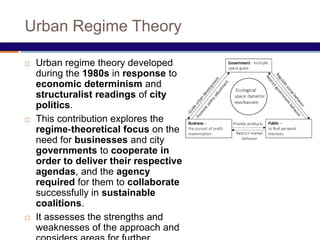
 Urban regime theory developed
during the 1980s in response to
economic determinism and
structuralist readings of city
politics.
 This contribution explores the
regime‐theoretical focus on the
need for businesses and city
governments to cooperate in
order to deliver their respective
agendas, and the agency
required for them to collaborate
successfully in sustainable
coalitions.
 It assesses the strengths and
weaknesses of the approach and
Urban Regime Theory
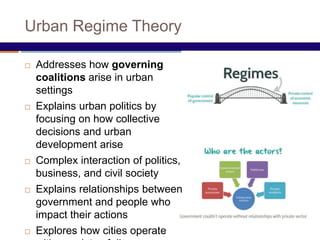
 Addresses how governing
coalitions arise in urban
settings
 Explains urban politics by
focusing on how collective
decisions and urban
development arise
 Complex interaction of politics,
business, and civil society
 Explains relationships between
government and people who
impact their actions
 Explores how cities operate
Urban Regime Theory
 Urban regimes are rooted in two structural elements of
political economy:
1. Local government needs property taxes
2. Capitalist economy is rooted in privatization of production
 Types of regimes
1. Response to debates on community power theory
2. Developed inductively through case studies
 Popular control of government
1. Becomes governor of Louisiana in 1928
2. Increased mobility of capital
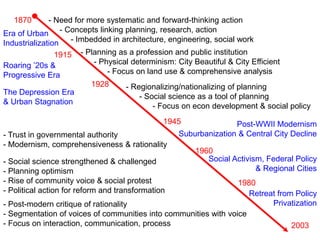
1870
1915
1928
1945
1960
1980
2003
- Need for more systematic and forward-thinking action
- Concepts linking planning, research, action
- Imbedded in architecture, engineering, social work
- Planning as a profession and public institution
- Physical determinism: City Beautiful & City Efficient
- Focus on land use & comprehensive analysis
- Regionalizing/nationalizing of planning
- Social science as a tool of planning
- Focus on econ development & social policy
Era of Urban
Industrialization
Roaring ’20s &
Progressive Era
The Depression Era
& Urban Stagnation
Post-WWII Modernism
Suburbanization & Central City Decline
Social Activism, Federal Policy
& Regional Cities
Retreat from Policy
Privatization
- Trust in governmental authority
- Modernism, comprehensiveness & rationality
- Social science strengthened & challenged
- Planning optimism
- Rise of community voice & social protest
- Political action for reform and transformation
- Post-modern critique of rationality
- Segmentation of voices of communities into communities with voice
- Focus on interaction, communication, process
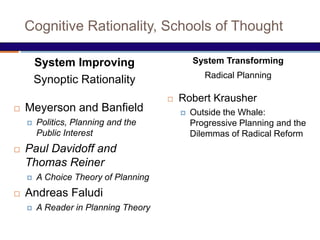
Cognitive Rationality, Schools of Thought
System Improving
Synoptic Rationality
 Meyerson and Banfield
 Politics, Planning and the
Public Interest
 Paul Davidoff and
Thomas Reiner
 A Choice Theory of Planning
 Andreas Faludi
 A Reader in Planning Theory
System Transforming
Radical Planning
 Robert Krausher
 Outside the Whale:
Progressive Planning and the
Dilemmas of Radical Reform
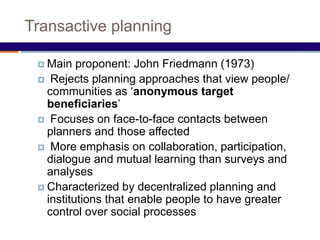
Transactive planning
 Main proponent: John Friedmann (1973)
 Rejects planning approaches that view people/
communities as ‘anonymous target
beneficiaries’
 Focuses on face-to-face contacts between
planners and those affected
 More emphasis on collaboration, participation,
dialogue and mutual learning than surveys and
analyses
 Characterized by decentralized planning and
institutions that enable people to have greater
control over social processes
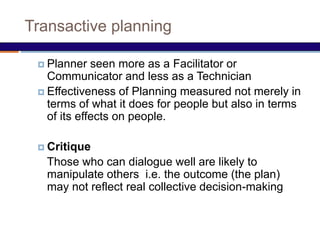
Transactive planning
 Planner seen more as a Facilitator or
Communicator and less as a Technician
 Effectiveness of Planning measured not merely in
terms of what it does for people but also in terms
of its effects on people.
 Critique
Those who can dialogue well are likely to
manipulate others i.e. the outcome (the plan)
may not reflect real collective decision-making

Planning Theory

  • 1.
    PROGRESSIVE PLANNING URBAN REGIME THEORY SOCIALLEARNING THEORY TRANS-ACTIVE PLANNING Submitted by :Satish Kumar Guided by: Ar/Pl . Abhishek Chahuhan Sir., MURP 2020,GBU PLANNING THEORY
  • 2.
    Progressive planning  ProgressiveEra (1890s – 1920s) – Social and Political reforms, in particular eradicate corruption in government.  A group of advocacy planning supporters turned to a more radical direction, they believed that the current American institutional setting could no longer meet the needs of the poor so a new institutional arrangement became a must.  They advocated public ownership of land, promotion of industries that could absorb the most unemployed, and a bottom-up approach in planning process.  The movement was named ―progressive planning with social justice, public participation, and planning legitimacy as goals.
  • 3.
    Progressive Movement asReform  Reaction against political and economic  influence of corporations; monopolies (Rockefeller)  influence of corrupt ward bosses (Tamany Hall) because of dispersed, decentralized power of elected officials  Loss of control of central cities by elites as democracy spread  elites moving to streetcar suburbs; dislocation of economic and political power  Emergence of corporate models of management  strong executive leadership  Rationalize and professionalize city governance  rationalize city service provision and infrastructure development  civil service  depoliticize city
  • 4.
    Social learning theory The social learning theory of Albert Bandura emphasizes the importance of observing and modeling the behaviors, attitudes, and emotional reactions of others.  Bandura (1977) states: “Learning would be exceedingly laborious, not to mention hazardous, if people had to rely solely on the effects of their own actions to inform them what to do. Fortunately, most human behavior is learned observationally through modeling: from observing others one forms an idea of how new behaviors are performed, and on later occasions this coded information serves as a guide for action.”  Social learning theory explains human
  • 5.
    Social learning theory The component processes underlying observational learning are:  Attention, including modelled events (distinctiveness, affective valence, complexity, prevalence, functional value) and observer characteristics (sensory capacities, arousal level, perceptual set, past reinforcement),  Retention, including symbolic coding, cognitive organization, symbolic rehearsal, motor rehearsal),  Motor Reproduction, including physical capabilities, self- observation of reproduction, accuracy of feedback, and  Motivation, including external, vicarious and self reinforcement.  Social learning theory has been applied extensively to the understanding of aggression (Bandura, 1973) and psychological disorders, particularly in the context of behaviour modification.
  • 6.
    Urban Regime Theory Urban regime theory developed during the 1980s in response to economic determinism and structuralist readings of city politics.  This contribution explores the regime‐theoretical focus on the need for businesses and city governments to cooperate in order to deliver their respective agendas, and the agency required for them to collaborate successfully in sustainable coalitions.  It assesses the strengths and weaknesses of the approach and
  • 7.
    Urban Regime Theory Addresses how governing coalitions arise in urban settings  Explains urban politics by focusing on how collective decisions and urban development arise  Complex interaction of politics, business, and civil society  Explains relationships between government and people who impact their actions  Explores how cities operate
  • 8.
    Urban Regime Theory Urban regimes are rooted in two structural elements of political economy: 1. Local government needs property taxes 2. Capitalist economy is rooted in privatization of production  Types of regimes 1. Response to debates on community power theory 2. Developed inductively through case studies  Popular control of government 1. Becomes governor of Louisiana in 1928 2. Increased mobility of capital
  • 9.
    1870 1915 1928 1945 1960 1980 2003 - Need formore systematic and forward-thinking action - Concepts linking planning, research, action - Imbedded in architecture, engineering, social work - Planning as a profession and public institution - Physical determinism: City Beautiful & City Efficient - Focus on land use & comprehensive analysis - Regionalizing/nationalizing of planning - Social science as a tool of planning - Focus on econ development & social policy Era of Urban Industrialization Roaring ’20s & Progressive Era The Depression Era & Urban Stagnation Post-WWII Modernism Suburbanization & Central City Decline Social Activism, Federal Policy & Regional Cities Retreat from Policy Privatization - Trust in governmental authority - Modernism, comprehensiveness & rationality - Social science strengthened & challenged - Planning optimism - Rise of community voice & social protest - Political action for reform and transformation - Post-modern critique of rationality - Segmentation of voices of communities into communities with voice - Focus on interaction, communication, process
  • 10.
    Cognitive Rationality, Schoolsof Thought System Improving Synoptic Rationality  Meyerson and Banfield  Politics, Planning and the Public Interest  Paul Davidoff and Thomas Reiner  A Choice Theory of Planning  Andreas Faludi  A Reader in Planning Theory System Transforming Radical Planning  Robert Krausher  Outside the Whale: Progressive Planning and the Dilemmas of Radical Reform
  • 11.
    Transactive planning  Mainproponent: John Friedmann (1973)  Rejects planning approaches that view people/ communities as ‘anonymous target beneficiaries’  Focuses on face-to-face contacts between planners and those affected  More emphasis on collaboration, participation, dialogue and mutual learning than surveys and analyses  Characterized by decentralized planning and institutions that enable people to have greater control over social processes
  • 12.
    Transactive planning  Plannerseen more as a Facilitator or Communicator and less as a Technician  Effectiveness of Planning measured not merely in terms of what it does for people but also in terms of its effects on people.  Critique Those who can dialogue well are likely to manipulate others i.e. the outcome (the plan) may not reflect real collective decision-making