The Minnesota State Colleges and Universities system is an Equal Opportunity employer and educator.
Minnesota State Colleges and Universities
Highlights from the MnSCU
Captioning Assessment Project
Lesley Blicker Maran Wolston
Mary Pietruszewski Rita Resendiz-Abfalter
MnSCU Captioning Assessment Project
Project undertaken by Captioning Assessment Work Group
under the auspices of the MnSCU ASA Technology Council
 Maran Wolston, Project Manager; Lesley Blicker and Kim
Lynch, System Office, Project Sponsors
 Work completed to date:
 Captioning practices survey
 Identified captioning vendors and products, conducted vendor
meetings/informal interviews
 Researched legal elements of captioning, created legal FAQ document
 Campus “deep dive” to assess and document best practices for captioning
 Conducted Captioning Symposium April 8, 2016
 Created Accessible-Ed listserv
 To explore options used by MnSCU institutions for the
provision of transcription and captioning services for
teaching and instructional purposes (products and
processes)
 To locate all places within an institution where there
are efforts being taken to caption course videos
 To help identify best practices or campuses with
whom the work group could follow up
 To serve as a baseline assessment (state of the state)
about course/instructional video captioning in MnSCU
MnSCU Course Video
Captioning Practices Survey
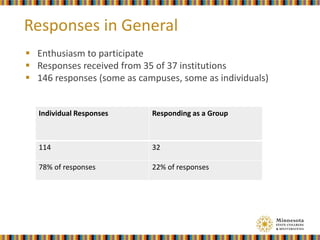
Individual Responses Responding as a Group
114 32
78% of responses 22% of responses
 Enthusiasm to participate
 Responses received from 35 of 37 institutions
 146 responses (some as campuses, some as individuals)
Responses in General
 MnSCU institutions are making accommodation requests
 When describing practices and processes for captioning,
the majority of the answers were referring to
accommodation requests, not advance captioning
 No established guidelines or procedures at campus
 No well-communicated process or understanding about
whose role it is to caption
 Cost and budget issues, need top-down support to make a
priority
 Web accessibility is slightly ahead of course accessibility
 Faculty feel they’re responsible yet lack the tools,
resources, time, and support needed
Recurring Themes 1
 Many, many “I don’t knows” to questions yet these are the
people most interested in and/or doing some form of
captioning at their institution
 Backlog of videos to be captioned is daunting
 Can’t keep up with faculty who post videos on the fly
 Universal design benefits many
 Outsourcing has been beneficial for those using it’; turn-
around is quick
 Misunderstanding about what constitutes meeting ADA
requirements
Recurring Themes 2
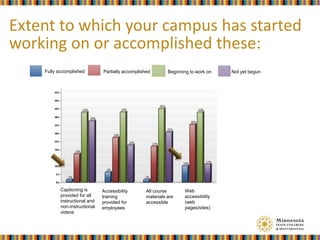
Captioning is
provided for all
instructional and
non-instructional
videos
Accessibility
training
provided for
employees
All course
materials are
accessible
Web
accessibility
(web
pages/sites)
Fully accomplished Partially accomplished Not yet begunBeginning to work on
Extent to which your campus has started
working on or accomplished these:
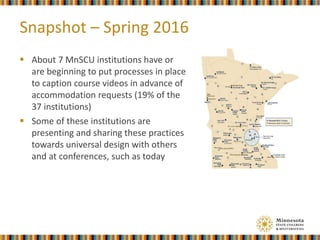
 About 7 MnSCU institutions have or
are beginning to put processes in place
to caption course videos in advance of
accommodation requests (19% of the
37 institutions)
 Some of these institutions are
presenting and sharing these practices
towards universal design with others
and at conferences, such as today
Snapshot – Spring 2016
 Campus financial commitment with dedicated budget
item for captioning
 Use of cross-functional teams with senior level
leadership endorsement; prioritizing videos to be
captioned
 Presence of tools, software, or services for captioning
(outsource, insource, or some combination)
 Training and technical support
 Clear processes in place
How Are They Doing It?
Commonly Used Captioning Services
and Products
 Captioning services
 3Play Media
 AutoSyncTechnologies (CaptionSync)
 Rev.com
 Captioning software/tools
 Camtasia
 YouTube
Note: See paper handout for details
Campus Processes: Four Examples
 North Hennepin Community College
 Central Lakes College
 MSU Mankato
 Anoka-Ramsey Community College
Common to all:
 Administrator support (acknowledgement of need; dedicated
funding)
 Cross-role workgroup to determine needs, processes,
advocate, and educate
13
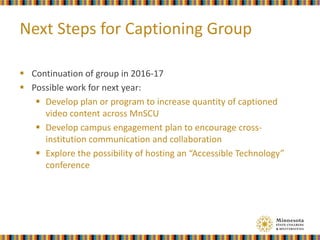
Next Steps for Captioning Group
 Continuation of group in 2016-17
 Possible work for next year:
 Develop plan or program to increase quantity of captioned
video content across MnSCU
 Develop campus engagement plan to encourage cross-
institution communication and collaboration
 Explore the possibility of hosting an “Accessible Technology”
conference
A Few Resources…
 Captioning Symposium (4/8/16) video recordings and slide
presentations
 Accessible-Ed Listserv
Note: See paper handout for more details on how to access the
above items
Audience Q&A
If you’d like to get in touch with the session presenters
after today’s event, please find our contact information
on the paper handout. Thanks!

Highlights from the MnSCU Captioning Assessment Project

  • 1.
    The Minnesota StateColleges and Universities system is an Equal Opportunity employer and educator. Minnesota State Colleges and Universities Highlights from the MnSCU Captioning Assessment Project Lesley Blicker Maran Wolston Mary Pietruszewski Rita Resendiz-Abfalter
  • 2.
    MnSCU Captioning AssessmentProject Project undertaken by Captioning Assessment Work Group under the auspices of the MnSCU ASA Technology Council  Maran Wolston, Project Manager; Lesley Blicker and Kim Lynch, System Office, Project Sponsors  Work completed to date:  Captioning practices survey  Identified captioning vendors and products, conducted vendor meetings/informal interviews  Researched legal elements of captioning, created legal FAQ document  Campus “deep dive” to assess and document best practices for captioning  Conducted Captioning Symposium April 8, 2016  Created Accessible-Ed listserv
  • 3.
     To exploreoptions used by MnSCU institutions for the provision of transcription and captioning services for teaching and instructional purposes (products and processes)  To locate all places within an institution where there are efforts being taken to caption course videos  To help identify best practices or campuses with whom the work group could follow up  To serve as a baseline assessment (state of the state) about course/instructional video captioning in MnSCU MnSCU Course Video Captioning Practices Survey
  • 5.
    Individual Responses Respondingas a Group 114 32 78% of responses 22% of responses  Enthusiasm to participate  Responses received from 35 of 37 institutions  146 responses (some as campuses, some as individuals) Responses in General
  • 6.
     MnSCU institutionsare making accommodation requests  When describing practices and processes for captioning, the majority of the answers were referring to accommodation requests, not advance captioning  No established guidelines or procedures at campus  No well-communicated process or understanding about whose role it is to caption  Cost and budget issues, need top-down support to make a priority  Web accessibility is slightly ahead of course accessibility  Faculty feel they’re responsible yet lack the tools, resources, time, and support needed Recurring Themes 1
  • 7.
     Many, many“I don’t knows” to questions yet these are the people most interested in and/or doing some form of captioning at their institution  Backlog of videos to be captioned is daunting  Can’t keep up with faculty who post videos on the fly  Universal design benefits many  Outsourcing has been beneficial for those using it’; turn- around is quick  Misunderstanding about what constitutes meeting ADA requirements Recurring Themes 2
  • 8.
    Captioning is provided forall instructional and non-instructional videos Accessibility training provided for employees All course materials are accessible Web accessibility (web pages/sites) Fully accomplished Partially accomplished Not yet begunBeginning to work on Extent to which your campus has started working on or accomplished these:
  • 9.
     About 7MnSCU institutions have or are beginning to put processes in place to caption course videos in advance of accommodation requests (19% of the 37 institutions)  Some of these institutions are presenting and sharing these practices towards universal design with others and at conferences, such as today Snapshot – Spring 2016
  • 10.
     Campus financialcommitment with dedicated budget item for captioning  Use of cross-functional teams with senior level leadership endorsement; prioritizing videos to be captioned  Presence of tools, software, or services for captioning (outsource, insource, or some combination)  Training and technical support  Clear processes in place How Are They Doing It?
  • 11.
    Commonly Used CaptioningServices and Products  Captioning services  3Play Media  AutoSyncTechnologies (CaptionSync)  Rev.com  Captioning software/tools  Camtasia  YouTube Note: See paper handout for details
  • 12.
    Campus Processes: FourExamples  North Hennepin Community College  Central Lakes College  MSU Mankato  Anoka-Ramsey Community College Common to all:  Administrator support (acknowledgement of need; dedicated funding)  Cross-role workgroup to determine needs, processes, advocate, and educate
  • 13.
  • 22.
    Next Steps forCaptioning Group  Continuation of group in 2016-17  Possible work for next year:  Develop plan or program to increase quantity of captioned video content across MnSCU  Develop campus engagement plan to encourage cross- institution communication and collaboration  Explore the possibility of hosting an “Accessible Technology” conference
  • 23.
    A Few Resources… Captioning Symposium (4/8/16) video recordings and slide presentations  Accessible-Ed Listserv Note: See paper handout for more details on how to access the above items
  • 24.
    Audience Q&A If you’dlike to get in touch with the session presenters after today’s event, please find our contact information on the paper handout. Thanks!