Scala Data
Pipelines @
Spotify
Neville Li
@sinisa_lyh
Who am I?
‣ SpotifyNYCsince2011
‣ FormerlyYahoo!Search
‣ Musicrecommendations
‣ Datainfrastructure
‣ Scalasince2013
Spotify in numbers
• Started in 2006, 58 markets
• 75M+ active users, 20M+ paying
• 30M+ songs, 20K new per day
• 1.5 billion playlists
• 1 TB logs per day
• 1200+ node Hadoop cluster
• 10K+ Hadoop jobs per day
Music recommendation @ Spotify
• Discover Weekly
• Radio
• RelatedArtists
• Discover Page
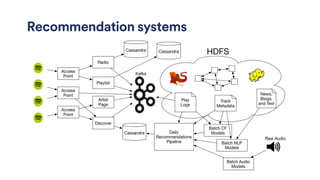
Recommendation systems
A little teaser
PGroupedTable<K,V>::combineValues(CombineFn<K,V> combineFn,
CombineFn<K,V> reduceFn)
Crunch: CombineFns are used to represent the associative operations…
Grouped[K, +V]::reduce[U >: V](fn: (U, U) U)
Scalding: reduce with fn which must be associative and commutative…
PairRDDFunctions[K, V]::reduceByKey(fn: (V, V) => V)
Spark: Merge the values for each key using an associative reduce function…
Monoid!
enables map side reduce
Actually it’s a semigroup
One more teaser
Linear equation inAlternate Least Square (ALS) Matrix factorization
xu = (YTY + YT(Cu − I)Y)−1YTCup(u)
vectors.map { case (id, v) => (id, v * v) }.map(_._2).reduce(_ + _) // YtY
ratings.keyBy(fixedKey).join(outerProducts) // YtCuIY
.map { case (_, (r, op)) =>
(solveKey(r), op * (r.rating * alpha))
}.reduceByKey(_ + _)
ratings.keyBy(fixedKey).join(vectors) // YtCupu
.map { case (_, (r, v)) =>
val (Cui, pui) = (r.rating * alpha + 1, if (Cui > 0.0) 1.0 else 0.0)
(solveKey(r), v * (Cui * pui))
}.reduceByKey(_ + _)
http://www.slideshare.net/MrChrisJohnson/scala-data-pipelines-for-music-recommendations
Success story
• Mid 2013: 100+ Python Luigi M/R jobs, few tests
• 10+ new hires since, most fresh grads
• Few with Java experience, none with Scala
• Now: 300+ Scalding jobs, 400+ tests
• More ad-hoc jobs untracked
• Spark also taking off
First 10 months
……
Activity over time
Guess how many jobs
written by yours truly?
Performance vs. Agility
https://nicholassterling.wordpress.com/2012/11/16/scala-performance/
Let’sdiveinto
something
technical
To join or not to join?
val streams: TypedPipe[(String, String)] = _ // (track, user)
val tgp: TypedPipe[(String, String)] = _ // (track, genre)
streams
.join(tgp)
.values // (user, genre)
.group
.mapValueStream(vs => Iterator(vs.toSet)) // reducer-only
Hash join
val streams: TypedPipe[(String, String)] = _ // (track, user)
val tgp: TypedPipe[(String, String)] = _ // (track, genre)
streams
.hashJoin(tgp.forceToDisk) // tgp replicated to all mappers
.values // (user, genre)
.group
.mapValueStream(vs => Iterator(vs.toSet)) // reducer-only
CoGroup
val streams: TypedPipe[(String, String)] = _ // (track, user)
val tgp: TypedPipe[(String, String)] = _ // (track, genre)
streams
.cogroup(tgp) { case (_, users, genres) =>
users.map((_, genres.toSet))
} // (track, (user, genres))
.values // (user, genres)

.group
.reduce(_ ++ _) // map-side reduce!
CoGroup
val streams: TypedPipe[(String, String)] = _ // (track, user)
val tgp: TypedPipe[(String, String)] = _ // (track, genre)
streams
.cogroup(tgp) { case (_, users, genres) =>
users.map((_, genres.toSet))
} // (track, (user, genres))
.values // (user, genres)

.group
.sum // SetMonoid[Set[T]] from Algebird
* sum[U >:V](implicit sg: Semigroup[U])
Key-value file as distributed cache
val streams: TypedPipe[(String, String)] = _ // (gid, user)
val tgp: SparkeyManager = _ // tgp replicated to all mappers
streams
.map { case (track, user) =>
(user, tgp.get(track).split(",").toSet)
}
.group
.sum
https://github.com/spotify/sparkey
SparkeyManagerwraps DistributedCacheFile
Joins and CoGroups
• Require shuffle and reduce step
• Some ops force everything to reducers

e.g. mapGroup, mapValueStream
• CoGroup more flexible for complex logic
• Scalding flattens a.join(b).join(c)…

into MultiJoin(a, b, c, …)
Distributed cache
• Fasterwith off-heap binary files
• Building cache = more wiring
• Memory mapping may interfere withYARN
• E.g. 64GB nodes with 48GB for containers (no cgroup)
• 12 × 2GB containers each with 2GB JVM heap + mmap cache
• OOM and swap!
• Keep files small (< 1GB) or fallback to joins…
Analyze your jobs
• Concurrent Driven
• Visualize job execution
• Workflow optimization
• Bottlenecks
• Data skew
Notenough
math?
Recommending tracks
• User listened to Rammstein - Du Hast
• Recommend 10 similartracks
• 40 dimension feature vectors fortracks
• Compute cosine similarity between all pairs
• O(n) lookup per userwhere n ≈ 30m
• Trythat with 50m users * 10 seed tracks each
ANNOY - cheat by approximation
• Approximate Nearest Neighbor OhYeah
• Random projections and binarytree search
• Build index on single machine
• Load in mappers via distribute cache
• O(log n) lookup
https://github.com/spotify/annoy
https://github.com/spotify/annoy-java
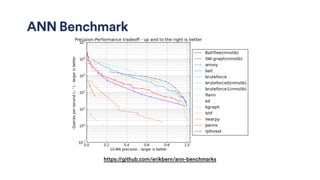
ANN Benchmark
https://github.com/erikbern/ann-benchmarks
Filtering candidates
• Users don’t like seeing artist/album/tracks they already know
• But may forget what they listened long ago
• 50m * thousands of items each
• Over 5 years of streaming logs
• Need to update daily
• Need to purge old items per user
Options
• Aggregate all logs daily
• Aggregate last x days daily
• CSVof artist/album/track ids
• Bloom filters
Decayed value with cutoff
• Compute new user-item score daily
• Weighted on context, e.g. radio, search, playlist
• score’ = score + previous * 0.99
• half life = log0.99
0.5 = 69 days
• Cut off at top 2000
• Items that users might remember seeing recently
Bloom filters
• Probabilistic data structure
• Encoding set of items with m bits and k hash functions
• No false negative
• Tunable false positive probability
• Size proportional to capacity & FP probability
• Let’s build one per user-{artists,albums,tracks}
• Algebird BloomFilterMonoid: z = all zero bits, + = bitwise OR
Size versus max items & FP prob
• User-item distribution is uneven
• Assuming same setting for all users
• # items << capacity → wasting space
• # items > capacity → high FP rate
Scalable Bloom Filter
• Growing sequence of standard BFs
• Increasing capacity and tighter FP probability
• Most users have few BFs
• Power users have many
• Serialization and lookup overhead
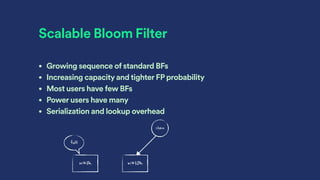
Scalable Bloom Filter
• Growing sequence of standard BFs
• Increasing capacity and tighter FP probability
• Most users have few BFs
• Power users have many
• Serialization and lookup overhead
n=1k
item
Scalable Bloom Filter
• Growing sequence of standard BFs
• Increasing capacity and tighter FP probability
• Most users have few BFs
• Power users have many
• Serialization and lookup overhead
n=1k n=10k
item
full
Scalable Bloom Filter
• Growing sequence of standard BFs
• Increasing capacity and tighter FP probability
• Most users have few BFs
• Power users have many
• Serialization and lookup overhead
item
n=1k n=10k n=100k
fullfull
Scalable Bloom Filter
• Growing sequence of standard BFs
• Increasing capacity and tighter FP probability
• Most users have few BFs
• Power users have many
• Serialization and lookup overhead
n=1k n=10k n=100k n=1m
item
fullfullfull
Opportunistic Bloom Filter
• Building n BFs of increasing capacity in parallel
• Up to << N max possible items
• Keep smallest one with capacity > items inserted
• Expensive to build
• Cheap to store and lookup
Opportunistic Bloom Filter
• Building n BFs of increasing capacity in parallel
• Up to << N max possible items
• Keep smallest one with capacity > items inserted
• Expensive to build
• Cheap to store and lookup
n=1k
 
80%
n=10k
 
8%
n=100k
 
0.8%
n=1m
 
0.08%
item
Opportunistic Bloom Filter
• Building n BFs of increasing capacity in parallel
• Up to  N max possible items
• Keep smallest one with capacity  items inserted
• Expensive to build
• Cheap to store and lookup
n=1k
 
100%
n=10k
 
70%
n=100k
 
7%
n=1m
 
0.7%
item
full
Opportunistic Bloom Filter
• Building n BFs of increasing capacity in parallel
• Up to  N max possible items
• Keep smallest one with capacity  items inserted
• Expensive to build
• Cheap to store and lookup
n=1k
 
100%
n=10k
 
100%
n=100k
 
60%
n=1m

Scala Data Pipelines @ Spotify

  • 1.
  • 2.
    Who am I? ‣SpotifyNYCsince2011 ‣ FormerlyYahoo!Search ‣ Musicrecommendations ‣ Datainfrastructure ‣ Scalasince2013
  • 3.
    Spotify in numbers •Started in 2006, 58 markets • 75M+ active users, 20M+ paying • 30M+ songs, 20K new per day • 1.5 billion playlists • 1 TB logs per day • 1200+ node Hadoop cluster • 10K+ Hadoop jobs per day
  • 4.
    Music recommendation @Spotify • Discover Weekly • Radio • RelatedArtists • Discover Page
  • 5.
  • 6.
    A little teaser PGroupedTable<K,V>::combineValues(CombineFn<K,V>combineFn, CombineFn<K,V> reduceFn) Crunch: CombineFns are used to represent the associative operations… Grouped[K, +V]::reduce[U >: V](fn: (U, U) U) Scalding: reduce with fn which must be associative and commutative… PairRDDFunctions[K, V]::reduceByKey(fn: (V, V) => V) Spark: Merge the values for each key using an associative reduce function…
  • 7.
    Monoid! enables map sidereduce Actually it’s a semigroup
  • 8.
    One more teaser Linearequation inAlternate Least Square (ALS) Matrix factorization xu = (YTY + YT(Cu − I)Y)−1YTCup(u) vectors.map { case (id, v) => (id, v * v) }.map(_._2).reduce(_ + _) // YtY ratings.keyBy(fixedKey).join(outerProducts) // YtCuIY .map { case (_, (r, op)) => (solveKey(r), op * (r.rating * alpha)) }.reduceByKey(_ + _) ratings.keyBy(fixedKey).join(vectors) // YtCupu .map { case (_, (r, v)) => val (Cui, pui) = (r.rating * alpha + 1, if (Cui > 0.0) 1.0 else 0.0) (solveKey(r), v * (Cui * pui)) }.reduceByKey(_ + _) http://www.slideshare.net/MrChrisJohnson/scala-data-pipelines-for-music-recommendations
  • 9.
    Success story • Mid2013: 100+ Python Luigi M/R jobs, few tests • 10+ new hires since, most fresh grads • Few with Java experience, none with Scala • Now: 300+ Scalding jobs, 400+ tests • More ad-hoc jobs untracked • Spark also taking off
  • 10.
  • 11.
  • 12.
    Guess how manyjobs written by yours truly?
  • 13.
  • 14.
  • 15.
    To join ornot to join? val streams: TypedPipe[(String, String)] = _ // (track, user) val tgp: TypedPipe[(String, String)] = _ // (track, genre) streams .join(tgp) .values // (user, genre) .group .mapValueStream(vs => Iterator(vs.toSet)) // reducer-only
  • 16.
    Hash join val streams:TypedPipe[(String, String)] = _ // (track, user) val tgp: TypedPipe[(String, String)] = _ // (track, genre) streams .hashJoin(tgp.forceToDisk) // tgp replicated to all mappers .values // (user, genre) .group .mapValueStream(vs => Iterator(vs.toSet)) // reducer-only
  • 17.
    CoGroup val streams: TypedPipe[(String,String)] = _ // (track, user) val tgp: TypedPipe[(String, String)] = _ // (track, genre) streams .cogroup(tgp) { case (_, users, genres) => users.map((_, genres.toSet)) } // (track, (user, genres)) .values // (user, genres)
 .group .reduce(_ ++ _) // map-side reduce!
  • 18.
    CoGroup val streams: TypedPipe[(String,String)] = _ // (track, user) val tgp: TypedPipe[(String, String)] = _ // (track, genre) streams .cogroup(tgp) { case (_, users, genres) => users.map((_, genres.toSet)) } // (track, (user, genres)) .values // (user, genres)
 .group .sum // SetMonoid[Set[T]] from Algebird * sum[U >:V](implicit sg: Semigroup[U])
  • 19.
    Key-value file asdistributed cache val streams: TypedPipe[(String, String)] = _ // (gid, user) val tgp: SparkeyManager = _ // tgp replicated to all mappers streams .map { case (track, user) => (user, tgp.get(track).split(",").toSet) } .group .sum https://github.com/spotify/sparkey SparkeyManagerwraps DistributedCacheFile
  • 20.
    Joins and CoGroups •Require shuffle and reduce step • Some ops force everything to reducers
 e.g. mapGroup, mapValueStream • CoGroup more flexible for complex logic • Scalding flattens a.join(b).join(c)…
 into MultiJoin(a, b, c, …)
  • 21.
    Distributed cache • Fasterwithoff-heap binary files • Building cache = more wiring • Memory mapping may interfere withYARN • E.g. 64GB nodes with 48GB for containers (no cgroup) • 12 × 2GB containers each with 2GB JVM heap + mmap cache • OOM and swap! • Keep files small (< 1GB) or fallback to joins…
  • 22.
    Analyze your jobs •Concurrent Driven • Visualize job execution • Workflow optimization • Bottlenecks • Data skew
  • 23.
  • 24.
    Recommending tracks • Userlistened to Rammstein - Du Hast • Recommend 10 similartracks • 40 dimension feature vectors fortracks • Compute cosine similarity between all pairs • O(n) lookup per userwhere n ≈ 30m • Trythat with 50m users * 10 seed tracks each
  • 25.
    ANNOY - cheatby approximation • Approximate Nearest Neighbor OhYeah • Random projections and binarytree search • Build index on single machine • Load in mappers via distribute cache • O(log n) lookup https://github.com/spotify/annoy https://github.com/spotify/annoy-java
  • 26.
  • 27.
    Filtering candidates • Usersdon’t like seeing artist/album/tracks they already know • But may forget what they listened long ago • 50m * thousands of items each • Over 5 years of streaming logs • Need to update daily • Need to purge old items per user
  • 28.
    Options • Aggregate alllogs daily • Aggregate last x days daily • CSVof artist/album/track ids • Bloom filters
  • 29.
    Decayed value withcutoff • Compute new user-item score daily • Weighted on context, e.g. radio, search, playlist • score’ = score + previous * 0.99 • half life = log0.99 0.5 = 69 days • Cut off at top 2000 • Items that users might remember seeing recently
  • 30.
    Bloom filters • Probabilisticdata structure • Encoding set of items with m bits and k hash functions • No false negative • Tunable false positive probability • Size proportional to capacity & FP probability • Let’s build one per user-{artists,albums,tracks} • Algebird BloomFilterMonoid: z = all zero bits, + = bitwise OR
  • 31.
    Size versus maxitems & FP prob • User-item distribution is uneven • Assuming same setting for all users • # items << capacity → wasting space • # items > capacity → high FP rate
  • 32.
    Scalable Bloom Filter •Growing sequence of standard BFs • Increasing capacity and tighter FP probability • Most users have few BFs • Power users have many • Serialization and lookup overhead
  • 33.
    Scalable Bloom Filter •Growing sequence of standard BFs • Increasing capacity and tighter FP probability • Most users have few BFs • Power users have many • Serialization and lookup overhead n=1k item
  • 34.
    Scalable Bloom Filter •Growing sequence of standard BFs • Increasing capacity and tighter FP probability • Most users have few BFs • Power users have many • Serialization and lookup overhead n=1k n=10k item full
  • 35.
    Scalable Bloom Filter •Growing sequence of standard BFs • Increasing capacity and tighter FP probability • Most users have few BFs • Power users have many • Serialization and lookup overhead item n=1k n=10k n=100k fullfull
  • 36.
    Scalable Bloom Filter •Growing sequence of standard BFs • Increasing capacity and tighter FP probability • Most users have few BFs • Power users have many • Serialization and lookup overhead n=1k n=10k n=100k n=1m item fullfullfull
  • 37.
    Opportunistic Bloom Filter •Building n BFs of increasing capacity in parallel • Up to << N max possible items • Keep smallest one with capacity > items inserted • Expensive to build • Cheap to store and lookup
  • 38.
    Opportunistic Bloom Filter •Building n BFs of increasing capacity in parallel • Up to << N max possible items • Keep smallest one with capacity > items inserted • Expensive to build • Cheap to store and lookup n=1k
  • 39.
  • 40.
  • 41.
  • 42.
  • 43.
    Opportunistic Bloom Filter •Building n BFs of increasing capacity in parallel • Up to N max possible items • Keep smallest one with capacity items inserted • Expensive to build • Cheap to store and lookup n=1k
  • 44.
  • 45.
  • 46.
  • 47.
  • 48.
    Opportunistic Bloom Filter •Building n BFs of increasing capacity in parallel • Up to N max possible items • Keep smallest one with capacity items inserted • Expensive to build • Cheap to store and lookup n=1k
  • 49.
  • 50.
  • 51.