Search @ Spotify.
Mounia Lalmas
and many others at Spotify Boston,
London, New York & Stockholm
November 27, 2018
1
2
3
4
5
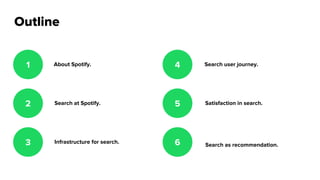
Outline
About Spotify.
Search at Spotify.
Infrastructure for search.
Search user journey.
Satisfaction in search.
6 Search as recommendation.
About Spotify.
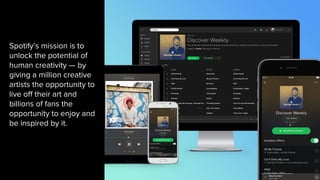
Spotify’s mission is to
unlock the potential of
human creativity — by
giving a million creative
artists the opportunity to
live off their art and
billions of fans the
opportunity to enjoy and
be inspired by it.
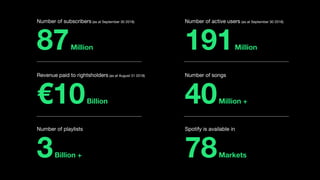
87Million
3Billion + 78Markets
40Million +
191Million
€10Billion
Number of playlists Spotify is available in
Revenue paid to rightsholders (as at August 31 2018) Number of songs
Number of subscribers (as at September 30 2018) Number of active users (as at September 30 2018)
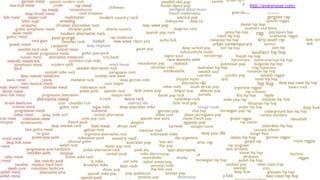
http://everynoise.com/
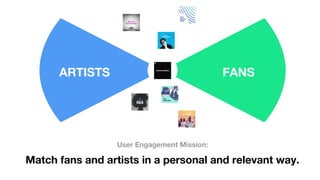
User Engagement Mission:
Match fans and artists in a personal and relevant way.
ARTISTS FANS
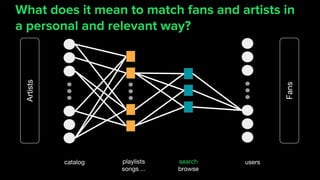
playlists
songs ...
catalog search
browse
users
What does it mean to match fans and artists in
a personal and relevant way?Artists
Fans
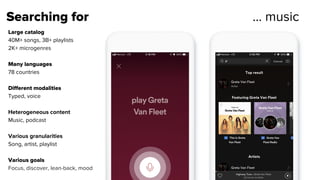
Search at
Spotify.
Large catalog
40M+ songs, 3B+ playlists
2K+ microgenres
Many languages
78 countries
Different modalities
Typed, voice
Heterogeneous content
Music, podcast
Various granularities
Song, artist, playlist
Various goals
Focus, discover, lean-back, mood
Searching for … music
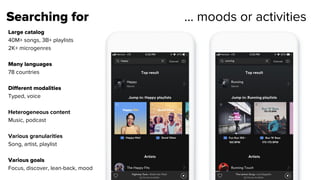
Large catalog
40M+ songs, 3B+ playlists
2K+ microgenres
Many languages
78 countries
Different modalities
Typed, voice
Heterogeneous content
Music, podcast
Various granularities
Song, artist, playlist
Various goals
Focus, discover, lean-back, mood
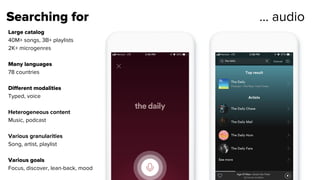
Searching for … audio
Large catalog
40M+ songs, 3B+ playlists
2K+ microgenres
Many languages
78 countries
Different modalities
Typed, voice
Heterogeneous content
Music, podcast
Various granularities
Song, artist, playlist
Various goals
Focus, discover, lean-back, mood
Searching for … moods or activities
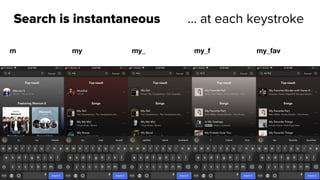
Search is instantaneous … at each keystroke
m my my_ my_f my_fav
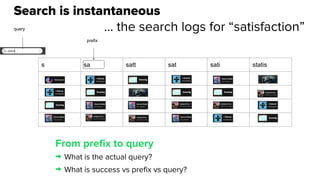
s sa satt sat sati statis
Search is instantaneous
… the search logs for “satisfaction”
From prefix to query
→ What is the actual query?
→ What is success vs prefix vs query?
prefix
query
Infrastructure for
search.
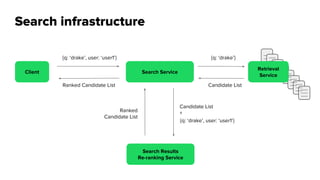
Search infrastructure
{q: ‘drake’, user: ‘user1’}
Client
{q: ‘drake’, user: ‘user1’}
Search Service
Search Results
Re-ranking Service
Candidate List
+Ranked
Candidate List
Retrieval
Service
Candidate List
{q: ‘drake’}
Ranked Candidate List
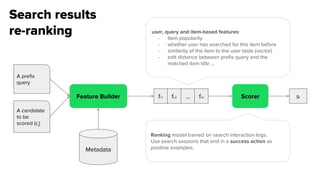
Search results
re-ranking
A prefix
query
A candidate
to be
scored (ci
)
Metadata
Feature Builder fi,1 fi,2 ... fi,k Scorer si
Ranking model trained on search interaction logs.
Use search sessions that end in a success action as
positive examples.
user, query and item-based features:
- Item popularity
- whether user has searched for this item before
- similarity of the item to the user taste (vector)
- edit distance between prefix query and the
matched item title ...
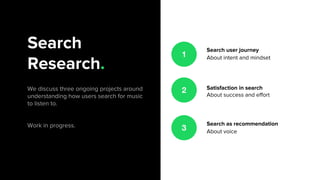
Search
Research.
We discuss three ongoing projects around
understanding how users search for music
to listen to.
Work in progress.
Search user journey
About intent and mindset
Satisfaction in search
About success and effort
Search as recommendation
About voice
1
2
3
Search user
journey.
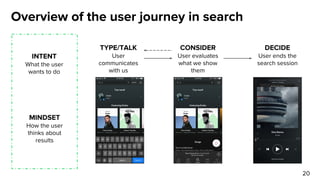
Overview of the user journey in search
TYPE/TALK
User
communicates
with us
20
CONSIDER
User evaluates
what we show
them
DECIDE
User ends the
search session
INTENT
What the user
wants to do
MINDSET
How the user
thinks about
results
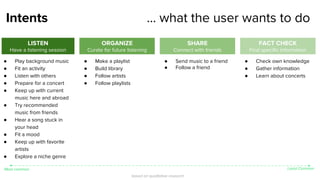
Intents … what the user wants to do
● Play background music
● Fit an activity
● Listen with others
● Prepare for a concert
● Keep up with current
music here and abroad
● Try recommended
music from friends
● Hear a song stuck in
your head
● Fit a mood
● Keep up with favorite
artists
● Explore a niche genre
LISTEN
Have a listening session
ORGANIZE
Curate for future listening
SHARE
Connect with friends
FACT CHECK
Find specific information
● Make a playlist
● Build library
● Follow artists
● Follow playlists
● Send music to a friend
● Follow a friend
● Check own knowledge
● Gather information
● Learn about concerts
Most common Least Common
based on qualitative research
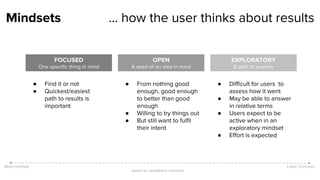
Mindsets … how the user thinks about results
FOCUSED
One specific thing in mind
OPEN
A seed of an idea in mind
EXPLORATORY
A path to explore
● Find it or not
● Quickest/easiest
path to results is
important
● From nothing good
enough, good enough
to better than good
enough
● Willing to try things out
● But still want to fulfil
their intent
● Difficult for users to
assess how it went
● May be able to answer
in relative terms
● Users expect to be
active when in an
exploratory mindset
● Effort is expected
Most common Least Common
based on qualitative research
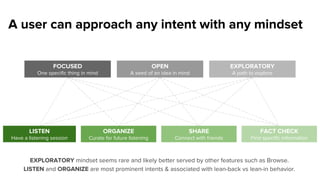
A user can approach any intent with any mindset
FOCUSED
One specific thing in mind
OPEN
A seed of an idea in mind
EXPLORATORY
A path to explore
LISTEN
Have a listening session
ORGANIZE
Curate for future listening
SHARE
Connect with friends
FACT CHECK
Find specific information
EXPLORATORY mindset seems rare and likely better served by other features such as Browse.
LISTEN and ORGANIZE are most prominent intents & associated with lean-back vs lean-in behavior.
Focused
mindset.
When users know what they want
to find.
The pull paradigm and how it
translates to the music context.
Findings from large-scale in-app
survey + behavioral analysis.
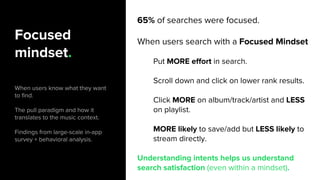
65% of searches were focused.
When users search with a Focused Mindset
Put MORE effort in search.
Scroll down and click on lower rank results.
Click MORE on album/track/artist and LESS
on playlist.
MORE likely to save/add but LESS likely to
stream directly.
Understanding intents helps us understand
search satisfaction (even within a mindset).
Satisfaction in search.
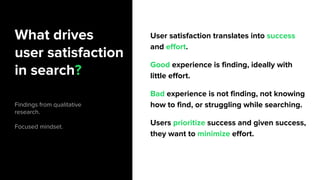
What drives
user satisfaction
in search?
Findings from qualitative
research.
Focused mindset.
User satisfaction translates into success
and effort.
Good experience is finding, ideally with
little effort.
Bad experience is not finding, not knowing
how to find, or struggling while searching.
Users prioritize success and given success,
they want to minimize effort.
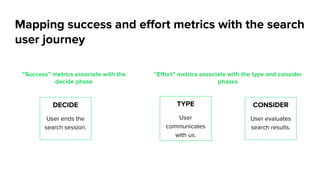
Mapping success and effort metrics with the search
user journey
DECIDE
User ends the
search session.
TYPE
User
communicates
with us.
CONSIDER
User evaluates
search results.
“Success” metrics associate with the
decide phase
“Effort” metrics associate with the type and consider
phases
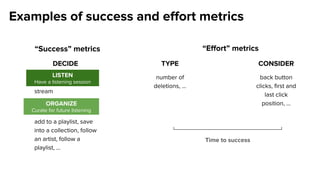
Examples of success and effort metrics
DECIDE TYPE
number of
deletions, ...
CONSIDER
back button
clicks, first and
last click
position, ...
Time to success
“Success” metrics “Effort” metrics
stream
LISTEN
Have a listening session
add to a playlist, save
into a collection, follow
an artist, follow a
playlist, ...
ORGANIZE
Curate for future listening
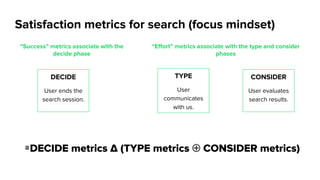
Satisfaction metrics for search (focus mindset)
DECIDE
User ends the
search session.
TYPE
User
communicates
with us.
CONSIDER
User evaluates
search results.
“Success” metrics associate with the
decide phase
“Effort” metrics associate with the type and consider
phases
≅DECIDE metrics ∆ (TYPE metrics ⨁ CONSIDER metrics)
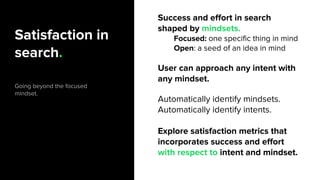
Satisfaction in
search.
Going beyond the focused
mindset.
Success and effort in search
shaped by mindsets.
Focused: one specific thing in mind
Open: a seed of an idea in mind
User can approach any intent with
any mindset.
Automatically identify mindsets.
Automatically identify intents.
Explore satisfaction metrics that
incorporates success and effort
with respect to intent and mindset.
Search as
recommendation.
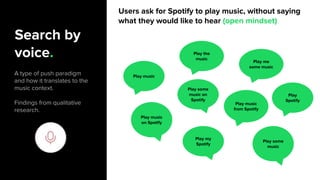
Users ask for Spotify to play music, without saying
what they would like to hear (open mindset)
Play
Spotify
Play music
Play music
from Spotify
Play me
some music
Play the
music
Play my
Spotify
Play some
music on
Spotify
Play some
music
Play music
on Spotify
Search by
voice.
A type of push paradigm
and how it translates to the
music context.
Findings from qualitative
research.
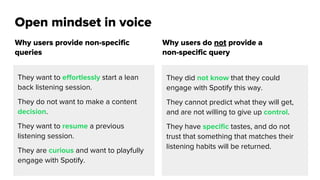
Why users provide non-specific
queries
Open mindset in voice
Private & Confidential, For Internal Use
Only
Why users do not provide a
non-specific query
They want to effortlessly start a lean
back listening session.
They do not want to make a content
decision.
They want to resume a previous
listening session.
They are curious and want to playfully
engage with Spotify.
They did not know that they could
engage with Spotify this way.
They cannot predict what they will get,
and are not willing to give up control.
They have specific tastes, and do not
trust that something that matches their
listening habits will be returned.
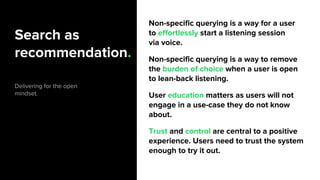
Search as
recommendation.
Delivering for the open
mindset.
Non-specific querying is a way for a user
to effortlessly start a listening session
via voice.
Non-specific querying is a way to remove
the burden of choice when a user is open
to lean-back listening.
User education matters as users will not
engage in a use-case they do not know
about.
Trust and control are central to a positive
experience. Users need to trust the system
enough to try it out.
Some final
words.
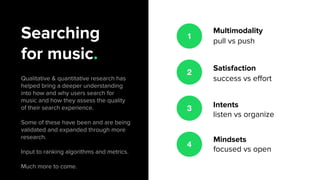
Searching
for music.
Qualitative & quantitative research has
helped bring a deeper understanding
into how and why users search for
music and how they assess the quality
of their search experience.
Some of these have been and are being
validated and expanded through more
research.
Input to ranking algorithms and metrics.
Much more to come.
1
Multimodality
pull vs push
Satisfaction
success vs effort
Intents
listen vs organize
Mindsets
focused vs open
2
3
4
Join the band!
https://www.spotifyjobs.com/search-jobs/

Search @ Spotify

  • 1.
    Search @ Spotify. MouniaLalmas and many others at Spotify Boston, London, New York & Stockholm November 27, 2018
  • 2.
    1 2 3 4 5 Outline About Spotify. Search atSpotify. Infrastructure for search. Search user journey. Satisfaction in search. 6 Search as recommendation.
  • 3.
  • 4.
    Spotify’s mission isto unlock the potential of human creativity — by giving a million creative artists the opportunity to live off their art and billions of fans the opportunity to enjoy and be inspired by it.
  • 5.
    87Million 3Billion + 78Markets 40Million+ 191Million €10Billion Number of playlists Spotify is available in Revenue paid to rightsholders (as at August 31 2018) Number of songs Number of subscribers (as at September 30 2018) Number of active users (as at September 30 2018)
  • 6.
  • 7.
    User Engagement Mission: Matchfans and artists in a personal and relevant way. ARTISTS FANS
  • 8.
    playlists songs ... catalog search browse users Whatdoes it mean to match fans and artists in a personal and relevant way?Artists Fans
  • 9.
  • 10.
    Large catalog 40M+ songs,3B+ playlists 2K+ microgenres Many languages 78 countries Different modalities Typed, voice Heterogeneous content Music, podcast Various granularities Song, artist, playlist Various goals Focus, discover, lean-back, mood Searching for … music
  • 11.
    Large catalog 40M+ songs,3B+ playlists 2K+ microgenres Many languages 78 countries Different modalities Typed, voice Heterogeneous content Music, podcast Various granularities Song, artist, playlist Various goals Focus, discover, lean-back, mood Searching for … audio
  • 12.
    Large catalog 40M+ songs,3B+ playlists 2K+ microgenres Many languages 78 countries Different modalities Typed, voice Heterogeneous content Music, podcast Various granularities Song, artist, playlist Various goals Focus, discover, lean-back, mood Searching for … moods or activities
  • 13.
    Search is instantaneous… at each keystroke m my my_ my_f my_fav
  • 14.
    s sa sattsat sati statis Search is instantaneous … the search logs for “satisfaction” From prefix to query → What is the actual query? → What is success vs prefix vs query? prefix query
  • 15.
  • 16.
    Search infrastructure {q: ‘drake’,user: ‘user1’} Client {q: ‘drake’, user: ‘user1’} Search Service Search Results Re-ranking Service Candidate List +Ranked Candidate List Retrieval Service Candidate List {q: ‘drake’} Ranked Candidate List
  • 17.
    Search results re-ranking A prefix query Acandidate to be scored (ci ) Metadata Feature Builder fi,1 fi,2 ... fi,k Scorer si Ranking model trained on search interaction logs. Use search sessions that end in a success action as positive examples. user, query and item-based features: - Item popularity - whether user has searched for this item before - similarity of the item to the user taste (vector) - edit distance between prefix query and the matched item title ...
  • 18.
    Search Research. We discuss threeongoing projects around understanding how users search for music to listen to. Work in progress. Search user journey About intent and mindset Satisfaction in search About success and effort Search as recommendation About voice 1 2 3
  • 19.
  • 20.
    Overview of theuser journey in search TYPE/TALK User communicates with us 20 CONSIDER User evaluates what we show them DECIDE User ends the search session INTENT What the user wants to do MINDSET How the user thinks about results
  • 21.
    Intents … whatthe user wants to do ● Play background music ● Fit an activity ● Listen with others ● Prepare for a concert ● Keep up with current music here and abroad ● Try recommended music from friends ● Hear a song stuck in your head ● Fit a mood ● Keep up with favorite artists ● Explore a niche genre LISTEN Have a listening session ORGANIZE Curate for future listening SHARE Connect with friends FACT CHECK Find specific information ● Make a playlist ● Build library ● Follow artists ● Follow playlists ● Send music to a friend ● Follow a friend ● Check own knowledge ● Gather information ● Learn about concerts Most common Least Common based on qualitative research
  • 22.
    Mindsets … howthe user thinks about results FOCUSED One specific thing in mind OPEN A seed of an idea in mind EXPLORATORY A path to explore ● Find it or not ● Quickest/easiest path to results is important ● From nothing good enough, good enough to better than good enough ● Willing to try things out ● But still want to fulfil their intent ● Difficult for users to assess how it went ● May be able to answer in relative terms ● Users expect to be active when in an exploratory mindset ● Effort is expected Most common Least Common based on qualitative research
  • 23.
    A user canapproach any intent with any mindset FOCUSED One specific thing in mind OPEN A seed of an idea in mind EXPLORATORY A path to explore LISTEN Have a listening session ORGANIZE Curate for future listening SHARE Connect with friends FACT CHECK Find specific information EXPLORATORY mindset seems rare and likely better served by other features such as Browse. LISTEN and ORGANIZE are most prominent intents & associated with lean-back vs lean-in behavior.
  • 24.
    Focused mindset. When users knowwhat they want to find. The pull paradigm and how it translates to the music context. Findings from large-scale in-app survey + behavioral analysis. 65% of searches were focused. When users search with a Focused Mindset Put MORE effort in search. Scroll down and click on lower rank results. Click MORE on album/track/artist and LESS on playlist. MORE likely to save/add but LESS likely to stream directly. Understanding intents helps us understand search satisfaction (even within a mindset).
  • 25.
  • 26.
    What drives user satisfaction insearch? Findings from qualitative research. Focused mindset. User satisfaction translates into success and effort. Good experience is finding, ideally with little effort. Bad experience is not finding, not knowing how to find, or struggling while searching. Users prioritize success and given success, they want to minimize effort.
  • 27.
    Mapping success andeffort metrics with the search user journey DECIDE User ends the search session. TYPE User communicates with us. CONSIDER User evaluates search results. “Success” metrics associate with the decide phase “Effort” metrics associate with the type and consider phases
  • 28.
    Examples of successand effort metrics DECIDE TYPE number of deletions, ... CONSIDER back button clicks, first and last click position, ... Time to success “Success” metrics “Effort” metrics stream LISTEN Have a listening session add to a playlist, save into a collection, follow an artist, follow a playlist, ... ORGANIZE Curate for future listening
  • 29.
    Satisfaction metrics forsearch (focus mindset) DECIDE User ends the search session. TYPE User communicates with us. CONSIDER User evaluates search results. “Success” metrics associate with the decide phase “Effort” metrics associate with the type and consider phases ≅DECIDE metrics ∆ (TYPE metrics ⨁ CONSIDER metrics)
  • 30.
    Satisfaction in search. Going beyondthe focused mindset. Success and effort in search shaped by mindsets. Focused: one specific thing in mind Open: a seed of an idea in mind User can approach any intent with any mindset. Automatically identify mindsets. Automatically identify intents. Explore satisfaction metrics that incorporates success and effort with respect to intent and mindset.
  • 31.
  • 32.
    Users ask forSpotify to play music, without saying what they would like to hear (open mindset) Play Spotify Play music Play music from Spotify Play me some music Play the music Play my Spotify Play some music on Spotify Play some music Play music on Spotify Search by voice. A type of push paradigm and how it translates to the music context. Findings from qualitative research.
  • 33.
    Why users providenon-specific queries Open mindset in voice Private & Confidential, For Internal Use Only Why users do not provide a non-specific query They want to effortlessly start a lean back listening session. They do not want to make a content decision. They want to resume a previous listening session. They are curious and want to playfully engage with Spotify. They did not know that they could engage with Spotify this way. They cannot predict what they will get, and are not willing to give up control. They have specific tastes, and do not trust that something that matches their listening habits will be returned.
  • 34.
    Search as recommendation. Delivering forthe open mindset. Non-specific querying is a way for a user to effortlessly start a listening session via voice. Non-specific querying is a way to remove the burden of choice when a user is open to lean-back listening. User education matters as users will not engage in a use-case they do not know about. Trust and control are central to a positive experience. Users need to trust the system enough to try it out.
  • 35.
  • 36.
    Searching for music. Qualitative &quantitative research has helped bring a deeper understanding into how and why users search for music and how they assess the quality of their search experience. Some of these have been and are being validated and expanded through more research. Input to ranking algorithms and metrics. Much more to come. 1 Multimodality pull vs push Satisfaction success vs effort Intents listen vs organize Mindsets focused vs open 2 3 4
  • 37.