Introduction to
Recommender Systems
Machine Learning 101 Tutorial

Strata + Hadoop World, NYC, 2015

Chris DuBois, Dato
Outline
Motivation


Fundamentals

Collaborative filtering

Content-based recommendations

Hybrid methods


Practical considerations

Feedback

Evaluation

Tuning

Deployment
2
ML for building data products
• Products that produce and consume data.

• Products that improve as they produce and
consume data.

• Products that use data to provide a
personalized experience.

• Personalized experiences increase
engagement and retention.
3
Recommender systems
• Personalized experiences through
recommendations

• Recommend products, social network
connections, events, songs, and more

• Implicitly and explicitly drive many of
experiences you’re familiar with
4
Recommender uses
• Netflix, Spotify, LinkedIn, Facebook with the most
visible examples

• “You May Also Like”

“People You May Know”

“People to Follow”

• Also silently power many other experiences

• Quora/FB/Stitchfix: given interest in A, what
else might they be interested in?

• Product listings, up-sell options, etc.
5
Outline
Motivation

Fundamentals
Collaborative filtering

Content-based recommendations

Hybrid methods

Practical considerations

Feedback

Evaluation

Tuning

Deployment
6
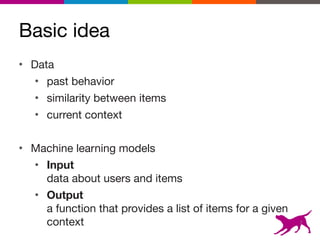
Basic idea
7
• Data

• past behavior

• similarity between items

• current context

• Machine learning models

• Input

data about users and items

• Output

a function that provides a list of items for a given
context
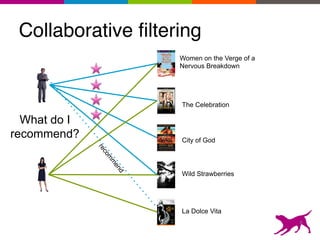
recom
m
end
City of God
Wild Strawberries
The Celebration
La Dolce Vita
Women on the Verge of a
Nervous Breakdown
What do I
recommend?
8
Collaborative filtering
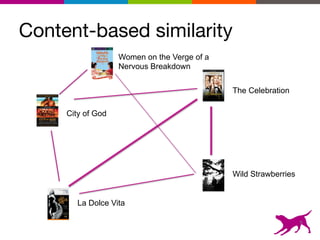
City of God
Wild Strawberries
The Celebration
La Dolce Vita
Women on the Verge of a
Nervous Breakdown
9
Content-based similarity
What data do you need?
• Required for collaborative filtering

• User identifier

• Product identifier

• Required for content-based recommendations
• Information about each item
• Further customization

• Ratings (explicit data), counts

• Side data
10
Outline
Motivation


Fundamentals

Collaborative filtering
Content-based recommendations

Hybrid methods


Practical considerations

Feedback

Evaluation

Tuning

Deployment
11
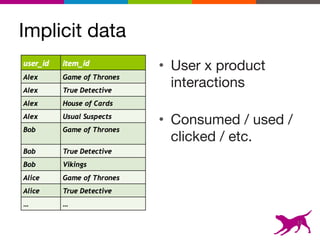
Implicit data
• User x product

interactions

• Consumed / used /

clicked / etc.
12
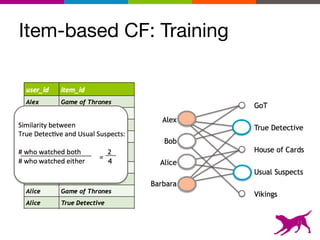
Item-based CF: Training
13
Item-based CF: predictions
14
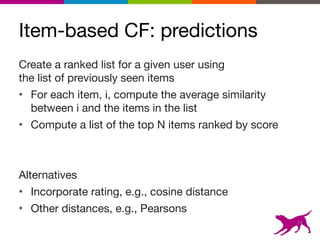
Create a ranked list for a given user using 

the list of previously seen items

• For each item, i, compute the average similarity
between i and the items in the list

• Compute a list of the top N items ranked by score

Alternatives

• Incorporate rating, e.g., cosine distance

• Other distances, e.g., Pearsons
Demo!
15
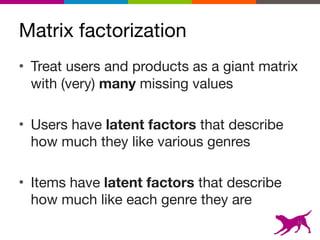
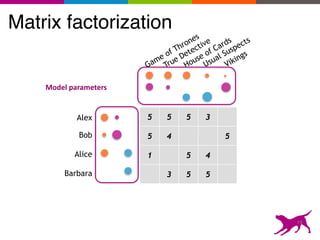
Matrix factorization
• Treat users and products as a giant matrix
with (very) many missing values

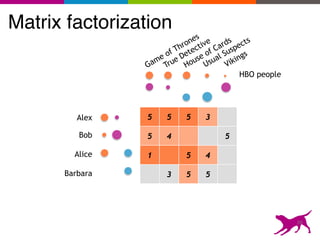
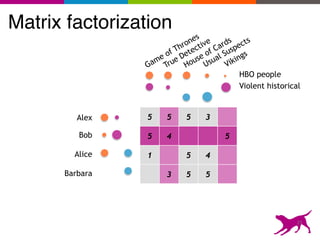
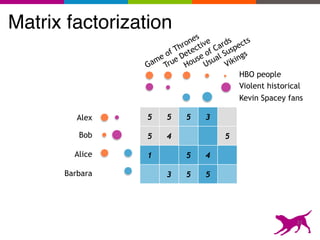
• Users have latent factors that describe
how much they like various genres

• Items have latent factors that describe
how much like each genre they are
16
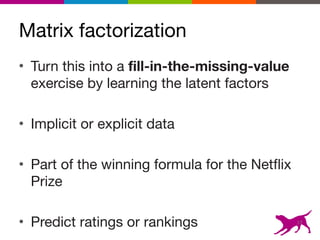
Matrix factorization
• Turn this into a fill-in-the-missing-value
exercise by learning the latent factors

• Implicit or explicit data

• Part of the winning formula for the Netflix
Prize

• Predict ratings or rankings 17
18
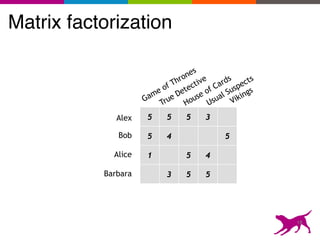
Alex
Bob
Alice
Barbara
Game of Thrones
Vikings
House of Cards
True Detective
Usual Suspects
5 5 5 3
5 4 5
1 5 4
3 5 5
Matrix factorization
19
5 5 5 3
5 4 5
1 5 4
3 5 5
Game of Thrones
Vikings
House of Cards
True Detective
Usual Suspects
Alex
Bob
Alice
Barbara
Model	
  parameters
Matrix factorization
20
5 5 5 3
5 4 5
1 5 4
3 5 5
HBO people
Game of Thrones
Vikings
House of Cards
True Detective
Usual Suspects
Alex
Bob
Alice
Barbara
Matrix factorization
21
5 5 5 3
5 4 5
1 5 4
3 5 5
HBO people
Violent historical
Game of Thrones
Vikings
House of Cards
True Detective
Usual Suspects
Alex
Bob
Alice
Barbara
Matrix factorization
22
5 5 5 3
5 4 5
1 5 4
3 5 5
HBO people
Violent historical
Kevin Spacey fans
Game of Thrones
Vikings
House of Cards
True Detective
Usual Suspects
Alex
Bob
Alice
Barbara
Matrix factorization
Fill in the blanks
• Learn the latent factors that minimize
prediction error on the observed values

• Fill in the missing values

• Sort the list by predicted rating &

recommend the unseen items
23
Demo!
24
Outline
Motivation


Fundamentals

Collaborative filtering

Content-based recommendations
Hybrid methods


Practical considerations

Feedback

Evaluation

Tuning

Deployment
25
recs = sim_model.recommend()
>>> nn_model
Class : NearestNeighborsModel
Distance : jaccard
Method : brute force
Number of examples : 195
Number of feature columns : 1
Number of unpacked features : 5170
Total training time (seconds) : 0.0318
talks[‘bow’] = gl.text_analytics.count_words(talks[‘abstract’])
talks[‘tfidf’] = gl.text_analytics.tf_idf(talks[‘bow’])
nn_model = gl.nearest_neighbors.create(talks, ‘id’, features=[‘tfidf’])
nbrs = nn_model.query(talks, label=‘id’, k=50)
sim_model = gl.item_similarity_recommender.create(historical, nearest=nbrs)
>>> historical
+------------+----------+------------------+---------+------------+
| date | time | user | item_id | event_type |
+------------+----------+------------------+---------+------------+
| 2015-02-12 | 07:05:37 | 809c0dc2548cbbc3 | 38825 | like |
| 2015-02-12 | 07:05:39 | 809c0dc2548cbbc3 | 38825 | like |
>>> talks
+------------+------------+-------------------------------+--------------------------------+
| date | start_time | title | tech_tags |
+------------+------------+-------------------------------+--------------------------------+
| 02/20/2015 | 10:40am | The IoT P2P Backbone | [MapReduce, Storm, Docker,... |
| 02/20/2015 | 10:40am | Practical Problems in Dete... | [Storm, Docker, Impala, R,... |
| 02/19/2015 | 1:30pm | From MapReduce to Programm... | [MapReduce, Spark, Apache,... |
| 02/19/2015 | 2:20pm | Drill into Drill: How Prov... | [JAVA, Docker, R, Hadoop, SQL] |
| 02/19/2015 | 4:50pm | Maintaining Low Latency wh... | [Apache, Hadoop, HBase, YA... |
| 02/20/2015 | 4:00pm | Top Ten Pitfalls to Avoid ... | [MapReduce, Hadoop, JAVA, ... |
| 02/20/2015 | 4:00pm | Using Data to Help Farmers... | [MapReduce, Spark, Storm, ... |
| 02/19/2015 | 1:30pm | Sears Hometown and Outlet... | [Hadoop, Spark, Docker, R,... |
| 02/20/2015 | 11:30am | Search Evolved: Unraveling... | [Docker, R, Hadoop, SQL, R... |
| 02/19/2015 | 4:00pm | Data Dexterity: Immediate ... | [Hadoop, NoSQL, Spark, Sto... |
| ... | ... | ... | ... |
+------------+------------+-------------------------------+--------------------------------+
[195 rows x 4 columns]
26
recs = sim_model.recommend()
>>> si
Class
Schema
------
User I
Item I
Target
Additi
Number
Number
Statis
------
Number
Number
Number
Traini
------
Traini
Settin
>>> nn_model
Class : NearestNeighborsModel
Distance : jaccard
Method : brute force
Number of examples : 195
Number of feature columns : 1
Number of unpacked features : 5170
Total training time (seconds) : 0.0318
talks[‘bow’] = gl.text_analytics.count_words(talks[‘abstract’])
talks[‘tfidf’] = gl.text_analytics.tf_idf(talks[‘bow’])
nn_model = gl.nearest_neighbors.create(talks, ‘id’, features=[‘tfidf’])
nbrs = nn_model.query(talks, label=‘id’, k=50)
sim_model = gl.item_similarity_recommender.create(historical, nearest=nbrs)
27
Side features
• Include information about users

• Geographic, demographic, time of day,
etc.

• Include information about products

• Product subtypes, geographic
availability, etc.
28
Demo!
29
Outline
Motivation


Fundamentals

Collaborative filtering

Content-based recommendations

Hybrid methods


Practical considerations

Feedback

Evaluation

Tuning

Deployment
30
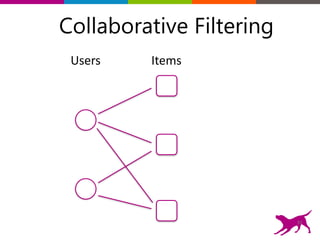
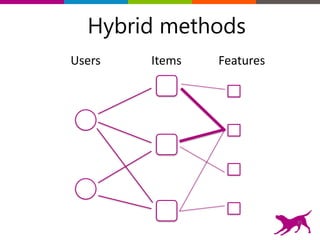
Users Items
Collaborative Filtering
31
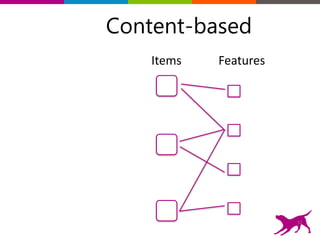
Items Features
Content-based
32
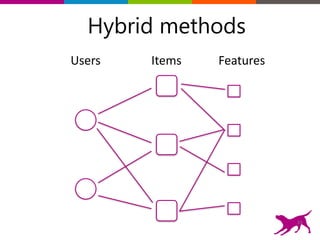
Items FeaturesUsers
Hybrid methods
33
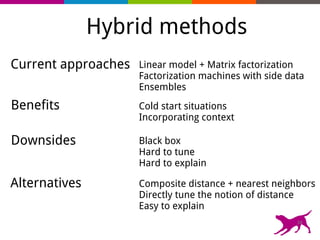
Current approaches
Downsides
Alternatives
Linear model + Matrix factorization
Factorization machines with side data
Ensembles
Black box
Hard to tune
Hard to explain
Composite distance + nearest neighbors
Directly tune the notion of distance
Easy to explain
Hybrid methods
34
Benefits Cold start situations
Incorporating context
Items FeaturesUsers
Hybrid methods
35
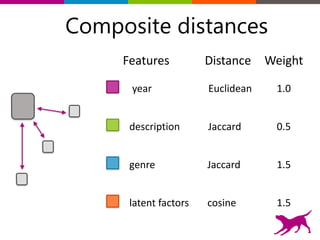
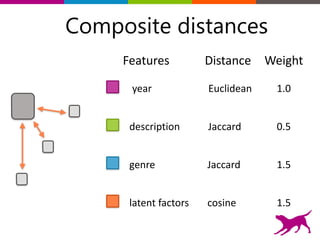
Features
Composite distances
Distance Weight
year Euclidean 1.0
description Jaccard 0.5
genre Jaccard 1.5
latent	
  factors cosine 1.5
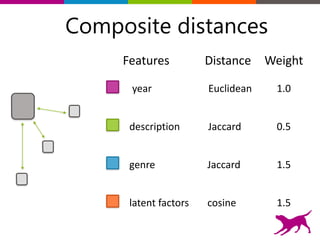
Features
Composite distances
Distance Weight
year Euclidean 1.0
description Jaccard 0.5
genre Jaccard 1.5
latent	
  factors cosine 1.5
Features
Composite distances
Distance Weight
year Euclidean 1.0
description Jaccard 0.5
genre Jaccard 1.5
latent	
  factors cosine 1.5
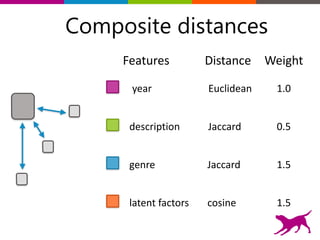
Features
Composite distances
Distance Weight
year Euclidean 1.0
description Jaccard 0.5
genre Jaccard 1.5
latent	
  factors cosine 1.5
Demo!
40
Outline
Motivation


Fundamentals

Collaborative filtering

Content-based recommendations

Hybrid methods


Practical considerations
Feedback

Evaluation

Tuning

Deployment
41
Outline
Motivation


Fundamentals

Collaborative filtering

Content-based recommendations

Hybrid methods


Practical considerations

Feedback
Evaluation

Tuning

Deployment
42
Feedback
Core assumption

past behavior will help predict future behavior. 

Collaborative filtering

data often comes from log data.

Plan ahead!

• value elicitation, e.g., like, watch, etc.

• ratings, stars, etc.

• critique, e.g. Improve the system’s recommendations!

• preference: e.g., Which do you prefer?

Preprocessing

• Item deduplication

Relationship to information retrieval

• position bias

• source of the event 43
Outline
Motivation


Fundamentals

Collaborative filtering

Content-based recommendations

Hybrid methods


Practical considerations

Feedback

Evaluation
Tuning

Deployment
44
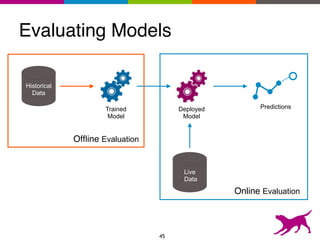
Evaluating Models
45
Historical
Data
Live
Data
PredictionsTrained
Model
Deployed
Model
Offline Evaluation
Online Evaluation
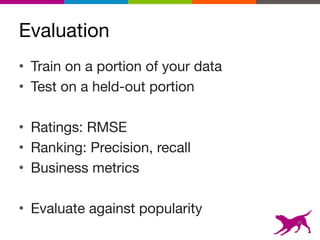
Evaluation
• Train on a portion of your data

• Test on a held-out portion

• Ratings: RMSE

• Ranking: Precision, recall

• Business metrics

• Evaluate against popularity
46
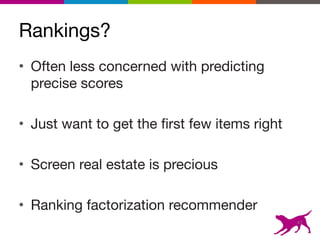
Rankings?
• Often less concerned with predicting
precise scores

• Just want to get the first few items right

• Screen real estate is precious

• Ranking factorization recommender
47
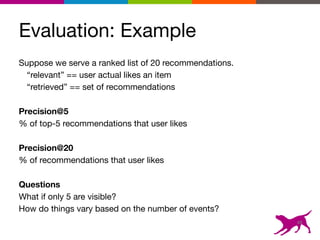
Evaluation: Example
Suppose we serve a ranked list of 20 recommendations. 

“relevant” == user actual likes an item

“retrieved” == set of recommendations

Precision@5

% of top-5 recommendations that user likes

Precision@20 

% of recommendations that user likes

Questions
What if only 5 are visible?

How do things vary based on the number of events?

48
Demo!
49
Outline
Motivation

Fundamentals

Collaborative filtering

Content-based recommendations

Hybrid methods

Practical considerations

Feedback

Evaluation

Tuning
Deployment
50
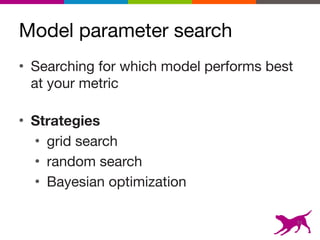
Model parameter search
• Searching for which model performs best
at your metric

• Strategies
• grid search

• random search

• Bayesian optimization
51
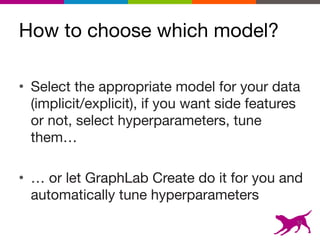
How to choose which model?
• Select the appropriate model for your data
(implicit/explicit), if you want side features
or not, select hyperparameters, tune
them…

• … or let GraphLab Create do it for you and
automatically tune hyperparameters
52
Outline
Motivation


Fundamentals

Collaborative filtering

Content-based recommendations

Hybrid methods


Practical considerations

Feedback

Evaluation

Tuning

Deployment
53
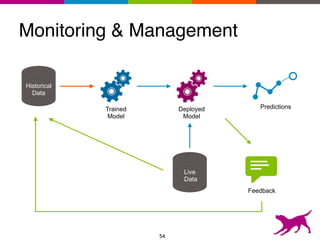
Monitoring & Management
54
Historical
Data
Live
Data
PredictionsTrained
Model
Deployed
Model
Feedback
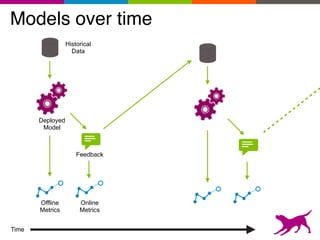
Models over time
Feedback
Deployed
Model
Time
Offline
Metrics
Online
Metrics
Historical
Data
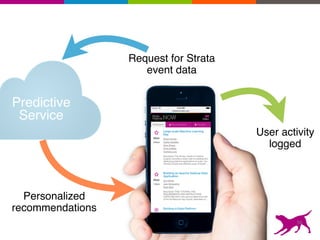
Predictive
Service
User activity
logged
Request for Strata
event data
Personalized
recommendations
56
Summary
Motivation


Fundamentals

Collaborative filtering

Content-based recommendations

Hybrid methods


Practical considerations

Feedback

Evaluation

Tuning

Deployment
57
Thank you!
58
Email	
  
Twitter	
  
chris@dato.com	
  
@chrisdubois	
  

Introduction to Recommender Systems