History revision THE COLD WAR
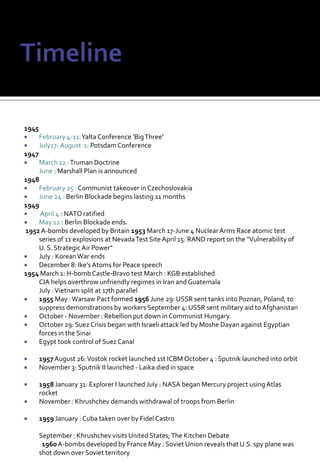
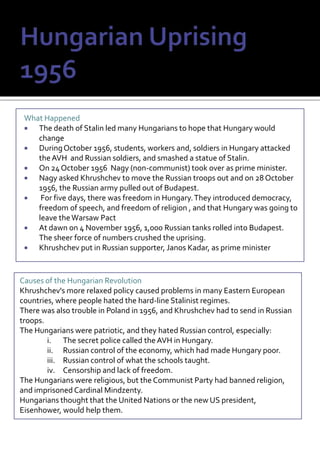
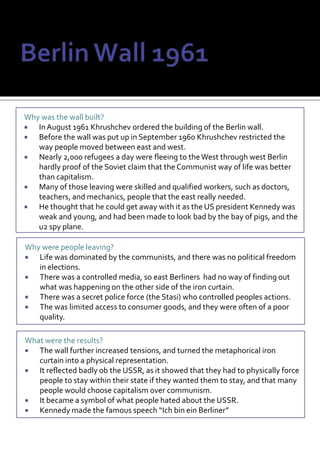
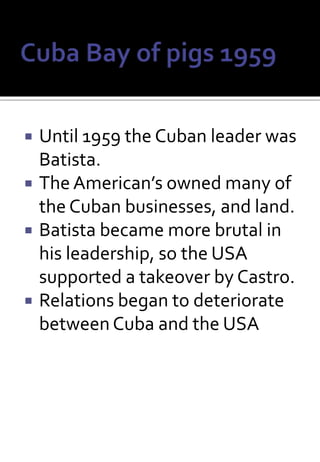
Timeline1945February 4-11: Yalta Conference 'Big Three’July17- August  1: Potsdam Conference1947March 12 : Truman Doctrine June : Marshall Plan is announced  1948February 25 : Communist takeover in CzechoslovakiaJune 24 : Berlin Blockade begins lasting 11 months1949April 4 : NATO ratifiedMay 12 : Berlin Blockade ends.1952A-bombs developed by Britain 1953 March 17-June 4 Nuclear Arms Race atomic test series of 11 explosions at Nevada Test Site April 15: RAND report on the "Vulnerability of U. S. Strategic Air Power" July : Korean War endsDecember 8: Ike's Atoms for Peace speech 1954 March 1: H-bomb Castle-Bravo test March : KGB establishedCIA helps overthrow unfriendly regimes in Iran and Guatemala July : Vietnam split at 17th parallel 1955 May : Warsaw Pact formed 1956 June 29: USSR sent tanks into Poznan, Poland, to suppress demonstrations by workers September 4: USSR sent military aid to AfghanistanOctober - November : Rebellion put down in Communist Hungary. October 29: Suez Crisis began with Israeli attack led by Moshe Dayan against Egyptian forces in the SinaiEgypt took control of Suez Canal 1957 August 26: Vostok rocket launched 1st ICBM October 4 : Sputnik launched into orbitNovember 3: Sputnik II launched - Laika died in space 1958 January 31: Explorer I launched July : NASA began Mercury project using Atlas rocket November : Khrushchev demands withdrawal of troops from Berlin 1959 January : Cuba taken over by Fidel CastroSeptember : Khrushchev visits United States; The Kitchen Debate  1960 A-bombs developed by France May : Soviet Union reveals that U.S. spy plane was shot down over Soviet territoryNovember : John F. Kennedy elected President of USADecember 19: Cuba openly aligns itself with the Soviet Union and their policies. 1961 April : Bay of Pigs invasion see Cuban Missile Crisis TimelineAugust 13 : Berlin border is closedAugust 17 : Construction of Berlin Wall begins  1962 U.S. involvement in Vietnam increases see Vietnam War Timeline October : Cuban Missile Crisis see Cuban Missile Crisis Timeline 1963 1963: July : Nuclear Test Ban Treaty ratified1963: November : President Kennedy assassinated in Dallas, Texas  1964 August : Gulf of Tonkin incident - see Vietnam War Timeline October: A-bombs developed by China 1965 April : U.S. Marines sent to Dominican Republic to fight CommunismJuly : Announcement of dispatching of 200,000 U.S. troops to Vietnam  1966 B-52s Bomb North Vietnam 1967 The US Secretary of Defence Robert McNamara admits that the US bombing raids had failed to meet their objectives  1968 January : North Korea captured U.S.S. Pueblo President Johnson does not run for the presidency and Richard Nixon Elected President of the USAAugust : Soviet Red Army crush Czechoslovakian revolt 1969 July 20 : Apollo 11 lands on the moon 1970 April : President Nixon extends Vietnam War to Cambodia 1971 Publication of the Pentagon Papers 1972 February: President Richard Nixon visits China July : SALT I signed 1973 January : Cease fire in Vietnam between North Vietnam and United StatesSeptember : U.S. supported coup overthrows Chilean governmentOctober : Egypt and Syria attack Israel; Egypt requests Soviet aid  1974 1974: August : President Nixon resigns 1975 April 17 : North Vietnam defeats South Vietnam which falls to Communist forces 1976 February: Soviet and Cuban forces help to install Communist government in Angola. 1979 January: U.S. and China establish diplomatic relations. July : SALT II signedNovember : Shah of Iran overthrown; Iranian Hostage CrisisDecember: Soviet forces invade Afghanistan  1980 August: Polish shipyard workers strike Solidarity Union formed. Strike leader Lech Walesa is elected as the head of Solidarity  1983 President Reagan proposes Strategic Defence Initiative1983: October : U.S. troops invades and overthrows regime in Grenada  1985 Mikhail Gorbachev becomes leader of the Soviet Union initiating a campaign of openness called "glasnost" and restructuring called "perestroika“  1986October : President Reagan and Gorbachev resolve to remove all intermediate nuclear missiles from Europe1987October : Reagan and Gorbachev agree to remove all medium and short-range nuclear missiles 1989June : Poland becomes independentSeptember : Hungary becomes independentNovember : Berlin Wall is demolished and East Germany allows unrestricted migration to West GermanyDecember : Communist governments fall in Czechoslovakia, Bulgaria, and Rumania Decline of the Soviet empire1990October 3 : Germany reunited  1991August : End of Soviet Union and the Cold War Ends
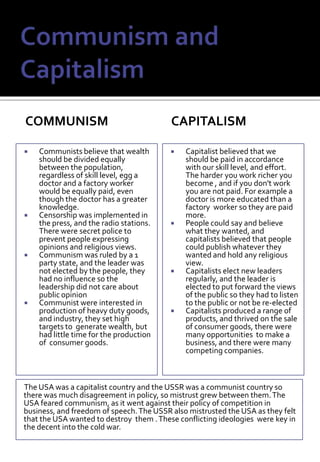
Communism and CapitalismcommunismcapitalismCommunists believe that wealth should be divided equally between the population, regardless of skill level, egg a doctor and a factory worker would be equally paid, even though the doctor has a greater knowledge.Censorship was implemented in the press, and the radio stations. There were secret police to prevent people expressing opinions and religious views.Communism was ruled by a 1 party state, and the leader was not elected by the people, they had no influence so the leadership did not care about public opinionCommunist were interested in  production of heavy duty goods, and industry, they set high targets to  generate wealth, but had little time for the production of  consumer goods.Capitalist believed that we should be paid in accordance with our skill level, and effort. The harder you work richer you become , and if you don't work you are not paid. For example a doctor is more educated than a factory  worker so they are paid more.People could say and believe what they wanted, and capitalists believed that people could publish whatever they wanted and hold any religious view.Capitalists elect new leaders regularly, and the leader is elected to put forward the views of the public so they had to listen to the public or not be re-electedCapitalists produced a range of products, and thrived on the sale of consumer goods, there were many opportunities  to make a business, and there were many competing companies.The USA was a capitalist country and the USSR was a communist country so there was much disagreement in policy, so mistrust grew between them. The USA feared communism, as it went against their policy of competition in business, and freedom of speech. The USSR also mistrusted the USA as they felt that the USA wanted to destroy  them . These conflicting ideologies  were key in the decent into the cold war.
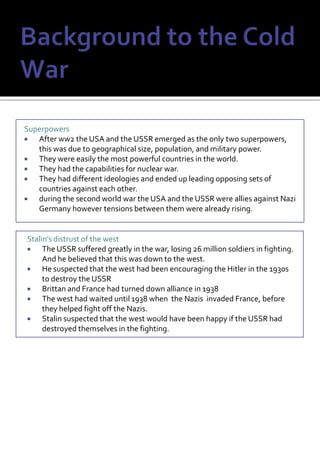
Background to the Cold WarSuperpowersAfter ww2 the USA and the USSR emerged as the only two superpowers, this was due to geographical size, population, and military power.They were easily the most powerful countries in the world.They had the capabilities for nuclear war.They had different ideologies and ended up leading opposing sets of countries against each other.during the second world war the USA and the USSR were allies against Nazi Germany however tensions between them were already rising.Stalin’s distrust of the west The USSR suffered greatly in the war, losing 26 million soldiers in fighting.  And he believed that this was down to the west.
He suspected that the west had been encouraging the Hitler in the 1930s  to destroy the USSR
Brittan and France had turned down alliance in 1938
The west had waited until 1938 when  the Nazis  invaded France, before they helped fight off the Nazis.
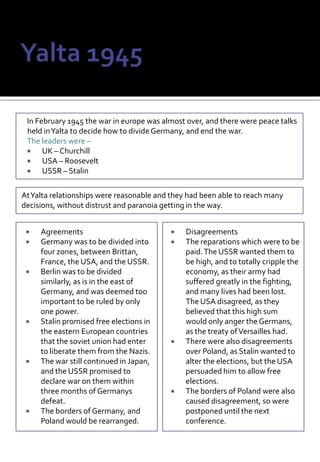
Stalin suspected that the west would have been happy if the USSR had destroyed themselves in the fighting.Yalta 1945In February 1945 the war in europe was almost over, and there were peace talks held in Yalta to decide how to divide Germany, and end the war.The leaders were – UK – Churchill
USA – Roosevelt
USSR – StalinAt Yalta relationships were reasonable and they had been able to reach many decisions, without distrust and paranoia getting in the way.Agreements Germany was to be divided into four zones, between Brittan, France, the USA, and the USSR.Berlin was to be divided similarly, as is in the east of Germany, and was deemed too important to be ruled by only one power.Stalin promised free elections in the eastern European countries that the soviet union had enter to liberate them from the Nazis.The war still continued in Japan, and the USSR promised to declare war on them within three months of Germanys defeat.The borders of Germany, and Poland would be rearranged.Disagreements The reparations which were to be paid. The USSR wanted them to be high, and to totally cripple the economy, as their army had suffered greatly in the fighting, and many lives had been lost. The USA disagreed, as they believed that this high sum would only anger the Germans, as the treaty of Versailles had.There were also disagreements over Poland, as Stalin wanted to alter the elections, but the USA persuaded him to allow free elections.The borders of Poland were also caused disagreement, so were postponed until the next conference.
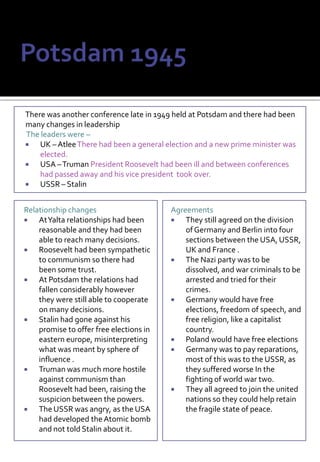
Potsdam 1945  There was another conference late in 1949 held at Potsdam and there had been many changes in leadershipThe leaders were – UK – Atlee There had been a general election and a new prime minister was elected.
USA – Truman President Roosevelt had been ill and between conferences had passed away and his vice president  took over.
USSR – StalinRelationship changesAt Yalta relationships had been reasonable and they had been able to reach many decisions.Roosevelt had been sympathetic to communism so there had been some trust.At Potsdam the relations had fallen considerably however  they were still able to cooperate  on many decisions.Stalin had gone against his promise to offer free elections in eastern europe, misinterpreting what was meant by sphere of influence .Truman was much more hostile against communism than Roosevelt had been, raising the suspicion between the powers.The USSR was angry, as the USA had developed the Atomic bomb and not told Stalin about it.AgreementsThey still agreed on the division of Germany and Berlin into four sections between the USA, USSR, UK and France .The Nazi party was to be dissolved, and war criminals to be arrested and tried for their crimes.Germany would have free elections, freedom of speech, and free religion, like a capitalist country.Poland would have free electionsGermany was to pay reparations, most of this was to the USSR, as they suffered worse In the fighting of world war two.They all agreed to join the united nations so they could help retain the fragile state of peace.
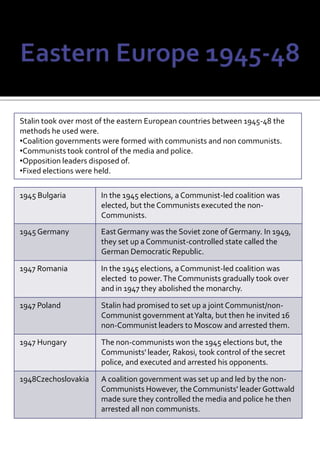
Eastern Europe 1945-48Stalin took over most of the eastern European countries between 1945-48 the methods he used were.Coalition governments were formed with communists and non communists.
Communists took control of the media and police.
Opposition leaders disposed of.
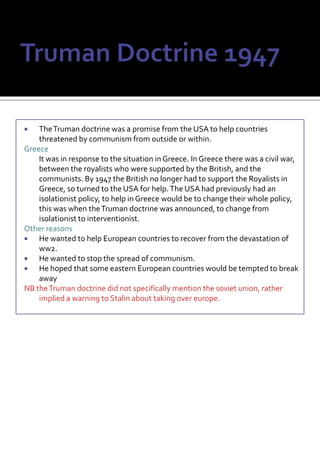
Fixed elections were held.Truman Doctrine 1947The Truman doctrine was a promise from the USA to help countries threatened by communism from outside or within. Greece 	It was in response to the situation in Greece. In Greece there was a civil war, between the royalists who were supported by the British, and the communists. By 1947 the British no longer had to support the Royalists in Greece, so turned to the USA for help. The USA had previously had an isolationist policy, to help in Greece would be to change their whole policy, this was when the Truman doctrine was announced, to change from isolationist to interventionist.Other reasons He wanted to help European countries to recover from the devastation of ww2.He wanted to stop the spread of communism.He hoped that some eastern European countries would be tempted to break awayNB the Truman doctrine did not specifically mention the soviet union, rather  implied a warning to Stalin about taking over europe.
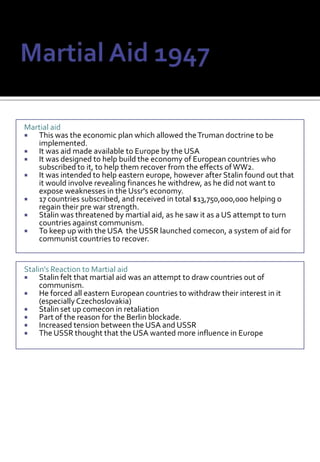
Martial Aid 1947Martial aid Thiswas the economic plan which allowed the Truman doctrine to be implemented.It was aid made available to Europe by the USA It was designed to help build the economy of European countries who subscribed to it, to help them recover from the effects of WW2.It was intended to help eastern europe, however after Stalin found out that it would involve revealing finances he withdrew, as he did not want to expose weaknesses in the Ussr's economy.17 countries subscribed, and received in total $13,750,000,000 helping o regain their pre war strength.Stalin was threatened by martial aid, as he saw it as a US attempt to turn countries against communism.To keep up with the USA  the USSR launched comecon, a system of aid for communist countries to recover.Stalin’s Reaction to Martial aid Stalin felt that martial aid was an attempt to draw countries out of communism.
He forced all eastern European countries to withdraw their interest in it (especially Czechoslovakia)
Stalin set up comecon in retaliation
Part of the reason for the Berlin blockade.
Increased tension between the USA and USSR
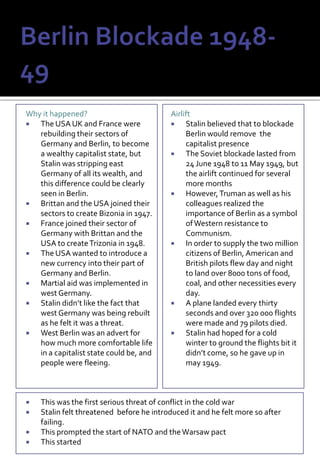
The USSR thought that the USA wanted more influence in EuropeBerlin Blockade 1948-49Why it happened?The USA UK and France were rebuilding their sectors of Germany and Berlin, to become a wealthy capitalist state, but Stalin was stripping east Germany of all its wealth, and this difference could be clearly seen in Berlin.Brittan and the USA joined their sectors to create Bizonia in 1947.France joined their sector of Germany with Brittan and the USA to create Trizonia in 1948.The USA wanted to introduce a new currency into their part of Germany and Berlin.   Martial aid was implemented in west Germany. Stalin didn’t like the fact that west Germany was being rebuilt as he felt it was a threat.West Berlin was an advert for                    how much more comfortable life in a capitalist state could be, and people were fleeing.AirliftStalin believed that to blockade Berlin would remove  the capitalist presenceThe Soviet blockade lasted from 24 June 1948 to 11 May 1949, but the airlift continued for several more months However, Truman as well as his colleagues realized the importance of Berlin as a symbol of Western resistance to Communism. In order to supply the two million citizens of Berlin, American and British pilots flew day and night to land over 8000 tons of food, coal, and other necessities every day.A plane landed every thirty seconds and over 320 000 flights were made and 79 pilots died.Stalin had hoped for a cold winter to ground the flights bit it didn’t come, so he gave up in may 1949.This was the first serious threat of conflict in the cold war
Stalin felt threatened  before he introduced it and he felt more so after failing.
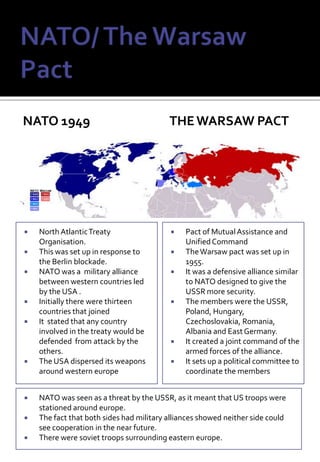
This prompted the start of NATO and the Warsaw pact

Cold War - Superpowers

  • 1.
  • 2.
    Timeline1945February 4-11: YaltaConference 'Big Three’July17- August 1: Potsdam Conference1947March 12 : Truman Doctrine June : Marshall Plan is announced  1948February 25 : Communist takeover in CzechoslovakiaJune 24 : Berlin Blockade begins lasting 11 months1949April 4 : NATO ratifiedMay 12 : Berlin Blockade ends.1952A-bombs developed by Britain 1953 March 17-June 4 Nuclear Arms Race atomic test series of 11 explosions at Nevada Test Site April 15: RAND report on the "Vulnerability of U. S. Strategic Air Power" July : Korean War endsDecember 8: Ike's Atoms for Peace speech 1954 March 1: H-bomb Castle-Bravo test March : KGB establishedCIA helps overthrow unfriendly regimes in Iran and Guatemala July : Vietnam split at 17th parallel 1955 May : Warsaw Pact formed 1956 June 29: USSR sent tanks into Poznan, Poland, to suppress demonstrations by workers September 4: USSR sent military aid to AfghanistanOctober - November : Rebellion put down in Communist Hungary. October 29: Suez Crisis began with Israeli attack led by Moshe Dayan against Egyptian forces in the SinaiEgypt took control of Suez Canal 1957 August 26: Vostok rocket launched 1st ICBM October 4 : Sputnik launched into orbitNovember 3: Sputnik II launched - Laika died in space 1958 January 31: Explorer I launched July : NASA began Mercury project using Atlas rocket November : Khrushchev demands withdrawal of troops from Berlin 1959 January : Cuba taken over by Fidel CastroSeptember : Khrushchev visits United States; The Kitchen Debate  1960 A-bombs developed by France May : Soviet Union reveals that U.S. spy plane was shot down over Soviet territoryNovember : John F. Kennedy elected President of USADecember 19: Cuba openly aligns itself with the Soviet Union and their policies. 1961 April : Bay of Pigs invasion see Cuban Missile Crisis TimelineAugust 13 : Berlin border is closedAugust 17 : Construction of Berlin Wall begins  1962 U.S. involvement in Vietnam increases see Vietnam War Timeline October : Cuban Missile Crisis see Cuban Missile Crisis Timeline 1963 1963: July : Nuclear Test Ban Treaty ratified1963: November : President Kennedy assassinated in Dallas, Texas  1964 August : Gulf of Tonkin incident - see Vietnam War Timeline October: A-bombs developed by China 1965 April : U.S. Marines sent to Dominican Republic to fight CommunismJuly : Announcement of dispatching of 200,000 U.S. troops to Vietnam  1966 B-52s Bomb North Vietnam 1967 The US Secretary of Defence Robert McNamara admits that the US bombing raids had failed to meet their objectives  1968 January : North Korea captured U.S.S. Pueblo President Johnson does not run for the presidency and Richard Nixon Elected President of the USAAugust : Soviet Red Army crush Czechoslovakian revolt 1969 July 20 : Apollo 11 lands on the moon 1970 April : President Nixon extends Vietnam War to Cambodia 1971 Publication of the Pentagon Papers 1972 February: President Richard Nixon visits China July : SALT I signed 1973 January : Cease fire in Vietnam between North Vietnam and United StatesSeptember : U.S. supported coup overthrows Chilean governmentOctober : Egypt and Syria attack Israel; Egypt requests Soviet aid  1974 1974: August : President Nixon resigns 1975 April 17 : North Vietnam defeats South Vietnam which falls to Communist forces 1976 February: Soviet and Cuban forces help to install Communist government in Angola. 1979 January: U.S. and China establish diplomatic relations. July : SALT II signedNovember : Shah of Iran overthrown; Iranian Hostage CrisisDecember: Soviet forces invade Afghanistan  1980 August: Polish shipyard workers strike Solidarity Union formed. Strike leader Lech Walesa is elected as the head of Solidarity  1983 President Reagan proposes Strategic Defence Initiative1983: October : U.S. troops invades and overthrows regime in Grenada  1985 Mikhail Gorbachev becomes leader of the Soviet Union initiating a campaign of openness called "glasnost" and restructuring called "perestroika“  1986October : President Reagan and Gorbachev resolve to remove all intermediate nuclear missiles from Europe1987October : Reagan and Gorbachev agree to remove all medium and short-range nuclear missiles 1989June : Poland becomes independentSeptember : Hungary becomes independentNovember : Berlin Wall is demolished and East Germany allows unrestricted migration to West GermanyDecember : Communist governments fall in Czechoslovakia, Bulgaria, and Rumania Decline of the Soviet empire1990October 3 : Germany reunited  1991August : End of Soviet Union and the Cold War Ends
  • 3.
    Communism and CapitalismcommunismcapitalismCommunistsbelieve that wealth should be divided equally between the population, regardless of skill level, egg a doctor and a factory worker would be equally paid, even though the doctor has a greater knowledge.Censorship was implemented in the press, and the radio stations. There were secret police to prevent people expressing opinions and religious views.Communism was ruled by a 1 party state, and the leader was not elected by the people, they had no influence so the leadership did not care about public opinionCommunist were interested in production of heavy duty goods, and industry, they set high targets to generate wealth, but had little time for the production of consumer goods.Capitalist believed that we should be paid in accordance with our skill level, and effort. The harder you work richer you become , and if you don't work you are not paid. For example a doctor is more educated than a factory worker so they are paid more.People could say and believe what they wanted, and capitalists believed that people could publish whatever they wanted and hold any religious view.Capitalists elect new leaders regularly, and the leader is elected to put forward the views of the public so they had to listen to the public or not be re-electedCapitalists produced a range of products, and thrived on the sale of consumer goods, there were many opportunities to make a business, and there were many competing companies.The USA was a capitalist country and the USSR was a communist country so there was much disagreement in policy, so mistrust grew between them. The USA feared communism, as it went against their policy of competition in business, and freedom of speech. The USSR also mistrusted the USA as they felt that the USA wanted to destroy them . These conflicting ideologies were key in the decent into the cold war.
  • 4.
    Background to theCold WarSuperpowersAfter ww2 the USA and the USSR emerged as the only two superpowers, this was due to geographical size, population, and military power.They were easily the most powerful countries in the world.They had the capabilities for nuclear war.They had different ideologies and ended up leading opposing sets of countries against each other.during the second world war the USA and the USSR were allies against Nazi Germany however tensions between them were already rising.Stalin’s distrust of the west The USSR suffered greatly in the war, losing 26 million soldiers in fighting. And he believed that this was down to the west.
  • 5.
    He suspected thatthe west had been encouraging the Hitler in the 1930s to destroy the USSR
  • 6.
    Brittan and Francehad turned down alliance in 1938
  • 7.
    The west hadwaited until 1938 when the Nazis invaded France, before they helped fight off the Nazis.
  • 8.
    Stalin suspected thatthe west would have been happy if the USSR had destroyed themselves in the fighting.Yalta 1945In February 1945 the war in europe was almost over, and there were peace talks held in Yalta to decide how to divide Germany, and end the war.The leaders were – UK – Churchill
  • 9.
  • 10.
    USSR – StalinAtYalta relationships were reasonable and they had been able to reach many decisions, without distrust and paranoia getting in the way.Agreements Germany was to be divided into four zones, between Brittan, France, the USA, and the USSR.Berlin was to be divided similarly, as is in the east of Germany, and was deemed too important to be ruled by only one power.Stalin promised free elections in the eastern European countries that the soviet union had enter to liberate them from the Nazis.The war still continued in Japan, and the USSR promised to declare war on them within three months of Germanys defeat.The borders of Germany, and Poland would be rearranged.Disagreements The reparations which were to be paid. The USSR wanted them to be high, and to totally cripple the economy, as their army had suffered greatly in the fighting, and many lives had been lost. The USA disagreed, as they believed that this high sum would only anger the Germans, as the treaty of Versailles had.There were also disagreements over Poland, as Stalin wanted to alter the elections, but the USA persuaded him to allow free elections.The borders of Poland were also caused disagreement, so were postponed until the next conference.
  • 11.
    Potsdam 1945 There was another conference late in 1949 held at Potsdam and there had been many changes in leadershipThe leaders were – UK – Atlee There had been a general election and a new prime minister was elected.
  • 12.
    USA – TrumanPresident Roosevelt had been ill and between conferences had passed away and his vice president took over.
  • 13.
    USSR – StalinRelationshipchangesAt Yalta relationships had been reasonable and they had been able to reach many decisions.Roosevelt had been sympathetic to communism so there had been some trust.At Potsdam the relations had fallen considerably however they were still able to cooperate on many decisions.Stalin had gone against his promise to offer free elections in eastern europe, misinterpreting what was meant by sphere of influence .Truman was much more hostile against communism than Roosevelt had been, raising the suspicion between the powers.The USSR was angry, as the USA had developed the Atomic bomb and not told Stalin about it.AgreementsThey still agreed on the division of Germany and Berlin into four sections between the USA, USSR, UK and France .The Nazi party was to be dissolved, and war criminals to be arrested and tried for their crimes.Germany would have free elections, freedom of speech, and free religion, like a capitalist country.Poland would have free electionsGermany was to pay reparations, most of this was to the USSR, as they suffered worse In the fighting of world war two.They all agreed to join the united nations so they could help retain the fragile state of peace.
  • 14.
    Eastern Europe 1945-48Stalintook over most of the eastern European countries between 1945-48 the methods he used were.Coalition governments were formed with communists and non communists.
  • 15.
    Communists took controlof the media and police.
  • 16.
  • 17.
    Fixed elections wereheld.Truman Doctrine 1947The Truman doctrine was a promise from the USA to help countries threatened by communism from outside or within. Greece It was in response to the situation in Greece. In Greece there was a civil war, between the royalists who were supported by the British, and the communists. By 1947 the British no longer had to support the Royalists in Greece, so turned to the USA for help. The USA had previously had an isolationist policy, to help in Greece would be to change their whole policy, this was when the Truman doctrine was announced, to change from isolationist to interventionist.Other reasons He wanted to help European countries to recover from the devastation of ww2.He wanted to stop the spread of communism.He hoped that some eastern European countries would be tempted to break awayNB the Truman doctrine did not specifically mention the soviet union, rather implied a warning to Stalin about taking over europe.
  • 18.
    Martial Aid 1947Martialaid Thiswas the economic plan which allowed the Truman doctrine to be implemented.It was aid made available to Europe by the USA It was designed to help build the economy of European countries who subscribed to it, to help them recover from the effects of WW2.It was intended to help eastern europe, however after Stalin found out that it would involve revealing finances he withdrew, as he did not want to expose weaknesses in the Ussr's economy.17 countries subscribed, and received in total $13,750,000,000 helping o regain their pre war strength.Stalin was threatened by martial aid, as he saw it as a US attempt to turn countries against communism.To keep up with the USA the USSR launched comecon, a system of aid for communist countries to recover.Stalin’s Reaction to Martial aid Stalin felt that martial aid was an attempt to draw countries out of communism.
  • 19.
    He forced alleastern European countries to withdraw their interest in it (especially Czechoslovakia)
  • 20.
    Stalin set upcomecon in retaliation
  • 21.
    Part of thereason for the Berlin blockade.
  • 22.
  • 23.
    The USSR thoughtthat the USA wanted more influence in EuropeBerlin Blockade 1948-49Why it happened?The USA UK and France were rebuilding their sectors of Germany and Berlin, to become a wealthy capitalist state, but Stalin was stripping east Germany of all its wealth, and this difference could be clearly seen in Berlin.Brittan and the USA joined their sectors to create Bizonia in 1947.France joined their sector of Germany with Brittan and the USA to create Trizonia in 1948.The USA wanted to introduce a new currency into their part of Germany and Berlin. Martial aid was implemented in west Germany. Stalin didn’t like the fact that west Germany was being rebuilt as he felt it was a threat.West Berlin was an advert for how much more comfortable life in a capitalist state could be, and people were fleeing.AirliftStalin believed that to blockade Berlin would remove the capitalist presenceThe Soviet blockade lasted from 24 June 1948 to 11 May 1949, but the airlift continued for several more months However, Truman as well as his colleagues realized the importance of Berlin as a symbol of Western resistance to Communism. In order to supply the two million citizens of Berlin, American and British pilots flew day and night to land over 8000 tons of food, coal, and other necessities every day.A plane landed every thirty seconds and over 320 000 flights were made and 79 pilots died.Stalin had hoped for a cold winter to ground the flights bit it didn’t come, so he gave up in may 1949.This was the first serious threat of conflict in the cold war
  • 24.
    Stalin felt threatened before he introduced it and he felt more so after failing.
  • 25.
    This prompted thestart of NATO and the Warsaw pact