By:  Bria Morgan December 4, 2007
TIMELINE 1914 World War  I started between the Central and the Allie  Powers.Germany and Austria- Hungary were the  Central Powers fighting on the Western Front. France,  the United States, Russia, Britain, and Italy were the  Allie Powers fighting on the Eastern Front. 1918 Fourteen Points were created by Woodrow Wilson.  They were a plan for long lasting peace. 1919 The Peace Conference was held in Paris were 32  countries attended. The decisions of the meeting were  made by a group called the Big Four. It included  Woodrow Wilson representing the United States,  Georges Clemenceau representing France, David  Lloyd George representing Great Britain, and Vittorio  Orlando representing Italy.
The Treaty of Versailles was between Germany and  France, the United States, Russia, Britain, and Italy. It  was signed on June 28. 1920 The League of Nations was created by the Treaty of  Versailles. 1922 On May 15 the German-Polish Convention was signed.  On September 18 Hungary was added to the league of  Nations. 1926 June 14, Brazil gave their notice of withdrawal from the  League of Nations.  September 8 Germany was added to the League of  Nations and made a permanent Member of the Council. 1934 On September 18, the Soviet Union was added the  League.  1936 Guatemala, Nicaragua, and Honduras give their notice  of withdrawal from the League. 1937 The Egyptian Government apply to be in the League.
Paraguay, Salvador, and Italy give their notice of  withdrawal from the League of Nations. 1938 The withdrawal of Guatemala takes effect on the  League.  Chile gives their notice of withdrawal from the League. The withdrawal of Honduras takes effect on the  League.  Venezuela gives their notice of withdrawal from the  League of Nations.  1946 On April 18, the League of Nations gives all its assets  to the United Nations. The contract was signed by W.  Moderow, the representative of the League and Sean  Lester, the last secretary- general of the League of  Nations.
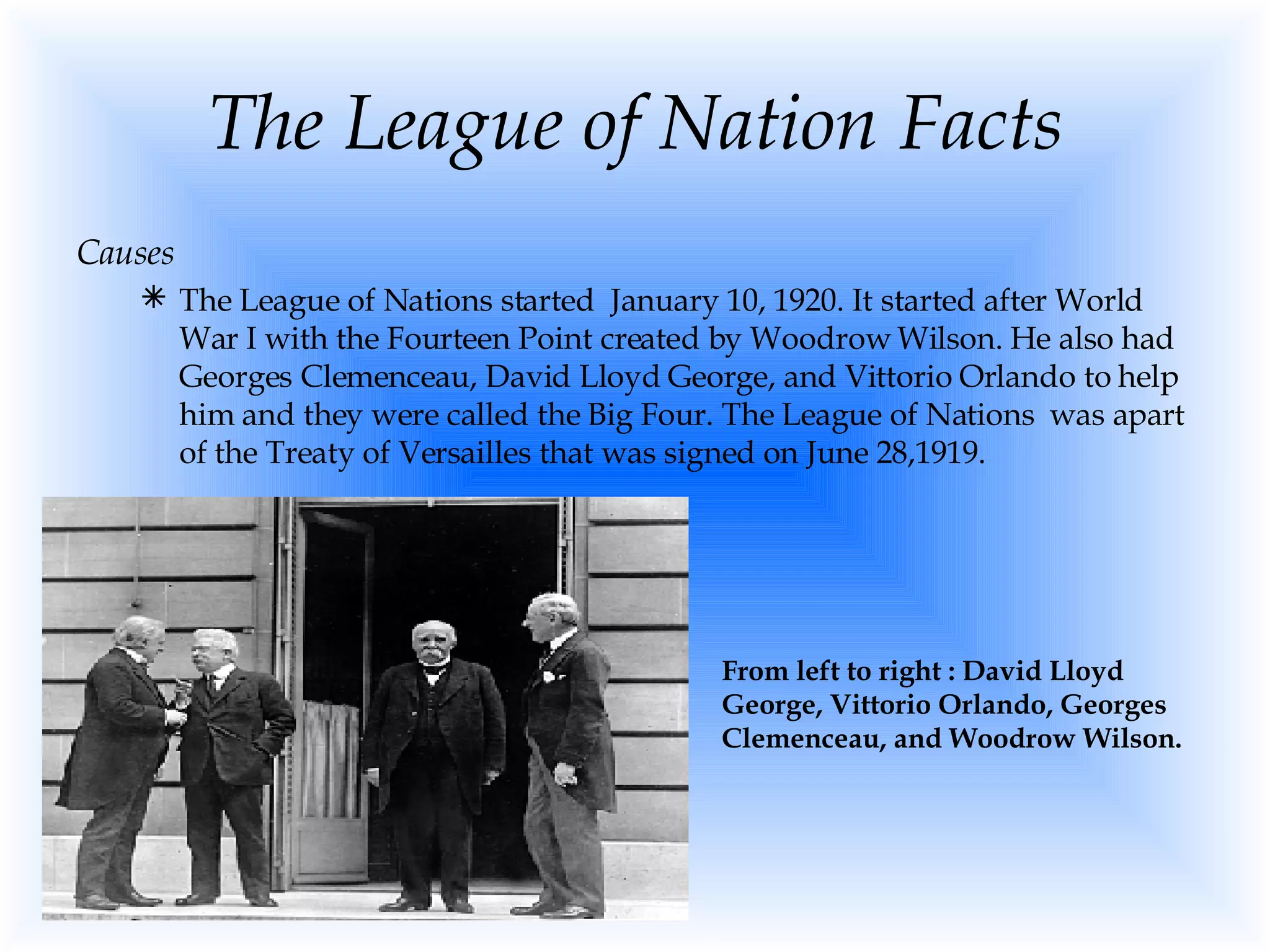
The League of Nation Facts Causes The League of Nations started  January 10, 1920. It started after World War I with the Fourteen Point created by Woodrow Wilson. He also had Georges Clemenceau, David Lloyd George, and Vittorio Orlando to help him and they were called the Big Four. The League of Nations  was apart of the Treaty of Versailles that was signed on June 28,1919.  From left to right : David Lloyd George, Vittorio Orlando, Georges Clemenceau, and Woodrow Wilson.
ORIGIN The League of Nations began after World War I. President Woodrow Wilson was discouraged by what he saw in World War I. He felt that the only way to stop this was to create an international group that would be responsible for keeping peace in the world and solving disputes between countries. The League of Nations began on November 15, 1920 in Geneva. There were 42 countries at the meeting. It ended April 8, 1946. It lasted for 26 years and 63 nations were members.
The League of Nations had several goals: The League of Nations would be sop wars. The League of Nations would help to improve peoples’ lives. The League of Nations would try to persuade countries to give up their weapons. There would be no more war.
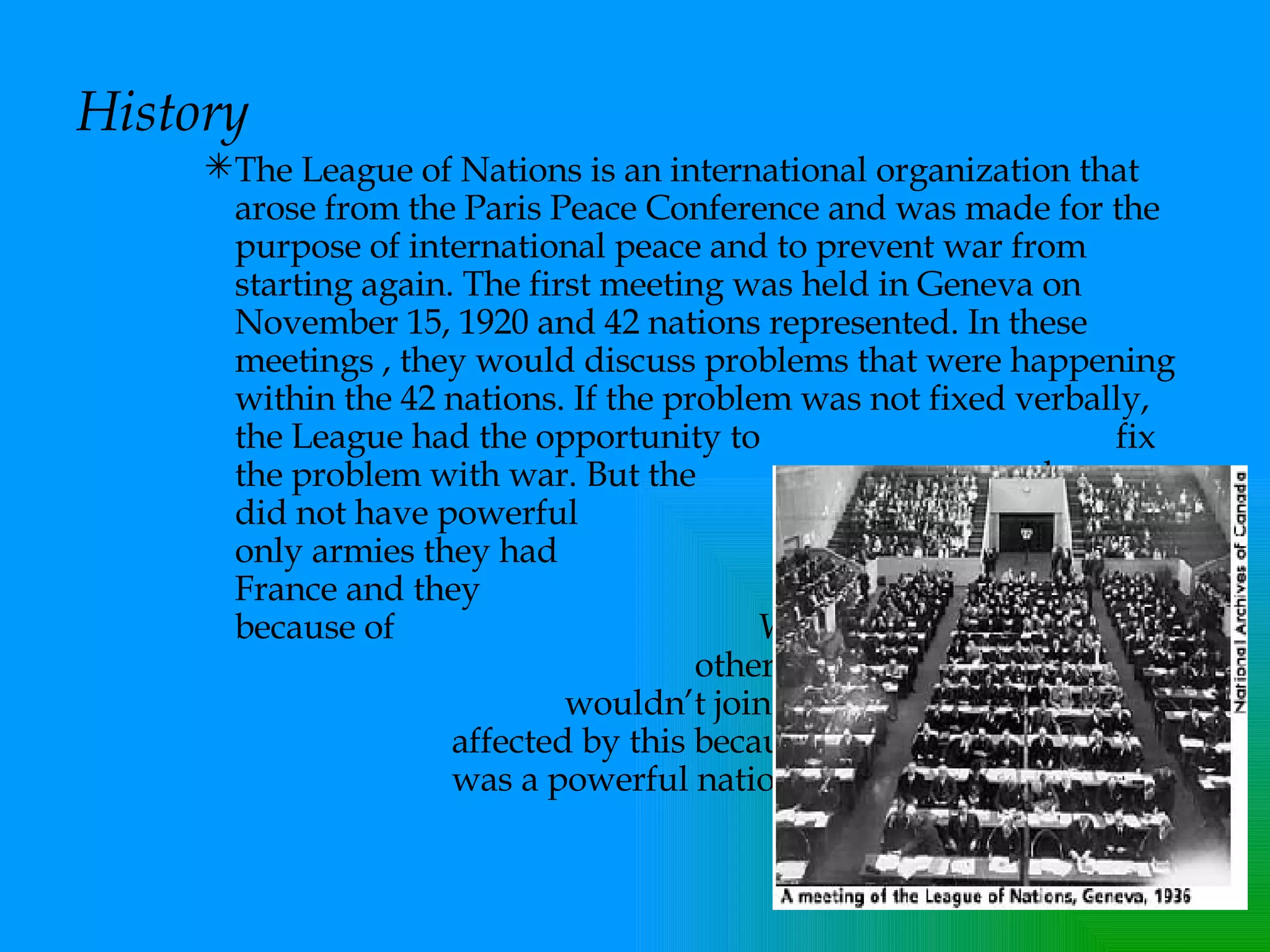
History The League of Nations is an international organization that arose from the Paris Peace Conference and was made for the purpose of international peace and to prevent war from starting again. The first meeting was held in Geneva on November 15, 1920 and 42 nations represented. In these meetings , they would discuss problems that were happening within the 42 nations. If the problem was not fixed verbally, the League had the opportunity to  fix the problem with war. But the  league did not have powerful  armies. The only armies they had  were Britain and France and they  weren’t that powerful because of  World War I. The Leagues  other problem was that America  wouldn’t join. The League was  affected by this because America  was a powerful nation.
IMPORTANT PEOPLE  “THE BIG FOUR” Woodrow Wilson was born in 1856 to strict religious parents; his Father was a Minister. He attended Princeton University, University of Virginia and John Hopkins University. WOODROW WILSON
He became Professor at Princeton University and in 1902, he was appointed to be the President of Princeton University.  He was elected Governor of New Jersey in 1910. In 1912, he ran for President. He won the election and became the 28 th  President of the United States. As the President of the United States, he spent time working on matters in the United States such as reorganizing the federal banking system. America entered WWI as an associated power. During the Peace talks, Wilson issued presented his  Fourteen Points  that called for world peace. He also recommended that a  League of Nations  would maintain world peace.
David Lloyd George David Lloyd George was born in Manchester, England in 1863. He was a Liberal and was elected as a Member of Parliament in 1890 and served for 55 years. He was a good speaker and  became a leader in the Parliament. He was responsible for leading many reforms to help the poor in society.
In December 1916, he became the Prime Minister of Great Britain. He took the role of mediator between those who wanted harsh punishment and those who thought that a “mild rebuke” was enough punishment for Germany.  He believed that Germany should be punished for the War but he did not believe in “total retribution” that some at the peace talks wanted.  He died in 1945.
Orlando Vittorio Orlando Vittorio was born in Palermo, Sicily in 1860. He was Professor of Law. In 1916, he was appointed to be the Minister of Justice. He became Prime Minister in 1918. At the Versailles Peace Settlement, he tried to make demands for more territory for Italy.
Italy wanted control of the Adriatic coast. Woodrow Wilson and others thought that his demands were unacceptable. At home, he was seen as a failure at the Versailles peace talks, and his political career ended.  He resigned from politics in June, 1919 and withdrew from public life after Mussolini came to power. He died in 1952.
Georges Clemenceau   Georges Clemenceau was born in 1841. He studied medicine and planned to become a doctor. He got into politics and was appointed as mayor of his home town in 1870. In March 1906, he was appointed as Minister of Home Affairs and appointed as French Prime Minister seven months later.
As a politician, he was given the name, “The Tiger.” As the French Prime Minister, he attended the Versailles peace talks, he was outspoken and wanted Germany to be completely destroyed. He represented the attitude of France that Germany should be smashed so it could never bring war again. He was not sure that Wilson’s plan for world peace would work. French people blamed him for the lenient treatment of Germany. He continued to write about how dangerous Germany could be. He died in 1929 at age 79. He had been in politics for almost 60 years.
RESULTS The League of Nations was a good idea but many see that it failed. There were many problems. America refused to join the League of Nations. Many of the countries that were members of the League of Nations did not change their policies to agree with the League of Nations. No country really saw the League as having any real global power.
Many countries withdrew from the League of Nations.  The final end to the League of Nations came when Italy attacked Ethiopia who was also a member of the League. The League of Nations did not take action when Italy invaded Ethiopia. SUCCESS OF THE LEAGUE OF NATIONS The goal of the League of nations was to stop war. The agreement had success in some countries such as the Aaland Islands, Memel, Turkey, Greece, and Bulgaria.  In Third World countries, the League of Nations tried to improve health to wipe out smallpox .
3. In third world countries, the League tried to improve the status of women and get rid of child slave labor. They also attacked drug addiction. The League was successful in letting the world know that there were social problems in Third world countries. FAILURES OF THE LEAGUE OF NATIONS The League of Nations was a good idea to end war forever, but there were problems: The League had no real power to enforce international law or economic rules. The United States refused to join. This hurt the power of the League. Woodrow Wilson who was President came up with idea of the League of Nations.
3.  It could not stop Japan when it attacked China or Italy when it attacked Ethiopia. When the League did nothing to to stop the attacks, it became unimportant. It had no role in World War II. It disbanded in 1946 and no one really noticed .
The League of Nations Map
This is the Treaty of Versailles that was signed on June 28, 1919.(primary source)
SOURCES Fenwick, C. G.. "The Failure of the League of Nations."  The American Journal of International Law .  Vol. 30, No. 3 (Jul., 1936), pp. 506-509 Simpkin, John. “First World War.”  Encyclopedia of the First World War.  September, 1997.  www.spartacus.schoolnet.com . November, 2007. Spartacus Educational. Strollo, Philip. “The League of Nations Timeline”  Essential Facts   About the League of Nations.  No date. http :// worldatwar.net /timeline . November, 2007. The World at War.   Trueman, Chris. “The Treaty of Versailles.”  The League of Nations.  No date of posting.  www.historylearningsite.com . November, 2007. The History Learning Site. White, Matthew. “Map-The League of Nations.”  Historical Atlas of the 20 th  Century.  October 18, 1998.  www.userserols.com . November, 2007.

League Of Nations

  • 1.
    By: BriaMorgan December 4, 2007
  • 2.
    TIMELINE 1914 WorldWar I started between the Central and the Allie Powers.Germany and Austria- Hungary were the Central Powers fighting on the Western Front. France, the United States, Russia, Britain, and Italy were the Allie Powers fighting on the Eastern Front. 1918 Fourteen Points were created by Woodrow Wilson. They were a plan for long lasting peace. 1919 The Peace Conference was held in Paris were 32 countries attended. The decisions of the meeting were made by a group called the Big Four. It included Woodrow Wilson representing the United States, Georges Clemenceau representing France, David Lloyd George representing Great Britain, and Vittorio Orlando representing Italy.
  • 3.
    The Treaty ofVersailles was between Germany and France, the United States, Russia, Britain, and Italy. It was signed on June 28. 1920 The League of Nations was created by the Treaty of Versailles. 1922 On May 15 the German-Polish Convention was signed. On September 18 Hungary was added to the league of Nations. 1926 June 14, Brazil gave their notice of withdrawal from the League of Nations. September 8 Germany was added to the League of Nations and made a permanent Member of the Council. 1934 On September 18, the Soviet Union was added the League. 1936 Guatemala, Nicaragua, and Honduras give their notice of withdrawal from the League. 1937 The Egyptian Government apply to be in the League.
  • 4.
    Paraguay, Salvador, andItaly give their notice of withdrawal from the League of Nations. 1938 The withdrawal of Guatemala takes effect on the League. Chile gives their notice of withdrawal from the League. The withdrawal of Honduras takes effect on the League. Venezuela gives their notice of withdrawal from the League of Nations. 1946 On April 18, the League of Nations gives all its assets to the United Nations. The contract was signed by W. Moderow, the representative of the League and Sean Lester, the last secretary- general of the League of Nations.
  • 5.
    The League ofNation Facts Causes The League of Nations started January 10, 1920. It started after World War I with the Fourteen Point created by Woodrow Wilson. He also had Georges Clemenceau, David Lloyd George, and Vittorio Orlando to help him and they were called the Big Four. The League of Nations was apart of the Treaty of Versailles that was signed on June 28,1919. From left to right : David Lloyd George, Vittorio Orlando, Georges Clemenceau, and Woodrow Wilson.
  • 6.
    ORIGIN The Leagueof Nations began after World War I. President Woodrow Wilson was discouraged by what he saw in World War I. He felt that the only way to stop this was to create an international group that would be responsible for keeping peace in the world and solving disputes between countries. The League of Nations began on November 15, 1920 in Geneva. There were 42 countries at the meeting. It ended April 8, 1946. It lasted for 26 years and 63 nations were members.
  • 7.
    The League ofNations had several goals: The League of Nations would be sop wars. The League of Nations would help to improve peoples’ lives. The League of Nations would try to persuade countries to give up their weapons. There would be no more war.
  • 8.
    History The Leagueof Nations is an international organization that arose from the Paris Peace Conference and was made for the purpose of international peace and to prevent war from starting again. The first meeting was held in Geneva on November 15, 1920 and 42 nations represented. In these meetings , they would discuss problems that were happening within the 42 nations. If the problem was not fixed verbally, the League had the opportunity to fix the problem with war. But the league did not have powerful armies. The only armies they had were Britain and France and they weren’t that powerful because of World War I. The Leagues other problem was that America wouldn’t join. The League was affected by this because America was a powerful nation.
  • 9.
    IMPORTANT PEOPLE “THE BIG FOUR” Woodrow Wilson was born in 1856 to strict religious parents; his Father was a Minister. He attended Princeton University, University of Virginia and John Hopkins University. WOODROW WILSON
  • 10.
    He became Professorat Princeton University and in 1902, he was appointed to be the President of Princeton University. He was elected Governor of New Jersey in 1910. In 1912, he ran for President. He won the election and became the 28 th President of the United States. As the President of the United States, he spent time working on matters in the United States such as reorganizing the federal banking system. America entered WWI as an associated power. During the Peace talks, Wilson issued presented his Fourteen Points that called for world peace. He also recommended that a League of Nations would maintain world peace.
  • 11.
    He became Professorat Princeton University and in 1902, he was appointed to be the President of Princeton University. He was elected Governor of New Jersey in 1910. In 1912, he ran for President. He won the election and became the 28 th President of the United States. As the President of the United States, he spent time working on matters in the United States such as reorganizing the federal banking system. America entered WWI as an associated power. During the Peace talks, Wilson issued presented his Fourteen Points that called for world peace. He also recommended that a League of Nations would maintain world peace.
  • 12.
    David Lloyd GeorgeDavid Lloyd George was born in Manchester, England in 1863. He was a Liberal and was elected as a Member of Parliament in 1890 and served for 55 years. He was a good speaker and became a leader in the Parliament. He was responsible for leading many reforms to help the poor in society.
  • 13.
    In December 1916,he became the Prime Minister of Great Britain. He took the role of mediator between those who wanted harsh punishment and those who thought that a “mild rebuke” was enough punishment for Germany. He believed that Germany should be punished for the War but he did not believe in “total retribution” that some at the peace talks wanted. He died in 1945.
  • 14.
    Orlando Vittorio OrlandoVittorio was born in Palermo, Sicily in 1860. He was Professor of Law. In 1916, he was appointed to be the Minister of Justice. He became Prime Minister in 1918. At the Versailles Peace Settlement, he tried to make demands for more territory for Italy.
  • 15.
    Italy wanted controlof the Adriatic coast. Woodrow Wilson and others thought that his demands were unacceptable. At home, he was seen as a failure at the Versailles peace talks, and his political career ended. He resigned from politics in June, 1919 and withdrew from public life after Mussolini came to power. He died in 1952.
  • 16.
    Georges Clemenceau Georges Clemenceau was born in 1841. He studied medicine and planned to become a doctor. He got into politics and was appointed as mayor of his home town in 1870. In March 1906, he was appointed as Minister of Home Affairs and appointed as French Prime Minister seven months later.
  • 17.
    As a politician,he was given the name, “The Tiger.” As the French Prime Minister, he attended the Versailles peace talks, he was outspoken and wanted Germany to be completely destroyed. He represented the attitude of France that Germany should be smashed so it could never bring war again. He was not sure that Wilson’s plan for world peace would work. French people blamed him for the lenient treatment of Germany. He continued to write about how dangerous Germany could be. He died in 1929 at age 79. He had been in politics for almost 60 years.
  • 18.
    RESULTS The Leagueof Nations was a good idea but many see that it failed. There were many problems. America refused to join the League of Nations. Many of the countries that were members of the League of Nations did not change their policies to agree with the League of Nations. No country really saw the League as having any real global power.
  • 19.
    Many countries withdrewfrom the League of Nations. The final end to the League of Nations came when Italy attacked Ethiopia who was also a member of the League. The League of Nations did not take action when Italy invaded Ethiopia. SUCCESS OF THE LEAGUE OF NATIONS The goal of the League of nations was to stop war. The agreement had success in some countries such as the Aaland Islands, Memel, Turkey, Greece, and Bulgaria. In Third World countries, the League of Nations tried to improve health to wipe out smallpox .
  • 20.
    3. In thirdworld countries, the League tried to improve the status of women and get rid of child slave labor. They also attacked drug addiction. The League was successful in letting the world know that there were social problems in Third world countries. FAILURES OF THE LEAGUE OF NATIONS The League of Nations was a good idea to end war forever, but there were problems: The League had no real power to enforce international law or economic rules. The United States refused to join. This hurt the power of the League. Woodrow Wilson who was President came up with idea of the League of Nations.
  • 21.
    3. Itcould not stop Japan when it attacked China or Italy when it attacked Ethiopia. When the League did nothing to to stop the attacks, it became unimportant. It had no role in World War II. It disbanded in 1946 and no one really noticed .
  • 22.
    The League ofNations Map
  • 23.
    This is theTreaty of Versailles that was signed on June 28, 1919.(primary source)
  • 24.
    SOURCES Fenwick, C.G.. "The Failure of the League of Nations." The American Journal of International Law . Vol. 30, No. 3 (Jul., 1936), pp. 506-509 Simpkin, John. “First World War.” Encyclopedia of the First World War. September, 1997. www.spartacus.schoolnet.com . November, 2007. Spartacus Educational. Strollo, Philip. “The League of Nations Timeline” Essential Facts About the League of Nations. No date. http :// worldatwar.net /timeline . November, 2007. The World at War. Trueman, Chris. “The Treaty of Versailles.” The League of Nations. No date of posting. www.historylearningsite.com . November, 2007. The History Learning Site. White, Matthew. “Map-The League of Nations.” Historical Atlas of the 20 th Century. October 18, 1998. www.userserols.com . November, 2007.