
Captain Pawanexh Kohli
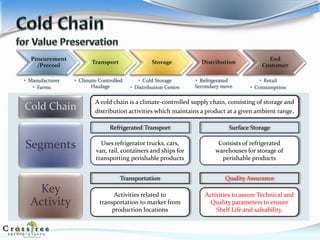
Procurement                                                                             End
                        Transport                Storage          Distribution
    /Precool                                                                            Customer

• Manufacturer   • Climate Controlled      • Cold Storage       • Refrigerated          • Retail
   • Farms              Haulage         • Distribution Centre   Secondary move      • Consumption

                         A cold chain is a climate-controlled supply chain, consisting of storage and
Cold Chain               distribution activities which maintains a product at a given ambient range.

                               Refrigerated Transport                       Surface Storage

Segments                   Uses refrigerator trucks, cars,
                         van, rail, containers and ships for
                                                                        Consists of refrigerated
                                                                       warehouses for storage of
                         transporting perishable products                perishable products


                                    Transportation                         Quality Assurance
   Key                           Activities related to             Activities to assure Technical and
  Activity                 transportation to market from            Quality parameters to ensure
                                production locations                   Shelf Life and saleability.
•   Nascent Yet increasingly Demanding, Estimated USD 9 billion in 2015.
              •   Increasing Volumes and global exposures.
 Market       •   Domestic development, burgeoning parity.
              •   Fragmented and disjointed.
              Drivers:                                Challenges:
              –   Growth in Organized Retail          –   Human Resources
 Drivers &    –   Shift Towards Horticultural Crops   –   Lack of Logistical Support
Challenges    –   Growth in Processed Food Sector     –   Uneven Distribution of Cold chains
              –   Government Initiatives              –   Cost Structure
              –   Growth in Bio-Pharma sector         –   Power Supply

              •   Cold Chains based on Public Private Partnership (PPP) model
              •   Rail Based Reefers, organised distribution.
  Trends
              •   Backward Integration, forward economy.
              •   Cold Chain Facilities for exports.
              •   Minimal: Few Private and State owned players.
              •   Surface Storage comprising of both organised and unorganised.
Competition
              •   At least 50 companies are offering refrigerated transport services in India
              •   Captive establishments & New entrants.
Globalisation
 Borderless consumers.

 Process Integration

 Bilateral trade

 Business friendly Global
  Banking
 Right Cost Country
  optimisation.
 Diminishing world,
  singular demands.
 5th largest retail market worldwide.
  62% of retail – food; fresh & processed.
  Farmers shifting to horticultural crops.
                                                                     1%

                                                                 3% 2%
      U$ Billion   Retail                                   4%
600                                                    4%                            Food
                                                                                     Fashion
500                                              6%
                                                                                     Leisure / entertainment
400
                                                                                     Fashion accessories
300                                         8%                                       Consumer durables
                               543
200                                                                                  Health, beauty, Pharma
                      353
                                                                                     Furniture
100      205
                                                                          62%        Telecom
                                                 10%
 0                                                                                   Books and music
      2002-03       2009-10   2014P
                                                                                Retail Segments
                                      Source IBEF
Industry turnovers (US$ bn)
                                                              Size–output/value     Projected   Processin   Organise
                                   98        Segment
                                                                  (2007–08)          growth      g levels   d players

                                          Dairy products       US$ 62.67 billion      15%         37%         15%

                                        Fruits & Vegetables   2.33 million tonnes     20%          2%         48%
                              49
                        38               Meat and poultry       US$ 13 million        10%          1%          5%
             22    24
        18                                   Fisheries        6.4 million tonnes      20%         12%         N/A
10
                                         Packaged foods          US$ 2 billion         8%          3%         80%

                                            Beverages          US$ 155 million        27%         N/A         77%


                                                                                                        Source IBEF


Food processing (US$98 bn), 9% of GDP, growing at 15% last 3 years.
Vision 2015 (GOI) action plan to double processed foods to US$210 bn.
MoFPI Envisages investment of US$21.05 bn in next 5 years.
FICCI-E&Y study sees investment opportunities to shoot up by 42.5% to
US$ 181 billion in 2015 and to US$ 318 billion by 2020.
 Changing consumer trends for convenience and
  processed foods.
 Government of India’s setting up 30 mega food parks
   To propel demand for cold storage and transportation.
700                                                           608
                                   Market Clinical Trials                         Indian clinical trials market
              600
                                                                  468             currently sized at US$ 250
US$ Million


              500
              400                                        360                      mill to US$ 275 mill and
              300
                                                 275                              expected to grow at CAGR of
                                           211
              200            124    161                                           30%, at almost double the
                       95                                                         global average.
              100
                0


                    Indian Pharma Industry: US$ 20 billion
                    in 2009; the domestic retail market is
                    expected to cross the US$ 10 billion
                    mark in 2010 and reach an estimated
                    US$ 12 billion to US$ 13 billion by 2012.


                                                 Source: IBEF, CRIS INFAC
Challenges
                                    Human Capital, Domain Skills

Drivers                             Lack of Logistical Support

Growth in Organized Retail
                                    Uneven Distribution of Cold Stores

Shift towards horticultural crops   Cost Structure (Capital), Parity

Growth in Processed Food Sector
                                    Power Supply (Erratic)

Government Initiatives

Demand from all user sectors
Lack of Logistical Support (Agri-produce)
 Small Land holding; remains logistical challenge
    Requires multiple farm gate collection centres.
 Fragmented cold chain industry has not encouraged the growth
  of cold logistics for horticulture produce.
 Minimal cooperative farming
    Irregular parameters in one catchment area.
 Underdeveloped domestic market for fresh perishable
  produce.
 Standard Refrigerated Systems inefficient & poorly designed.

Uneven Capacity distribution
 Capacity mostly for focused on single commodities.
 Financial viability due to seasonality.
 No proper origin/destination pairing.
 Capital Intensive Infrastructure.
 Restrictive land use and other regulations.
 High Operational costs, Low yield models.
 High Insurance/risk coverage premiums.
 Nascent, Limited knowledge, limited experience.
 Large gap in demand supply conducive to small
 unorganised service providers.
 Users have developed captive resources.
 Federal tax and commercial regulations.
 No fast-track perishables corridor.
Government
                                        policy as a
                                        ‘Catalyst’


                  Encourages    Liberalises                                       Foreign
Encourages                                      Rationalises    Grants &
                  Organised     Marketing                                       Investment
Investments                                      Tax Laws       Subsidies
                    Sector        Norms                                            Eased


                                  Focus on
                   ECB route                      Moving       VG Funding,      100% FDI in
  Agri/Foods                      increased
                    opened,                       towards         Grants,        food sector,
 identified as                      Retail,
                  Import duty                     uniform      Infrastructure   ECB for cold
priority sector                   improved
                    relaxed                      VAT/GST           status           chain.
                                supply chain.
 Excise waived on F&V, meat preparations, ice cream, other RTE food mixes.
 Automatic approval for 100% foreign equity in processed food items.
  External Commercial Borrowing opened (except alcohol, beer, etc).
 Priority lending status; Duties reduced on imports; zero service tax on
  installations.
 EOI floated for 30 mega food parks – allocated US$ 1.02 billion by 2012.
    Objective of the scheme is to provide backward and forward linkages as well
     develop reliable and sustainable supply chain
 GoI initiating National Highway Development Program and partnering with
  Indian Railways to establish cold chain infrastructure.
    Indian Railways is planning to invite private parties to run refrigerated container
     trains for transporting agricultural products across the country.
 Integrated Food Law (FSSA) notified and ready for implementation.
 Rs 1000 cr corpus for agro-processing industry and market development.
 Task Force on Development of Cold-Chain established & National Centre for
  Cold Chain Development (NCCD).
 100% capital deprecation for cold chain.
 Weighted deduction 200% for R&D in Pharma.
Farmer Groups   Self Help Groups   Individual farmers

                                                                                                      Field
                                                                                               Collection Centers


       GoI PPP venture
                                                                                             -Primary Processing-
-Cluster based Approach.
                                        PPC               PPC               PPC              Precooling, Grading,
-Food Processing Focus.                                                                    Sorting, Waxing, packing,
-Backward & Forward Integrated.                                                               Temporary storage
-Shared enabling Infrastructure.
- Common facilities/amenities.

                                                                                           -Central Processing-
             Importer                                                               Processing Units, Aseptic packing,
                                                                                     Pulping, RTE units, CA chamber,
                                                                                             Dairy products,
                                                       Mega                           Logistics center, Warehouse,
                                                                                    QC Labs, Utility, Supply Lines, etc
                       Exporter                      Food Park
                                                          CPC
                                                      Industries
                    Domestic
                   Distribution                                                            Domestic
                                                                                            Retail
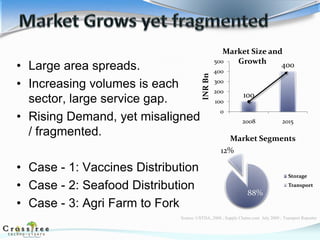
Market Size and
• Large area spreads.                                 Growth
                                                500
                                                                  400
                                                400


                                       INR Bn
• Increasing volumes is each                    300
                                                200
  sector, large service gap.                    100
                                                             100

• Rising Demand, yet misaligned
                                                 0
                                                            2008                 2015
  / fragmented.                                     Market Segments
                                                  12%

• Case - 1: Vaccines Distribution
                                                                                    Storage

• Case - 2: Seafood Distribution                               88%
                                                                                    Transport


• Case - 3: Agri Farm to Fork
                             Source: USTDA, 2008 ; Supply Chains.com July 2009 ; Transport Reporter
Cold Supply Chain (India): Poised for a Quantum Jump

 Best practises for India Market.
 Demand for training establishments.
 Gaps in appropriate Infrastructure development.
 Adoption of energy efficient technology.
 Adapting to Indian backdrop – move from mass storage
  to direct access storage.
 Partner with networked Indian logistics companies.
 Manage and develop Multiple complexities in human
  capital development.
 Anticipate ahead of a developing market.
      Here is History in the making and the Opportunity to be part of it. A market develops to oblige!
 Changing Perceptions
    Process delays - understanding.
    Control - global.
    Quality - total.


 Customer Attrition and Loyalty.

 Market specific Branding.

 India specific USPs.

 Socio-ecological interactions.

 Inter-cultural communications.
      “The key to improved logistics is complete and high quality information from the supply chain.”
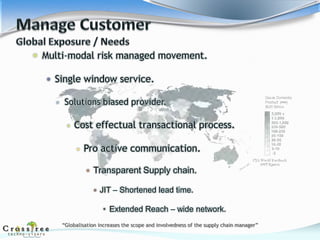
 Multi-modal risk managed movement.

   Single window service.

        Solutions biased provider.

            Cost effectual transactional process.

                Pro active communication.

                    Transparent Supply chain.

                        JIT – Shortened lead time.

                         • Extended Reach – wide network.
        “Globalisation increases the scope and involvedness of the supply chain manager”
 People.
    Cross cultural exposure
    Local Knowledge
 Leadership Mix.
    Best practices in cross functions
    Synergise corporate and managerial mores
 Laws & Norms.
    Commercial Taxation
    Regulatory Compliances
    Corporate Governance
 Affiliation with Trade Development Bodies.
 Partner Integration, Cross-enterprise processes.
      "We've got the fuel. We've got the technology… It's what's in between that's the challenge.”
   Changing Demographics.
   Modified Purchase Habits.
   Traceability and flexibility.
   Free Trade Agreements.
   Inclusive Globalisation.
   Security & IP Concerns.
   New Business & Opportunities.
   Affected National Priorities.
   Environmental Sustainability.
   Changed perceptions, fading borders.
   Technology reliant business processes.
         “Dynamic, Innovative, Lean, Universal, Enabled, Agile, Involved – Cold Chain Solutions.”
 Technology Provision and implementation.
 Cold Logistics and Supply Chain services.
 Infrastructure designers and planners.
 Scalable Refrigeration technology.
 Refrigerated Vehicles and delivery systems.
 Alternate energy, environmental protection expertise.
 Shipping and international food trade.
 Innovators and solutions biased companies.
 Education, Training & Cold chain experts.
 Knowledge Managers and Integration specialists.

           There is a fledgling Cold chain awaiting shape – to serve a billion people.
Pawanexh Kohli


                 22

Cold-chain Market prospects in India

  • 1.
  • 2.
    Procurement End Transport Storage Distribution /Precool Customer • Manufacturer • Climate Controlled • Cold Storage • Refrigerated • Retail • Farms Haulage • Distribution Centre Secondary move • Consumption A cold chain is a climate-controlled supply chain, consisting of storage and Cold Chain distribution activities which maintains a product at a given ambient range. Refrigerated Transport Surface Storage Segments Uses refrigerator trucks, cars, van, rail, containers and ships for Consists of refrigerated warehouses for storage of transporting perishable products perishable products Transportation Quality Assurance Key Activities related to Activities to assure Technical and Activity transportation to market from Quality parameters to ensure production locations Shelf Life and saleability.
  • 3.
    Nascent Yet increasingly Demanding, Estimated USD 9 billion in 2015. • Increasing Volumes and global exposures. Market • Domestic development, burgeoning parity. • Fragmented and disjointed. Drivers: Challenges: – Growth in Organized Retail – Human Resources Drivers & – Shift Towards Horticultural Crops – Lack of Logistical Support Challenges – Growth in Processed Food Sector – Uneven Distribution of Cold chains – Government Initiatives – Cost Structure – Growth in Bio-Pharma sector – Power Supply • Cold Chains based on Public Private Partnership (PPP) model • Rail Based Reefers, organised distribution. Trends • Backward Integration, forward economy. • Cold Chain Facilities for exports. • Minimal: Few Private and State owned players. • Surface Storage comprising of both organised and unorganised. Competition • At least 50 companies are offering refrigerated transport services in India • Captive establishments & New entrants.
  • 4.
    Globalisation  Borderless consumers. Process Integration  Bilateral trade  Business friendly Global Banking  Right Cost Country optimisation.  Diminishing world, singular demands.
  • 5.
     5th largestretail market worldwide.  62% of retail – food; fresh & processed.  Farmers shifting to horticultural crops. 1% 3% 2% U$ Billion Retail 4% 600 4% Food Fashion 500 6% Leisure / entertainment 400 Fashion accessories 300 8% Consumer durables 543 200 Health, beauty, Pharma 353 Furniture 100 205 62% Telecom 10% 0 Books and music 2002-03 2009-10 2014P Retail Segments Source IBEF
  • 6.
    Industry turnovers (US$bn) Size–output/value Projected Processin Organise 98 Segment (2007–08) growth g levels d players Dairy products US$ 62.67 billion 15% 37% 15% Fruits & Vegetables 2.33 million tonnes 20% 2% 48% 49 38 Meat and poultry US$ 13 million 10% 1% 5% 22 24 18 Fisheries 6.4 million tonnes 20% 12% N/A 10 Packaged foods US$ 2 billion 8% 3% 80% Beverages US$ 155 million 27% N/A 77% Source IBEF Food processing (US$98 bn), 9% of GDP, growing at 15% last 3 years. Vision 2015 (GOI) action plan to double processed foods to US$210 bn. MoFPI Envisages investment of US$21.05 bn in next 5 years. FICCI-E&Y study sees investment opportunities to shoot up by 42.5% to US$ 181 billion in 2015 and to US$ 318 billion by 2020.
  • 7.
     Changing consumertrends for convenience and processed foods.  Government of India’s setting up 30 mega food parks  To propel demand for cold storage and transportation.
  • 8.
    700 608 Market Clinical Trials Indian clinical trials market 600 468 currently sized at US$ 250 US$ Million 500 400 360 mill to US$ 275 mill and 300 275 expected to grow at CAGR of 211 200 124 161 30%, at almost double the 95 global average. 100 0 Indian Pharma Industry: US$ 20 billion in 2009; the domestic retail market is expected to cross the US$ 10 billion mark in 2010 and reach an estimated US$ 12 billion to US$ 13 billion by 2012. Source: IBEF, CRIS INFAC
  • 9.
    Challenges Human Capital, Domain Skills Drivers Lack of Logistical Support Growth in Organized Retail Uneven Distribution of Cold Stores Shift towards horticultural crops Cost Structure (Capital), Parity Growth in Processed Food Sector Power Supply (Erratic) Government Initiatives Demand from all user sectors
  • 10.
    Lack of LogisticalSupport (Agri-produce)  Small Land holding; remains logistical challenge  Requires multiple farm gate collection centres.  Fragmented cold chain industry has not encouraged the growth of cold logistics for horticulture produce.  Minimal cooperative farming  Irregular parameters in one catchment area.  Underdeveloped domestic market for fresh perishable produce.  Standard Refrigerated Systems inefficient & poorly designed. Uneven Capacity distribution  Capacity mostly for focused on single commodities.  Financial viability due to seasonality.  No proper origin/destination pairing.
  • 11.
     Capital IntensiveInfrastructure.  Restrictive land use and other regulations.  High Operational costs, Low yield models.  High Insurance/risk coverage premiums.  Nascent, Limited knowledge, limited experience.  Large gap in demand supply conducive to small unorganised service providers.  Users have developed captive resources.  Federal tax and commercial regulations.  No fast-track perishables corridor.
  • 12.
    Government policy as a ‘Catalyst’ Encourages Liberalises Foreign Encourages Rationalises Grants & Organised Marketing Investment Investments Tax Laws Subsidies Sector Norms Eased Focus on ECB route Moving VG Funding, 100% FDI in Agri/Foods increased opened, towards Grants, food sector, identified as Retail, Import duty uniform Infrastructure ECB for cold priority sector improved relaxed VAT/GST status chain. supply chain.
  • 13.
     Excise waivedon F&V, meat preparations, ice cream, other RTE food mixes.  Automatic approval for 100% foreign equity in processed food items. External Commercial Borrowing opened (except alcohol, beer, etc).  Priority lending status; Duties reduced on imports; zero service tax on installations.  EOI floated for 30 mega food parks – allocated US$ 1.02 billion by 2012.  Objective of the scheme is to provide backward and forward linkages as well develop reliable and sustainable supply chain  GoI initiating National Highway Development Program and partnering with Indian Railways to establish cold chain infrastructure.  Indian Railways is planning to invite private parties to run refrigerated container trains for transporting agricultural products across the country.  Integrated Food Law (FSSA) notified and ready for implementation.  Rs 1000 cr corpus for agro-processing industry and market development.  Task Force on Development of Cold-Chain established & National Centre for Cold Chain Development (NCCD).  100% capital deprecation for cold chain.  Weighted deduction 200% for R&D in Pharma.
  • 14.
    Farmer Groups Self Help Groups Individual farmers Field Collection Centers GoI PPP venture -Primary Processing- -Cluster based Approach. PPC PPC PPC Precooling, Grading, -Food Processing Focus. Sorting, Waxing, packing, -Backward & Forward Integrated. Temporary storage -Shared enabling Infrastructure. - Common facilities/amenities. -Central Processing- Importer Processing Units, Aseptic packing, Pulping, RTE units, CA chamber, Dairy products, Mega Logistics center, Warehouse, QC Labs, Utility, Supply Lines, etc Exporter Food Park CPC Industries Domestic Distribution Domestic Retail
  • 15.
    Market Size and •Large area spreads. Growth 500 400 400 INR Bn • Increasing volumes is each 300 200 sector, large service gap. 100 100 • Rising Demand, yet misaligned 0 2008 2015 / fragmented. Market Segments 12% • Case - 1: Vaccines Distribution Storage • Case - 2: Seafood Distribution 88% Transport • Case - 3: Agri Farm to Fork Source: USTDA, 2008 ; Supply Chains.com July 2009 ; Transport Reporter
  • 16.
    Cold Supply Chain(India): Poised for a Quantum Jump  Best practises for India Market.  Demand for training establishments.  Gaps in appropriate Infrastructure development.  Adoption of energy efficient technology.  Adapting to Indian backdrop – move from mass storage to direct access storage.  Partner with networked Indian logistics companies.  Manage and develop Multiple complexities in human capital development.  Anticipate ahead of a developing market. Here is History in the making and the Opportunity to be part of it. A market develops to oblige!
  • 17.
     Changing Perceptions  Process delays - understanding.  Control - global.  Quality - total.  Customer Attrition and Loyalty.  Market specific Branding.  India specific USPs.  Socio-ecological interactions.  Inter-cultural communications. “The key to improved logistics is complete and high quality information from the supply chain.”
  • 18.
     Multi-modal riskmanaged movement.  Single window service.  Solutions biased provider.  Cost effectual transactional process.  Pro active communication.  Transparent Supply chain.  JIT – Shortened lead time. • Extended Reach – wide network. “Globalisation increases the scope and involvedness of the supply chain manager”
  • 19.
     People.  Cross cultural exposure  Local Knowledge  Leadership Mix.  Best practices in cross functions  Synergise corporate and managerial mores  Laws & Norms.  Commercial Taxation  Regulatory Compliances  Corporate Governance  Affiliation with Trade Development Bodies.  Partner Integration, Cross-enterprise processes. "We've got the fuel. We've got the technology… It's what's in between that's the challenge.”
  • 20.
    Changing Demographics.  Modified Purchase Habits.  Traceability and flexibility.  Free Trade Agreements.  Inclusive Globalisation.  Security & IP Concerns.  New Business & Opportunities.  Affected National Priorities.  Environmental Sustainability.  Changed perceptions, fading borders.  Technology reliant business processes. “Dynamic, Innovative, Lean, Universal, Enabled, Agile, Involved – Cold Chain Solutions.”
  • 21.
     Technology Provisionand implementation.  Cold Logistics and Supply Chain services.  Infrastructure designers and planners.  Scalable Refrigeration technology.  Refrigerated Vehicles and delivery systems.  Alternate energy, environmental protection expertise.  Shipping and international food trade.  Innovators and solutions biased companies.  Education, Training & Cold chain experts.  Knowledge Managers and Integration specialists. There is a fledgling Cold chain awaiting shape – to serve a billion people.
  • 22.