







Captain Pawanexh Kohli
Founder, CrossTree techno-visors
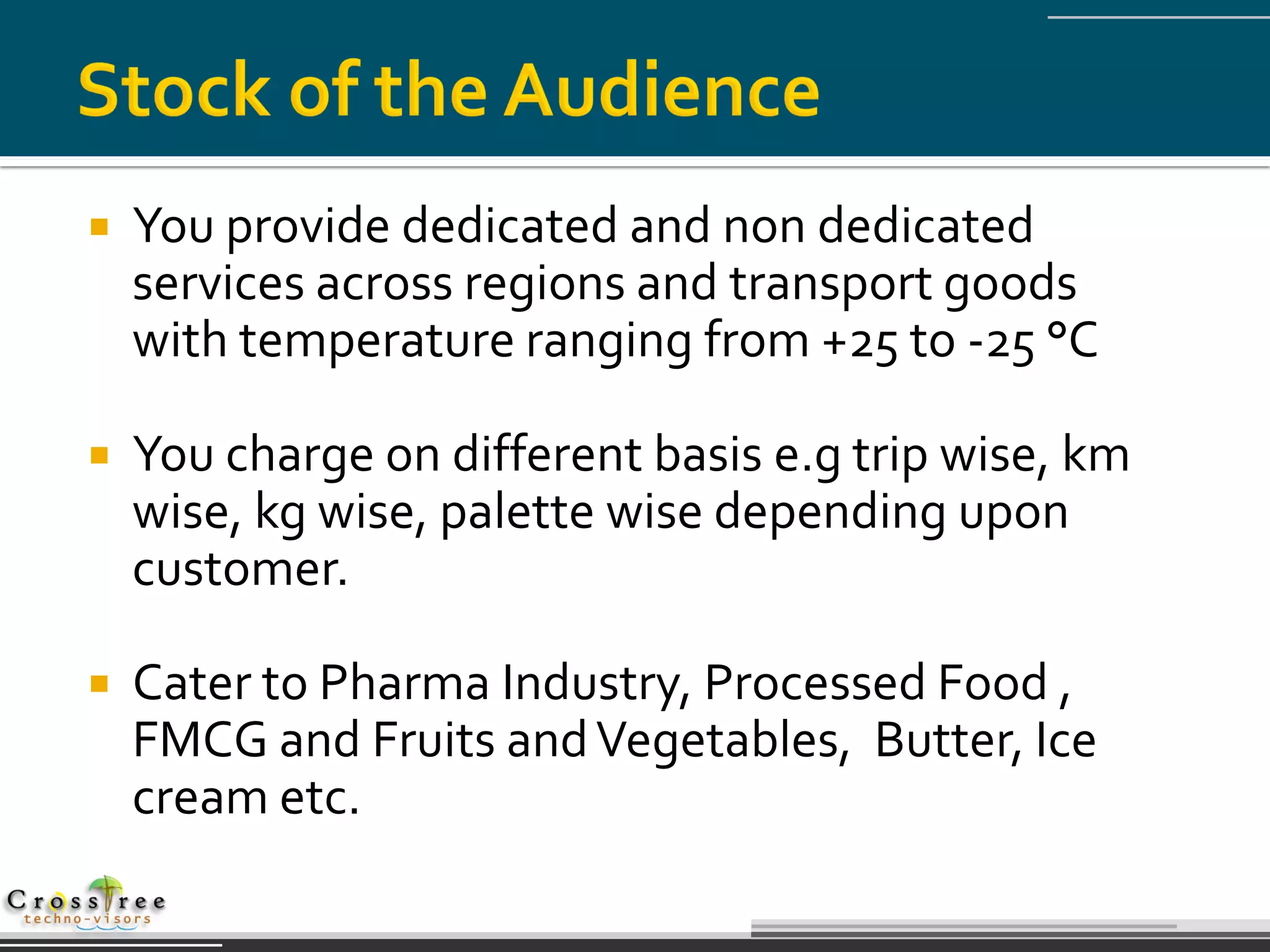
   You provide dedicated and non dedicated
    services across regions and transport goods
    with temperature ranging from +25 to -25 °C

   You charge on different basis e.g trip wise, km
    wise, kg wise, palette wise depending upon
    customer.

   Cater to Pharma Industry, Processed Food ,
    FMCG and Fruits and Vegetables, Butter, Ice
    cream etc.
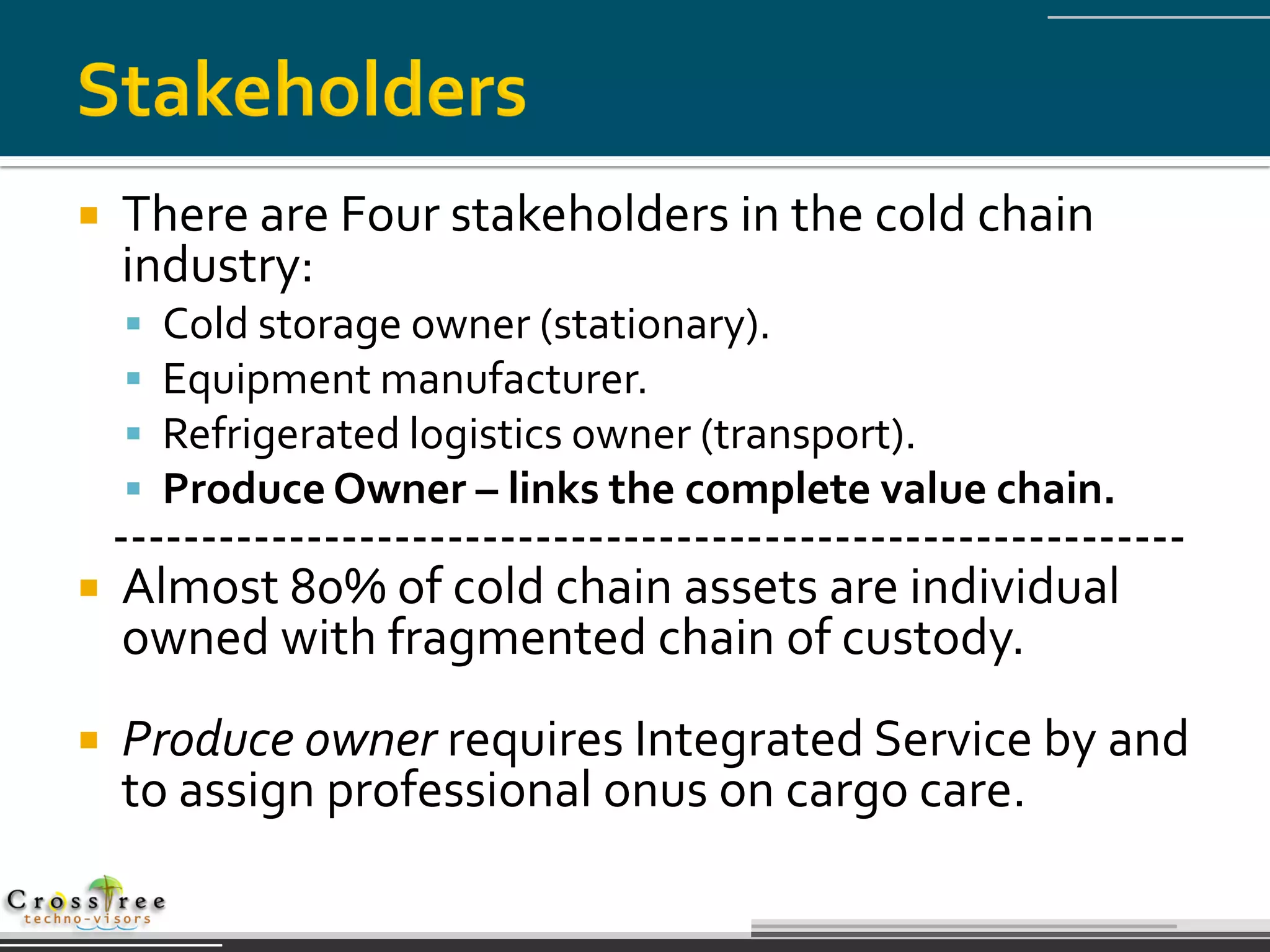
   There are Four stakeholders in the cold chain
    industry:
       Cold storage owner (stationary).
       Equipment manufacturer.
       Refrigerated logistics owner (transport).
       Produce Owner – links the complete value chain.
  -------------------------------------------------------------
 Almost 80% of cold chain assets are individual
   owned with fragmented chain of custody.
   Produce owner requires Integrated Service by and
    to assign professional onus on cargo care.
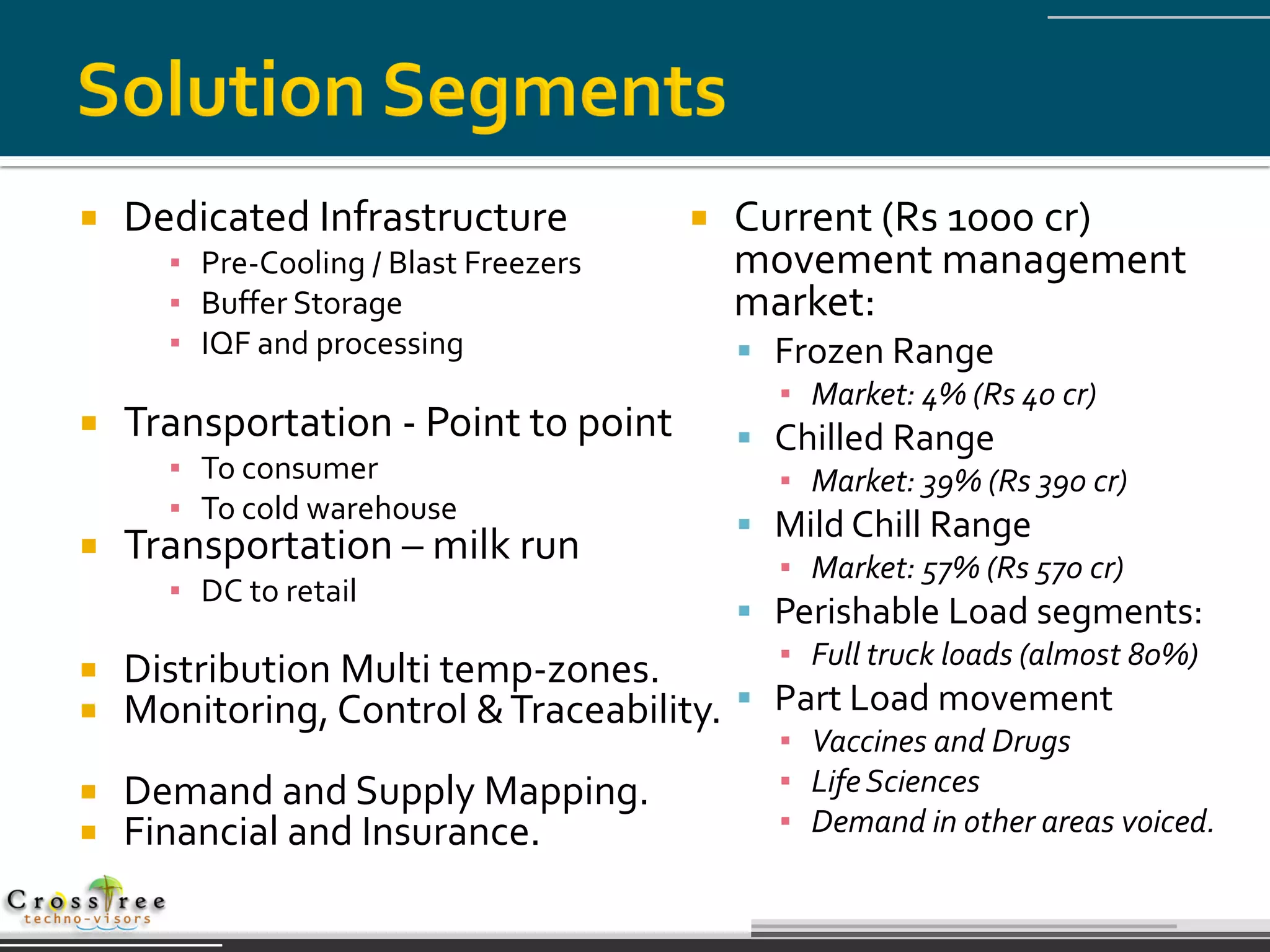
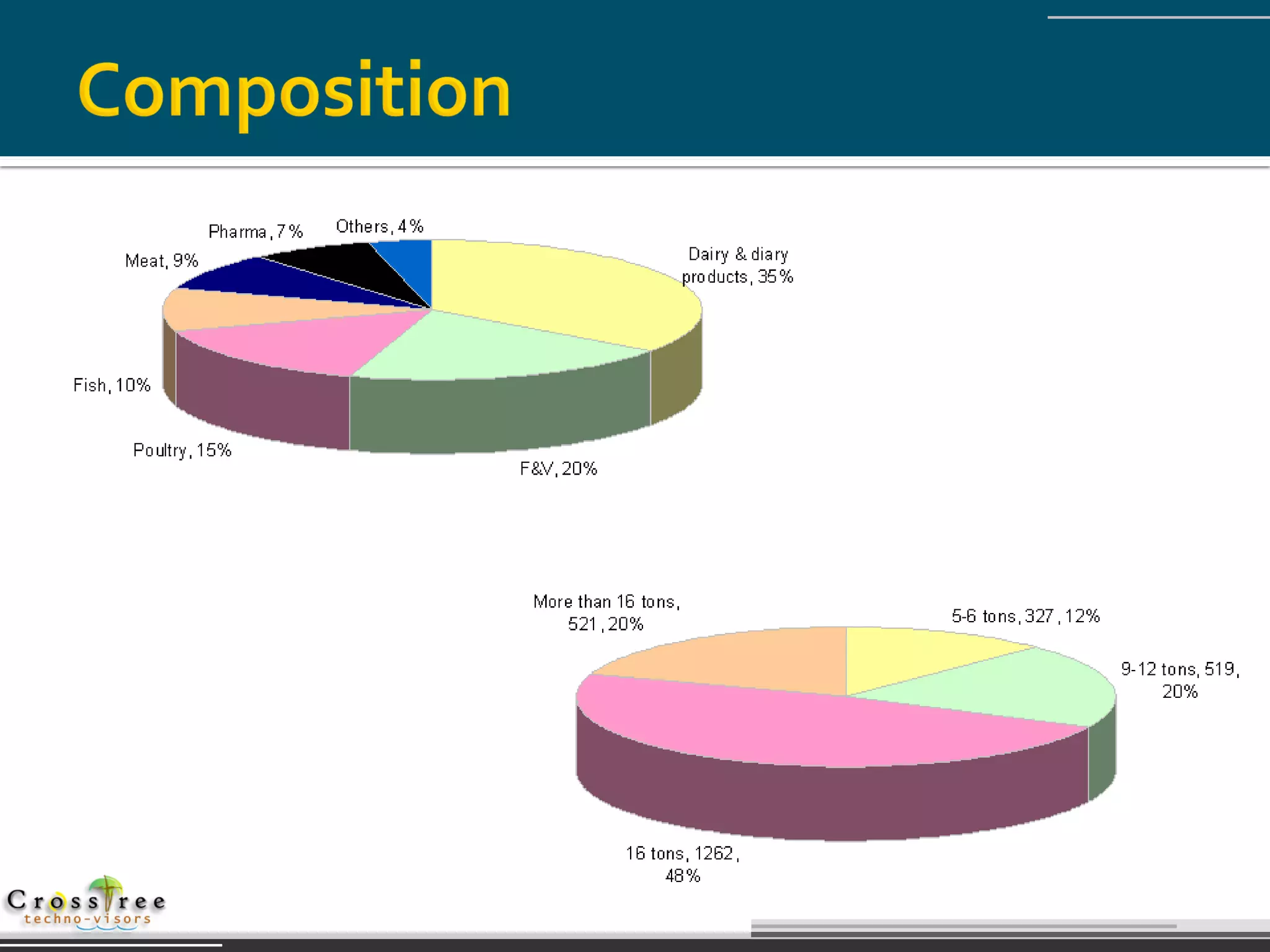
   Dedicated Infrastructure              Current (Rs 1000 cr)
      ▪ Pre-Cooling / Blast Freezers       movement management
      ▪ Buffer Storage                     market:
      ▪ IQF and processing                  Frozen Range
                                             ▪ Market: 4% (Rs 40 cr)
   Transportation - Point to point         Chilled Range
      ▪ To consumer                          ▪ Market: 39% (Rs 390 cr)
      ▪ To cold warehouse
                                            Mild Chill Range
   Transportation – milk run                ▪ Market: 57% (Rs 570 cr)
      ▪ DC to retail
                                            Perishable Load segments:
                                             ▪ Full truck loads (almost 80%)
   Distribution Multi temp-zones.
   Monitoring, Control & Traceability.     Part Load movement
                                             ▪ Vaccines and Drugs
   Demand and Supply Mapping.               ▪ Life Sciences
   Financial and Insurance.                 ▪ Demand in other areas voiced.
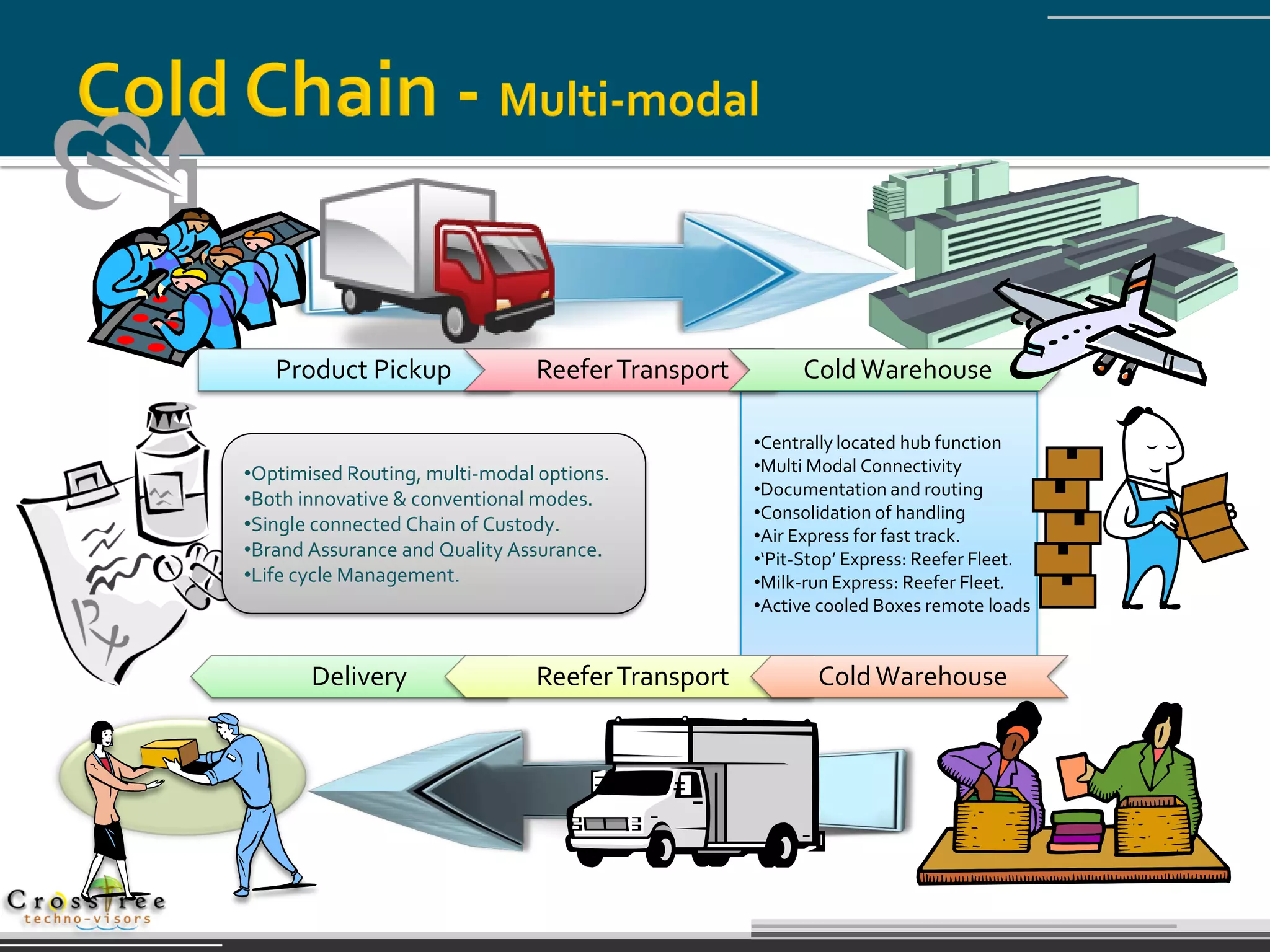
Product Pickup              Reefer Transport         Cold Warehouse

                                                  •Centrally located hub function
•Optimised Routing, multi-modal options.          •Multi Modal Connectivity
                                                  •Documentation and routing
•Both innovative & conventional modes.
                                                  •Consolidation of handling
•Single connected Chain of Custody.
                                                  •Air Express for fast track.
•Brand Assurance and Quality Assurance.           •‘Pit-Stop’ Express: Reefer Fleet.
•Life cycle Management.                           •Milk-run Express: Reefer Fleet.
                                                  •Active cooled Boxes remote loads


       Delivery                Reefer Transport          Cold Warehouse
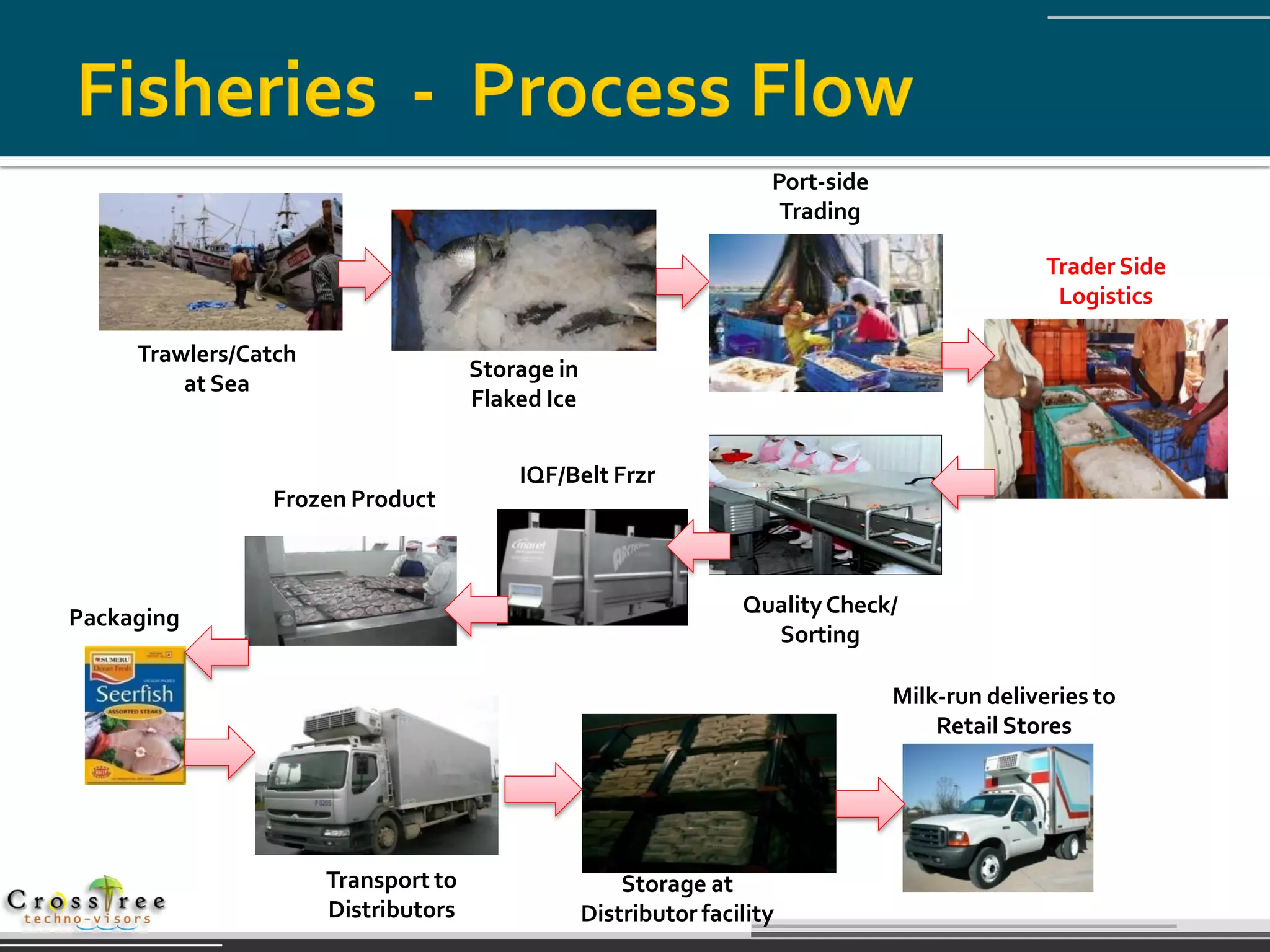
Port-side
                                                                      Trading

                                                                                                Trader Side
                                                                                                 Logistics

     Trawlers/Catch
                                     Storage in
         at Sea
                                     Flaked Ice


                                         IQF/Belt Frzr
                Frozen Product


                                                                  Quality Check/
Packaging
                                                                    Sorting

                                                                                 Milk-run deliveries to
                                                                                     Retail Stores


                      Transport to                    Storage at
                      Distributors                Distributor facility
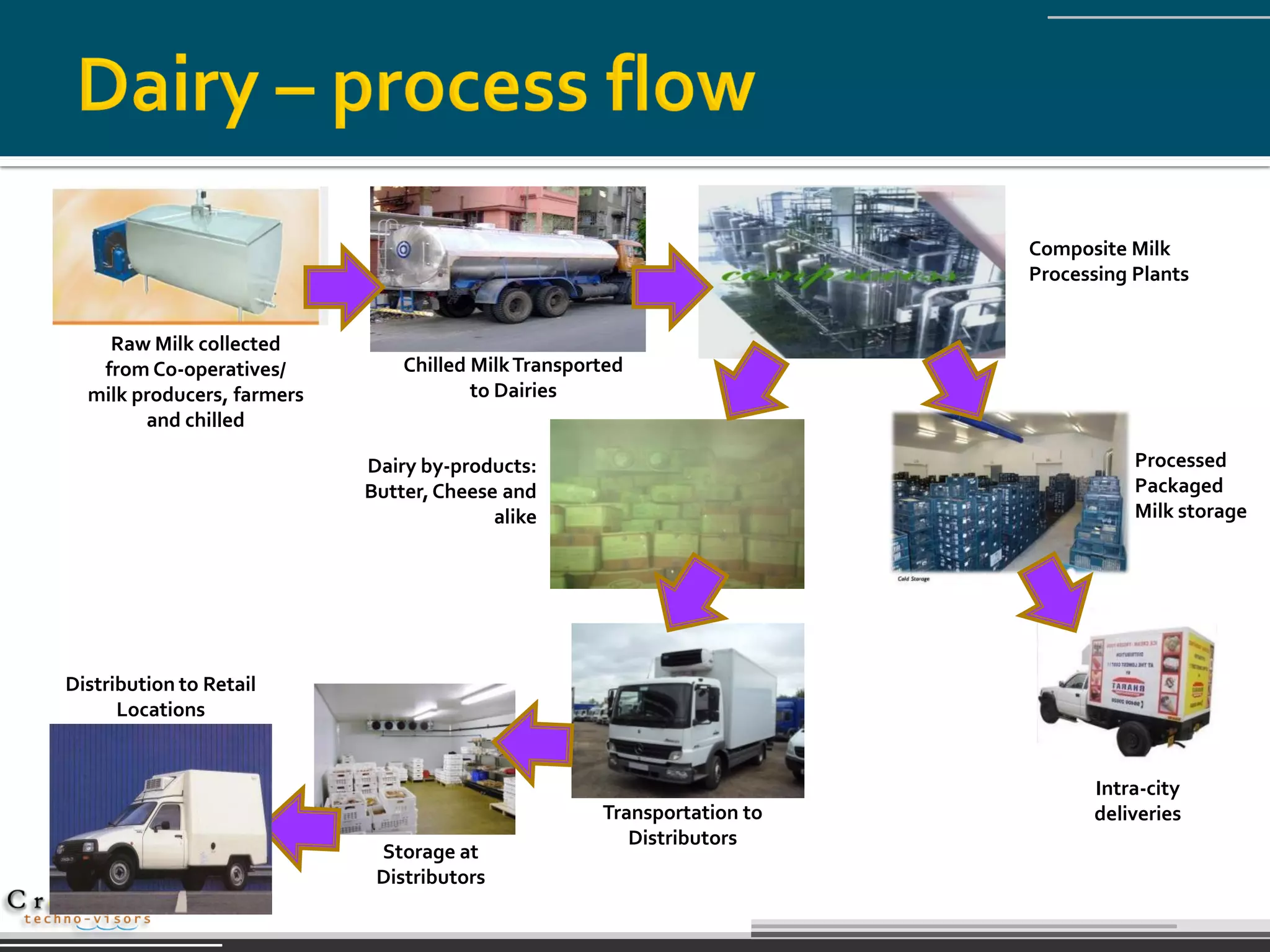
Composite Milk
                                                                         Processing Plants


    Raw Milk collected
   from Co-operatives/          Chilled Milk Transported
  milk producers, farmers               to Dairies
        and chilled

                            Dairy by-products:                                      Processed
                            Butter, Cheese and                                      Packaged
                                          alike                                     Milk storage


Distribution to Retail
      Locations


                                                                               Intra-city
                                                     Transportation to         deliveries
                                                        Distributors
                             Storage at
                             Distributors
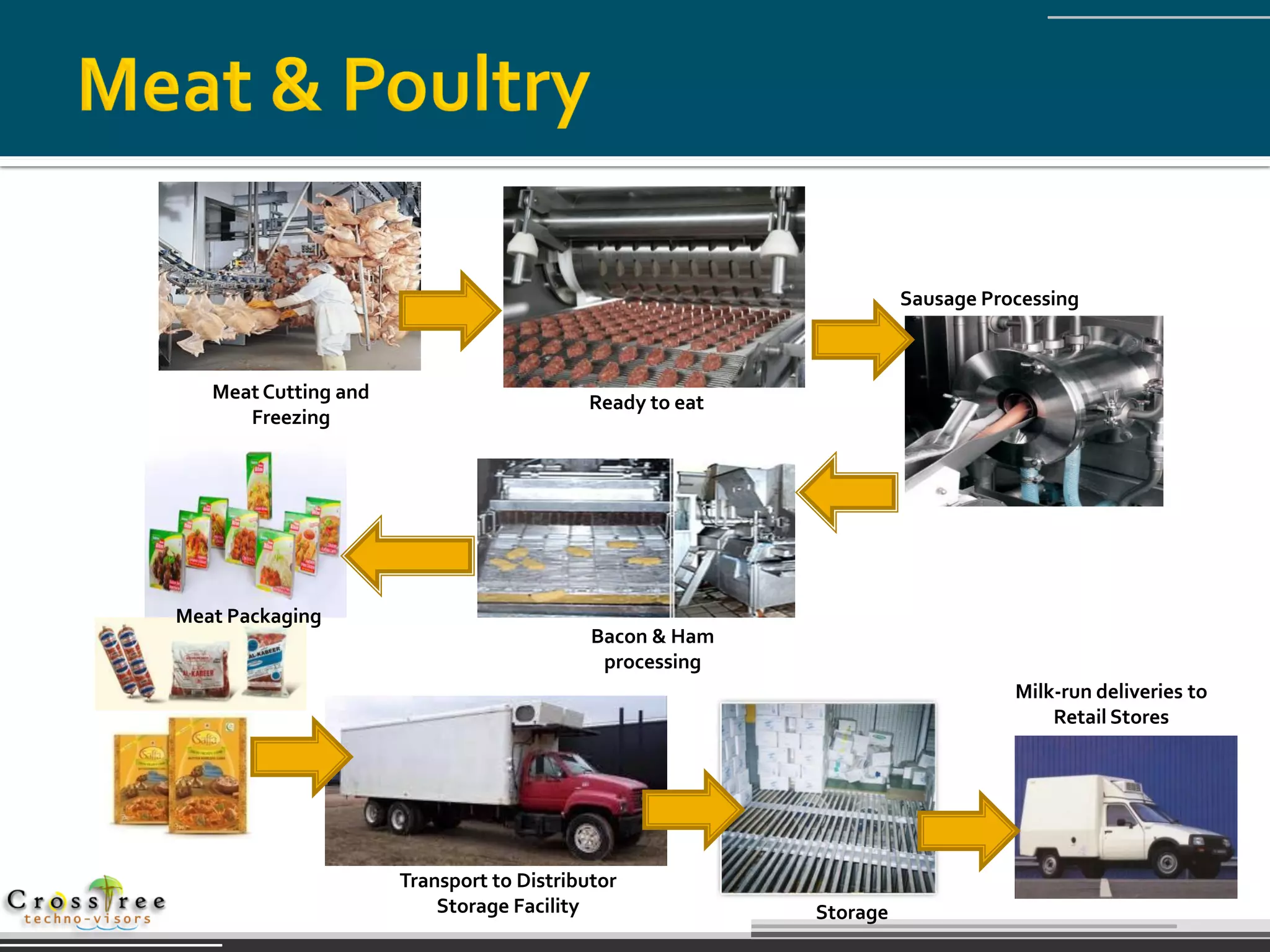
Sausage Processing


   Meat Cutting and                       Ready to eat
      Freezing


Meat Packaging
                                           Bacon & Ham
                                            processing
                                                                              Milk-run deliveries to
                                                                                  Retail Stores


                      Transport to Distributor
                          Storage Facility               Storage
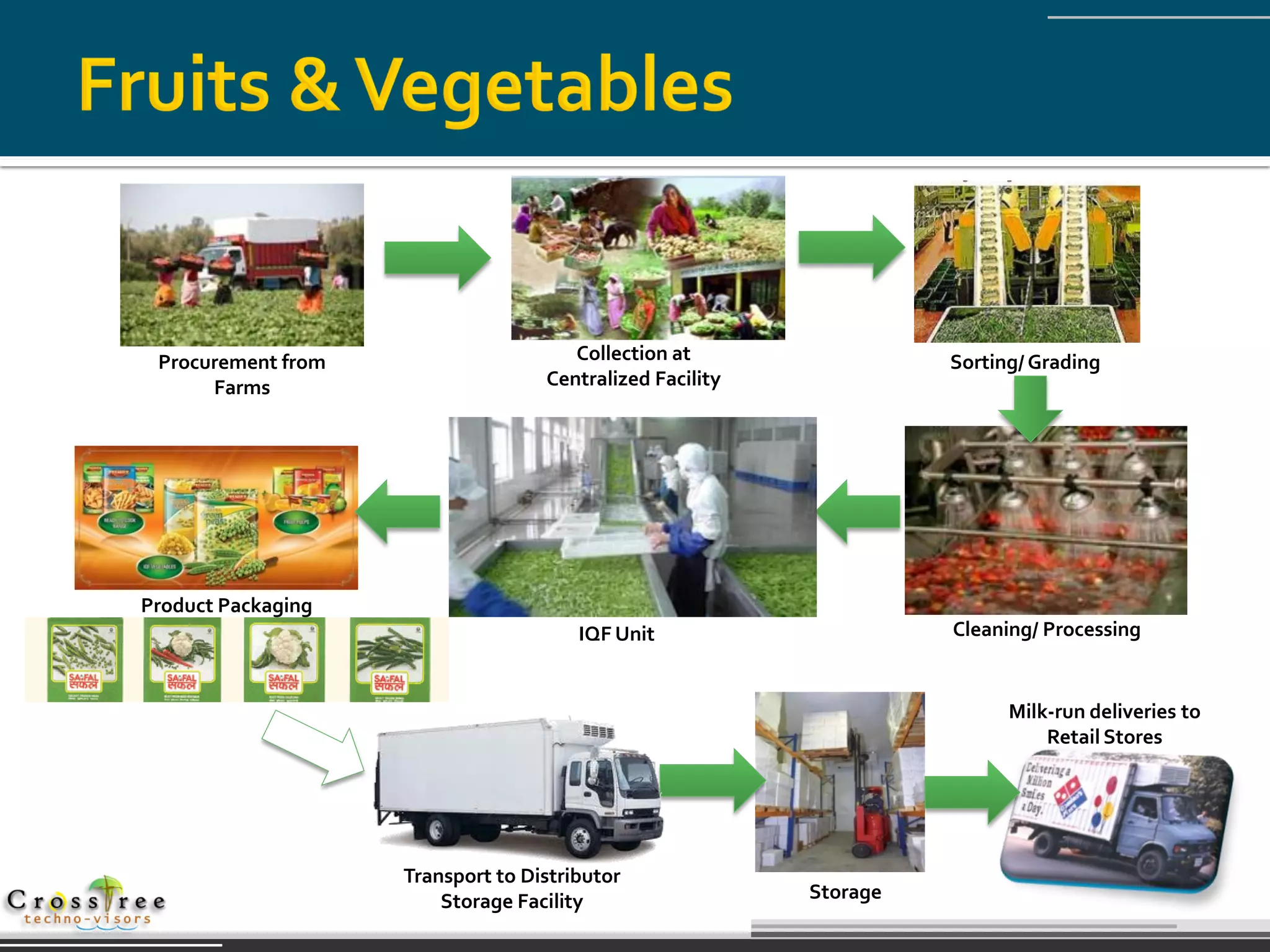
Procurement from                     Collection at                 Sorting/ Grading
      Farms                        Centralized Facility


Product Packaging
                                       IQF Unit                     Cleaning/ Processing


                                                                          Milk-run deliveries to
                                                                              Retail Stores


                    Transport to Distributor
                        Storage Facility                  Storage
   Minimal touch points;
                                                                            Cold Supply Chain



    Technology Driven
    DSD or DC as preferred OD Pairs;
                                                        Cold Supply Chain
                                                                                 Spoke
                                                                                                Cold Supply Chain


                                  Cold Supply Chain

   Traceablity & speed;
         Knowledge Driven
                                                                                                     Spoke


                                       Spoke                                               Cold Supply Chain

                                                            HUB
    Specialised packaging;

                 Speed Driven                                                                      Spoke


   Perishability (Product knowledge) strives to be.
          and Everything the ordinary Supply Chain
                                                      Existing (Layered)
                                                        Supply Chain
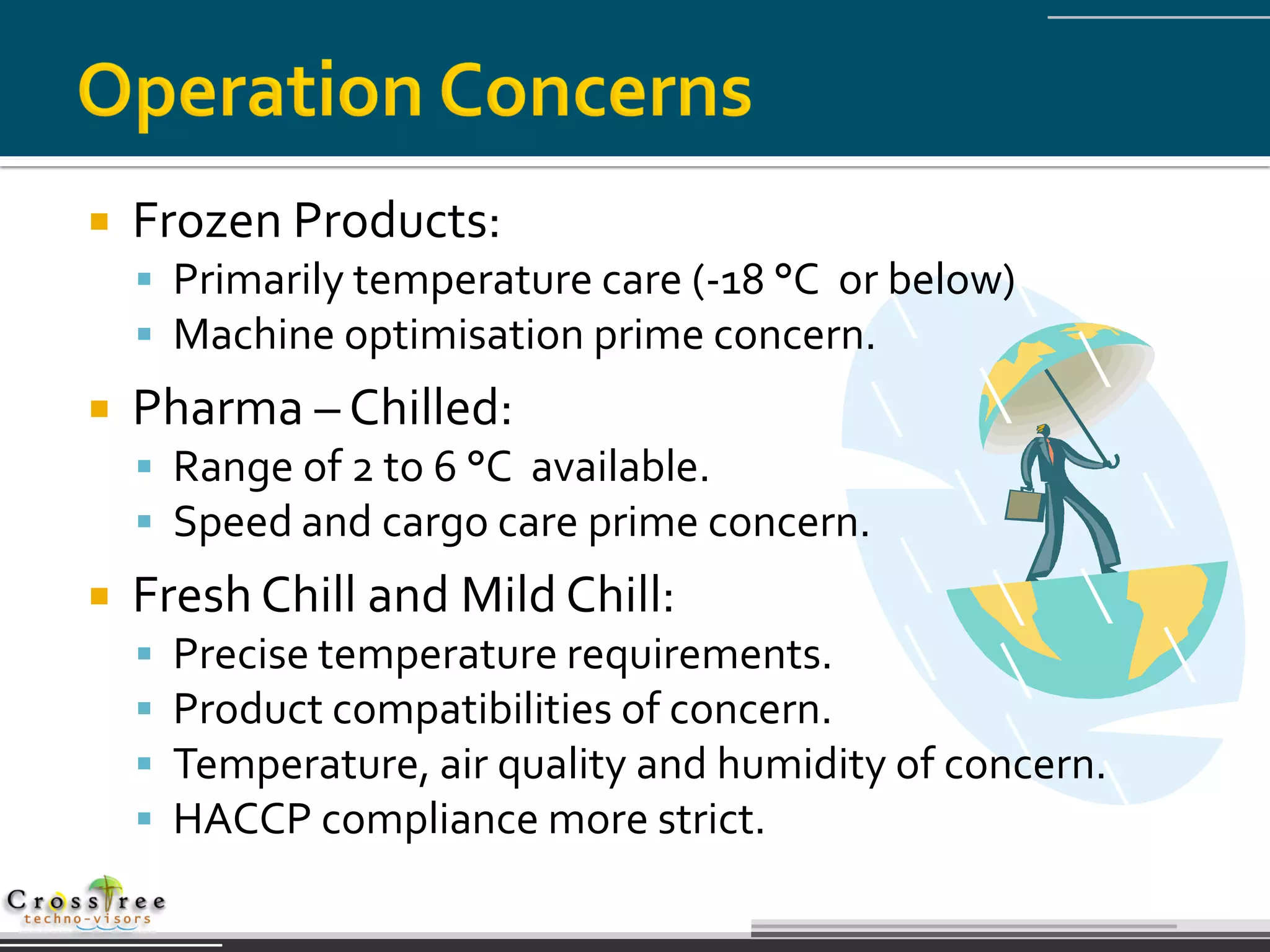
   Frozen Products:
     Primarily temperature care (-18 °C or below)
     Machine optimisation prime concern.
   Pharma – Chilled:
     Range of 2 to 6 °C available.
     Speed and cargo care prime concern.
   Fresh Chill and Mild Chill:
       Precise temperature requirements.
       Product compatibilities of concern.
       Temperature, air quality and humidity of concern.
       HACCP compliance more strict.
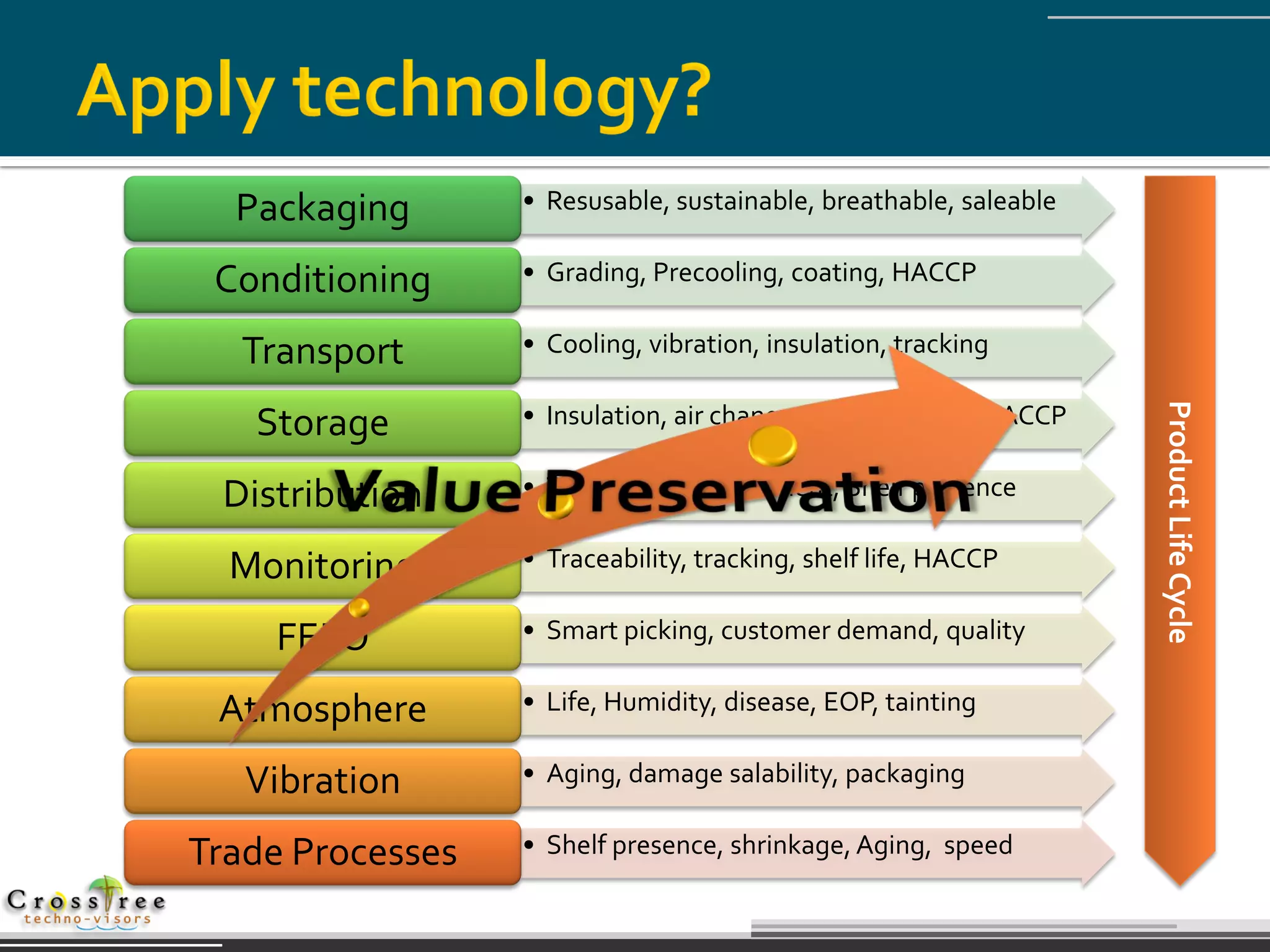
Packaging       • Resusable, sustainable, breathable, saleable

 Conditioning     • Grading, Precooling, coating, HACCP

  Transport       • Cooling, vibration, insulation, tracking


                                                                   Product Life Cycle
   Storage        • Insulation, air change, energy saving, HACCP

 Distribution     • TMS, JIT, Replenishment, Shelf presence

  Monitoring      • Traceability, tracking, shelf life, HACCP

    FEFO          • Smart picking, customer demand, quality

 Atmosphere       • Life, Humidity, disease, EOP, tainting

   Vibration      • Aging, damage salability, packaging

Trade Processes   • Shelf presence, shrinkage, Aging, speed
End of Deck
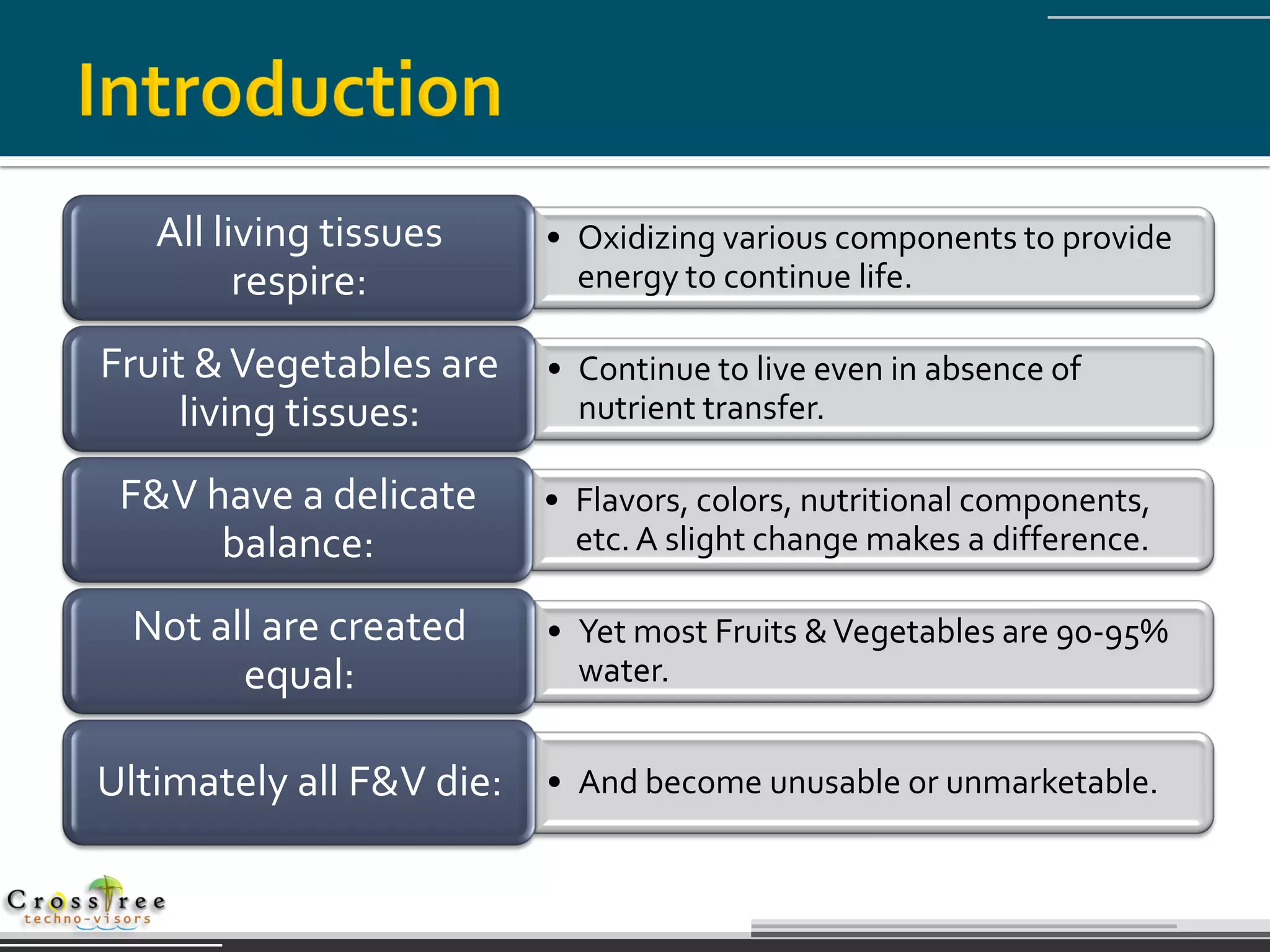
All living tissues     • Oxidizing various components to provide
         respire:           energy to continue life.

Fruit & Vegetables are    • Continue to live even in absence of
     living tissues:        nutrient transfer.

 F&V have a delicate      • Flavors, colors, nutritional components,
      balance:              etc. A slight change makes a difference.

  Not all are created     • Yet most Fruits & Vegetables are 90-95%
        equal:              water.


Ultimately all F&V die: • And become unusable or unmarketable.
• Cooling requires energy and tends to invite
  Tainting:        compartment sharing and other shortcuts.

                 • Cooling effects external environment and
Moisture Loss:     changes ambient conditions.

                 • Cooling creates condensate which encourages
  Disease:         disease and rots.

                 • Cooling is ineffective if the medium spread is
  Stowage:         in-correct.


   Control:      • Cooling causes chill injuries and even death.


                                                                    15
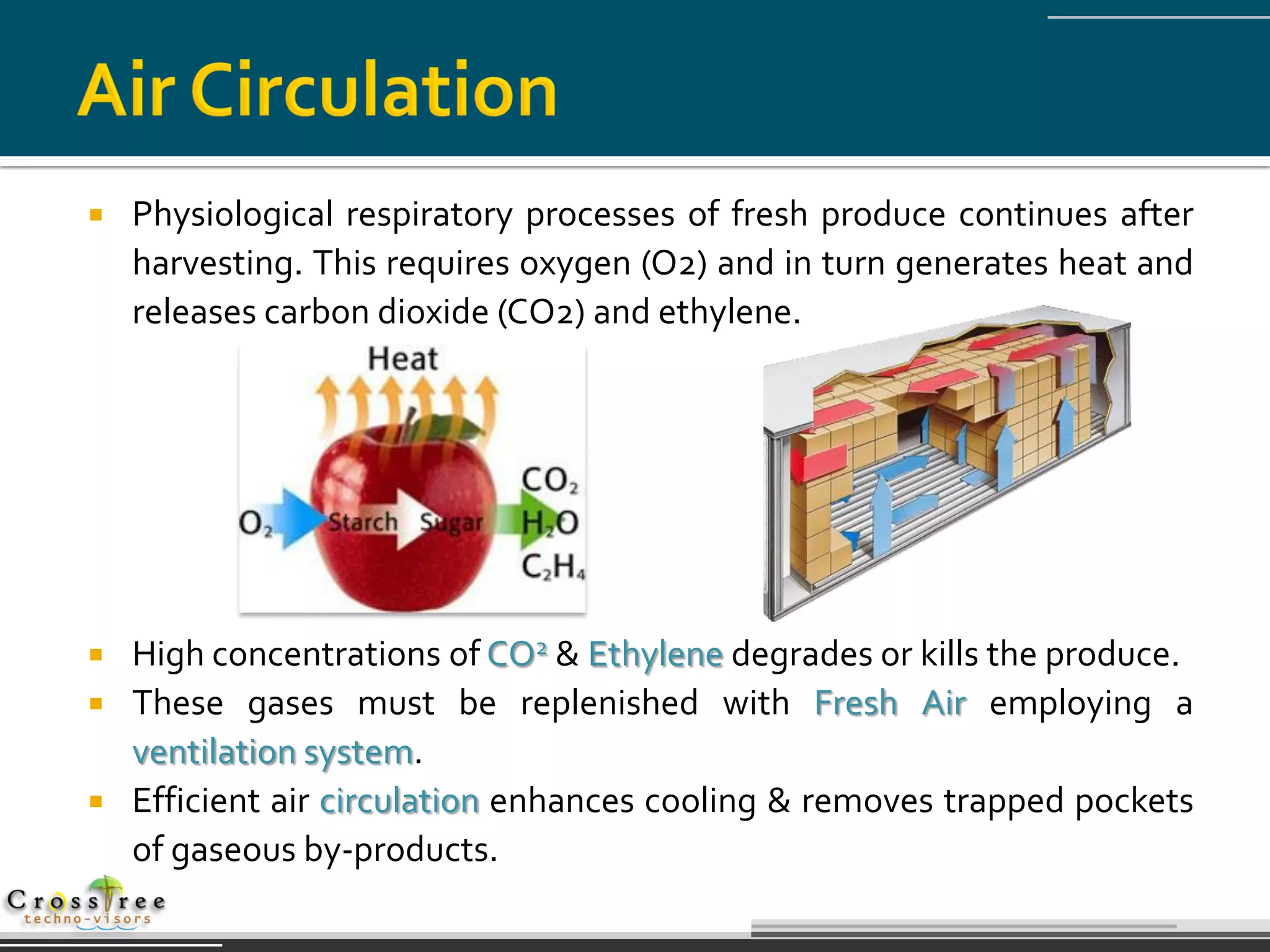
   Physiological respiratory processes of fresh produce continues after
    harvesting. This requires oxygen (O2) and in turn generates heat and
    releases carbon dioxide (CO2) and ethylene.


 High concentrations of CO2 & Ethylene degrades or kills the produce.
 These gases must be replenished with Fresh Air employing a
  ventilation system.
 Efficient air circulation enhances cooling & removes trapped pockets
  of gaseous by-products.
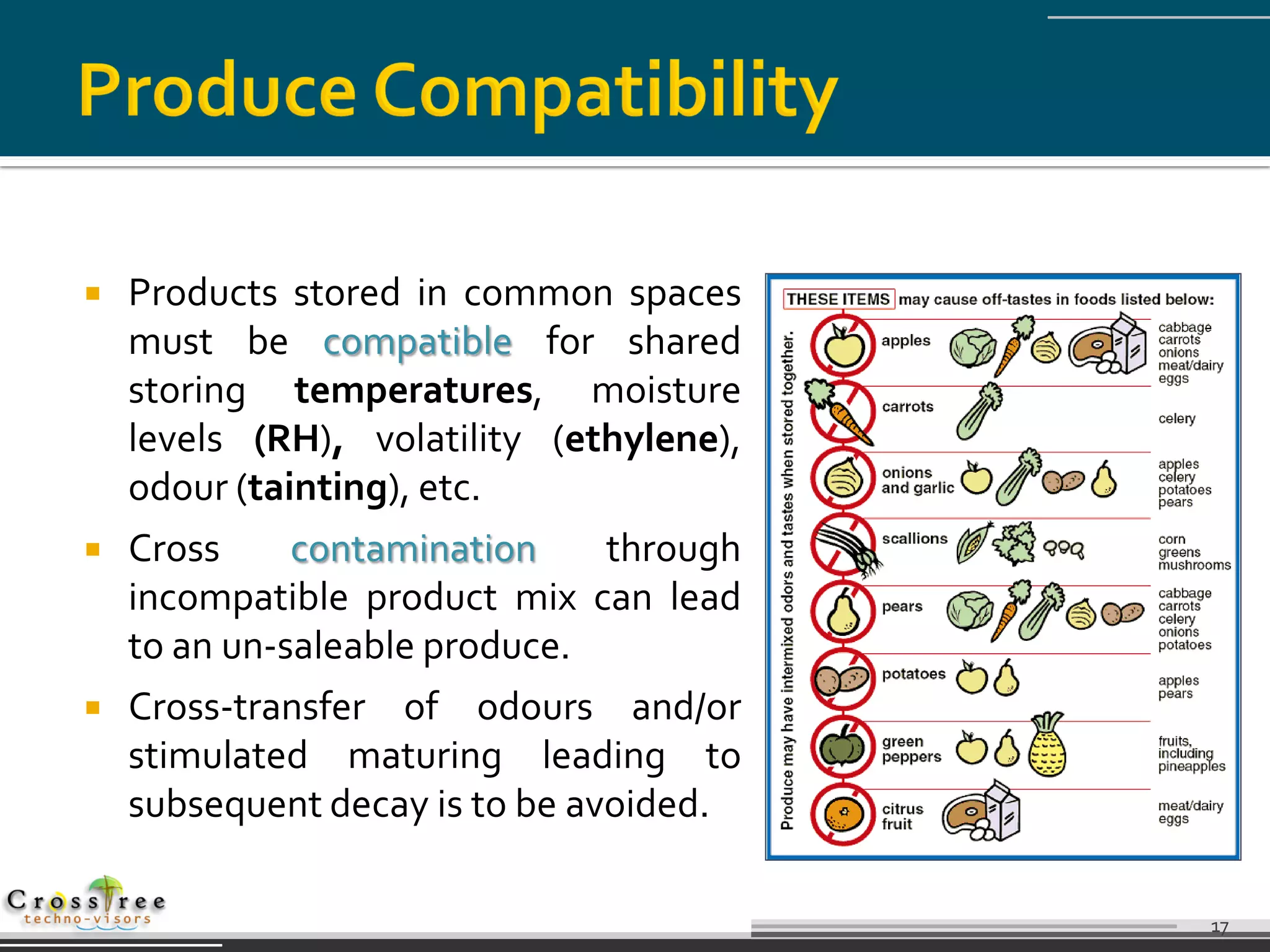
   Products stored in common spaces
    must be compatible for shared
    storing temperatures, moisture
    levels (RH), volatility (ethylene),
    odour (tainting), etc.
   Cross     contamination     through
    incompatible product mix can lead
    to an un-saleable produce.
   Cross-transfer of odours and/or
    stimulated maturing leading to
    subsequent decay is to be avoided.

                                          17
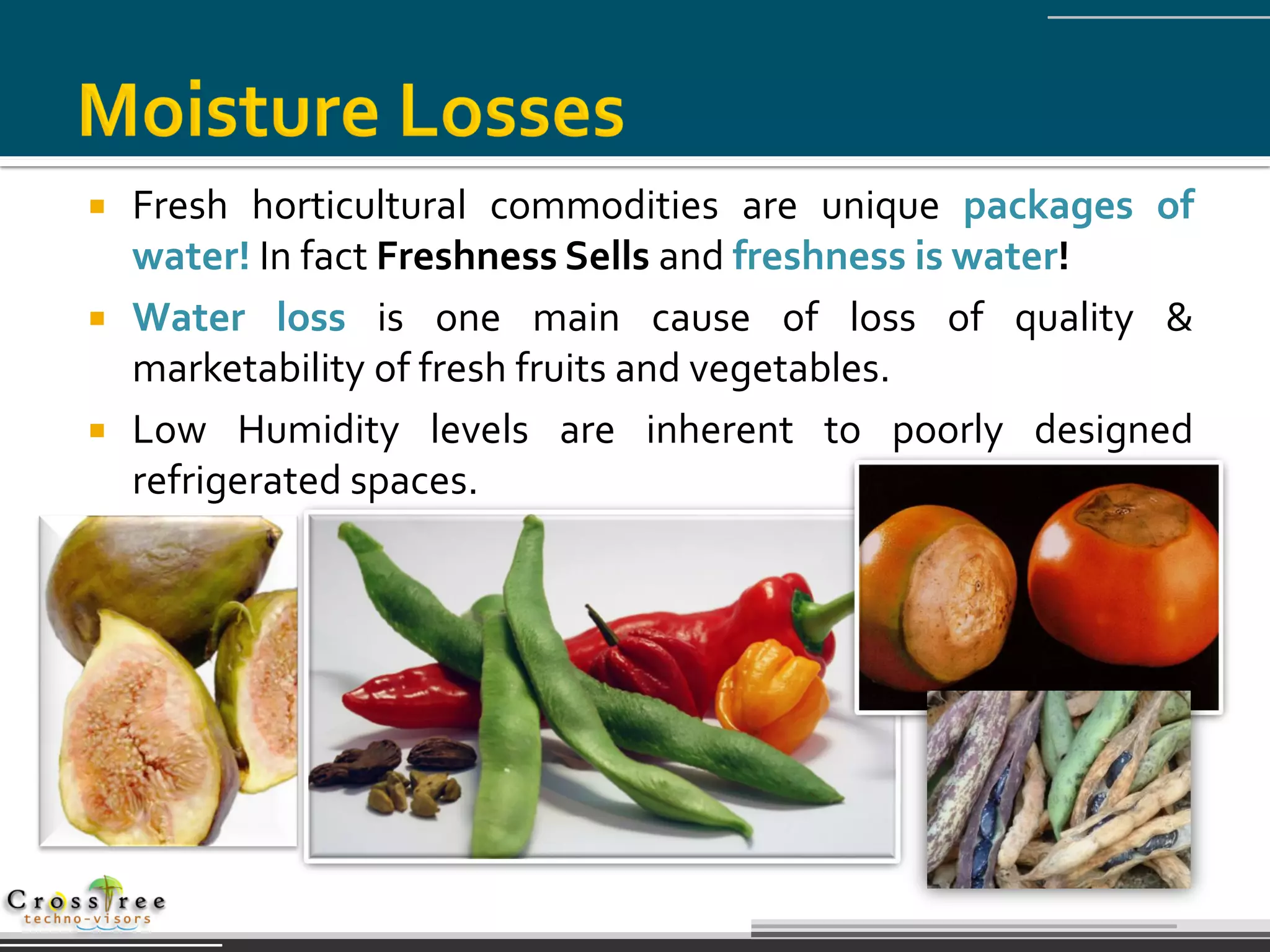
 Fresh horticultural commodities are unique packages of
  water! In fact Freshness Sells and freshness is water!
 Water loss is one main cause of loss of quality &
  marketability of fresh fruits and vegetables.
 Low Humidity levels are inherent to poorly designed
  refrigerated spaces.
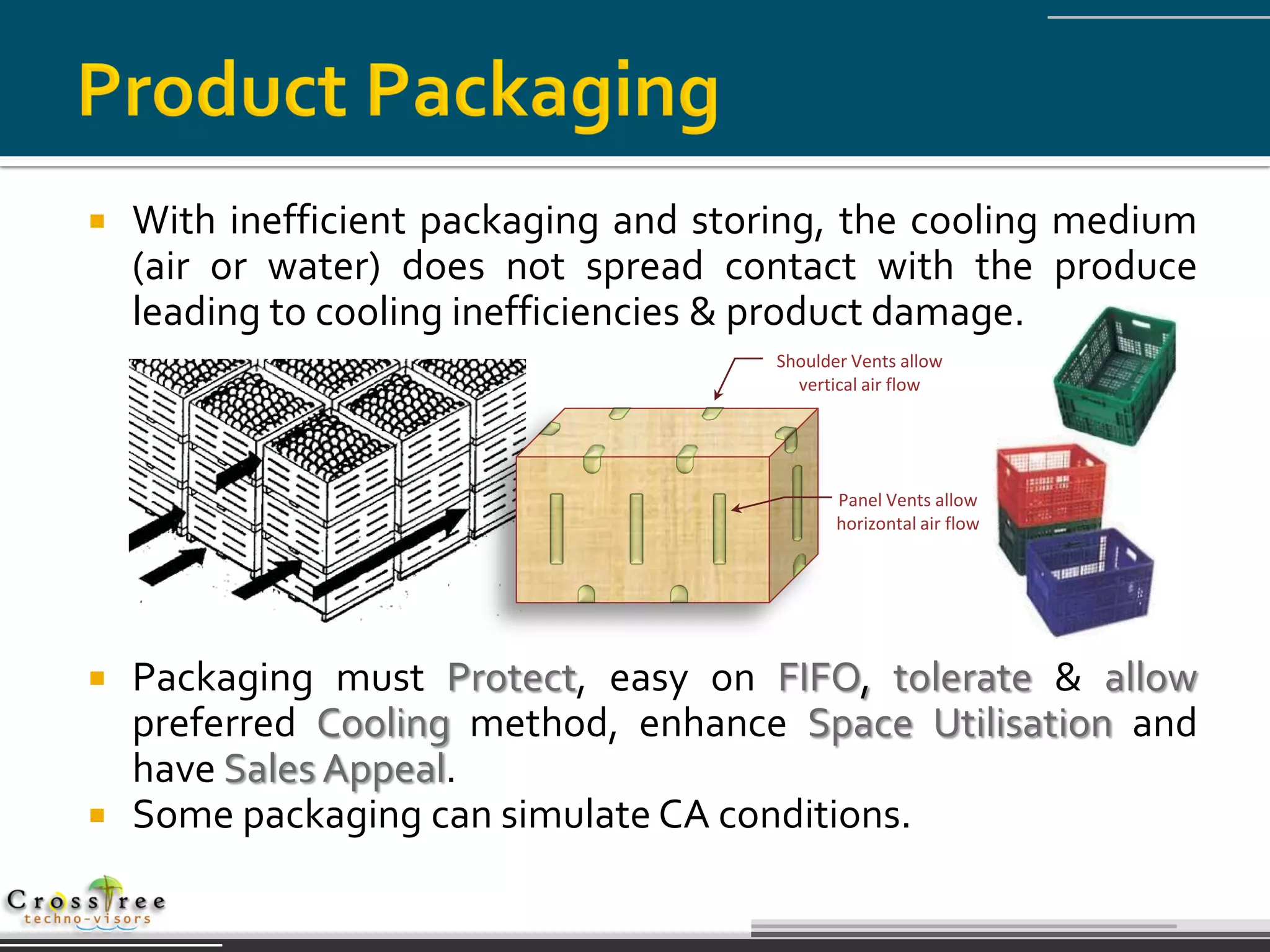
   With inefficient packaging and storing, the cooling medium
    (air or water) does not spread contact with the produce
    leading to cooling inefficiencies & product damage.
                                       Shoulder Vents allow
                                         vertical air flow


                                              Panel Vents allow
                                              horizontal air flow


   Packaging must Protect, easy on FIFO, tolerate & allow
    preferred Cooling method, enhance Space Utilisation and
    have Sales Appeal.
   Some packaging can simulate CA conditions.
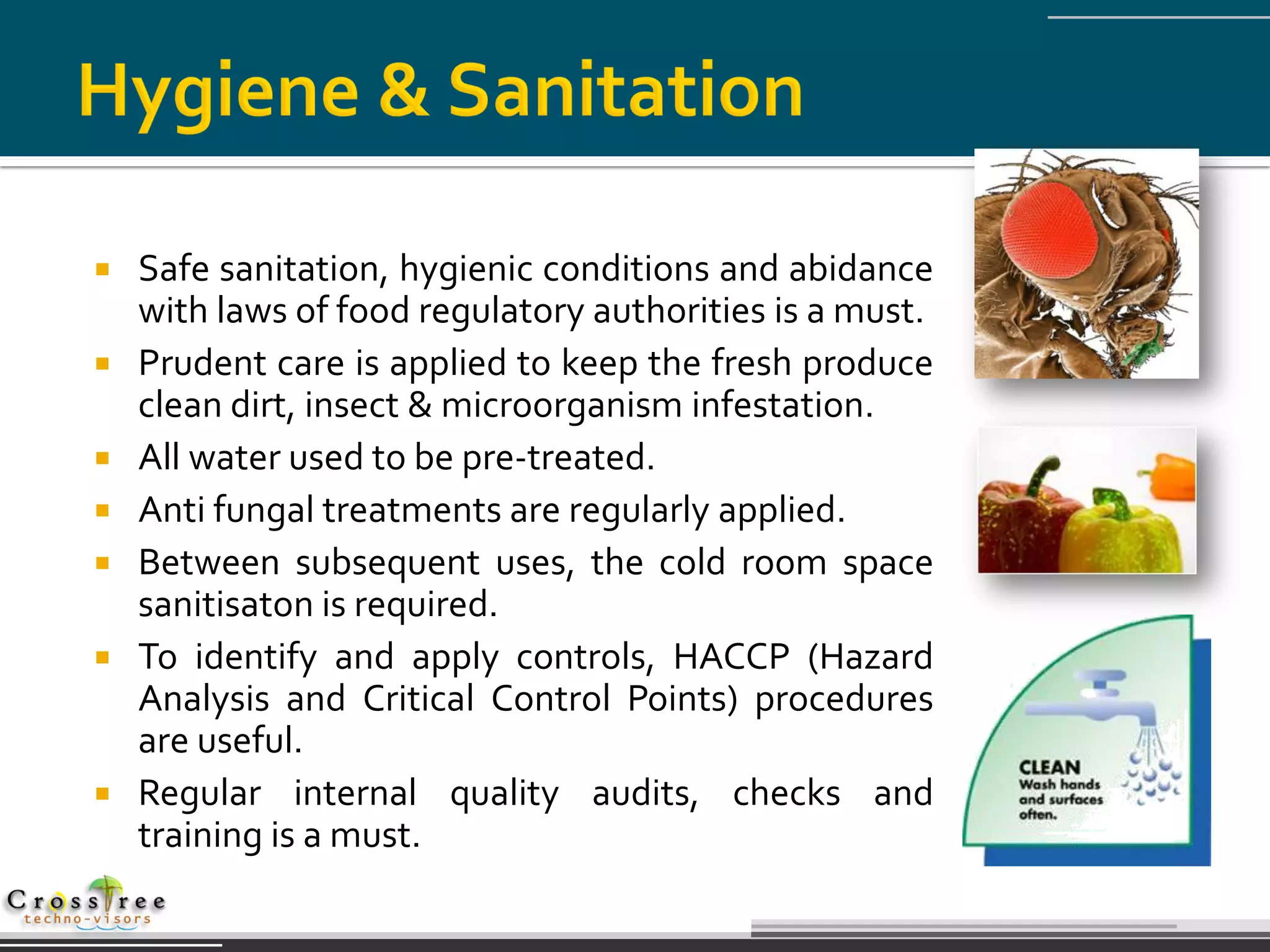
   Safe sanitation, hygienic conditions and abidance
    with laws of food regulatory authorities is a must.
   Prudent care is applied to keep the fresh produce
    clean dirt, insect & microorganism infestation.
   All water used to be pre-treated.
   Anti fungal treatments are regularly applied.
   Between subsequent uses, the cold room space
    sanitisaton is required.
   To identify and apply controls, HACCP (Hazard
    Analysis and Critical Control Points) procedures
    are useful.
   Regular internal quality audits, checks and
    training is a must.
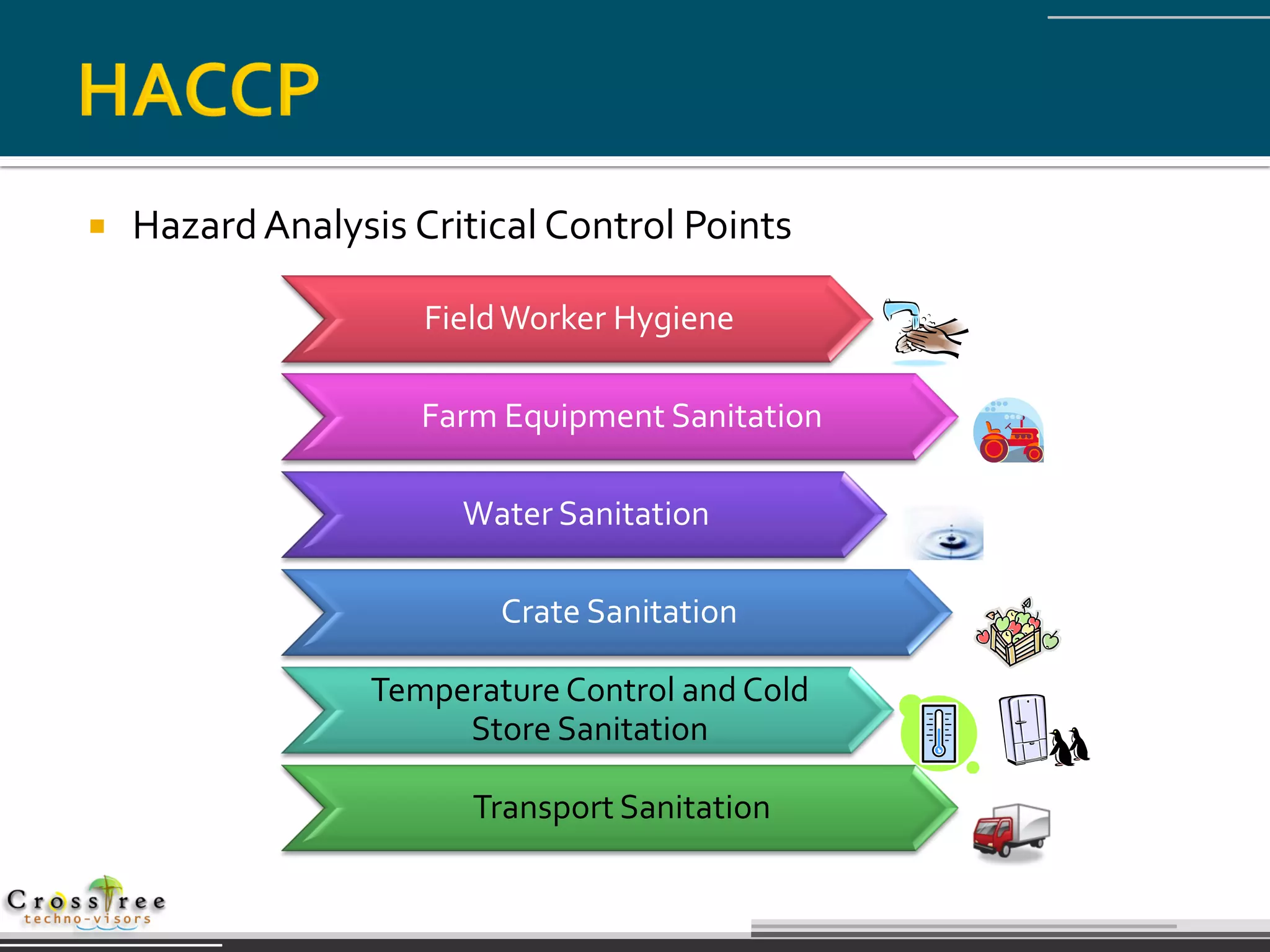
   Hazard Analysis Critical Control Points

                     Field Worker Hygiene

                     Farm Equipment Sanitation

                       Water Sanitation

                          Crate Sanitation

                  Temperature Control and Cold
                       Store Sanitation

                        Transport Sanitation
End of Deck
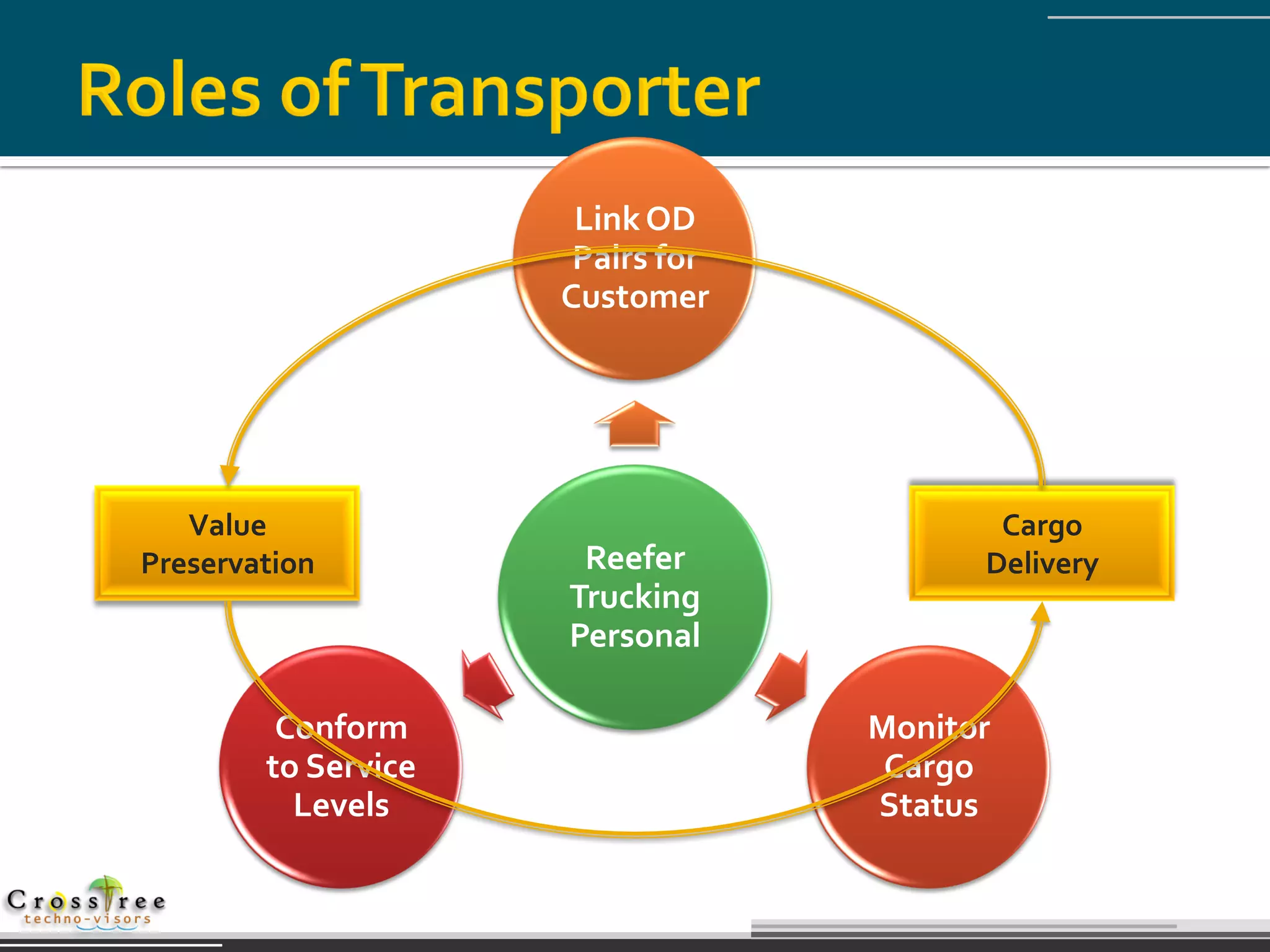
Link OD
                      Pairs for
                     Customer


   Value                                 Cargo
Preservation          Reefer            Delivery
                     Trucking
                     Personal

         Conform                  Monitor
        to Service                 Cargo
          Levels                  Status
Saleable Quality
     Moisture                 Color         Potency


Shrinkage    Firmness   Rot       Disease   Efficacy
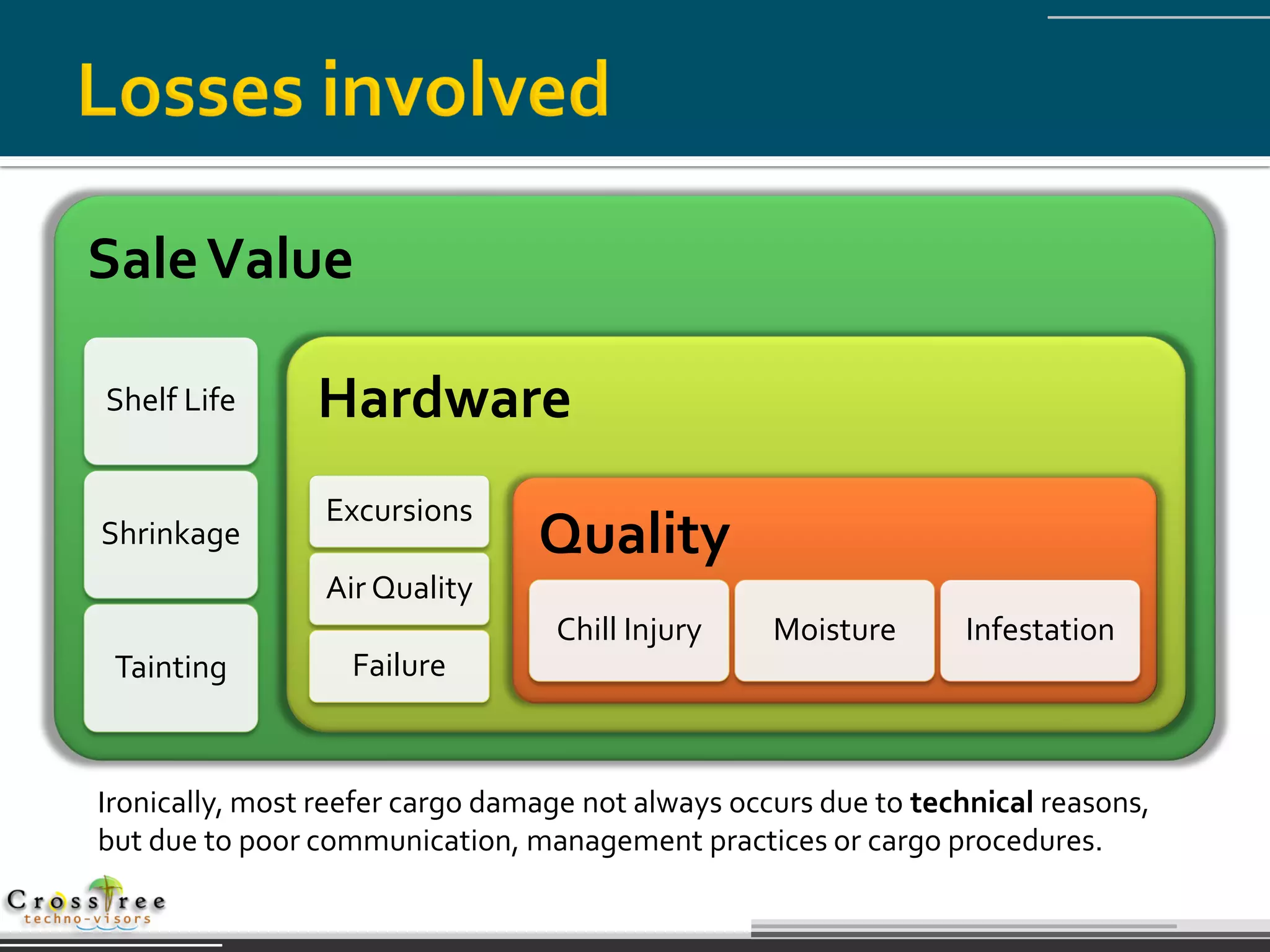
Sale Value

Shelf Life      Hardware
                 Excursions
Shrinkage                        Quality
                 Air Quality
                                  Chill Injury     Moisture      Infestation
 Tainting          Failure


Ironically, most reefer cargo damage not always occurs due to technical reasons,
but due to poor communication, management practices or cargo procedures.
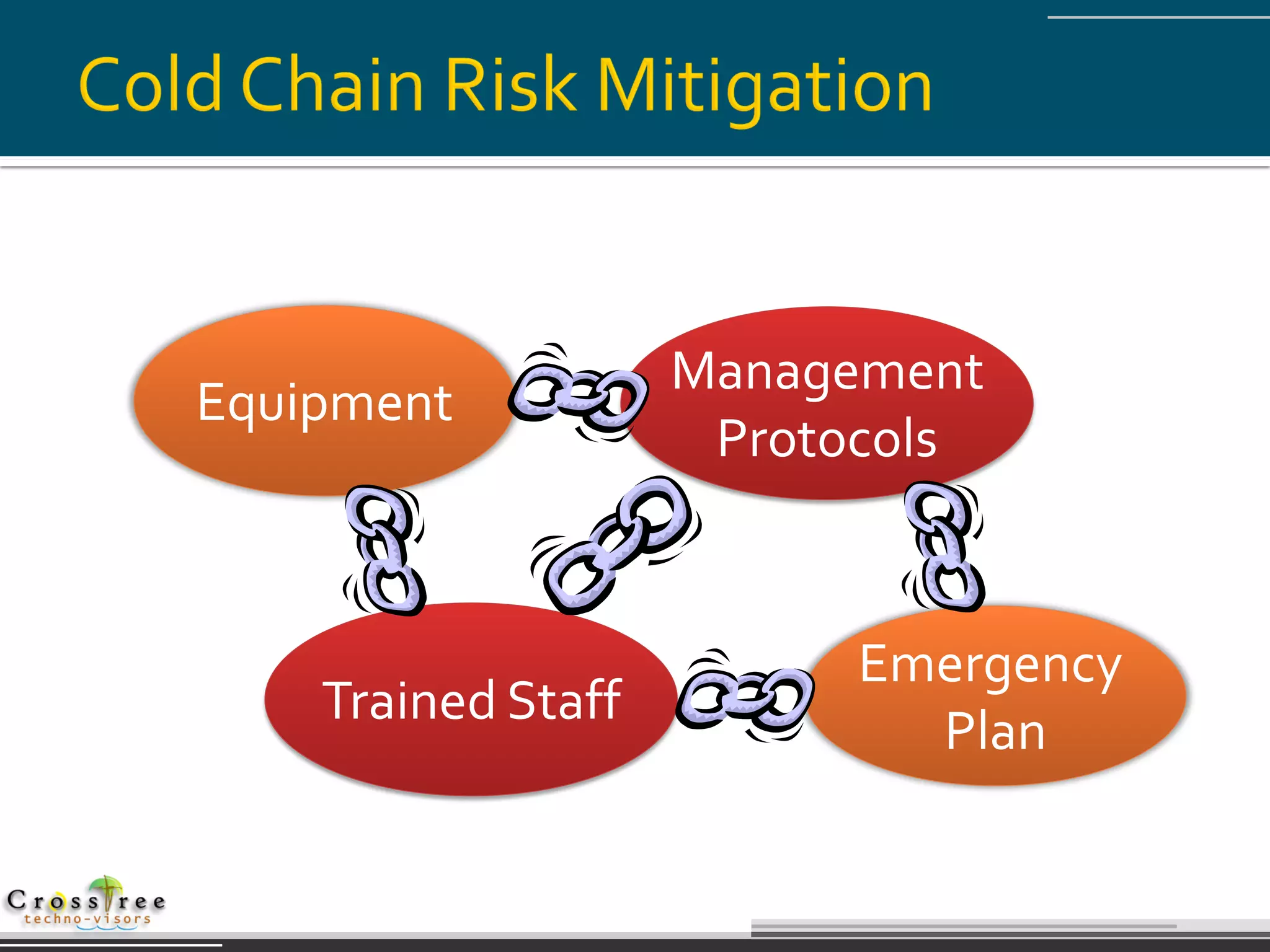
Management
Equipment
                     Protocols


                         Emergency
    Trained Staff
                           Plan
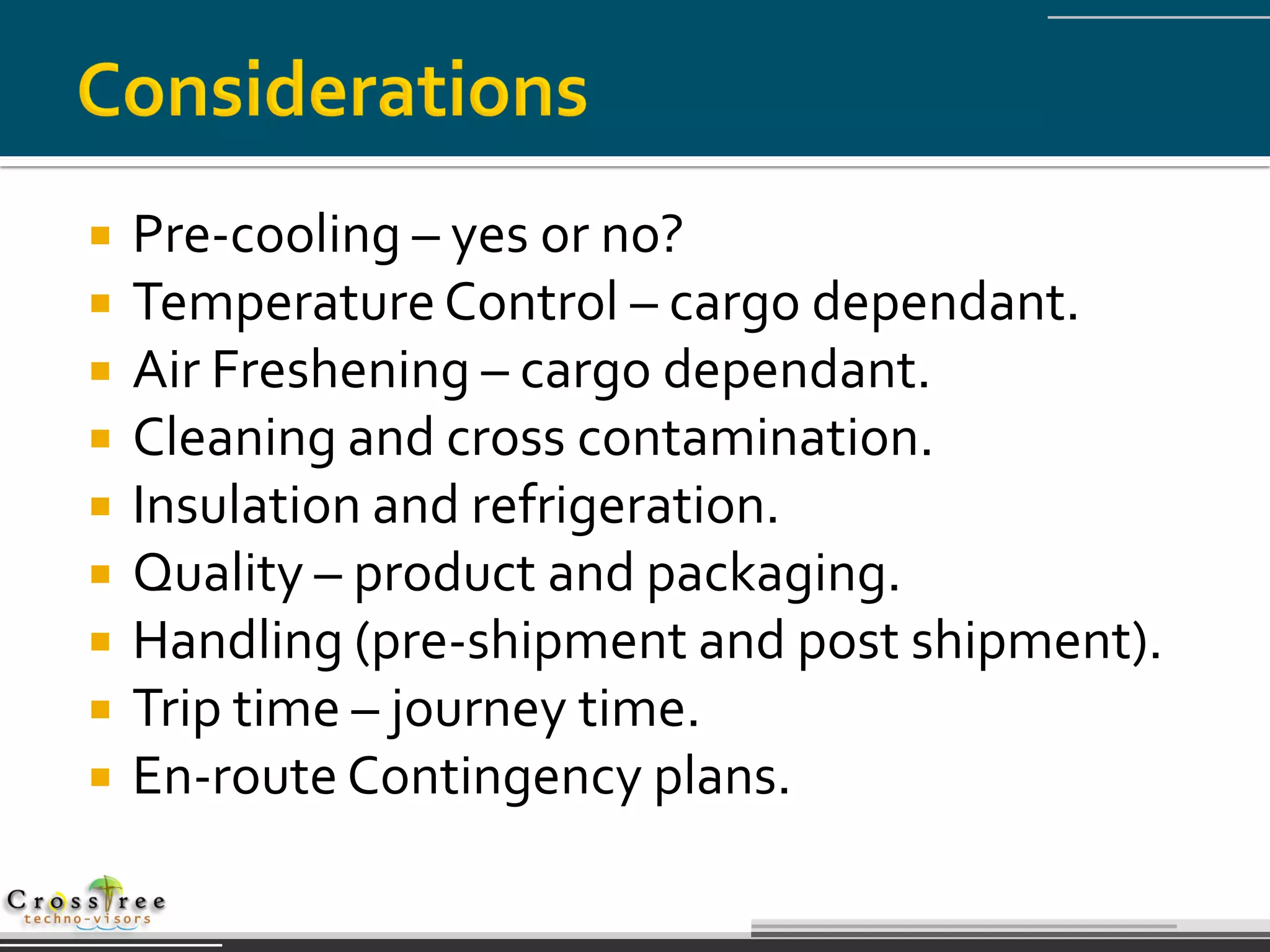
   Pre-cooling – yes or no?
   Temperature Control – cargo dependant.
   Air Freshening – cargo dependant.
   Cleaning and cross contamination.
   Insulation and refrigeration.
   Quality – product and packaging.
   Handling (pre-shipment and post shipment).
   Trip time – journey time.
   En-route Contingency plans.
End of Deck
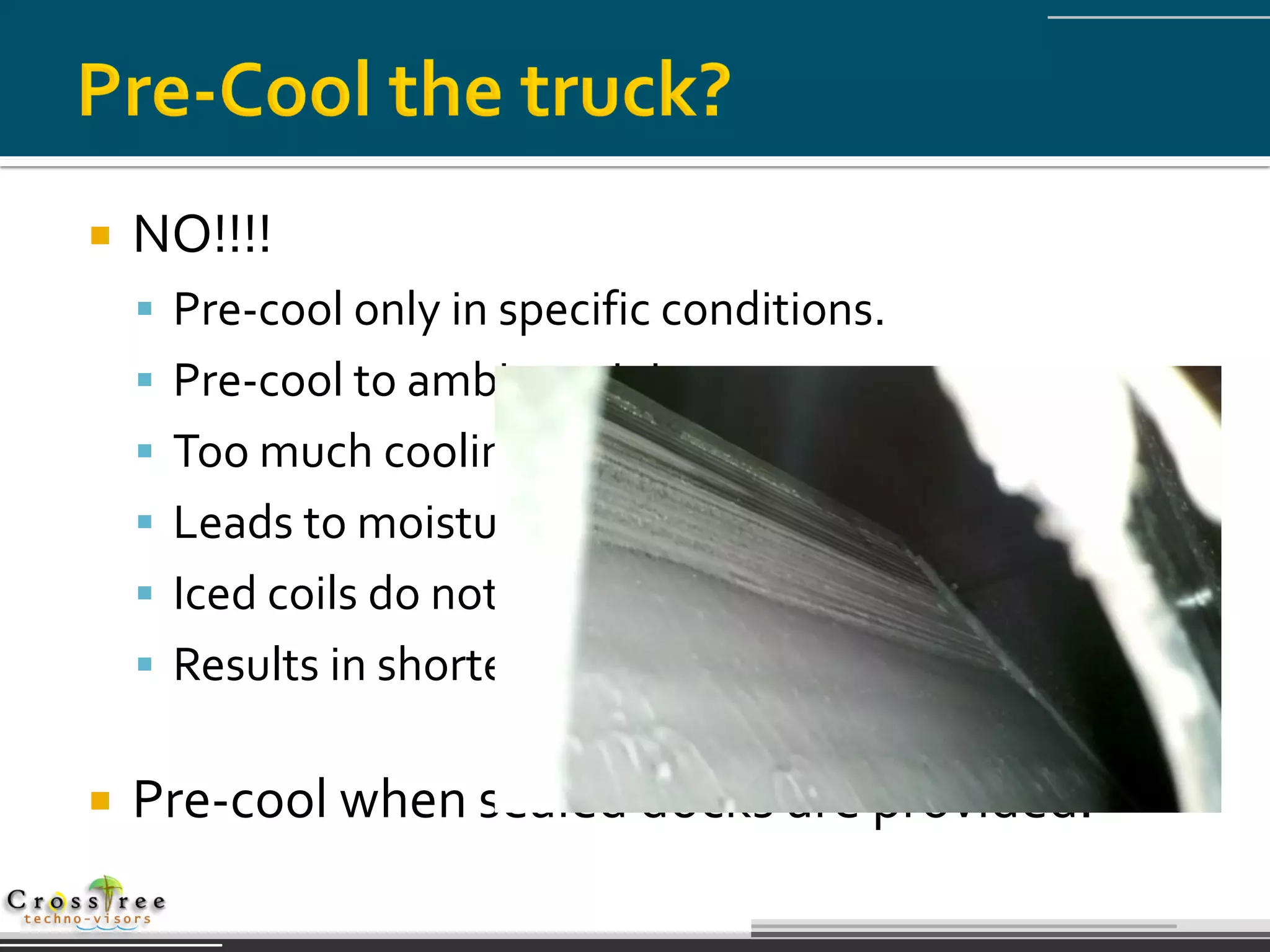
   NO!!!!
     Pre-cool only in specific conditions.
     Pre-cool to ambient air ingress temperatures.
     Too much cooling causes condensate to form.
     Leads to moisture damage and icing on coils.
     Iced coils do not allow efficient heat exchange.
     Results in shorter defrost cycles on initial load up.


   Pre-cool when sealed docks are provided.
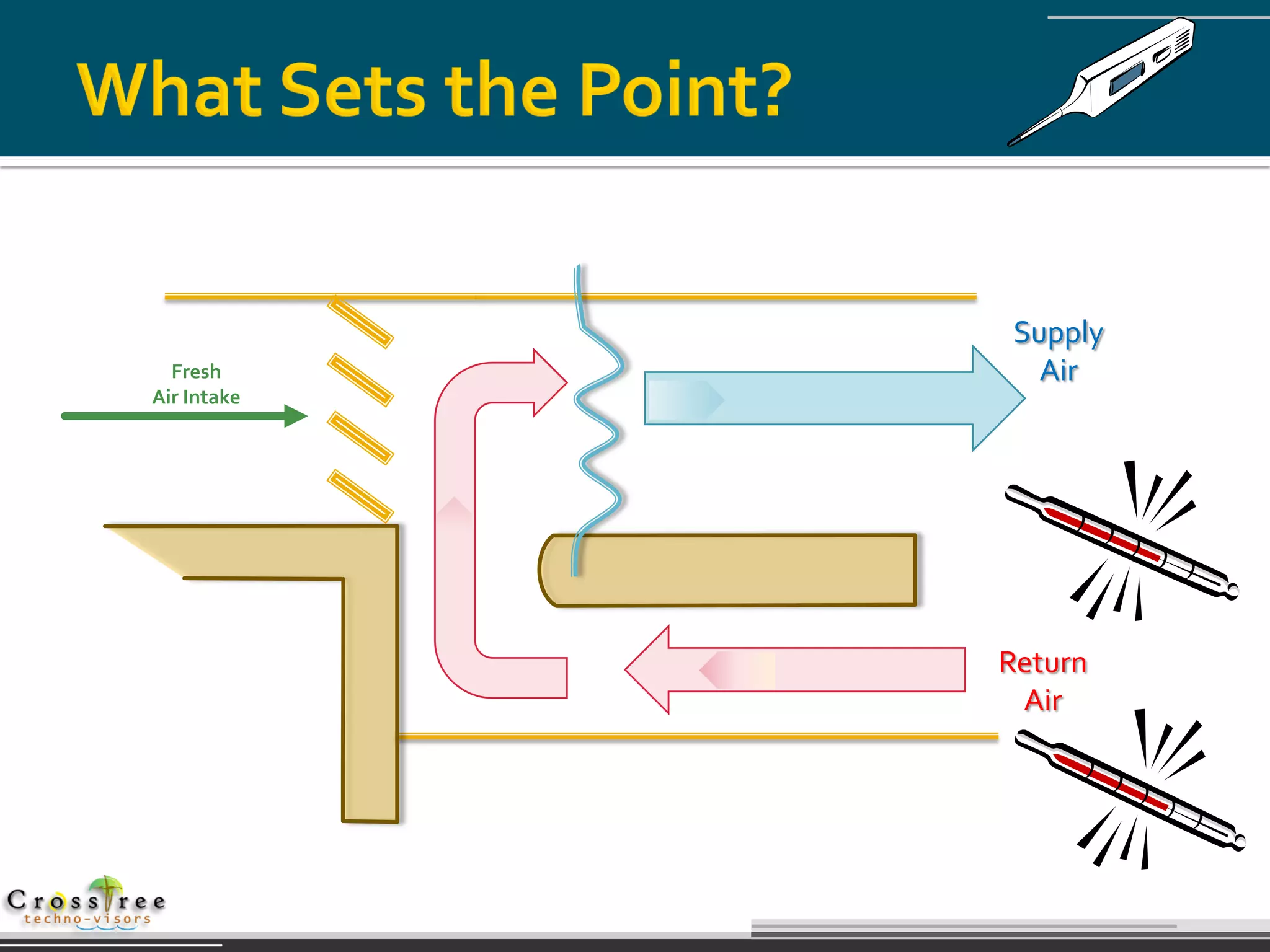
Supply
  Fresh         Air
Air Intake


             Return
              Air
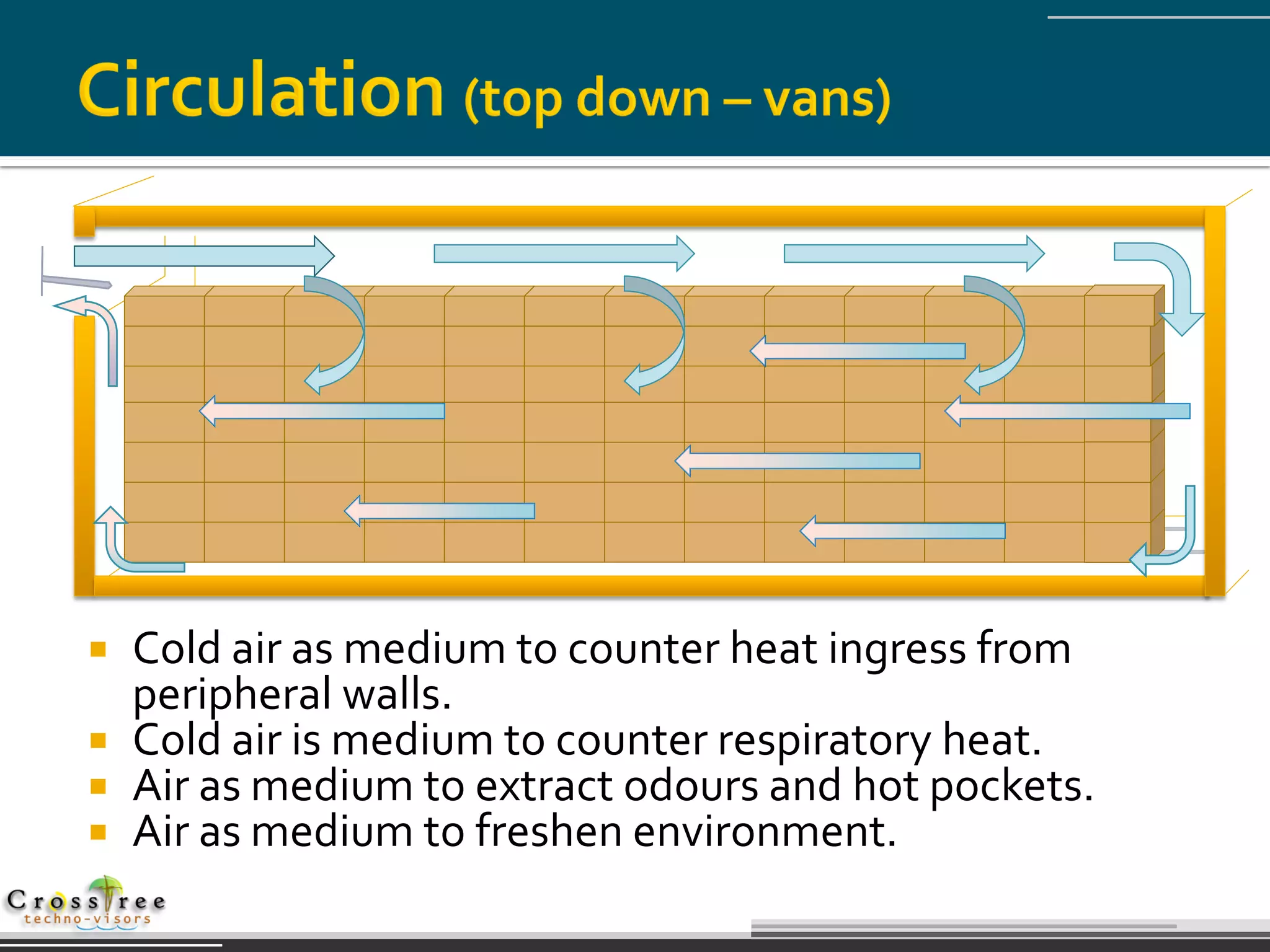
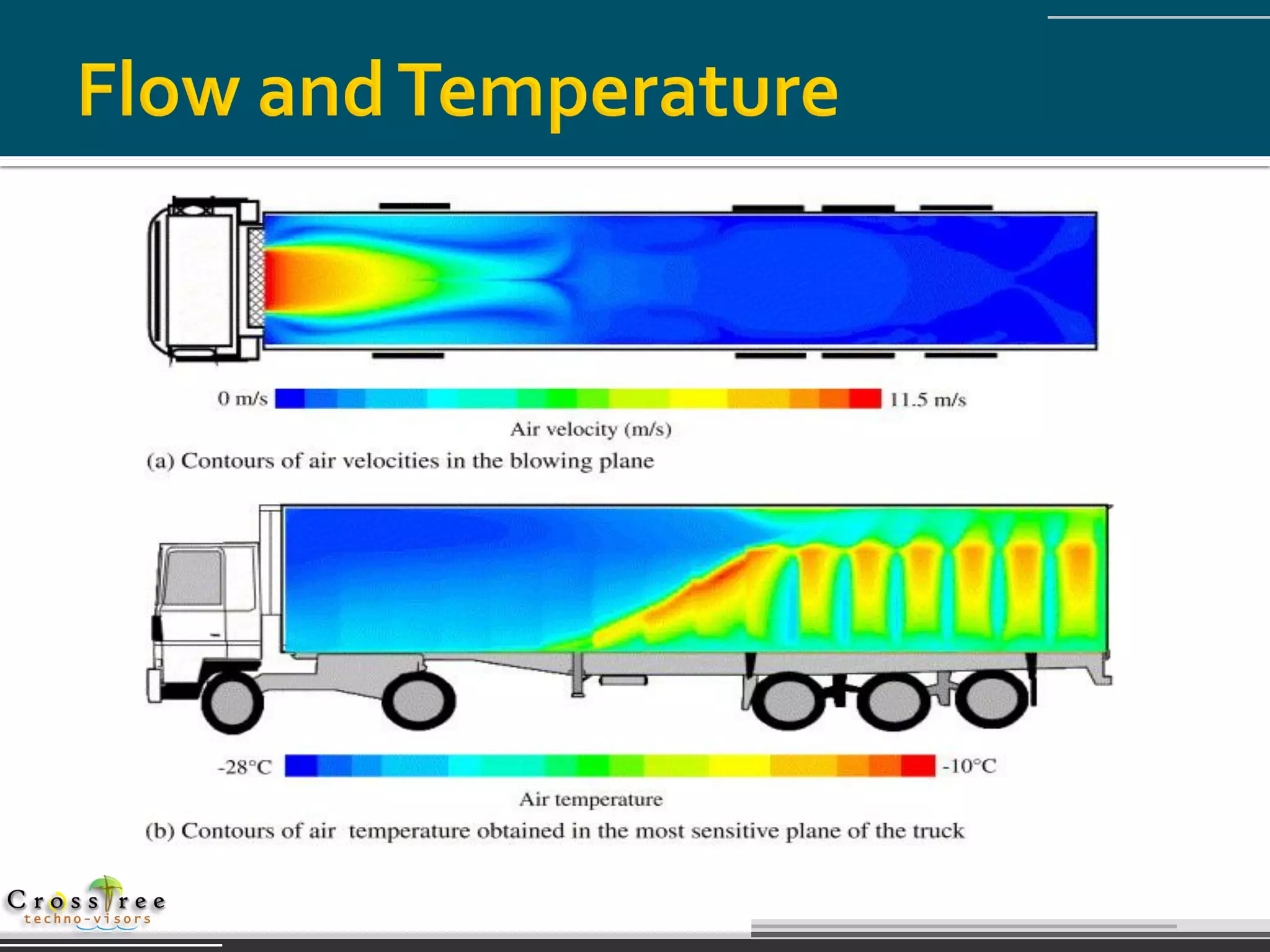
 Cold air as medium to counter heat ingress from
  peripheral walls.
 Cold air is medium to counter respiratory heat.
 Air as medium to extract odours and hot pockets.
 Air as medium to freshen environment.
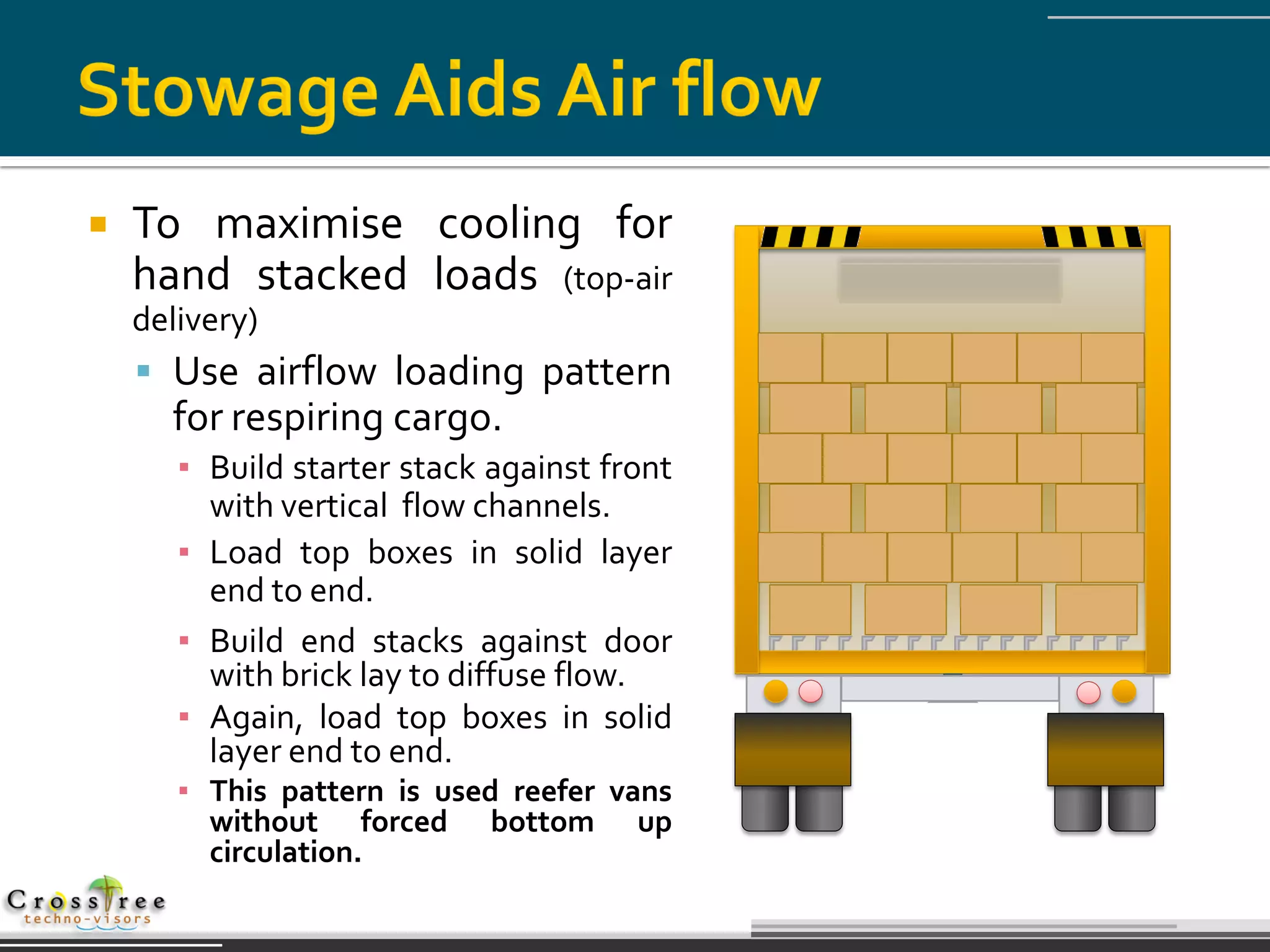
   To maximise cooling for
    hand stacked loads (top-air
    delivery)
     Use airflow loading pattern
      for respiring cargo.
       ▪ Build starter stack against front
         with vertical flow channels.
       ▪ Load top boxes in solid layer
         end to end.
       ▪ Build end stacks against door
         with brick lay to diffuse flow.
       ▪ Again, load top boxes in solid
         layer end to end.
       ▪ This pattern is used reefer vans
         without forced bottom up
         circulation.
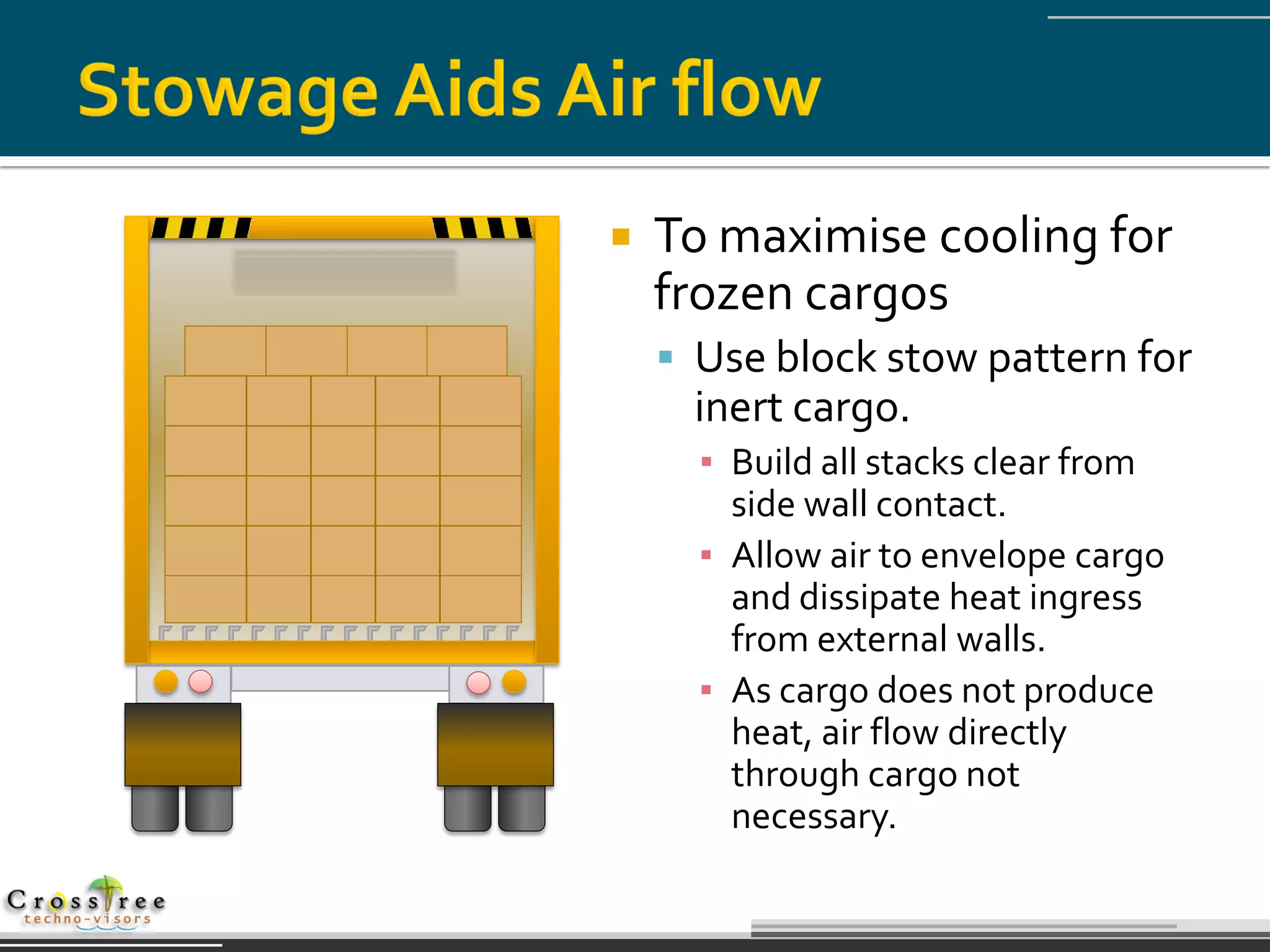
   To maximise cooling for
    frozen cargos
     Use block stow pattern for
     inert cargo.
      ▪ Build all stacks clear from
        side wall contact.
      ▪ Allow air to envelope cargo
        and dissipate heat ingress
        from external walls.
      ▪ As cargo does not produce
        heat, air flow directly
        through cargo not
        necessary.
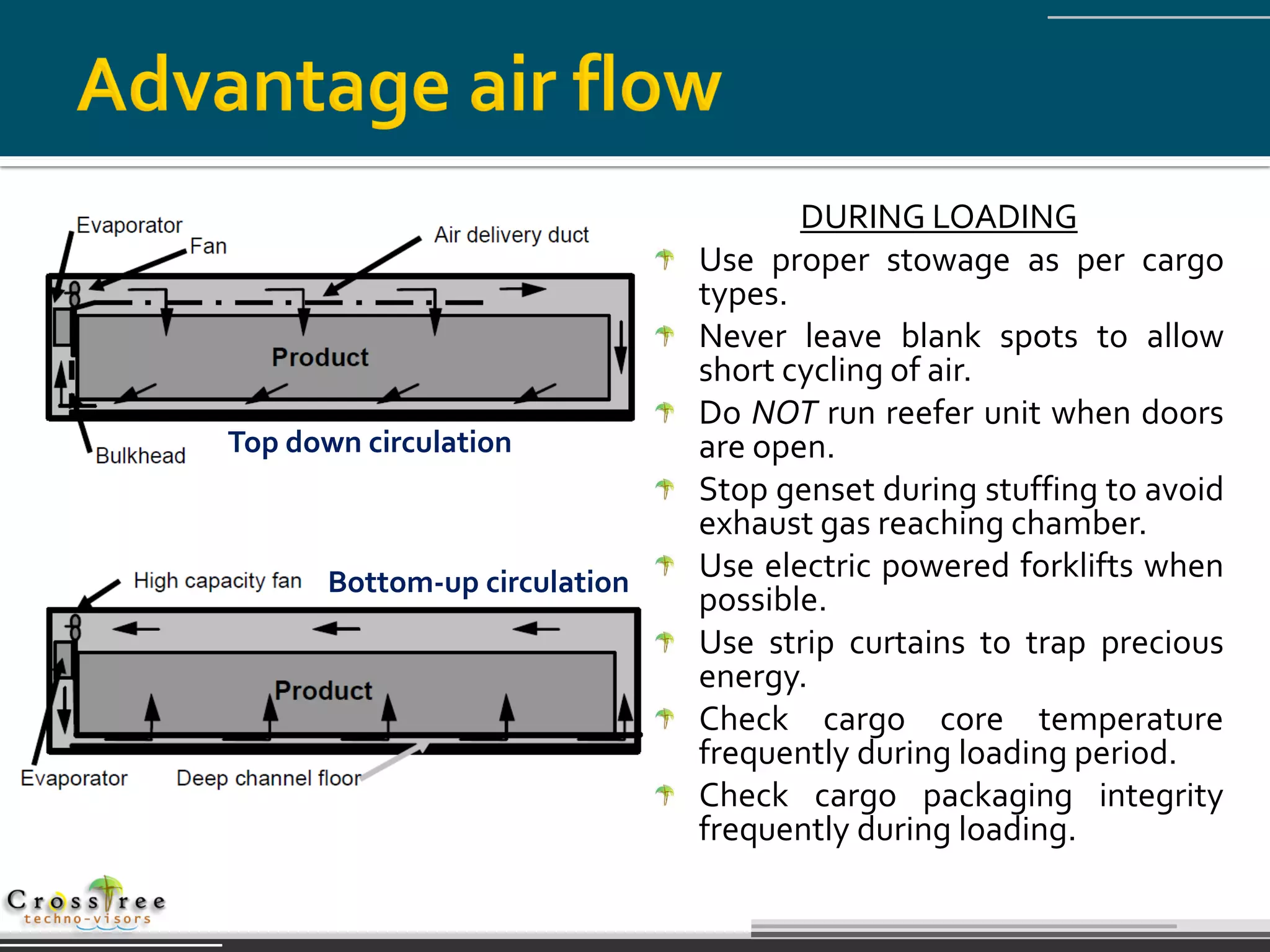
DURING LOADING
                               Use proper stowage as per cargo
                               types.
                               Never leave blank spots to allow
                               short cycling of air.
                               Do NOT run reefer unit when doors
Top down circulation           are open.
                               Stop genset during stuffing to avoid
                               exhaust gas reaching chamber.
       Bottom-up circulation   Use electric powered forklifts when
                               possible.
                               Use strip curtains to trap precious
                               energy.
                               Check cargo core temperature
                               frequently during loading period.
                               Check cargo packaging integrity
                               frequently during loading.
Complete pre-trip checks on vehicle and record
the same.
Demand all parameters required for safe
transport of cargo, including-
   Temperature range in transit.
   Set point required.
   Air freshening if any.
   Loading temperature permitted.
   Packaging type to be deployed.
   Shelf life of product.
Get sign off on cleanliness before loading.
Request recommended stowage pattern.
Record start of loading time.
Do NOT leave areas uncovered on floor plate of
vehicle.
Check no over stow of cargo beyond limit line.
Check that cargo is stable for transit.
Bracing of cargo preferred with dunnage, air
bags or cargo nets.
Ensure bracing does not block floor channels on
ends.
Ensure no loose packing or wrapping material
which can create blockage of fan.
Reconfirm set point and other parameters.
   Avoid multiple point loading.
   Avoid delayed loading process.
   If required by customer, insist on indemnity.

   When forced into such situation, stop the
    evaporator fans.
   Secondary load “must” be at the requisite
    carriage temperature.
   Loading should preferably be at sealed docks.
Vehicle doors not properly sealed.
Incorrect pre-cooling of vehicle.
Keeping fans running during loading.
Improper cargo status on loading.
Cargo packaging compromised.
Quality of cargo previously compromised.
Hot spots in cargo chamber.
Incorrect set point parameters.
Overloading in chamber.
Poor maintenance of equipment.
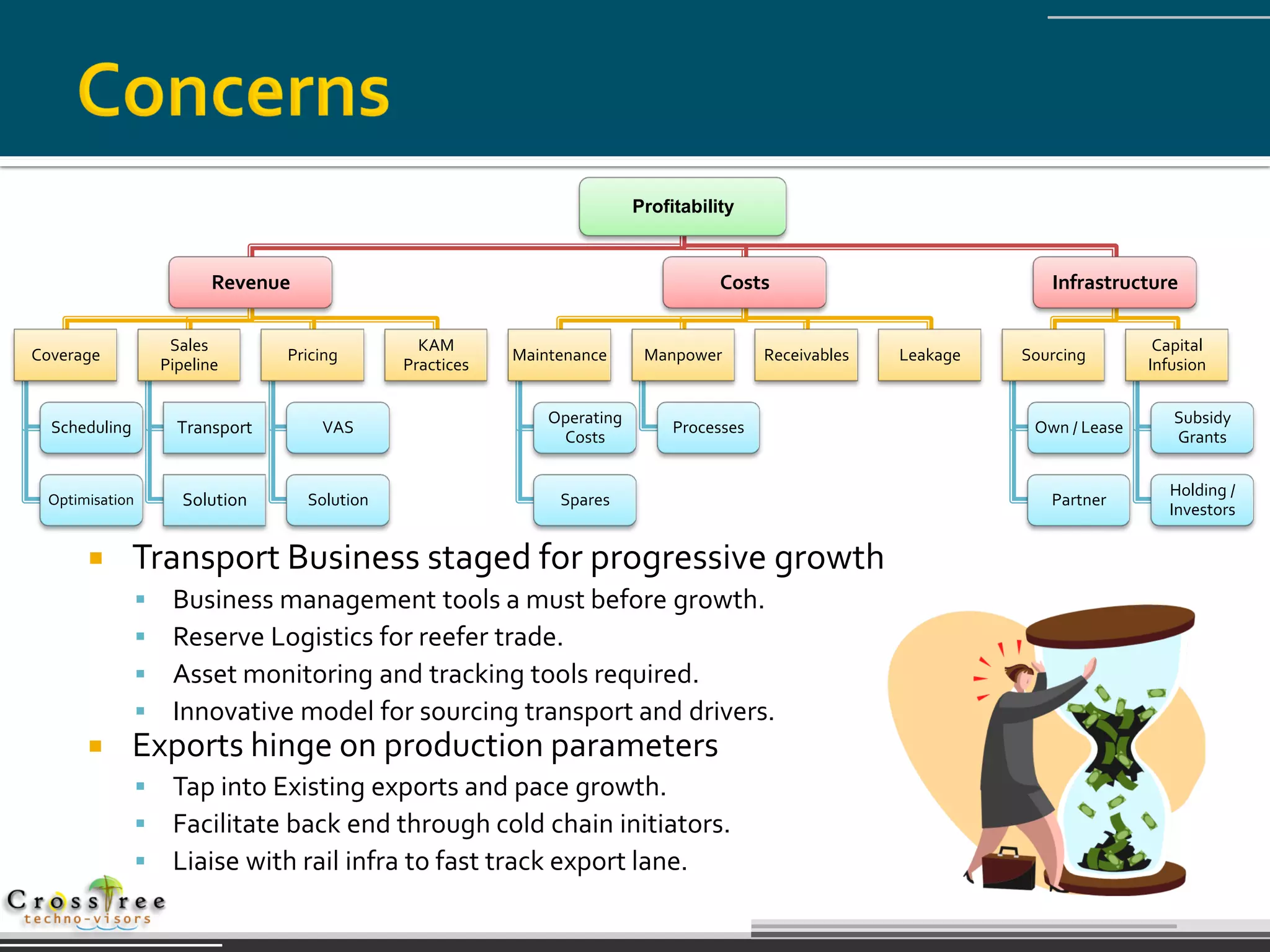
Profitability


                           Revenue                                                     Costs                            Infrastructure

                     Sales                        KAM                                                                                Capital
Coverage                          Pricing                   Maintenance      Manpower        Receivables   Leakage   Sourcing
                    Pipeline                    Practices                                                                           Infusion


                                                                Operating                                                              Subsidy
  Scheduling          Transport       VAS                                        Processes                            Own / Lease
                                                                 Costs                                                                 Grants


                                                                                                                                      Holding /
 Optimisation          Solution      Solution                    Spares                                                 Partner
                                                                                                                                      Investors


              Transport Business staged for progressive growth
                    Business management tools a must before growth.
                    Reserve Logistics for reefer trade.
                    Asset monitoring and tracking tools required.
                    Innovative model for sourcing transport and drivers.
              Exports hinge on production parameters
                    Tap into Existing exports and pace growth.
                    Facilitate back end through cold chain initiators.
                    Liaise with rail infra to fast track export lane.
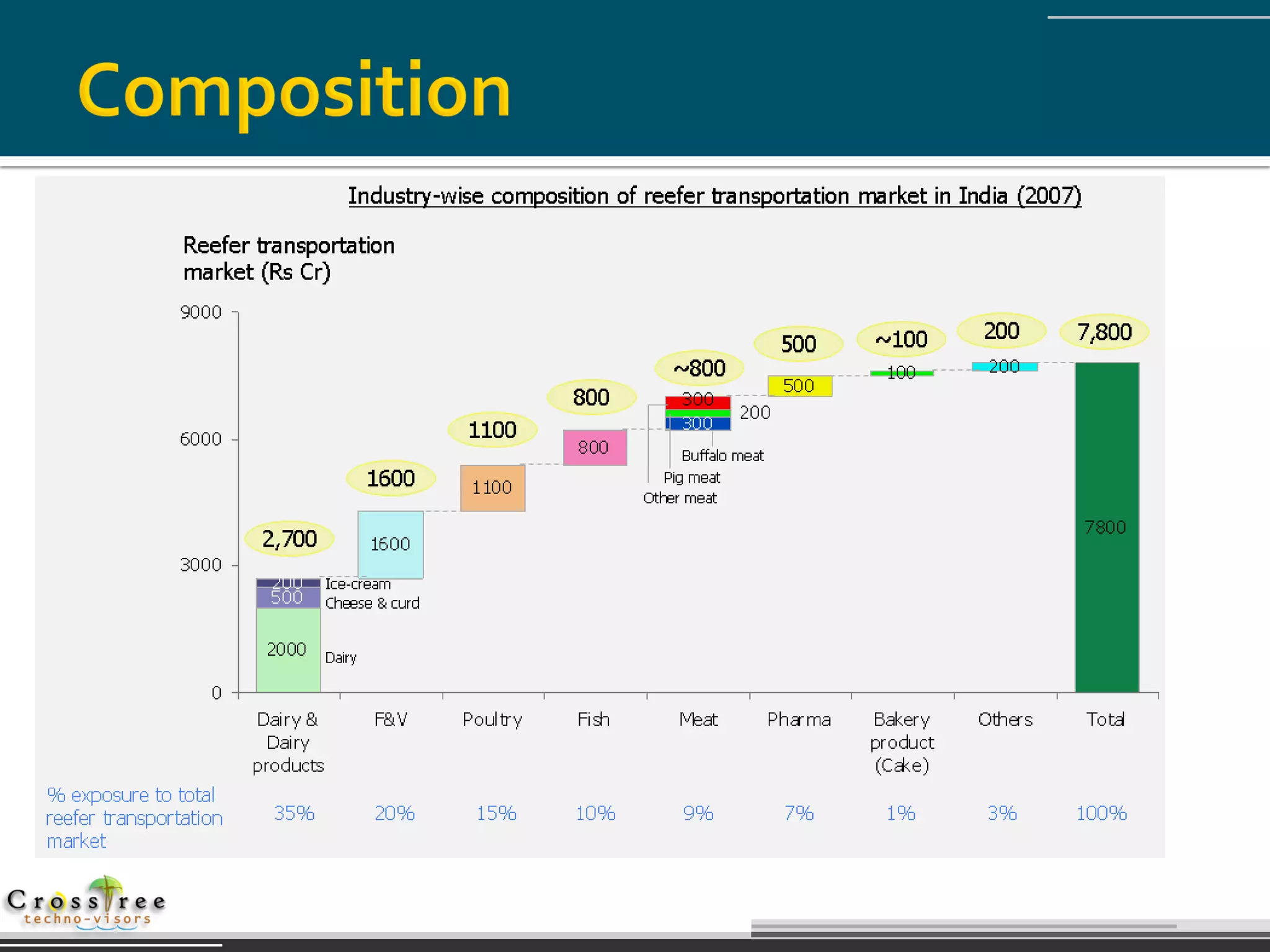
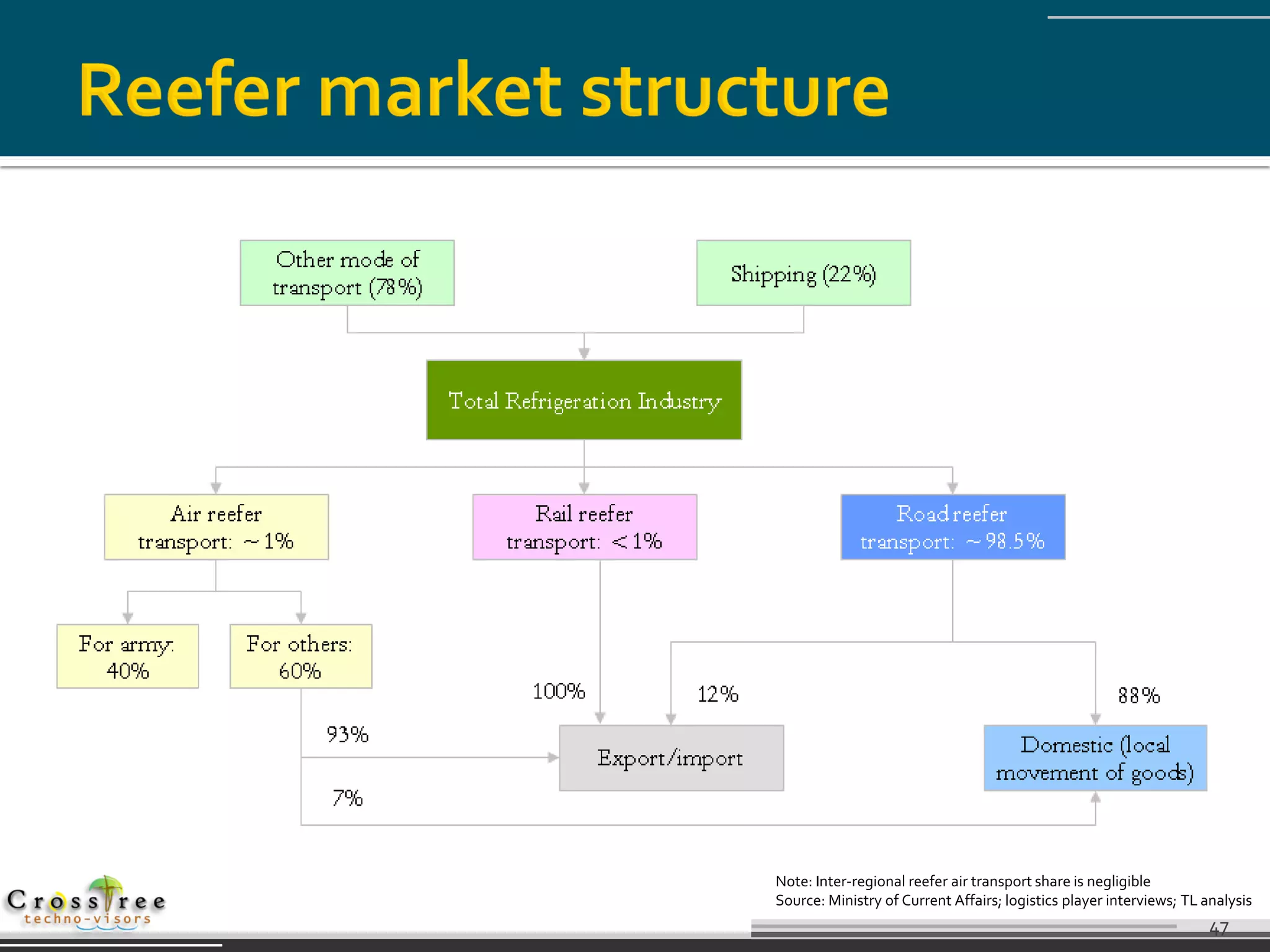
Note: Inter-regional reefer air transport share is negligible
Source: Ministry of Current Affairs; logistics player interviews; TL analysis
                                                                      47
Thank You

Transport Operators; skill development in cold chain

  • 1.
    Captain Pawanexh Kohli Founder,CrossTree techno-visors
  • 2.
    You provide dedicated and non dedicated services across regions and transport goods with temperature ranging from +25 to -25 °C  You charge on different basis e.g trip wise, km wise, kg wise, palette wise depending upon customer.  Cater to Pharma Industry, Processed Food , FMCG and Fruits and Vegetables, Butter, Ice cream etc.
  • 3.
    There are Four stakeholders in the cold chain industry:  Cold storage owner (stationary).  Equipment manufacturer.  Refrigerated logistics owner (transport).  Produce Owner – links the complete value chain. -------------------------------------------------------------  Almost 80% of cold chain assets are individual owned with fragmented chain of custody.  Produce owner requires Integrated Service by and to assign professional onus on cargo care.
  • 4.
    Dedicated Infrastructure  Current (Rs 1000 cr) ▪ Pre-Cooling / Blast Freezers movement management ▪ Buffer Storage market: ▪ IQF and processing  Frozen Range ▪ Market: 4% (Rs 40 cr)  Transportation - Point to point  Chilled Range ▪ To consumer ▪ Market: 39% (Rs 390 cr) ▪ To cold warehouse  Mild Chill Range  Transportation – milk run ▪ Market: 57% (Rs 570 cr) ▪ DC to retail  Perishable Load segments: ▪ Full truck loads (almost 80%)  Distribution Multi temp-zones.  Monitoring, Control & Traceability.  Part Load movement ▪ Vaccines and Drugs  Demand and Supply Mapping. ▪ Life Sciences  Financial and Insurance. ▪ Demand in other areas voiced.
  • 5.
    Product Pickup Reefer Transport Cold Warehouse •Centrally located hub function •Optimised Routing, multi-modal options. •Multi Modal Connectivity •Documentation and routing •Both innovative & conventional modes. •Consolidation of handling •Single connected Chain of Custody. •Air Express for fast track. •Brand Assurance and Quality Assurance. •‘Pit-Stop’ Express: Reefer Fleet. •Life cycle Management. •Milk-run Express: Reefer Fleet. •Active cooled Boxes remote loads Delivery Reefer Transport Cold Warehouse
  • 6.
    Port-side Trading Trader Side Logistics Trawlers/Catch Storage in at Sea Flaked Ice IQF/Belt Frzr Frozen Product Quality Check/ Packaging Sorting Milk-run deliveries to Retail Stores Transport to Storage at Distributors Distributor facility
  • 7.
    Composite Milk Processing Plants Raw Milk collected from Co-operatives/ Chilled Milk Transported milk producers, farmers to Dairies and chilled Dairy by-products: Processed Butter, Cheese and Packaged alike Milk storage Distribution to Retail Locations Intra-city Transportation to deliveries Distributors Storage at Distributors
  • 8.
    Sausage Processing Meat Cutting and Ready to eat Freezing Meat Packaging Bacon & Ham processing Milk-run deliveries to Retail Stores Transport to Distributor Storage Facility Storage
  • 9.
    Procurement from Collection at Sorting/ Grading Farms Centralized Facility Product Packaging IQF Unit Cleaning/ Processing Milk-run deliveries to Retail Stores Transport to Distributor Storage Facility Storage
  • 10.
    Minimal touch points; Cold Supply Chain  Technology Driven DSD or DC as preferred OD Pairs; Cold Supply Chain Spoke Cold Supply Chain Cold Supply Chain  Traceablity & speed; Knowledge Driven Spoke Spoke Cold Supply Chain HUB Specialised packaging;  Speed Driven Spoke  Perishability (Product knowledge) strives to be. and Everything the ordinary Supply Chain Existing (Layered) Supply Chain
  • 11.
    Frozen Products:  Primarily temperature care (-18 °C or below)  Machine optimisation prime concern.  Pharma – Chilled:  Range of 2 to 6 °C available.  Speed and cargo care prime concern.  Fresh Chill and Mild Chill:  Precise temperature requirements.  Product compatibilities of concern.  Temperature, air quality and humidity of concern.  HACCP compliance more strict.
  • 12.
    Packaging • Resusable, sustainable, breathable, saleable Conditioning • Grading, Precooling, coating, HACCP Transport • Cooling, vibration, insulation, tracking Product Life Cycle Storage • Insulation, air change, energy saving, HACCP Distribution • TMS, JIT, Replenishment, Shelf presence Monitoring • Traceability, tracking, shelf life, HACCP FEFO • Smart picking, customer demand, quality Atmosphere • Life, Humidity, disease, EOP, tainting Vibration • Aging, damage salability, packaging Trade Processes • Shelf presence, shrinkage, Aging, speed
  • 13.
  • 14.
    All living tissues • Oxidizing various components to provide respire: energy to continue life. Fruit & Vegetables are • Continue to live even in absence of living tissues: nutrient transfer. F&V have a delicate • Flavors, colors, nutritional components, balance: etc. A slight change makes a difference. Not all are created • Yet most Fruits & Vegetables are 90-95% equal: water. Ultimately all F&V die: • And become unusable or unmarketable.
  • 15.
    • Cooling requiresenergy and tends to invite Tainting: compartment sharing and other shortcuts. • Cooling effects external environment and Moisture Loss: changes ambient conditions. • Cooling creates condensate which encourages Disease: disease and rots. • Cooling is ineffective if the medium spread is Stowage: in-correct. Control: • Cooling causes chill injuries and even death. 15
  • 16.
    Physiological respiratory processes of fresh produce continues after harvesting. This requires oxygen (O2) and in turn generates heat and releases carbon dioxide (CO2) and ethylene.  High concentrations of CO2 & Ethylene degrades or kills the produce.  These gases must be replenished with Fresh Air employing a ventilation system.  Efficient air circulation enhances cooling & removes trapped pockets of gaseous by-products.
  • 17.
    Products stored in common spaces must be compatible for shared storing temperatures, moisture levels (RH), volatility (ethylene), odour (tainting), etc.  Cross contamination through incompatible product mix can lead to an un-saleable produce.  Cross-transfer of odours and/or stimulated maturing leading to subsequent decay is to be avoided. 17
  • 18.
     Fresh horticulturalcommodities are unique packages of water! In fact Freshness Sells and freshness is water!  Water loss is one main cause of loss of quality & marketability of fresh fruits and vegetables.  Low Humidity levels are inherent to poorly designed refrigerated spaces.
  • 19.
    With inefficient packaging and storing, the cooling medium (air or water) does not spread contact with the produce leading to cooling inefficiencies & product damage. Shoulder Vents allow vertical air flow Panel Vents allow horizontal air flow  Packaging must Protect, easy on FIFO, tolerate & allow preferred Cooling method, enhance Space Utilisation and have Sales Appeal.  Some packaging can simulate CA conditions.
  • 20.
    Safe sanitation, hygienic conditions and abidance with laws of food regulatory authorities is a must.  Prudent care is applied to keep the fresh produce clean dirt, insect & microorganism infestation.  All water used to be pre-treated.  Anti fungal treatments are regularly applied.  Between subsequent uses, the cold room space sanitisaton is required.  To identify and apply controls, HACCP (Hazard Analysis and Critical Control Points) procedures are useful.  Regular internal quality audits, checks and training is a must.
  • 21.
    Hazard Analysis Critical Control Points Field Worker Hygiene Farm Equipment Sanitation Water Sanitation Crate Sanitation Temperature Control and Cold Store Sanitation Transport Sanitation
  • 22.
  • 23.
    Link OD Pairs for Customer Value Cargo Preservation Reefer Delivery Trucking Personal Conform Monitor to Service Cargo Levels Status
  • 24.
    Saleable Quality Moisture Color Potency Shrinkage Firmness Rot Disease Efficacy
  • 25.
    Sale Value Shelf Life Hardware Excursions Shrinkage Quality Air Quality Chill Injury Moisture Infestation Tainting Failure Ironically, most reefer cargo damage not always occurs due to technical reasons, but due to poor communication, management practices or cargo procedures.
  • 26.
    Management Equipment Protocols Emergency Trained Staff Plan
  • 27.
    Pre-cooling – yes or no?  Temperature Control – cargo dependant.  Air Freshening – cargo dependant.  Cleaning and cross contamination.  Insulation and refrigeration.  Quality – product and packaging.  Handling (pre-shipment and post shipment).  Trip time – journey time.  En-route Contingency plans.
  • 28.
  • 29.
    NO!!!!  Pre-cool only in specific conditions.  Pre-cool to ambient air ingress temperatures.  Too much cooling causes condensate to form.  Leads to moisture damage and icing on coils.  Iced coils do not allow efficient heat exchange.  Results in shorter defrost cycles on initial load up.  Pre-cool when sealed docks are provided.
  • 30.
    Supply Fresh Air Air Intake Return Air
  • 33.
     Cold airas medium to counter heat ingress from peripheral walls.  Cold air is medium to counter respiratory heat.  Air as medium to extract odours and hot pockets.  Air as medium to freshen environment.
  • 35.
    To maximise cooling for hand stacked loads (top-air delivery)  Use airflow loading pattern for respiring cargo. ▪ Build starter stack against front with vertical flow channels. ▪ Load top boxes in solid layer end to end. ▪ Build end stacks against door with brick lay to diffuse flow. ▪ Again, load top boxes in solid layer end to end. ▪ This pattern is used reefer vans without forced bottom up circulation.
  • 36.
    To maximise cooling for frozen cargos  Use block stow pattern for inert cargo. ▪ Build all stacks clear from side wall contact. ▪ Allow air to envelope cargo and dissipate heat ingress from external walls. ▪ As cargo does not produce heat, air flow directly through cargo not necessary.
  • 37.
    DURING LOADING Use proper stowage as per cargo types. Never leave blank spots to allow short cycling of air. Do NOT run reefer unit when doors Top down circulation are open. Stop genset during stuffing to avoid exhaust gas reaching chamber. Bottom-up circulation Use electric powered forklifts when possible. Use strip curtains to trap precious energy. Check cargo core temperature frequently during loading period. Check cargo packaging integrity frequently during loading.
  • 38.
    Complete pre-trip checkson vehicle and record the same. Demand all parameters required for safe transport of cargo, including-  Temperature range in transit.  Set point required.  Air freshening if any.  Loading temperature permitted.  Packaging type to be deployed.  Shelf life of product. Get sign off on cleanliness before loading. Request recommended stowage pattern. Record start of loading time.
  • 39.
    Do NOT leaveareas uncovered on floor plate of vehicle. Check no over stow of cargo beyond limit line. Check that cargo is stable for transit. Bracing of cargo preferred with dunnage, air bags or cargo nets. Ensure bracing does not block floor channels on ends. Ensure no loose packing or wrapping material which can create blockage of fan. Reconfirm set point and other parameters.
  • 40.
    Avoid multiple point loading.  Avoid delayed loading process.  If required by customer, insist on indemnity.  When forced into such situation, stop the evaporator fans.  Secondary load “must” be at the requisite carriage temperature.  Loading should preferably be at sealed docks.
  • 41.
    Vehicle doors notproperly sealed. Incorrect pre-cooling of vehicle. Keeping fans running during loading. Improper cargo status on loading. Cargo packaging compromised. Quality of cargo previously compromised. Hot spots in cargo chamber. Incorrect set point parameters. Overloading in chamber. Poor maintenance of equipment.
  • 42.
    Profitability Revenue Costs Infrastructure Sales KAM Capital Coverage Pricing Maintenance Manpower Receivables Leakage Sourcing Pipeline Practices Infusion Operating Subsidy Scheduling Transport VAS Processes Own / Lease Costs Grants Holding / Optimisation Solution Solution Spares Partner Investors  Transport Business staged for progressive growth  Business management tools a must before growth.  Reserve Logistics for reefer trade.  Asset monitoring and tracking tools required.  Innovative model for sourcing transport and drivers.  Exports hinge on production parameters  Tap into Existing exports and pace growth.  Facilitate back end through cold chain initiators.  Liaise with rail infra to fast track export lane.
  • 47.
    Note: Inter-regional reeferair transport share is negligible Source: Ministry of Current Affairs; logistics player interviews; TL analysis 47
  • 50.

Editor's Notes