
राष्ट्रीय कोल्ड-चेन विकास कें द्र
India Ports and Shipping Conference
November-2014
New Delhi, India
Ministry of
Agriculture
initiative
Pawanexh Kohli
The largest producer of milk (140 million tons).
Largest producer of mangoes (15 million tons).
Largest producer of bananas (29 million tonnes).
Largest buffalo livestock (105 million), exporting
2.1 million tons in animal products.
Second in fruit (84 mlllion tons) and vegetable
production (170 million tons).
Third-largest producer of fish (9 million tons).
Third largest pharmaceutical producer, 8% of
global production.
Pawanexh Kohli
Coastline is more than 7,500 km long.
Interspersed with more than 200 ports.
International cargo: 95% by volume and 75% by
value is carried by sea.
Ports capacity 1,247 million tonnes, doubling by
2017.
Railways: 87,087 km, across 7,083 stations and
operates more than 18,000 trains every day.
4.2 million km Roads : National Highways - 76,818
km, State Highways - 154,522 km, District Roads -
2,577,396 km, Rural Roads - 1,433,577 km.
Pawanexh Kohli
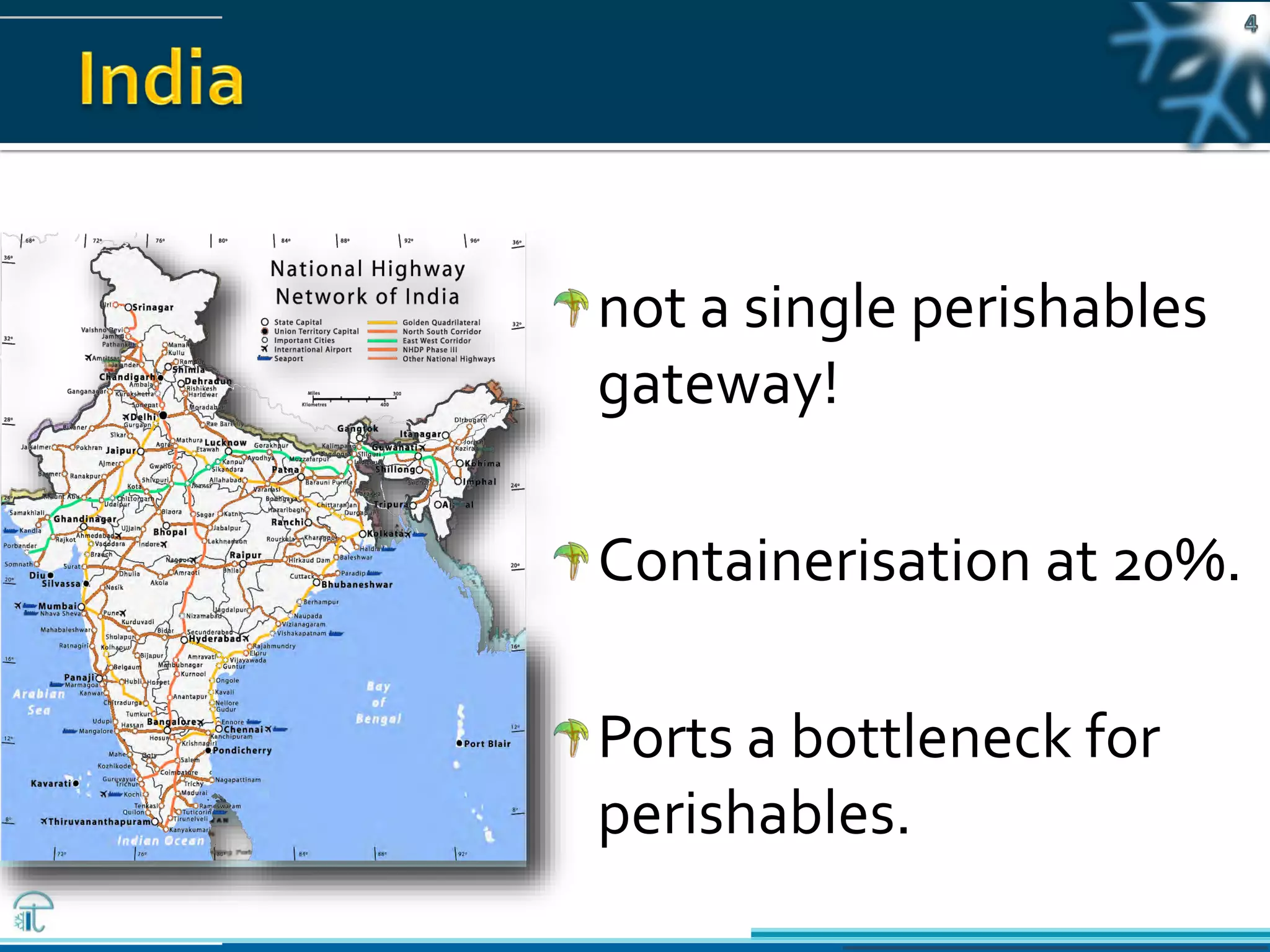
not a single perishables
gateway!
Containerisation at 20%.
Ports a bottleneck for
perishables.
Pawanexh Kohli
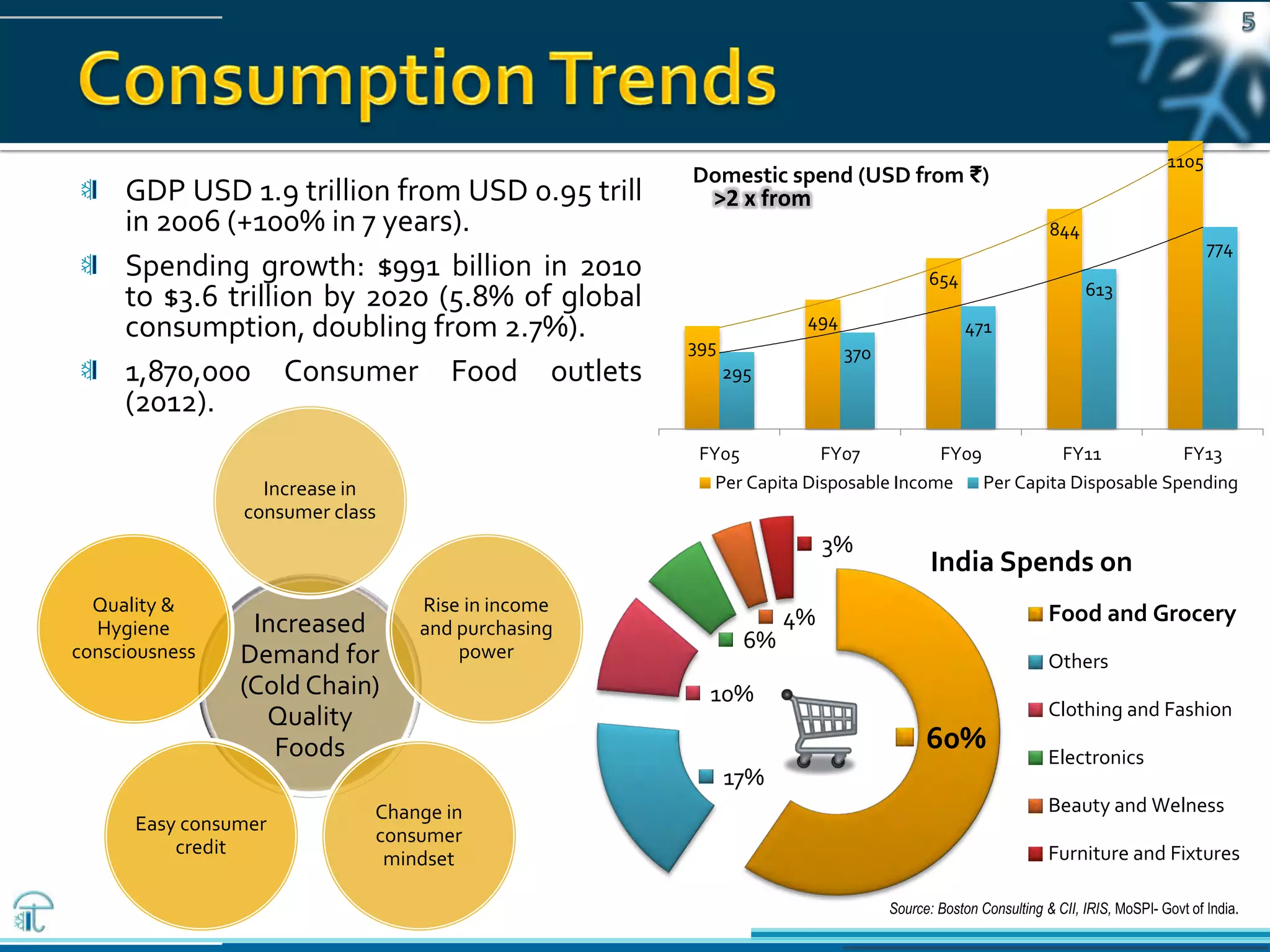
GDP USD 1.9 trillion from USD 0.95 trill
in 2006 (+100% in 7 years).
Spending growth: $991 billion in 2010
to $3.6 trillion by 2020 (5.8% of global
consumption, doubling from 2.7%).
1,870,000 Consumer Food outlets
(2012).
Source: Boston Consulting & CII, IRIS, MoSPI- Govt of India.
Increased
Demand for
(Cold Chain)
Quality
Foods
Increase in
consumer class
Rise in income
and purchasing
power
Change in
consumer
mindset
Easy consumer
credit
Quality &
Hygiene
consciousness
60%
17%
10%
6%
4%
3%
India Spends on
Food and Grocery
Others
Clothing and Fashion
Electronics
Beauty and Welness
Furniture and Fixtures
395
494
654
844
1105
295
370
471
613
774
FY05 FY07 FY09 FY11 FY13
Domestic spend (USD from ₹)
Per Capita Disposable Income Per Capita Disposable Spending
>2 x from
Pawanexh Kohli
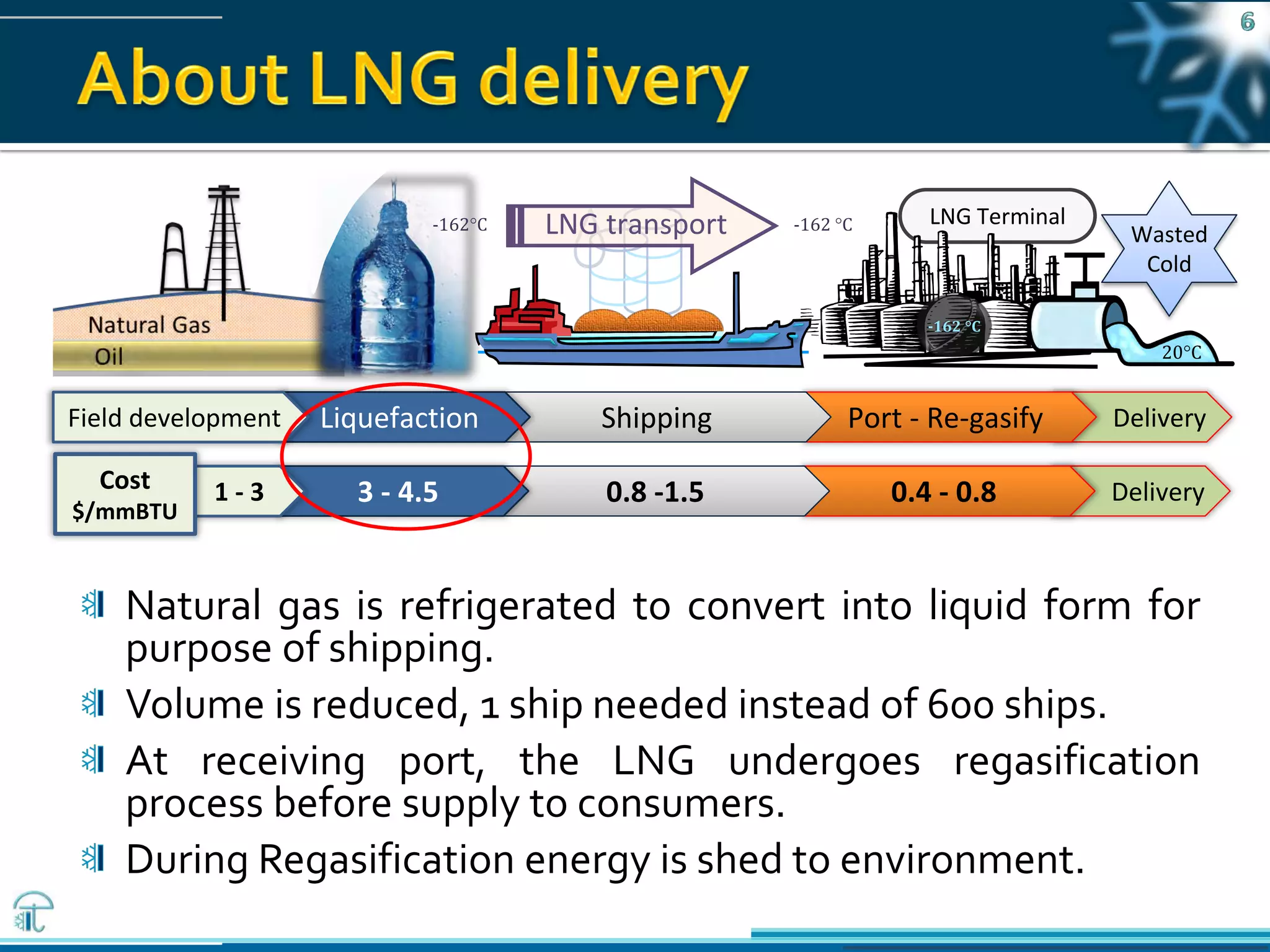
Natural gas is refrigerated to convert into liquid form for
purpose of shipping.
Volume is reduced, 1 ship needed instead of 600 ships.
At receiving port, the LNG undergoes regasification
process before supply to consumers.
During Regasification energy is shed to environment.
LNG Terminal
DeliveryPort - Re-gasifyShippingLiquefaction
Wasted
Cold
LNG transport-162°C -162 °C
20°C
-162 °C
Field development
Delivery0.4 - 0.80.8 -1.53 - 4.51 - 3Cost
$/mmBTU
Pawanexh Kohli
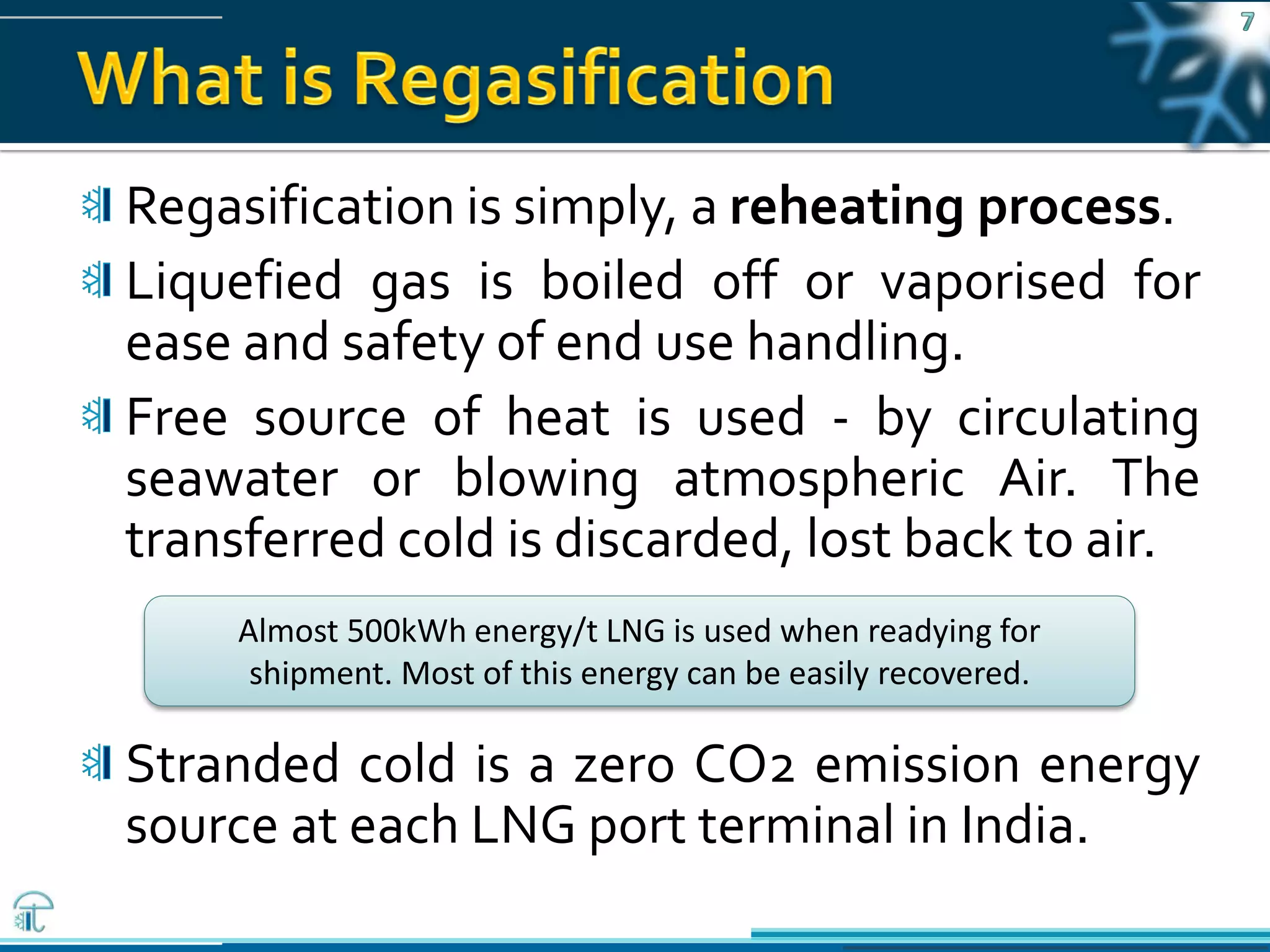
Regasification is simply, a reheating process.
Liquefied gas is boiled off or vaporised for
ease and safety of end use handling.
Free source of heat is used - by circulating
seawater or blowing atmospheric Air. The
transferred cold is discarded, lost back to air.
Stranded cold is a zero CO2 emission energy
source at each LNG port terminal in India.
Almost 500kWh energy/t LNG is used when readying for
shipment. Most of this energy can be easily recovered.
Pawanexh Kohli
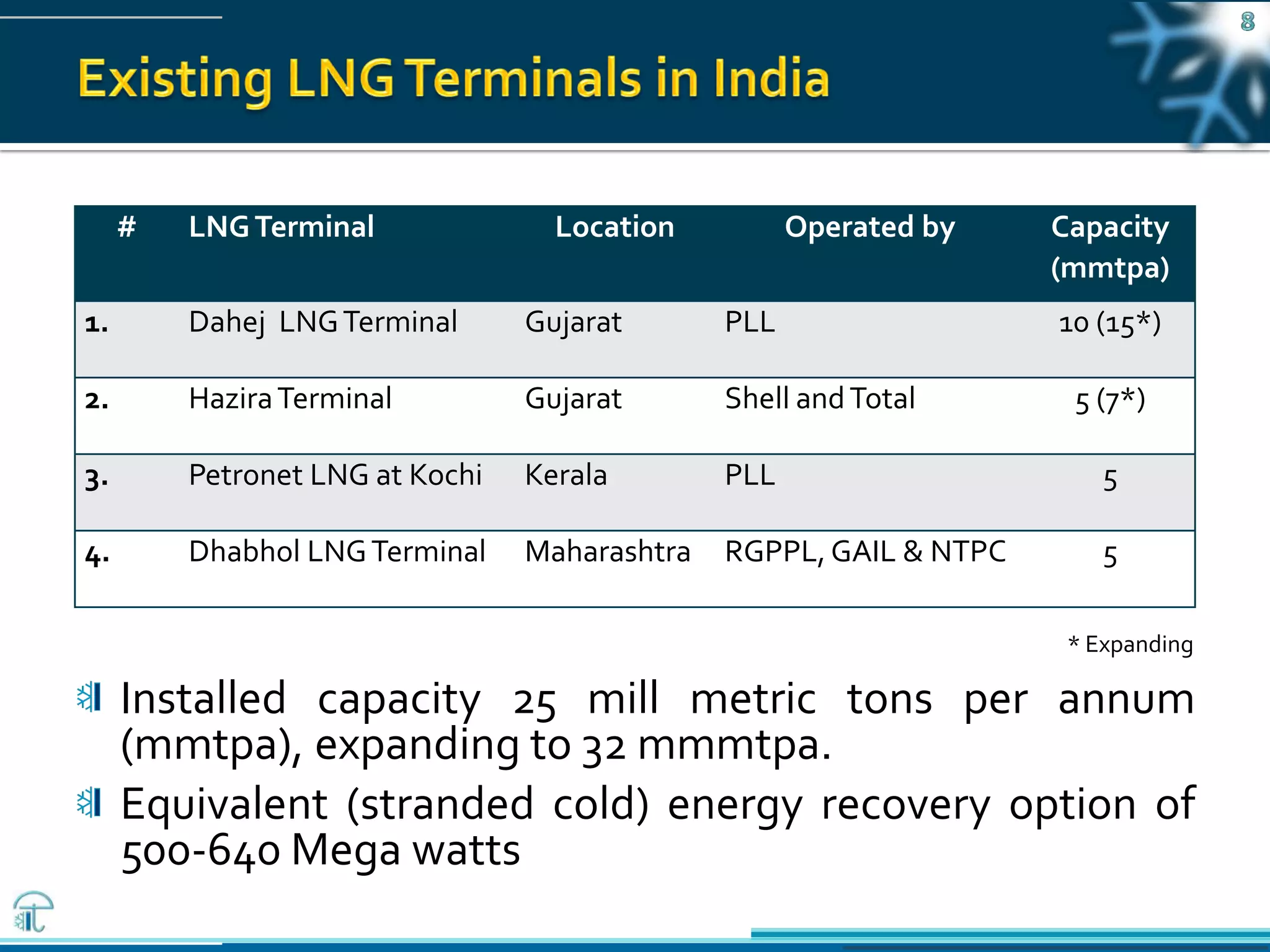
# LNGTerminal Location Operated by Capacity
(mmtpa)
1. Dahej LNGTerminal Gujarat PLL 10 (15*)
2. HaziraTerminal Gujarat Shell andTotal 5 (7*)
3. Petronet LNG at Kochi Kerala PLL 5
4. Dhabhol LNGTerminal Maharashtra RGPPL,GAIL & NTPC 5
Installed capacity 25 mill metric tons per annum
(mmtpa), expanding to 32 mmmtpa.
Equivalent (stranded cold) energy recovery option of
500-640 Mega watts
* Expanding
Pawanexh Kohli
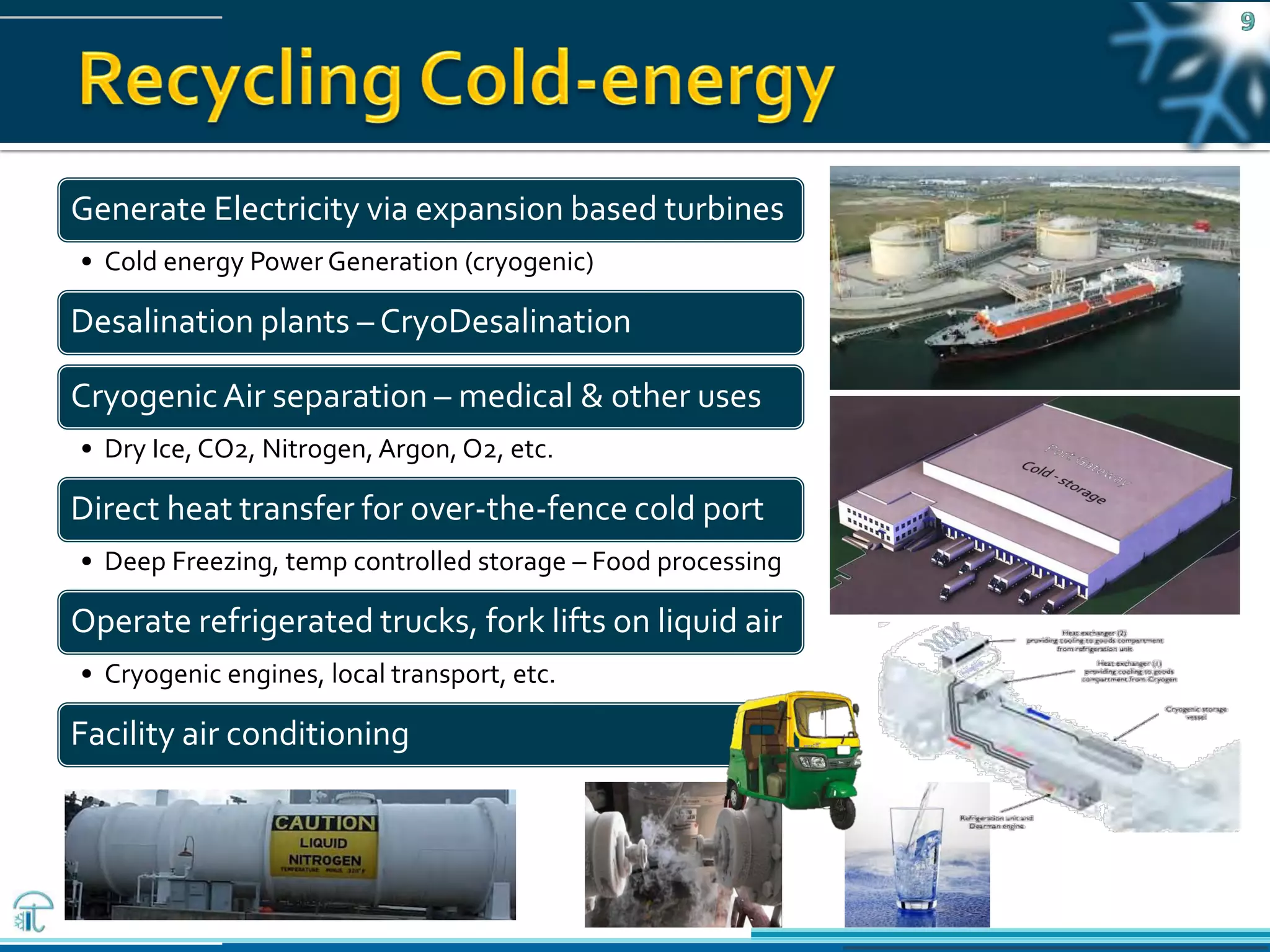
Generate Electricity via expansion based turbines
• Cold energy Power Generation (cryogenic)
Desalination plants – CryoDesalination
CryogenicAir separation – medical & other uses
• Dry Ice, CO2, Nitrogen, Argon, O2, etc.
Direct heat transfer for over-the-fence cold port
• Deep Freezing, temp controlled storage – Food processing
Operate refrigerated trucks, fork lifts on liquid air
• Cryogenic engines, local transport, etc.
Facility air conditioning
Pawanexh Kohli
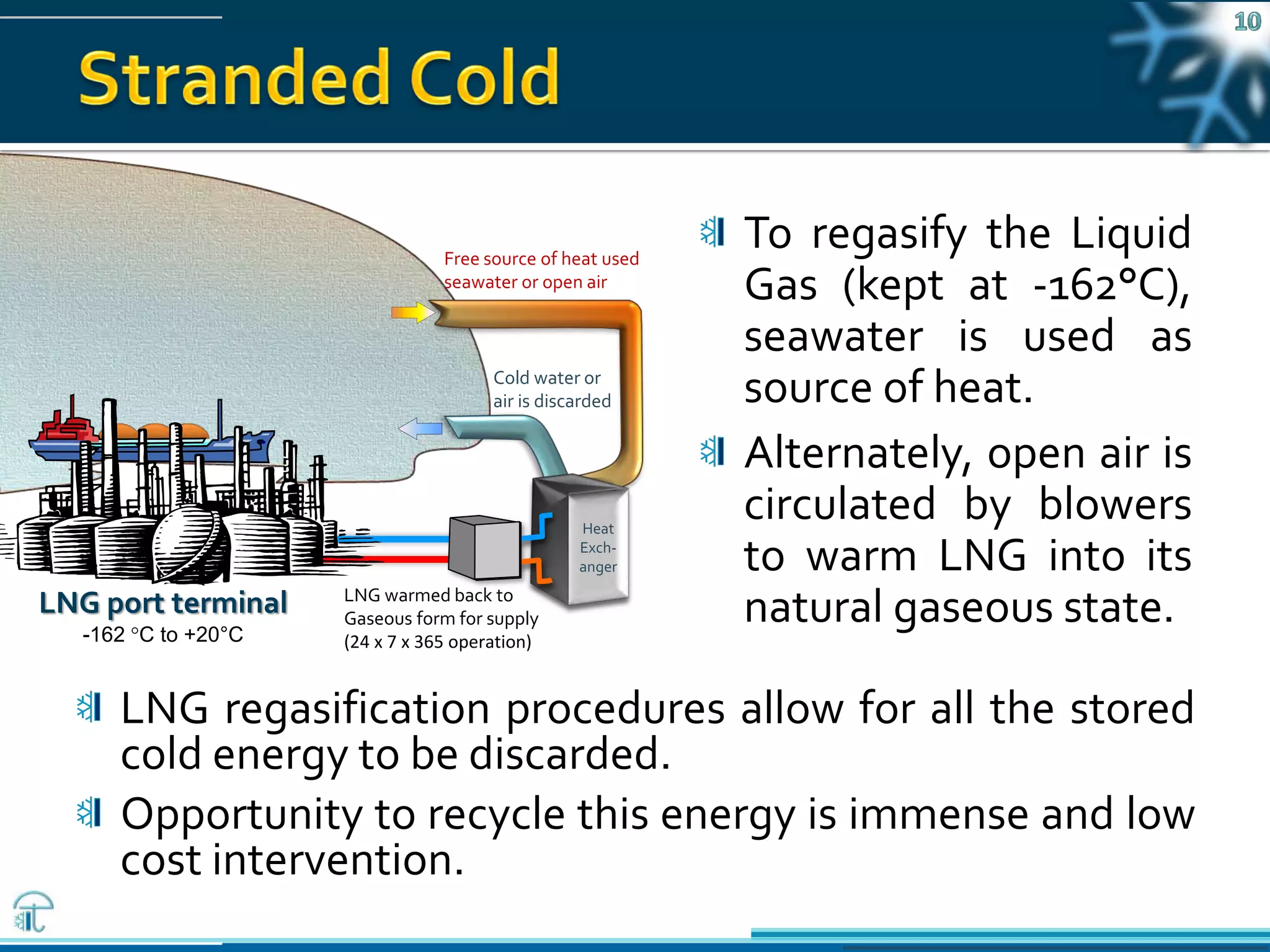
LNG regasification procedures allow for all the stored
cold energy to be discarded.
Opportunity to recycle this energy is immense and low
cost intervention.
Heat
Exch-
anger
LNG port terminal
-162 °C to +20°C
LNG warmed back to
Gaseous form for supply
(24 x 7 x 365 operation)
To regasify the Liquid
Gas (kept at -162°C),
seawater is used as
source of heat.
Alternately, open air is
circulated by blowers
to warm LNG into its
natural gaseous state.
Free source of heat used
seawater or open air
Cold water or
air is discarded
Pawanexh Kohli
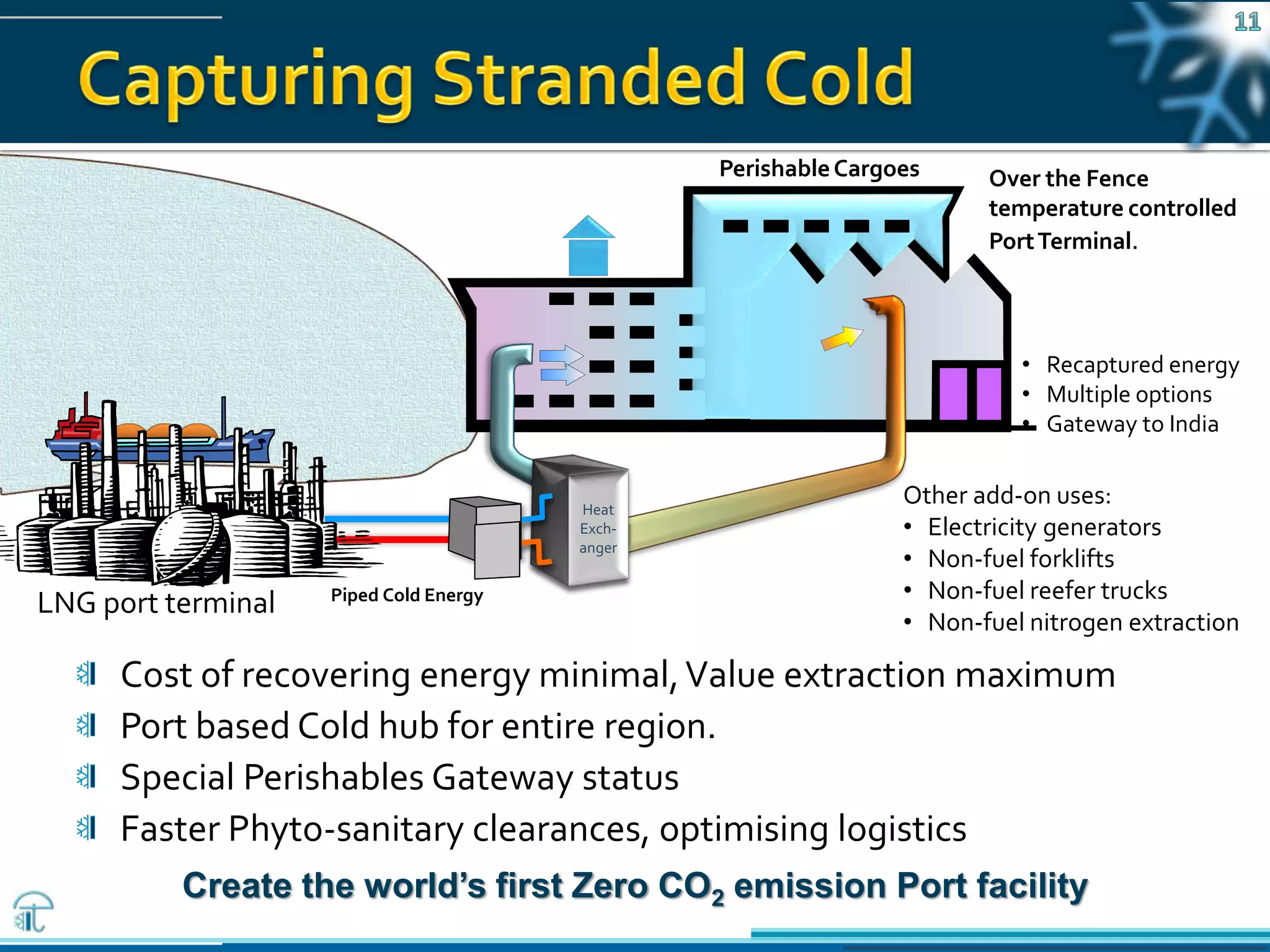
Cost of recovering energy minimal,Value extraction maximum
Port based Cold hub for entire region.
Special Perishables Gateway status
Faster Phyto-sanitary clearances, optimising logistics
Heat
Exch-
anger
Over the Fence
temperature controlled
PortTerminal.
LNG port terminal Piped Cold Energy
• Recaptured energy
• Multiple options
• Gateway to India
Other add-on uses:
• Electricity generators
• Non-fuel forklifts
• Non-fuel reefer trucks
• Non-fuel nitrogen extraction
PerishableCargoes
Create the world’s first Zero CO2 emission Port facility
Pawanexh Kohli
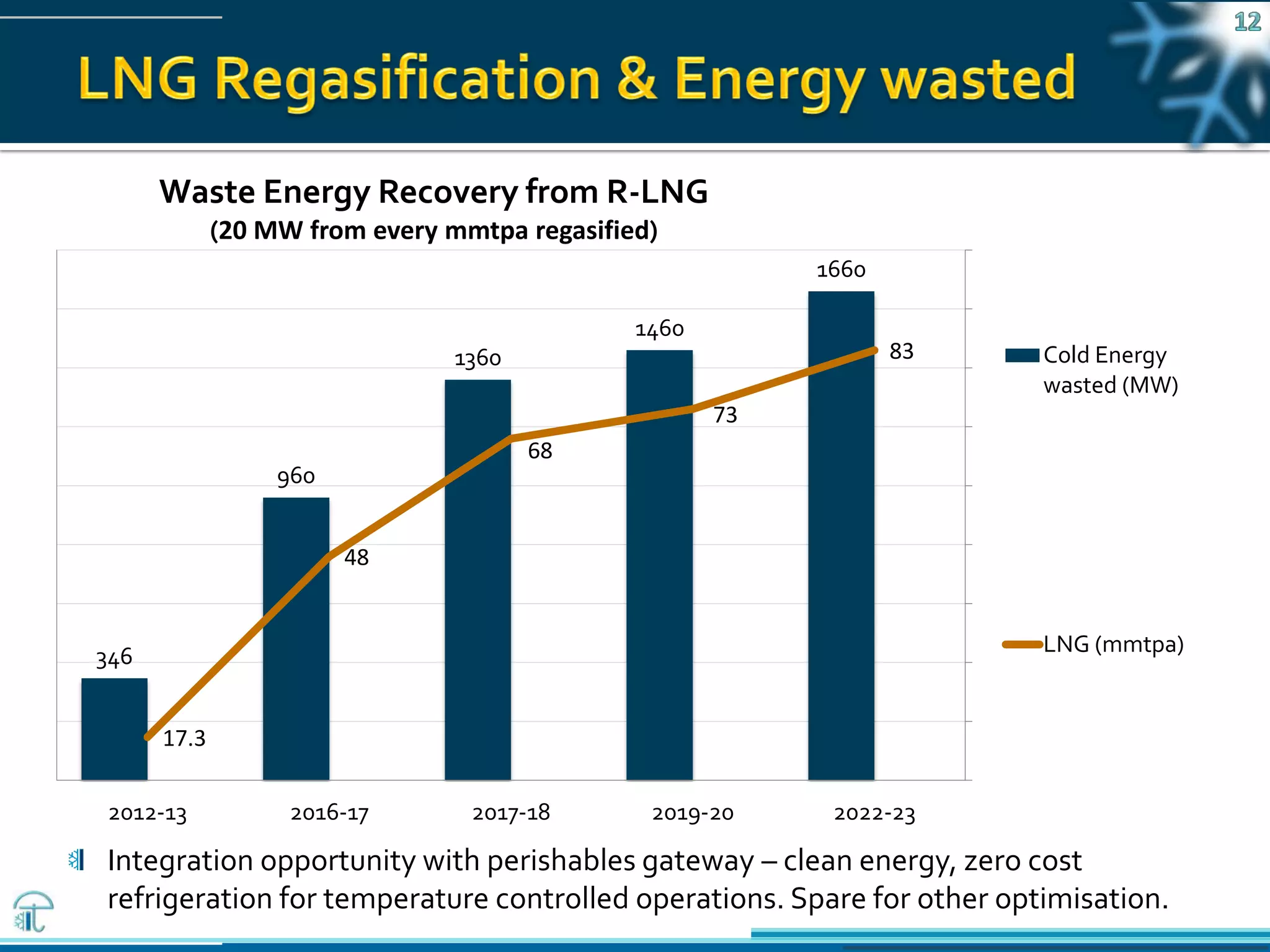
346
960
1360
1460
1660
17.3
48
68
73
83
2012-13 2016-17 2017-18 2019-20 2022-23
Waste Energy Recovery from R-LNG
(20 MW from every mmtpa regasified)
Cold Energy
wasted (MW)
LNG (mmtpa)
Integration opportunity with perishables gateway – clean energy, zero cost
refrigeration for temperature controlled operations. Spare for other optimisation.
Pawanexh Kohli
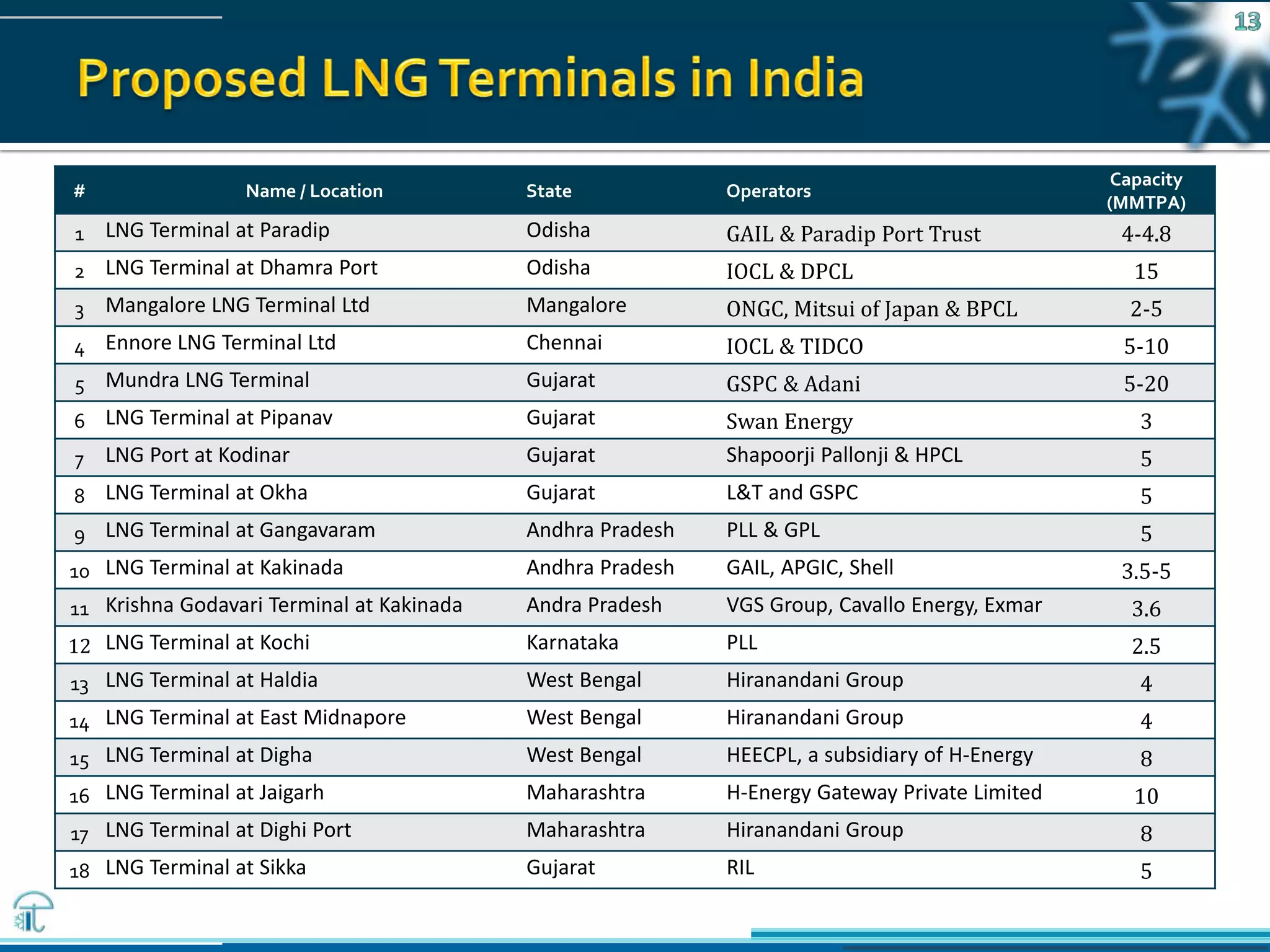
# Name / Location State Operators
Capacity
(MMTPA)
1 LNG Terminal at Paradip Odisha GAIL & Paradip Port Trust 4-4.8
2 LNG Terminal at Dhamra Port Odisha IOCL & DPCL 15
3 Mangalore LNG Terminal Ltd Mangalore ONGC, Mitsui of Japan & BPCL 2-5
4 Ennore LNG Terminal Ltd Chennai IOCL & TIDCO 5-10
5 Mundra LNG Terminal Gujarat GSPC & Adani 5-20
6 LNG Terminal at Pipanav Gujarat Swan Energy 3
7 LNG Port at Kodinar Gujarat Shapoorji Pallonji & HPCL 5
8 LNG Terminal at Okha Gujarat L&T and GSPC 5
9 LNG Terminal at Gangavaram Andhra Pradesh PLL & GPL 5
10 LNG Terminal at Kakinada Andhra Pradesh GAIL, APGIC, Shell 3.5-5
11 Krishna Godavari Terminal at Kakinada Andra Pradesh VGS Group, Cavallo Energy, Exmar 3.6
12 LNG Terminal at Kochi Karnataka PLL 2.5
13 LNG Terminal at Haldia West Bengal Hiranandani Group 4
14 LNG Terminal at East Midnapore West Bengal Hiranandani Group 4
15 LNG Terminal at Digha West Bengal HEECPL, a subsidiary of H-Energy 8
16 LNG Terminal at Jaigarh Maharashtra H-Energy Gateway Private Limited 10
17 LNG Terminal at Dighi Port Maharashtra Hiranandani Group 8
18 LNG Terminal at Sikka Gujarat RIL 5
Pawanexh Kohli
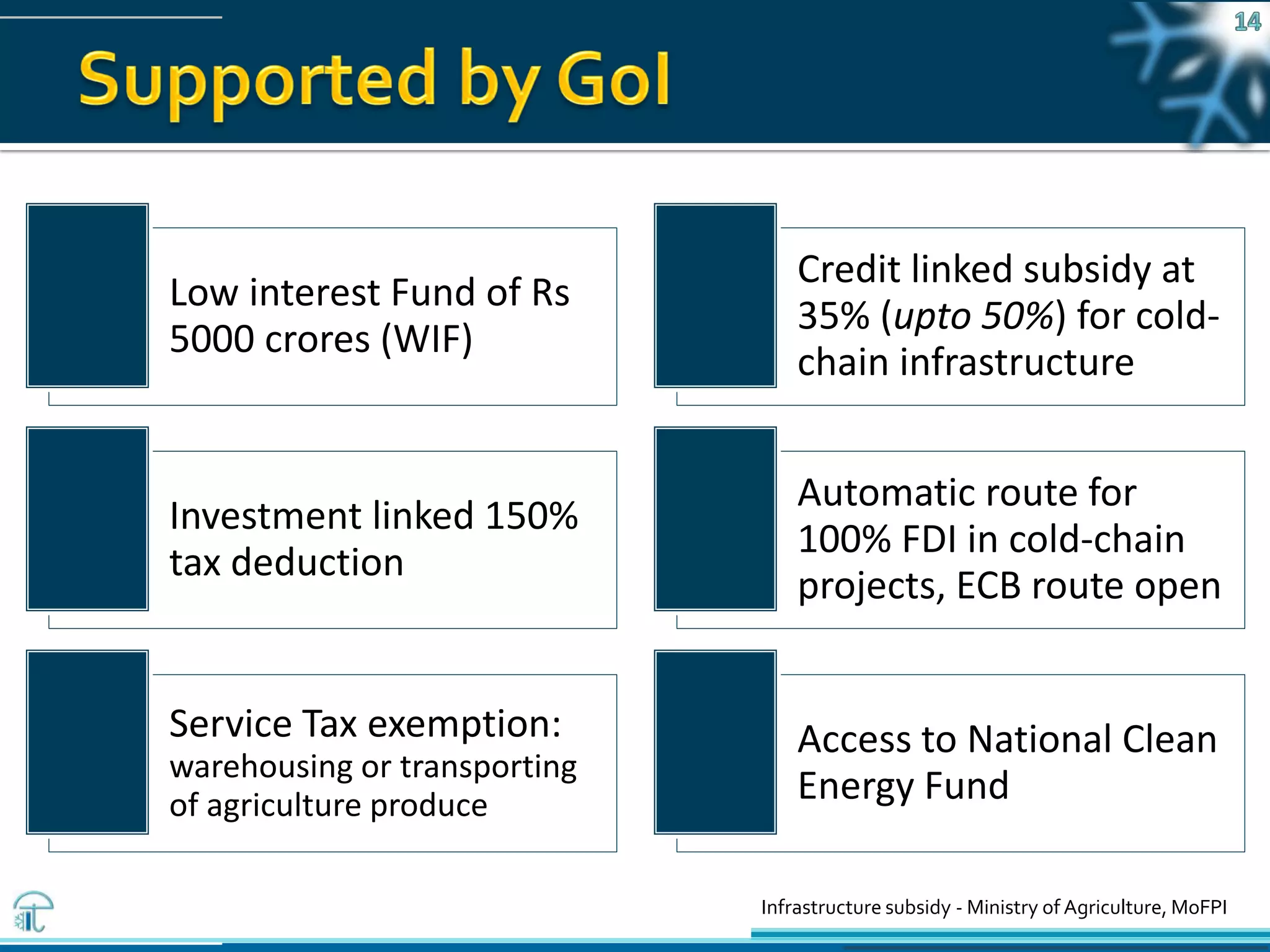
Low interest Fund of Rs
5000 crores (WIF)
Credit linked subsidy at
35% (upto 50%) for cold-
chain infrastructure
Investment linked 150%
tax deduction
Automatic route for
100% FDI in cold-chain
projects, ECB route open
Service Tax exemption:
warehousing or transporting
of agriculture produce
Access to National Clean
Energy Fund
Infrastructure subsidy - Ministry of Agriculture, MoFPI
धन्यवाद
राष्ट्रीय कोल्ड-चेन ववकास कें द्र
www.nccd.gov.in
Contact-NCCD@gov.in

Capturing Stranded Cold

  • 1.
    राष्ट्रीय कोल्ड-चेन विकासकें द्र India Ports and Shipping Conference November-2014 New Delhi, India Ministry of Agriculture initiative
  • 2.
    Pawanexh Kohli The largestproducer of milk (140 million tons). Largest producer of mangoes (15 million tons). Largest producer of bananas (29 million tonnes). Largest buffalo livestock (105 million), exporting 2.1 million tons in animal products. Second in fruit (84 mlllion tons) and vegetable production (170 million tons). Third-largest producer of fish (9 million tons). Third largest pharmaceutical producer, 8% of global production.
  • 3.
    Pawanexh Kohli Coastline ismore than 7,500 km long. Interspersed with more than 200 ports. International cargo: 95% by volume and 75% by value is carried by sea. Ports capacity 1,247 million tonnes, doubling by 2017. Railways: 87,087 km, across 7,083 stations and operates more than 18,000 trains every day. 4.2 million km Roads : National Highways - 76,818 km, State Highways - 154,522 km, District Roads - 2,577,396 km, Rural Roads - 1,433,577 km.
  • 4.
    Pawanexh Kohli not asingle perishables gateway! Containerisation at 20%. Ports a bottleneck for perishables.
  • 5.
    Pawanexh Kohli GDP USD1.9 trillion from USD 0.95 trill in 2006 (+100% in 7 years). Spending growth: $991 billion in 2010 to $3.6 trillion by 2020 (5.8% of global consumption, doubling from 2.7%). 1,870,000 Consumer Food outlets (2012). Source: Boston Consulting & CII, IRIS, MoSPI- Govt of India. Increased Demand for (Cold Chain) Quality Foods Increase in consumer class Rise in income and purchasing power Change in consumer mindset Easy consumer credit Quality & Hygiene consciousness 60% 17% 10% 6% 4% 3% India Spends on Food and Grocery Others Clothing and Fashion Electronics Beauty and Welness Furniture and Fixtures 395 494 654 844 1105 295 370 471 613 774 FY05 FY07 FY09 FY11 FY13 Domestic spend (USD from ₹) Per Capita Disposable Income Per Capita Disposable Spending >2 x from
  • 6.
    Pawanexh Kohli Natural gasis refrigerated to convert into liquid form for purpose of shipping. Volume is reduced, 1 ship needed instead of 600 ships. At receiving port, the LNG undergoes regasification process before supply to consumers. During Regasification energy is shed to environment. LNG Terminal DeliveryPort - Re-gasifyShippingLiquefaction Wasted Cold LNG transport-162°C -162 °C 20°C -162 °C Field development Delivery0.4 - 0.80.8 -1.53 - 4.51 - 3Cost $/mmBTU
  • 7.
    Pawanexh Kohli Regasification issimply, a reheating process. Liquefied gas is boiled off or vaporised for ease and safety of end use handling. Free source of heat is used - by circulating seawater or blowing atmospheric Air. The transferred cold is discarded, lost back to air. Stranded cold is a zero CO2 emission energy source at each LNG port terminal in India. Almost 500kWh energy/t LNG is used when readying for shipment. Most of this energy can be easily recovered.
  • 8.
    Pawanexh Kohli # LNGTerminalLocation Operated by Capacity (mmtpa) 1. Dahej LNGTerminal Gujarat PLL 10 (15*) 2. HaziraTerminal Gujarat Shell andTotal 5 (7*) 3. Petronet LNG at Kochi Kerala PLL 5 4. Dhabhol LNGTerminal Maharashtra RGPPL,GAIL & NTPC 5 Installed capacity 25 mill metric tons per annum (mmtpa), expanding to 32 mmmtpa. Equivalent (stranded cold) energy recovery option of 500-640 Mega watts * Expanding
  • 9.
    Pawanexh Kohli Generate Electricityvia expansion based turbines • Cold energy Power Generation (cryogenic) Desalination plants – CryoDesalination CryogenicAir separation – medical & other uses • Dry Ice, CO2, Nitrogen, Argon, O2, etc. Direct heat transfer for over-the-fence cold port • Deep Freezing, temp controlled storage – Food processing Operate refrigerated trucks, fork lifts on liquid air • Cryogenic engines, local transport, etc. Facility air conditioning
  • 10.
    Pawanexh Kohli LNG regasificationprocedures allow for all the stored cold energy to be discarded. Opportunity to recycle this energy is immense and low cost intervention. Heat Exch- anger LNG port terminal -162 °C to +20°C LNG warmed back to Gaseous form for supply (24 x 7 x 365 operation) To regasify the Liquid Gas (kept at -162°C), seawater is used as source of heat. Alternately, open air is circulated by blowers to warm LNG into its natural gaseous state. Free source of heat used seawater or open air Cold water or air is discarded
  • 11.
    Pawanexh Kohli Cost ofrecovering energy minimal,Value extraction maximum Port based Cold hub for entire region. Special Perishables Gateway status Faster Phyto-sanitary clearances, optimising logistics Heat Exch- anger Over the Fence temperature controlled PortTerminal. LNG port terminal Piped Cold Energy • Recaptured energy • Multiple options • Gateway to India Other add-on uses: • Electricity generators • Non-fuel forklifts • Non-fuel reefer trucks • Non-fuel nitrogen extraction PerishableCargoes Create the world’s first Zero CO2 emission Port facility
  • 12.
    Pawanexh Kohli 346 960 1360 1460 1660 17.3 48 68 73 83 2012-13 2016-172017-18 2019-20 2022-23 Waste Energy Recovery from R-LNG (20 MW from every mmtpa regasified) Cold Energy wasted (MW) LNG (mmtpa) Integration opportunity with perishables gateway – clean energy, zero cost refrigeration for temperature controlled operations. Spare for other optimisation.
  • 13.
    Pawanexh Kohli # Name/ Location State Operators Capacity (MMTPA) 1 LNG Terminal at Paradip Odisha GAIL & Paradip Port Trust 4-4.8 2 LNG Terminal at Dhamra Port Odisha IOCL & DPCL 15 3 Mangalore LNG Terminal Ltd Mangalore ONGC, Mitsui of Japan & BPCL 2-5 4 Ennore LNG Terminal Ltd Chennai IOCL & TIDCO 5-10 5 Mundra LNG Terminal Gujarat GSPC & Adani 5-20 6 LNG Terminal at Pipanav Gujarat Swan Energy 3 7 LNG Port at Kodinar Gujarat Shapoorji Pallonji & HPCL 5 8 LNG Terminal at Okha Gujarat L&T and GSPC 5 9 LNG Terminal at Gangavaram Andhra Pradesh PLL & GPL 5 10 LNG Terminal at Kakinada Andhra Pradesh GAIL, APGIC, Shell 3.5-5 11 Krishna Godavari Terminal at Kakinada Andra Pradesh VGS Group, Cavallo Energy, Exmar 3.6 12 LNG Terminal at Kochi Karnataka PLL 2.5 13 LNG Terminal at Haldia West Bengal Hiranandani Group 4 14 LNG Terminal at East Midnapore West Bengal Hiranandani Group 4 15 LNG Terminal at Digha West Bengal HEECPL, a subsidiary of H-Energy 8 16 LNG Terminal at Jaigarh Maharashtra H-Energy Gateway Private Limited 10 17 LNG Terminal at Dighi Port Maharashtra Hiranandani Group 8 18 LNG Terminal at Sikka Gujarat RIL 5
  • 14.
    Pawanexh Kohli Low interestFund of Rs 5000 crores (WIF) Credit linked subsidy at 35% (upto 50%) for cold- chain infrastructure Investment linked 150% tax deduction Automatic route for 100% FDI in cold-chain projects, ECB route open Service Tax exemption: warehousing or transporting of agriculture produce Access to National Clean Energy Fund Infrastructure subsidy - Ministry of Agriculture, MoFPI
  • 15.