

Fruits and Vegetables (F&V) Supply Chains in
                    Delhi


           Bodhiswatta Saha
              2010SMF6848
           Under the Guidance Of
            Prof. Ravi Shankar
Objectives Of The Project
   To visit NAFED at Lawrence Road ,Delhi and prepare a case study
   To visit SAFAL (Constituent of Mother Diary )at Mongolepuri,
    Delhi and prepare a case study
   To gather details of the procurement side of the F&V supply chain by
    visiting Tapukada and Tijara districts under Alwar and Shajhanpur
    ,Meerut city and meet famers and understand their problems.
   To understand the traditional supply chain i.e. Sabzi Mandis by
    visiting various Mandis and prepare a case study . .
   To identify the stakeholders and key salient features of the chain and
    form a matrix.
   To use AHP using primary data to see which the chain is which being
    sought after.
   To use ANP to check which cold chain is most sought after
Outline
   Background of the Study
   Literature Review: Situation in other Developing Countries
   Emerging Models
   NAFED
   SAFAL
   Procurement
   Traditional Sabzi Mandis
   Use tools like AHP and ANP for reaching a result
   Conclusion
Background of the Study

   The marketing of F&V in India is changing dramatically
   Change from the traditional markets to modern formats
   Entry of big retail names – Reliance, ITC, Aditya Birla Group,
    Godrej, Bharti Airtel, Adani Group
   Initiation of organized retailing and wholesaling of F&V:
       Reliance Fresh, Chopal Fresh, Namdhari’s Fresh
   FAO and MoA undertook the current study to understand the
    ground situation
       Emerging models for backward and forward linkages
       Issues in setting up the chains
Literature Review

   The perception of retail chains being a phenomena of the
    developed countries has changed significantly
   Significant presence in developing countries – Latin America,
    Asia, Africa
   What does retail chains have to do with development?
       Development perspective: farmers involved in modern value chains
        earn much higher by bypassing the traders
       Large and medium farmers have the resources to meet the
        requirements of the chains, easier to co-ordinate
       Development efforts: linking small farmers to these chains
Emerging Models
   Co-operative (HOPCOMS, Karnataka, SAFAL(Mother Diary Ltd.)

   Exports with EUREPGAP Certification (Namdhari Fresh, Bharti
    Airtel)

   Farm to Fork -- Complete Chain (Godrej, Reliance, ITC)

   Wholesaling – (Adani Fresh, Metro)

   Front end – Convenience Stores (Food Bazaar, C3)

   Economy Stores (Subhiksha)

   NAFED
THANKFUL TO :MR .S.N.SOLANKI(G.M,NAFED)
            CONTACT NUMBER:9312632245
                        &
MR KHOSLA (MANAGER,LAWRENCE ROAD COLD STORAGE)
NAFED(National Agriculture Cooperative
        Marketing Federation Of India)
   To facilitate, coordinate and promote the marketing and trading
    activities of the cooperative institutions in agricultural and other
    commodities.
   To act as agent of any government agency or cooperative
    institution i.e., if the minimum support price is not maintained
    then it that case NAFED picks up goods from farmers at MSP.
   To organize consultancy work in various fields for the benefit of
    the cooperative institutions in general and for its members in
    particular i.e., for farmers with Kisan cards can get free consulting
    from experts regarding agricultural needs.
   We also found out that they undertake manufacture of agricultural
    machinery i.e. they sell seeds to farmers in need.
   To guarantee loans or advances to farmers.
UNIQUE FEATURES :NAFED
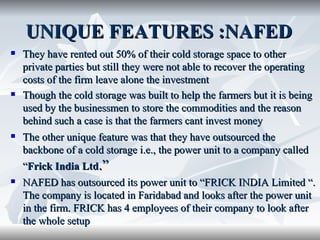
   They have rented out 50% of their cold storage space to other
    private parties but still they were not able to recover the operating
    costs of the firm leave alone the investment
   Though the cold storage was built to help the farmers but it is being
    used by the businessmen to store the commodities and the reason
    behind such a case is that the farmers cant invest money
   The other unique feature was that they have outsourced the
    backbone of a cold storage i.e., the power unit to a company called
    “Frick India Ltd.”
   NAFED has outsourced its power unit to “FRICK INDIA Limited “.
    The company is located in Faridabad and looks after the power unit
    in the firm. FRICK has 4 employees of their company to look after
    the whole setup
COSTS FOR THE COLD
    STORAGE
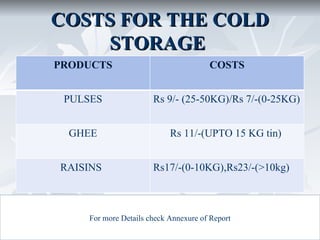
PRODUCTS                              COSTS


 PULSES               Rs 9/- (25-50KG)/Rs 7/-(0-25KG)


  GHEE                     Rs 11/-(UPTO 15 KG tin)


RAISINS               Rs17/-(0-10KG),Rs23/-(>10kg)


    For more Details check Annexure of Report
NAFED BACKEND IN REALITY
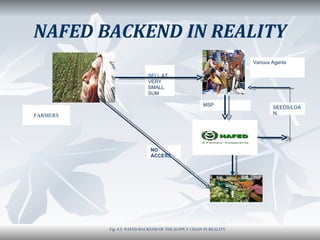
                                                                   Various Agents

                            SELL AT
                            VERY
                            SMALL
                            SUM

                                                     MSP
                                                                           SEEDS/LOA
FARMERS                                                                    N


                             NO
                             ACCESS


          Fig: 4.2: NAFED BACKEND OF THE SUPPLY CHAIN IN REALITY
RECOMMENDATION ON
          BACKEND CHAIN
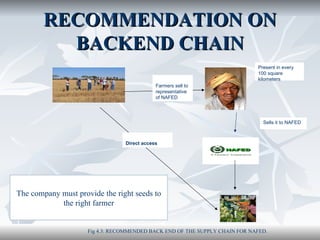
                                                                             Present in every
                                                                             100 square
                                                                             kilometers
                                             Farmers sell to
                                             representative
                                             of NAFED


                                                                               Sells it to NAFED


                                 Direct access


The company must provide the right seeds to
            the right farmer


                     Fig 4.3: RECOMMENDED BACK END OF THE SUPPLY CHAIN FOR NAFED.
FEATURES OF SAFAL
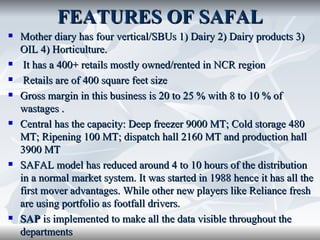
   Mother diary has four vertical/SBUs 1) Dairy 2) Dairy products 3)
    OIL 4) Horticulture.
    It has a 400+ retails mostly owned/rented in NCR region
    Retails are of 400 square feet size
   Gross margin in this business is 20 to 25 % with 8 to 10 % of
    wastages .
   Central has the capacity: Deep freezer 9000 MT; Cold storage 480
    MT; Ripening 100 MT; dispatch hall 2160 MT and production hall
    3900 MT
   SAFAL model has reduced around 4 to 10 hours of the distribution
    in a normal market system. It was started in 1988 hence it has all the
    first mover advantages. While other new players like Reliance fresh
    are using portfolio as footfall drivers.
   SAP is implemented to make all the data visible throughout the
    departments
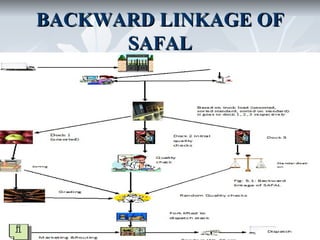
BACKWARD LINKAGE OF
      SAFAL
UNIQUE FACTORS
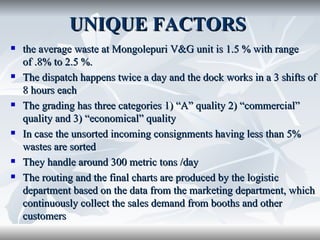
   the average waste at Mongolepuri V&G unit is 1.5 % with range
    of .8% to 2.5 %.
   The dispatch happens twice a day and the dock works in a 3 shifts of
    8 hours each
   The grading has three categories 1) “A” quality 2) “commercial”
    quality and 3) “economical” quality
   In case the unsorted incoming consignments having less than 5%
    wastes are sorted
   They handle around 300 metric tons /day
   The routing and the final charts are produced by the logistic
    department based on the data from the marketing department, which
    continuously collect the sales demand from booths and other
    customers
PROBLEMS IN SAFAL
                 SUPPLY CHAIN
   The procurement is limited to few numbers of large farmers. There is very less
    inclusion of small farmers.
   The untimely demand or sudden demand makes the consignment reach late to the
    CSG plant at Mongolepuri.
   No agriculture input is provided to the farmers.
   Problems in Logistics
   The logistics is not provided on time to the procurement centre sometimes.
   The number of trucks and other vehicles are needed to be increased.
   Many of the trucks in logistics are old and are not in good condition
Problems in Marketing
   The prices of the products are high as compared to local mandis.
   The fruit and vegetables lack freshness and are not in good condition.
   The booth keepers always complain about the supply of bad quality of supply.
RECOMMENDATIONS
   The farmers association should procure more from small
    farmers.
   The fruit and vegetables procured at the farmers association
    must go though primary sorting before procurement.
   The logistics support should be on time.
   The officials from mother dairy should at least do meeting
    with farmers and should share their grievances.
   More and effective promotional campaigns should be done to
    increase customer’s awareness on benefits of Safal products.
   Mother dairy should come up with more innovating concepts
    like home delivery
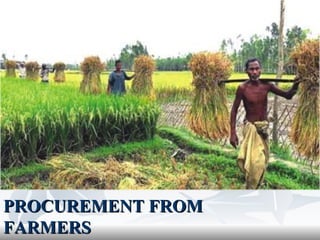
PROCUREMENT FROM
FARMERS
ALWAR
   Farmers grow wheat and onion as major products.
   Illegal mining of stone is a big concern and because of which labour cost is very
    high.
   Rs 500/day is what labourers get in stone cutting and because of which it seriously
    affects the farmers labour cost.
   Farmers are not very well aware of the “Mandi system” and most of them are afraid
    of the Mandi system and feel cheated by the Commission agents
   It happens such that they are unable to recover cost of transportation”
   lack of storage facility is a major factor
   They are aware of the KCC but it is like a passbook and most of them withdraw all
    credit at once
   They are not very keen on the selling price of the vegetables; they ask local vendors
    about the cost and then sell it accordingly.
   SAFAL has the tie up with villagers at Tijara for water melon and farmers there are
    showing interest in this chain.
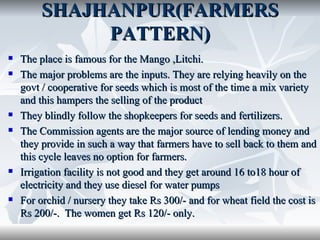
SHAJHANPUR(FARMERS
              PATTERN)
   The place is famous for the Mango ,Litchi.
   The major problems are the inputs. They are relying heavily on the
    govt / cooperative for seeds which is most of the time a mix variety
    and this hampers the selling of the product
   They blindly follow the shopkeepers for seeds and fertilizers.
   The Commission agents are the major source of lending money and
    they provide in such a way that farmers have to sell back to them and
    this cycle leaves no option for farmers.
   Irrigation facility is not good and they get around 16 to18 hour of
    electricity and they use diesel for water pumps
   For orchid / nursery they take Rs 300/- and for wheat field the cost is
    Rs 200/-. The women get Rs 120/- only.
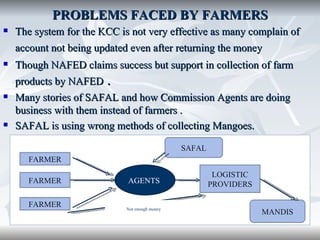
PROBLEMS FACED BY FARMERS
   The system for the KCC is not very effective as many complain of
    account not being updated even after returning the money
   Though NAFED claims success but support in collection of farm
    products by NAFED .
   Many stories of SAFAL and how Commission Agents are doing
    business with them instead of farmers .
   SAFAL is using wrong methods of collecting Mangoes.

                                                SAFAL
       FARMER
                                                         LOGISTIC
       FARMER                AGENTS                     PROVIDERS

       FARMER                Not enough money
                                                                    MANDIS
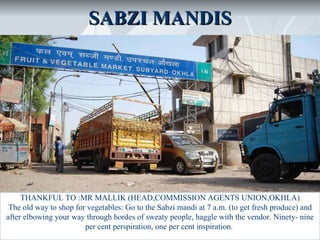
SABZI MANDIS


     THANKFUL TO :MR MALLIK (HEAD,COMMISSION AGENTS UNION,OKHLA)
 The old way to shop for vegetables: Go to the Sabzi mandi at 7 a.m. (to get fresh produce) and
after elbowing your way through hordes of sweaty people, haggle with the vendor. Ninety- nine
                        per cent perspiration, one per cent inspiration.
STAKEHOLDERS
   FARMERS
   COMMISSION AGENTS
   LABOURS
   APMC
   RETAILERS
   LOGISTIC PROVIDERS
   BANKS AND MONEY LENDERS
   AGRICULTURAL SOLUTION PROVIDERS
   CONSUMERS
   GOVERNMENT OF INDIA
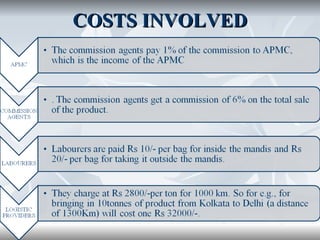
COSTS INVOLVED
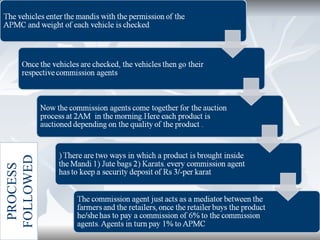
PROCESS
FOLLOWED
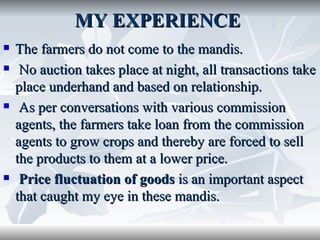
MY EXPERIENCE
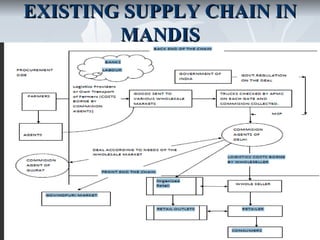
   The farmers do not come to the mandis.
    No auction takes place at night, all transactions take
    place underhand and based on relationship.
    As per conversations with various commission
    agents, the farmers take loan from the commission
    agents to grow crops and thereby are forced to sell
    the products to them at a lower price.
    Price fluctuation of goods is an important aspect
    that caught my eye in these mandis.
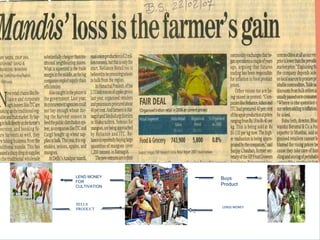
INTERVIEWS WITH
COMMISSION AGENTS
LEND MONEY    Buys
FOR
CULTIVATION   Product


SELLS
              LENDS MONEY
PRODUCT
EXISTING SUPPLY CHAIN IN
        MANDIS
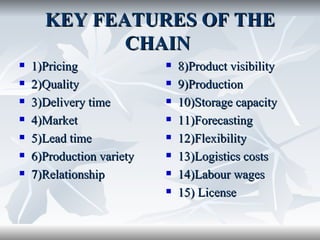
KEY FEATURES OF THE
             CHAIN
   1)Pricing                 8)Product visibility
   2)Quality                 9)Production
   3)Delivery time           10)Storage capacity
   4)Market                  11)Forecasting
   5)Lead time               12)Flexibility
   6)Production variety      13)Logistics costs
   7)Relationship            14)Labour wages
                              15) License
MATRIX BETWEEN THE
STAKEHOLDERS AND KEY
FEATURES OF THE CHAIN
PRICING   PRODUCTION   DELIVERY   FLEXIBILITY   LEAD   PRODUCT   VOLUME     PRODUCT      RELATIONSHIP   QUALITY   STORAGE    FORCASTING   MARKET   LOGISTICS   LABOUR   LISCENCE   NUMBER         IMPORT/EXPOR   PACKAGING
                                                                                                                                                                                                                                    T

                                                         TIME                     TIME   VARIETY   OF         VISIBILITY                            CAPACITY                         COSTS       WAGES               OF
                                                                                                                                                                                                                                    RATE

                                                                                                   PRODUCTS                                                                                                          TRANSACTIONS


FARMERS                           Y         Y            N          N             N      Y         N          N            N              Y         Y          Y            Y        N           Y        N          N              N              Y


COMMISION AGENTS                  Y         Y            Y          Y             Y      Y         Y          N            Y              Y         N          Y            Y        Y           Y        Y          Y              Y              Y


LABOURS                           N         Y            N          N             N      N         N          N            N              N         N          N            Y        N           Y        N          Y              N              N


APMC                              Y         N            N          N             N      N         N          N            N              N         N          Y            Y        N           N        Y          Y              N              Y


WHOLESELLER                       Y         Y            Y          N             N      N         Y          Y            Y              Y         Y          Y            Y        Y           Y        Y          N              N              Y


RETAILERS                         Y         Y            Y          Y             Y      Y         N          Y            Y              Y         Y          Y            Y        Y           Y        Y          N              N              Y


LOGISTIC PROVIDERS                N         Y            Y          N             Y      N         Y          N            Y              N         Y          Y            N        Y           Y        Y          Y              N              Y


GOVERNMENT OF INDIA               Y         Y            N          N             N      N         N          N            N              Y         N          Y            N        N           N        Y          N              Y              Y


BANKS AND MONEY LENDERS           N         N            N          N             N      N         N          N            Y              N         N          N            N        N           N        N          Y              N              N


AGRICULTURAL SOLUTION PROVIDERS   N         Y            N          N             N      Y         N          N            Y              Y         N          Y            N        N           N        N          N              N              Y


CONSUMERS                         Y         Y            N          N             Y      Y         N          N            N              Y         N          N            Y        N           N        N          N              Y              Y
WHICH CHAIN IS THE MOST EFFECTIVE

F&v supply chain

  • 1.
    Fruits and Vegetables(F&V) Supply Chains in Delhi Bodhiswatta Saha 2010SMF6848 Under the Guidance Of Prof. Ravi Shankar
  • 2.
    Objectives Of TheProject  To visit NAFED at Lawrence Road ,Delhi and prepare a case study  To visit SAFAL (Constituent of Mother Diary )at Mongolepuri, Delhi and prepare a case study  To gather details of the procurement side of the F&V supply chain by visiting Tapukada and Tijara districts under Alwar and Shajhanpur ,Meerut city and meet famers and understand their problems.  To understand the traditional supply chain i.e. Sabzi Mandis by visiting various Mandis and prepare a case study . .  To identify the stakeholders and key salient features of the chain and form a matrix.  To use AHP using primary data to see which the chain is which being sought after.  To use ANP to check which cold chain is most sought after
  • 3.
    Outline  Background of the Study  Literature Review: Situation in other Developing Countries  Emerging Models  NAFED  SAFAL  Procurement  Traditional Sabzi Mandis  Use tools like AHP and ANP for reaching a result  Conclusion
  • 4.
    Background of theStudy  The marketing of F&V in India is changing dramatically  Change from the traditional markets to modern formats  Entry of big retail names – Reliance, ITC, Aditya Birla Group, Godrej, Bharti Airtel, Adani Group  Initiation of organized retailing and wholesaling of F&V:  Reliance Fresh, Chopal Fresh, Namdhari’s Fresh  FAO and MoA undertook the current study to understand the ground situation  Emerging models for backward and forward linkages  Issues in setting up the chains
  • 5.
    Literature Review  The perception of retail chains being a phenomena of the developed countries has changed significantly  Significant presence in developing countries – Latin America, Asia, Africa  What does retail chains have to do with development?  Development perspective: farmers involved in modern value chains earn much higher by bypassing the traders  Large and medium farmers have the resources to meet the requirements of the chains, easier to co-ordinate  Development efforts: linking small farmers to these chains
  • 6.
    Emerging Models  Co-operative (HOPCOMS, Karnataka, SAFAL(Mother Diary Ltd.)  Exports with EUREPGAP Certification (Namdhari Fresh, Bharti Airtel)  Farm to Fork -- Complete Chain (Godrej, Reliance, ITC)  Wholesaling – (Adani Fresh, Metro)  Front end – Convenience Stores (Food Bazaar, C3)  Economy Stores (Subhiksha)  NAFED
  • 7.
    THANKFUL TO :MR.S.N.SOLANKI(G.M,NAFED) CONTACT NUMBER:9312632245 & MR KHOSLA (MANAGER,LAWRENCE ROAD COLD STORAGE)
  • 8.
    NAFED(National Agriculture Cooperative Marketing Federation Of India)  To facilitate, coordinate and promote the marketing and trading activities of the cooperative institutions in agricultural and other commodities.  To act as agent of any government agency or cooperative institution i.e., if the minimum support price is not maintained then it that case NAFED picks up goods from farmers at MSP.  To organize consultancy work in various fields for the benefit of the cooperative institutions in general and for its members in particular i.e., for farmers with Kisan cards can get free consulting from experts regarding agricultural needs.  We also found out that they undertake manufacture of agricultural machinery i.e. they sell seeds to farmers in need.  To guarantee loans or advances to farmers.
  • 9.
    UNIQUE FEATURES :NAFED  They have rented out 50% of their cold storage space to other private parties but still they were not able to recover the operating costs of the firm leave alone the investment  Though the cold storage was built to help the farmers but it is being used by the businessmen to store the commodities and the reason behind such a case is that the farmers cant invest money  The other unique feature was that they have outsourced the backbone of a cold storage i.e., the power unit to a company called “Frick India Ltd.”  NAFED has outsourced its power unit to “FRICK INDIA Limited “. The company is located in Faridabad and looks after the power unit in the firm. FRICK has 4 employees of their company to look after the whole setup
  • 10.
    COSTS FOR THECOLD STORAGE PRODUCTS COSTS PULSES Rs 9/- (25-50KG)/Rs 7/-(0-25KG) GHEE Rs 11/-(UPTO 15 KG tin) RAISINS Rs17/-(0-10KG),Rs23/-(>10kg) For more Details check Annexure of Report
  • 11.
    NAFED BACKEND INREALITY Various Agents SELL AT VERY SMALL SUM MSP SEEDS/LOA FARMERS N NO ACCESS Fig: 4.2: NAFED BACKEND OF THE SUPPLY CHAIN IN REALITY
  • 12.
    RECOMMENDATION ON BACKEND CHAIN Present in every 100 square kilometers Farmers sell to representative of NAFED Sells it to NAFED Direct access The company must provide the right seeds to the right farmer Fig 4.3: RECOMMENDED BACK END OF THE SUPPLY CHAIN FOR NAFED.
  • 14.
    FEATURES OF SAFAL  Mother diary has four vertical/SBUs 1) Dairy 2) Dairy products 3) OIL 4) Horticulture.  It has a 400+ retails mostly owned/rented in NCR region  Retails are of 400 square feet size  Gross margin in this business is 20 to 25 % with 8 to 10 % of wastages .  Central has the capacity: Deep freezer 9000 MT; Cold storage 480 MT; Ripening 100 MT; dispatch hall 2160 MT and production hall 3900 MT  SAFAL model has reduced around 4 to 10 hours of the distribution in a normal market system. It was started in 1988 hence it has all the first mover advantages. While other new players like Reliance fresh are using portfolio as footfall drivers.  SAP is implemented to make all the data visible throughout the departments
  • 15.
  • 16.
    UNIQUE FACTORS  the average waste at Mongolepuri V&G unit is 1.5 % with range of .8% to 2.5 %.  The dispatch happens twice a day and the dock works in a 3 shifts of 8 hours each  The grading has three categories 1) “A” quality 2) “commercial” quality and 3) “economical” quality  In case the unsorted incoming consignments having less than 5% wastes are sorted  They handle around 300 metric tons /day  The routing and the final charts are produced by the logistic department based on the data from the marketing department, which continuously collect the sales demand from booths and other customers
  • 17.
    PROBLEMS IN SAFAL SUPPLY CHAIN  The procurement is limited to few numbers of large farmers. There is very less inclusion of small farmers.  The untimely demand or sudden demand makes the consignment reach late to the CSG plant at Mongolepuri.  No agriculture input is provided to the farmers.  Problems in Logistics  The logistics is not provided on time to the procurement centre sometimes.  The number of trucks and other vehicles are needed to be increased.  Many of the trucks in logistics are old and are not in good condition Problems in Marketing  The prices of the products are high as compared to local mandis.  The fruit and vegetables lack freshness and are not in good condition.  The booth keepers always complain about the supply of bad quality of supply.
  • 18.
    RECOMMENDATIONS  The farmers association should procure more from small farmers.  The fruit and vegetables procured at the farmers association must go though primary sorting before procurement.  The logistics support should be on time.  The officials from mother dairy should at least do meeting with farmers and should share their grievances.  More and effective promotional campaigns should be done to increase customer’s awareness on benefits of Safal products.  Mother dairy should come up with more innovating concepts like home delivery
  • 19.
  • 20.
    ALWAR  Farmers grow wheat and onion as major products.  Illegal mining of stone is a big concern and because of which labour cost is very high.  Rs 500/day is what labourers get in stone cutting and because of which it seriously affects the farmers labour cost.  Farmers are not very well aware of the “Mandi system” and most of them are afraid of the Mandi system and feel cheated by the Commission agents  It happens such that they are unable to recover cost of transportation”  lack of storage facility is a major factor  They are aware of the KCC but it is like a passbook and most of them withdraw all credit at once  They are not very keen on the selling price of the vegetables; they ask local vendors about the cost and then sell it accordingly.  SAFAL has the tie up with villagers at Tijara for water melon and farmers there are showing interest in this chain.
  • 21.
    SHAJHANPUR(FARMERS PATTERN)  The place is famous for the Mango ,Litchi.  The major problems are the inputs. They are relying heavily on the govt / cooperative for seeds which is most of the time a mix variety and this hampers the selling of the product  They blindly follow the shopkeepers for seeds and fertilizers.  The Commission agents are the major source of lending money and they provide in such a way that farmers have to sell back to them and this cycle leaves no option for farmers.  Irrigation facility is not good and they get around 16 to18 hour of electricity and they use diesel for water pumps  For orchid / nursery they take Rs 300/- and for wheat field the cost is Rs 200/-. The women get Rs 120/- only.
  • 22.
    PROBLEMS FACED BYFARMERS  The system for the KCC is not very effective as many complain of account not being updated even after returning the money  Though NAFED claims success but support in collection of farm products by NAFED .  Many stories of SAFAL and how Commission Agents are doing business with them instead of farmers .  SAFAL is using wrong methods of collecting Mangoes. SAFAL FARMER LOGISTIC FARMER AGENTS PROVIDERS FARMER Not enough money MANDIS
  • 23.
    SABZI MANDIS THANKFUL TO :MR MALLIK (HEAD,COMMISSION AGENTS UNION,OKHLA) The old way to shop for vegetables: Go to the Sabzi mandi at 7 a.m. (to get fresh produce) and after elbowing your way through hordes of sweaty people, haggle with the vendor. Ninety- nine per cent perspiration, one per cent inspiration.
  • 24.
    STAKEHOLDERS  FARMERS  COMMISSION AGENTS  LABOURS  APMC  RETAILERS  LOGISTIC PROVIDERS  BANKS AND MONEY LENDERS  AGRICULTURAL SOLUTION PROVIDERS  CONSUMERS  GOVERNMENT OF INDIA
  • 25.
  • 26.
  • 27.
    MY EXPERIENCE  The farmers do not come to the mandis.  No auction takes place at night, all transactions take place underhand and based on relationship.  As per conversations with various commission agents, the farmers take loan from the commission agents to grow crops and thereby are forced to sell the products to them at a lower price.  Price fluctuation of goods is an important aspect that caught my eye in these mandis.
  • 28.
  • 29.
    LEND MONEY Buys FOR CULTIVATION Product SELLS LENDS MONEY PRODUCT
  • 30.
  • 31.
    KEY FEATURES OFTHE CHAIN  1)Pricing  8)Product visibility  2)Quality  9)Production  3)Delivery time  10)Storage capacity  4)Market  11)Forecasting  5)Lead time  12)Flexibility  6)Production variety  13)Logistics costs  7)Relationship  14)Labour wages  15) License
  • 32.
    MATRIX BETWEEN THE STAKEHOLDERSAND KEY FEATURES OF THE CHAIN
  • 33.
    PRICING PRODUCTION DELIVERY FLEXIBILITY LEAD PRODUCT VOLUME PRODUCT RELATIONSHIP QUALITY STORAGE FORCASTING MARKET LOGISTICS LABOUR LISCENCE NUMBER IMPORT/EXPOR PACKAGING T TIME TIME VARIETY OF VISIBILITY CAPACITY COSTS WAGES OF RATE PRODUCTS TRANSACTIONS FARMERS Y Y N N N Y N N N Y Y Y Y N Y N N N Y COMMISION AGENTS Y Y Y Y Y Y Y N Y Y N Y Y Y Y Y Y Y Y LABOURS N Y N N N N N N N N N N Y N Y N Y N N APMC Y N N N N N N N N N N Y Y N N Y Y N Y WHOLESELLER Y Y Y N N N Y Y Y Y Y Y Y Y Y Y N N Y RETAILERS Y Y Y Y Y Y N Y Y Y Y Y Y Y Y Y N N Y LOGISTIC PROVIDERS N Y Y N Y N Y N Y N Y Y N Y Y Y Y N Y GOVERNMENT OF INDIA Y Y N N N N N N N Y N Y N N N Y N Y Y BANKS AND MONEY LENDERS N N N N N N N N Y N N N N N N N Y N N AGRICULTURAL SOLUTION PROVIDERS N Y N N N Y N N Y Y N Y N N N N N N Y CONSUMERS Y Y N N Y Y N N N Y N N Y N N N N Y Y
  • 34.
    WHICH CHAIN ISTHE MOST EFFECTIVE

Editor's Notes

  • #34 Based on surveys with various commission agents, labourers, APMC employees, logistic providers