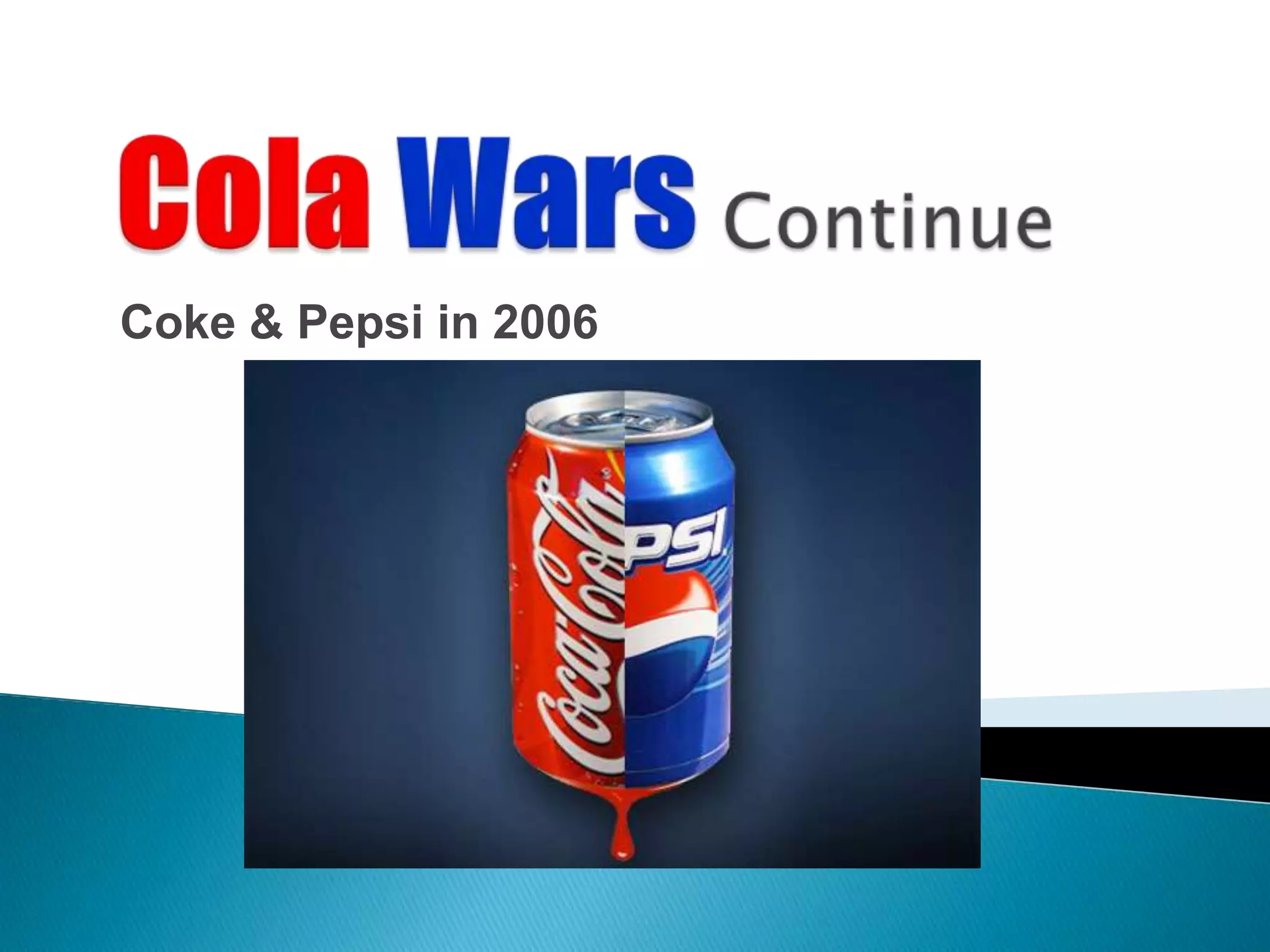
Coke & Pepsi in 2006
   Abhishek Rahman
   Md. Estanul Kabir
   C. M. Sadat Ullah
   Abdullah Al Jubayer
   Amitabh Roy
•   Coca-Cola was formulated in 1886 by
    pharmacist John Pemperton who sold
    the product at drug stores as “potion for
    mental and physical disorders.”
•   In 1891, Asa Candler acquired the
    formula, established a sales force and
    began brand advertising of Coca-Cola.
•   In 1919, went public under control of
    Robert Woodruff expanded and
    developed in national and international
    markets
•   Successful during WWII with the high
    CSD consumption from the U.S soldiers
•   Pepsi was created in 1893 in North
    Carolina by Pharmacist Caleb Bradham.
•   By 1910 Pepsi had built a network of
    270 bottlers.
•   Pepsi struggled and declared
    bankruptcy twice
•   During Great Depression grew in
    popularity due to price decrease to a
    nickel.
•   In 1938, Coke sued Pepsi-Cola brand
    for infringement on Coca-Cola’s
    trademark.
   So called cold wars were fought over $66 billion in
    *CSD industry in the USA
   Both achieved average annual growth of 10%
    within1975 ~ Mid 90’s
    ◦ Continues growth in the USA and worldwide
   However, the war started more then a centaury ago


   At the late 90’s
    ◦ US per capita went down slightly
    ◦ Their relationship began fray
    ◦ Avg consumption of 52 gallons by the US people

                          *CSD: Carbonated Soft Drinks
   At the late 90’s
    ◦ Both experienced ups and downs on
      Coke started facing operational difficulties
      Pepsi became more aggressive and launched new
       alternatives
    ◦ & both started working on
      Developing Brand Strategies
      Pricing &
      Bottling
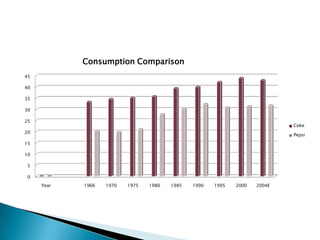
   Consumption grew by an avg. of 3% annually
   In 1970, avg. consumption was 23 gallons
   Went up because of
    ◦ Availability of CSD
    ◦ Introduction of diet &
    ◦ Flavored items

   Alternatives & status of CSD
    ◦ Beer, Milk, Coffee, Bottled water, juices, tea, powdered drinks,
      wine, sports drinks, distilled spirits & tap water
    ◦ Yet, Americans drank soda than any other beverage
    ◦ Cola maintained its dominance although its market share
    ◦ Dropped from 71% in 1990 to 60% in 2004
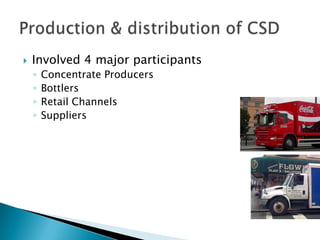
   Involved 4 major participants
    ◦   Concentrate Producers
    ◦   Bottlers
    ◦   Retail Channels
    ◦   Suppliers
   Concentrate Producers

    ◦ Blend raw material ingredients
    ◦ Packaged the mixture in plastic canisters &
    ◦ Shipped the containers to the bottlers

   Concentrate makers often added artificial
    sweetener with regular CSDs
   Bottlers added sugar or high fructose corn syrup
    themselves
   Concentrate manufacturing
    ◦ Involves capital investment in Machinery & overhead
    ◦ Cost about $ 25 million to $50 million
       Good enough to serve the entire United States

   Most significant cost involves
    ◦ Advertising, Promotion, Market Research and bottler support
    ◦ Innovative & sophisticated campaigns
    ◦ Spend on joint marketing programs with bottlers

   Also look after
    ◦ Customer development agreement
    ◦ Supporting the bottlers in Sales efforts, setting standards &
      suggesting operational improvements
    ◦ Negotiate with the bottlers’ supplier for reliable supply, fast
      delivery and lower price
       Sweetener & packaging makers
   Coca cola and Pepsi Cola combined 74.8% of
    the US CSD market sales volume in 2004
    followed by Cadbury and Cott Corporation
   Bottlers
    ◦ Purchased concentrate, add Carbonated water and
      high fructose corn syrup ( in bottled or canned)
    ◦ Deliver to the customer accounts
    ◦ Responsible for
        Direct Store Door
        Secure shelf space
        Staking CSD products
        Positioning the brands trademark label
        Setting POS & ensure in store displays
   Bottlers process was capital intensive
    ◦ High speed production line
    ◦ Cost $4 million to $10 million each
      Invest in trucks and distribution network
    ◦ Cost allocation
        Packaging involved 40% cost
        Cost of sales 45%
        Sweeteners 5 to 10%
        Concentrate 5%
    ◦ Gross profit routinely exceeded 40%
    ◦ Operating margin within 7% to 9%
   Retail Channel
    ◦ Pepsi had focused on sales through retail outlets
    ◦ Coke had dominated fountain sales
      Restaurants, Cafeterias and other outlets using
       fountain type dispensers
    ◦ At the 80’s
      Pepsi entered into the restaurants by acquiring Pizza
       Hut, Taco Bell, KFC
      Coca Cola took the same route targeting the
       competitors - Burger King, Wendy’s &
       Burger, McDonadls, Subway
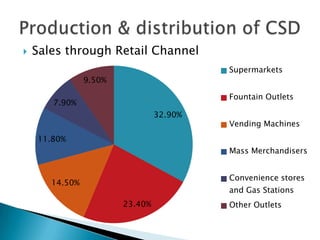
   Sales through Retail Channel
                                          Supermarkets
                9.50%

                                          Fountain Outlets
       7.90%
                                 32.90%
                                          Vending Machines
    11.80%
                                          Mass Merchandisers


                                          Convenience stores
       14.50%
                                          and Gas Stations
                        23.40%            Other Outlets
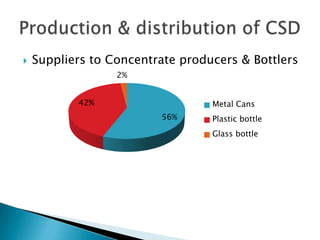
   Suppliers to Concentrate producers & Bottlers
                  2%


           42%                    Metal Cans
                         56%      Plastic bottle
                                  Glass bottle
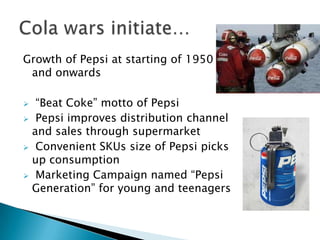
Growth of Pepsi at starting of 1950
 and onwards

 “Beat Coke” motto of Pepsi
 Pepsi improves distribution channel
 and sales through supermarket
 Convenient SKUs size of Pepsi picks
 up consumption
 Marketing Campaign named “Pepsi
 Generation” for young and teenagers
 Pepsi sells concentrate to its bottlers @ 20%
  lower cost of Coke
 Pepsi take initiatives to modernize the
  Bottlers plant and store delivery service
 Coke remain unchanged with 800
  independent bottlers
 After modernizing the bottlers of
  Pepsi, increase the rate of concentrate equal
  to coke rate by promising to take part in
  advertising and marketing campaign
 Coke experiment with new cola and non cola
 flavors, that includes
 Coke
 - Fanta in 1960
 - Sprite in (1961)
 - Tab in 1963, low calorie cola
 Pepsi
 - Teem in 1960
 - Mountain Dew in 1964
 - Diet Pepsi in 1964
 Both introduced nonrefundable bottle and
 convenient bottle size
   Coke purchased
    - Minute Maid : fruit juice
    - Duncan Foods: Coffee, Tea, chocolate etc

   Pepsi merged with
    - Frito-Lay: snack food to form PepsiCo

   Bothe diversify their business to reach same
    target customer, use delivery system and same
    marketing orientation

   Coke take initiatives to expand in overseas
    market and become aggressive in late 1970
Consumption Comparison
45

40

35

30

25
                                                                            Coke
20
                                                                            Pepsi
15

10

 5

 0
     Year   1966   1970   1975   1980   1985   1990   1995   2000   2004E
   Coke advertising message
    ◦ “American’s preferred Taste” in 1955 and
    ◦ “No Wonder Coke refreshes Best” in 1960

    Pepsi’s Market Survey and demonstration
    that Consumer Preferred Pepsi to Coke

   Coke Counter part- discounting on price

   Pepsi passed Coke in food store sales for first
    time in 1979
   Coke switched from using sugar to high-
    fructose corn syrup, lower price
    concentration

   Doubling advertising cost in 1981 to 1984 by
    Coke and Pepsi.

   in 1982
    ◦ Coke sold off Non-CSD business and introduced
      Diet Coke
    ◦ became most successful beverage in Eighties
   In between 1983 to 1987
    ◦ Coke again introduced 11 new products and
    ◦ Pepsi introduced 13

Coke- Caffeine free coke, Cherry Coke etc

Pepsi- Lemon lime slice, caffeine free Pepsi cola

   Both introduced new packaging, bottle size and shape.
    Discounting from both parties grew the customer

   Cadbury Schweppes become third largest concentrate
    producer and became threat to the two giants
   Both Coke and Pepsi is busy to manage Bottlers

   Coke started to buy poorly managed Bottlers and
    sell those to better performing bottlers

   Coke bought two big bottlers in 1985 and owned
    one third coke’s volume in company owned
    operations and created Coca-Cola Enterprise
    (CCE)

   Pepsi acquired few bottlers and open subsidiary
    by name of Pepsi Bottling Group.
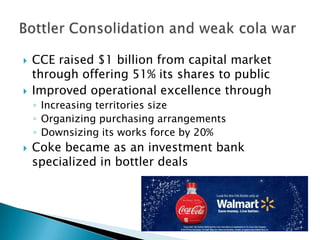
   CCE raised $1 billion from capital market
    through offering 51% its shares to public
   Improved operational excellence through
    ◦ Increasing territories size
    ◦ Organizing purchasing arrangements
    ◦ Downsizing its works force by 20%
   Coke became as an investment bank
    specialized in bottler deals
   New challenges faced by the CSD Industry
    from 90’s onwards
    ◦ Core product demand was leveling down
    ◦ Sales volume grew at a meager rate of 1% or less
      between 1998 to 2004 in contrast to 3% to 7%
      during the 1980’s and early 1990’s
    ◦ Global CSD demand remained flat increasing only
      0.26 billion during 1999 and 2003
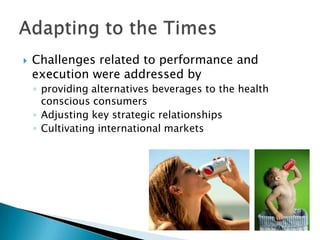
   Challenges related to performance and
    execution were addressed by
    ◦ providing alternatives beverages to the health
      conscious consumers
    ◦ Adjusting key strategic relationships
    ◦ Cultivating international markets
Coke                               Pepsi
                                   • “Grow the core and add
 Unsuccessful
                                     some more” – Pepsi CEO
  execution of several                – Diversified portfolio of
  initiatives                           Products
    ◦ Failed joint ventures with         – Launch of new CSDs
                                            like Sierra Mist and
      P&G and Quaker Oats                   Mountain Dew and
      (the latter was later                 expanding into other
      purchased by PEPSI)                   beverage categories
                                            like Getorade
   Disagreement among                – Volume growth by 3% in
    internal top                        2004
    management and                 • Proactive to consumer
    radical shifts in                demand
                                         – Pepsi distributed its
    company policies                       focus to DIET PEPSI to
    ◦                                      cater the increasing
                                           popularity of
                                           alternative beverages
   Share of total CSD volume grew from
    24.6% to 29.1% during 1997 to 2004
    ◦ Primarily due to the gaining popularity of the
      diet/alternative beverages
    ◦ New products such as Coca-Cola Zero, Pepsi
      One and Sierra Mist Free became popular among
      young fitness conscious individuals especially
      men

   In 2004 the US market experienced:
    ◦ 1% growth in CSD volume
    ◦ 7.6% growth in Non-Carb volume
    ◦ 18.8% leap in single-serve bottled-water volume
• In 2004, Non-carb/alternative drinks grew at twice the rate of
  other food and beverage items


   Pepsi was more aggressive than Coke in adapting
    to this shift in trend
    ◦ Pepsi developed a portfolio of Non-CSD products that
      outsold Cokes’s rival product in each category
      Getorade (Pepsi) led PowerAde (Coke) by 80.4% to 18.1%
      Tropicana (Pepsi) lead Minute Maid (Coke) by 26.8% to 14.8%
    ◦ In the overall non-carb market Pepsi had a market share of
      47.3% with Coke’s share of 27%
   After losing out on market share in the CSD
    category both Coke and Pepsi fared back in
    the $11.4 billion bottled water category
   Primarily it was their distribution prowess
    that gave them a competitive advantage over
    the other companies selling Spring water.
   By 2004:
    ◦ Aquafina (Pepsico) led the market share with 13.6%
      over Dasani (Coke) holding 12.1%
    ◦ The market leader was however Nestle waters with
      42.1% market share
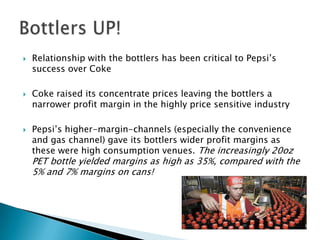
   Relationship with the bottlers has been critical to Pepsi’s
    success over Coke

   Coke raised its concentrate prices leaving the bottlers a
    narrower profit margin in the highly price sensitive industry

   Pepsi’s higher-margin-channels (especially the convenience
    and gas channel) gave its bottlers wider profit margins as
    these were high consumption venues. The increasingly 20oz
    PET bottle yielded margins as high as 35%, compared with the
    5% and 7% margins on cans!
Cola wars continue final

Cola wars continue final

  • 1.
    Coke & Pepsiin 2006
  • 2.
    Abhishek Rahman  Md. Estanul Kabir  C. M. Sadat Ullah  Abdullah Al Jubayer  Amitabh Roy
  • 3.
    Coca-Cola was formulated in 1886 by pharmacist John Pemperton who sold the product at drug stores as “potion for mental and physical disorders.” • In 1891, Asa Candler acquired the formula, established a sales force and began brand advertising of Coca-Cola. • In 1919, went public under control of Robert Woodruff expanded and developed in national and international markets • Successful during WWII with the high CSD consumption from the U.S soldiers
  • 4.
    Pepsi was created in 1893 in North Carolina by Pharmacist Caleb Bradham. • By 1910 Pepsi had built a network of 270 bottlers. • Pepsi struggled and declared bankruptcy twice • During Great Depression grew in popularity due to price decrease to a nickel. • In 1938, Coke sued Pepsi-Cola brand for infringement on Coca-Cola’s trademark.
  • 5.
    So called cold wars were fought over $66 billion in *CSD industry in the USA  Both achieved average annual growth of 10% within1975 ~ Mid 90’s ◦ Continues growth in the USA and worldwide  However, the war started more then a centaury ago  At the late 90’s ◦ US per capita went down slightly ◦ Their relationship began fray ◦ Avg consumption of 52 gallons by the US people *CSD: Carbonated Soft Drinks
  • 6.
    At the late 90’s ◦ Both experienced ups and downs on  Coke started facing operational difficulties  Pepsi became more aggressive and launched new alternatives ◦ & both started working on  Developing Brand Strategies  Pricing &  Bottling
  • 7.
    Consumption grew by an avg. of 3% annually  In 1970, avg. consumption was 23 gallons  Went up because of ◦ Availability of CSD ◦ Introduction of diet & ◦ Flavored items  Alternatives & status of CSD ◦ Beer, Milk, Coffee, Bottled water, juices, tea, powdered drinks, wine, sports drinks, distilled spirits & tap water ◦ Yet, Americans drank soda than any other beverage ◦ Cola maintained its dominance although its market share ◦ Dropped from 71% in 1990 to 60% in 2004
  • 8.
    Involved 4 major participants ◦ Concentrate Producers ◦ Bottlers ◦ Retail Channels ◦ Suppliers
  • 9.
    Concentrate Producers ◦ Blend raw material ingredients ◦ Packaged the mixture in plastic canisters & ◦ Shipped the containers to the bottlers  Concentrate makers often added artificial sweetener with regular CSDs  Bottlers added sugar or high fructose corn syrup themselves
  • 10.
    Concentrate manufacturing ◦ Involves capital investment in Machinery & overhead ◦ Cost about $ 25 million to $50 million  Good enough to serve the entire United States  Most significant cost involves ◦ Advertising, Promotion, Market Research and bottler support ◦ Innovative & sophisticated campaigns ◦ Spend on joint marketing programs with bottlers  Also look after ◦ Customer development agreement ◦ Supporting the bottlers in Sales efforts, setting standards & suggesting operational improvements ◦ Negotiate with the bottlers’ supplier for reliable supply, fast delivery and lower price  Sweetener & packaging makers
  • 11.
    Coca cola and Pepsi Cola combined 74.8% of the US CSD market sales volume in 2004 followed by Cadbury and Cott Corporation
  • 12.
    Bottlers ◦ Purchased concentrate, add Carbonated water and high fructose corn syrup ( in bottled or canned) ◦ Deliver to the customer accounts ◦ Responsible for  Direct Store Door  Secure shelf space  Staking CSD products  Positioning the brands trademark label  Setting POS & ensure in store displays
  • 13.
    Bottlers process was capital intensive ◦ High speed production line ◦ Cost $4 million to $10 million each  Invest in trucks and distribution network ◦ Cost allocation  Packaging involved 40% cost  Cost of sales 45%  Sweeteners 5 to 10%  Concentrate 5% ◦ Gross profit routinely exceeded 40% ◦ Operating margin within 7% to 9%
  • 14.
    Retail Channel ◦ Pepsi had focused on sales through retail outlets ◦ Coke had dominated fountain sales  Restaurants, Cafeterias and other outlets using fountain type dispensers ◦ At the 80’s  Pepsi entered into the restaurants by acquiring Pizza Hut, Taco Bell, KFC  Coca Cola took the same route targeting the competitors - Burger King, Wendy’s & Burger, McDonadls, Subway
  • 15.
    Sales through Retail Channel Supermarkets 9.50% Fountain Outlets 7.90% 32.90% Vending Machines 11.80% Mass Merchandisers Convenience stores 14.50% and Gas Stations 23.40% Other Outlets
  • 16.
    Suppliers to Concentrate producers & Bottlers 2% 42% Metal Cans 56% Plastic bottle Glass bottle
  • 17.
    Growth of Pepsiat starting of 1950 and onwards  “Beat Coke” motto of Pepsi  Pepsi improves distribution channel and sales through supermarket  Convenient SKUs size of Pepsi picks up consumption  Marketing Campaign named “Pepsi Generation” for young and teenagers
  • 18.
     Pepsi sellsconcentrate to its bottlers @ 20% lower cost of Coke  Pepsi take initiatives to modernize the Bottlers plant and store delivery service  Coke remain unchanged with 800 independent bottlers  After modernizing the bottlers of Pepsi, increase the rate of concentrate equal to coke rate by promising to take part in advertising and marketing campaign
  • 19.
     Coke experimentwith new cola and non cola flavors, that includes Coke - Fanta in 1960 - Sprite in (1961) - Tab in 1963, low calorie cola Pepsi - Teem in 1960 - Mountain Dew in 1964 - Diet Pepsi in 1964  Both introduced nonrefundable bottle and convenient bottle size
  • 20.
    Coke purchased - Minute Maid : fruit juice - Duncan Foods: Coffee, Tea, chocolate etc  Pepsi merged with - Frito-Lay: snack food to form PepsiCo  Bothe diversify their business to reach same target customer, use delivery system and same marketing orientation  Coke take initiatives to expand in overseas market and become aggressive in late 1970
  • 21.
    Consumption Comparison 45 40 35 30 25 Coke 20 Pepsi 15 10 5 0 Year 1966 1970 1975 1980 1985 1990 1995 2000 2004E
  • 22.
    Coke advertising message ◦ “American’s preferred Taste” in 1955 and ◦ “No Wonder Coke refreshes Best” in 1960  Pepsi’s Market Survey and demonstration that Consumer Preferred Pepsi to Coke  Coke Counter part- discounting on price  Pepsi passed Coke in food store sales for first time in 1979
  • 23.
    Coke switched from using sugar to high- fructose corn syrup, lower price concentration  Doubling advertising cost in 1981 to 1984 by Coke and Pepsi.  in 1982 ◦ Coke sold off Non-CSD business and introduced Diet Coke ◦ became most successful beverage in Eighties
  • 24.
    In between 1983 to 1987 ◦ Coke again introduced 11 new products and ◦ Pepsi introduced 13 Coke- Caffeine free coke, Cherry Coke etc Pepsi- Lemon lime slice, caffeine free Pepsi cola  Both introduced new packaging, bottle size and shape. Discounting from both parties grew the customer  Cadbury Schweppes become third largest concentrate producer and became threat to the two giants
  • 25.
    Both Coke and Pepsi is busy to manage Bottlers  Coke started to buy poorly managed Bottlers and sell those to better performing bottlers  Coke bought two big bottlers in 1985 and owned one third coke’s volume in company owned operations and created Coca-Cola Enterprise (CCE)  Pepsi acquired few bottlers and open subsidiary by name of Pepsi Bottling Group.
  • 26.
    CCE raised $1 billion from capital market through offering 51% its shares to public  Improved operational excellence through ◦ Increasing territories size ◦ Organizing purchasing arrangements ◦ Downsizing its works force by 20%  Coke became as an investment bank specialized in bottler deals
  • 27.
    New challenges faced by the CSD Industry from 90’s onwards ◦ Core product demand was leveling down ◦ Sales volume grew at a meager rate of 1% or less between 1998 to 2004 in contrast to 3% to 7% during the 1980’s and early 1990’s ◦ Global CSD demand remained flat increasing only 0.26 billion during 1999 and 2003
  • 28.
    Challenges related to performance and execution were addressed by ◦ providing alternatives beverages to the health conscious consumers ◦ Adjusting key strategic relationships ◦ Cultivating international markets
  • 29.
    Coke Pepsi • “Grow the core and add  Unsuccessful some more” – Pepsi CEO execution of several – Diversified portfolio of initiatives Products ◦ Failed joint ventures with – Launch of new CSDs like Sierra Mist and P&G and Quaker Oats Mountain Dew and (the latter was later expanding into other purchased by PEPSI) beverage categories like Getorade  Disagreement among – Volume growth by 3% in internal top 2004 management and • Proactive to consumer radical shifts in demand – Pepsi distributed its company policies focus to DIET PEPSI to ◦ cater the increasing popularity of alternative beverages
  • 30.
    Share of total CSD volume grew from 24.6% to 29.1% during 1997 to 2004 ◦ Primarily due to the gaining popularity of the diet/alternative beverages ◦ New products such as Coca-Cola Zero, Pepsi One and Sierra Mist Free became popular among young fitness conscious individuals especially men  In 2004 the US market experienced: ◦ 1% growth in CSD volume ◦ 7.6% growth in Non-Carb volume ◦ 18.8% leap in single-serve bottled-water volume
  • 31.
    • In 2004,Non-carb/alternative drinks grew at twice the rate of other food and beverage items  Pepsi was more aggressive than Coke in adapting to this shift in trend ◦ Pepsi developed a portfolio of Non-CSD products that outsold Cokes’s rival product in each category  Getorade (Pepsi) led PowerAde (Coke) by 80.4% to 18.1%  Tropicana (Pepsi) lead Minute Maid (Coke) by 26.8% to 14.8% ◦ In the overall non-carb market Pepsi had a market share of 47.3% with Coke’s share of 27%
  • 32.
    After losing out on market share in the CSD category both Coke and Pepsi fared back in the $11.4 billion bottled water category  Primarily it was their distribution prowess that gave them a competitive advantage over the other companies selling Spring water.  By 2004: ◦ Aquafina (Pepsico) led the market share with 13.6% over Dasani (Coke) holding 12.1% ◦ The market leader was however Nestle waters with 42.1% market share
  • 33.
    Relationship with the bottlers has been critical to Pepsi’s success over Coke  Coke raised its concentrate prices leaving the bottlers a narrower profit margin in the highly price sensitive industry  Pepsi’s higher-margin-channels (especially the convenience and gas channel) gave its bottlers wider profit margins as these were high consumption venues. The increasingly 20oz PET bottle yielded margins as high as 35%, compared with the 5% and 7% margins on cans!