
DISSERTATION IMC- ANALYSIS OF COCA COLA COMPANY
Page | 1
INTEGRATED MARKETING COMMUNICATION (IMC)
ANALYSIS OF
“COCA COLA COMPANY”
(Study of Promotional Activity by the Company)
Research Conducted By
Deepen Upadhyaya
Batch – 6, Roll no – 15
Specialization – Advertising, Public Relations
& Corporate Communication
National Institute of Mass Communication & Journalism
Researcher’s Note:-
This Paper was prepared under the project of Integrated Marketing
communication research for National Institute of Mass Communication as
final year academic project. The research was analytical and based on
investigating Primary & Secondary data of Coca Cola Company.
IMC OF COCA COLA
Page | 2
CERTIFICATE
This is to certify that Mr. Deepen P. Upadhyaya has successfully
completed the project work titled ‘Integrated Marketing
Communication (IMC) Analysis Of “Coca Cola Company”’ in
partial fulfillment of requirement for the award of ‘Post Graduation
Diploma in Mass Communication and Journalism’ as prescribed by
the ‘National Institute of Mass Communication and Journalism,
Ahmedabad’.
This project is the record of authentic work carried out by above students
as part of college curriculum of Semester –IV; Group – C – Advertising,
Public Relations and Corporate Communication as Specialization; during
the academic year (2014 – 2015).
Signature of Research Guide
Mr. Venketesh Iyar
(Indian Express - Ahmedabad)
IMC OF COCA COLA
Page | 3
DECLARATION
I the undersigned hereby, declare that the project work titled ‘Integrated
Marketing Communication (IMC) analysis of ‚Coca Cola Company’ is a
result of my research work. Keeping in mind the commonality of the
subject where there already are similar project and research papers. I have
tried my best to include information, stats, data, photographs which are
scouted by me and latest. Thus except few common point which are
unavoidable I have given best justice to make this project original work
and thus this work has not been previously submitted to any other
University or Institute.
I hereby, further declare that all information of this document has been
obtained and presented in accordance with academic rules and ethical
conduct.
Deepen P. Upadhyaya
Roll No 15, Section – B,
Sem – IV, Batch -6,
Group C – AD, PR and Corporate Communication
National Institute of Mass Communication and Journalism
Ahmedabad
IMC OF COCA COLA
Page | 4
IMC OF COCA COLA
Page | 5
ABSTRACT
This paper explores the concept of integrating Marketing Communications tools
by Coca Cola Company as a customer focused means of promoting & branding
its businesses. The Marketing communication tools considered includes
advertising, sales promotion, public relations, direct marketing and
internet/interactive communications.
Earlier, most companies concentrated generally on advertising to communicate
to their target customers and seldom used the other communication tools. Some
companies used other communication tools but on separate basis which is in
contrast to the concept of Integrated Marketing Communication (IMC). This is
the hypothesis on which this paper studies how modern firm like Coca Cola use
comprehensive integration of marketing communications tools which enhances
success through synergistic execution of their marketing communication
programs. Available literature indicates that an effective IMC program ensures a
successful marketing of a company’s product/service and improves on their
brand image as well as corporate image. This again focuses on finding out
whether this could be proven practically
While numerous studies have been conducted to measure the effectiveness of
individual IMC elements, far less attention has been given to examining the
boosting effects of multiple marketing communication tools working together,
despite the fact that consumers are likely to receive information from a variety of
sources. Indeed, one of the fundamental ideas behind IMC is that all of a
company’s marketing and promotional activities should project a consistent and
unified message and image to the consumer.
IMC OF COCA COLA
Page | 6
PREFACE
The project is a part of training in the 4rd semester as a part of Final Project
Submission for Group – C ‚Advertising, Public Relations & Corporate
Communication‛. I as a student of this group am presenting my research paper
which I have researched, prepared during my academics sessions in 4th Semester
of Mass Communication and Journalism. It was a learning experience and I am
happy to share my findings and conclusion to the institute.
The primary aim of this project is to explore the use of marketing
communication to build and sustain brands, based on knowledge of how
communication works, the institutions which participate in the process, and the
practical business processes necessary to achieve and measure defined
communication goals. In particular, I will be able to understand the integrated
nature of communication and develop a full appreciation of advertising, sales
promotion, public relations, publicity and direct marketing in a digital and
contemporary environment.
Best efforts in preparing this project as finest as possible within a time
limit. Greatest efforts are put to understand the needs and problems of the
subject of my research. I hope that the concerned authority will kindly accept
this project.
IMC OF COCA COLA
Page | 7
ACKNOWLEDGEMENT
I wish to take this opportunity to express my sincere gratitude towards all
who has helped us profoundly throughout the project work…
I want to say special thanks to
Prof. Shashikant Bhagat (Group ‚C‛ Head)
Mr. Vanketesh Iyar (Project - Mentor) from Indian Express
Dr. Shrish Kashikar, (Director NIMCJ)
I am thankful to Ms. Sigma Soni for her constant support in my academic work and all
other faculty members for their very useful guidance.
I am very grateful to …
Mr. Urvish Kanthariya –
Gujarat Chamber of Commerce &
Global Indian Business Council Services LLP
Mr. Kedar Vashi –
Associate Vice President & Head (Learning & Development) –
Hindustan Coca Cola Beverages Pvt. Ltd - Gurgaon
For supporting me in my project research and giving his valuable contribution in
making this project the best possible.
I convey our thanks to National Institute of Mass Communication &
Journalism, Ahmedabad for providing the required training and guidance to
accomplish the desired output and learn from the experience of this research
paper.
Thank you…
Yours Faithfully,
Deepen Upadhyay
IMC OF COCA COLA
Page | 8
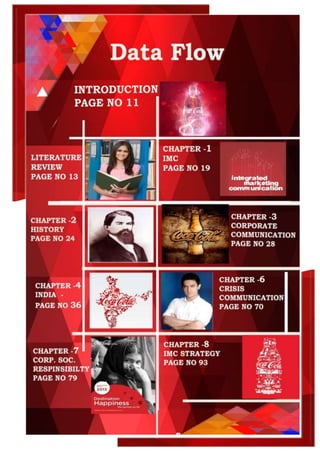
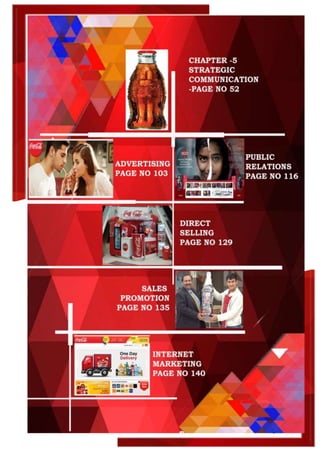
Sr. No Index of the Content Page Number
1 Title page 1
2 Certificate 2
3 Declaration 3
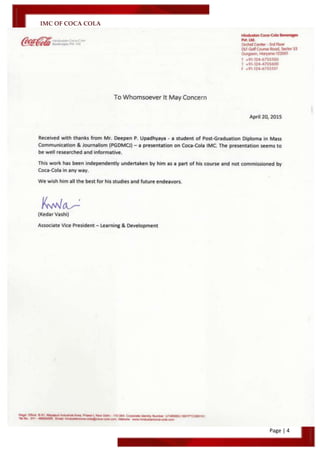
4 Certificate from Hindustan Coca Cola Beverages 4
5 Abstract 5
6 Preface 6
7 Acknowledgement 7
8 Index 8
9 Data Flow 9
10 Executive Summary 11
11 Introduction 12
12 Literature Review 14
13 Chapter -1-IMC 20
14 Chapter -2-History 25
15 Chapter -3-Corporate Communication 29
16 Chapter -4-India 37
17 Chapter -5-Strategic Communication 53
18 Chapter -6-Crisis Communication 71
19 Chapter -7- Corp. Soc. Responsibility 80
20 Chapter -8-IMC Strategy 94
21 Advertising 104
22 Public Relations 117
23 Direct Selling 130
24 Sales Promotion 136
25 Internet Marketing 141
26 Personal Selling 150
27 Conclusion 151
28 Recommendation 152
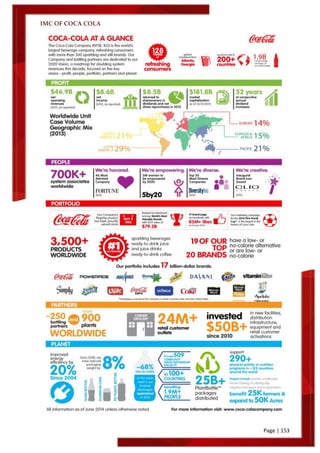
29 Coca Cola at a Glance 153
30 Bibliography 154
IMC OF COCA COLA
Page | 9
IMC OF COCA COLA
Page | 10
IMC OF COCA COLA
Page | 11
EXECUTIVE SUMMARY
I as a student of ‚Mass Communication‛ have tried to understand the Integrated
Marketing Communication and Cross Cultural Communication by Coca Cola
Company in order to establish itself as an integral brand recognized in Indian
market.
Any Organization true to its brand image carries a set of mission, vision and
values to set in minds of people. Integrated Marketing Communication is not
just related to external publics but also to internal publics related to the
corporation. Integration itself means not just passing on message as
communication, rather using all mass medium speaking the same ideology,
message and image through various media forms.
This research paper consist of understand various aspects of IMC process by
Coca Cola Company such as Advertising, Sales Promotion, Direct Selling, Online
presence etc. The type of media mix it used and what type of positioning it made
for its brand, along with the change in the market.
There are graphical as well theoretical examples to add to the validity of this
research along with help from experts, representatives of IMC or Coca Cola
Company in order to makes the research work more authentic by me.
IMC OF COCA COLA
Page | 12
IMC OF COCA COLA
Page | 13
INTRODUCTION
The creation of an Integrated Marketing Communications (IMC) program helps
companies to create single, consistent and unified customer focused messages
using electronic, print and outdoor media. An effective and efficient execution of
an IMC program ensures that the needed awareness of company’s offerings is
created. It has been argued that IMC is the foundation of new customer-focused
marketing efforts for acquiring, retaining, and growing relationships with
customers and other stakeholders (Duncan and Moriarty, 1998).
(Moriarty et al, 1994) indicate that the shift toward the IMC perspective has been
hailed as one of the most significant changes in the history of advertising and
promotion. (Kitchen et al, 2004) also add that it is the major communications
development of the last decade of the 20th century.
This research tries to discover the approach of Coca Cola Company using Media
Mix for its communication to Indian audience. This is done through an analysis
of various market studies work by Kotler, Keller and Wind. Further, it is
necessary to integrate and target marketing communication even more than the
holistic pattern requires and integrate the need to create relationships in the
process in which media channels are selected. This is done by integrating
branding theory and brand value as the core of any campaign.
To test the validity of the above ideas, a case study of one of the market leaders
of relations and emotional marketing ‚Coca-Cola‛ is carried out. Coca-Cola's
history and marketing techniques examined, and it made framework is tested by
being used as the main analytical tool in the analysis of one of Coca-Cola's latest
global campaigns.
IMC OF COCA COLA
Page | 14
IMC OF COCA COLA
Page | 15
REVIEW OF LITERATURE
A Research review is a part of a research project. It usually opens the research report,
but its function is beyond just summarizing and analyzing he literature; it is meant to
indicate that there exists a research gap which needs to be filled. This is necessary to
show that our research is looking at a problem that is either new or existing without
being noticed. Selecting appropriate method is also very important in order to conduct
and write a research
On Coca Cola
‘If Coca-Cola were to lose all of its production-related assets in a disaster, the company
would survive. By contrast, if all consumers were to have a sudden lapse of memory
and forget everything related to Coca-Cola, the company would go out of business.’
(Power of Branding, Keller, Page 38, 2002)
Each promotional tool has its own characteristics. Marketers must understand these
characteristics in selecting their tools. Using Coca-Cola as an example, demonstrate
how each of the promotional tools might be used to create an integrated marketing
communications approach for the upcoming year. (Philips Kotler - Integrated
Marketing Strategies, 2002 edition)
Notable Quotes on IMC
‚Once upon a time, when a manufacturer had a dollar for marketing, it was spent on
advertising. Today, there are a lot of interesting things that can be done with a
marketing dollar. All of these things add up to one big thing called ‘Integrated
marketing communications’ – ‘MarCom’ for short.
‚Five forms of marketing communications *are+: Advertising, Public Relations, Direct
Response, Sales Promotion, Personal Selling.‛(Bruce Bendinger, The Copy Workshop
Workbook, kindle version 2005 edition)
IMC OF COCA COLA
Page | 16
‚Understanding how to tie the business of advertising to the creative of advertising is
one of the basic foundations behind integrated marketing communication (IMC).
Creative represents the voice of business and can ultimately determine the success or
failure of a product or service in the marketplace.‛ (Robyn Blakeman, Integrated
Marketing Communication: Creative Strategy from Idea to Implementation)
‚Advertising is no longer the only thing.‛
‚Creative represents the voice of business and can ultimately determine the success or
failure of a product or service in the marketplace.‛ (Robyn Blakeman, Integrated
Marketing Communication: Creative Strategy from Idea to Implementation)
‚One of the major reasons for the growing importance of integrated marketing
communications over the past decade is that it plays a major role in the process of
developing and sustaining brand identity and equity…. With more and more products
and services competing for consideration by customers who have less and less time to
make choices, well-known brands have a major competitive advantage in today’s
marketplace. Building and maintaining brand identity and equity require the creation
of well-known brands that have favorable, strong and unique association in the mind of
the consumer. Companies recognize that brand equity is an important an asset as
factories, patents and cash because strong brands have the power to command a
premium price from consumers as well as investors.‛ (George and Michael Belch,
Advertising and Promotion: An Integrated Marketing Communications Perspective)
‚1. IMC is everywhere, whether we like it or not.
‚2. You can never know enough about your customer.
‚3. You can never know too much about your customer.
‚4. Everything is relevant.
IMC OF COCA COLA
Page | 17
METHODS
In this section we will understand the method of data generation and collection. The
method used in this project is investigation of various Primary Data from Coca Cola
Company through their website, video sharing website like YouTube, Metcalfe which
are mentioned in the bibliography. Apart from the primary data secondary data is
collected through sampling of various research papers, marketing-promotional concept
books by well known authors, online web sources like PDF files, presentations etc. is
done to understand the concept of IMC and its applications in Coca Cola’s Branding
cum promotion.
Following methods are useful in getting important information as resource.
 Reading Literature of other writers or research papers.
 Referring statics of the past few years
 Google searching information
 Communicating to relevant people in the research areas.
I have implied the above means to get towards a conclusion of my research. There have
been many debate and discussion over the topic of medium of instruction.
Data Collection
For the Research purpose I had collected secondary data from online and offline
resources which are mentioned in the Bibliography.
Among the secondary data the following were the reference material.
 Books from well known author from Institute’s Library
 Research Paper on Marketing of Cola Brands as well as generic papers
 Official websites of the Coca Cola India and Hindustand Coca Cola Beverages
 Blogs, Unofficial websites, News Websites etc.
IMC OF COCA COLA
Page | 18
Sampling Method
The Data sampling method used here more like Snow Ball sampling as one link and
source in online, offline and personal medium lead to further detailing of the required
information to complete this project successfully.
People related to Coca Cola directly or indirectly were approached for getting their
precious feedback and updating of the research paper.
Following people were contacted while doing the research study
1) Mr. Kedar Vashi – Associate Vice President & Head (Learning & Development) –
Hindustan Coca Cola Beverages Pvt. Ltd – Gurgaon
2) Mr. Smit Dave – Human Resource Manager – Ahmedabad
3) Mr. Tushar Sharma – Former Channel Marketing Team Head - Ahmedabad
4) Dev Parmar – Coca Cola Rural Distributor – Rajkot District
Methodology
The Procedure of data collection was interacting personally and telephonically the
above people and presenting my findings with them for their feedback and correction
in case of any modifications required. Apart from this I have personally scouted
Locations which displayed the various images of Coca Cola in Wall paintings, Cooler
Machine, Vending Machine, Poster and Ice Box for my Case study purpose.
IMC OF COCA COLA
Page | 19
SUBJECT
As mentioned the Subject of this research was Coca Cola as a Brand, Company with
wide range of products in the Indian market along with a comparative studies of its
promotional activities undertaken in various mass media tools such as Advertising,
Public Relations, Sales Promotion, and Corporate Communication in order to use a
holistic approach for its IMC.
Coca-Cola is the most recognized brand name in the world with 94% recognition. This
profile has spread with increasing rapidity in recent years as evidenced for example in
China, where Coca-Cola became the most recognized trademark in the late 1990s.
Today you can buy a Coke almost anywhere from Beijing to Buenos Aires, from
Moscow to Mexico City. The Coca-Cola Company sells half of all soft drinks consumed
throughout the world.
The Coca-Cola Company has, on occasion, introduced other cola drinks under the Coke
brand name. The most common of these is Diet Coke, Free, Coca-Cola Cherry, Coca-
Cola Zero, Coca-Cola Vanilla, and special versions with lemon, lime or coffee. In 2013,
Coke products could be found in over 200 countries worldwide, with consumers
downing more than 1.8 billion company beverage servings each day.
Based on its reach around the world it has been into Cross Cultural Communication as
per the geographical location of the market it is specifically targeting. The main Subject
of this research is to know Integrated Marketing Methods with blends of Cross cultural
communication done by Coca Cola in a completely diversified country of India.
Which would include its journey from the beginning till the present condition along
with keeping in mind its product life cycle (PLC). What all strategies were implemented
and what kind of innovative measures were developed by Coca Cola.
IMC OF COCA COLA
Page | 20
IMC OF COCA COLA
Page | 21
CHAPTER – 1
What is Integrated Marketing Communications?
The American Marketing Association defines Integrated Marketing Communications
(IMC) as ‚a planning process designed to assure that all brand contacts received by a
customer or prospect for a product, service, or organization are relevant to that person
and consistent over time.‛
‚An approach to achieving the objectives of a marketing campaign, through a well
coordinated use of different promotional methods that are intended to reinforce each
other‛
IMC in Marketing
IMC is a strategic marketing process specifically designed to ensure that all messaging
and communications strategies are unified across all channels and are centred around
the customer. The IMC process emphasizes identifying and assessing customer
prospects, tailoring messaging to customers and prospects that are both serviceable and
profitable, and evaluating the success of these efforts to minimize waste and transform
marketing from an expense into a profit-centre.
A more contemporary definition states, "True IMC is the development of marketing
strategies and creative campaigns that weave together multiple marketing disciplines
(paid advertising, public relations, promotion, owned assets, and social media) that are
selected and then executed to suit the particular goals of the brand. Instead of simply
using various media to help tell a brand's overall story, with IMC the
marketing leverages each communication channel's essential strengths to achieve a
greater impact together than each channel could achieve individually. It requires the
marketer to understand each medium's limitation, including the audience's
ability/willingness to absorb messaging from that medium. This understanding is
integrated into a campaign's strategic plan from the very beginning of planning - so
IMC OF COCA COLA
Page | 22
that the brand no longer simply speaks with consistency, but speaks with planned
efficacy. This concept inherently provides added benefits that include: a
singular/synchronized brand voice and experience, cost efficiencies generated through
creativity and production, and opportunities for added value and bonus.
Why Integrated Marketing Communications?
Five major shifts in the worlds of advertising, marketing and media have caused an
increased interest in (and need for) IMC. These include:
A shift From… To…
Traditional Advertising Digital/Interactive Media
Mass Media Specialized Media
Low Agency Accountability High Agency Accountability
Traditional Compensation Performance-Based Compensation
Limited Connectivity Pervasive Connectedness
These shifts are forcing organizations to look at the whole marketing picture, re-
aligning their communications and seeing things the way the consumer sees them – as a
constant flow of information from indistinguishable sources. Those who
practice IMC are avoiding duplicate messages, capitalizing on the synergy among
promotional tools, creating more effective marketing programs and maximizing ROI.
IMC weaves diverse aspects of business and marketing together. These include:
 Organizational culture
1) The organization's vision and mission
2) Attitudes and behaviors of employees & partners
3) Communication within the company
IMC OF COCA COLA
Page | 23
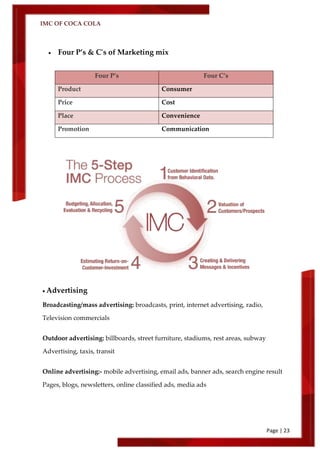
 Four P’s & C's of Marketing mix
Four P’s Four C’s
Product Consumer
Price Cost
Place Convenience
Promotion Communication
 Advertising
Broadcasting/mass advertising: broadcasts, print, internet advertising, radio,
Television commercials
Outdoor advertising: billboards, street furniture, stadiums, rest areas, subway
Advertising, taxis, transit
Online advertising:- mobile advertising, email ads, banner ads, search engine result
Pages, blogs, newsletters, online classified ads, media ads
IMC OF COCA COLA
Page | 24
 Direct marketing: direct mail, telemarketing, catalogs, shopping channels,
internet sales, emails, text messaging, websites, online display ads, fliers, catalog
distribution, promotional letters, outdoor advertising, telemarketing, coupons,
direct mail, direct selling, grassroots/community marketing, mobile
 Online/internet marketing
 E-commerce
 Search engine optimization (SEO)
 Search engine marketing (SEM)
 Mobile Marketing
 Email marketing
 Content marketing
Social Media (Facebook, Twitter, LinkedIn, Google +, Foursquare, Pinterest,
YouTube, Wikipedia, Instagram)
 Public Relations :- Special events, interviews, conference speeches, industry awards,
press conferences, testimonials, news releases, publicity stunts, community
involvement, charity involvement & events
 Sales Promotions:- Contests, coupons, product samples (freebies), premiums, prizes,
rebates, special events
 Trade shows:- Booths, product demonstrations
 Corporate Social Responsibility :- Donations, volunteering, charitable actions
When these diverse aspects of business and marketing are weaved together properly
an effective campaign can be achieved. Effective campaigns are demonstrated on the
Integrated Brands showcase which recognizes brands that are innovative, strategic
and successfully growing their sales.[3]
IMC OF COCA COLA
Page | 25
IMC OF COCA COLA
Page | 26
CHAPTER -2
COMPANY’S HISTORY
The Coca-Cola Company traces it’s beginning to 1886,
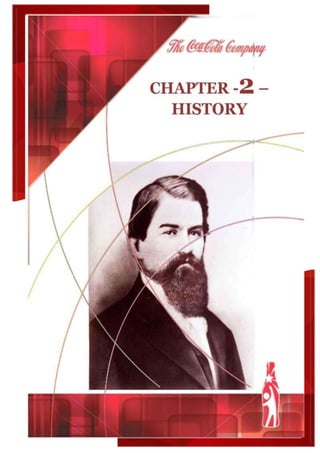
when an Atlanta pharmacist, Dr. John Pemberton, [to the
right] began to produce Coca-Cola syrup for sale in
fountain drinks. However the bottling business began in
1899 when two Chattanooga businessmen, Benjamin F.
Thomas and Joseph B. Whitehead, secured the exclusive
rights to bottle and sell Coca-Cola for most of the United
States from The Coca-Cola Company.
The Coca-Cola formula and brand was bought in
1889 by Asa Griggs Candler [to the left]
(December 30, 1851 - March 12, 1929), who
incorporated The Coca-Cola Company in 1892.
Besides its namesake Coca-Cola beverage, Coca-
Cola currently offers more than 500 brands in
over 200 countries or territories and serves over
1.7 billion servings each day.
The company operates a franchised distribution
system dating from 1889 where The Coca-Cola
Company only produces syrup concentrate which is
then sold to various bottlers throughout the world
who hold an exclusive territory. The Coca-Cola
Company owns its anchor bottler in North America,
Coca-Cola Refreshments
IMC OF COCA COLA
Page | 27
COCA COLA AROUND THE WORLD AND INDIA
The Coca-Cola Company is the world's largest beverage company. Along with Coca-
Cola, recognized as the world's most-valuable brand, the Company markets four of the
world's top five soft drink brands, including Coke, Fanta, Sprite plus a wide range of
other beverages, including diet, light soft drinks, water, juices, juice drinks, tea, coffee
and sports drinks. Through one of the world's largest beverage distribution system,
consumers in more than 200 countries enjoy the Company's beverages at a rate
exceeding 1.8 billion servings each day.
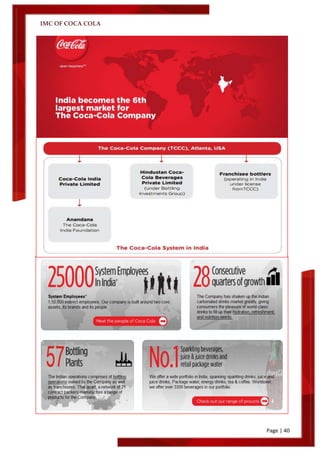
Coca-Cola in India is the country's leading beverage Company with an unmatched
portfolio of beverages. The Company manufactures and markets leading beverage
brands like Coca-Cola, Diet Coke, Thums Up, Fanta, Limca, Sprite, Maaza, Minute
Maid Pulpy Orange, Minute Maid Nimbu Fresh, Minute Maid 100%, Burn, Kinley and
Georgia range of tea and coffee.
One of the early investors in India, the Coca-Cola system provides direct and indirect
employment to more than 1, 50,000 people. The Company has more than 2.2 million
retailers and our business has a multiplier effect on employment and earning
opportunities. The Company's business also positively impacts industries like glass,
plastics, resin manufacturers, sugar, automobiles, white goods manufacturers, banking
etc.
At the heart of business is a mission statement called the Coca-Cola Promise - "The
Coca-Cola Company exists to benefit and refresh everyone that it touches". This basic
proposition entails that the Company's business should refresh the markets, protect,
preserve and enhance the environment and strengthen the community. Coca-Cola in
India provides extensive support for community programs across the country, with a
focus on education, health and water conservation. The system has installed more than
500 rain water harvesting structures in the country. The system has also undertaken the
rejuvenation and reconstruction of several traditional water bodies including check
dams. The Coca-Cola system is committed to work with communities across India in its
effort to contribute to mutual growth and development.
IMC OF COCA COLA
Page | 28
COCA COLA INDIA ORGANIZATION STRUCTURE
IMC OF COCA COLA
Page | 29
IMC OF COCA COLA
Page | 30
CHAPTER - 3
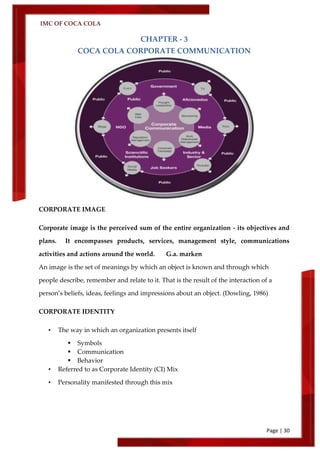
COCA COLA CORPORATE COMMUNICATION
CORPORATE IMAGE
Corporate image is the perceived sum of the entire organization - its objectives and
plans. It encompasses products, services, management style, communications
activities and actions around the world. G.a. marken
An image is the set of meanings by which an object is known and through which
people describe, remember and relate to it. That is the result of the interaction of a
person’s beliefs, ideas, feelings and impressions about an object. (Dowling, 1986)
CORPORATE IDENTITY
• The way in which an organization presents itself
 Symbols
 Communication
 Behavior
• Referred to as Corporate Identity (CI) Mix
• Personality manifested through this mix
IMC OF COCA COLA
Page | 31
CORPORATE IDENTITY MEDIA
• Product
• Price
• Logos
• Name
• Stationery
• Brochures
• Signs
IMPORTANCE OF IDENTITY
• Raises motivation among employees
• Inspires confidence in stakeholder groups
• Acknowledges important role of customers
• Acknowledges vital role of financial groups
THE THREE I’S - MISSION ORIENTED
• Identity: Who we are
• Image: What we are
• Ideas: What we stand for and believe
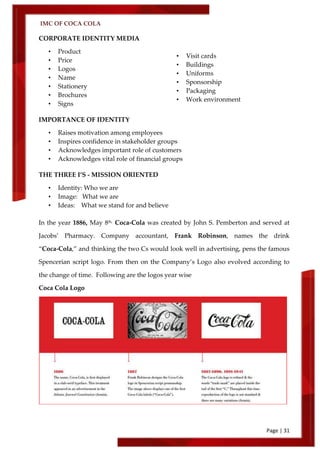
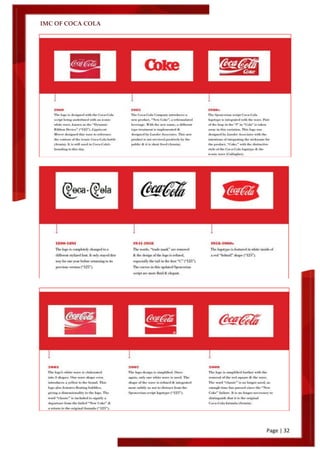
In the year 1886, May 8th,
Coca‑Cola was created by John S. Pemberton and served at
Jacobs’ Pharmacy. Company accountant, Frank Robinson, names the drink
‚Coca‑Cola,‛ and thinking the two Cs would look well in advertising, pens the famous
Spencerian script logo. From then on the Company’s Logo also evolved according to
the change of time. Following are the logos year wise
Coca Cola Logo
• Visit cards
• Buildings
• Uniforms
• Sponsorship
• Packaging
• Work environment
• Figure or
IMC OF COCA COLA
Page | 32
IMC OF COCA COLA
Page | 33
Brand Identity
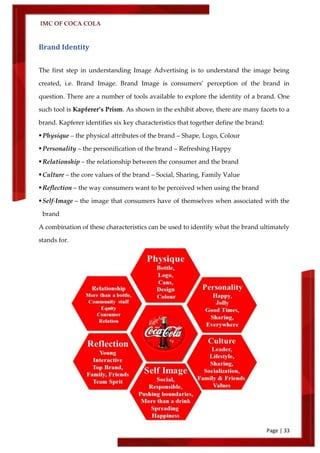
The first step in understanding Image Advertising is to understand the image being
created, i.e. Brand Image. Brand Image is consumers’ perception of the brand in
question. There are a number of tools available to explore the identity of a brand. One
such tool is Kapferer’s Prism. As shown in the exhibit above, there are many facets to a
brand. Kapferer identifies six key characteristics that together define the brand:
Physique – the physical attributes of the brand – Shape, Logo, Colour
Personality – the personification of the brand – Refreshing Happy
Relationship – the relationship between the consumer and the brand
Culture – the core values of the brand – Social, Sharing, Family Value
Reflection – the way consumers want to be perceived when using the brand
Self-Image – the image that consumers have of themselves when associated with the
brand
A combination of these characteristics can be used to identify what the brand ultimately
stands for.
IMC OF COCA COLA
Page | 34
The Contour Bottle
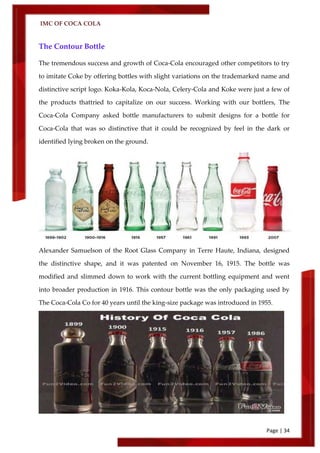
The tremendous success and growth of Coca‑Cola encouraged other competitors to try
to imitate Coke by offering bottles with slight variations on the trademarked name and
distinctive script logo. Koka-Kola, Koca-Nola, Celery-Cola and Koke were just a few of
the products thattried to capitalize on our success. Working with our bottlers, The
Coca‑Cola Company asked bottle manufacturers to submit designs for a bottle for
Coca‑Cola that was so distinctive that it could be recognized by feel in the dark or
identified lying broken on the ground.
Alexander Samuelson of the Root Glass Company in Terre Haute, Indiana, designed
the distinctive shape, and it was patented on November 16, 1915. The bottle was
modified and slimmed down to work with the current bottling equipment and went
into broader production in 1916. This contour bottle was the only packaging used by
The Coca‑Cola Co for 40 years until the king-size package was introduced in 1955.
IMC OF COCA COLA
Page | 35
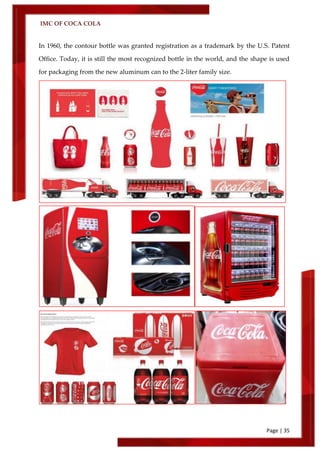
In 1960, the contour bottle was granted registration as a trademark by the U.S. Patent
Office. Today, it is still the most recognized bottle in the world, and the shape is used
for packaging from the new aluminum can to the 2-liter family size.
IMC OF COCA COLA
Page | 36
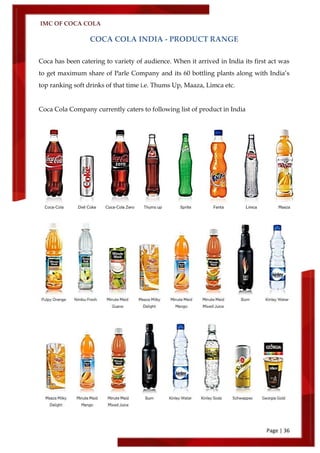
COCA COLA INDIA - PRODUCT RANGE
Coca has been catering to variety of audience. When it arrived in India its first act was
to get maximum share of Parle Company and its 60 bottling plants along with India’s
top ranking soft drinks of that time i.e. Thums Up, Maaza, Limca etc.
Coca Cola Company currently caters to following list of product in India
IMC OF COCA COLA
Page | 37
IMC OF COCA COLA
Page | 38
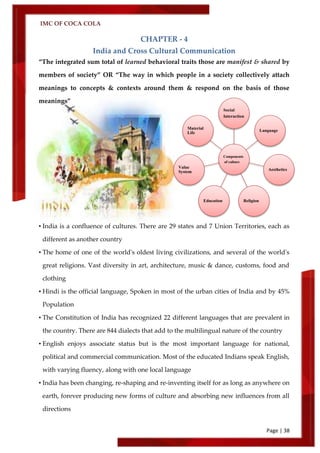
CHAPTER - 4
India and Cross Cultural Communication
‚The integrated sum total of learned behavioral traits those are manifest & shared by
members of society‛ OR ‚The way in which people in a society collectively attach
meanings to concepts & contexts around them & respond on the basis of those
meanings‛
• India is a confluence of cultures. There are 29 states and 7 Union Territories, each as
different as another country
• The home of one of the world's oldest living civilizations, and several of the world's
great religions. Vast diversity in art, architecture, music & dance, customs, food and
clothing
• Hindi is the official language, Spoken in most of the urban cities of India and by 45%
Population
• The Constitution of India has recognized 22 different languages that are prevalent in
the country. There are 844 dialects that add to the multilingual nature of the country
• English enjoys associate status but is the most important language for national,
political and commercial communication. Most of the educated Indians speak English,
with varying fluency, along with one local language
• India has been changing, re-shaping and re-inventing itself for as long as anywhere on
earth, forever producing new forms of culture and absorbing new influences from all
directions
Components
of culture
Social
Interaction
Language
Aesthetics
ReligionEducation
Value
System
Material
Life
IMC OF COCA COLA
Page | 39
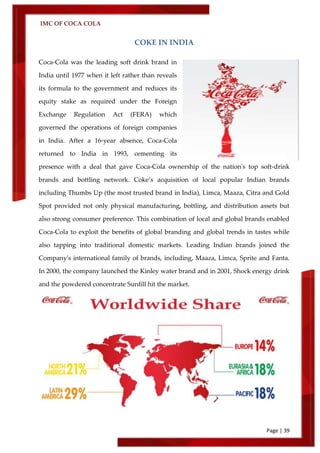
COKE IN INDIA
Coca-Cola was the leading soft drink brand in
India until 1977 when it left rather than reveals
its formula to the government and reduces its
equity stake as required under the Foreign
Exchange Regulation Act (FERA) which
governed the operations of foreign companies
in India. After a 16-year absence, Coca-Cola
returned to India in 1993, cementing its
presence with a deal that gave Coca-Cola ownership of the nation's top soft-drink
brands and bottling network. Coke’s acquisition of local popular Indian brands
including Thumbs Up (the most trusted brand in India), Limca, Maaza, Citra and Gold
Spot provided not only physical manufacturing, bottling, and distribution assets but
also strong consumer preference. This combination of local and global brands enabled
Coca-Cola to exploit the benefits of global branding and global trends in tastes while
also tapping into traditional domestic markets. Leading Indian brands joined the
Company's international family of brands, including, Maaza, Limca, Sprite and Fanta.
In 2000, the company launched the Kinley water brand and in 2001, Shock energy drink
and the powdered concentrate Sunfill hit the market.
IMC OF COCA COLA
Page | 40
IMC OF COCA COLA
Page | 41
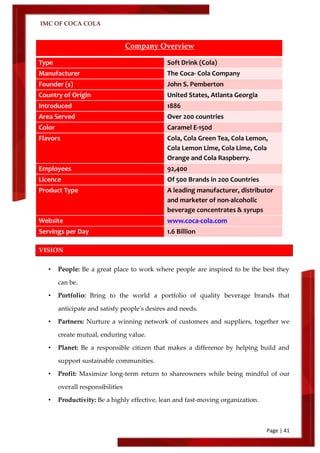
Company Overview
Type Soft Drink (Cola)
Manufacturer The Coca- Cola Company
Founder (s) John S. Pemberton
Country of Origin United States, Atlanta Georgia
Introduced 1886
Area Served Over 200 countries
Color Caramel E-150d
Flavors Cola, Cola Green Tea, Cola Lemon,
Cola Lemon Lime, Cola Lime, Cola
Orange and Cola Raspberry.
Employees 92,400
Licence Of 500 Brands in 200 Countries
Product Type A leading manufacturer, distributor
and marketer of non-alcoholic
beverage concentrates & syrups
Website www.coca-cola.com
Servings per Day 1.6 Billion
VISION
• People: Be a great place to work where people are inspired to be the best they
can be.
• Portfolio: Bring to the world a portfolio of quality beverage brands that
anticipate and satisfy people's desires and needs.
• Partners: Nurture a winning network of customers and suppliers, together we
create mutual, enduring value.
• Planet: Be a responsible citizen that makes a difference by helping build and
support sustainable communities.
• Profit: Maximize long-term return to shareowners while being mindful of our
overall responsibilities
• Productivity: Be a highly effective, lean and fast-moving organization.
IMC OF COCA COLA
Page | 42
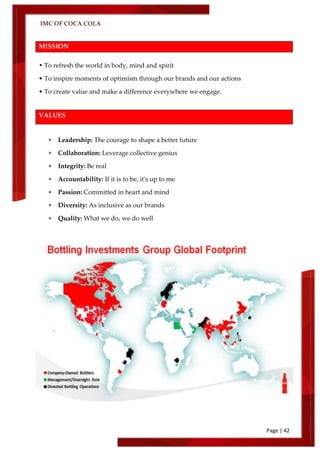
MISSION
• To refresh the world in body, mind and spirit
• To inspire moments of optimism through our brands and our actions
• To create value and make a difference everywhere we engage.
VALUES
 Leadership: The courage to shape a better future
 Collaboration: Leverage collective genius
 Integrity: Be real
 Accountability: If it is to be, it's up to me
 Passion: Committed in heart and mind
 Diversity: As inclusive as our brands
 Quality: What we do, we do well
IMC OF COCA COLA
Page | 43
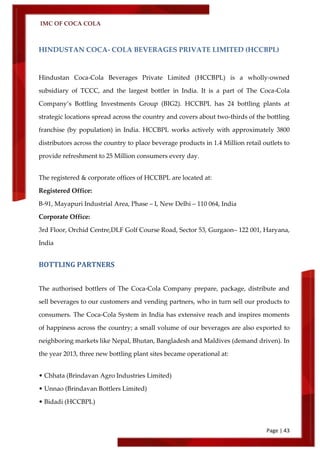
HINDUSTAN COCA- COLA BEVERAGES PRIVATE LIMITED (HCCBPL)
Hindustan Coca-Cola Beverages Private Limited (HCCBPL) is a wholly-owned
subsidiary of TCCC, and the largest bottler in India. It is a part of The Coca-Cola
Company’s Bottling Investments Group (BIG2). HCCBPL has 24 bottling plants at
strategic locations spread across the country and covers about two-thirds of the bottling
franchise (by population) in India. HCCBPL works actively with approximately 3800
distributors across the country to place beverage products in 1.4 Million retail outlets to
provide refreshment to 25 Million consumers every day.
The registered & corporate offices of HCCBPL are located at:
Registered Office:
B-91, Mayapuri Industrial Area, Phase – I, New Delhi – 110 064, India
Corporate Office:
3rd Floor, Orchid Centre,DLF Golf Course Road, Sector 53, Gurgaon– 122 001, Haryana,
India
BOTTLING PARTNERS
The authorised bottlers of The Coca-Cola Company prepare, package, distribute and
sell beverages to our customers and vending partners, who in turn sell our products to
consumers. The Coca-Cola System in India has extensive reach and inspires moments
of happiness across the country; a small volume of our beverages are also exported to
neighboring markets like Nepal, Bhutan, Bangladesh and Maldives (demand driven). In
the year 2013, three new bottling plant sites became operational at:
• Chhata (Brindavan Agro Industries Limited)
• Unnao (Brindavan Bottlers Limited)
• Bidadi (HCCBPL)
IMC OF COCA COLA
Page | 44
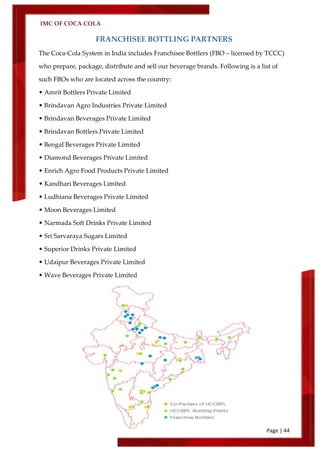
FRANCHISEE BOTTLING PARTNERS
The Coca-Cola System in India includes Franchisee Bottlers (FBO – licensed by TCCC)
who prepare, package, distribute and sell our beverage brands. Following is a list of
such FBOs who are located across the country:
• Amrit Bottlers Private Limited
• Brindavan Agro Industries Private Limited
• Brindavan Beverages Private Limited
• Brindavan Bottlers Private Limited
• Bengal Beverages Private Limited
• Diamond Beverages Private Limited
• Enrich Agro Food Products Private Limited
• Kandhari Beverages Limited
• Ludhiana Beverages Private Limited
• Moon Beverages Limited
• Narmada Soft Drinks Private Limited
• Sri Sarvaraya Sugars Limited
• Superior Drinks Private Limited
• Udaipur Beverages Private Limited
• Wave Beverages Private Limited
IMC OF COCA COLA
Page | 45
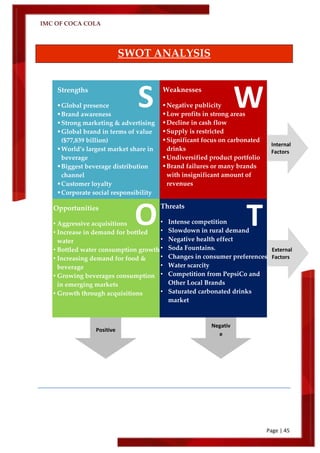
SWOT ANALYSIS
S W
O T
Strengths
Global presence
Brand awareness
Strong marketing & advertising
Global brand in terms of value
($77,839 billion)
World’s largest market share in
beverage
Biggest beverage distribution
channel
Customer loyalty
Corporate social responsibility
Weaknesses
Negative publicity
Low profits in strong areas
Decline in cash flow
Supply is restricted
Significant focus on carbonated
drinks
Undiversified product portfolio
Brand failures or many brands
with insignificant amount of
revenues
Opportunities
• Aggressive acquisitions
• Increase in demand for bottled
water
• Bottled water consumption growth
• Increasing demand for food &
beverage
• Growing beverages consumption
in emerging markets
• Growth through acquisitions
Threats
• Intense competition
• Slowdown in rural demand
• Negative health effect
• Soda Fountains.
• Changes in consumer preferences
• Water scarcity
• Competition from PepsiCo and
Other Local Brands
• Saturated carbonated drinks
market
Internal
Factors
External
Factors
Positive
Negativ
e
IMC OF COCA COLA
Page | 46
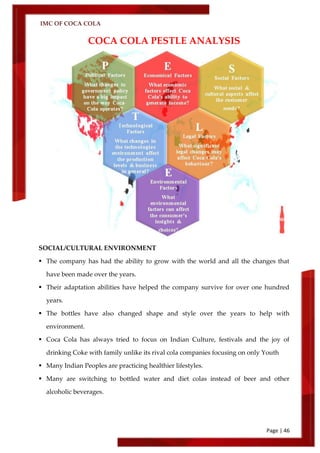
COCA COLA PESTLE ANALYSIS
SOCIAL/CULTURAL ENVIRONMENT
 The company has had the ability to grow with the world and all the changes that
have been made over the years.
 Their adaptation abilities have helped the company survive for over one hundred
years.
 The bottles have also changed shape and style over the years to help with
environment.
 Coca Cola has always tried to focus on Indian Culture, festivals and the joy of
drinking Coke with family unlike its rival cola companies focusing on only Youth
 Many Indian Peoples are practicing healthier lifestyles.
 Many are switching to bottled water and diet colas instead of beer and other
alcoholic beverages.
IMC OF COCA COLA
Page | 47
POLITICAL AND REGULATORY ENVIRONMENT
 The Governments involvement in the soda industry has not affected operations
much. There have been regulations put out for bottling procedures & the way Coke
was labeled.
 In the early years of the company there was actually one ingredient removed from
the original formula.
 The ingredient was the Coca also known as ‚Cocaine‛ from the recipe.
ECONOMIC ENVIRONMENT
Company also had decided to leave in year 1977 during Morarji Desai’s Government.
George Fernandez’s department under Janta Party rule was the acting force. Foreign
Exchanges Regulation Act (FERA) demanded foreign companies to dilute their equity
stake in their Indian associates to 40 percent if they wished to remain in the country.
 The Company left rather than compromising its Cola formula to the Government.
 Coca- Cola has a continuous business cycle that never stops.
 They offer so many different products that there are no specific dropping points on
sales.
 As long as the product is being manufactured and continues to grow around the
world the market for the drinks offered will not diminish anytime soon.
 The Coca-Cola Company contracts with numerous bottling companies around the
world to create and distribute their beverages.
 The Coca-Cola Company has been very successful in helping other nations grow and
become economically stable by investing millions of dollars back into the countries in
which they are operating.
 The non-alcoholic beverage industry has high sales in countries outside the U.S.
TECHNOLOGICAL ENVIRONMENT
 With the new bottling techniques a lot more of cokes products have been able to be
distributed a lot faster and in higher volumes.
 They have the capability to serve 1.6 billion people a day.
IMC OF COCA COLA
Page | 48
 The company has also managed to purchase most of the bottling plants and make
them a pure company asset rather than being privately owned.
 With the advancements in advertising and the Medias that can be used Coke has
been able to reach more people faster.
 The new technology of internet and television which use special effects for
advertising through media
 Introduction of cans and plastic bottles have increased sales for Coca-Cola as these
are easier to carry and you can ‚bin‛ them once used.
 There has been introduction of new machineries all the time.
LEGAL ANALYSIS
 Soft drink Inter brand competition act of 1980 secured the right of concentrate
 Producers (cps) to grant exclusive territories to bottlers
 The company was granted a trademark for the name ‚Coke‛ in 1945.
 Pressure from the scientific community for the FDA to enforce caffeine labels
warning of the dangers of caffeine consumption
 Obstacles in international operations included regulations, price controls,
advertising restrictions and lack of infrastructure Eg. China, Cuba
ENVIRONMENTAL ANALYSIS
 Increasing the importance of environmental policies does effect Coca Cola directly
 The Environmental Protection group like NGO who are against Coca Cola for using
water for its factory in Gujarat and Orissa
 Introducing water saving methodology for its Cola production. Eg. Anandana –
Coca-Cola India Foundation
 Anandana focuses on supporting social projects in the domains of water
sustainability and the spread of new and renewable energy sources.
Geographically, Anandana focuses on some of the most backward regions of the
country.
 The Pesticide crisis which took place in year 2003
IMC OF COCA COLA
Page | 49
 In spite of these Coca Cola has been able to make a clean image through CSR
activities and ads showing its quality tests in factory.
DEMOGRAPHIC ANALYSIS
 Educated people belonging to upper and middle-income groups also commonly use
Coca-Cola.
 Major emphasis of Coca-Cola is to attract teenagers.
 Diet Coca-Cola offered by Company is Very popular among diabetic patients.
 Consumers of the ages of 37 to 55 are also increasingly concerned with nutrition.
[Source: Coca-Cola Back to School Conference]
IMC OF COCA COLA
Page | 50
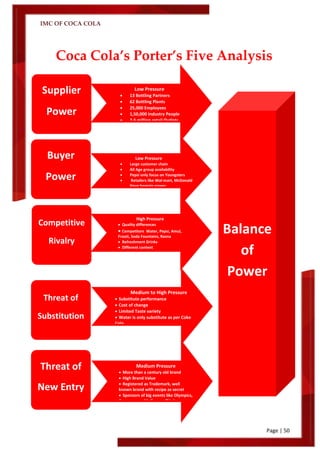
Coca Cola’s Porter’s Five Analysis
w
Supplier
Power
Buyer
Power
Competitive
Rivalry
Threat of
Substitution
Threat of
New Entry
Low Pressure
 13 Bottling Partners
 62 Bottling Plants
 25,000 Employees
 1,50,000 Industry People
 2.6 million retail Outlets
Low Pressure
 Large customer chain
 All Age group availability
 Pepsi only focus on Youngsters
 Retailers like Wal-mart, McDonald
Have bargain power.
High Pressure
 Quality differences
 Competitors Water, Pepsi, Amul,
Frooti, Soda Fountains, Rasna
 Refreshment Drinks
 Different content
Medium to High Pressure
 Substitute performance
 Cost of change
 Limited Taste variety
 Water is only substitute as per Coke
Cola
Medium Pressure
 More than a century old brand
 High Brand Value
 Registered as Trademark, well
known brand with recipe as secret
 Sponsors of big events like Olympics,
Commonwealth Games, TV shows
Balance
of
Power
IMC OF COCA COLA
Page | 51
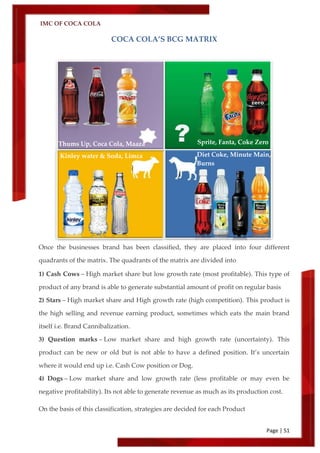
COCA COLA’S BCG MATRIX
Once the businesses brand has been classified, they are placed into four different
quadrants of the matrix. The quadrants of the matrix are divided into
1) Cash Cows – High market share but low growth rate (most profitable). This type of
product of any brand is able to generate substantial amount of profit on regular basis
2) Stars – High market share and High growth rate (high competition). This product is
the high selling and revenue earning product, sometimes which eats the main brand
itself i.e. Brand Cannibalization.
3) Question marks – Low market share and high growth rate (uncertainty). This
product can be new or old but is not able to have a defined position. It’s uncertain
where it would end up i.e. Cash Cow position or Dog.
4) Dogs – Low market share and low growth rate (less profitable or may even be
negative profitability). Its not able to generate revenue as much as its production cost.
On the basis of this classification, strategies are decided for each Product
Thums Up, Coca Cola, Maaza Sprite, Fanta, Coke Zero
Kinley water & Soda, Limca Diet Coke, Minute Main,
Burns
IMC OF COCA COLA
Page | 52
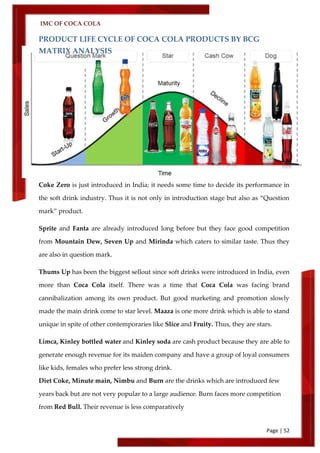
PRODUCT LIFE CYCLE OF COCA COLA PRODUCTS BY BCG
MATRIX ANALYSIS
Coke Zero is just introduced in India; it needs some time to decide its performance in
the soft drink industry. Thus it is not only in introduction stage but also as ‚Question
mark‛ product.
Sprite and Fanta are already introduced long before but they face good competition
from Mountain Dew, Seven Up and Mirinda which caters to similar taste. Thus they
are also in question mark.
Thums Up has been the biggest sellout since soft drinks were introduced in India, even
more than Coca Cola itself. There was a time that Coca Cola was facing brand
cannibalization among its own product. But good marketing and promotion slowly
made the main drink come to star level. Maaza is one more drink which is able to stand
unique in spite of other contemporaries like Slice and Fruity. Thus, they are stars.
Limca, Kinley bottled water and Kinley soda are cash product because they are able to
generate enough revenue for its maiden company and have a group of loyal consumers
like kids, females who prefer less strong drink.
Diet Coke, Minute main, Nimbu and Burn are the drinks which are introduced few
years back but are not very popular to a large audience. Burn faces more competition
from Red Bull. Their revenue is less comparatively
IMC OF COCA COLA
Page | 53
IMC OF COCA COLA
Page | 54
CHAPTER-5
COCA COLA STRATEGIC COMMUNICATION
What is Strategic Planning?
Strategic planning is an organization's process of defining its strategy, or direction, and
making decisions on allocating its resources to pursue this strategy. It may also extend
to control mechanisms for guiding the implementation of the strategy.
In order to achieve the same communication to both internal & external publics is
required.
Following skills are important in strategic planning
a. Research to understand current situation
b. Utilization of maximum resources by deciding modes operandi
c. Choosing medium, media mix and tactics operations
d. Taking feedback and Researching after completing project
NINE STEPS OF STRATEGIC PLANNING
 Phase One: Formative Research –
 Step 1: Analyzing the Situation
 Step 2: Analyzing the Organization
 Step 3: Analyzing the Publics
 Phase Two: Strategy –
 Step 4: Establishing Goals and Objectives
 Step 5: Formulating Action and Response Strategies
 Step 6: Using Effective Communication
 Phase Three: Tactics –
 Step 7: Choosing Communication Tactics
 Step 8: Implementing the Strategic Plan
 Phase Four: Evaluative Research –
 Step 9: Evaluative the Strategic Plan
IMC OF COCA COLA
Page | 55
Phase One: Formative Research
Step 1: Analyzing the situation
Analysis of the situation is the crucial beginning to the process. It is imperative that all
involved-planner, clients, supervisors, key colleagues and the ultimate decision
makers agrees to the opportunity or threat to be observed in this program.
Step 2: Analyzing the Organization:
This step involves a careful and candid look at three aspects of the organization:
(1) Its internal environment (mission, performance and resources),
(2) Its public perception (reputation)
(3) Its external environment, (competitors and opponents, as well as supporters).
Step 3: Analyzing the Publics:
This step includes an analysis of each public in terms of their wants, needs and
expectations about the issue, their relationship to the organization, their involvement in
communication and with various media, and a variety of social, economic, political,
cultural and technological trends that may affect them
To analyze the publics, three things are very important to understand the market
segments which comprises from family to friends, people to politics, boss to business
etc. and they are:
i). Public: It consist of communication and interdependency between organizations
having common goals, command interest and face common concern.
ii). A Market: It’s mainly to conduct business or generate support and participation.
iii). Audiences: The main target or people for whom the process of informing &
educating to aware is done.
Step 4: Establishing Goals and Objectives
The second phase of the planning process, Strategy, deals with the heart of planning:
making decisions dealing with the expected impact of the communication, as well as
the nature of the communication itself.
IMC OF COCA COLA
Page | 56
Phase Two: Strategy
Step 5: Formulating Action and Response Strategy:
A range of actions is available to the organization, and in this step you consider what
you might do in various situations. This section includes typologies of initiatives and
responses.
Communication Strategy: Approach with persuasion to make public support and use
maximum advantage of this service should be created in order to avoid public
opposition in development.
Proactive Strategies: Utilizing Visual media and one on one personalized
communication to approach people in order to get supportive response. As, there are
fair chances of people opposing the operations when in progress if they lack the vision
of big picture
Reactive Strategies: Keeping Crisis & Safety measures in mind and in case of any
unexpected occurrence or accident taking place then convincing public to assure of
being careful next time with guarantee of precautionary measures.
Step 6: Using Effective Communication:
It deals with the various decisions about the message, such as the sources who will
present the message to the key publics, the content of the message, its tone and style,
verbal and nonverbal cues, and related issues
Following strategy can be considered to communicate effectively
Information level- Utilization of upgradable mass media like New Media, Social
media, Short Message Service, Monthly One article on Coke in Popular News Papers,
Related events and Site updates
Persuasion level: In order to persuade skills like communication, data analyzing,
convincing, negotiation etc. is required. The best way to achieve the desired response is
to do lobbying and PR activity consisting of propaganda of modes operandi with
expected results.
Dialogue level: The Level of communication should be taking place considering
Megacities & Metro city in mind. Higher authorities in charge of decision making
should be communicating to the common mass and audience
IMC OF COCA COLA
Page | 57
Phase Three: Tactics
During the Tactics phase, various communication tools are considered & the visible
elements of the communication plan are created.
Step 7: Choosing Communication Tactics
This inventory deals with the various communication options. Specifically, the
planner considers four categories:
(1) Face-to-face communication & opportunities for personal involvement
(2) Organizational media (sometimes called controlled media)
(3) News media (uncontrolled media)
(4) Advertising and promotional media (another form of controlled media).
While all of these tools can be used by any organization, not every tool is appropriate
for each issue. This is the phase where we allocate the controlled and uncontrolled
media precisely.
Step 8: Implementing the strategic plan
You develop budgets and schedules and otherwise prepare to implement the
communication program. This step turns the raw ingredients identified in the previous
step into a recipe for successful public relations and marketing communication
Phase Four: Evaluative Research
The final phase, Evaluative Research, deals with evaluation and assessment, enabling
you to determine the degree to which the stated objectives have been met and thus to
modify or continue the communication activities
Step 9: Evaluating the Strategic Plan
This is the final planning element, indicating specific methods for measuring the
effectiveness of each recommended tactic in meeting the stated objectives.
IMC OF COCA COLA
Page | 58
COCA-COLA INDIA
Coca-Cola is a leading brand in the Indian beverage market with a 60 percent share in
the carbonated soft drinks segment, 36 percent share in fruit drinks segment and 33
percent share in the packaged water segment.
INITIAL SUFFERINGS
Coca Cola initially entered the Indian market during the late 1970s it was though a well
-known drink by the time it had entered the market. In the late 1977 The Minister of
Industries, George Fernandes, in the new Janata government of Morarji Desai, projected
itself as a party dedicated to Swadeshi (self-reliance), raised a particular provision of
the Foreign Exchanges Regulation Act (FERA) which demanded foreign companies to
dilute their equity stake in their Indian associates to 40 percent if they wished to
operate in the country.
After the economic reforms policy of LPG (Liberalization, Privatization and
Globalization) the company again entered in India in the year 1993 after the new
government decided to liberalize the market again.
INITIAL MISTAKE
This entry in the market was more dramatic for the company as it bought out all the
leading soft drink brands of India like Thums-up, Limca, and Gold Spot resulting to a
position where it was accused of cannibalizing its competition by using its financial
power. This was due to the fact that for some time Coca Cola was the only product into
prime focus of their promotion rather than other Indian brand it had over taken.
Though this was slowly realized by the Company and they gave Thums up and Limca
equal weightage. This gave the Coca Cola Company an advantage of getting ready
made established set up of 60 Bottling Plants of Parle Group and additional 13 of the
companies own in India benefitting it to cover 60% of the market share of Cola Industry
in India.
IMC OF COCA COLA
Page | 59
STRATEGIC DRAWBACK IN THE BEGINNING
In the beginning the company signed well known stars like Aamir Khan, Hritik Roshan,
Karishma Kapoor, Rani Mukherjee, Akshaya Kumar, Aishwaria Rai from film industry
and did heavy converted Ads in movies like Taal, Rang De Basanti, Yadeein etc. It also
bagged that time shining cricketer Virendra Sehwang who was in his best form and
new to Indian Cricket. Trying to be present in minds of the customers as much as
possible from any recollection medium like TV, Radio, News Paper, Movies etc.
But, even after years had passed in the Indian market, the company was unable to make
profits compared to its competitors. The breakeven point or profit was not yet
generated because of its very aggressive investment strategies of large amounts of
promotions and competitive pricing strategy to try and beat the competition.
REASON OF THE ERROR
Their prime appeal was to urban lifestyle and to urban youth. This was more like
American way of life which could only influence a limited number of people. There
was a large segment which preferred Thums Up, Limca a local brand more than and
Cola’s which were supposed to be ‘Refrigerated’ before consumption. The only
advantage that Coca Cola could consider that time was taking over the bestselling soft
drink brand.
Coca Cola realizing its lack of understanding of local preference and Indian culture did
an extensive research in India. It realised that it was competing with traditional
refreshments such as Narial-pani (coconut-water), Ganne ka Ras (Sugarcane Juice),
Nimbu-pani (lemon-water), Chai (tea), Chaaj - Lassi (yoghurt drink), Shikanji (Sweet-
Syrup) and Fruit juices. All these traditional drinks were available in price half of the
Cold drinks available in market.
All this was also giving indication towards a big demographic population which was
not properly noticed by Coca Cola Middle Class, Lower Middle Class and Rural India.
IMC OF COCA COLA
Page | 60
Additionally one could note that affordability was a driver in the Indian context for
desirability. It was also noted that soft drink consumption was somewhat limited to
special occasions like outings, parties, festivals and weddings in compared to more
developed countries where daily consumption was in practice.
Within consumers Coke located two distinct target markets: urban youth which they
called ‚India A‛ and rural Indians which were called ‚India B‛. ‚India A‛ only made
up 4% of India’s total population, remaining 96% population consisted of Middle class
and Rural people who were not the prime focus of Coca Cola promotional activity.
Coca Cola appeared like a product for niche product.
STRATEGIES TO OVERCOME CHALLENGES
STRATEGIC IMPLIMENTATION
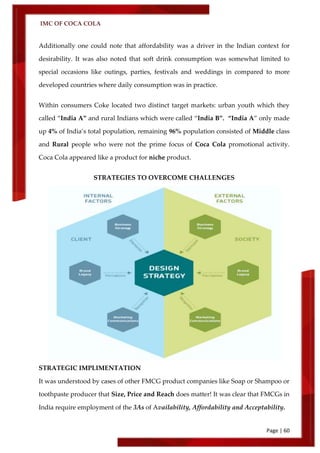
It was understood by cases of other FMCG product companies like Soap or Shampoo or
toothpaste producer that Size, Price and Reach does matter! It was clear that FMCGs in
India require employment of the 3As of Availability, Affordability and Acceptability.
IMC OF COCA COLA
Page | 61
AVAILABILITY
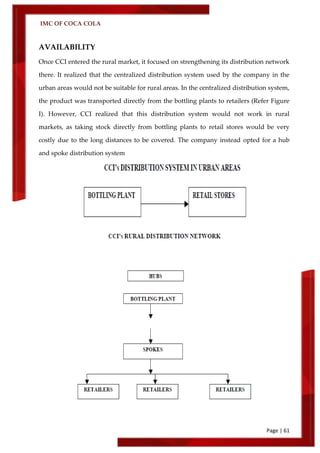
Once CCI entered the rural market, it focused on strengthening its distribution network
there. It realized that the centralized distribution system used by the company in the
urban areas would not be suitable for rural areas. In the centralized distribution system,
the product was transported directly from the bottling plants to retailers (Refer Figure
I). However, CCI realized that this distribution system would not work in rural
markets, as taking stock directly from bottling plants to retail stores would be very
costly due to the long distances to be covered. The company instead opted for a hub
and spoke distribution system
IMC OF COCA COLA
Page | 62
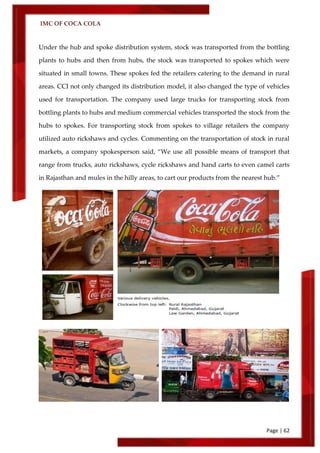
Under the hub and spoke distribution system, stock was transported from the bottling
plants to hubs and then from hubs, the stock was transported to spokes which were
situated in small towns. These spokes fed the retailers catering to the demand in rural
areas. CCI not only changed its distribution model, it also changed the type of vehicles
used for transportation. The company used large trucks for transporting stock from
bottling plants to hubs and medium commercial vehicles transported the stock from the
hubs to spokes. For transporting stock from spokes to village retailers the company
utilized auto rickshaws and cycles. Commenting on the transportation of stock in rural
markets, a company spokesperson said, ‚We use all possible means of transport that
range from trucks, auto rickshaws, cycle rickshaws and hand carts to even camel carts
in Rajasthan and mules in the hilly areas, to cart our products from the nearest hub.‛
IMC OF COCA COLA
Page | 63
AFFORDABILITY
A survey conducted by CCI in 2001 revealed that 300 ml bottles were not popular with
rural and semi-urban residents where two persons often shared a 300 ml bottle. It was
also found that the price of Rs10/- per bottle was considered too high by rural
consumers. For these reasons, CCI decided to make some changes in the size of its
bottles and pricing to win over consumers in the rural market. So Coke launched a
200ml returnable glass bottle called ‚Chota Coke‛at a lower price of Rs. 5 with
accompanying advertising campaigns
The Chota Coke of Coca Cola India proved competitive against local brands in the
unorganized sector. It was reported that in the states of Rajasthan and Gujarat the local
cola brands such as Choice and Tikli costed only half the price offered by CCI, which
gave them the advantage in garnering the major market share before CCI came out
with Chota Coke. CCI also targeted the rural consumer aggressively in its marketing
campaigns, which were aimed at increasing awareness of its brands in rural areas.
IMC OF COCA COLA
Page | 64
IMC OF COCA COLA
Page | 65
ACCEPTABILITY
The initiatives of CCI in distribution and pricing were supported by extensive
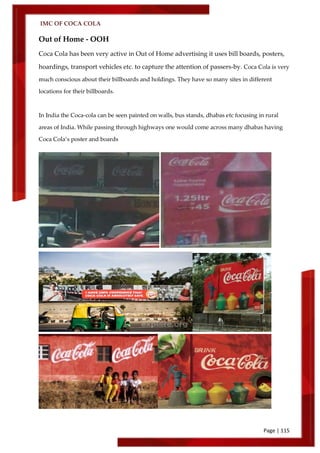
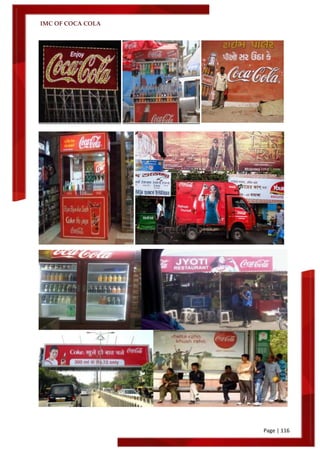
marketing in the mass media as well as through outdoor advertising. The company put
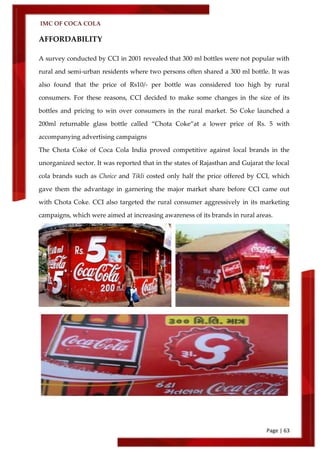
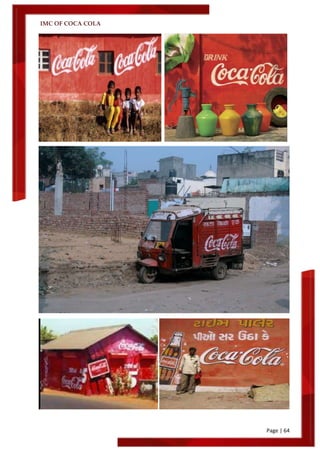
up hoardings in villages and painted the name Coca Cola on the compounds of the
residences in the villages. Further, CCI also participated in the weekly Mandies by
setting up temporary retail outlets, and also took part in the annual haats11 and fairs -
major sources of business activity and entertainment in rural India. CCI also launched
television commercials (TVCs) targeted at rural consumers. In order to reach more rural
consumers, CCI increased its ad-spend on Doordarshan[6]
The company ensured that all its rural marketing initiatives were well-supported by
TVCs. When CCI launched Chota Coke in 2002 priced at Rs. 5, it bought out a
commercial featuring Bollywood actor Aamir Khan to communicate the message of the
price cut and the launch of 200 ml bottles to the rural consumers.
A sub-section of the Thanda campaign
promoted the reduced size and
corresponding price reduction of Coca Cola
bottles, using the tag-line Panch Rupiya
Matlab Chota Coca Cola (Five Rupees Means
Small Coca Cola) - UP Bahiya in the Panch
Rupiya TVC
IMC OF COCA COLA
Page | 66
The commercial was shot in a rural setting. In the summer of 2003, CCI came up with a
new commercial featuring Aamir Khan, to further strengthen the Coca-Cola brand
image among rural consumers.
The commercial aimed at making coke a generic name for ‘Thanda.’ Of the reason for
picking up the word ‘Thanda’, Prasoon Joshi, national creative director – McCann
Erickson, the creator of the commercial, said, ‚Thanda is a very North India-centric
phenomenon. Go to any restaurant in the north, and attendants would promptly ask,
‘thanda ya garam?’ ‘Thanda’ usually means lassi or nimbu pani, ‘garam’ is essentially
tea. Because the character, in itself, represented a culture, we wanted to equate Coke
with ‘Thanda’, since ‘Thanda’ too is part of the popular dialect of the north. Thus
making ‘Thanda’ generic for Coca-Cola. With the long-playing possibilities of the
‘Thanda’ idea becoming evident, ‘Thanda’ became the central idea. Once we decided to
work on that idea, the creative mind just opened up.‛[7]
Between March and September 2003, CCI launched three commercials with the ‘Thanda
Matlab Coca-Cola’ tag line. All the three commercials aimed to make rural and semi-
urban consumers connect with Coca-cola.
The first ad featured Aamir Khan as a ‘Tapori’ (street smart); in the ad he makes the
association between Coca-Cola and the word ‘Thanda.’
IMC OF COCA COLA
Page | 67
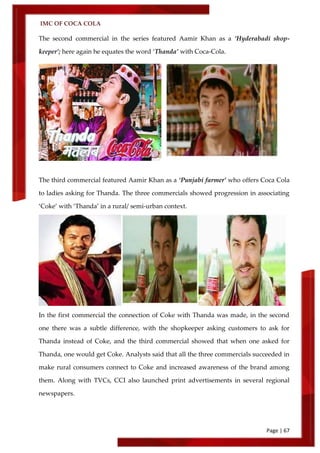
The second commercial in the series featured Aamir Khan as a ‘Hyderabadi shop-
keeper’; here again he equates the word ‘Thanda’ with Coca-Cola.
The third commercial featured Aamir Khan as a ‘Punjabi farmer’ who offers Coca Cola
to ladies asking for Thanda. The three commercials showed progression in associating
‘Coke’ with ‘Thanda’ in a rural/ semi-urban context.
In the first commercial the connection of Coke with Thanda was made, in the second
one there was a subtle difference, with the shopkeeper asking customers to ask for
Thanda instead of Coke, and the third commercial showed that when one asked for
Thanda, one would get Coke. Analysts said that all the three commercials succeeded in
make rural consumers connect to Coke and increased awareness of the brand among
them. Along with TVCs, CCI also launched print advertisements in several regional
newspapers.
IMC OF COCA COLA
Page | 68
To be successful, the company decided invested more than US$ 1bn to build overall
infrastructure required for succeeding in India. The company invested in setting-up 25
wholly owned bottling plants in India. All these steps taken by the company ensured
that the company was able to ensure a deeper level of penetration in the Indian market
– even in the rural areas [4]
Following the Success of these TVCs the Company launched another Advertisement to
symbolize Coca Cola as Thanda. Where a Nepali Tourist Guide makes a honeymoon
couple realize that Thanda means Coca Cola not just any other drink
FACILITY AND DURABILITY
Though it was made to believe that Thanda means Coca Cola the company knew that to
just pitch it as Thanda (Cold) and serve it cold is another thing. Thus Coca Cola
introduced first time in India facility for keeping Cold drink cold that Coca Cola Ice
Box. It was useful because of the following reason
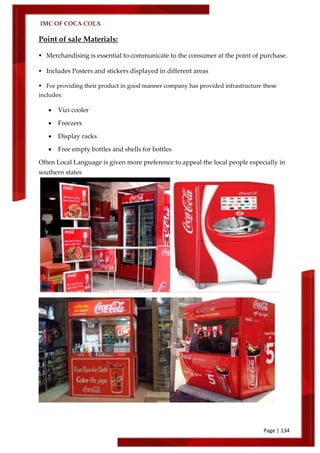
1) No Electricity required. Considering that villages have more power cut and less
electric supply.
2) Easy storage and economical. It was natural that location where they had to sell their
soft drink in half the rate would not afford Freeze Cooler or Refrigerator.
3) Stands or Mobile Coca Cola sales carrier were introduced for village, Highway
Vendors
4) Their focus was to be more Global + Local = Glocalized
IMC OF COCA COLA
Page | 69
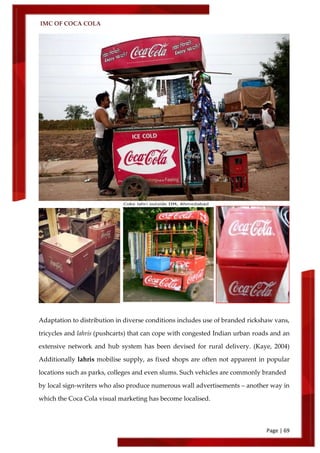
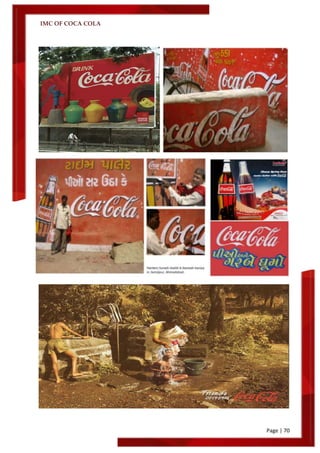
Adaptation to distribution in diverse conditions includes use of branded rickshaw vans,
tricycles and lahris (pushcarts) that can cope with congested Indian urban roads and an
extensive network and hub system has been devised for rural delivery. (Kaye, 2004)
Additionally lahris mobilise supply, as fixed shops are often not apparent in popular
locations such as parks, colleges and even slums. Such vehicles are commonly branded
by local sign-writers who also produce numerous wall advertisements – another way in
which the Coca Cola visual marketing has become localised.
IMC OF COCA COLA
Page | 70
IMC OF COCA COLA
Page | 71
IMC OF COCA COLA
Page | 72
CHAPTER- 6
CRISIS COMMUNICATION
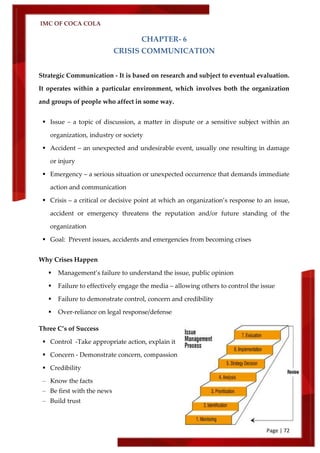
Strategic Communication - It is based on research and subject to eventual evaluation.
It operates within a particular environment, which involves both the organization
and groups of people who affect in some way.
 Issue – a topic of discussion, a matter in dispute or a sensitive subject within an
organization, industry or society
 Accident – an unexpected and undesirable event, usually one resulting in damage
or injury
 Emergency – a serious situation or unexpected occurrence that demands immediate
action and communication
 Crisis – a critical or decisive point at which an organization’s response to an issue,
accident or emergency threatens the reputation and/or future standing of the
organization
 Goal: Prevent issues, accidents and emergencies from becoming crises
Why Crises Happen
 Management’s failure to understand the issue, public opinion
 Failure to effectively engage the media – allowing others to control the issue
 Failure to demonstrate control, concern and credibility
 Over-reliance on legal response/defense
Three C’s of Success
 Control -Take appropriate action, explain it
 Concern - Demonstrate concern, compassion
 Credibility
– Know the facts
– Be first with the news
– Build trust
IMC OF COCA COLA
Page | 73
Crisis Management
Crisis management is a situation-based management system that includes clear roles
and responsibilities and process related organizational requirements company-wide.
The response shall include action in the following areas: Crisis prevention, crisis
assessment, crisis handling and crisis termination. The aim of crisis management is to
be well prepared for crisis, ensure a rapid and adequate response to the crisis,
maintaining clear lines of reporting and communication in the event of crisis and
agreeing rules for crisis termination.
Crisis management consists of different aspects including
 Methods used to respond to both the reality and perception of crises.
 Establishing metrics to define what scenarios constitute a crisis and should
consequently trigger the necessary response mechanisms.
 Communication that occurs within the response phase of emergency-management
scenarios.
Types of Crisis
1. Natural disaster
2. Technological crises
3. Confrontation
4. Malevolence
5. Organizational Misdeeds
6. Workplace Violence
7. Rumours
8. Terrorist attacks/man-made disasters
IMC OF COCA COLA
Page | 74
Before Emergencies Strike / Crisis Management
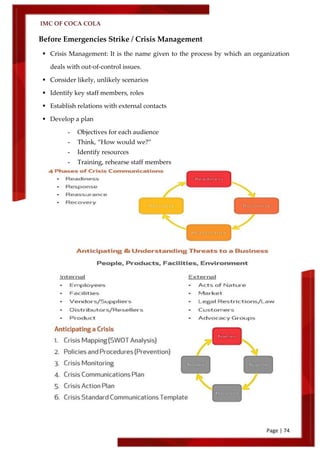
 Crisis Management: It is the name given to the process by which an organization
deals with out-of-control issues.
 Consider likely, unlikely scenarios
 Identify key staff members, roles
 Establish relations with external contacts
 Develop a plan
- Objectives for each audience
- Think, ‚How would we?‛
- Identify resources
- Training, rehearse staff members
IMC OF COCA COLA
Page | 75
COCA COLA’S CRISIS COMMUNICATION
THE PESTICIDE CONTROVERSY
Coca Cola had suffered in the Indian market
because of the pesticides controversy that
took place in the year 2003 that resulted in 11
percent decline in the sales during that time. It
had a very negative impact on Coca-Cola’s
brand image in the minds of the Indian
consumers [8]. This was claimed by CSE that
Coca Cola had 25% pesticide content
On August 5, 2003, The Center for Science and Environment (CSE), an NGO in India,
attacked the safety of Coca-Cola India’s products in a press release titled ‚Twelve Major
Drink Brands Sold in and Around Delhi Contain a Deadly Cocktail of Pesticide
Residues.‛
STRATEGY COMMUNICATION TO CRISIS
The company successfully overcame the biggest challenge it faced in the year 2003 of
the pesticide controversy. They hired Aamir Khan and Smriti Irani - popular TV actor
at that time to ensure that customers retain the faith they had in the market. They
showed commercial where Aamir is given a tour of the Coca-Cola factory and is briefed
about the 400 quality control tests that are a part of the production process to convince
the customers that the brand they are consuming is totally safe for them.
IMC OF COCA COLA
Page | 76
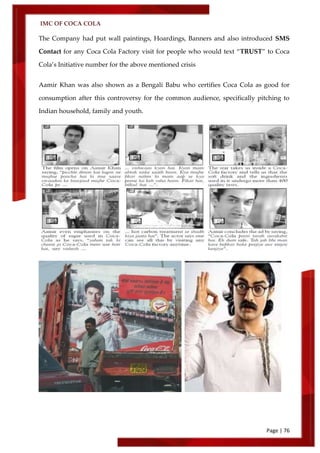
The Company had put wall paintings, Hoardings, Banners and also introduced SMS
Contact for any Coca Cola Factory visit for people who would text ‚TRUST‛ to Coca
Cola’s Initiative number for the above mentioned crisis
Aamir Khan was also shown as a Bengali Babu who certifies Coca Cola as good for
consumption after this controversy for the common audience, specifically pitching to
Indian household, family and youth.
IMC OF COCA COLA
Page | 77
WATER POLLUTION AND THE OVER-EXTRACTION OF GROUNDWATER
Coca-Cola was also accused of causing water shortages in – among other areas – the
community of Plachimada in Kerala, southern India. In addition, Coca-Cola was
accused of water pollution by discharging wastewater into fields and rivers
surrounding Coca-Cola’s plants in the same community. Groundwater and soil were
polluted to an extent that Indian public health authorities saw the need to post signs
around wells and hand pumps advising the community that the water was unfit for
human consumption[8]
In 2000, the company established its production operations in Plachimada. Local people
claimed that they started experiencing water scarcity soon after the operations began.
The state government initiated proceedings against Coca-Cola in 2003, and soon after
that the High Court of Kerala prohibited Coca- Cola from over-extracting
groundwater.[8] By 2004 the company had suspended its production operations, while
it attempted to renew its licence to operate. Coca-Cola argued that patterns of
decreasing rainfall were the main cause of the draught conditions experienced in the
area. After a long judicial procedure and ongoing demonstrations, the company
succeeded in obtaining the licence renewal to resume its operations[8] In 2006 Coca-
Cola’s successful re-establishment of operations was reversed when the government of
Kerala banned the manufacture and sale of Coca-Cola products in Kerala on the ground
that it was unsafe due to its high content of pesticides.[8] However, the ban did not last
for long and later that same year the High Court of India overturned Kerala’s Court
decision.[8]
After overcoming all these challenges, Coca-Cola was again set to expand India as a
market further and took it from number 7 in the global pecking order to a market that is
number 5 for Coca-Cola globally and for achieving this objective the company has
earmarked US$ 5 billion for ensuring that the company is not letting go its focus on
developing the Indian market further successfully
IMC OF COCA COLA
Page | 78
COCA-COLA’S CSR POLICIES POST-CONFLICTS
Two years before the water conflict in India in 2003, Coca-Cola adopted the GRI
Guidelines and started reporting on sustainability. By 2003, the company had already
experienced a few CSR-related conflicts in other parts of the world.[8] However, none
of them had the grave consequence of a loss of trust in the company and its products by
consumers and the public in general.
In 2008 the company published its first environmental performance report on
operations in India, which covered activities from 2004 to 2007[8] It also created the
Coca-Cola India Foundation, ‚ANANDANA‛, which works with local communities
and NGOs to address local water problems. [8] But perhaps the most outstanding
change of strategy by Coca-Cola consisted of launching various community water
projects in India. An example is the rainwater harvesting project, where Coca-Cola’s
operations partnered with the Central Ground Water Authority, the State Ground
Water Boards,NGOs and communities to address water scarcity and depleting
groundwater levels through rainwater harvesting techniques across 17 states in India.
These techniques consist mainly of collecting and storing rainwater while preventing its
evaporation and runoff for its efficient utilisation and conservation. The idea behind
this is to capture large quantities of good quality water that could otherwise go to
waste. By returning to the ecosystem the water used in its operations in India through
water harvesting, the company expected that this project could eventually turn the
company into a ‘net zero’ user of groundwater by 2009[8]
IMC OF COCA COLA
Page | 79
IMC OF COCA COLA
Page | 80
IMC OF COCA COLA
Page | 81
CHAPTER – 7
COCA COLA CORPORATE SOCIAL RESPONSIBILITY
There is no clear definition of CSR. In Corporate Social Responsibility, Legal and semi-
legal frameworks supporting CSR Lambooy gives an overview of several definitions of
CSR.1 The European Commission defines CSR as ‘the responsibility of enterprises for
their impacts on society’.[9]
Corporate Social Responsibility is the continuing commitment by business to behave
ethically and contribute to economic development while improving the quality of life of
the workforce and their families as well as of the local community and society at large
• Corporate Conscience
• Corporate citizenship
• Social performance
• Sustainable responsible business
The Coca Cola Company used large amounts of water and energy in its beverage
production and tons of packaging material for its products, it had taken up several
initiatives to act as a responsible company and reduce its environmental impact. In
addition to water, energy, and sustainable packaging, Coca-Cola India also focused on
several community initiatives in India as part of its social responsibility initiatives.
IMC OF COCA COLA
Page | 82
Their Sustainability Framework – which they call ‚Me, We, World‛– is their shared
vision for how they can work together to create social value and make a positive
difference for the consumers and communities they serve. [13]
Me
Enhancing personal well-being
Our longstanding commitment to consumers’ well-being begins with ensuring that
each and every beverage we deliver is safe, delicious and refreshing. Further, we
work to inspire consumers to pursue happier, healthier lives—and provide
opportunities to do so—through the wide variety of products we offer, our
transparent labeling practices, our responsible marketing practices and the many
physical activity programs we support around the world.
We
Building stronger communities
Community well-being for us means more than just giving back to the community -
we firmly believe that our businesses are only as strong as the communities which
we serve. Women play a crucial role in our value chain; we believe that unleashing
the entrepreneurial potential of women is one of the surest ways to make our
business sustainable and also create lasting impact on families and communities.
Through suitable training programs, we are assisting retailers keep pace with
changing customer preferences. We are also contributing to the development of
local communities, through need-based programs – such programs are focused on
education, enhancement of employability and well-being. Respecting human and
workplace rights is yet another key constituent of the ‘We’ pillar.
World
Protecting the environment
Water is a top sustainability and business priority for Coca-Cola. It is critical to the
communities we serve and the ecosystems on which we all depend, and hence, finds
a special place in our approach to sustainability. The Coca-Cola system in India has
been working with a variety of partners to reduce and recycle packaging material.
Project Unnati, a sustainable agriculture project, has been helping Mango farmers in
Andhra Pradesh adopt modern farming techniques like drip irrigation and Ultra-
High Density Plantation. The project substantially increases mango yield and
enhances farmer income. Our bottling locations are also focused on energy efficiency
and adoption of renewable energy, thereby reducing our carbon footprint.
IMC OF COCA COLA
Page | 83
ANANDANA – Water Conservation
Anandana – Coca-Cola India Foundation, a Company registered under Section 25 of the
Companies’ Act, is a wholly owned not for profit charitable subsidiary of CCIPL.
Anandana provides monetary grants and other assistance to civil society organizations,
cooperatives, philanthropic organizations and such others who can be suitable partners
in implementing projects for social welfare.
Anandana focuses on supporting social projects in the domains of water sustainability
and the spread of new and renewable energy sources. Geographically, Anandana
focuses on some of the most backward regions of the country.
Anandana constantly aspires to ensure project execution, maintenance and
sustainability through active involvement and direct participation of the beneficiary
community at the grass-root level. Anandana is housed in the same premises as CCIPL
(at the Corporate Office in Gurgaon). Anandana’s website http://www.anandana.org
Conserve Water , watershed protection, rainwater harvesting projects. 110 recharge
shafts that collected rainwater. Reverse filter system. The company initiated drinking
water projects in Maharashtra and Gujarat to provide potable water to the local
communities.[13]
IMC OF COCA COLA
Page | 84
5by20 Programs
WOMEN’S ECONOMIC EMPOWERMENT – ENERGY
1. eKOcool Solar Cooler program:
‘eKOcool’ is an innovative solar cooler that has been pioneered by us and provides
income generating opportunity for women retailers in electricity deficit areas of rural
India. The solar coolers also help reduce the cost of running retail business since no cost
is incurred on account of electricity or ice procurement, used to chill beverages. The
cooler has in-built charging ports for mobile phones and a solar lantern (which
facilitates the retailer to keep her store open even after the sunset). Over 1,000
eKOcool units have been installed across 5 states in India in women run outlets by the
end of 2013
‘eKOfreshment’ reduces energy consumption and emission of GHGs by refrigeration.
‘eKOfreshment’ is cooler that uses technologies devoid of hydro fluorocarbons. GHG
emission reduced by three-fourths increasing the energy efficiency of its equipment by
40 to 50%
IMC OF COCA COLA
Page | 85
IMC OF COCA COLA
Page | 86
2. Parivartan:
This program is focused on building the retailing capabilities of women entrepreneurs
especially in the areas of cash and, stock management; shop management and customer
interactions. The program is conducted by the Coca-Cola University, in mobile buses
that have been converted into classrooms. The buses travel across remote parts of rural
India. In 2013, the program got a major impetus when we celebrated International
Women’s Day by organizing retail training programs for more than 1,400 women
retailers in a single day across India and Nepal. The program was scaled-up
substantially in 2013 and close to 10,000 women retailers were trained during the year.
IMC OF COCA COLA
Page | 87
3. Pragati:
Pragati program is also focused on building the retailing capabilities of women
entrepreneurs by providing training, product knowledge and business start-up support
to women retailers. The program is conducted by HCCBPL, mostly in bottling plants in
remote parts of rural India. Over 13,000 women have been supported under this
program by the end of 2013.
IMC OF COCA COLA
Page | 88
4. Unnati:
In addition to the retailer segment of the value chain, CCIPL is also supporting
producers through Project Unnati, a supply chain initiative that would enable 10,000
women mango farmers to adopt modern farming techniques and good agricultural
practices (please refer the section on Sustainable Sourcing for further details of the
program). Around 1,000 women have been covered under this initiative till end 2013
Since 5by20 began, we have enabled more than 26,000 women across our value chain
through business skill enhancement, access to assets and networking and mentoring.
The Program received the World CSR award and was featured as a best practice by the
Ministry of Corporate Affairs for empowering women retailers in the distribution value
chain in an environment friendly way.
IMC OF COCA COLA
Page | 89
COMMUNITIES:
The Coca-Cola India is also undertaking some projects as a part of their social cause
and part of the corporate social responsibility. The support my school campaign along
with NDTV has Sachin Tendulkar as the brand ambassador.
• A commitment to the community was part of Coca-Cola India’s CSR
• In 2003,launched Jagriti Learning Centers to provide education to more than 1,800
children residing near its bottling facilities in Pune
• The initiative aimed to curb waterborne diseases
• It set up around 2,000 schools for children
IMC OF COCA COLA
Page | 90
IMC OF COCA COLA
Page | 91
World Protecting the Environment
 Water Stewardship Working to protect watersheds, reduce risks to water
supplies and moving towards balancing our water use
 Sustainable Packaging Our efforts to reduce our materials use, source recycled
and renewable materials and build a restorative packaging system.
 The Coca-Cola System in India offers its beverages in Returnable Glass Bottles
(RGB’s), Aluminium cans, PET bottles and tetra packs. In excess of 50% of our
beverage sale takes place in RGB packaging, which is completely recovered
from the market (except for breakages).
 Climate Protection Working to reduce our impacts and partnering to take action
against climate change.
 Sustainable Agriculture Helping to ensure a sustainable supply of ingredients,
while supporting farmers and agricultural communities.
IMC OF COCA COLA
Page | 92
HEALTH
• Provided health checkups, medicine, and education to rural communities on health-
related topics
• Company conducted blood donation camps and supported a 24-hour emergency
service for children
• In a few districts of Andhra Pradesh, conducted camps for Hepatitis B vaccinations,
eye checkups, and malaria eradication
COCA COLA CSR PARTNERSHIP
• Coca-Cola takes its corporate responsibilities seriously and works in partnership
with a number of organizations. These include:
• The Bharatiya Agro Industries Foundation. (B.A.I.F)
• The United Nations Human Settlements Programme (UNHABITAT)
• SOS Children's Village of India
• The Forum for Organized Resource Conservation & Enhancement (FORCE)
• WWF, WRAP, The Carbon Trust, Special Olympics, Thames21, Street Games,
Save the Children
IMC OF COCA COLA
Page | 93
AWARDS AND ACCOLADES ON CORPORATE SOCIAL RESPONSIBILITY
IMC OF COCA COLA
Page | 94
IMC OF COCA COLA
Page | 95
CHAPTER – 8
INTEGRATED MARKETING COMMUNICATION STRATEGY
Why Integration?
Organizations are looking for a ‚total solutions‛ communications approach to
solving business problems. There is a demand for comprehensive, seamless
campaigns
The Communication process Models
Macromodel
 Selective Attention
Selective attention is when audience only sees what they want to see out of the clutter
of the ads. Eg. A person who wants to buy Bike will not pay attention to any Laptop
ads.
 Selective Distortion
When the attention of the audience is deliberately captured because they are willing to
take a break from the actual presentation they see. Eg. While watching a movie if
someone calls then then picking the call is selective Distortion. Not to see what you
don’t want to recall.
 Selective Retention
Selective retention is recalling selected number of product or brand while coming
through a range of them. Eg. While recollecting medium makes it a reflexive action, we
can recall only selective brand and its slogan like ‚Thanda Matlab Coca Cola‛
Micromodel
Learn-feel-do –
High involvement with the product category - purchasing a house or an automobile
Do-feel-learn –
Audience has high involvement but perceives little or no differentiation within the
product category – purchasing an airline ticket or a computer.
Learn-do-feel –
Low involvement and perceives little difference within the product category –
purchasing salt or batteries
IMC OF COCA COLA
Page | 96
Steps in Marketing Communications Development
1. IDENTIFY THE TARGET AUDIENCE - It includes assessing the audience’s
perceptions of the company/product image and competitor’s company/product
image
2. DETERMINE OBJECTIVES OF COMMUNICATION
 Category needs (I-pod, Laptop)
 Brand Awareness (Coke)
 Brand Attitude (Rolex, Mountain Dew)
 Brand Purchase Intention (Dettol, Dispirin)
Coca Cola Company focuses on the ‚Brand Awareness‛ factor more while doing any
promotional activity.
3. DESIGNING THE MESSAGE
 Message Strategy (Appeal, Theme, Idea) – Youth, Happiness / Joy, Share Coke
 Content – A Message which would make people persuade to buy Coke
 Structure - Based on the kind of mass medium used
a) Format
Message format decisions vary with the type of media, but may include:
Graphics, visuals, Headline, copy or script, Sound effects, voice qualities, Shape, scent,
texture of package
b) Source
Message source characteristics can influence attention and recall
 Principle of Congruity – Thanda Matlab… Coca Cola, Life ho to Aisi
 Factors underlying perceptions of source credibility: Mass Mediums
c) Creative Strategy
 Informational Appeals – Direct Appeal – Sprite Clear he, Bujhae only Pyaas
 Transformational Appeals – Indirect Appeal – Coke has this approach
IMC OF COCA COLA
Page | 97
4. SELECT COMMUNICATION CHANNELS
a) Personal Communication Channels
Effectiveness derives from personalization and feedback like Mouth publicity. Several
methods of stimulating personal communication channels exist such as business
partnership. Coca Cola has partnership with large variety of food chains which caters
to Coca Cola Products. Eg Mc. Donald’s, Dominos, Real Paprika.
b) Non personal Communication Channels
Influence derives from two-step flow-of-communication process Opinion leader or
celebrity who has an influence on the common public Eg. Aamir Khan, Sachin
Tendulkar, Virendra Sehwang, Farhan Akhtar, Smriti Irani
5. ESTABLISH THE BUDGET
Communications Budget Types
a) Affordability method – Setting the promotion budget at the level management
thinks the company can afford
b) Percentage-of-sales method – Setting the promotion budget at a certain
percentage of current or forecasted sales or as a percentage of the unit sales price
c) Competitive-parity method – Setting the promotion budget to match
competitor’s outlays.
d) Objective-and-task method –
Defining specific promotion objectives – Sales, Branding, Awareness
Determining the tasks need to achieve these objectives – Promotional Activity
Estimating the costs of performing these tasks – Budgeting, Planning, Research
Coca Cola Company has not considered any brand as its competitor including Pepsi, It
only considers WATER as its biggest competition. If you can drink water you can drink
Coca Cola is their dream target. So it uses a combination of Percentage of Sales method
and Objective & Task method for its promotional Budgeting.
IMC OF COCA COLA
Page | 98
6. SELECT THE MARKETING COMMUNICATIONS MIX
a) Communications Mix Selection
Types of promotional tools i.e. Integrated Marketing Tools
 Advertising
 Sales promotion
 Public relations and publicity
 Direct marketing
 Personal selling
 E-marketing
b) Selection factors - Consumer vs. business market
IMC OF COCA COLA
Page | 99
c) Stage of buyer readiness / Decision
i) Pre-purchase Stage - Advertising is most valuable
It informs potential customers about the existence of the product and the seller.
ii) Purchase Stage - Importance of personal selling is highest
Sales promotion can encourage demand for the newly introduced product
iii) Post-purchase Stage - Personal contact after the sale leads to buyer satisfaction.
Advertising and personal selling help reduce post purchase anxiety.
iv) Stage of product life cycle –
7. MEASURE RESULTS
Measure Results - Recognition, recall, attitudes, behavioral responses
8. MANAGE THE IMC PROCESS
 Manage the Integrated Marketing Communications Process
 Provides stronger message consistency and greater sales impact
 Improves firms’ ability to reach right customers at right time with right message
IMC OF COCA COLA
Page | 100
INTEGRATED MARKETING COMMUNICATION PROCESS
Competition
Coca Cola as stated doesn’t consider any other cola company as it competitor except
WATER. Though considering marketing strategies following forms are to be considered
for competition.
Brand
A company views its competitors as other companies offering similar products and
services to the same customers at similar prices Eg. Pepsi
Industry
A company views its competitors as all companies making the same products or class
of products Eg. Fruity, Rasna, Soda Shops, Local Brands etc.
Form
A company views its competitors as all companies manufacturing products that supply
the same service. Eg. Anything providing refreshments like Sugarcane Juice, Fruit Juice,
Lassi, Milk, Ice Cream, Milk Shakes, Amul Cool, Lime Juice etc.
Generic
A company views its competitors as all companies that compete for the same consumer
rupee & Rate. Eg. Any spending done with 10 to 50 rupees on Burger, Drink or
Chocolate
IMC OF COCA COLA
Page | 101
INTEGRATEDPROMOTIONALSTRATEGYOFCOCA-COLA
‘Promotion & Branding’ have played a big role in Coca-Cola’s success. Its advertising has been
rather pervasive, as one of Woodruff’s stated goals was to ensure that everyone on Earth drank
Coca-Cola as their preferred beverage. The most popular words in the world in 20th contrary
are: God, she and Coca-Cola. After the highest popularization of word – ‚OK‛, the second one
is ‚Coca-Cola‛. 98% of the people know ‚Coca-Cola‛. That’s the result of Coca-Cola spending
6 hundred million dollar on promotions.
There are five main ways of promoting the brand – Coca-Cola.
 The first one is traditional advertising, like showing advertisements on TV or posters.
 The second one is the sponsoring of sport events.
 The third one is online promotion.
 The fourth one is selling Coca-Cola’s collections.
 The fifth one is local promotion held by bottlers or retailers.
Although the main promotion in every country still follow this strategy, especially using the
local stars to attract young customers, Coca-Cola begun to use computer technology to make
cartoon images which matches local culture or just funny.
TOOLS OF IMC – PROMOTIONAL MIX
Marketing Communications is a management concept that is designed to make all
aspects of marketing communication such as advertising, sales promotion, public
relations, personal selling and direct marketing work together as a unified force, rather
than permitting each to work in isolation. It’s also known as promotional mix as it uses
360 degree form of mass communication and public appeal in order to promote, brand
and sell any product or services. Promotion mix is a part of IMC its tools are
 Advertising
 Public Relations
 Direct Selling
 Sales Promotion
 Personal Selling
 Internet Marketing
IMC OF COCA COLA
Page | 102
IMC OF COCA COLA
Page | 103
IMC OF COCA COLA
Page | 104
IMC OF COCA COLA
Page | 105
ADVERTISING
Advertising is any paid form of non-personal presentation and promotion of ideas,
goods, or services by an identified sponsor; and it is disseminated through mass
channels of communication.
Continuity, Flighting and Pulsing
• Continuity ( some time call straight-through advertising)
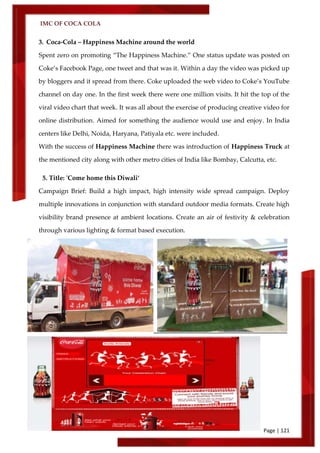
• This pattern is continuous, would be to run one ad everyday for 365 days or 52
weeks
• Continuity is needed when an advertisers has a message that it does not want
consumer to forget.
• Continuous advertising works as a reminder keeping the message always. Other
reason for using continuous is make it possible to take advantage of larger media
discounts granted when so much advertising is purchased
Flighting ( sometime called bursting)
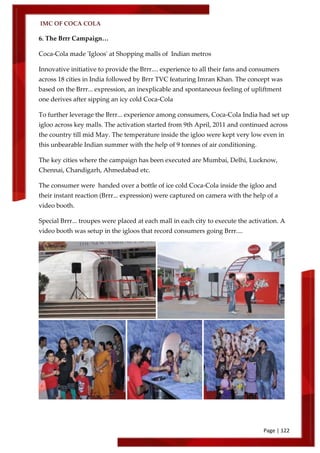
Flighting is an intermittent pattern with gaps of time when no advertising is done
Year time period
IMC OF COCA COLA
Page | 106
PULSING
 Pulsing is a form of flighting and continuity combined . An advertiser buys
continuous advertising throughout the year and heavies up at various propitious
time.
 Pulsing represent the best of both technique.
• It is a mixture of continuity and flighting
• Fit to categories which there are sold all year round.
DIFFERENT MEDIA OF ADVERTISING
Print Electronic Digital/ New Media
Newspaper Televison Internet websites
Handbill Radio CD/ DVDs of films and music
Poster Cable Network Cell Phones
Banner (paper, cloth) Cinema
Pamphlet
Brochure
Leaflet
Books
Magazines
Print Ads – Coca Colas Print ads are theme based and display mostly family find and
happiness. It’s tag line is ‚Spreading Happiness‛ – ‚Baato Khushiya‛. Print ads in
News Paper, Magazine have always been a source of recollection to its consumers.
Display of Celebrity like Movie stars and Cricketers adds to its appeals
IMC OF COCA COLA
Page | 107
IMC OF COCA COLA
Page | 108
IMC OF COCA COLA
Page | 109
COCA COLA IN MOVIES – COVERT ADVERTISING - PRODUCT PLACEMENT
Product placement, which has become an established marketing tactic due to its clear
effectiveness in building brand recall and recognition, is not just for Hollywood.
Hollywood‟s ‚big players‛ of product placement also play in Bollywood. Coca Cola in
India, for instance, has benefited from placement in movies along with a celebrity
endorsement with Bollywood movie star Amir Khan and won Pepsi for its market
share
Coca-Cola was ahead of the game even in Bollywood movies. In a scene from the film
Shree 420 (1955) when Raj Kapoor, the protagonist, enters Mumbai for the first time, a
large Coca-Cola banner was visible right above his head. In the movie, An Evening in
Paris (1967), Coca-Cola was featured more than once. Product placement, as the
numbers suggests is bringing revolutionary change in entertainment economics.
However, it was Taal(1999) by Subhash Ghai, which played the same role in Bollywood
.It was after Coca-Cola‟s placement in Taal that people started becoming aware of the
practice of product placement..
The most successful movie branding for Coca-Cola in India was probably that of Rang
De Basanti.
IMC OF COCA COLA
Page | 110
Bollywood Movies:
• Shree 420,
• Kaho Naa Pyar Hai,
• Rang De Basanti,
• Taal,
• Yadeein
• Kuch Naa Kaho,
• Bobby.
• Shuddh Desi Romance
• Dhoom 2 – 3
• Aashique 2
Hollywood Movies :
• Borat, Click,
• Failure to Launch,
• Glory Road,
• Gridiron Gang,
• Hostel,
• Mission: Impossible III,
• Silent Hill, The Covenant,
• The Departed
• Letter to Juliet
• Ted
IMC OF COCA COLA
Page | 111
IMC OF COCA COLA
Page | 112
TV COMMERCIALS
As everybody know that TV is a most common entertaining medium so TV
commercials is one of the most attractive way of doing advertisement. So Coca Cola
Company does regular TV commercials on different channels. Hindi being the national
language and the most spoken language in the country, most of the company’s
advertisements are broadcasted in Hindi language.
Economic Times Bureau Apr 6, 2012, 04.50AM IST NEW DELHI: Brand Coca-Cola now
has two of the country's best-known names in creative advertising, Prasoon Joshi and R
Balki, to create its campaigns. Coca-Cola India has named Balki-led Lowe Lintas and V
Sunil's Weiden + Kennedy as additional advertising agencies to work on the creatives of
brand Coke along with its long-standing agency, Prasoon Joshi's McCann Erickson.
In India Coke slogan ‚Thanda Matlab Coca-Cola‛ has gained reasonable customer attention.
E.g. Thanda Matlab Cola-Cola, Jo chaho ho jae Cola-Cola enjoy, Coca-Cola-Piyo sir utha ke,
Brrrrrrr!!!
The main strategy behind celebrity endorsement is
utilizing the hype of the celebrity along with movie
stars who are in public list. This includes any recent
hit movie and stars associated with it.
Coca Cola’s brand ambassadors are selected based
on any recent movie which is doing good or any
new entry in the Film Federation.
Eg. Hiritik Roshan was Launched in Kaho na Pyaar hein… and was Coca Cola’s brand
ambassador. He was the rising star in movie world in year 2000
IMC OF COCA COLA
Page | 113
Vivek Oberoi made it to hit list when he gave successful movies like Company, Sathiya
Karishma Kapoor had won an award in Dil to Pagal hein and became Coca’s brand face.
Alia Bhatt, Siddharth Malhotra and Varun Dhawan are Coca Cola’s new addition. Aamir Khan
has been full term Celebrity face of Coca Cola till now.
Though celebrity endorsement is not the only mode that Coca Cola has used for its promotion;
Commercials based on various theme such as ‚Brrrr, Come home this Diwali, Umeedo wali
Khushi and most famous recently is haa me Crazy hun….‛
IMC OF COCA COLA
Page | 114
It was projected as a beverage enjoyed by the entire family together through ad
campaigns like ‚Saath Khao Khushiyaan Badao‛. Coca Cola India campaign ‚umeedon
whale Dhoop, sunshine Wali Asha‛ commercials launched in the year 2012 , sells hope
for better tomorrow . The clearly gives a message of hope, growth, shows that every
and any dream is achievable. Similarly the brand also roped in Sachin Tendulkar, as a
‚happiness brand ambassador‛ to support various CSR initiatives the brand is
undertaking .
Besides Flagship coke ad campaign, the brand has focused upon positioning other
umbrella brands i.e Thumbs Up , Limca , sprite and Fanta etc. Salman Khan as the
brand ambassador for Thums up. Coca Cola India has in turn partnered with Salman
Khan’s Charitable foundation ‚Being Human‚ and would be involved in various
philanthropic initiates of the brands. Brand Fanta has been working on Zyada Fanta
Zyada Fun’ tagline and Bollywood actress Asin currently endorses the brand. Kareena
Kapoor was seen promoting Limca in TV commercials. This includes south starts
IMC OF COCA COLA
Page | 115
Out of Home - OOH
Coca Cola has been very active in Out of Home advertising it uses bill boards, posters,
hoardings, transport vehicles etc. to capture the attention of passers-by. Coca Cola is very
much conscious about their billboards and holdings. They have so many sites in different
locations for their billboards.
In India the Coca-cola can be seen painted on walls, bus stands, dhabas etc focusing in rural
areas of India. While passing through highways one would come across many dhabas having
Coca Cola’s poster and boards
IMC OF COCA COLA
Page | 116
IMC OF COCA COLA
Page | 117
IMC OF COCA COLA
Page | 118
PUBLIC RELATIONS
Public relations is defined as a management function which identifies, establishes, and
maintains mutually beneficial relationships between an organization and the public
upon which its success or failure depends. Whereas advertising is a one-way
communication from sender (the marketer) to the receiver (the consumer or the retail
trade), public relations considers multiple audiences (consumers, employees, suppliers,
vendors, etc.) and uses two-way communication to monitor feedback and adjust both
its message and the organization’s actions for maximum benefit. A primary tool used
by public relations practitioners is publicity. Publicity capitalizes on the news value of a
product, service, idea, person or event so that the information can be disseminated
through the news media. This third party ‚endorsement‛ by the news media provides a
vital boost to the marketing communication message: credibility. Articles in the media
are perceived as being more objective than advertisements, and their messages are
more likely to be absorbed and believed.
 The Coca-Cola India is also undertaking some projects as a part of their social
cause and part of the corporate social responsibility. The support my school
campaign along with NDTV has Sachin Tendulkar as the brand ambassador.
 Coca Cola also Sponsors events in cricket and music.
Coca Cola has done various Public Relations Activity among which following are few
as mentioned below
IMC OF COCA COLA
Page | 119
1. Kumbh Mela Sangam – having kiosks of Coca Cola refreshment for people who
visited Kumbh Mela. Coca Cola also had hoardings and Posters displaying it’s Logo
and banners
2. COCA COLA FOOTBALLER HULLOR
As a mark of the football frenzy that grips the city of Kolkata every four years -
announced COCA COLA FOOTBALLER HULLOR adding to the fervour of the FIFA
World Cup 2010. Inviting paras to show off their passion by decorating their
clubs/paras in the theme of their favoured team. Coke canter was touring the city -
visiting paras, asking people to show their passion for football by participating in
contests. Contest Winners were gratified with LCD Televisions & Cash Prizes
IMC OF COCA COLA
Page | 120
Coca Cola Small World Machine
Economic Times Bureau Mar 21, 2013, 03.09AM IST
Coca-Cola vending machine in upscale mall in South Delhi not only dispenses Coke but
will very soon connect India and Pakistan. Once a similar machine is installed in
Karachi or another Pakistan city, users of the two vending machines can see and
virtually touch each other. Coca-Cola had quietly launched an online campaign that
seeks to connect people in not-so-friendly countries through vending machines, starting
with India and Pakistan this year.
"This year, two countries will show that what unites us is stronger than what sets us
apart and come together to share a Coca-Cola," says the commercial launched on
YouTube. This world peace initiative is part of the firm's happiness project. "A moment
of happiness has the power to bring the world together," it says.
IMC OF COCA COLA
Page | 121
3. Coca-Cola – Happiness Machine around the world
Spent zero on promoting ‚The Happiness Machine.‛ One status update was posted on
Coke’s Facebook Page, one tweet and that was it. Within a day the video was picked up
by bloggers and it spread from there. Coke uploaded the web video to Coke’s YouTube
channel on day one. In the first week there were one million visits. It hit the top of the
viral video chart that week. It was all about the exercise of producing creative video for
online distribution. Aimed for something the audience would use and enjoy. In India
centers like Delhi, Noida, Haryana, Patiyala etc. were included.
With the success of Happiness Machine there was introduction of Happiness Truck at
the mentioned city along with other metro cities of India like Bombay, Calcutta, etc.
5. Title: 'Come home this Diwali‘
Campaign Brief: Build a high impact, high intensity wide spread campaign. Deploy
multiple innovations in conjunction with standard outdoor media formats. Create high
visibility brand presence at ambient locations. Create an air of festivity & celebration
through various lighting & format based execution.
IMC OF COCA COLA
Page | 122
6. The Brrr Campaign…
Coca-Cola made 'Igloos' at Shopping malls of Indian metros
Innovative initiative to provide the Brrr.... experience to all their fans and consumers
across 18 cities in India followed by Brrr TVC featuring Imran Khan. The concept was
based on the Brrr... expression, an inexplicable and spontaneous feeling of upliftment
one derives after sipping an icy cold Coca-Cola
To further leverage the Brrr... experience among consumers, Coca-Cola India had set up
igloo across key malls. The activation started from 9th April, 2011 and continued across
the country till mid May. The temperature inside the igloo were kept very low even in
this unbearable Indian summer with the help of 9 tonnes of air conditioning.
The key cities where the campaign has been executed are Mumbai, Delhi, Lucknow,
Chennai, Chandigarh, Ahmedabad etc.
The consumer were handed over a bottle of ice cold Coca-Cola inside the igloo and
their instant reaction (Brrr... expression) were captured on camera with the help of a
video booth.
Special Brrr... troupes were placed at each mall in each city to execute the activation. A
video booth was setup in the igloos that record consumers going Brrr....
IMC OF COCA COLA
Page | 123
7. Jaipur Heritage Fair
Kiosk at Jaipur Heritage Fair in Jaipur City Malls were placed with Traditional theme
and Coca Cola’s corporate identity
IMC OF COCA COLA
Page | 124
IMC OF COCA COLA
Page | 125
8. Coca Cola Year Beginning Meet – 2015
Coca Cola too part in Year Beginning Meet (YBM) 2015 at New Delhi
IMC OF COCA COLA
Page | 126
IMC OF COCA COLA
Page | 127
9. Coca-Cola Fan Park at Deshapriya Fifa World cup 2014
10 Coca-cola-distribution-point
IMC OF COCA COLA
Page | 128
Sponsorship
Coca-Cola India was the official beverage partner of The Commonwealth Games. Has launched
an impactful outdoor campaign in Delhi; NCR. A 45-day campaign rolled out on September 10.
Is complemented by Coca-Cola India also launching its new visual identity system (VIS) and
logo for the Games
Associated with mega sporting events in its efforts to promote healthy, active living and
promoting social cohesiveness.
Partnership with sporting events across the world provides an opportunity to enhance brand
value, build capabilities and further build upon the employee and system pride in being
associated with such sporting events.
By associating with the Commonwealth Games, will have the opportunity to refresh more than
8,000 athletes and delegates and more than 30,000 volunteers who will take part in the Games
IMC OF COCA COLA
Page | 129
IMC OF COCA COLA
Page | 130
IMC OF COCA COLA
Page | 131
DIRECT SELLING
Direct marketing, the oldest form of marketing, is the process of communicating
directly with target customers to encourage response by telephone, mail, electronic
means, or personal visit. Users of direct marketing include retailers, wholesalers,
manufacturers, and service providers, and they use a variety of methods including
direct mail, telemarketing, direct-response advertising, online computer shopping
services, cable shopping networks, and infomercials. Traditionally not viewed as an
element in the promotional mix, direct marketing represents one of the most profound
changes in marketing and promotion in the last 25 years. Aspects of direct marketing,
which includes direct response advertising and direct mail advertising as well as the
various research and support activities necessary for their implementation, have been
adopted by virtually all companies engaged in marketing products, services, ideas, or
persons.
Coca Cola Company has tie up with food joints, multiplexes, restaurants, local grocers
and cold drink vendors in order to sell its soft drink apart from regular sales medium
and channel.
Coca Cola Company makes two types of selling
1. Direct selling
2. Indirect selling
Direct Selling
In direct selling they supply their products in shops by using their own transports.
They have almost 450 vehicles to supply their bottles. In this type of selling company
have more profit margin.
Indirect Selling
They have their whole sellers and agencies to cover all area. Because it is very difficult
for them to cover all area of India by their own so they have so many whole sellers and
agencies to assure their customers for availability of Coca Cola products.
IMC OF COCA COLA
Page | 132
Coca Cola’s Business Partnership for its product’s direct selling
Marketing Intermediaries help the company to promote, sell and distribute its products
to final buyers. They include resellers and distribution channel firms that help the
company find customers or makes sales to them. These include wholesales and
retailers, who buy and resell merchandise.
IMC OF COCA COLA
Page | 133
IMC OF COCA COLA
Page | 134
Point of sale Materials:
 Merchandising is essential to communicate to the consumer at the point of purchase.
 Includes Posters and stickers displayed in different areas
 For providing their product in good manner company has provided infrastructure these
includes:
 Vizi cooler
 Freezers
 Display racks
 Free empty bottles and shells for bottles
Often Local Language is given more preference to appeal the local people especially in
southern states
IMC OF COCA COLA
Page | 135
EYE CATCHING POSITION
Salesman of the Coca Cola company positions their freezers and their products in eye-
catching positions. Normally they keep their freezers near the entrance of the stores.
GETTING SHELVES
They get or purchase shelves in big departmental stores and display their products in
that shelves in that style which show their product more clear and more attractive for
the consumers.
IMC OF COCA COLA
Page | 136
IMC OF COCA COLA
Page | 137
SALES PROMOTION
Sales promotions are direct inducements that offer extra incentives to enhance or
accelerate the product’s movement from producer to consumer. Sales promotions may
be directed at the consumer or the trade. Consumer promotions such as coupons,
sampling, premiums, sweepstakes, price packs (packs that offer greater quantity or
lower cost than normal), low-cost financing deals, and rebates are purchase incentives
in that they induce product trial and encourage repurchase. Consumer promotions may
also include incentives to visit a retail establishment or request additional information.
Trade promotions include slotting allowances (‚buying‛ shelf space in retail stores),
allowances for featuring the brand in retail advertising, display and merchandising
allowances, buying allowances (volume discounts and other volume-oriented
incentives), bill back allowances (pay-for-performance incentives), incentives to
salespeople, and other tactics to encourage retailers to carry the item and to push the
brand.
 Consumer - Oriented sales promotion:
Getting Shelves
Eye Catching Position
Under The Crown Scheme
 Trade - Oriented sales promotion:
Discounts to retailers and stores
Return back allowances
Merchandising assets
Free goods or free tours
Coca Cola has use various mass medium for its sales promotion right from the
beginning of its promotional activities started in India. Following are few of them
 Pio Coca Cola Dekho Karishma – Offering a chance to meet Karishma Kapoor.
 Jo Chae Ho Jae Coca Cola – A Chance to meet Hritika Roshan
 Aish k Saath Cash offer – A chance to meet and dine with Aishwaria Rai
 Dhoom 2 – Drink Coca Cola and win exciting prizes from movie Dhoom -2
IMC OF COCA COLA
Page | 138
IMC OF COCA COLA
Page | 139
IMC OF COCA COLA
Page | 140
Company also do sponsorships with different college and school’s cafes and sponsors
their sports events and other extra curriculum activities for getting market share.
SALES PROMOTION ACTIVITIES:
Coca-Cola Cricket
Cricket the most sought after watched & played game in India. The game of cricket has
been owned by various brands in the industry for the promotion of their products over
a period of time. The Coca-Cola Company developed many TV commercials &
testimonial ads with the player & ran them on the national network during various
cricket matches. This campaign helped Coca-Cola to establish its association with the
game & the players.
There are various other ways through which Coca Cola has promoted itself like,
Unveils special edition Coca-Cola bottle sporting the insignia of Gautam Gambhir
for the fans of Delhi Daredevils team.
Five lucky winners of Coca-Cola’s ongoing ‘Dilhi Dil Se’ consumer initiative wish
‘Best of Luck’ to their favourite team players of Delhi Daredevils. All five lucky
winners got an opportunity to meet Opening batsman & Coca-Cola Brand
Ambassador- Gautam Gambhir, Captain, Delhi Daredevils - Virender Sehwag & All
rounder, Delhi Daredevils.
Coca-Cola is an ‘Associate Partner’ of Delhi Daredevils team. As part of the
partnership, brand Coca-Cola gets featured on the players’ apparel & on their helmets.
IMC OF COCA COLA
Page | 141
IMC OF COCA COLA
Page | 142
INTERNET MARKETING
Internet marketing also referred to as i-marketing, web-marketing, online-marketing or
e-Marketing, is the marketing of products or services over the Internet. The Internet has
brought media to a global audience. The interactive nature of Internet marketing in
terms of providing instant responses and eliciting responses are the unique qualities of
the medium. Internet marketing is sometimes considered to be broad in scope because
it not only refers to marketing on the Internet, but also includes marketing done via e-
mail and wireless media. Management of digital customer data and electronic customer
relationship management (ECRM) systems are also often grouped together under
internet marketing.
Coca-Cola India now with its ecommerce presence
Coke2home.com provides home delivery. First of its kind venture by any FMCG company till
date in India. Initially services will be available only in Ahmedabad providing free home
delivery at minimum order of Rs. 300. Same day delivery is available if ordered before 12 noon.
Can also make order with mobiles through m.coke2home.com.
IMC OF COCA COLA
Page | 143
COCA COLA SOCIAL NETWORKING PRESENCE
IMC OF COCA COLA
Page | 144
IMC OF COCA COLA
Page | 145
IMC OF COCA COLA
Page | 146
IMC OF COCA COLA
Page | 147
IMC OF COCA COLA
Page | 148
IMC OF COCA COLA
Page | 149
IMC OF COCA COLA
Page | 150
UTC SCHEME
UTC mean under the crown scheme, Coca Cola often do this type of scheme and they
offer very handy prizes in it. Like once they offer bicycles, caps, tv sets, cash prizes etc.
This scheme is very much popular among children.
PERSONAL SELLING
Personal selling includes all person-to-person contact with customers with the purpose
of introducing the product to the customer, convincing him or her of the product’s
value, and closing the sale. The role of personal selling varies from organization to
organization, depending on the nature and size of the company, the industry, and the
products or services it is marketing. Many marketing executives realize that both sales
and non-sales employees act as salespeople for their organization in one way or
another. Employee reward programs now reward employees for their efforts in this
regard.
It Has many salespeople, who are individuals representing the company to
communicate, sell, service, and build relationships with customers. These salespeople
promote their product to different customers within their regions, and once they
sustain a customer, they sell their products to them and service them many times per
week. They individuals form close relationships with the customers in order to
continue business with them.
Thus though minimum, the company also thus have many sales people for personal
selling.
Personal Selling Outlets
 Grocery shopping
 Other shopping & services
 Eating and drinking
 Entertainment / Recreation / Leisure
 Travel / Transportation / Hospitality
 Educational
 At Work
IMC OF COCA COLA
Page | 151
CONCLUSION
This paper has studied the related issues in the case of Coca-Cola Company in general,
and their core products Coca-Cola soft drink in particular. The company relies on
media extensively in order to conduct its integrated marketing communication strategy.
The choice of media used by Coca-Cola includes newspapers, magazines, internet,
television, cinema, radio, posters and billboards.
Analysis of images and words used in Coca-Cola marketing campaigns has identified
that these marketing efforts aim to communicate three types of messages. Firstly, Coca-
Cola marketing initiatives aim to communicate a message that this drink is a best
solution to satisfy the thirst. Secondly, Coca-Cola marketing campaigns aim to
communicate a message that drinking Coca-Cola is associated with style, being ‘cool’
and trendy. Thirdly, marketing campaigns devised by Coca-Cola aim to communicate
the message that drinking Coca-Cola is a part of everyday life and that the drink is a
part of a lifestyle.
In supermarkets and convenience stores Coca-Cola has their own fridge which contains
only their products. There is little personal selling, but that is made up for in public
relations and corporate image. Coca-Cola sponsors a lot of events including sports and
recreational activities.
With the advancement of time as there is a shift in the communication process from
traditional media to New Media. Coca Cola is making a good balance between its old
marketing modes as well as integrating it with internet in their website www.coca-
colaindia.com and http://www.hindustancoca-cola.com. The Company is already
focusing on proper use of Social media but considering that it has more relevance to
recollection of its brand rather than sales it should use audio visual media along with
social media i.e. Radio and TV. This would act as a best communication propaganda for
Coca Cola Company
IMC OF COCA COLA
Page | 152
RECOMMENDATION
Even though the Integrated Marketing Communications (IMC) approach has been
successful so far, it can be further enhanced by considering the following
recommendations:
Focusing on people of older age groups in the advertisements. It has been observed
that the main theme of the T.V advertisements revolve around youth consuming coke.
The older people are a part of the advertisement, but they seem to be in the
background. It suggests the idea that older people are not so enthusiastic about having
coke, but youth will definitely consume it.
The launch of New Coke had been quite unsuccessful. The basic problem occurred was
that previously the marketing of coke had been exclusively focusing on the concept of
its originality. By bringing in the new coke, coca cola had indirectly challenged that
concept. People rejected the idea of change in the familiar soft drink. In future,
launching a new product needs to be carefully evaluated. It needs to be understood that
the consumers of coke perceive it as the real thing, and this idea should not be
challenged.
It is vital to keep integrating marketing communication effectively for Coke to continue
its growth and domination in the soft drinks industry. For Coke, it is an advantage to
have millions of loyal customers. By using competitive advantage and a combined
digital strategy, Coke can not only stabilize its territory, but also can create more profit.
Nevertheless, Coke should use their advertising to enhance the message of new
products, such as "Coke Zero" which is a no- calorie alternative to Coke Classic.
Otherwise, ambiguous products may confuse the consumers.
IMC OF COCA COLA
Page | 153
IMC OF COCA COLA
Page | 154
BIBLIOGRAPHY
1) Books: -
I). Levy, Stuart M., ‚Public Relations and Integrated Communication‛
II). Berger, Arthur. ASA, ‚Media Analysis Techniques‛
III). Vilanilam, J.V, ‚Public Relations in India‛
IV). Tripathi, Manoranjan. ‚Public Relations Bridging Technology & Monitoring Public
the Media‛
VI). Haig, Matt. ‚Why Brands Fail‛2005. PDF file, Google books, 2015
VII). Rao, Dr. A.S, ‚Marketing Research‛
2) References
[1] "It's Time to Redefine Integrated Marketing"
February 2014.
[2] Shashidhar, Ajit, Colas’ Countryside Crusade, The Hindu Business Line – Catalyst,
July 3, 2003.
[3] Integrated Brands, Retrieved 5 February 2014.
[4] Mukherjee, et al. 2008
[5] Schultz, Don E.; Schultz, Heidi F. (1998). "Transitioning marketing communication
into the twenty-first century". Journal of Marketing Communications -4th
edition
[6] State-owned broadcaster in India. According to reports it reaches around 70 million
homes.
[7] Shartrujeet .N, Vaid Dixit, Sumita, ‘Thanda III’ – Coke Scores on Naturalness,
www.agencyfaqs.com, September 30, 2002
[8] Torres, Cristina A. Cedillo, “Do Conflicts Affect a Company’s Corporate Social
Responsibility Policy?‛, 2012
[9]European Commission, Communication from the Commission to the European Economic
and Social Committee and the Committee of the regions: A renewed EU strategy 2011-14 for
Corporate Social Responsibility, COM(2011) 681 final, p. 6.
[10]Marketing Management by Kotler, Keller, Koshy and Jha 13th
Edition.
IMC OF COCA COLA
Page | 155
[11]Advertising and Promotion- An integrated marketing communications perspective
6th
Edition by Belch and Belch
[12]Kotlar, Philips. ‚Principles of Marketing‛, 4th
edition, year 2000
[13] Coca Cola Sustainability Report 2013, Downloaded on 26 May 2015
3) Websites: -
[As visited between 8th
April to 31st
May, Last Visited at 31st
May 2015, 7:10 PM IST]
http://www.cocacola.com/India Last Visited at 31st
May 2015, 7:10 PM IST
http://www.hindustancoca-cola.com Last Visited at 31st
May 2015, 7:10 PM IST
http://www.coca-cola.com/ Last Visited at 31st
May 2015, 7:10 PM IST
http://www.twitter.com.com/CocaCola_India Last Visited at 31st
May 2015, 7:10 PM IST
http://www.facebook.com.com/Coca-cola Last Visited at 31st
May 2015, 7:10 PM IST
http://www.flickre.com/Coca-Cola Last Visited at 31st
May 2015, 7:10 PM IST
http://www.coce2home.com Last Visited at 31st
May 2015, 7:10 PM IST
http://www.instagram.com/coca-cola-india Last Visited at 31st
May 2015, 7:10 PM IST
http://www.googleplus.com/Coca-Cola Last Visited at 31st
May 2015, 7:10 PM IST
http://www.youtube.com/cocacola-india Last Visited at 31st
May 2015, 7:10 PM IST
http://www.cokestudio.in Last Visited at 31st
May 2015, 7:10 PM IST
http://www.coca-colacompany.com/brands/coca-cola Last Visited at 31st
May 2015, 7:10 PM
IST
http://www.coca-colacompany.com/our-company/ Last Visited at 31st
May 2015, 7:10 PM IST
http://www.coca-colacompany.com/history/ Last Visited at 31st
May 2015, 7:10 PM IST
http://www.coca-colacompany.com/careers/student-zone Last Visited at 31st
May 2015, 7:10
PM IST
http://www.adex.in Last Visited at 31st
May 2015, 7:10 PM IST
http://www.slideshare.com Last Visited at 31st
May 2015, 7:10 PM IST
http://www.suredividend.com/coca-colas-growth-potential-dividend-analysis/
http://softdrinkcolawar.blogspot.in/
http://www.csrwire.com/archive/our_pick/974 last visited on 9-June-2015

Coca cola imc - dissertation

  • 1.
    DISSERTATION IMC- ANALYSISOF COCA COLA COMPANY Page | 1 INTEGRATED MARKETING COMMUNICATION (IMC) ANALYSIS OF “COCA COLA COMPANY” (Study of Promotional Activity by the Company) Research Conducted By Deepen Upadhyaya Batch – 6, Roll no – 15 Specialization – Advertising, Public Relations & Corporate Communication National Institute of Mass Communication & Journalism Researcher’s Note:- This Paper was prepared under the project of Integrated Marketing communication research for National Institute of Mass Communication as final year academic project. The research was analytical and based on investigating Primary & Secondary data of Coca Cola Company.
  • 2.
    IMC OF COCACOLA Page | 2 CERTIFICATE This is to certify that Mr. Deepen P. Upadhyaya has successfully completed the project work titled ‘Integrated Marketing Communication (IMC) Analysis Of “Coca Cola Company”’ in partial fulfillment of requirement for the award of ‘Post Graduation Diploma in Mass Communication and Journalism’ as prescribed by the ‘National Institute of Mass Communication and Journalism, Ahmedabad’. This project is the record of authentic work carried out by above students as part of college curriculum of Semester –IV; Group – C – Advertising, Public Relations and Corporate Communication as Specialization; during the academic year (2014 – 2015). Signature of Research Guide Mr. Venketesh Iyar (Indian Express - Ahmedabad)
  • 3.
    IMC OF COCACOLA Page | 3 DECLARATION I the undersigned hereby, declare that the project work titled ‘Integrated Marketing Communication (IMC) analysis of ‚Coca Cola Company’ is a result of my research work. Keeping in mind the commonality of the subject where there already are similar project and research papers. I have tried my best to include information, stats, data, photographs which are scouted by me and latest. Thus except few common point which are unavoidable I have given best justice to make this project original work and thus this work has not been previously submitted to any other University or Institute. I hereby, further declare that all information of this document has been obtained and presented in accordance with academic rules and ethical conduct. Deepen P. Upadhyaya Roll No 15, Section – B, Sem – IV, Batch -6, Group C – AD, PR and Corporate Communication National Institute of Mass Communication and Journalism Ahmedabad
  • 4.
    IMC OF COCACOLA Page | 4
  • 5.
    IMC OF COCACOLA Page | 5 ABSTRACT This paper explores the concept of integrating Marketing Communications tools by Coca Cola Company as a customer focused means of promoting & branding its businesses. The Marketing communication tools considered includes advertising, sales promotion, public relations, direct marketing and internet/interactive communications. Earlier, most companies concentrated generally on advertising to communicate to their target customers and seldom used the other communication tools. Some companies used other communication tools but on separate basis which is in contrast to the concept of Integrated Marketing Communication (IMC). This is the hypothesis on which this paper studies how modern firm like Coca Cola use comprehensive integration of marketing communications tools which enhances success through synergistic execution of their marketing communication programs. Available literature indicates that an effective IMC program ensures a successful marketing of a company’s product/service and improves on their brand image as well as corporate image. This again focuses on finding out whether this could be proven practically While numerous studies have been conducted to measure the effectiveness of individual IMC elements, far less attention has been given to examining the boosting effects of multiple marketing communication tools working together, despite the fact that consumers are likely to receive information from a variety of sources. Indeed, one of the fundamental ideas behind IMC is that all of a company’s marketing and promotional activities should project a consistent and unified message and image to the consumer.
  • 6.
    IMC OF COCACOLA Page | 6 PREFACE The project is a part of training in the 4rd semester as a part of Final Project Submission for Group – C ‚Advertising, Public Relations & Corporate Communication‛. I as a student of this group am presenting my research paper which I have researched, prepared during my academics sessions in 4th Semester of Mass Communication and Journalism. It was a learning experience and I am happy to share my findings and conclusion to the institute. The primary aim of this project is to explore the use of marketing communication to build and sustain brands, based on knowledge of how communication works, the institutions which participate in the process, and the practical business processes necessary to achieve and measure defined communication goals. In particular, I will be able to understand the integrated nature of communication and develop a full appreciation of advertising, sales promotion, public relations, publicity and direct marketing in a digital and contemporary environment. Best efforts in preparing this project as finest as possible within a time limit. Greatest efforts are put to understand the needs and problems of the subject of my research. I hope that the concerned authority will kindly accept this project.
  • 7.
    IMC OF COCACOLA Page | 7 ACKNOWLEDGEMENT I wish to take this opportunity to express my sincere gratitude towards all who has helped us profoundly throughout the project work… I want to say special thanks to Prof. Shashikant Bhagat (Group ‚C‛ Head) Mr. Vanketesh Iyar (Project - Mentor) from Indian Express Dr. Shrish Kashikar, (Director NIMCJ) I am thankful to Ms. Sigma Soni for her constant support in my academic work and all other faculty members for their very useful guidance. I am very grateful to … Mr. Urvish Kanthariya – Gujarat Chamber of Commerce & Global Indian Business Council Services LLP Mr. Kedar Vashi – Associate Vice President & Head (Learning & Development) – Hindustan Coca Cola Beverages Pvt. Ltd - Gurgaon For supporting me in my project research and giving his valuable contribution in making this project the best possible. I convey our thanks to National Institute of Mass Communication & Journalism, Ahmedabad for providing the required training and guidance to accomplish the desired output and learn from the experience of this research paper. Thank you… Yours Faithfully, Deepen Upadhyay
  • 8.
    IMC OF COCACOLA Page | 8 Sr. No Index of the Content Page Number 1 Title page 1 2 Certificate 2 3 Declaration 3 4 Certificate from Hindustan Coca Cola Beverages 4 5 Abstract 5 6 Preface 6 7 Acknowledgement 7 8 Index 8 9 Data Flow 9 10 Executive Summary 11 11 Introduction 12 12 Literature Review 14 13 Chapter -1-IMC 20 14 Chapter -2-History 25 15 Chapter -3-Corporate Communication 29 16 Chapter -4-India 37 17 Chapter -5-Strategic Communication 53 18 Chapter -6-Crisis Communication 71 19 Chapter -7- Corp. Soc. Responsibility 80 20 Chapter -8-IMC Strategy 94 21 Advertising 104 22 Public Relations 117 23 Direct Selling 130 24 Sales Promotion 136 25 Internet Marketing 141 26 Personal Selling 150 27 Conclusion 151 28 Recommendation 152 29 Coca Cola at a Glance 153 30 Bibliography 154
  • 9.
    IMC OF COCACOLA Page | 9
  • 10.
    IMC OF COCACOLA Page | 10
  • 11.
    IMC OF COCACOLA Page | 11 EXECUTIVE SUMMARY I as a student of ‚Mass Communication‛ have tried to understand the Integrated Marketing Communication and Cross Cultural Communication by Coca Cola Company in order to establish itself as an integral brand recognized in Indian market. Any Organization true to its brand image carries a set of mission, vision and values to set in minds of people. Integrated Marketing Communication is not just related to external publics but also to internal publics related to the corporation. Integration itself means not just passing on message as communication, rather using all mass medium speaking the same ideology, message and image through various media forms. This research paper consist of understand various aspects of IMC process by Coca Cola Company such as Advertising, Sales Promotion, Direct Selling, Online presence etc. The type of media mix it used and what type of positioning it made for its brand, along with the change in the market. There are graphical as well theoretical examples to add to the validity of this research along with help from experts, representatives of IMC or Coca Cola Company in order to makes the research work more authentic by me.
  • 12.
    IMC OF COCACOLA Page | 12
  • 13.
    IMC OF COCACOLA Page | 13 INTRODUCTION The creation of an Integrated Marketing Communications (IMC) program helps companies to create single, consistent and unified customer focused messages using electronic, print and outdoor media. An effective and efficient execution of an IMC program ensures that the needed awareness of company’s offerings is created. It has been argued that IMC is the foundation of new customer-focused marketing efforts for acquiring, retaining, and growing relationships with customers and other stakeholders (Duncan and Moriarty, 1998). (Moriarty et al, 1994) indicate that the shift toward the IMC perspective has been hailed as one of the most significant changes in the history of advertising and promotion. (Kitchen et al, 2004) also add that it is the major communications development of the last decade of the 20th century. This research tries to discover the approach of Coca Cola Company using Media Mix for its communication to Indian audience. This is done through an analysis of various market studies work by Kotler, Keller and Wind. Further, it is necessary to integrate and target marketing communication even more than the holistic pattern requires and integrate the need to create relationships in the process in which media channels are selected. This is done by integrating branding theory and brand value as the core of any campaign. To test the validity of the above ideas, a case study of one of the market leaders of relations and emotional marketing ‚Coca-Cola‛ is carried out. Coca-Cola's history and marketing techniques examined, and it made framework is tested by being used as the main analytical tool in the analysis of one of Coca-Cola's latest global campaigns.
  • 14.
    IMC OF COCACOLA Page | 14
  • 15.
    IMC OF COCACOLA Page | 15 REVIEW OF LITERATURE A Research review is a part of a research project. It usually opens the research report, but its function is beyond just summarizing and analyzing he literature; it is meant to indicate that there exists a research gap which needs to be filled. This is necessary to show that our research is looking at a problem that is either new or existing without being noticed. Selecting appropriate method is also very important in order to conduct and write a research On Coca Cola ‘If Coca-Cola were to lose all of its production-related assets in a disaster, the company would survive. By contrast, if all consumers were to have a sudden lapse of memory and forget everything related to Coca-Cola, the company would go out of business.’ (Power of Branding, Keller, Page 38, 2002) Each promotional tool has its own characteristics. Marketers must understand these characteristics in selecting their tools. Using Coca-Cola as an example, demonstrate how each of the promotional tools might be used to create an integrated marketing communications approach for the upcoming year. (Philips Kotler - Integrated Marketing Strategies, 2002 edition) Notable Quotes on IMC ‚Once upon a time, when a manufacturer had a dollar for marketing, it was spent on advertising. Today, there are a lot of interesting things that can be done with a marketing dollar. All of these things add up to one big thing called ‘Integrated marketing communications’ – ‘MarCom’ for short. ‚Five forms of marketing communications *are+: Advertising, Public Relations, Direct Response, Sales Promotion, Personal Selling.‛(Bruce Bendinger, The Copy Workshop Workbook, kindle version 2005 edition)
  • 16.
    IMC OF COCACOLA Page | 16 ‚Understanding how to tie the business of advertising to the creative of advertising is one of the basic foundations behind integrated marketing communication (IMC). Creative represents the voice of business and can ultimately determine the success or failure of a product or service in the marketplace.‛ (Robyn Blakeman, Integrated Marketing Communication: Creative Strategy from Idea to Implementation) ‚Advertising is no longer the only thing.‛ ‚Creative represents the voice of business and can ultimately determine the success or failure of a product or service in the marketplace.‛ (Robyn Blakeman, Integrated Marketing Communication: Creative Strategy from Idea to Implementation) ‚One of the major reasons for the growing importance of integrated marketing communications over the past decade is that it plays a major role in the process of developing and sustaining brand identity and equity…. With more and more products and services competing for consideration by customers who have less and less time to make choices, well-known brands have a major competitive advantage in today’s marketplace. Building and maintaining brand identity and equity require the creation of well-known brands that have favorable, strong and unique association in the mind of the consumer. Companies recognize that brand equity is an important an asset as factories, patents and cash because strong brands have the power to command a premium price from consumers as well as investors.‛ (George and Michael Belch, Advertising and Promotion: An Integrated Marketing Communications Perspective) ‚1. IMC is everywhere, whether we like it or not. ‚2. You can never know enough about your customer. ‚3. You can never know too much about your customer. ‚4. Everything is relevant.
  • 17.
    IMC OF COCACOLA Page | 17 METHODS In this section we will understand the method of data generation and collection. The method used in this project is investigation of various Primary Data from Coca Cola Company through their website, video sharing website like YouTube, Metcalfe which are mentioned in the bibliography. Apart from the primary data secondary data is collected through sampling of various research papers, marketing-promotional concept books by well known authors, online web sources like PDF files, presentations etc. is done to understand the concept of IMC and its applications in Coca Cola’s Branding cum promotion. Following methods are useful in getting important information as resource.  Reading Literature of other writers or research papers.  Referring statics of the past few years  Google searching information  Communicating to relevant people in the research areas. I have implied the above means to get towards a conclusion of my research. There have been many debate and discussion over the topic of medium of instruction. Data Collection For the Research purpose I had collected secondary data from online and offline resources which are mentioned in the Bibliography. Among the secondary data the following were the reference material.  Books from well known author from Institute’s Library  Research Paper on Marketing of Cola Brands as well as generic papers  Official websites of the Coca Cola India and Hindustand Coca Cola Beverages  Blogs, Unofficial websites, News Websites etc.
  • 18.
    IMC OF COCACOLA Page | 18 Sampling Method The Data sampling method used here more like Snow Ball sampling as one link and source in online, offline and personal medium lead to further detailing of the required information to complete this project successfully. People related to Coca Cola directly or indirectly were approached for getting their precious feedback and updating of the research paper. Following people were contacted while doing the research study 1) Mr. Kedar Vashi – Associate Vice President & Head (Learning & Development) – Hindustan Coca Cola Beverages Pvt. Ltd – Gurgaon 2) Mr. Smit Dave – Human Resource Manager – Ahmedabad 3) Mr. Tushar Sharma – Former Channel Marketing Team Head - Ahmedabad 4) Dev Parmar – Coca Cola Rural Distributor – Rajkot District Methodology The Procedure of data collection was interacting personally and telephonically the above people and presenting my findings with them for their feedback and correction in case of any modifications required. Apart from this I have personally scouted Locations which displayed the various images of Coca Cola in Wall paintings, Cooler Machine, Vending Machine, Poster and Ice Box for my Case study purpose.
  • 19.
    IMC OF COCACOLA Page | 19 SUBJECT As mentioned the Subject of this research was Coca Cola as a Brand, Company with wide range of products in the Indian market along with a comparative studies of its promotional activities undertaken in various mass media tools such as Advertising, Public Relations, Sales Promotion, and Corporate Communication in order to use a holistic approach for its IMC. Coca-Cola is the most recognized brand name in the world with 94% recognition. This profile has spread with increasing rapidity in recent years as evidenced for example in China, where Coca-Cola became the most recognized trademark in the late 1990s. Today you can buy a Coke almost anywhere from Beijing to Buenos Aires, from Moscow to Mexico City. The Coca-Cola Company sells half of all soft drinks consumed throughout the world. The Coca-Cola Company has, on occasion, introduced other cola drinks under the Coke brand name. The most common of these is Diet Coke, Free, Coca-Cola Cherry, Coca- Cola Zero, Coca-Cola Vanilla, and special versions with lemon, lime or coffee. In 2013, Coke products could be found in over 200 countries worldwide, with consumers downing more than 1.8 billion company beverage servings each day. Based on its reach around the world it has been into Cross Cultural Communication as per the geographical location of the market it is specifically targeting. The main Subject of this research is to know Integrated Marketing Methods with blends of Cross cultural communication done by Coca Cola in a completely diversified country of India. Which would include its journey from the beginning till the present condition along with keeping in mind its product life cycle (PLC). What all strategies were implemented and what kind of innovative measures were developed by Coca Cola.
  • 20.
    IMC OF COCACOLA Page | 20
  • 21.
    IMC OF COCACOLA Page | 21 CHAPTER – 1 What is Integrated Marketing Communications? The American Marketing Association defines Integrated Marketing Communications (IMC) as ‚a planning process designed to assure that all brand contacts received by a customer or prospect for a product, service, or organization are relevant to that person and consistent over time.‛ ‚An approach to achieving the objectives of a marketing campaign, through a well coordinated use of different promotional methods that are intended to reinforce each other‛ IMC in Marketing IMC is a strategic marketing process specifically designed to ensure that all messaging and communications strategies are unified across all channels and are centred around the customer. The IMC process emphasizes identifying and assessing customer prospects, tailoring messaging to customers and prospects that are both serviceable and profitable, and evaluating the success of these efforts to minimize waste and transform marketing from an expense into a profit-centre. A more contemporary definition states, "True IMC is the development of marketing strategies and creative campaigns that weave together multiple marketing disciplines (paid advertising, public relations, promotion, owned assets, and social media) that are selected and then executed to suit the particular goals of the brand. Instead of simply using various media to help tell a brand's overall story, with IMC the marketing leverages each communication channel's essential strengths to achieve a greater impact together than each channel could achieve individually. It requires the marketer to understand each medium's limitation, including the audience's ability/willingness to absorb messaging from that medium. This understanding is integrated into a campaign's strategic plan from the very beginning of planning - so
  • 22.
    IMC OF COCACOLA Page | 22 that the brand no longer simply speaks with consistency, but speaks with planned efficacy. This concept inherently provides added benefits that include: a singular/synchronized brand voice and experience, cost efficiencies generated through creativity and production, and opportunities for added value and bonus. Why Integrated Marketing Communications? Five major shifts in the worlds of advertising, marketing and media have caused an increased interest in (and need for) IMC. These include: A shift From… To… Traditional Advertising Digital/Interactive Media Mass Media Specialized Media Low Agency Accountability High Agency Accountability Traditional Compensation Performance-Based Compensation Limited Connectivity Pervasive Connectedness These shifts are forcing organizations to look at the whole marketing picture, re- aligning their communications and seeing things the way the consumer sees them – as a constant flow of information from indistinguishable sources. Those who practice IMC are avoiding duplicate messages, capitalizing on the synergy among promotional tools, creating more effective marketing programs and maximizing ROI. IMC weaves diverse aspects of business and marketing together. These include:  Organizational culture 1) The organization's vision and mission 2) Attitudes and behaviors of employees & partners 3) Communication within the company
  • 23.
    IMC OF COCACOLA Page | 23  Four P’s & C's of Marketing mix Four P’s Four C’s Product Consumer Price Cost Place Convenience Promotion Communication  Advertising Broadcasting/mass advertising: broadcasts, print, internet advertising, radio, Television commercials Outdoor advertising: billboards, street furniture, stadiums, rest areas, subway Advertising, taxis, transit Online advertising:- mobile advertising, email ads, banner ads, search engine result Pages, blogs, newsletters, online classified ads, media ads
  • 24.
    IMC OF COCACOLA Page | 24  Direct marketing: direct mail, telemarketing, catalogs, shopping channels, internet sales, emails, text messaging, websites, online display ads, fliers, catalog distribution, promotional letters, outdoor advertising, telemarketing, coupons, direct mail, direct selling, grassroots/community marketing, mobile  Online/internet marketing  E-commerce  Search engine optimization (SEO)  Search engine marketing (SEM)  Mobile Marketing  Email marketing  Content marketing Social Media (Facebook, Twitter, LinkedIn, Google +, Foursquare, Pinterest, YouTube, Wikipedia, Instagram)  Public Relations :- Special events, interviews, conference speeches, industry awards, press conferences, testimonials, news releases, publicity stunts, community involvement, charity involvement & events  Sales Promotions:- Contests, coupons, product samples (freebies), premiums, prizes, rebates, special events  Trade shows:- Booths, product demonstrations  Corporate Social Responsibility :- Donations, volunteering, charitable actions When these diverse aspects of business and marketing are weaved together properly an effective campaign can be achieved. Effective campaigns are demonstrated on the Integrated Brands showcase which recognizes brands that are innovative, strategic and successfully growing their sales.[3]
  • 25.
    IMC OF COCACOLA Page | 25
  • 26.
    IMC OF COCACOLA Page | 26 CHAPTER -2 COMPANY’S HISTORY The Coca-Cola Company traces it’s beginning to 1886, when an Atlanta pharmacist, Dr. John Pemberton, [to the right] began to produce Coca-Cola syrup for sale in fountain drinks. However the bottling business began in 1899 when two Chattanooga businessmen, Benjamin F. Thomas and Joseph B. Whitehead, secured the exclusive rights to bottle and sell Coca-Cola for most of the United States from The Coca-Cola Company. The Coca-Cola formula and brand was bought in 1889 by Asa Griggs Candler [to the left] (December 30, 1851 - March 12, 1929), who incorporated The Coca-Cola Company in 1892. Besides its namesake Coca-Cola beverage, Coca- Cola currently offers more than 500 brands in over 200 countries or territories and serves over 1.7 billion servings each day. The company operates a franchised distribution system dating from 1889 where The Coca-Cola Company only produces syrup concentrate which is then sold to various bottlers throughout the world who hold an exclusive territory. The Coca-Cola Company owns its anchor bottler in North America, Coca-Cola Refreshments
  • 27.
    IMC OF COCACOLA Page | 27 COCA COLA AROUND THE WORLD AND INDIA The Coca-Cola Company is the world's largest beverage company. Along with Coca- Cola, recognized as the world's most-valuable brand, the Company markets four of the world's top five soft drink brands, including Coke, Fanta, Sprite plus a wide range of other beverages, including diet, light soft drinks, water, juices, juice drinks, tea, coffee and sports drinks. Through one of the world's largest beverage distribution system, consumers in more than 200 countries enjoy the Company's beverages at a rate exceeding 1.8 billion servings each day. Coca-Cola in India is the country's leading beverage Company with an unmatched portfolio of beverages. The Company manufactures and markets leading beverage brands like Coca-Cola, Diet Coke, Thums Up, Fanta, Limca, Sprite, Maaza, Minute Maid Pulpy Orange, Minute Maid Nimbu Fresh, Minute Maid 100%, Burn, Kinley and Georgia range of tea and coffee. One of the early investors in India, the Coca-Cola system provides direct and indirect employment to more than 1, 50,000 people. The Company has more than 2.2 million retailers and our business has a multiplier effect on employment and earning opportunities. The Company's business also positively impacts industries like glass, plastics, resin manufacturers, sugar, automobiles, white goods manufacturers, banking etc. At the heart of business is a mission statement called the Coca-Cola Promise - "The Coca-Cola Company exists to benefit and refresh everyone that it touches". This basic proposition entails that the Company's business should refresh the markets, protect, preserve and enhance the environment and strengthen the community. Coca-Cola in India provides extensive support for community programs across the country, with a focus on education, health and water conservation. The system has installed more than 500 rain water harvesting structures in the country. The system has also undertaken the rejuvenation and reconstruction of several traditional water bodies including check dams. The Coca-Cola system is committed to work with communities across India in its effort to contribute to mutual growth and development.
  • 28.
    IMC OF COCACOLA Page | 28 COCA COLA INDIA ORGANIZATION STRUCTURE
  • 29.
    IMC OF COCACOLA Page | 29
  • 30.
    IMC OF COCACOLA Page | 30 CHAPTER - 3 COCA COLA CORPORATE COMMUNICATION CORPORATE IMAGE Corporate image is the perceived sum of the entire organization - its objectives and plans. It encompasses products, services, management style, communications activities and actions around the world. G.a. marken An image is the set of meanings by which an object is known and through which people describe, remember and relate to it. That is the result of the interaction of a person’s beliefs, ideas, feelings and impressions about an object. (Dowling, 1986) CORPORATE IDENTITY • The way in which an organization presents itself  Symbols  Communication  Behavior • Referred to as Corporate Identity (CI) Mix • Personality manifested through this mix
  • 31.
    IMC OF COCACOLA Page | 31 CORPORATE IDENTITY MEDIA • Product • Price • Logos • Name • Stationery • Brochures • Signs IMPORTANCE OF IDENTITY • Raises motivation among employees • Inspires confidence in stakeholder groups • Acknowledges important role of customers • Acknowledges vital role of financial groups THE THREE I’S - MISSION ORIENTED • Identity: Who we are • Image: What we are • Ideas: What we stand for and believe In the year 1886, May 8th, Coca‑Cola was created by John S. Pemberton and served at Jacobs’ Pharmacy. Company accountant, Frank Robinson, names the drink ‚Coca‑Cola,‛ and thinking the two Cs would look well in advertising, pens the famous Spencerian script logo. From then on the Company’s Logo also evolved according to the change of time. Following are the logos year wise Coca Cola Logo • Visit cards • Buildings • Uniforms • Sponsorship • Packaging • Work environment • Figure or
  • 32.
    IMC OF COCACOLA Page | 32
  • 33.
    IMC OF COCACOLA Page | 33 Brand Identity The first step in understanding Image Advertising is to understand the image being created, i.e. Brand Image. Brand Image is consumers’ perception of the brand in question. There are a number of tools available to explore the identity of a brand. One such tool is Kapferer’s Prism. As shown in the exhibit above, there are many facets to a brand. Kapferer identifies six key characteristics that together define the brand: Physique – the physical attributes of the brand – Shape, Logo, Colour Personality – the personification of the brand – Refreshing Happy Relationship – the relationship between the consumer and the brand Culture – the core values of the brand – Social, Sharing, Family Value Reflection – the way consumers want to be perceived when using the brand Self-Image – the image that consumers have of themselves when associated with the brand A combination of these characteristics can be used to identify what the brand ultimately stands for.
  • 34.
    IMC OF COCACOLA Page | 34 The Contour Bottle The tremendous success and growth of Coca‑Cola encouraged other competitors to try to imitate Coke by offering bottles with slight variations on the trademarked name and distinctive script logo. Koka-Kola, Koca-Nola, Celery-Cola and Koke were just a few of the products thattried to capitalize on our success. Working with our bottlers, The Coca‑Cola Company asked bottle manufacturers to submit designs for a bottle for Coca‑Cola that was so distinctive that it could be recognized by feel in the dark or identified lying broken on the ground. Alexander Samuelson of the Root Glass Company in Terre Haute, Indiana, designed the distinctive shape, and it was patented on November 16, 1915. The bottle was modified and slimmed down to work with the current bottling equipment and went into broader production in 1916. This contour bottle was the only packaging used by The Coca‑Cola Co for 40 years until the king-size package was introduced in 1955.
  • 35.
    IMC OF COCACOLA Page | 35 In 1960, the contour bottle was granted registration as a trademark by the U.S. Patent Office. Today, it is still the most recognized bottle in the world, and the shape is used for packaging from the new aluminum can to the 2-liter family size.
  • 36.
    IMC OF COCACOLA Page | 36 COCA COLA INDIA - PRODUCT RANGE Coca has been catering to variety of audience. When it arrived in India its first act was to get maximum share of Parle Company and its 60 bottling plants along with India’s top ranking soft drinks of that time i.e. Thums Up, Maaza, Limca etc. Coca Cola Company currently caters to following list of product in India
  • 37.
    IMC OF COCACOLA Page | 37
  • 38.
    IMC OF COCACOLA Page | 38 CHAPTER - 4 India and Cross Cultural Communication ‚The integrated sum total of learned behavioral traits those are manifest & shared by members of society‛ OR ‚The way in which people in a society collectively attach meanings to concepts & contexts around them & respond on the basis of those meanings‛ • India is a confluence of cultures. There are 29 states and 7 Union Territories, each as different as another country • The home of one of the world's oldest living civilizations, and several of the world's great religions. Vast diversity in art, architecture, music & dance, customs, food and clothing • Hindi is the official language, Spoken in most of the urban cities of India and by 45% Population • The Constitution of India has recognized 22 different languages that are prevalent in the country. There are 844 dialects that add to the multilingual nature of the country • English enjoys associate status but is the most important language for national, political and commercial communication. Most of the educated Indians speak English, with varying fluency, along with one local language • India has been changing, re-shaping and re-inventing itself for as long as anywhere on earth, forever producing new forms of culture and absorbing new influences from all directions Components of culture Social Interaction Language Aesthetics ReligionEducation Value System Material Life
  • 39.
    IMC OF COCACOLA Page | 39 COKE IN INDIA Coca-Cola was the leading soft drink brand in India until 1977 when it left rather than reveals its formula to the government and reduces its equity stake as required under the Foreign Exchange Regulation Act (FERA) which governed the operations of foreign companies in India. After a 16-year absence, Coca-Cola returned to India in 1993, cementing its presence with a deal that gave Coca-Cola ownership of the nation's top soft-drink brands and bottling network. Coke’s acquisition of local popular Indian brands including Thumbs Up (the most trusted brand in India), Limca, Maaza, Citra and Gold Spot provided not only physical manufacturing, bottling, and distribution assets but also strong consumer preference. This combination of local and global brands enabled Coca-Cola to exploit the benefits of global branding and global trends in tastes while also tapping into traditional domestic markets. Leading Indian brands joined the Company's international family of brands, including, Maaza, Limca, Sprite and Fanta. In 2000, the company launched the Kinley water brand and in 2001, Shock energy drink and the powdered concentrate Sunfill hit the market.
  • 40.
    IMC OF COCACOLA Page | 40
  • 41.
    IMC OF COCACOLA Page | 41 Company Overview Type Soft Drink (Cola) Manufacturer The Coca- Cola Company Founder (s) John S. Pemberton Country of Origin United States, Atlanta Georgia Introduced 1886 Area Served Over 200 countries Color Caramel E-150d Flavors Cola, Cola Green Tea, Cola Lemon, Cola Lemon Lime, Cola Lime, Cola Orange and Cola Raspberry. Employees 92,400 Licence Of 500 Brands in 200 Countries Product Type A leading manufacturer, distributor and marketer of non-alcoholic beverage concentrates & syrups Website www.coca-cola.com Servings per Day 1.6 Billion VISION • People: Be a great place to work where people are inspired to be the best they can be. • Portfolio: Bring to the world a portfolio of quality beverage brands that anticipate and satisfy people's desires and needs. • Partners: Nurture a winning network of customers and suppliers, together we create mutual, enduring value. • Planet: Be a responsible citizen that makes a difference by helping build and support sustainable communities. • Profit: Maximize long-term return to shareowners while being mindful of our overall responsibilities • Productivity: Be a highly effective, lean and fast-moving organization.
  • 42.
    IMC OF COCACOLA Page | 42 MISSION • To refresh the world in body, mind and spirit • To inspire moments of optimism through our brands and our actions • To create value and make a difference everywhere we engage. VALUES  Leadership: The courage to shape a better future  Collaboration: Leverage collective genius  Integrity: Be real  Accountability: If it is to be, it's up to me  Passion: Committed in heart and mind  Diversity: As inclusive as our brands  Quality: What we do, we do well
  • 43.
    IMC OF COCACOLA Page | 43 HINDUSTAN COCA- COLA BEVERAGES PRIVATE LIMITED (HCCBPL) Hindustan Coca-Cola Beverages Private Limited (HCCBPL) is a wholly-owned subsidiary of TCCC, and the largest bottler in India. It is a part of The Coca-Cola Company’s Bottling Investments Group (BIG2). HCCBPL has 24 bottling plants at strategic locations spread across the country and covers about two-thirds of the bottling franchise (by population) in India. HCCBPL works actively with approximately 3800 distributors across the country to place beverage products in 1.4 Million retail outlets to provide refreshment to 25 Million consumers every day. The registered & corporate offices of HCCBPL are located at: Registered Office: B-91, Mayapuri Industrial Area, Phase – I, New Delhi – 110 064, India Corporate Office: 3rd Floor, Orchid Centre,DLF Golf Course Road, Sector 53, Gurgaon– 122 001, Haryana, India BOTTLING PARTNERS The authorised bottlers of The Coca-Cola Company prepare, package, distribute and sell beverages to our customers and vending partners, who in turn sell our products to consumers. The Coca-Cola System in India has extensive reach and inspires moments of happiness across the country; a small volume of our beverages are also exported to neighboring markets like Nepal, Bhutan, Bangladesh and Maldives (demand driven). In the year 2013, three new bottling plant sites became operational at: • Chhata (Brindavan Agro Industries Limited) • Unnao (Brindavan Bottlers Limited) • Bidadi (HCCBPL)
  • 44.
    IMC OF COCACOLA Page | 44 FRANCHISEE BOTTLING PARTNERS The Coca-Cola System in India includes Franchisee Bottlers (FBO – licensed by TCCC) who prepare, package, distribute and sell our beverage brands. Following is a list of such FBOs who are located across the country: • Amrit Bottlers Private Limited • Brindavan Agro Industries Private Limited • Brindavan Beverages Private Limited • Brindavan Bottlers Private Limited • Bengal Beverages Private Limited • Diamond Beverages Private Limited • Enrich Agro Food Products Private Limited • Kandhari Beverages Limited • Ludhiana Beverages Private Limited • Moon Beverages Limited • Narmada Soft Drinks Private Limited • Sri Sarvaraya Sugars Limited • Superior Drinks Private Limited • Udaipur Beverages Private Limited • Wave Beverages Private Limited
  • 45.
    IMC OF COCACOLA Page | 45 SWOT ANALYSIS S W O T Strengths Global presence Brand awareness Strong marketing & advertising Global brand in terms of value ($77,839 billion) World’s largest market share in beverage Biggest beverage distribution channel Customer loyalty Corporate social responsibility Weaknesses Negative publicity Low profits in strong areas Decline in cash flow Supply is restricted Significant focus on carbonated drinks Undiversified product portfolio Brand failures or many brands with insignificant amount of revenues Opportunities • Aggressive acquisitions • Increase in demand for bottled water • Bottled water consumption growth • Increasing demand for food & beverage • Growing beverages consumption in emerging markets • Growth through acquisitions Threats • Intense competition • Slowdown in rural demand • Negative health effect • Soda Fountains. • Changes in consumer preferences • Water scarcity • Competition from PepsiCo and Other Local Brands • Saturated carbonated drinks market Internal Factors External Factors Positive Negativ e
  • 46.
    IMC OF COCACOLA Page | 46 COCA COLA PESTLE ANALYSIS SOCIAL/CULTURAL ENVIRONMENT  The company has had the ability to grow with the world and all the changes that have been made over the years.  Their adaptation abilities have helped the company survive for over one hundred years.  The bottles have also changed shape and style over the years to help with environment.  Coca Cola has always tried to focus on Indian Culture, festivals and the joy of drinking Coke with family unlike its rival cola companies focusing on only Youth  Many Indian Peoples are practicing healthier lifestyles.  Many are switching to bottled water and diet colas instead of beer and other alcoholic beverages.
  • 47.
    IMC OF COCACOLA Page | 47 POLITICAL AND REGULATORY ENVIRONMENT  The Governments involvement in the soda industry has not affected operations much. There have been regulations put out for bottling procedures & the way Coke was labeled.  In the early years of the company there was actually one ingredient removed from the original formula.  The ingredient was the Coca also known as ‚Cocaine‛ from the recipe. ECONOMIC ENVIRONMENT Company also had decided to leave in year 1977 during Morarji Desai’s Government. George Fernandez’s department under Janta Party rule was the acting force. Foreign Exchanges Regulation Act (FERA) demanded foreign companies to dilute their equity stake in their Indian associates to 40 percent if they wished to remain in the country.  The Company left rather than compromising its Cola formula to the Government.  Coca- Cola has a continuous business cycle that never stops.  They offer so many different products that there are no specific dropping points on sales.  As long as the product is being manufactured and continues to grow around the world the market for the drinks offered will not diminish anytime soon.  The Coca-Cola Company contracts with numerous bottling companies around the world to create and distribute their beverages.  The Coca-Cola Company has been very successful in helping other nations grow and become economically stable by investing millions of dollars back into the countries in which they are operating.  The non-alcoholic beverage industry has high sales in countries outside the U.S. TECHNOLOGICAL ENVIRONMENT  With the new bottling techniques a lot more of cokes products have been able to be distributed a lot faster and in higher volumes.  They have the capability to serve 1.6 billion people a day.
  • 48.
    IMC OF COCACOLA Page | 48  The company has also managed to purchase most of the bottling plants and make them a pure company asset rather than being privately owned.  With the advancements in advertising and the Medias that can be used Coke has been able to reach more people faster.  The new technology of internet and television which use special effects for advertising through media  Introduction of cans and plastic bottles have increased sales for Coca-Cola as these are easier to carry and you can ‚bin‛ them once used.  There has been introduction of new machineries all the time. LEGAL ANALYSIS  Soft drink Inter brand competition act of 1980 secured the right of concentrate  Producers (cps) to grant exclusive territories to bottlers  The company was granted a trademark for the name ‚Coke‛ in 1945.  Pressure from the scientific community for the FDA to enforce caffeine labels warning of the dangers of caffeine consumption  Obstacles in international operations included regulations, price controls, advertising restrictions and lack of infrastructure Eg. China, Cuba ENVIRONMENTAL ANALYSIS  Increasing the importance of environmental policies does effect Coca Cola directly  The Environmental Protection group like NGO who are against Coca Cola for using water for its factory in Gujarat and Orissa  Introducing water saving methodology for its Cola production. Eg. Anandana – Coca-Cola India Foundation  Anandana focuses on supporting social projects in the domains of water sustainability and the spread of new and renewable energy sources. Geographically, Anandana focuses on some of the most backward regions of the country.  The Pesticide crisis which took place in year 2003
  • 49.
    IMC OF COCACOLA Page | 49  In spite of these Coca Cola has been able to make a clean image through CSR activities and ads showing its quality tests in factory. DEMOGRAPHIC ANALYSIS  Educated people belonging to upper and middle-income groups also commonly use Coca-Cola.  Major emphasis of Coca-Cola is to attract teenagers.  Diet Coca-Cola offered by Company is Very popular among diabetic patients.  Consumers of the ages of 37 to 55 are also increasingly concerned with nutrition. [Source: Coca-Cola Back to School Conference]
  • 50.
    IMC OF COCACOLA Page | 50 Coca Cola’s Porter’s Five Analysis w Supplier Power Buyer Power Competitive Rivalry Threat of Substitution Threat of New Entry Low Pressure  13 Bottling Partners  62 Bottling Plants  25,000 Employees  1,50,000 Industry People  2.6 million retail Outlets Low Pressure  Large customer chain  All Age group availability  Pepsi only focus on Youngsters  Retailers like Wal-mart, McDonald Have bargain power. High Pressure  Quality differences  Competitors Water, Pepsi, Amul, Frooti, Soda Fountains, Rasna  Refreshment Drinks  Different content Medium to High Pressure  Substitute performance  Cost of change  Limited Taste variety  Water is only substitute as per Coke Cola Medium Pressure  More than a century old brand  High Brand Value  Registered as Trademark, well known brand with recipe as secret  Sponsors of big events like Olympics, Commonwealth Games, TV shows Balance of Power
  • 51.
    IMC OF COCACOLA Page | 51 COCA COLA’S BCG MATRIX Once the businesses brand has been classified, they are placed into four different quadrants of the matrix. The quadrants of the matrix are divided into 1) Cash Cows – High market share but low growth rate (most profitable). This type of product of any brand is able to generate substantial amount of profit on regular basis 2) Stars – High market share and High growth rate (high competition). This product is the high selling and revenue earning product, sometimes which eats the main brand itself i.e. Brand Cannibalization. 3) Question marks – Low market share and high growth rate (uncertainty). This product can be new or old but is not able to have a defined position. It’s uncertain where it would end up i.e. Cash Cow position or Dog. 4) Dogs – Low market share and low growth rate (less profitable or may even be negative profitability). Its not able to generate revenue as much as its production cost. On the basis of this classification, strategies are decided for each Product Thums Up, Coca Cola, Maaza Sprite, Fanta, Coke Zero Kinley water & Soda, Limca Diet Coke, Minute Main, Burns
  • 52.
    IMC OF COCACOLA Page | 52 PRODUCT LIFE CYCLE OF COCA COLA PRODUCTS BY BCG MATRIX ANALYSIS Coke Zero is just introduced in India; it needs some time to decide its performance in the soft drink industry. Thus it is not only in introduction stage but also as ‚Question mark‛ product. Sprite and Fanta are already introduced long before but they face good competition from Mountain Dew, Seven Up and Mirinda which caters to similar taste. Thus they are also in question mark. Thums Up has been the biggest sellout since soft drinks were introduced in India, even more than Coca Cola itself. There was a time that Coca Cola was facing brand cannibalization among its own product. But good marketing and promotion slowly made the main drink come to star level. Maaza is one more drink which is able to stand unique in spite of other contemporaries like Slice and Fruity. Thus, they are stars. Limca, Kinley bottled water and Kinley soda are cash product because they are able to generate enough revenue for its maiden company and have a group of loyal consumers like kids, females who prefer less strong drink. Diet Coke, Minute main, Nimbu and Burn are the drinks which are introduced few years back but are not very popular to a large audience. Burn faces more competition from Red Bull. Their revenue is less comparatively
  • 53.
    IMC OF COCACOLA Page | 53
  • 54.
    IMC OF COCACOLA Page | 54 CHAPTER-5 COCA COLA STRATEGIC COMMUNICATION What is Strategic Planning? Strategic planning is an organization's process of defining its strategy, or direction, and making decisions on allocating its resources to pursue this strategy. It may also extend to control mechanisms for guiding the implementation of the strategy. In order to achieve the same communication to both internal & external publics is required. Following skills are important in strategic planning a. Research to understand current situation b. Utilization of maximum resources by deciding modes operandi c. Choosing medium, media mix and tactics operations d. Taking feedback and Researching after completing project NINE STEPS OF STRATEGIC PLANNING  Phase One: Formative Research –  Step 1: Analyzing the Situation  Step 2: Analyzing the Organization  Step 3: Analyzing the Publics  Phase Two: Strategy –  Step 4: Establishing Goals and Objectives  Step 5: Formulating Action and Response Strategies  Step 6: Using Effective Communication  Phase Three: Tactics –  Step 7: Choosing Communication Tactics  Step 8: Implementing the Strategic Plan  Phase Four: Evaluative Research –  Step 9: Evaluative the Strategic Plan
  • 55.
    IMC OF COCACOLA Page | 55 Phase One: Formative Research Step 1: Analyzing the situation Analysis of the situation is the crucial beginning to the process. It is imperative that all involved-planner, clients, supervisors, key colleagues and the ultimate decision makers agrees to the opportunity or threat to be observed in this program. Step 2: Analyzing the Organization: This step involves a careful and candid look at three aspects of the organization: (1) Its internal environment (mission, performance and resources), (2) Its public perception (reputation) (3) Its external environment, (competitors and opponents, as well as supporters). Step 3: Analyzing the Publics: This step includes an analysis of each public in terms of their wants, needs and expectations about the issue, their relationship to the organization, their involvement in communication and with various media, and a variety of social, economic, political, cultural and technological trends that may affect them To analyze the publics, three things are very important to understand the market segments which comprises from family to friends, people to politics, boss to business etc. and they are: i). Public: It consist of communication and interdependency between organizations having common goals, command interest and face common concern. ii). A Market: It’s mainly to conduct business or generate support and participation. iii). Audiences: The main target or people for whom the process of informing & educating to aware is done. Step 4: Establishing Goals and Objectives The second phase of the planning process, Strategy, deals with the heart of planning: making decisions dealing with the expected impact of the communication, as well as the nature of the communication itself.
  • 56.
    IMC OF COCACOLA Page | 56 Phase Two: Strategy Step 5: Formulating Action and Response Strategy: A range of actions is available to the organization, and in this step you consider what you might do in various situations. This section includes typologies of initiatives and responses. Communication Strategy: Approach with persuasion to make public support and use maximum advantage of this service should be created in order to avoid public opposition in development. Proactive Strategies: Utilizing Visual media and one on one personalized communication to approach people in order to get supportive response. As, there are fair chances of people opposing the operations when in progress if they lack the vision of big picture Reactive Strategies: Keeping Crisis & Safety measures in mind and in case of any unexpected occurrence or accident taking place then convincing public to assure of being careful next time with guarantee of precautionary measures. Step 6: Using Effective Communication: It deals with the various decisions about the message, such as the sources who will present the message to the key publics, the content of the message, its tone and style, verbal and nonverbal cues, and related issues Following strategy can be considered to communicate effectively Information level- Utilization of upgradable mass media like New Media, Social media, Short Message Service, Monthly One article on Coke in Popular News Papers, Related events and Site updates Persuasion level: In order to persuade skills like communication, data analyzing, convincing, negotiation etc. is required. The best way to achieve the desired response is to do lobbying and PR activity consisting of propaganda of modes operandi with expected results. Dialogue level: The Level of communication should be taking place considering Megacities & Metro city in mind. Higher authorities in charge of decision making should be communicating to the common mass and audience
  • 57.
    IMC OF COCACOLA Page | 57 Phase Three: Tactics During the Tactics phase, various communication tools are considered & the visible elements of the communication plan are created. Step 7: Choosing Communication Tactics This inventory deals with the various communication options. Specifically, the planner considers four categories: (1) Face-to-face communication & opportunities for personal involvement (2) Organizational media (sometimes called controlled media) (3) News media (uncontrolled media) (4) Advertising and promotional media (another form of controlled media). While all of these tools can be used by any organization, not every tool is appropriate for each issue. This is the phase where we allocate the controlled and uncontrolled media precisely. Step 8: Implementing the strategic plan You develop budgets and schedules and otherwise prepare to implement the communication program. This step turns the raw ingredients identified in the previous step into a recipe for successful public relations and marketing communication Phase Four: Evaluative Research The final phase, Evaluative Research, deals with evaluation and assessment, enabling you to determine the degree to which the stated objectives have been met and thus to modify or continue the communication activities Step 9: Evaluating the Strategic Plan This is the final planning element, indicating specific methods for measuring the effectiveness of each recommended tactic in meeting the stated objectives.
  • 58.
    IMC OF COCACOLA Page | 58 COCA-COLA INDIA Coca-Cola is a leading brand in the Indian beverage market with a 60 percent share in the carbonated soft drinks segment, 36 percent share in fruit drinks segment and 33 percent share in the packaged water segment. INITIAL SUFFERINGS Coca Cola initially entered the Indian market during the late 1970s it was though a well -known drink by the time it had entered the market. In the late 1977 The Minister of Industries, George Fernandes, in the new Janata government of Morarji Desai, projected itself as a party dedicated to Swadeshi (self-reliance), raised a particular provision of the Foreign Exchanges Regulation Act (FERA) which demanded foreign companies to dilute their equity stake in their Indian associates to 40 percent if they wished to operate in the country. After the economic reforms policy of LPG (Liberalization, Privatization and Globalization) the company again entered in India in the year 1993 after the new government decided to liberalize the market again. INITIAL MISTAKE This entry in the market was more dramatic for the company as it bought out all the leading soft drink brands of India like Thums-up, Limca, and Gold Spot resulting to a position where it was accused of cannibalizing its competition by using its financial power. This was due to the fact that for some time Coca Cola was the only product into prime focus of their promotion rather than other Indian brand it had over taken. Though this was slowly realized by the Company and they gave Thums up and Limca equal weightage. This gave the Coca Cola Company an advantage of getting ready made established set up of 60 Bottling Plants of Parle Group and additional 13 of the companies own in India benefitting it to cover 60% of the market share of Cola Industry in India.
  • 59.
    IMC OF COCACOLA Page | 59 STRATEGIC DRAWBACK IN THE BEGINNING In the beginning the company signed well known stars like Aamir Khan, Hritik Roshan, Karishma Kapoor, Rani Mukherjee, Akshaya Kumar, Aishwaria Rai from film industry and did heavy converted Ads in movies like Taal, Rang De Basanti, Yadeein etc. It also bagged that time shining cricketer Virendra Sehwang who was in his best form and new to Indian Cricket. Trying to be present in minds of the customers as much as possible from any recollection medium like TV, Radio, News Paper, Movies etc. But, even after years had passed in the Indian market, the company was unable to make profits compared to its competitors. The breakeven point or profit was not yet generated because of its very aggressive investment strategies of large amounts of promotions and competitive pricing strategy to try and beat the competition. REASON OF THE ERROR Their prime appeal was to urban lifestyle and to urban youth. This was more like American way of life which could only influence a limited number of people. There was a large segment which preferred Thums Up, Limca a local brand more than and Cola’s which were supposed to be ‘Refrigerated’ before consumption. The only advantage that Coca Cola could consider that time was taking over the bestselling soft drink brand. Coca Cola realizing its lack of understanding of local preference and Indian culture did an extensive research in India. It realised that it was competing with traditional refreshments such as Narial-pani (coconut-water), Ganne ka Ras (Sugarcane Juice), Nimbu-pani (lemon-water), Chai (tea), Chaaj - Lassi (yoghurt drink), Shikanji (Sweet- Syrup) and Fruit juices. All these traditional drinks were available in price half of the Cold drinks available in market. All this was also giving indication towards a big demographic population which was not properly noticed by Coca Cola Middle Class, Lower Middle Class and Rural India.
  • 60.
    IMC OF COCACOLA Page | 60 Additionally one could note that affordability was a driver in the Indian context for desirability. It was also noted that soft drink consumption was somewhat limited to special occasions like outings, parties, festivals and weddings in compared to more developed countries where daily consumption was in practice. Within consumers Coke located two distinct target markets: urban youth which they called ‚India A‛ and rural Indians which were called ‚India B‛. ‚India A‛ only made up 4% of India’s total population, remaining 96% population consisted of Middle class and Rural people who were not the prime focus of Coca Cola promotional activity. Coca Cola appeared like a product for niche product. STRATEGIES TO OVERCOME CHALLENGES STRATEGIC IMPLIMENTATION It was understood by cases of other FMCG product companies like Soap or Shampoo or toothpaste producer that Size, Price and Reach does matter! It was clear that FMCGs in India require employment of the 3As of Availability, Affordability and Acceptability.
  • 61.
    IMC OF COCACOLA Page | 61 AVAILABILITY Once CCI entered the rural market, it focused on strengthening its distribution network there. It realized that the centralized distribution system used by the company in the urban areas would not be suitable for rural areas. In the centralized distribution system, the product was transported directly from the bottling plants to retailers (Refer Figure I). However, CCI realized that this distribution system would not work in rural markets, as taking stock directly from bottling plants to retail stores would be very costly due to the long distances to be covered. The company instead opted for a hub and spoke distribution system
  • 62.
    IMC OF COCACOLA Page | 62 Under the hub and spoke distribution system, stock was transported from the bottling plants to hubs and then from hubs, the stock was transported to spokes which were situated in small towns. These spokes fed the retailers catering to the demand in rural areas. CCI not only changed its distribution model, it also changed the type of vehicles used for transportation. The company used large trucks for transporting stock from bottling plants to hubs and medium commercial vehicles transported the stock from the hubs to spokes. For transporting stock from spokes to village retailers the company utilized auto rickshaws and cycles. Commenting on the transportation of stock in rural markets, a company spokesperson said, ‚We use all possible means of transport that range from trucks, auto rickshaws, cycle rickshaws and hand carts to even camel carts in Rajasthan and mules in the hilly areas, to cart our products from the nearest hub.‛
  • 63.
    IMC OF COCACOLA Page | 63 AFFORDABILITY A survey conducted by CCI in 2001 revealed that 300 ml bottles were not popular with rural and semi-urban residents where two persons often shared a 300 ml bottle. It was also found that the price of Rs10/- per bottle was considered too high by rural consumers. For these reasons, CCI decided to make some changes in the size of its bottles and pricing to win over consumers in the rural market. So Coke launched a 200ml returnable glass bottle called ‚Chota Coke‛at a lower price of Rs. 5 with accompanying advertising campaigns The Chota Coke of Coca Cola India proved competitive against local brands in the unorganized sector. It was reported that in the states of Rajasthan and Gujarat the local cola brands such as Choice and Tikli costed only half the price offered by CCI, which gave them the advantage in garnering the major market share before CCI came out with Chota Coke. CCI also targeted the rural consumer aggressively in its marketing campaigns, which were aimed at increasing awareness of its brands in rural areas.
  • 64.
    IMC OF COCACOLA Page | 64
  • 65.
    IMC OF COCACOLA Page | 65 ACCEPTABILITY The initiatives of CCI in distribution and pricing were supported by extensive marketing in the mass media as well as through outdoor advertising. The company put up hoardings in villages and painted the name Coca Cola on the compounds of the residences in the villages. Further, CCI also participated in the weekly Mandies by setting up temporary retail outlets, and also took part in the annual haats11 and fairs - major sources of business activity and entertainment in rural India. CCI also launched television commercials (TVCs) targeted at rural consumers. In order to reach more rural consumers, CCI increased its ad-spend on Doordarshan[6] The company ensured that all its rural marketing initiatives were well-supported by TVCs. When CCI launched Chota Coke in 2002 priced at Rs. 5, it bought out a commercial featuring Bollywood actor Aamir Khan to communicate the message of the price cut and the launch of 200 ml bottles to the rural consumers. A sub-section of the Thanda campaign promoted the reduced size and corresponding price reduction of Coca Cola bottles, using the tag-line Panch Rupiya Matlab Chota Coca Cola (Five Rupees Means Small Coca Cola) - UP Bahiya in the Panch Rupiya TVC
  • 66.
    IMC OF COCACOLA Page | 66 The commercial was shot in a rural setting. In the summer of 2003, CCI came up with a new commercial featuring Aamir Khan, to further strengthen the Coca-Cola brand image among rural consumers. The commercial aimed at making coke a generic name for ‘Thanda.’ Of the reason for picking up the word ‘Thanda’, Prasoon Joshi, national creative director – McCann Erickson, the creator of the commercial, said, ‚Thanda is a very North India-centric phenomenon. Go to any restaurant in the north, and attendants would promptly ask, ‘thanda ya garam?’ ‘Thanda’ usually means lassi or nimbu pani, ‘garam’ is essentially tea. Because the character, in itself, represented a culture, we wanted to equate Coke with ‘Thanda’, since ‘Thanda’ too is part of the popular dialect of the north. Thus making ‘Thanda’ generic for Coca-Cola. With the long-playing possibilities of the ‘Thanda’ idea becoming evident, ‘Thanda’ became the central idea. Once we decided to work on that idea, the creative mind just opened up.‛[7] Between March and September 2003, CCI launched three commercials with the ‘Thanda Matlab Coca-Cola’ tag line. All the three commercials aimed to make rural and semi- urban consumers connect with Coca-cola. The first ad featured Aamir Khan as a ‘Tapori’ (street smart); in the ad he makes the association between Coca-Cola and the word ‘Thanda.’
  • 67.
    IMC OF COCACOLA Page | 67 The second commercial in the series featured Aamir Khan as a ‘Hyderabadi shop- keeper’; here again he equates the word ‘Thanda’ with Coca-Cola. The third commercial featured Aamir Khan as a ‘Punjabi farmer’ who offers Coca Cola to ladies asking for Thanda. The three commercials showed progression in associating ‘Coke’ with ‘Thanda’ in a rural/ semi-urban context. In the first commercial the connection of Coke with Thanda was made, in the second one there was a subtle difference, with the shopkeeper asking customers to ask for Thanda instead of Coke, and the third commercial showed that when one asked for Thanda, one would get Coke. Analysts said that all the three commercials succeeded in make rural consumers connect to Coke and increased awareness of the brand among them. Along with TVCs, CCI also launched print advertisements in several regional newspapers.
  • 68.
    IMC OF COCACOLA Page | 68 To be successful, the company decided invested more than US$ 1bn to build overall infrastructure required for succeeding in India. The company invested in setting-up 25 wholly owned bottling plants in India. All these steps taken by the company ensured that the company was able to ensure a deeper level of penetration in the Indian market – even in the rural areas [4] Following the Success of these TVCs the Company launched another Advertisement to symbolize Coca Cola as Thanda. Where a Nepali Tourist Guide makes a honeymoon couple realize that Thanda means Coca Cola not just any other drink FACILITY AND DURABILITY Though it was made to believe that Thanda means Coca Cola the company knew that to just pitch it as Thanda (Cold) and serve it cold is another thing. Thus Coca Cola introduced first time in India facility for keeping Cold drink cold that Coca Cola Ice Box. It was useful because of the following reason 1) No Electricity required. Considering that villages have more power cut and less electric supply. 2) Easy storage and economical. It was natural that location where they had to sell their soft drink in half the rate would not afford Freeze Cooler or Refrigerator. 3) Stands or Mobile Coca Cola sales carrier were introduced for village, Highway Vendors 4) Their focus was to be more Global + Local = Glocalized
  • 69.
    IMC OF COCACOLA Page | 69 Adaptation to distribution in diverse conditions includes use of branded rickshaw vans, tricycles and lahris (pushcarts) that can cope with congested Indian urban roads and an extensive network and hub system has been devised for rural delivery. (Kaye, 2004) Additionally lahris mobilise supply, as fixed shops are often not apparent in popular locations such as parks, colleges and even slums. Such vehicles are commonly branded by local sign-writers who also produce numerous wall advertisements – another way in which the Coca Cola visual marketing has become localised.
  • 70.
    IMC OF COCACOLA Page | 70
  • 71.
    IMC OF COCACOLA Page | 71
  • 72.
    IMC OF COCACOLA Page | 72 CHAPTER- 6 CRISIS COMMUNICATION Strategic Communication - It is based on research and subject to eventual evaluation. It operates within a particular environment, which involves both the organization and groups of people who affect in some way.  Issue – a topic of discussion, a matter in dispute or a sensitive subject within an organization, industry or society  Accident – an unexpected and undesirable event, usually one resulting in damage or injury  Emergency – a serious situation or unexpected occurrence that demands immediate action and communication  Crisis – a critical or decisive point at which an organization’s response to an issue, accident or emergency threatens the reputation and/or future standing of the organization  Goal: Prevent issues, accidents and emergencies from becoming crises Why Crises Happen  Management’s failure to understand the issue, public opinion  Failure to effectively engage the media – allowing others to control the issue  Failure to demonstrate control, concern and credibility  Over-reliance on legal response/defense Three C’s of Success  Control -Take appropriate action, explain it  Concern - Demonstrate concern, compassion  Credibility – Know the facts – Be first with the news – Build trust
  • 73.
    IMC OF COCACOLA Page | 73 Crisis Management Crisis management is a situation-based management system that includes clear roles and responsibilities and process related organizational requirements company-wide. The response shall include action in the following areas: Crisis prevention, crisis assessment, crisis handling and crisis termination. The aim of crisis management is to be well prepared for crisis, ensure a rapid and adequate response to the crisis, maintaining clear lines of reporting and communication in the event of crisis and agreeing rules for crisis termination. Crisis management consists of different aspects including  Methods used to respond to both the reality and perception of crises.  Establishing metrics to define what scenarios constitute a crisis and should consequently trigger the necessary response mechanisms.  Communication that occurs within the response phase of emergency-management scenarios. Types of Crisis 1. Natural disaster 2. Technological crises 3. Confrontation 4. Malevolence 5. Organizational Misdeeds 6. Workplace Violence 7. Rumours 8. Terrorist attacks/man-made disasters
  • 74.
    IMC OF COCACOLA Page | 74 Before Emergencies Strike / Crisis Management  Crisis Management: It is the name given to the process by which an organization deals with out-of-control issues.  Consider likely, unlikely scenarios  Identify key staff members, roles  Establish relations with external contacts  Develop a plan - Objectives for each audience - Think, ‚How would we?‛ - Identify resources - Training, rehearse staff members
  • 75.
    IMC OF COCACOLA Page | 75 COCA COLA’S CRISIS COMMUNICATION THE PESTICIDE CONTROVERSY Coca Cola had suffered in the Indian market because of the pesticides controversy that took place in the year 2003 that resulted in 11 percent decline in the sales during that time. It had a very negative impact on Coca-Cola’s brand image in the minds of the Indian consumers [8]. This was claimed by CSE that Coca Cola had 25% pesticide content On August 5, 2003, The Center for Science and Environment (CSE), an NGO in India, attacked the safety of Coca-Cola India’s products in a press release titled ‚Twelve Major Drink Brands Sold in and Around Delhi Contain a Deadly Cocktail of Pesticide Residues.‛ STRATEGY COMMUNICATION TO CRISIS The company successfully overcame the biggest challenge it faced in the year 2003 of the pesticide controversy. They hired Aamir Khan and Smriti Irani - popular TV actor at that time to ensure that customers retain the faith they had in the market. They showed commercial where Aamir is given a tour of the Coca-Cola factory and is briefed about the 400 quality control tests that are a part of the production process to convince the customers that the brand they are consuming is totally safe for them.
  • 76.
    IMC OF COCACOLA Page | 76 The Company had put wall paintings, Hoardings, Banners and also introduced SMS Contact for any Coca Cola Factory visit for people who would text ‚TRUST‛ to Coca Cola’s Initiative number for the above mentioned crisis Aamir Khan was also shown as a Bengali Babu who certifies Coca Cola as good for consumption after this controversy for the common audience, specifically pitching to Indian household, family and youth.
  • 77.
    IMC OF COCACOLA Page | 77 WATER POLLUTION AND THE OVER-EXTRACTION OF GROUNDWATER Coca-Cola was also accused of causing water shortages in – among other areas – the community of Plachimada in Kerala, southern India. In addition, Coca-Cola was accused of water pollution by discharging wastewater into fields and rivers surrounding Coca-Cola’s plants in the same community. Groundwater and soil were polluted to an extent that Indian public health authorities saw the need to post signs around wells and hand pumps advising the community that the water was unfit for human consumption[8] In 2000, the company established its production operations in Plachimada. Local people claimed that they started experiencing water scarcity soon after the operations began. The state government initiated proceedings against Coca-Cola in 2003, and soon after that the High Court of Kerala prohibited Coca- Cola from over-extracting groundwater.[8] By 2004 the company had suspended its production operations, while it attempted to renew its licence to operate. Coca-Cola argued that patterns of decreasing rainfall were the main cause of the draught conditions experienced in the area. After a long judicial procedure and ongoing demonstrations, the company succeeded in obtaining the licence renewal to resume its operations[8] In 2006 Coca- Cola’s successful re-establishment of operations was reversed when the government of Kerala banned the manufacture and sale of Coca-Cola products in Kerala on the ground that it was unsafe due to its high content of pesticides.[8] However, the ban did not last for long and later that same year the High Court of India overturned Kerala’s Court decision.[8] After overcoming all these challenges, Coca-Cola was again set to expand India as a market further and took it from number 7 in the global pecking order to a market that is number 5 for Coca-Cola globally and for achieving this objective the company has earmarked US$ 5 billion for ensuring that the company is not letting go its focus on developing the Indian market further successfully
  • 78.
    IMC OF COCACOLA Page | 78 COCA-COLA’S CSR POLICIES POST-CONFLICTS Two years before the water conflict in India in 2003, Coca-Cola adopted the GRI Guidelines and started reporting on sustainability. By 2003, the company had already experienced a few CSR-related conflicts in other parts of the world.[8] However, none of them had the grave consequence of a loss of trust in the company and its products by consumers and the public in general. In 2008 the company published its first environmental performance report on operations in India, which covered activities from 2004 to 2007[8] It also created the Coca-Cola India Foundation, ‚ANANDANA‛, which works with local communities and NGOs to address local water problems. [8] But perhaps the most outstanding change of strategy by Coca-Cola consisted of launching various community water projects in India. An example is the rainwater harvesting project, where Coca-Cola’s operations partnered with the Central Ground Water Authority, the State Ground Water Boards,NGOs and communities to address water scarcity and depleting groundwater levels through rainwater harvesting techniques across 17 states in India. These techniques consist mainly of collecting and storing rainwater while preventing its evaporation and runoff for its efficient utilisation and conservation. The idea behind this is to capture large quantities of good quality water that could otherwise go to waste. By returning to the ecosystem the water used in its operations in India through water harvesting, the company expected that this project could eventually turn the company into a ‘net zero’ user of groundwater by 2009[8]
  • 79.
    IMC OF COCACOLA Page | 79
  • 80.
    IMC OF COCACOLA Page | 80
  • 81.
    IMC OF COCACOLA Page | 81 CHAPTER – 7 COCA COLA CORPORATE SOCIAL RESPONSIBILITY There is no clear definition of CSR. In Corporate Social Responsibility, Legal and semi- legal frameworks supporting CSR Lambooy gives an overview of several definitions of CSR.1 The European Commission defines CSR as ‘the responsibility of enterprises for their impacts on society’.[9] Corporate Social Responsibility is the continuing commitment by business to behave ethically and contribute to economic development while improving the quality of life of the workforce and their families as well as of the local community and society at large • Corporate Conscience • Corporate citizenship • Social performance • Sustainable responsible business The Coca Cola Company used large amounts of water and energy in its beverage production and tons of packaging material for its products, it had taken up several initiatives to act as a responsible company and reduce its environmental impact. In addition to water, energy, and sustainable packaging, Coca-Cola India also focused on several community initiatives in India as part of its social responsibility initiatives.
  • 82.
    IMC OF COCACOLA Page | 82 Their Sustainability Framework – which they call ‚Me, We, World‛– is their shared vision for how they can work together to create social value and make a positive difference for the consumers and communities they serve. [13] Me Enhancing personal well-being Our longstanding commitment to consumers’ well-being begins with ensuring that each and every beverage we deliver is safe, delicious and refreshing. Further, we work to inspire consumers to pursue happier, healthier lives—and provide opportunities to do so—through the wide variety of products we offer, our transparent labeling practices, our responsible marketing practices and the many physical activity programs we support around the world. We Building stronger communities Community well-being for us means more than just giving back to the community - we firmly believe that our businesses are only as strong as the communities which we serve. Women play a crucial role in our value chain; we believe that unleashing the entrepreneurial potential of women is one of the surest ways to make our business sustainable and also create lasting impact on families and communities. Through suitable training programs, we are assisting retailers keep pace with changing customer preferences. We are also contributing to the development of local communities, through need-based programs – such programs are focused on education, enhancement of employability and well-being. Respecting human and workplace rights is yet another key constituent of the ‘We’ pillar. World Protecting the environment Water is a top sustainability and business priority for Coca-Cola. It is critical to the communities we serve and the ecosystems on which we all depend, and hence, finds a special place in our approach to sustainability. The Coca-Cola system in India has been working with a variety of partners to reduce and recycle packaging material. Project Unnati, a sustainable agriculture project, has been helping Mango farmers in Andhra Pradesh adopt modern farming techniques like drip irrigation and Ultra- High Density Plantation. The project substantially increases mango yield and enhances farmer income. Our bottling locations are also focused on energy efficiency and adoption of renewable energy, thereby reducing our carbon footprint.
  • 83.
    IMC OF COCACOLA Page | 83 ANANDANA – Water Conservation Anandana – Coca-Cola India Foundation, a Company registered under Section 25 of the Companies’ Act, is a wholly owned not for profit charitable subsidiary of CCIPL. Anandana provides monetary grants and other assistance to civil society organizations, cooperatives, philanthropic organizations and such others who can be suitable partners in implementing projects for social welfare. Anandana focuses on supporting social projects in the domains of water sustainability and the spread of new and renewable energy sources. Geographically, Anandana focuses on some of the most backward regions of the country. Anandana constantly aspires to ensure project execution, maintenance and sustainability through active involvement and direct participation of the beneficiary community at the grass-root level. Anandana is housed in the same premises as CCIPL (at the Corporate Office in Gurgaon). Anandana’s website http://www.anandana.org Conserve Water , watershed protection, rainwater harvesting projects. 110 recharge shafts that collected rainwater. Reverse filter system. The company initiated drinking water projects in Maharashtra and Gujarat to provide potable water to the local communities.[13]
  • 84.
    IMC OF COCACOLA Page | 84 5by20 Programs WOMEN’S ECONOMIC EMPOWERMENT – ENERGY 1. eKOcool Solar Cooler program: ‘eKOcool’ is an innovative solar cooler that has been pioneered by us and provides income generating opportunity for women retailers in electricity deficit areas of rural India. The solar coolers also help reduce the cost of running retail business since no cost is incurred on account of electricity or ice procurement, used to chill beverages. The cooler has in-built charging ports for mobile phones and a solar lantern (which facilitates the retailer to keep her store open even after the sunset). Over 1,000 eKOcool units have been installed across 5 states in India in women run outlets by the end of 2013 ‘eKOfreshment’ reduces energy consumption and emission of GHGs by refrigeration. ‘eKOfreshment’ is cooler that uses technologies devoid of hydro fluorocarbons. GHG emission reduced by three-fourths increasing the energy efficiency of its equipment by 40 to 50%
  • 85.
    IMC OF COCACOLA Page | 85
  • 86.
    IMC OF COCACOLA Page | 86 2. Parivartan: This program is focused on building the retailing capabilities of women entrepreneurs especially in the areas of cash and, stock management; shop management and customer interactions. The program is conducted by the Coca-Cola University, in mobile buses that have been converted into classrooms. The buses travel across remote parts of rural India. In 2013, the program got a major impetus when we celebrated International Women’s Day by organizing retail training programs for more than 1,400 women retailers in a single day across India and Nepal. The program was scaled-up substantially in 2013 and close to 10,000 women retailers were trained during the year.
  • 87.
    IMC OF COCACOLA Page | 87 3. Pragati: Pragati program is also focused on building the retailing capabilities of women entrepreneurs by providing training, product knowledge and business start-up support to women retailers. The program is conducted by HCCBPL, mostly in bottling plants in remote parts of rural India. Over 13,000 women have been supported under this program by the end of 2013.
  • 88.
    IMC OF COCACOLA Page | 88 4. Unnati: In addition to the retailer segment of the value chain, CCIPL is also supporting producers through Project Unnati, a supply chain initiative that would enable 10,000 women mango farmers to adopt modern farming techniques and good agricultural practices (please refer the section on Sustainable Sourcing for further details of the program). Around 1,000 women have been covered under this initiative till end 2013 Since 5by20 began, we have enabled more than 26,000 women across our value chain through business skill enhancement, access to assets and networking and mentoring. The Program received the World CSR award and was featured as a best practice by the Ministry of Corporate Affairs for empowering women retailers in the distribution value chain in an environment friendly way.
  • 89.
    IMC OF COCACOLA Page | 89 COMMUNITIES: The Coca-Cola India is also undertaking some projects as a part of their social cause and part of the corporate social responsibility. The support my school campaign along with NDTV has Sachin Tendulkar as the brand ambassador. • A commitment to the community was part of Coca-Cola India’s CSR • In 2003,launched Jagriti Learning Centers to provide education to more than 1,800 children residing near its bottling facilities in Pune • The initiative aimed to curb waterborne diseases • It set up around 2,000 schools for children
  • 90.
    IMC OF COCACOLA Page | 90
  • 91.
    IMC OF COCACOLA Page | 91 World Protecting the Environment  Water Stewardship Working to protect watersheds, reduce risks to water supplies and moving towards balancing our water use  Sustainable Packaging Our efforts to reduce our materials use, source recycled and renewable materials and build a restorative packaging system.  The Coca-Cola System in India offers its beverages in Returnable Glass Bottles (RGB’s), Aluminium cans, PET bottles and tetra packs. In excess of 50% of our beverage sale takes place in RGB packaging, which is completely recovered from the market (except for breakages).  Climate Protection Working to reduce our impacts and partnering to take action against climate change.  Sustainable Agriculture Helping to ensure a sustainable supply of ingredients, while supporting farmers and agricultural communities.
  • 92.
    IMC OF COCACOLA Page | 92 HEALTH • Provided health checkups, medicine, and education to rural communities on health- related topics • Company conducted blood donation camps and supported a 24-hour emergency service for children • In a few districts of Andhra Pradesh, conducted camps for Hepatitis B vaccinations, eye checkups, and malaria eradication COCA COLA CSR PARTNERSHIP • Coca-Cola takes its corporate responsibilities seriously and works in partnership with a number of organizations. These include: • The Bharatiya Agro Industries Foundation. (B.A.I.F) • The United Nations Human Settlements Programme (UNHABITAT) • SOS Children's Village of India • The Forum for Organized Resource Conservation & Enhancement (FORCE) • WWF, WRAP, The Carbon Trust, Special Olympics, Thames21, Street Games, Save the Children
  • 93.
    IMC OF COCACOLA Page | 93 AWARDS AND ACCOLADES ON CORPORATE SOCIAL RESPONSIBILITY
  • 94.
    IMC OF COCACOLA Page | 94
  • 95.
    IMC OF COCACOLA Page | 95 CHAPTER – 8 INTEGRATED MARKETING COMMUNICATION STRATEGY Why Integration? Organizations are looking for a ‚total solutions‛ communications approach to solving business problems. There is a demand for comprehensive, seamless campaigns The Communication process Models Macromodel  Selective Attention Selective attention is when audience only sees what they want to see out of the clutter of the ads. Eg. A person who wants to buy Bike will not pay attention to any Laptop ads.  Selective Distortion When the attention of the audience is deliberately captured because they are willing to take a break from the actual presentation they see. Eg. While watching a movie if someone calls then then picking the call is selective Distortion. Not to see what you don’t want to recall.  Selective Retention Selective retention is recalling selected number of product or brand while coming through a range of them. Eg. While recollecting medium makes it a reflexive action, we can recall only selective brand and its slogan like ‚Thanda Matlab Coca Cola‛ Micromodel Learn-feel-do – High involvement with the product category - purchasing a house or an automobile Do-feel-learn – Audience has high involvement but perceives little or no differentiation within the product category – purchasing an airline ticket or a computer. Learn-do-feel – Low involvement and perceives little difference within the product category – purchasing salt or batteries
  • 96.
    IMC OF COCACOLA Page | 96 Steps in Marketing Communications Development 1. IDENTIFY THE TARGET AUDIENCE - It includes assessing the audience’s perceptions of the company/product image and competitor’s company/product image 2. DETERMINE OBJECTIVES OF COMMUNICATION  Category needs (I-pod, Laptop)  Brand Awareness (Coke)  Brand Attitude (Rolex, Mountain Dew)  Brand Purchase Intention (Dettol, Dispirin) Coca Cola Company focuses on the ‚Brand Awareness‛ factor more while doing any promotional activity. 3. DESIGNING THE MESSAGE  Message Strategy (Appeal, Theme, Idea) – Youth, Happiness / Joy, Share Coke  Content – A Message which would make people persuade to buy Coke  Structure - Based on the kind of mass medium used a) Format Message format decisions vary with the type of media, but may include: Graphics, visuals, Headline, copy or script, Sound effects, voice qualities, Shape, scent, texture of package b) Source Message source characteristics can influence attention and recall  Principle of Congruity – Thanda Matlab… Coca Cola, Life ho to Aisi  Factors underlying perceptions of source credibility: Mass Mediums c) Creative Strategy  Informational Appeals – Direct Appeal – Sprite Clear he, Bujhae only Pyaas  Transformational Appeals – Indirect Appeal – Coke has this approach
  • 97.
    IMC OF COCACOLA Page | 97 4. SELECT COMMUNICATION CHANNELS a) Personal Communication Channels Effectiveness derives from personalization and feedback like Mouth publicity. Several methods of stimulating personal communication channels exist such as business partnership. Coca Cola has partnership with large variety of food chains which caters to Coca Cola Products. Eg Mc. Donald’s, Dominos, Real Paprika. b) Non personal Communication Channels Influence derives from two-step flow-of-communication process Opinion leader or celebrity who has an influence on the common public Eg. Aamir Khan, Sachin Tendulkar, Virendra Sehwang, Farhan Akhtar, Smriti Irani 5. ESTABLISH THE BUDGET Communications Budget Types a) Affordability method – Setting the promotion budget at the level management thinks the company can afford b) Percentage-of-sales method – Setting the promotion budget at a certain percentage of current or forecasted sales or as a percentage of the unit sales price c) Competitive-parity method – Setting the promotion budget to match competitor’s outlays. d) Objective-and-task method – Defining specific promotion objectives – Sales, Branding, Awareness Determining the tasks need to achieve these objectives – Promotional Activity Estimating the costs of performing these tasks – Budgeting, Planning, Research Coca Cola Company has not considered any brand as its competitor including Pepsi, It only considers WATER as its biggest competition. If you can drink water you can drink Coca Cola is their dream target. So it uses a combination of Percentage of Sales method and Objective & Task method for its promotional Budgeting.
  • 98.
    IMC OF COCACOLA Page | 98 6. SELECT THE MARKETING COMMUNICATIONS MIX a) Communications Mix Selection Types of promotional tools i.e. Integrated Marketing Tools  Advertising  Sales promotion  Public relations and publicity  Direct marketing  Personal selling  E-marketing b) Selection factors - Consumer vs. business market
  • 99.
    IMC OF COCACOLA Page | 99 c) Stage of buyer readiness / Decision i) Pre-purchase Stage - Advertising is most valuable It informs potential customers about the existence of the product and the seller. ii) Purchase Stage - Importance of personal selling is highest Sales promotion can encourage demand for the newly introduced product iii) Post-purchase Stage - Personal contact after the sale leads to buyer satisfaction. Advertising and personal selling help reduce post purchase anxiety. iv) Stage of product life cycle – 7. MEASURE RESULTS Measure Results - Recognition, recall, attitudes, behavioral responses 8. MANAGE THE IMC PROCESS  Manage the Integrated Marketing Communications Process  Provides stronger message consistency and greater sales impact  Improves firms’ ability to reach right customers at right time with right message
  • 100.
    IMC OF COCACOLA Page | 100 INTEGRATED MARKETING COMMUNICATION PROCESS Competition Coca Cola as stated doesn’t consider any other cola company as it competitor except WATER. Though considering marketing strategies following forms are to be considered for competition. Brand A company views its competitors as other companies offering similar products and services to the same customers at similar prices Eg. Pepsi Industry A company views its competitors as all companies making the same products or class of products Eg. Fruity, Rasna, Soda Shops, Local Brands etc. Form A company views its competitors as all companies manufacturing products that supply the same service. Eg. Anything providing refreshments like Sugarcane Juice, Fruit Juice, Lassi, Milk, Ice Cream, Milk Shakes, Amul Cool, Lime Juice etc. Generic A company views its competitors as all companies that compete for the same consumer rupee & Rate. Eg. Any spending done with 10 to 50 rupees on Burger, Drink or Chocolate
  • 101.
    IMC OF COCACOLA Page | 101 INTEGRATEDPROMOTIONALSTRATEGYOFCOCA-COLA ‘Promotion & Branding’ have played a big role in Coca-Cola’s success. Its advertising has been rather pervasive, as one of Woodruff’s stated goals was to ensure that everyone on Earth drank Coca-Cola as their preferred beverage. The most popular words in the world in 20th contrary are: God, she and Coca-Cola. After the highest popularization of word – ‚OK‛, the second one is ‚Coca-Cola‛. 98% of the people know ‚Coca-Cola‛. That’s the result of Coca-Cola spending 6 hundred million dollar on promotions. There are five main ways of promoting the brand – Coca-Cola.  The first one is traditional advertising, like showing advertisements on TV or posters.  The second one is the sponsoring of sport events.  The third one is online promotion.  The fourth one is selling Coca-Cola’s collections.  The fifth one is local promotion held by bottlers or retailers. Although the main promotion in every country still follow this strategy, especially using the local stars to attract young customers, Coca-Cola begun to use computer technology to make cartoon images which matches local culture or just funny. TOOLS OF IMC – PROMOTIONAL MIX Marketing Communications is a management concept that is designed to make all aspects of marketing communication such as advertising, sales promotion, public relations, personal selling and direct marketing work together as a unified force, rather than permitting each to work in isolation. It’s also known as promotional mix as it uses 360 degree form of mass communication and public appeal in order to promote, brand and sell any product or services. Promotion mix is a part of IMC its tools are  Advertising  Public Relations  Direct Selling  Sales Promotion  Personal Selling  Internet Marketing
  • 102.
    IMC OF COCACOLA Page | 102
  • 103.
    IMC OF COCACOLA Page | 103
  • 104.
    IMC OF COCACOLA Page | 104
  • 105.
    IMC OF COCACOLA Page | 105 ADVERTISING Advertising is any paid form of non-personal presentation and promotion of ideas, goods, or services by an identified sponsor; and it is disseminated through mass channels of communication. Continuity, Flighting and Pulsing • Continuity ( some time call straight-through advertising) • This pattern is continuous, would be to run one ad everyday for 365 days or 52 weeks • Continuity is needed when an advertisers has a message that it does not want consumer to forget. • Continuous advertising works as a reminder keeping the message always. Other reason for using continuous is make it possible to take advantage of larger media discounts granted when so much advertising is purchased Flighting ( sometime called bursting) Flighting is an intermittent pattern with gaps of time when no advertising is done Year time period
  • 106.
    IMC OF COCACOLA Page | 106 PULSING  Pulsing is a form of flighting and continuity combined . An advertiser buys continuous advertising throughout the year and heavies up at various propitious time.  Pulsing represent the best of both technique. • It is a mixture of continuity and flighting • Fit to categories which there are sold all year round. DIFFERENT MEDIA OF ADVERTISING Print Electronic Digital/ New Media Newspaper Televison Internet websites Handbill Radio CD/ DVDs of films and music Poster Cable Network Cell Phones Banner (paper, cloth) Cinema Pamphlet Brochure Leaflet Books Magazines Print Ads – Coca Colas Print ads are theme based and display mostly family find and happiness. It’s tag line is ‚Spreading Happiness‛ – ‚Baato Khushiya‛. Print ads in News Paper, Magazine have always been a source of recollection to its consumers. Display of Celebrity like Movie stars and Cricketers adds to its appeals
  • 107.
    IMC OF COCACOLA Page | 107
  • 108.
    IMC OF COCACOLA Page | 108
  • 109.
    IMC OF COCACOLA Page | 109 COCA COLA IN MOVIES – COVERT ADVERTISING - PRODUCT PLACEMENT Product placement, which has become an established marketing tactic due to its clear effectiveness in building brand recall and recognition, is not just for Hollywood. Hollywood‟s ‚big players‛ of product placement also play in Bollywood. Coca Cola in India, for instance, has benefited from placement in movies along with a celebrity endorsement with Bollywood movie star Amir Khan and won Pepsi for its market share Coca-Cola was ahead of the game even in Bollywood movies. In a scene from the film Shree 420 (1955) when Raj Kapoor, the protagonist, enters Mumbai for the first time, a large Coca-Cola banner was visible right above his head. In the movie, An Evening in Paris (1967), Coca-Cola was featured more than once. Product placement, as the numbers suggests is bringing revolutionary change in entertainment economics. However, it was Taal(1999) by Subhash Ghai, which played the same role in Bollywood .It was after Coca-Cola‟s placement in Taal that people started becoming aware of the practice of product placement.. The most successful movie branding for Coca-Cola in India was probably that of Rang De Basanti.
  • 110.
    IMC OF COCACOLA Page | 110 Bollywood Movies: • Shree 420, • Kaho Naa Pyar Hai, • Rang De Basanti, • Taal, • Yadeein • Kuch Naa Kaho, • Bobby. • Shuddh Desi Romance • Dhoom 2 – 3 • Aashique 2 Hollywood Movies : • Borat, Click, • Failure to Launch, • Glory Road, • Gridiron Gang, • Hostel, • Mission: Impossible III, • Silent Hill, The Covenant, • The Departed • Letter to Juliet • Ted
  • 111.
    IMC OF COCACOLA Page | 111
  • 112.
    IMC OF COCACOLA Page | 112 TV COMMERCIALS As everybody know that TV is a most common entertaining medium so TV commercials is one of the most attractive way of doing advertisement. So Coca Cola Company does regular TV commercials on different channels. Hindi being the national language and the most spoken language in the country, most of the company’s advertisements are broadcasted in Hindi language. Economic Times Bureau Apr 6, 2012, 04.50AM IST NEW DELHI: Brand Coca-Cola now has two of the country's best-known names in creative advertising, Prasoon Joshi and R Balki, to create its campaigns. Coca-Cola India has named Balki-led Lowe Lintas and V Sunil's Weiden + Kennedy as additional advertising agencies to work on the creatives of brand Coke along with its long-standing agency, Prasoon Joshi's McCann Erickson. In India Coke slogan ‚Thanda Matlab Coca-Cola‛ has gained reasonable customer attention. E.g. Thanda Matlab Cola-Cola, Jo chaho ho jae Cola-Cola enjoy, Coca-Cola-Piyo sir utha ke, Brrrrrrr!!! The main strategy behind celebrity endorsement is utilizing the hype of the celebrity along with movie stars who are in public list. This includes any recent hit movie and stars associated with it. Coca Cola’s brand ambassadors are selected based on any recent movie which is doing good or any new entry in the Film Federation. Eg. Hiritik Roshan was Launched in Kaho na Pyaar hein… and was Coca Cola’s brand ambassador. He was the rising star in movie world in year 2000
  • 113.
    IMC OF COCACOLA Page | 113 Vivek Oberoi made it to hit list when he gave successful movies like Company, Sathiya Karishma Kapoor had won an award in Dil to Pagal hein and became Coca’s brand face. Alia Bhatt, Siddharth Malhotra and Varun Dhawan are Coca Cola’s new addition. Aamir Khan has been full term Celebrity face of Coca Cola till now. Though celebrity endorsement is not the only mode that Coca Cola has used for its promotion; Commercials based on various theme such as ‚Brrrr, Come home this Diwali, Umeedo wali Khushi and most famous recently is haa me Crazy hun….‛
  • 114.
    IMC OF COCACOLA Page | 114 It was projected as a beverage enjoyed by the entire family together through ad campaigns like ‚Saath Khao Khushiyaan Badao‛. Coca Cola India campaign ‚umeedon whale Dhoop, sunshine Wali Asha‛ commercials launched in the year 2012 , sells hope for better tomorrow . The clearly gives a message of hope, growth, shows that every and any dream is achievable. Similarly the brand also roped in Sachin Tendulkar, as a ‚happiness brand ambassador‛ to support various CSR initiatives the brand is undertaking . Besides Flagship coke ad campaign, the brand has focused upon positioning other umbrella brands i.e Thumbs Up , Limca , sprite and Fanta etc. Salman Khan as the brand ambassador for Thums up. Coca Cola India has in turn partnered with Salman Khan’s Charitable foundation ‚Being Human‚ and would be involved in various philanthropic initiates of the brands. Brand Fanta has been working on Zyada Fanta Zyada Fun’ tagline and Bollywood actress Asin currently endorses the brand. Kareena Kapoor was seen promoting Limca in TV commercials. This includes south starts
  • 115.
    IMC OF COCACOLA Page | 115 Out of Home - OOH Coca Cola has been very active in Out of Home advertising it uses bill boards, posters, hoardings, transport vehicles etc. to capture the attention of passers-by. Coca Cola is very much conscious about their billboards and holdings. They have so many sites in different locations for their billboards. In India the Coca-cola can be seen painted on walls, bus stands, dhabas etc focusing in rural areas of India. While passing through highways one would come across many dhabas having Coca Cola’s poster and boards
  • 116.
    IMC OF COCACOLA Page | 116
  • 117.
    IMC OF COCACOLA Page | 117
  • 118.
    IMC OF COCACOLA Page | 118 PUBLIC RELATIONS Public relations is defined as a management function which identifies, establishes, and maintains mutually beneficial relationships between an organization and the public upon which its success or failure depends. Whereas advertising is a one-way communication from sender (the marketer) to the receiver (the consumer or the retail trade), public relations considers multiple audiences (consumers, employees, suppliers, vendors, etc.) and uses two-way communication to monitor feedback and adjust both its message and the organization’s actions for maximum benefit. A primary tool used by public relations practitioners is publicity. Publicity capitalizes on the news value of a product, service, idea, person or event so that the information can be disseminated through the news media. This third party ‚endorsement‛ by the news media provides a vital boost to the marketing communication message: credibility. Articles in the media are perceived as being more objective than advertisements, and their messages are more likely to be absorbed and believed.  The Coca-Cola India is also undertaking some projects as a part of their social cause and part of the corporate social responsibility. The support my school campaign along with NDTV has Sachin Tendulkar as the brand ambassador.  Coca Cola also Sponsors events in cricket and music. Coca Cola has done various Public Relations Activity among which following are few as mentioned below
  • 119.
    IMC OF COCACOLA Page | 119 1. Kumbh Mela Sangam – having kiosks of Coca Cola refreshment for people who visited Kumbh Mela. Coca Cola also had hoardings and Posters displaying it’s Logo and banners 2. COCA COLA FOOTBALLER HULLOR As a mark of the football frenzy that grips the city of Kolkata every four years - announced COCA COLA FOOTBALLER HULLOR adding to the fervour of the FIFA World Cup 2010. Inviting paras to show off their passion by decorating their clubs/paras in the theme of their favoured team. Coke canter was touring the city - visiting paras, asking people to show their passion for football by participating in contests. Contest Winners were gratified with LCD Televisions & Cash Prizes
  • 120.
    IMC OF COCACOLA Page | 120 Coca Cola Small World Machine Economic Times Bureau Mar 21, 2013, 03.09AM IST Coca-Cola vending machine in upscale mall in South Delhi not only dispenses Coke but will very soon connect India and Pakistan. Once a similar machine is installed in Karachi or another Pakistan city, users of the two vending machines can see and virtually touch each other. Coca-Cola had quietly launched an online campaign that seeks to connect people in not-so-friendly countries through vending machines, starting with India and Pakistan this year. "This year, two countries will show that what unites us is stronger than what sets us apart and come together to share a Coca-Cola," says the commercial launched on YouTube. This world peace initiative is part of the firm's happiness project. "A moment of happiness has the power to bring the world together," it says.
  • 121.
    IMC OF COCACOLA Page | 121 3. Coca-Cola – Happiness Machine around the world Spent zero on promoting ‚The Happiness Machine.‛ One status update was posted on Coke’s Facebook Page, one tweet and that was it. Within a day the video was picked up by bloggers and it spread from there. Coke uploaded the web video to Coke’s YouTube channel on day one. In the first week there were one million visits. It hit the top of the viral video chart that week. It was all about the exercise of producing creative video for online distribution. Aimed for something the audience would use and enjoy. In India centers like Delhi, Noida, Haryana, Patiyala etc. were included. With the success of Happiness Machine there was introduction of Happiness Truck at the mentioned city along with other metro cities of India like Bombay, Calcutta, etc. 5. Title: 'Come home this Diwali‘ Campaign Brief: Build a high impact, high intensity wide spread campaign. Deploy multiple innovations in conjunction with standard outdoor media formats. Create high visibility brand presence at ambient locations. Create an air of festivity & celebration through various lighting & format based execution.
  • 122.
    IMC OF COCACOLA Page | 122 6. The Brrr Campaign… Coca-Cola made 'Igloos' at Shopping malls of Indian metros Innovative initiative to provide the Brrr.... experience to all their fans and consumers across 18 cities in India followed by Brrr TVC featuring Imran Khan. The concept was based on the Brrr... expression, an inexplicable and spontaneous feeling of upliftment one derives after sipping an icy cold Coca-Cola To further leverage the Brrr... experience among consumers, Coca-Cola India had set up igloo across key malls. The activation started from 9th April, 2011 and continued across the country till mid May. The temperature inside the igloo were kept very low even in this unbearable Indian summer with the help of 9 tonnes of air conditioning. The key cities where the campaign has been executed are Mumbai, Delhi, Lucknow, Chennai, Chandigarh, Ahmedabad etc. The consumer were handed over a bottle of ice cold Coca-Cola inside the igloo and their instant reaction (Brrr... expression) were captured on camera with the help of a video booth. Special Brrr... troupes were placed at each mall in each city to execute the activation. A video booth was setup in the igloos that record consumers going Brrr....
  • 123.
    IMC OF COCACOLA Page | 123 7. Jaipur Heritage Fair Kiosk at Jaipur Heritage Fair in Jaipur City Malls were placed with Traditional theme and Coca Cola’s corporate identity
  • 124.
    IMC OF COCACOLA Page | 124
  • 125.
    IMC OF COCACOLA Page | 125 8. Coca Cola Year Beginning Meet – 2015 Coca Cola too part in Year Beginning Meet (YBM) 2015 at New Delhi
  • 126.
    IMC OF COCACOLA Page | 126
  • 127.
    IMC OF COCACOLA Page | 127 9. Coca-Cola Fan Park at Deshapriya Fifa World cup 2014 10 Coca-cola-distribution-point
  • 128.
    IMC OF COCACOLA Page | 128 Sponsorship Coca-Cola India was the official beverage partner of The Commonwealth Games. Has launched an impactful outdoor campaign in Delhi; NCR. A 45-day campaign rolled out on September 10. Is complemented by Coca-Cola India also launching its new visual identity system (VIS) and logo for the Games Associated with mega sporting events in its efforts to promote healthy, active living and promoting social cohesiveness. Partnership with sporting events across the world provides an opportunity to enhance brand value, build capabilities and further build upon the employee and system pride in being associated with such sporting events. By associating with the Commonwealth Games, will have the opportunity to refresh more than 8,000 athletes and delegates and more than 30,000 volunteers who will take part in the Games
  • 129.
    IMC OF COCACOLA Page | 129
  • 130.
    IMC OF COCACOLA Page | 130
  • 131.
    IMC OF COCACOLA Page | 131 DIRECT SELLING Direct marketing, the oldest form of marketing, is the process of communicating directly with target customers to encourage response by telephone, mail, electronic means, or personal visit. Users of direct marketing include retailers, wholesalers, manufacturers, and service providers, and they use a variety of methods including direct mail, telemarketing, direct-response advertising, online computer shopping services, cable shopping networks, and infomercials. Traditionally not viewed as an element in the promotional mix, direct marketing represents one of the most profound changes in marketing and promotion in the last 25 years. Aspects of direct marketing, which includes direct response advertising and direct mail advertising as well as the various research and support activities necessary for their implementation, have been adopted by virtually all companies engaged in marketing products, services, ideas, or persons. Coca Cola Company has tie up with food joints, multiplexes, restaurants, local grocers and cold drink vendors in order to sell its soft drink apart from regular sales medium and channel. Coca Cola Company makes two types of selling 1. Direct selling 2. Indirect selling Direct Selling In direct selling they supply their products in shops by using their own transports. They have almost 450 vehicles to supply their bottles. In this type of selling company have more profit margin. Indirect Selling They have their whole sellers and agencies to cover all area. Because it is very difficult for them to cover all area of India by their own so they have so many whole sellers and agencies to assure their customers for availability of Coca Cola products.
  • 132.
    IMC OF COCACOLA Page | 132 Coca Cola’s Business Partnership for its product’s direct selling Marketing Intermediaries help the company to promote, sell and distribute its products to final buyers. They include resellers and distribution channel firms that help the company find customers or makes sales to them. These include wholesales and retailers, who buy and resell merchandise.
  • 133.
    IMC OF COCACOLA Page | 133
  • 134.
    IMC OF COCACOLA Page | 134 Point of sale Materials:  Merchandising is essential to communicate to the consumer at the point of purchase.  Includes Posters and stickers displayed in different areas  For providing their product in good manner company has provided infrastructure these includes:  Vizi cooler  Freezers  Display racks  Free empty bottles and shells for bottles Often Local Language is given more preference to appeal the local people especially in southern states
  • 135.
    IMC OF COCACOLA Page | 135 EYE CATCHING POSITION Salesman of the Coca Cola company positions their freezers and their products in eye- catching positions. Normally they keep their freezers near the entrance of the stores. GETTING SHELVES They get or purchase shelves in big departmental stores and display their products in that shelves in that style which show their product more clear and more attractive for the consumers.
  • 136.
    IMC OF COCACOLA Page | 136
  • 137.
    IMC OF COCACOLA Page | 137 SALES PROMOTION Sales promotions are direct inducements that offer extra incentives to enhance or accelerate the product’s movement from producer to consumer. Sales promotions may be directed at the consumer or the trade. Consumer promotions such as coupons, sampling, premiums, sweepstakes, price packs (packs that offer greater quantity or lower cost than normal), low-cost financing deals, and rebates are purchase incentives in that they induce product trial and encourage repurchase. Consumer promotions may also include incentives to visit a retail establishment or request additional information. Trade promotions include slotting allowances (‚buying‛ shelf space in retail stores), allowances for featuring the brand in retail advertising, display and merchandising allowances, buying allowances (volume discounts and other volume-oriented incentives), bill back allowances (pay-for-performance incentives), incentives to salespeople, and other tactics to encourage retailers to carry the item and to push the brand.  Consumer - Oriented sales promotion: Getting Shelves Eye Catching Position Under The Crown Scheme  Trade - Oriented sales promotion: Discounts to retailers and stores Return back allowances Merchandising assets Free goods or free tours Coca Cola has use various mass medium for its sales promotion right from the beginning of its promotional activities started in India. Following are few of them  Pio Coca Cola Dekho Karishma – Offering a chance to meet Karishma Kapoor.  Jo Chae Ho Jae Coca Cola – A Chance to meet Hritika Roshan  Aish k Saath Cash offer – A chance to meet and dine with Aishwaria Rai  Dhoom 2 – Drink Coca Cola and win exciting prizes from movie Dhoom -2
  • 138.
    IMC OF COCACOLA Page | 138
  • 139.
    IMC OF COCACOLA Page | 139
  • 140.
    IMC OF COCACOLA Page | 140 Company also do sponsorships with different college and school’s cafes and sponsors their sports events and other extra curriculum activities for getting market share. SALES PROMOTION ACTIVITIES: Coca-Cola Cricket Cricket the most sought after watched & played game in India. The game of cricket has been owned by various brands in the industry for the promotion of their products over a period of time. The Coca-Cola Company developed many TV commercials & testimonial ads with the player & ran them on the national network during various cricket matches. This campaign helped Coca-Cola to establish its association with the game & the players. There are various other ways through which Coca Cola has promoted itself like, Unveils special edition Coca-Cola bottle sporting the insignia of Gautam Gambhir for the fans of Delhi Daredevils team. Five lucky winners of Coca-Cola’s ongoing ‘Dilhi Dil Se’ consumer initiative wish ‘Best of Luck’ to their favourite team players of Delhi Daredevils. All five lucky winners got an opportunity to meet Opening batsman & Coca-Cola Brand Ambassador- Gautam Gambhir, Captain, Delhi Daredevils - Virender Sehwag & All rounder, Delhi Daredevils. Coca-Cola is an ‘Associate Partner’ of Delhi Daredevils team. As part of the partnership, brand Coca-Cola gets featured on the players’ apparel & on their helmets.
  • 141.
    IMC OF COCACOLA Page | 141
  • 142.
    IMC OF COCACOLA Page | 142 INTERNET MARKETING Internet marketing also referred to as i-marketing, web-marketing, online-marketing or e-Marketing, is the marketing of products or services over the Internet. The Internet has brought media to a global audience. The interactive nature of Internet marketing in terms of providing instant responses and eliciting responses are the unique qualities of the medium. Internet marketing is sometimes considered to be broad in scope because it not only refers to marketing on the Internet, but also includes marketing done via e- mail and wireless media. Management of digital customer data and electronic customer relationship management (ECRM) systems are also often grouped together under internet marketing. Coca-Cola India now with its ecommerce presence Coke2home.com provides home delivery. First of its kind venture by any FMCG company till date in India. Initially services will be available only in Ahmedabad providing free home delivery at minimum order of Rs. 300. Same day delivery is available if ordered before 12 noon. Can also make order with mobiles through m.coke2home.com.
  • 143.
    IMC OF COCACOLA Page | 143 COCA COLA SOCIAL NETWORKING PRESENCE
  • 144.
    IMC OF COCACOLA Page | 144
  • 145.
    IMC OF COCACOLA Page | 145
  • 146.
    IMC OF COCACOLA Page | 146
  • 147.
    IMC OF COCACOLA Page | 147
  • 148.
    IMC OF COCACOLA Page | 148
  • 149.
    IMC OF COCACOLA Page | 149
  • 150.
    IMC OF COCACOLA Page | 150 UTC SCHEME UTC mean under the crown scheme, Coca Cola often do this type of scheme and they offer very handy prizes in it. Like once they offer bicycles, caps, tv sets, cash prizes etc. This scheme is very much popular among children. PERSONAL SELLING Personal selling includes all person-to-person contact with customers with the purpose of introducing the product to the customer, convincing him or her of the product’s value, and closing the sale. The role of personal selling varies from organization to organization, depending on the nature and size of the company, the industry, and the products or services it is marketing. Many marketing executives realize that both sales and non-sales employees act as salespeople for their organization in one way or another. Employee reward programs now reward employees for their efforts in this regard. It Has many salespeople, who are individuals representing the company to communicate, sell, service, and build relationships with customers. These salespeople promote their product to different customers within their regions, and once they sustain a customer, they sell their products to them and service them many times per week. They individuals form close relationships with the customers in order to continue business with them. Thus though minimum, the company also thus have many sales people for personal selling. Personal Selling Outlets  Grocery shopping  Other shopping & services  Eating and drinking  Entertainment / Recreation / Leisure  Travel / Transportation / Hospitality  Educational  At Work
  • 151.
    IMC OF COCACOLA Page | 151 CONCLUSION This paper has studied the related issues in the case of Coca-Cola Company in general, and their core products Coca-Cola soft drink in particular. The company relies on media extensively in order to conduct its integrated marketing communication strategy. The choice of media used by Coca-Cola includes newspapers, magazines, internet, television, cinema, radio, posters and billboards. Analysis of images and words used in Coca-Cola marketing campaigns has identified that these marketing efforts aim to communicate three types of messages. Firstly, Coca- Cola marketing initiatives aim to communicate a message that this drink is a best solution to satisfy the thirst. Secondly, Coca-Cola marketing campaigns aim to communicate a message that drinking Coca-Cola is associated with style, being ‘cool’ and trendy. Thirdly, marketing campaigns devised by Coca-Cola aim to communicate the message that drinking Coca-Cola is a part of everyday life and that the drink is a part of a lifestyle. In supermarkets and convenience stores Coca-Cola has their own fridge which contains only their products. There is little personal selling, but that is made up for in public relations and corporate image. Coca-Cola sponsors a lot of events including sports and recreational activities. With the advancement of time as there is a shift in the communication process from traditional media to New Media. Coca Cola is making a good balance between its old marketing modes as well as integrating it with internet in their website www.coca- colaindia.com and http://www.hindustancoca-cola.com. The Company is already focusing on proper use of Social media but considering that it has more relevance to recollection of its brand rather than sales it should use audio visual media along with social media i.e. Radio and TV. This would act as a best communication propaganda for Coca Cola Company
  • 152.
    IMC OF COCACOLA Page | 152 RECOMMENDATION Even though the Integrated Marketing Communications (IMC) approach has been successful so far, it can be further enhanced by considering the following recommendations: Focusing on people of older age groups in the advertisements. It has been observed that the main theme of the T.V advertisements revolve around youth consuming coke. The older people are a part of the advertisement, but they seem to be in the background. It suggests the idea that older people are not so enthusiastic about having coke, but youth will definitely consume it. The launch of New Coke had been quite unsuccessful. The basic problem occurred was that previously the marketing of coke had been exclusively focusing on the concept of its originality. By bringing in the new coke, coca cola had indirectly challenged that concept. People rejected the idea of change in the familiar soft drink. In future, launching a new product needs to be carefully evaluated. It needs to be understood that the consumers of coke perceive it as the real thing, and this idea should not be challenged. It is vital to keep integrating marketing communication effectively for Coke to continue its growth and domination in the soft drinks industry. For Coke, it is an advantage to have millions of loyal customers. By using competitive advantage and a combined digital strategy, Coke can not only stabilize its territory, but also can create more profit. Nevertheless, Coke should use their advertising to enhance the message of new products, such as "Coke Zero" which is a no- calorie alternative to Coke Classic. Otherwise, ambiguous products may confuse the consumers.
  • 153.
    IMC OF COCACOLA Page | 153
  • 154.
    IMC OF COCACOLA Page | 154 BIBLIOGRAPHY 1) Books: - I). Levy, Stuart M., ‚Public Relations and Integrated Communication‛ II). Berger, Arthur. ASA, ‚Media Analysis Techniques‛ III). Vilanilam, J.V, ‚Public Relations in India‛ IV). Tripathi, Manoranjan. ‚Public Relations Bridging Technology & Monitoring Public the Media‛ VI). Haig, Matt. ‚Why Brands Fail‛2005. PDF file, Google books, 2015 VII). Rao, Dr. A.S, ‚Marketing Research‛ 2) References [1] "It's Time to Redefine Integrated Marketing" February 2014. [2] Shashidhar, Ajit, Colas’ Countryside Crusade, The Hindu Business Line – Catalyst, July 3, 2003. [3] Integrated Brands, Retrieved 5 February 2014. [4] Mukherjee, et al. 2008 [5] Schultz, Don E.; Schultz, Heidi F. (1998). "Transitioning marketing communication into the twenty-first century". Journal of Marketing Communications -4th edition [6] State-owned broadcaster in India. According to reports it reaches around 70 million homes. [7] Shartrujeet .N, Vaid Dixit, Sumita, ‘Thanda III’ – Coke Scores on Naturalness, www.agencyfaqs.com, September 30, 2002 [8] Torres, Cristina A. Cedillo, “Do Conflicts Affect a Company’s Corporate Social Responsibility Policy?‛, 2012 [9]European Commission, Communication from the Commission to the European Economic and Social Committee and the Committee of the regions: A renewed EU strategy 2011-14 for Corporate Social Responsibility, COM(2011) 681 final, p. 6. [10]Marketing Management by Kotler, Keller, Koshy and Jha 13th Edition.
  • 155.
    IMC OF COCACOLA Page | 155 [11]Advertising and Promotion- An integrated marketing communications perspective 6th Edition by Belch and Belch [12]Kotlar, Philips. ‚Principles of Marketing‛, 4th edition, year 2000 [13] Coca Cola Sustainability Report 2013, Downloaded on 26 May 2015 3) Websites: - [As visited between 8th April to 31st May, Last Visited at 31st May 2015, 7:10 PM IST] http://www.cocacola.com/India Last Visited at 31st May 2015, 7:10 PM IST http://www.hindustancoca-cola.com Last Visited at 31st May 2015, 7:10 PM IST http://www.coca-cola.com/ Last Visited at 31st May 2015, 7:10 PM IST http://www.twitter.com.com/CocaCola_India Last Visited at 31st May 2015, 7:10 PM IST http://www.facebook.com.com/Coca-cola Last Visited at 31st May 2015, 7:10 PM IST http://www.flickre.com/Coca-Cola Last Visited at 31st May 2015, 7:10 PM IST http://www.coce2home.com Last Visited at 31st May 2015, 7:10 PM IST http://www.instagram.com/coca-cola-india Last Visited at 31st May 2015, 7:10 PM IST http://www.googleplus.com/Coca-Cola Last Visited at 31st May 2015, 7:10 PM IST http://www.youtube.com/cocacola-india Last Visited at 31st May 2015, 7:10 PM IST http://www.cokestudio.in Last Visited at 31st May 2015, 7:10 PM IST http://www.coca-colacompany.com/brands/coca-cola Last Visited at 31st May 2015, 7:10 PM IST http://www.coca-colacompany.com/our-company/ Last Visited at 31st May 2015, 7:10 PM IST http://www.coca-colacompany.com/history/ Last Visited at 31st May 2015, 7:10 PM IST http://www.coca-colacompany.com/careers/student-zone Last Visited at 31st May 2015, 7:10 PM IST http://www.adex.in Last Visited at 31st May 2015, 7:10 PM IST http://www.slideshare.com Last Visited at 31st May 2015, 7:10 PM IST http://www.suredividend.com/coca-colas-growth-potential-dividend-analysis/ http://softdrinkcolawar.blogspot.in/ http://www.csrwire.com/archive/our_pick/974 last visited on 9-June-2015