Case Study on
Mountain Man
Brewing Company
Harward Business School Case
Bringing Brand to Light
Mountain Man Brewing Company(MMBC)
Present Situation
Analysis
Proof and Action
Renewed Strategy
Agenda
Company Overview
Founded in 1925 by Guntar Prangel.
Reformulated an old family brew recipe by selection of
rare ingredients.
Brand product – Mountain Man Lager Original
- popularly known as ‘West Virginia’s Beer ‘.
Majorly concentrated in the East Central Region* of US.
* Illinois, Indiana, Kentucky,Michigan,Ohio,West Virginia, Wisconsin
Key Personalities
 Guntar Prangel - Founder of MMBC
 Oscar Prangel - Owner and President of MMBC
 John Fader - V.P. of sales
 Chris Prangel - MBA graduate and successor of MMBC
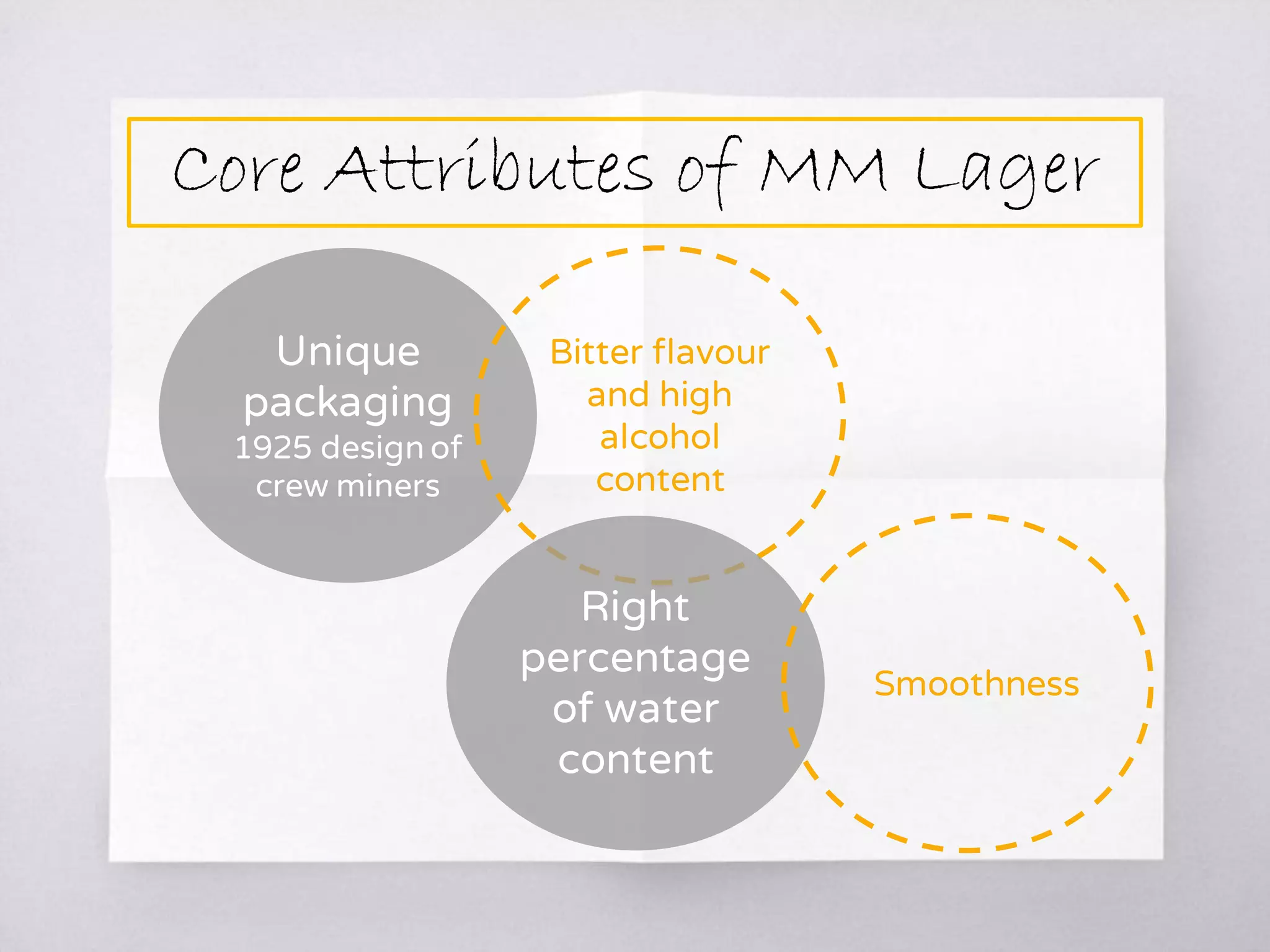
Core Attributes of MM Lager
Unique
packaging
1925 design of
crew miners
Bitter flavour
and high
alcohol
content
Right
percentage
of water
content
Smoothness
Target Market
 Males
 Working class/
Blue Collar men
Middle to lower
income market
Older generation
Profile of Mountain Man
Lager drinkers
(2005)
81%
19%
Gender
Male Female
0%
5%
10%
15%
20%
25%
30%
35%
21-24 25-34 35-44 45-54 55-64 65+
Age
20%
27%
25%
15%
13%
Household income
<$25k
$25-
49.9k
$50-
74.9k
$75-
99.9k
$100k+
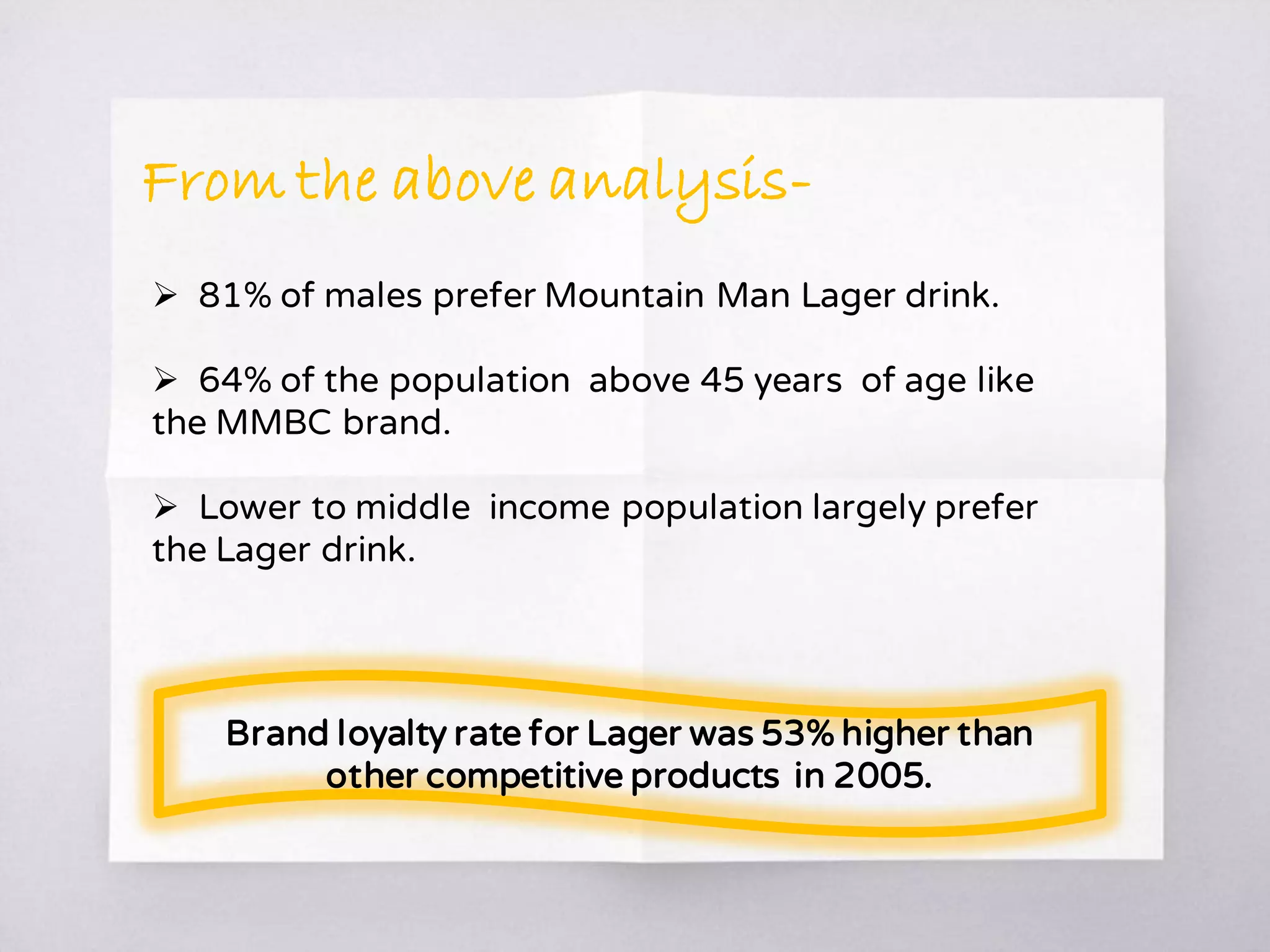
 81% of males prefer Mountain Man Lager drink.
 64% of the population above 45 years of age like
the MMBC brand.
 Lower to middle income population largely prefer
the Lager drink.
Brand loyalty rate for Lager was 53% higher than
other competitive products in 2005.
From the above analysis-
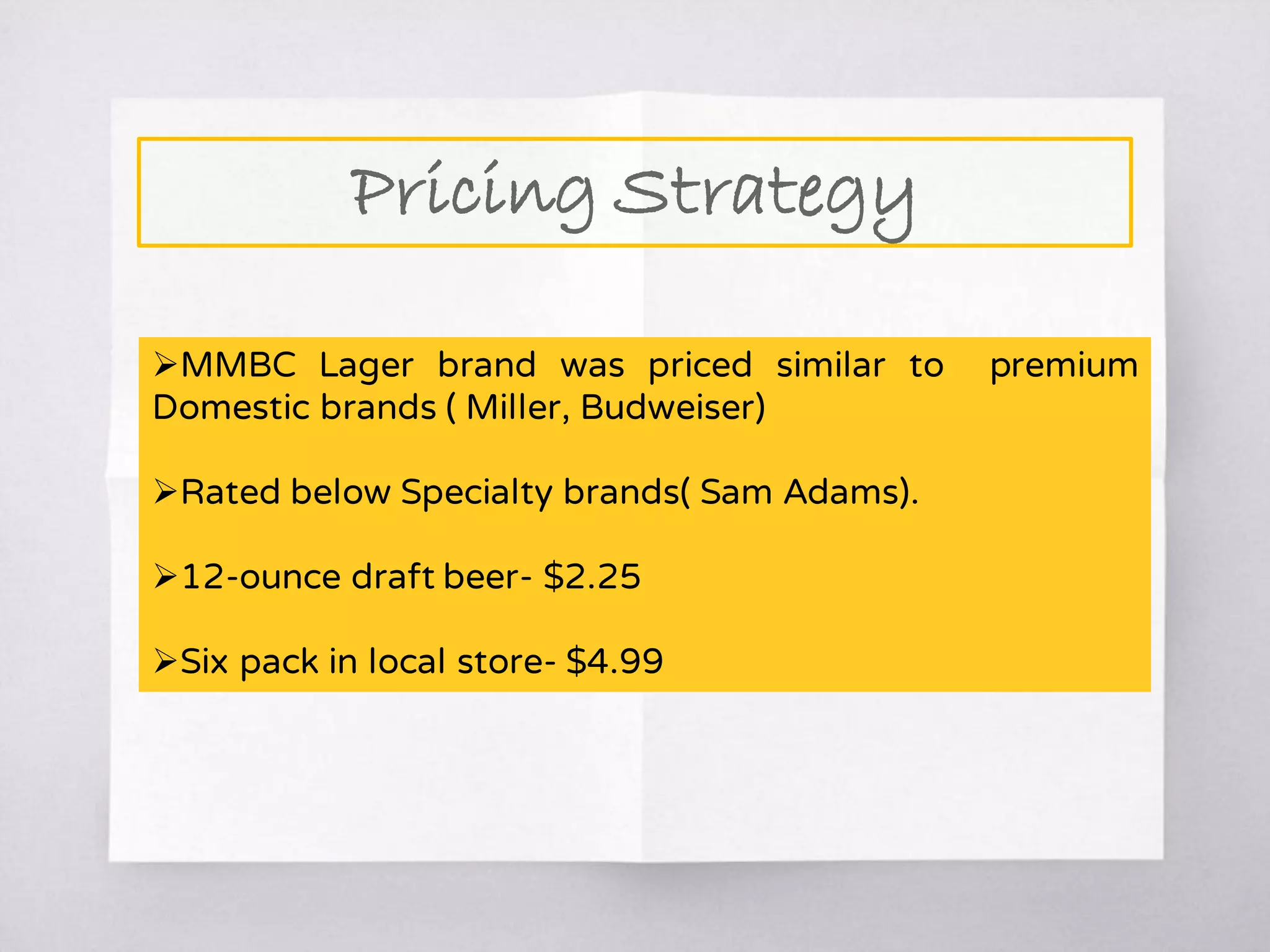
Pricing Strategy
MMBC Lager brand was priced similar to premium
Domestic brands ( Miller, Budweiser)
Rated below Specialty brands( Sam Adams).
12-ounce draft beer- $2.25
Six pack in local store- $4.99
Place
 Bars
 Restaurants
 Liquor stores
 Supermarket stores
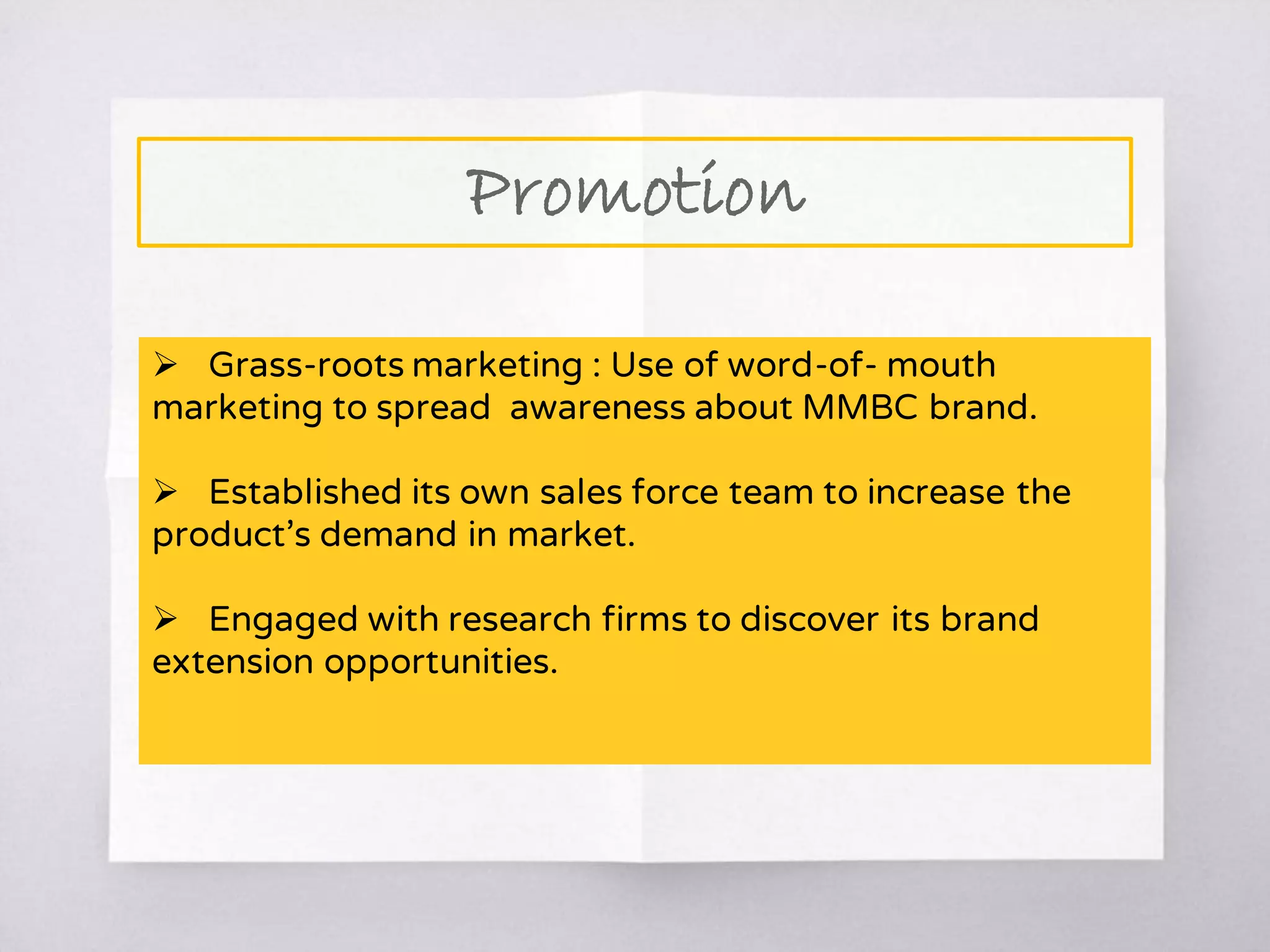
Promotion
 Grass-roots marketing : Use of word-of- mouth
marketing to spread awareness about MMBC brand.
 Established its own sales force team to increase the
product’s demand in market.
 Engaged with research firms to discover its brand
extension opportunities.
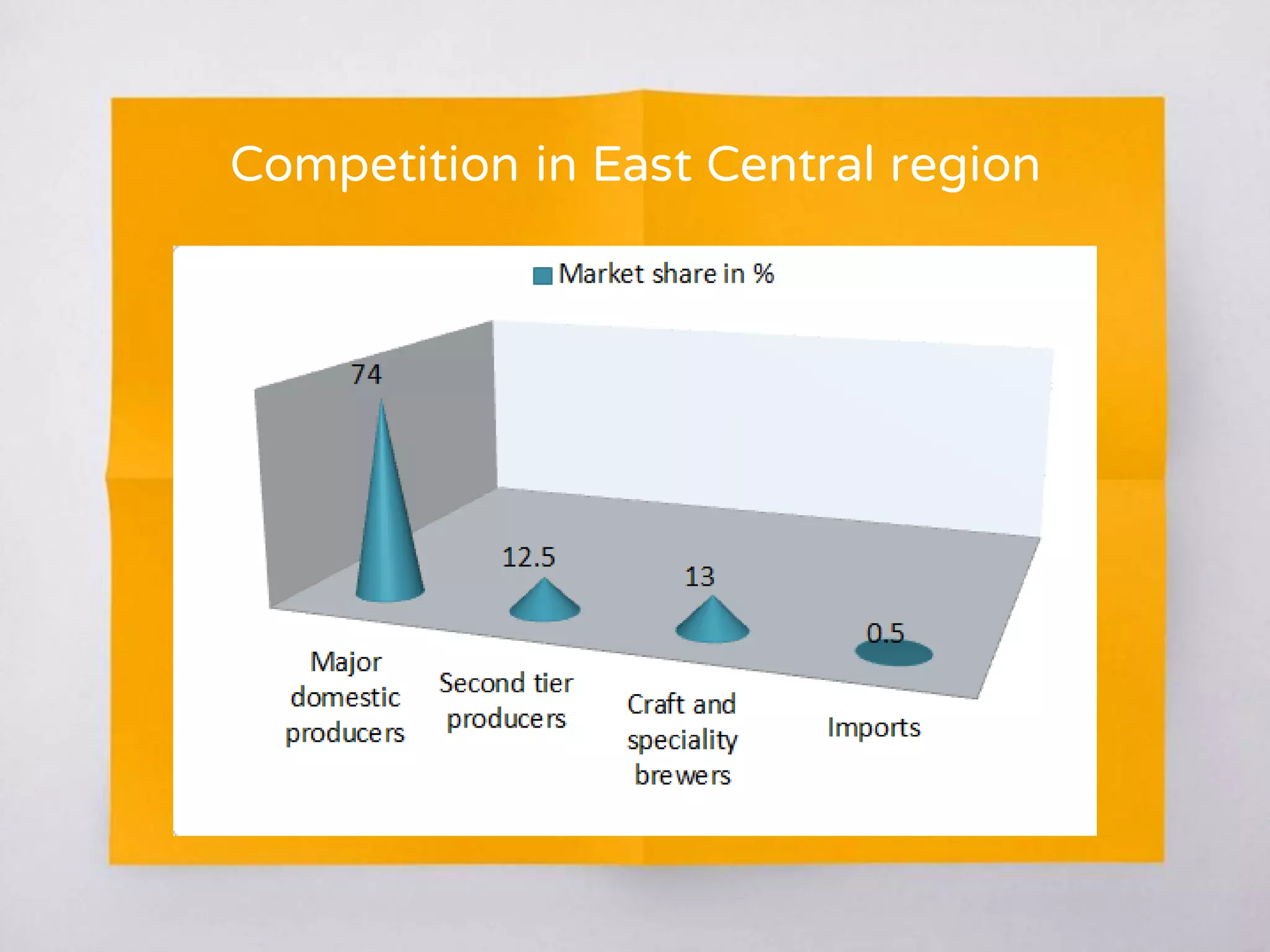
Competition in East Central region
Major Domestic
Anheuser-Busch
Adolf Coors
Miller
Second tier
Pabst Brewing Co.
Genessee
Craft
Sam Adam’s
Sierra Nevada
Harpoon
Import
Corona
Molson
Beck’s
Situation in 2005
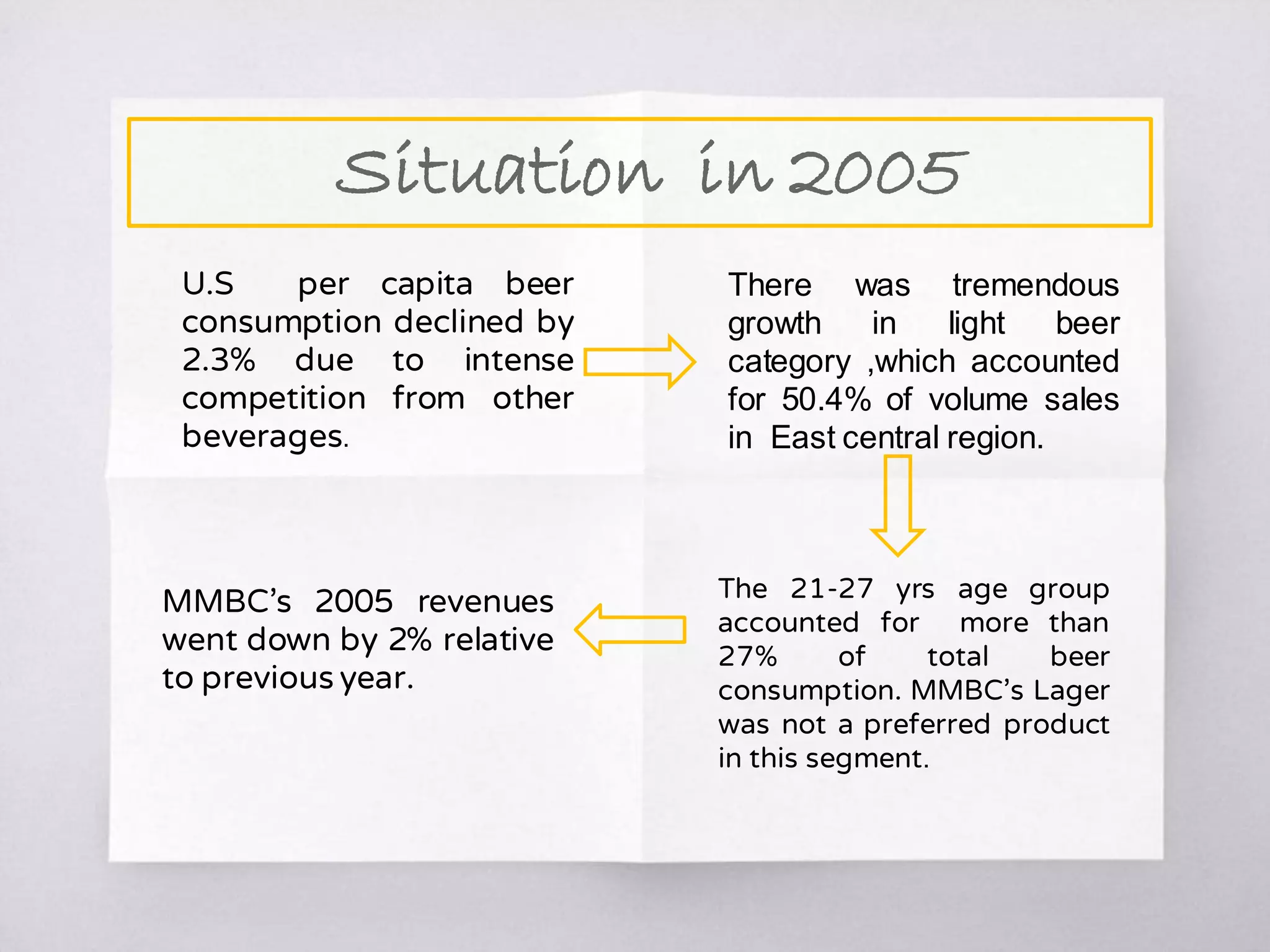
U.S per capita beer
consumption declined by
2.3% due to intense
competition from other
beverages.
There was tremendous
growth in light beer
category ,which accounted
for 50.4% of volume sales
in East central region.
The 21-27 yrs age group
accounted for more than
27% of total beer
consumption. MMBC’s Lager
was not a preferred product
in this segment.
MMBC’s 2005 revenues
went down by 2% relative
to previous year.
 Variable cost – These costs vary with company’s
production volume.
 Fixed cost – These costs are to be paid by a company,
irrespective of increase or decrease in the amount of goods
or services produced or sold.
 COGS (Cost of Goods sold) – The direct cost involved in
creating a product or service, sold by the company.
 Gross Margin – The difference between revenue and cost
of goods sold by the company.
Terminologies
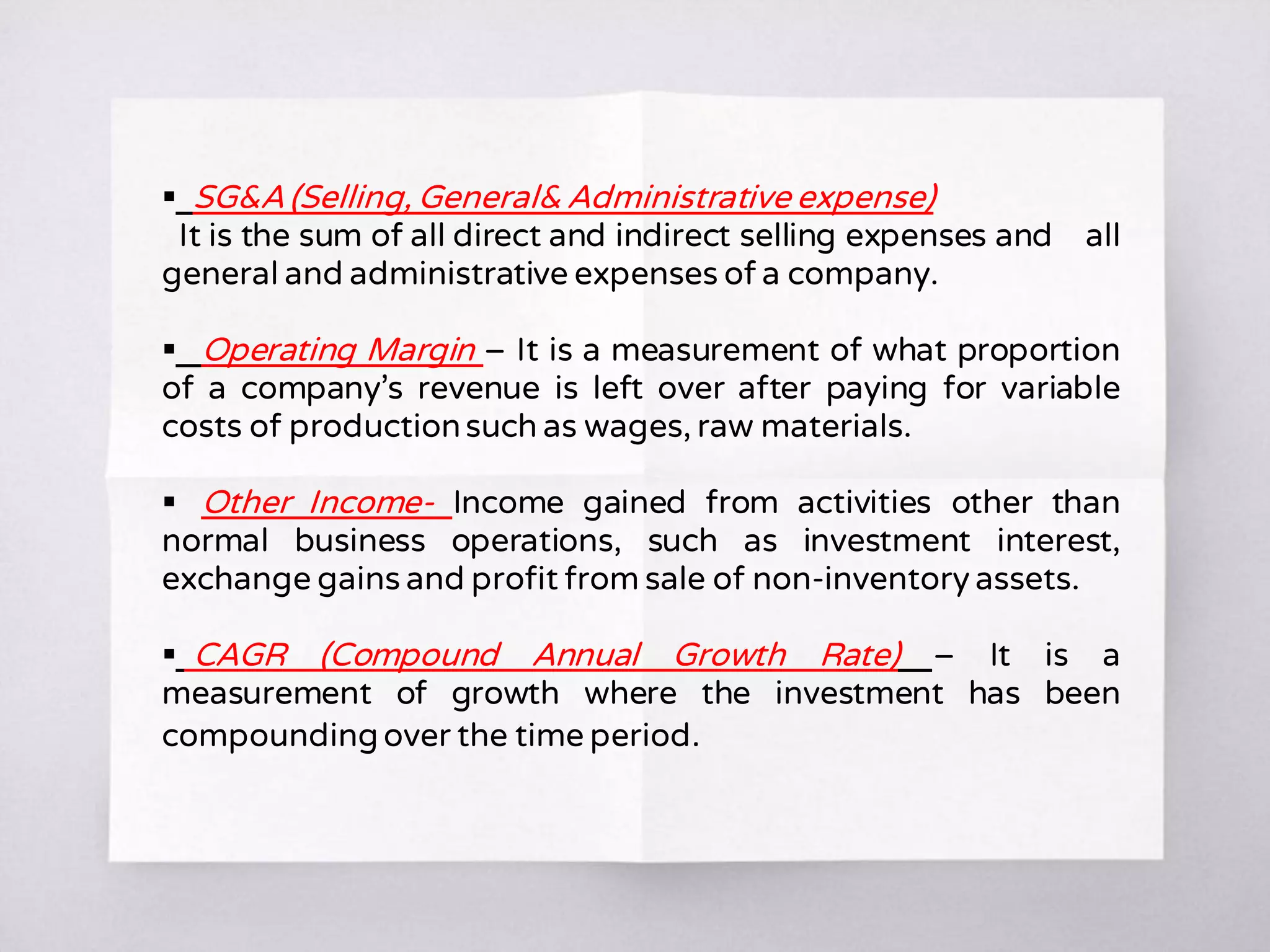
 SG&A (Selling, General& Administrative expense)
It is the sum of all direct and indirect selling expenses and all
general and administrative expenses of a company.
 Operating Margin – It is a measurement of what proportion
of a company’s revenue is left over after paying for variable
costs of productionsuch as wages, raw materials.
 Other Income- Income gained from activities other than
normal business operations, such as investment interest,
exchange gains and profit from sale of non-inventory assets.
 CAGR (Compound Annual Growth Rate) – It is a
measurement of growth where the investment has been
compounding over the time period.
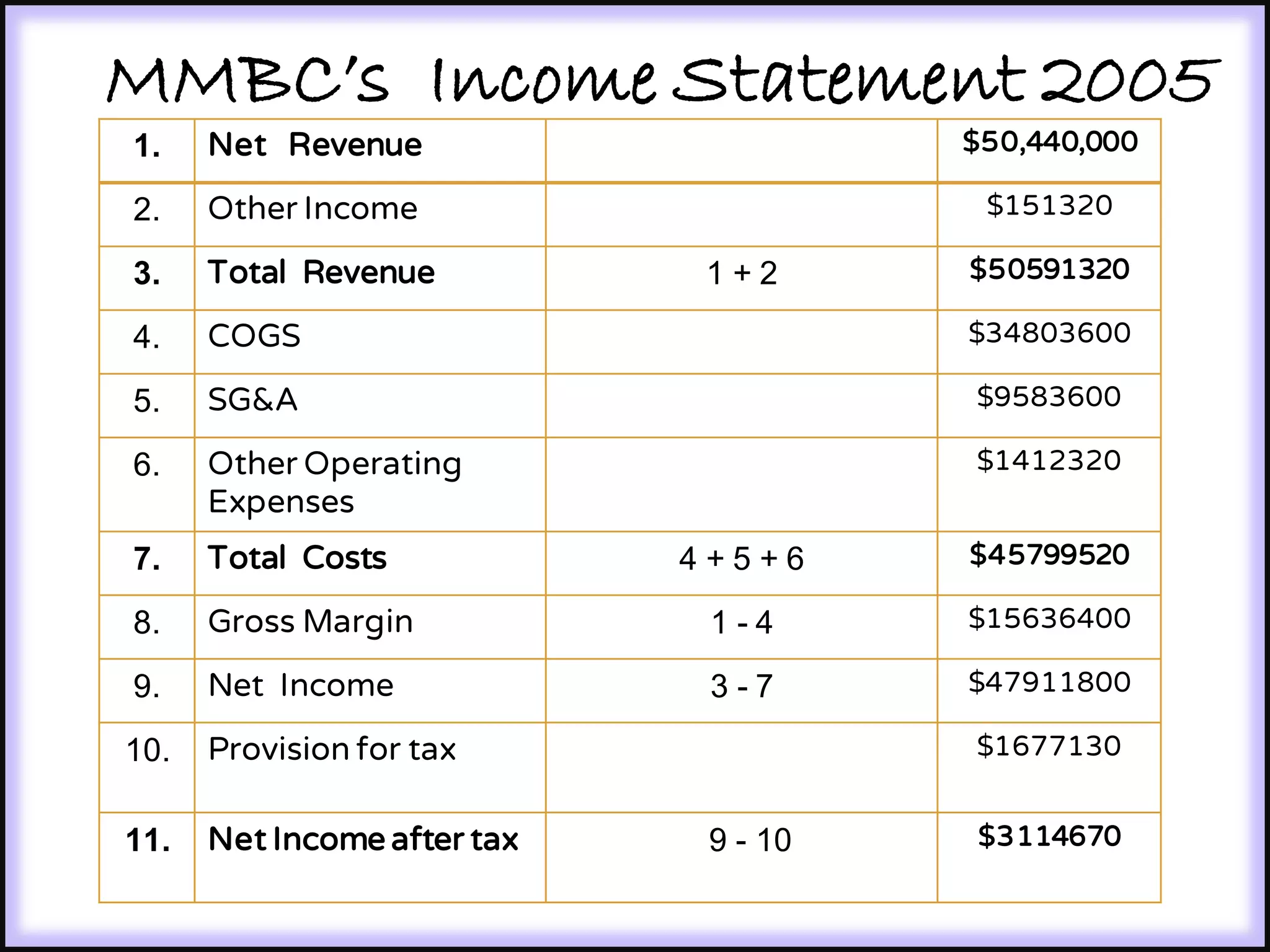
1. Net Revenue $50,440,000
2. Other Income $151320
3. Total Revenue 1 + 2 $50591320
4. COGS $34803600
5. SG&A $9583600
6. Other Operating
Expenses
$1412320
7. Total Costs 4 + 5 + 6 $45799520
8. Gross Margin 1 - 4 $15636400
9. Net Income 3 - 7 $47911800
10. Provision for tax $1677130
11. Net Income after tax 9 - 10 $3114670
MMBC’s Income Statement 2005
Decline of MMBC
Competition from alternate beverages- wine and spirits
Increase in Federal Excise Tax (upto 43% of COGS)
Increasing health concerns of consumers
Negligence in targeting the growing target customers-
women and young generation
Pressure from other existing large national domestic
brewers, craft and imported brands.
Chris Prangel
wanted to
launch a new
product…
Why
Light Beer?
Profile of Light Beer
drinkers (2005)
Male
58%
Female
42%
Gender
14%
25%
21%
16%
24%
Household income
<$25k
$25-
49.9k
$50-
74.9k
$75-
99.9k
$100k+
0%
5%
10%
15%
20%
25%
30%
35%
21-24 25-34 35-44 45-54 55-64 65+
Age
 Light beer brand was equally popular among men
and woman.
 The brand was consumed by customers across all
age groups.(young and old drinkers)
 Light beer had same presence in low-income as well
as high-income target markets.
Light beer accounted for 50.4% of volume sales in
2005 and is expected to grow at 4% CAGR rate.
From the above analysis-
It will lead to
diversification of
brand portfolio and
its popularity may
even boost the sales
of other brand
product-Lager.
The new product
meets the demand of
young drinkers and
females .
Light beer launch will
help to gain share in
on-premise locations:
bars & restaurants.
Light beer has been
consistently showing
growth (+4.3%) in
market.
Chris Prangel’s belief…
Retailers would not
grant incremental
shelf space for
MMBC brand or
particularly for old
product like Lager.
Launching a new
product requires
huge additional
investment in
inventory, packaging
and advertising.
A new product can
dilute MMBC’s Lager
popularity.
There are already
major brands in light
beer market which
have high advertising
and marketing
standards.
Oscar Prangel & V.P’s belief…
Light Beer Competitive market shares
0
5
10
15
20
25
30
35
40
45
50 49
24
11
14
2
Anheuser-Busch Miller
Coors Other brands
Imports
Oscar
Prangel
had fear of
already
existing
popular
brands in
Light Beer
market
Market share of light beer in %
But…
Vision is the art of seeing what is
invisible to others.
Chris had a vision for MMBC’s future!
.
Analysis done
by Chris Prangel
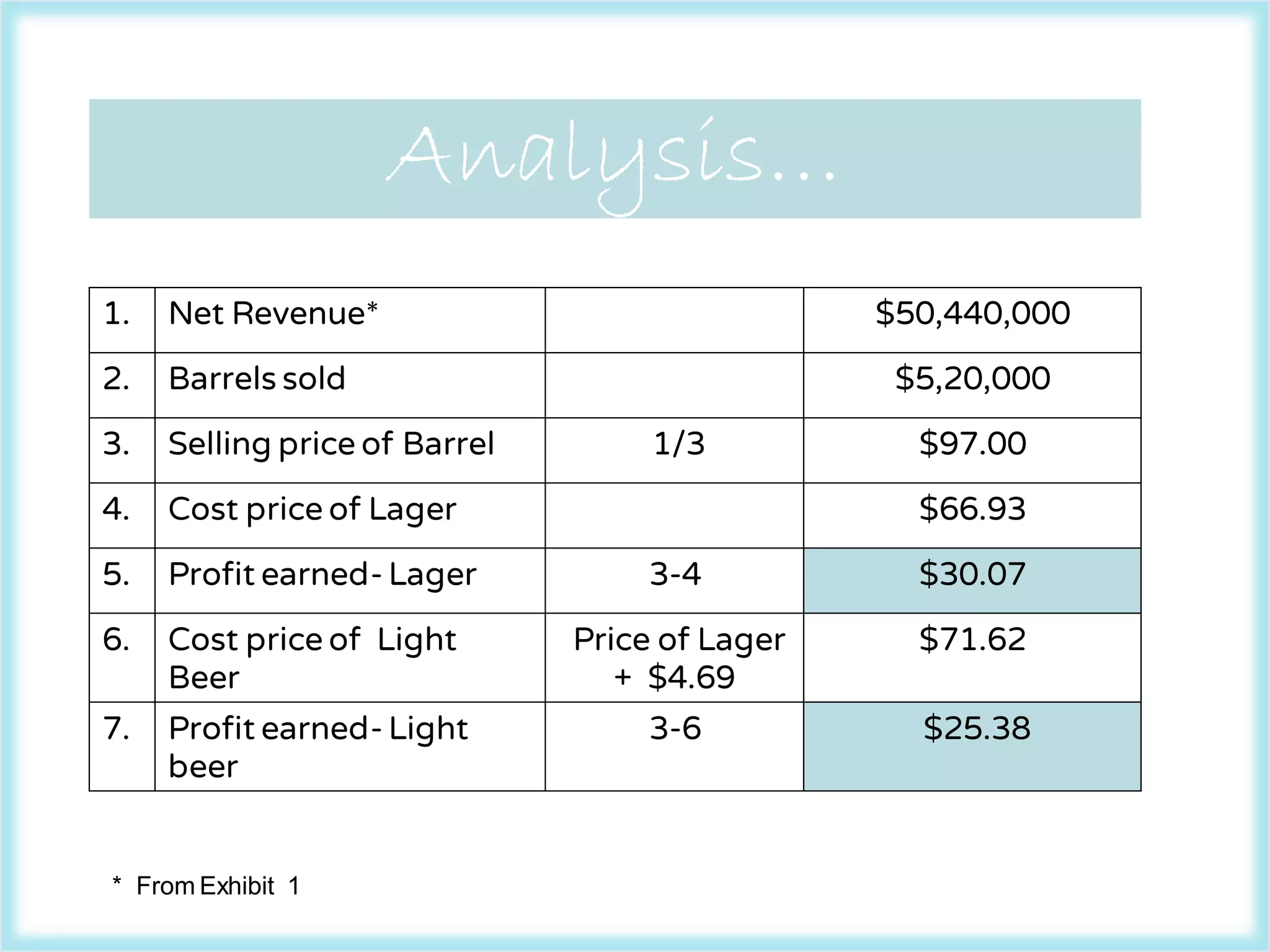
1. Net Revenue* $50,440,000
2. Barrels sold $5,20,000
3. Selling price of Barrel 1/3 $97.00
4. Cost price of Lager $66.93
5. Profit earned- Lager 3-4 $30.07
6. Cost price of Light
Beer
Price of Lager
+ $4.69
$71.62
7. Profit earned- Light
beer
3-6 $25.38
* From Exhibit 1
Analysis…
8. SG&A cost $90,000
9. Advertising campaign $7,50,000
10. Total cost(1+2) $1,650,000
11.
Profit earned- Light beer
$25.38
12. Break even volume * 65,012
* Break even volume = Total cost / Profit earned (Light Beer)
 MMBC would receive the same price per barrel for
both the products.
 Contribution of MM Light ($25.38) would be lower
compared to Lager($30.07).
 The brand was required to achieve more than
$1,650,000 revenue and target of selling around 65012
barrels of light beer to start making profits in this
segment.
From the above analysis-
Chris Prangel developed net profit
projections to 2010 assuming that-
Mountain Man Lager lost 2% of its revenue base annually.
Growth of light beer product in East Central region at 4%
on an annual basis.
MM Light growth in regional light beer market share at
0.25% every year.
Eastern Market Consumption
There is 4 % annual increase in
Light Beer sales in East Central
region.
Market share (in barrels)
MMBC expects the light beer
consumption to grow at 0.25%
every year.
MMBC revenue from Light Beer
= Market share * Selling price
of each barrel
($97)
Variable cost
These costs vary with company’s
production volume.
Fixed cost
In the first year, total cost is
$1,650,000.
From the next year, costs
excluding the advertising
campaign are considered.
Net revenue
= MMBC revenue-Variablecost-
Fixed cost
Revenue from Mountain Man Light
2005 2006 2007 2008 2009 2010
Eastern
Market
Consum
ption
18744303 19494075.12 20273838.12 21084791.65 21928183.32 22805310.6
Market
share
48735.19 101369.19 158135.94 219281.83 285066.38
MMBC
revenue
$4727313.22 $9832811.49 $15339185.9 $21270337.8 $27651439
COGS
Light
$3490414.15 $7260061.43 $11325695.8 $15704964.9 $20416454
Fixed
cost
$1650000 $900000 $900000 $900000 $900000
Net
revenue
-413100.93 $1672750.06 $3113490.09 $4665372.93 $6334984.8
$1672750.06
Light Beer
Can be a total success!
In just 2 years after launch
Expected Net Revenue of MMBC from Lager & Light brand
After introducing 5% cannibalization in
above analysis, due to the introduction of
Light beer brand ,
Mountain Man brewing Company
can still retain its overall position in the
market!!!
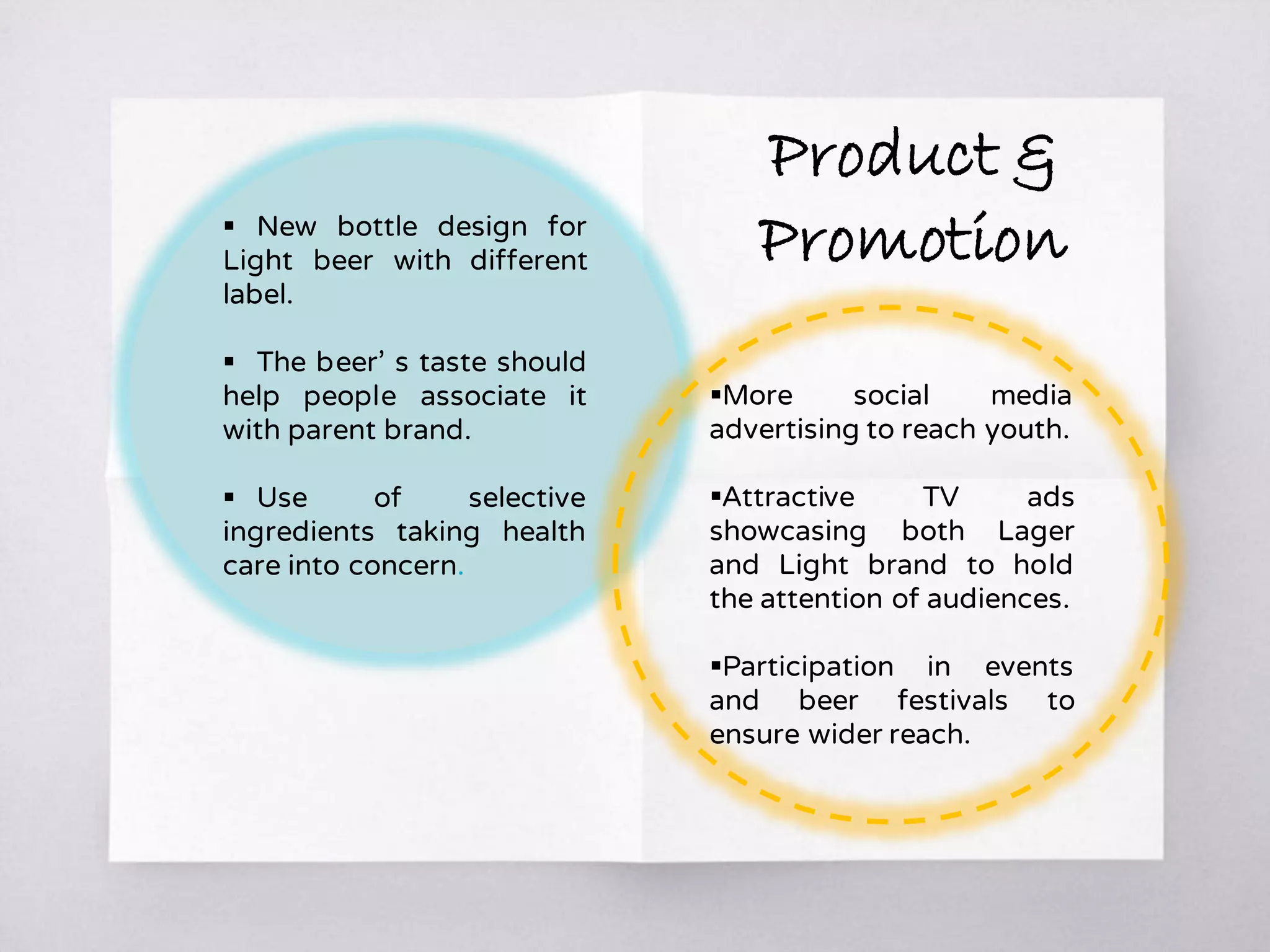
 New bottle design for
Light beer with different
label.
 The beer’ s taste should
help people associate it
with parent brand.
 Use of selective
ingredients taking health
care into concern.
More social media
advertising to reach youth.
Attractive TV ads
showcasing both Lager
and Light brand to hold
the attention of audiences.
Participation in events
and beer festivals to
ensure wider reach.
Product &
Promotion
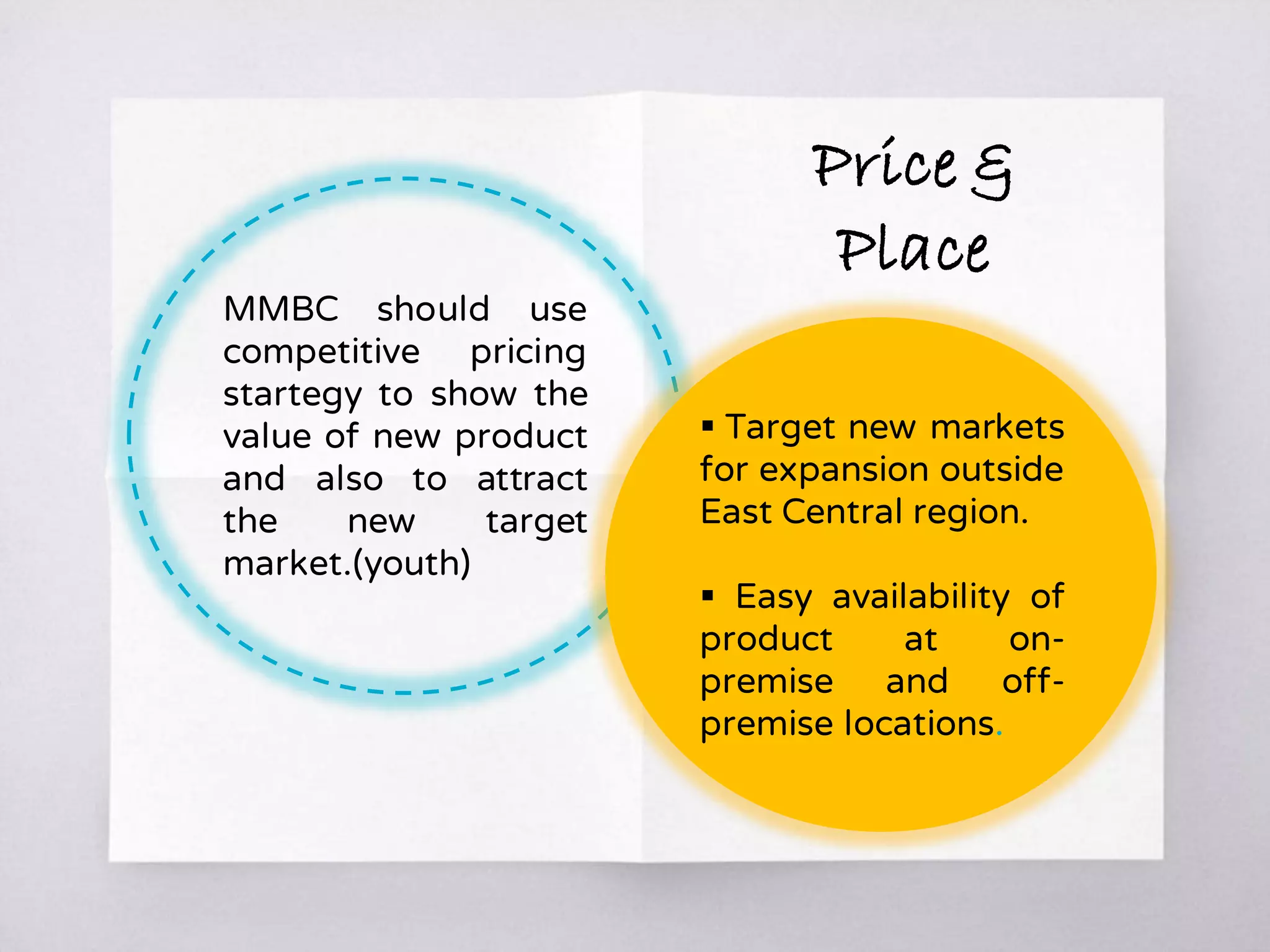
MMBC should use
competitive pricing
startegy to show the
value of new product
and also to attract
the new target
market.(youth)
 Target new markets
for expansion outside
East Central region.
 Easy availability of
product at on-
premise and off-
premise locations.
Price &
Place
Conclusion
MMBC should launch the light beer brand to
diversify its portfolio and to ensure continued
growth of its family-owned brewery.
The company should also renew the marketing
strategy of its flagship product to retain core
brand equity and Lager’s loyal customers.
Created by Avani Jain, NIT Raipur,
during a marketing internship under
Prof. Sameer Mathur, IIM Lucknow
Sameer Mathur
Indian Institute of Management,Lucknow
DISCLAIMER

Mountain Man Brewing Co. Case Study

  • 1.
    Case Study on MountainMan Brewing Company
  • 2.
    Harward Business SchoolCase Bringing Brand to Light Mountain Man Brewing Company(MMBC)
  • 3.
    Present Situation Analysis Proof andAction Renewed Strategy Agenda
  • 4.
    Company Overview Founded in1925 by Guntar Prangel. Reformulated an old family brew recipe by selection of rare ingredients. Brand product – Mountain Man Lager Original - popularly known as ‘West Virginia’s Beer ‘. Majorly concentrated in the East Central Region* of US. * Illinois, Indiana, Kentucky,Michigan,Ohio,West Virginia, Wisconsin
  • 5.
    Key Personalities  GuntarPrangel - Founder of MMBC  Oscar Prangel - Owner and President of MMBC  John Fader - V.P. of sales  Chris Prangel - MBA graduate and successor of MMBC
  • 7.
    Core Attributes ofMM Lager Unique packaging 1925 design of crew miners Bitter flavour and high alcohol content Right percentage of water content Smoothness
  • 8.
    Target Market  Males Working class/ Blue Collar men Middle to lower income market Older generation
  • 9.
    Profile of MountainMan Lager drinkers (2005)
  • 10.
    81% 19% Gender Male Female 0% 5% 10% 15% 20% 25% 30% 35% 21-24 25-3435-44 45-54 55-64 65+ Age 20% 27% 25% 15% 13% Household income <$25k $25- 49.9k $50- 74.9k $75- 99.9k $100k+
  • 11.
     81% ofmales prefer Mountain Man Lager drink.  64% of the population above 45 years of age like the MMBC brand.  Lower to middle income population largely prefer the Lager drink. Brand loyalty rate for Lager was 53% higher than other competitive products in 2005. From the above analysis-
  • 12.
    Pricing Strategy MMBC Lagerbrand was priced similar to premium Domestic brands ( Miller, Budweiser) Rated below Specialty brands( Sam Adams). 12-ounce draft beer- $2.25 Six pack in local store- $4.99
  • 13.
    Place  Bars  Restaurants Liquor stores  Supermarket stores
  • 14.
    Promotion  Grass-roots marketing: Use of word-of- mouth marketing to spread awareness about MMBC brand.  Established its own sales force team to increase the product’s demand in market.  Engaged with research firms to discover its brand extension opportunities.
  • 15.
    Competition in EastCentral region
  • 16.
    Major Domestic Anheuser-Busch Adolf Coors Miller Secondtier Pabst Brewing Co. Genessee Craft Sam Adam’s Sierra Nevada Harpoon Import Corona Molson Beck’s
  • 17.
    Situation in 2005 U.Sper capita beer consumption declined by 2.3% due to intense competition from other beverages. There was tremendous growth in light beer category ,which accounted for 50.4% of volume sales in East central region. The 21-27 yrs age group accounted for more than 27% of total beer consumption. MMBC’s Lager was not a preferred product in this segment. MMBC’s 2005 revenues went down by 2% relative to previous year.
  • 18.
     Variable cost– These costs vary with company’s production volume.  Fixed cost – These costs are to be paid by a company, irrespective of increase or decrease in the amount of goods or services produced or sold.  COGS (Cost of Goods sold) – The direct cost involved in creating a product or service, sold by the company.  Gross Margin – The difference between revenue and cost of goods sold by the company. Terminologies
  • 19.
     SG&A (Selling,General& Administrative expense) It is the sum of all direct and indirect selling expenses and all general and administrative expenses of a company.  Operating Margin – It is a measurement of what proportion of a company’s revenue is left over after paying for variable costs of productionsuch as wages, raw materials.  Other Income- Income gained from activities other than normal business operations, such as investment interest, exchange gains and profit from sale of non-inventory assets.  CAGR (Compound Annual Growth Rate) – It is a measurement of growth where the investment has been compounding over the time period.
  • 20.
    1. Net Revenue$50,440,000 2. Other Income $151320 3. Total Revenue 1 + 2 $50591320 4. COGS $34803600 5. SG&A $9583600 6. Other Operating Expenses $1412320 7. Total Costs 4 + 5 + 6 $45799520 8. Gross Margin 1 - 4 $15636400 9. Net Income 3 - 7 $47911800 10. Provision for tax $1677130 11. Net Income after tax 9 - 10 $3114670 MMBC’s Income Statement 2005
  • 21.
    Decline of MMBC Competitionfrom alternate beverages- wine and spirits Increase in Federal Excise Tax (upto 43% of COGS) Increasing health concerns of consumers Negligence in targeting the growing target customers- women and young generation Pressure from other existing large national domestic brewers, craft and imported brands.
  • 22.
  • 24.
  • 26.
    Profile of LightBeer drinkers (2005)
  • 27.
  • 28.
     Light beerbrand was equally popular among men and woman.  The brand was consumed by customers across all age groups.(young and old drinkers)  Light beer had same presence in low-income as well as high-income target markets. Light beer accounted for 50.4% of volume sales in 2005 and is expected to grow at 4% CAGR rate. From the above analysis-
  • 29.
    It will leadto diversification of brand portfolio and its popularity may even boost the sales of other brand product-Lager. The new product meets the demand of young drinkers and females . Light beer launch will help to gain share in on-premise locations: bars & restaurants. Light beer has been consistently showing growth (+4.3%) in market. Chris Prangel’s belief…
  • 30.
    Retailers would not grantincremental shelf space for MMBC brand or particularly for old product like Lager. Launching a new product requires huge additional investment in inventory, packaging and advertising. A new product can dilute MMBC’s Lager popularity. There are already major brands in light beer market which have high advertising and marketing standards. Oscar Prangel & V.P’s belief…
  • 31.
    Light Beer Competitivemarket shares 0 5 10 15 20 25 30 35 40 45 50 49 24 11 14 2 Anheuser-Busch Miller Coors Other brands Imports Oscar Prangel had fear of already existing popular brands in Light Beer market Market share of light beer in %
  • 32.
    But… Vision is theart of seeing what is invisible to others.
  • 33.
    Chris had avision for MMBC’s future!
  • 34.
  • 35.
    1. Net Revenue*$50,440,000 2. Barrels sold $5,20,000 3. Selling price of Barrel 1/3 $97.00 4. Cost price of Lager $66.93 5. Profit earned- Lager 3-4 $30.07 6. Cost price of Light Beer Price of Lager + $4.69 $71.62 7. Profit earned- Light beer 3-6 $25.38 * From Exhibit 1 Analysis…
  • 36.
    8. SG&A cost$90,000 9. Advertising campaign $7,50,000 10. Total cost(1+2) $1,650,000 11. Profit earned- Light beer $25.38 12. Break even volume * 65,012 * Break even volume = Total cost / Profit earned (Light Beer)
  • 37.
     MMBC wouldreceive the same price per barrel for both the products.  Contribution of MM Light ($25.38) would be lower compared to Lager($30.07).  The brand was required to achieve more than $1,650,000 revenue and target of selling around 65012 barrels of light beer to start making profits in this segment. From the above analysis-
  • 38.
    Chris Prangel developednet profit projections to 2010 assuming that- Mountain Man Lager lost 2% of its revenue base annually. Growth of light beer product in East Central region at 4% on an annual basis. MM Light growth in regional light beer market share at 0.25% every year.
  • 39.
    Eastern Market Consumption Thereis 4 % annual increase in Light Beer sales in East Central region. Market share (in barrels) MMBC expects the light beer consumption to grow at 0.25% every year. MMBC revenue from Light Beer = Market share * Selling price of each barrel ($97) Variable cost These costs vary with company’s production volume. Fixed cost In the first year, total cost is $1,650,000. From the next year, costs excluding the advertising campaign are considered. Net revenue = MMBC revenue-Variablecost- Fixed cost Revenue from Mountain Man Light
  • 40.
    2005 2006 20072008 2009 2010 Eastern Market Consum ption 18744303 19494075.12 20273838.12 21084791.65 21928183.32 22805310.6 Market share 48735.19 101369.19 158135.94 219281.83 285066.38 MMBC revenue $4727313.22 $9832811.49 $15339185.9 $21270337.8 $27651439 COGS Light $3490414.15 $7260061.43 $11325695.8 $15704964.9 $20416454 Fixed cost $1650000 $900000 $900000 $900000 $900000 Net revenue -413100.93 $1672750.06 $3113490.09 $4665372.93 $6334984.8
  • 41.
    $1672750.06 Light Beer Can bea total success! In just 2 years after launch
  • 42.
    Expected Net Revenueof MMBC from Lager & Light brand
  • 43.
    After introducing 5%cannibalization in above analysis, due to the introduction of Light beer brand , Mountain Man brewing Company can still retain its overall position in the market!!!
  • 46.
     New bottledesign for Light beer with different label.  The beer’ s taste should help people associate it with parent brand.  Use of selective ingredients taking health care into concern. More social media advertising to reach youth. Attractive TV ads showcasing both Lager and Light brand to hold the attention of audiences. Participation in events and beer festivals to ensure wider reach. Product & Promotion
  • 47.
    MMBC should use competitivepricing startegy to show the value of new product and also to attract the new target market.(youth)  Target new markets for expansion outside East Central region.  Easy availability of product at on- premise and off- premise locations. Price & Place
  • 48.
    Conclusion MMBC should launchthe light beer brand to diversify its portfolio and to ensure continued growth of its family-owned brewery. The company should also renew the marketing strategy of its flagship product to retain core brand equity and Lager’s loyal customers.
  • 49.
    Created by AvaniJain, NIT Raipur, during a marketing internship under Prof. Sameer Mathur, IIM Lucknow Sameer Mathur Indian Institute of Management,Lucknow DISCLAIMER