Joseph D’Elia
Warren DeRevere
Laura Louriero
The
Company
Coca-Cola
The Global Drink
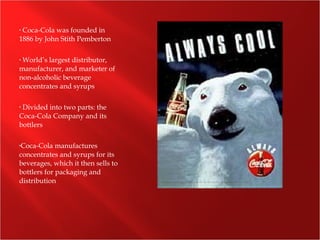
• Coca-Cola was founded in
1886 by John Stith Pemberton
• World’s largest distributor,
manufacturer, and marketer of
non-alcoholic beverage
concentrates and syrups
• Divided into two parts: the
Coca-Cola Company and its
bottlers
•Coca-Cola manufactures
concentrates and syrups for its
beverages, which it then sells to
bottlers for packaging and
distribution
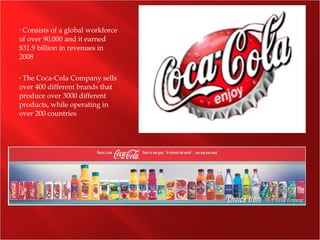
• Consists of a global workforce
of over 90,000 and it earned
$31.9 billion in revenues in
2008
• The Coca-Cola Company sells
over 400 different brands that
produce over 3000 different
products, while operating in
over 200 countries
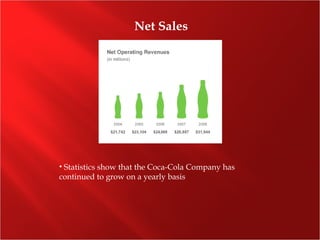
• Statistics show that the Coca-Cola Company has
continued to grow on a yearly basis
Net Sales
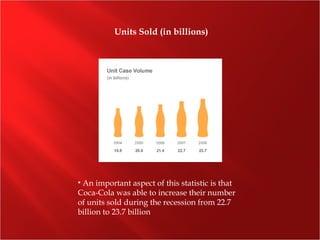
• An important aspect of this statistic is that
Coca-Cola was able to increase their number
of units sold during the recession from 22.7
billion to 23.7 billion
Units Sold (in billions)
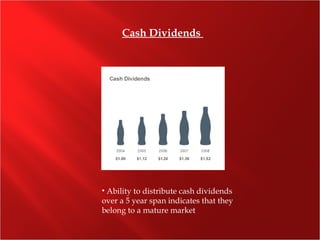
Cash Dividends
• Ability to distribute cash dividends
over a 5 year span indicates that they
belong to a mature market
• Carbonated soft drinks make
up 78% of the total volume of
beverages sold in 2008
•Beverages that are labeled
with the famous Coke
trademark make up 82% of the
total volume of carbonated soft
drinks sold
• Also offers non-carbonated
drinks such as Dasani bottled
water, Glaceau Vitamin Water,
POWERade sports drinks,
Nestea, Minute Maid, and
Aquarius sports drinks
• The Coca-Cola Company’s
most notable product is the soft
drink Coca-Cola
• Original promotion for Coke
included giving away
thousands of free drink
coupons and placing posters
around the city of Atlanta
• Coke was first advertised as a
remedy for headaches and
exhaustion
• First bottle of Coke was sold
on May 8, 1886 in Atlanta,
Georgia
• Coca-Cola sold only 25 bottles
in the first year
• Nowadays, they sell over one
billion bottles per day
• In July 1985, Coke was the first
soft drink to be enjoyed in outer
space on the space shuttle
Challenger
• Coca-Cola is recognized by
94% of the world’s population
• Approximately 10,450 Coca-
Cola brand drinks are
consumed around the world
each second of every day
• Coke advertises 200 in
countries around the world.
• Earn approximately 75% of
their sales from outside the
United States
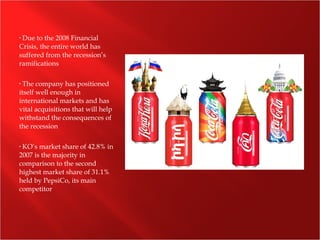
• Due to the 2008 Financial
Crisis, the entire world has
suffered from the recession’s
ramifications
• The company has positioned
itself well enough in
international markets and has
vital acquisitions that will help
withstand the consequences of
the recession
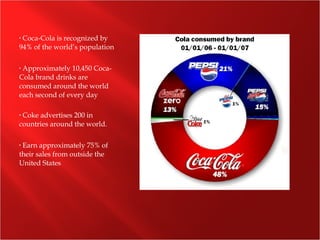
• KO’s market share of 42.8% in
2007 is the majority in
comparison to the second
highest market share of 31.1%
held by PepsiCo, its main
competitor
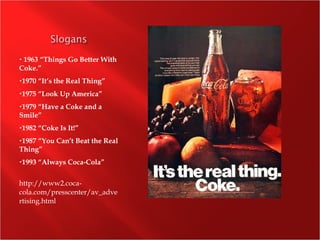
• 1963 “Things Go Better With
Coke.”
•1970 “It’s the Real Thing”
•1975 “Look Up America”
•1979 “Have a Coke and a
Smile”
•1982 “Coke Is It!”
•1987 “You Can’t Beat the Real
Thing”
•1993 “Always Coca-Cola”
http://www2.coca-
cola.com/presscenter/av_adve
rtising.html
• Recent recession has put a damper on
mostly everyone’s ability to buy unnecessary
goods.
• Luckily for Coke, it is a highly popular
beverage that customers choose to drink
• Despite the popularity Coca-Cola, The Coca-
Cola Company is very sensitive to changes in
demand
• As a result of the current
economic environment, the
Coca-Cola Company posted a
3% decrease in revenues in the
first quarter of 2009 compared
to the first quarter of 2008.
• Net income also fell 10%.
Coca-Cola was especially hurt
by the dollars’ strengthening
against the euro, Brazilian real,
Mexican Peso, and South
African rand.
• The Coca-Cola Company is
based in the US, but around
75% of the operating income is
from outside the United States.
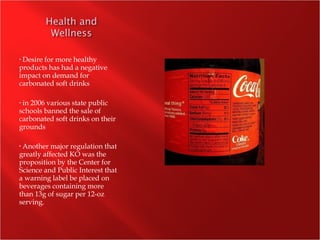
• Desire for more healthy
products has had a negative
impact on demand for
carbonated soft drinks
• in 2006 various state public
schools banned the sale of
carbonated soft drinks on their
grounds
• Another major regulation that
greatly affected KO was the
proposition by the Center for
Science and Public Interest that
a warning label be placed on
beverages containing more
than 13g of sugar per 12-oz
serving.
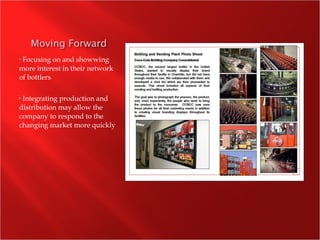
• Focusing on and showwing
more interest in their network
of bottlers
• Integrating production and
distribution may allow the
company to respond to the
changing market more quickly
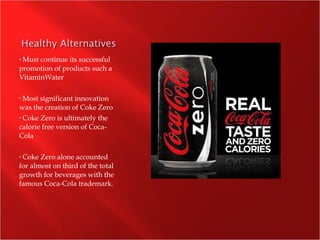
• Must continue its successful
promotion of products such a
VitaminWater
• Most significant innovation
was the creation of Coke Zero
• Coke Zero is ultimately the
calorie free version of Coca-
Cola
• Coke Zero alone accounted
for almost on third of the total
growth for beverages with the
famous Coca-Cola trademark.
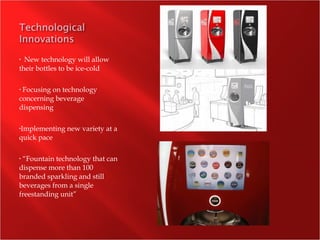
• New technology will allow
their bottles to be ice-cold
• Focusing on technology
concerning beverage
dispensing
•Implementing new variety at a
quick pace
• “Fountain technology that can
dispense more than 100
branded sparkling and still
beverages from a single
freestanding unit”
 Entered market in 1898
 Dominates 30.8% of Cola market (Coke
dominates 42.7%
 Earned $35,137 million in revenues in 2006
 Large free cash flow
Strong market position
Successful marketing campaigns
 Takes higher risks with its marketing and
advertisements
 Renamed itself as Pecsi in Argentina
 Internationally known and popular
 Targets segments effectively
SWOT
 Health concerns
Caffeine and sugar
Yellow Teeth
 70% of its revenues concentrated in North
America
 Health craze- staying fit
Water, juice, diet beverages
SWOT
 Constant need of beverages
 Expand to foreign countries
Utilizes globalization
 “Think globally, act locally”
 African Americans 1947- untapped
niche market (not global, but targeted
specifically)
 Brand recognition
SWOT
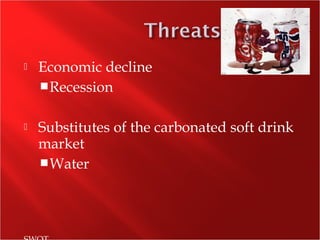
 Economic decline
Recession
 Substitutes of the carbonated soft drink
market
Water
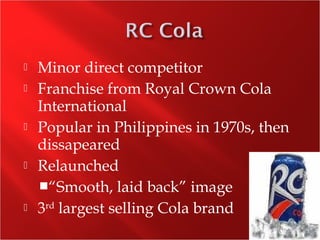
 Minor direct competitor
 Franchise from Royal Crown Cola
International
 Popular in Philippines in 1970s, then
dissapeared
 Relaunched
“Smooth, laid back” image
 3rd
largest selling Cola brand
 Price
 Affordability
 Concentrated brand identity from a focus on
mass marketing
 Growing availability
 Increasing number of plants
 Creative marketing ideas
 Contests
 Sponsoring organizations
SWOT
 Limited to lower class market
 Marketing and advertising not pushed
 Not available on fast-food chains
Prevents the word from spreading
SWOT
 Foreign markets
China
 Economic crisis
Decreased spending
 Popularity and brand loyalty of Coke
and Pepsi brand
SWOT
 Water, juice, milk, alcoholic beverages
etc
 Widely available
 Varying prices
 Healthier substitutes
 Switched from mass marketing to
target marketing
Segregated like-minded
individuals with same need and
then targeted them
 Specific targeting people boosts sales
and increases revenues
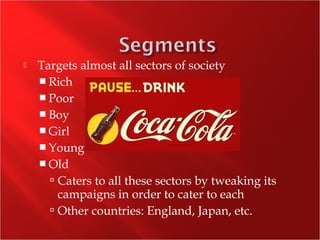
 Targets almost all sectors of society
 Rich
 Poor
 Boy
 Girl
 Young
 Old
 Caters to all these sectors by tweaking its
campaigns in order to cater to each
 Other countries: England, Japan, etc.
 Primary age group: 13 – 24
Coke appears hip and cool
Advertised on TV
Famous celebrities used to promote
Vivid ads & catchy phrases
 Secondary age group: 10-39
 Coke has been successful in
targeting these markets
94% of the world recognize brand
Never had to revamp its logo since
it first came out in 1886
Never redesigned its packaging
completely
 Product
 Price
 Promotion
 Place
 World's #1 non-alcoholic beverage distributor
 Most diverse product mix in the industry
 Has grown to over 3,000 products spanning
across over 400 brands
 78% of sales volume is carbonated soft drinks
 Price stability- Important to retain consumers.
Must remain at the price level of competitors.
 In 1886, Coca Cola was sold at $.05 per glass.
 Accounting for inflation, that equates to $1.18
in 2008.
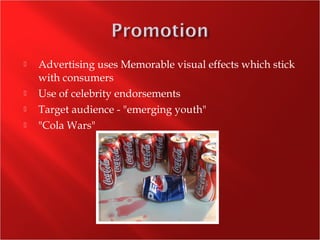
 Advertising uses Memorable visual effects which stick
with consumers
 Use of celebrity endorsements
 Target audience - "emerging youth"
 "Cola Wars"
 Coca Cola products are now sold in over 200
countries worldwide
 Vending Machines enhance availability. Coca
Cola teamed up with Sapient to form new
technology
 Competitive advantage. Coca Cola has
contractual agreements with fast food giants:
McDonalds, Burger King, and Subway, among
others. These chains exclusively sell Coca Cola
products. Coca Cola controls over two thirds
of this segment.
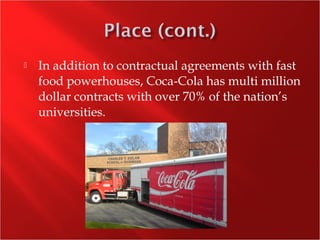
 In addition to contractual agreements with fast
food powerhouses, Coca-Cola has multi million
dollar contracts with over 70% of the nation’s
universities.
 Company looks to expand into new markets
and further develop existing ones
 Shift from mass marketing to localized, "one-on-
one" marketing
 Expand portfolio of products. Further develop
presence in growing segments (Ex- Water, Juice,
Tea, etc)
 Main Focus: "To become the number one non-
alcoholic beverage business in every market
category of value."

The coca cola-company

  • 1.
  • 2.
  • 3.
    • Coca-Cola wasfounded in 1886 by John Stith Pemberton • World’s largest distributor, manufacturer, and marketer of non-alcoholic beverage concentrates and syrups • Divided into two parts: the Coca-Cola Company and its bottlers •Coca-Cola manufactures concentrates and syrups for its beverages, which it then sells to bottlers for packaging and distribution
  • 4.
    • Consists ofa global workforce of over 90,000 and it earned $31.9 billion in revenues in 2008 • The Coca-Cola Company sells over 400 different brands that produce over 3000 different products, while operating in over 200 countries
  • 5.
    • Statistics showthat the Coca-Cola Company has continued to grow on a yearly basis Net Sales
  • 6.
    • An importantaspect of this statistic is that Coca-Cola was able to increase their number of units sold during the recession from 22.7 billion to 23.7 billion Units Sold (in billions)
  • 7.
    Cash Dividends • Abilityto distribute cash dividends over a 5 year span indicates that they belong to a mature market
  • 8.
    • Carbonated softdrinks make up 78% of the total volume of beverages sold in 2008 •Beverages that are labeled with the famous Coke trademark make up 82% of the total volume of carbonated soft drinks sold • Also offers non-carbonated drinks such as Dasani bottled water, Glaceau Vitamin Water, POWERade sports drinks, Nestea, Minute Maid, and Aquarius sports drinks
  • 9.
    • The Coca-ColaCompany’s most notable product is the soft drink Coca-Cola • Original promotion for Coke included giving away thousands of free drink coupons and placing posters around the city of Atlanta • Coke was first advertised as a remedy for headaches and exhaustion • First bottle of Coke was sold on May 8, 1886 in Atlanta, Georgia
  • 10.
    • Coca-Cola soldonly 25 bottles in the first year • Nowadays, they sell over one billion bottles per day • In July 1985, Coke was the first soft drink to be enjoyed in outer space on the space shuttle Challenger
  • 11.
    • Coca-Cola isrecognized by 94% of the world’s population • Approximately 10,450 Coca- Cola brand drinks are consumed around the world each second of every day • Coke advertises 200 in countries around the world. • Earn approximately 75% of their sales from outside the United States
  • 12.
    • Due tothe 2008 Financial Crisis, the entire world has suffered from the recession’s ramifications • The company has positioned itself well enough in international markets and has vital acquisitions that will help withstand the consequences of the recession • KO’s market share of 42.8% in 2007 is the majority in comparison to the second highest market share of 31.1% held by PepsiCo, its main competitor
  • 13.
    • 1963 “ThingsGo Better With Coke.” •1970 “It’s the Real Thing” •1975 “Look Up America” •1979 “Have a Coke and a Smile” •1982 “Coke Is It!” •1987 “You Can’t Beat the Real Thing” •1993 “Always Coca-Cola” http://www2.coca- cola.com/presscenter/av_adve rtising.html
  • 14.
    • Recent recessionhas put a damper on mostly everyone’s ability to buy unnecessary goods. • Luckily for Coke, it is a highly popular beverage that customers choose to drink • Despite the popularity Coca-Cola, The Coca- Cola Company is very sensitive to changes in demand
  • 15.
    • As aresult of the current economic environment, the Coca-Cola Company posted a 3% decrease in revenues in the first quarter of 2009 compared to the first quarter of 2008. • Net income also fell 10%. Coca-Cola was especially hurt by the dollars’ strengthening against the euro, Brazilian real, Mexican Peso, and South African rand. • The Coca-Cola Company is based in the US, but around 75% of the operating income is from outside the United States.
  • 16.
    • Desire formore healthy products has had a negative impact on demand for carbonated soft drinks • in 2006 various state public schools banned the sale of carbonated soft drinks on their grounds • Another major regulation that greatly affected KO was the proposition by the Center for Science and Public Interest that a warning label be placed on beverages containing more than 13g of sugar per 12-oz serving.
  • 17.
    • Focusing onand showwing more interest in their network of bottlers • Integrating production and distribution may allow the company to respond to the changing market more quickly
  • 18.
    • Must continueits successful promotion of products such a VitaminWater • Most significant innovation was the creation of Coke Zero • Coke Zero is ultimately the calorie free version of Coca- Cola • Coke Zero alone accounted for almost on third of the total growth for beverages with the famous Coca-Cola trademark.
  • 19.
    • New technologywill allow their bottles to be ice-cold • Focusing on technology concerning beverage dispensing •Implementing new variety at a quick pace • “Fountain technology that can dispense more than 100 branded sparkling and still beverages from a single freestanding unit”
  • 20.
     Entered marketin 1898  Dominates 30.8% of Cola market (Coke dominates 42.7%  Earned $35,137 million in revenues in 2006
  • 21.
     Large freecash flow Strong market position Successful marketing campaigns  Takes higher risks with its marketing and advertisements  Renamed itself as Pecsi in Argentina  Internationally known and popular  Targets segments effectively SWOT
  • 22.
     Health concerns Caffeineand sugar Yellow Teeth  70% of its revenues concentrated in North America  Health craze- staying fit Water, juice, diet beverages SWOT
  • 23.
     Constant needof beverages  Expand to foreign countries Utilizes globalization  “Think globally, act locally”  African Americans 1947- untapped niche market (not global, but targeted specifically)  Brand recognition SWOT
  • 24.
     Economic decline Recession Substitutes of the carbonated soft drink market Water
  • 25.
     Minor directcompetitor  Franchise from Royal Crown Cola International  Popular in Philippines in 1970s, then dissapeared  Relaunched “Smooth, laid back” image  3rd largest selling Cola brand
  • 26.
     Price  Affordability Concentrated brand identity from a focus on mass marketing  Growing availability  Increasing number of plants  Creative marketing ideas  Contests  Sponsoring organizations SWOT
  • 27.
     Limited tolower class market  Marketing and advertising not pushed  Not available on fast-food chains Prevents the word from spreading SWOT
  • 28.
     Foreign markets China Economic crisis Decreased spending  Popularity and brand loyalty of Coke and Pepsi brand SWOT
  • 29.
     Water, juice,milk, alcoholic beverages etc  Widely available  Varying prices  Healthier substitutes
  • 30.
     Switched frommass marketing to target marketing Segregated like-minded individuals with same need and then targeted them  Specific targeting people boosts sales and increases revenues
  • 31.
     Targets almostall sectors of society  Rich  Poor  Boy  Girl  Young  Old  Caters to all these sectors by tweaking its campaigns in order to cater to each  Other countries: England, Japan, etc.
  • 32.
     Primary agegroup: 13 – 24 Coke appears hip and cool Advertised on TV Famous celebrities used to promote Vivid ads & catchy phrases  Secondary age group: 10-39
  • 33.
     Coke hasbeen successful in targeting these markets 94% of the world recognize brand Never had to revamp its logo since it first came out in 1886 Never redesigned its packaging completely
  • 34.
     Product  Price Promotion  Place
  • 35.
     World's #1non-alcoholic beverage distributor  Most diverse product mix in the industry  Has grown to over 3,000 products spanning across over 400 brands  78% of sales volume is carbonated soft drinks
  • 36.
     Price stability-Important to retain consumers. Must remain at the price level of competitors.  In 1886, Coca Cola was sold at $.05 per glass.  Accounting for inflation, that equates to $1.18 in 2008.
  • 37.
     Advertising usesMemorable visual effects which stick with consumers  Use of celebrity endorsements  Target audience - "emerging youth"  "Cola Wars"
  • 38.
     Coca Colaproducts are now sold in over 200 countries worldwide  Vending Machines enhance availability. Coca Cola teamed up with Sapient to form new technology  Competitive advantage. Coca Cola has contractual agreements with fast food giants: McDonalds, Burger King, and Subway, among others. These chains exclusively sell Coca Cola products. Coca Cola controls over two thirds of this segment.
  • 39.
     In additionto contractual agreements with fast food powerhouses, Coca-Cola has multi million dollar contracts with over 70% of the nation’s universities.
  • 40.
     Company looksto expand into new markets and further develop existing ones  Shift from mass marketing to localized, "one-on- one" marketing  Expand portfolio of products. Further develop presence in growing segments (Ex- Water, Juice, Tea, etc)  Main Focus: "To become the number one non- alcoholic beverage business in every market category of value."