MOUNTAIN MAN
BREWING CO.
CASE STUDY BY:
DEVASHISH KHULBE
KEY HIGHLIGHTS ABOUT THE COMPANY
• Market leader in West Virginia for over 50 years.
• Also known as 'Virginia beer'.
• Marketing operations managed by Chris Prangel, a recent MBA graduate.
• Brewed one beer called 'Mountain Man Lager'.
• Mountain Man's beer quite popular among blue collar workers.
TIMELINE
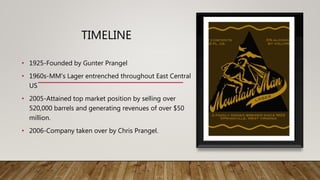
• 1925-Founded by Gunter Prangel
• 1960s-MM's Lager entrenched throughout East Central
US
• 2005-Attained top market position by selling over
520,000 barrels and generating revenues of over $50
million.
• 2006-Company taken over by Chris Prangel.
CURRENT SITUATION IN MARKET
• 2% decline in revenue.
• 4% growth in light beer segment due to youth preferences.
• High brand equity in premium segment.
• Mostly sold at off-premise locations.
• Challenge to company to remain profitable.
COMPETITORS
• Anhueser Bush
• Miller Brewing Co.
• Adolf Coors
• These companies possess 74% share
of overall brewing market.
• They have 84% market share in light
beer segment.
• Rely heavily on broadcasting market
as well as diversifications to create
barriers for entry of other brands.
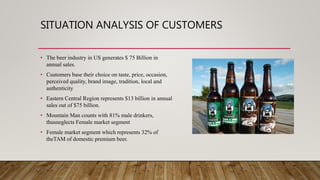
SITUATION ANALYSIS OF CUSTOMERS
• The beer industry in US generates $ 75 Billion in
annual sales.
• Customers base their choice on taste, price, occasion,
perceived quality, brand image, tradition, local and
authenticity
• Eastern Central Region represents $13 billion in annual
sales out of $75 billion.
• Mountain Man counts with 81% male drinkers,
thusneglects Female market segment
• Female market segment which represents 32% of
theTAM of domestic premium beer.
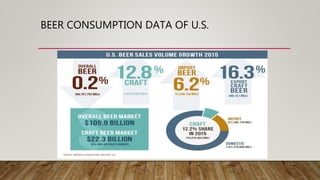
BEER CONSUMPTION DATA OF U.S.
AIM OF THE CASE STUDY
• Capturing the light beer market.
• Its effect on brand value and current product.
• Investment and returns on the new product.
SOLUTIONS
• Launch Mountain Man Light via brand extension.
• Launch new product using 4p`s of marketing mix i.e Product, Price, Place Promotion.
• Advertising the new beer brand through Online Media and Social Networking Sites
• Providing offer in prices for Mountain Man Light if bought in high quantity
• Easy to convince retailers to stock &promote
• Labeling and packaging efficiency
PROS AND CONS OF NEW APPROACH
Pros
• Increase in revenue
• No brand dilution.
• Cater Untapped market.
Cons
• High advertising costs.
• Difficult to build new brand name.
• Pressure by competitors.
• Light beer already has a strong
presence.
PROJECTED COSTS TO COMPANY
• Advertising: $750,000 for intensive six-month advertising.
• Variable cost per barrel of Mountain Man Lager: $66.
• SG & A costs: $900,000 annually.
• Variable cost of new light beer: $71.
• Market price per barrel of new beer: $97.
PROJECTED REVENUES
• Market price of new beer per barrel: $97.
• Revenue per barrel: $25.
• Total investment: $1.65 million.
• Break even volume: 1650,000/25= 65000 barrels.
RISKS
• New product can get lost in the sea of other
products introduced by other companies.
• Projections may be overly optimistic.
• Advertising cannot be as aggressive as other big
companies.
• Product awareness and brand value may not
reach up to the mark.
THANK YOU!

Case Study-Mountain Man Brewing Co.

  • 1.
    MOUNTAIN MAN BREWING CO. CASESTUDY BY: DEVASHISH KHULBE
  • 2.
    KEY HIGHLIGHTS ABOUTTHE COMPANY • Market leader in West Virginia for over 50 years. • Also known as 'Virginia beer'. • Marketing operations managed by Chris Prangel, a recent MBA graduate. • Brewed one beer called 'Mountain Man Lager'. • Mountain Man's beer quite popular among blue collar workers.
  • 3.
    TIMELINE • 1925-Founded byGunter Prangel • 1960s-MM's Lager entrenched throughout East Central US • 2005-Attained top market position by selling over 520,000 barrels and generating revenues of over $50 million. • 2006-Company taken over by Chris Prangel.
  • 4.
    CURRENT SITUATION INMARKET • 2% decline in revenue. • 4% growth in light beer segment due to youth preferences. • High brand equity in premium segment. • Mostly sold at off-premise locations. • Challenge to company to remain profitable.
  • 5.
    COMPETITORS • Anhueser Bush •Miller Brewing Co. • Adolf Coors • These companies possess 74% share of overall brewing market. • They have 84% market share in light beer segment. • Rely heavily on broadcasting market as well as diversifications to create barriers for entry of other brands.
  • 6.
    SITUATION ANALYSIS OFCUSTOMERS • The beer industry in US generates $ 75 Billion in annual sales. • Customers base their choice on taste, price, occasion, perceived quality, brand image, tradition, local and authenticity • Eastern Central Region represents $13 billion in annual sales out of $75 billion. • Mountain Man counts with 81% male drinkers, thusneglects Female market segment • Female market segment which represents 32% of theTAM of domestic premium beer.
  • 7.
  • 8.
    AIM OF THECASE STUDY • Capturing the light beer market. • Its effect on brand value and current product. • Investment and returns on the new product.
  • 9.
    SOLUTIONS • Launch MountainMan Light via brand extension. • Launch new product using 4p`s of marketing mix i.e Product, Price, Place Promotion. • Advertising the new beer brand through Online Media and Social Networking Sites • Providing offer in prices for Mountain Man Light if bought in high quantity • Easy to convince retailers to stock &promote • Labeling and packaging efficiency
  • 10.
    PROS AND CONSOF NEW APPROACH Pros • Increase in revenue • No brand dilution. • Cater Untapped market. Cons • High advertising costs. • Difficult to build new brand name. • Pressure by competitors. • Light beer already has a strong presence.
  • 11.
    PROJECTED COSTS TOCOMPANY • Advertising: $750,000 for intensive six-month advertising. • Variable cost per barrel of Mountain Man Lager: $66. • SG & A costs: $900,000 annually. • Variable cost of new light beer: $71. • Market price per barrel of new beer: $97.
  • 12.
    PROJECTED REVENUES • Marketprice of new beer per barrel: $97. • Revenue per barrel: $25. • Total investment: $1.65 million. • Break even volume: 1650,000/25= 65000 barrels.
  • 13.
    RISKS • New productcan get lost in the sea of other products introduced by other companies. • Projections may be overly optimistic. • Advertising cannot be as aggressive as other big companies. • Product awareness and brand value may not reach up to the mark.
  • 14.