Presented By: 
Anubhav Choudhary 
(2013 MGB 1029)
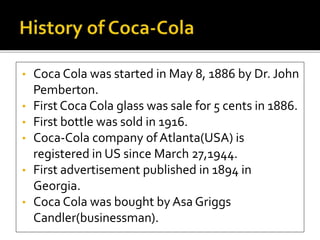
• Coca Cola was started in May 8, 1886 by Dr. John 
Pemberton. 
• First Coca Cola glass was sale for 5 cents in 1886. 
• First bottle was sold in 1916. 
• Coca-Cola company of Atlanta(USA) is 
registered in US since March 27,1944. 
• First advertisement published in 1894 in 
Georgia. 
• Coca Cola was bought by Asa Griggs 
Candler(businessman).
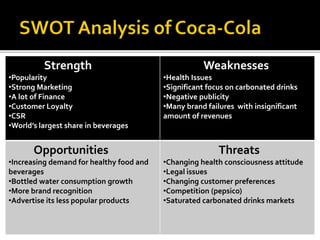
Strength 
•Popularity 
•Strong Marketing 
•A lot of Finance 
•Customer Loyalty 
•CSR 
•World’s largest share in beverages 
Weaknesses 
•Health Issues 
•Significant focus on carbonated drinks 
•Negative publicity 
•Many brand failures with insignificant 
amount of revenues 
Opportunities 
•Increasing demand for healthy food and 
beverages 
•Bottled water consumption growth 
•More brand recognition 
•Advertise its less popular products 
Threats 
•Changing health consciousness attitude 
•Legal issues 
•Changing customer preferences 
•Competition (pepsico) 
•Saturated carbonated drinks markets
 Coca Cola holds worlds largest beverage 
market share in the world about 40% 
 Coca Cola advertising expenses accounted 
more than $3 billion in 2013 
 Company serves more than 200 countries and 
more than 1.7 billion per day 
 Coca Cola is focusing in CSR programs like 
recycling, energy conservation, water 
stewardship and many others.
 Significant focus on selling Coke, Fenta, 
Sprite this prove weak as the world is moving 
towards healthier food and drinks 
 High debt level, interest rates due to acquire 
nearly $8 billion of debt 
 Negative publicity due to criticized for high 
consumption of water scarce regions and 
using harmful ingredients. 
 Company sells more than 500 brands but few 
are results more than $1 billion sales.
 Bottled water consumption increasing day by 
day 
 Increasing demand for healthy food and 
beverages 
 Consumption of soft drinks still growing in 
emerging markets specially BRIC countries.
 Changing consumer preferences and usage of 
carbonated drinks is decreasing due to health 
issues 
 Water become scarcer which increases 
criticism of Coca Cola Company for usage of 
huge amount of water in production 
 Competition with Pepsico in BRIC countries 
 Saturated carbonated drinks markets which is 
threat for Coca cola as carbonated drinks 
market is declining in the world
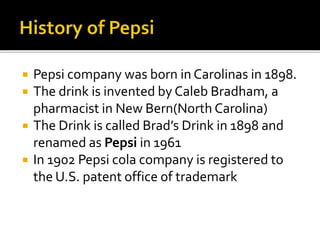
 Pepsi company was born in Carolinas in 1898. 
 The drink is invented by Caleb Bradham, a 
pharmacist in New Bern(North Carolina) 
 The Drink is called Brad’s Drink in 1898 and 
renamed as Pepsi in 1961 
 In 1902 Pepsi cola company is registered to 
the U.S. patent office of trademark
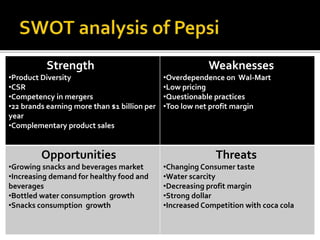
Strength 
•Product Diversity 
•CSR 
•Competency in mergers 
•22 brands earning more than $1 billion per 
year 
•Complementary product sales 
Weaknesses 
•Overdependence on Wal-Mart 
•Low pricing 
•Questionable practices 
•Too low net profit margin 
Opportunities 
•Growing snacks and beverages market 
•Increasing demand for healthy food and 
beverages 
•Bottled water consumption growth 
•Snacks consumption growth 
Threats 
•Changing Consumer taste 
•Water scarcity 
•Decreasing profit margin 
•Strong dollar 
•Increased Competition with coca cola
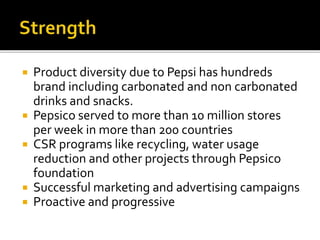
 Product diversity due to Pepsi has hundreds 
brand including carbonated and non carbonated 
drinks and snacks. 
 Pepsico served to more than 10 million stores 
per week in more than 200 countries 
 CSR programs like recycling, water usage 
reduction and other projects through Pepsico 
foundation 
 Successful marketing and advertising campaigns 
 Proactive and progressive
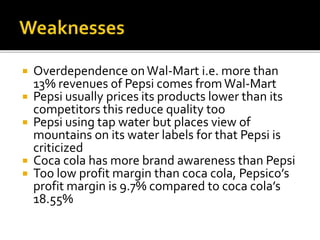
 Overdependence on Wal-Mart i.e. more than 
13% revenues of Pepsi comes from Wal-Mart 
 Pepsi usually prices its products lower than its 
competitors this reduce quality too 
 Pepsi using tap water but places view of 
mountains on its water labels for that Pepsi is 
criticized 
 Coca cola has more brand awareness than Pepsi 
 Too low profit margin than coca cola, Pepsico’s 
profit margin is 9.7% compared to coca cola’s 
18.55%
 Pepsico made large investment in BRIC 
countries to expand its market share. 
 Increasing consumer demand for healthy 
food and drinks(juices etc) 
 Pepsico has been successful in acquiring 
other companies 
 Bottled water consumption is expected to 
grow both in US and rest of world.
 Changes consumer taste reduce consumption of soft 
drinks due to increase interest in healthy products. 
 Water become scarcer around the world that increase 
both cost and criticism for Pepsico. over the use of 
large amount of water for production 
 Pepsico.’s gross profit margin was decreasing over last 
past years and may continue to decrease 
 Legal requirements to disclose negative information 
on labels. 
 Pepsico. earn 50% of income from outside US so due 
to strong dollar Pepsico’s income should fall
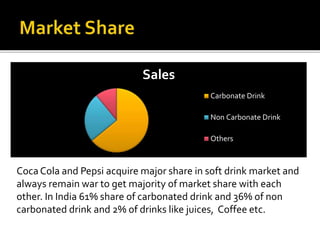
Sales 
Carbonate Drink 
Non Carbonate Drink 
Others 
Coca Cola and Pepsi acquire major share in soft drink market and 
always remain war to get majority of market share with each 
other. In India 61% share of carbonated drink and 36% of non 
carbonated drink and 2% of drinks like juices, Coffee etc.
 A market segment consist of group of 
customers who share similar set of needs and 
wants. Rather than creating segment and 
deciding about target. Both Coca Cola and 
Pepsi follow similar segmentation strategy 
for target marketing. 
 In mass marketing both the companies follow 
mass marketing strategy in this company 
target whole market not particular segment 
of population.
Targeted group of the company is the whole 
population they want to earn revenue from a 
segment than their other revenue generator 
sources. The following are the bases for 
segmentation: 
 Geographical 
 Demographic segmentation
 Region: Both companies treat 
hot countries like Asia, Middle 
East and African. In countries 
like India and Pakistan invest 
huge and their target was 
school, college, restaurants 
etc. 
 Rural and Urban Market: Coca 
Cola spotted the rural market 
sector because rural sector is 
more conscious about price 
so both company introduce 
200ml bottle of Rs 5 on 2002 
for rural market. 
 Age: India is consider as 
young country thus target of 
both companies is Youth in 
India. In Europe average 
population is older than coca 
cola target older similarly in 
USA Pepsi target generation 
X(young) 
 Gender: As taste of male 
female is different so coca 
cola promotes thumbs up for 
males and fanta for ladies and 
children. Same in Pepsi 
Mirinda for ladies and 
children's.
COCA COLA 
 Brand Localization 
Strategy:Two India’s 
 India A: Life ho to aise 
 India B: Thanda mtlb 
coca cola 
 Small bottle scheme 
PEPSI 
 It was positioned as 
new youth cool icon 
 Yeh Dil mange more 
 Mera number kab 
aayega? 
 Yeh pyass hai badi 
 Youngistan 
 Change the Game
According to a survey people in Asia are 
more inclined to them and feel happy when 
some gives them personal recognition. So in 
china coca cola starts advertising through 
mobile phone. This advertisement strategy 
gives the touch of personal feeling. The sales 
of coca cola increased through this 
advertisement strategy.
New advertising method is going in today in 
which company does not take direct 
sponsorship but do advertisement outside 
the main sponsorship area like Cricket world 
cup in 1996 in which Coca cola take 
sponsorship and Pepsi done advertisement 
outside the stadium.
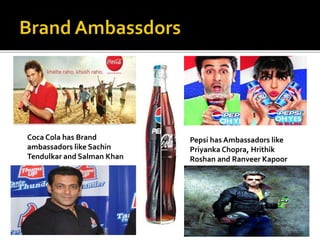
Coca Cola has Brand 
ambassadors like Sachin 
Tendulkar and Salman Khan 
Pepsi has Ambassadors like 
Priyanka Chopra, Hrithik 
Roshan and Ranveer Kapoor
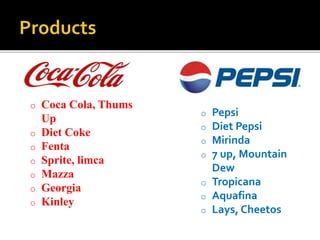
o Coca Cola, Thums 
Up 
o Diet Coke 
o Fenta 
o Sprite, limca 
o Mazza 
o Georgia 
o Kinley 
o Pepsi 
o Diet Pepsi 
o Mirinda 
o 7 up, Mountain 
Dew 
o Tropicana 
o Aquafina 
o Lays, Cheetos
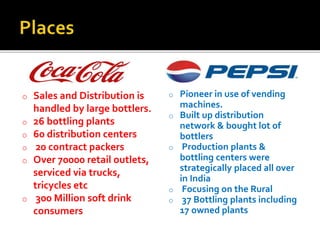
o Sales and Distribution is 
handled by large bottlers. 
o 26 bottling plants 
o 60 distribution centers 
o 20 contract packers 
o Over 70000 retail outlets, 
serviced via trucks, 
tricycles etc 
o 300 Million soft drink 
consumers 
o Pioneer in use of vending 
machines. 
o Built up distribution 
network & bought lot of 
bottlers 
o Production plants & 
bottling centers were 
strategically placed all over 
in India 
o Focusing on the Rural 
o 37 Bottling plants including 
17 owned plants
o Earlier COST BASED 
pricing 
o The Rs 8 bottle(200ml) 
o Coca Cola Tin Rs 
25(300ml) 
o Coca Cola Rs 75(2L) 
o Coca Cola spends more 
on advertising than 
manufacturing 
o Competition based 
o The Rs 8(200ml) 
o Pepsi Tin Rs 
25(300ml) 
o Pepsi Rs 75(2L) 
o Very Flexible to come 
down with the price 
very quickly
For some it makes no difference, and for some it’s 
a matter of life and death. The taste of both Coca- 
Cola and Pepsi is differ, it is concluded that 
Pepsi is indeed sweeter than Coca-Cola while 
Coca-Cola has more carbonation. They 
definitely have different recipes. Coca-Cola 
gives the fizzy effect as it has a higher percentage 
of carbonation. Coca-Cola is preferred by more 
serious and mature drinkers, while Pepsi is loved 
by youth and fun-loving people.
THANK YOU

Coke vs pepsi ppt

  • 2.
    Presented By: AnubhavChoudhary (2013 MGB 1029)
  • 3.
    • Coca Colawas started in May 8, 1886 by Dr. John Pemberton. • First Coca Cola glass was sale for 5 cents in 1886. • First bottle was sold in 1916. • Coca-Cola company of Atlanta(USA) is registered in US since March 27,1944. • First advertisement published in 1894 in Georgia. • Coca Cola was bought by Asa Griggs Candler(businessman).
  • 4.
    Strength •Popularity •StrongMarketing •A lot of Finance •Customer Loyalty •CSR •World’s largest share in beverages Weaknesses •Health Issues •Significant focus on carbonated drinks •Negative publicity •Many brand failures with insignificant amount of revenues Opportunities •Increasing demand for healthy food and beverages •Bottled water consumption growth •More brand recognition •Advertise its less popular products Threats •Changing health consciousness attitude •Legal issues •Changing customer preferences •Competition (pepsico) •Saturated carbonated drinks markets
  • 5.
     Coca Colaholds worlds largest beverage market share in the world about 40%  Coca Cola advertising expenses accounted more than $3 billion in 2013  Company serves more than 200 countries and more than 1.7 billion per day  Coca Cola is focusing in CSR programs like recycling, energy conservation, water stewardship and many others.
  • 6.
     Significant focuson selling Coke, Fenta, Sprite this prove weak as the world is moving towards healthier food and drinks  High debt level, interest rates due to acquire nearly $8 billion of debt  Negative publicity due to criticized for high consumption of water scarce regions and using harmful ingredients.  Company sells more than 500 brands but few are results more than $1 billion sales.
  • 7.
     Bottled waterconsumption increasing day by day  Increasing demand for healthy food and beverages  Consumption of soft drinks still growing in emerging markets specially BRIC countries.
  • 8.
     Changing consumerpreferences and usage of carbonated drinks is decreasing due to health issues  Water become scarcer which increases criticism of Coca Cola Company for usage of huge amount of water in production  Competition with Pepsico in BRIC countries  Saturated carbonated drinks markets which is threat for Coca cola as carbonated drinks market is declining in the world
  • 9.
     Pepsi companywas born in Carolinas in 1898.  The drink is invented by Caleb Bradham, a pharmacist in New Bern(North Carolina)  The Drink is called Brad’s Drink in 1898 and renamed as Pepsi in 1961  In 1902 Pepsi cola company is registered to the U.S. patent office of trademark
  • 10.
    Strength •Product Diversity •CSR •Competency in mergers •22 brands earning more than $1 billion per year •Complementary product sales Weaknesses •Overdependence on Wal-Mart •Low pricing •Questionable practices •Too low net profit margin Opportunities •Growing snacks and beverages market •Increasing demand for healthy food and beverages •Bottled water consumption growth •Snacks consumption growth Threats •Changing Consumer taste •Water scarcity •Decreasing profit margin •Strong dollar •Increased Competition with coca cola
  • 11.
     Product diversitydue to Pepsi has hundreds brand including carbonated and non carbonated drinks and snacks.  Pepsico served to more than 10 million stores per week in more than 200 countries  CSR programs like recycling, water usage reduction and other projects through Pepsico foundation  Successful marketing and advertising campaigns  Proactive and progressive
  • 12.
     Overdependence onWal-Mart i.e. more than 13% revenues of Pepsi comes from Wal-Mart  Pepsi usually prices its products lower than its competitors this reduce quality too  Pepsi using tap water but places view of mountains on its water labels for that Pepsi is criticized  Coca cola has more brand awareness than Pepsi  Too low profit margin than coca cola, Pepsico’s profit margin is 9.7% compared to coca cola’s 18.55%
  • 13.
     Pepsico madelarge investment in BRIC countries to expand its market share.  Increasing consumer demand for healthy food and drinks(juices etc)  Pepsico has been successful in acquiring other companies  Bottled water consumption is expected to grow both in US and rest of world.
  • 14.
     Changes consumertaste reduce consumption of soft drinks due to increase interest in healthy products.  Water become scarcer around the world that increase both cost and criticism for Pepsico. over the use of large amount of water for production  Pepsico.’s gross profit margin was decreasing over last past years and may continue to decrease  Legal requirements to disclose negative information on labels.  Pepsico. earn 50% of income from outside US so due to strong dollar Pepsico’s income should fall
  • 15.
    Sales Carbonate Drink Non Carbonate Drink Others Coca Cola and Pepsi acquire major share in soft drink market and always remain war to get majority of market share with each other. In India 61% share of carbonated drink and 36% of non carbonated drink and 2% of drinks like juices, Coffee etc.
  • 16.
     A marketsegment consist of group of customers who share similar set of needs and wants. Rather than creating segment and deciding about target. Both Coca Cola and Pepsi follow similar segmentation strategy for target marketing.  In mass marketing both the companies follow mass marketing strategy in this company target whole market not particular segment of population.
  • 17.
    Targeted group ofthe company is the whole population they want to earn revenue from a segment than their other revenue generator sources. The following are the bases for segmentation:  Geographical  Demographic segmentation
  • 18.
     Region: Bothcompanies treat hot countries like Asia, Middle East and African. In countries like India and Pakistan invest huge and their target was school, college, restaurants etc.  Rural and Urban Market: Coca Cola spotted the rural market sector because rural sector is more conscious about price so both company introduce 200ml bottle of Rs 5 on 2002 for rural market.  Age: India is consider as young country thus target of both companies is Youth in India. In Europe average population is older than coca cola target older similarly in USA Pepsi target generation X(young)  Gender: As taste of male female is different so coca cola promotes thumbs up for males and fanta for ladies and children. Same in Pepsi Mirinda for ladies and children's.
  • 19.
    COCA COLA Brand Localization Strategy:Two India’s  India A: Life ho to aise  India B: Thanda mtlb coca cola  Small bottle scheme PEPSI  It was positioned as new youth cool icon  Yeh Dil mange more  Mera number kab aayega?  Yeh pyass hai badi  Youngistan  Change the Game
  • 20.
    According to asurvey people in Asia are more inclined to them and feel happy when some gives them personal recognition. So in china coca cola starts advertising through mobile phone. This advertisement strategy gives the touch of personal feeling. The sales of coca cola increased through this advertisement strategy.
  • 21.
    New advertising methodis going in today in which company does not take direct sponsorship but do advertisement outside the main sponsorship area like Cricket world cup in 1996 in which Coca cola take sponsorship and Pepsi done advertisement outside the stadium.
  • 22.
    Coca Cola hasBrand ambassadors like Sachin Tendulkar and Salman Khan Pepsi has Ambassadors like Priyanka Chopra, Hrithik Roshan and Ranveer Kapoor
  • 23.
    o Coca Cola,Thums Up o Diet Coke o Fenta o Sprite, limca o Mazza o Georgia o Kinley o Pepsi o Diet Pepsi o Mirinda o 7 up, Mountain Dew o Tropicana o Aquafina o Lays, Cheetos
  • 24.
    o Sales andDistribution is handled by large bottlers. o 26 bottling plants o 60 distribution centers o 20 contract packers o Over 70000 retail outlets, serviced via trucks, tricycles etc o 300 Million soft drink consumers o Pioneer in use of vending machines. o Built up distribution network & bought lot of bottlers o Production plants & bottling centers were strategically placed all over in India o Focusing on the Rural o 37 Bottling plants including 17 owned plants
  • 25.
    o Earlier COSTBASED pricing o The Rs 8 bottle(200ml) o Coca Cola Tin Rs 25(300ml) o Coca Cola Rs 75(2L) o Coca Cola spends more on advertising than manufacturing o Competition based o The Rs 8(200ml) o Pepsi Tin Rs 25(300ml) o Pepsi Rs 75(2L) o Very Flexible to come down with the price very quickly
  • 26.
    For some itmakes no difference, and for some it’s a matter of life and death. The taste of both Coca- Cola and Pepsi is differ, it is concluded that Pepsi is indeed sweeter than Coca-Cola while Coca-Cola has more carbonation. They definitely have different recipes. Coca-Cola gives the fizzy effect as it has a higher percentage of carbonation. Coca-Cola is preferred by more serious and mature drinkers, while Pepsi is loved by youth and fun-loving people.
  • 27.